control arm HONDA CIVIC 1991 User Guide
[x] Cancel search | Manufacturer: HONDA, Model Year: 1991, Model line: CIVIC, Model: HONDA CIVIC 1991Pages: 136, PDF Size: 1.33 MB
Page 49 of 136
Heating and Cooling (cont'd)
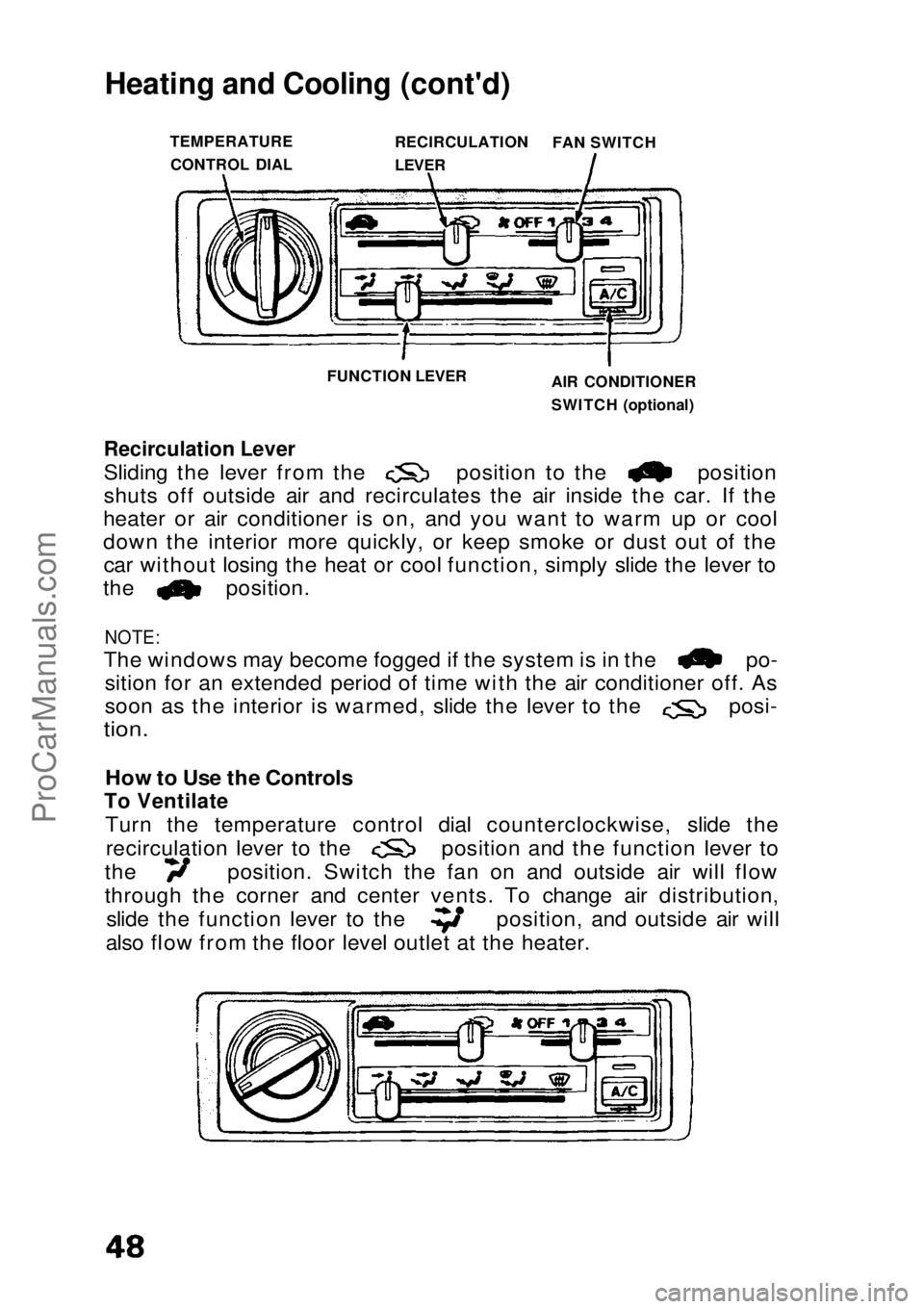
Recirculation Lever
Sliding the lever from the position to the position
shuts off outside air and recirculates the air inside the car. If the
heater or air conditioner is on, and you want to warm up or cool
down the interior more quickly, or keep smoke or dust out of the car without losing the heat or cool function, simply slide the lever to the position.
NOTE:
The windows may become fogged if the system is in the po-
sition for an extended period of time with the air conditioner off. As soon as the interior is warmed, slide the lever to the posi-
tion.
How to Use the Controls
To Ventilate
Turn the temperature control dial counterclockwise, slide the recirculation lever to the position and the function lever to
the position. Switch the fan on and outside air will flow
through the corner and center vents. To change air distribution,
slide the function lever to the position, and outside air will
also flow from the floor level outlet at the heater.
TEMPERATURE
CONTROL DIAL RECIRCULATION
LEVER
FAN SWITCH
FUNCTION LEVER AIR CONDITIONER
SWITCH (optional)ProCarManuals.comMain Menu s t
Page 50 of 136
To Cool (with optional air conditioner)
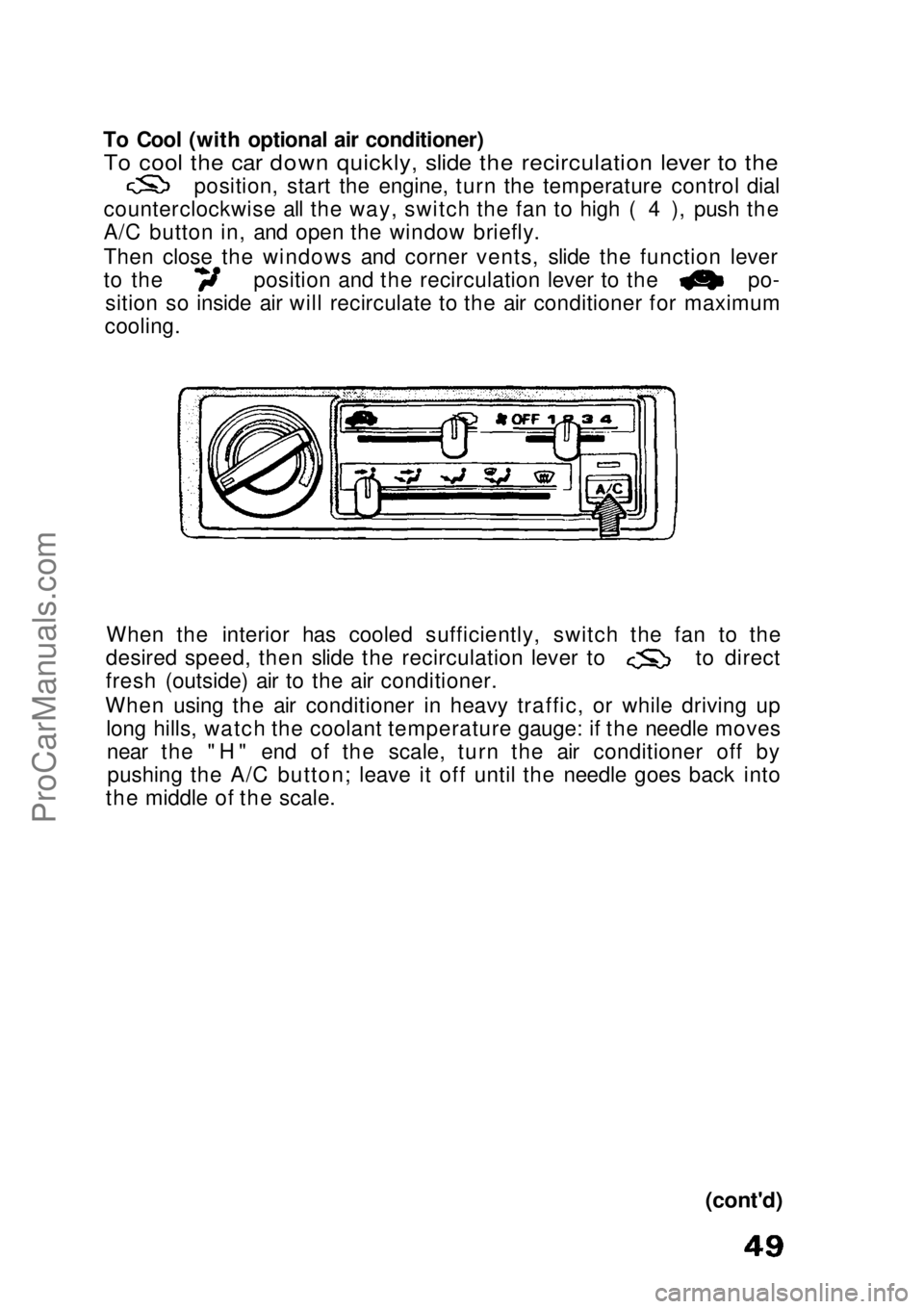
To cool the car down quickly, slide the recirculation lever to the
position, start the engine, turn the temperature control dial
counterclockwise all the way, switch the fan to high ( 4 ), push the
A/C button in, and open the window briefly.
Then close the windows and corner vents, slide the function lever to the position and the recirculation lever to the po-
sition so inside air will recirculate to the air conditioner for maximum
cooling.
When the interior has cooled sufficiently, switch the fan to the desired speed, then slide the recirculation lever to to direct
fresh (outside) air to the air conditioner.
When using the air conditioner in heavy traffic, or while driving up long hills, watch the coolant temperature gauge: if the needle movesnear the "H" end of the scale, turn the air conditioner off bypushing the A/C button; leave it off until the needle goes back into
the middle of the scale.
(cont'd)ProCarManuals.comMain Menu s t
Page 51 of 136
Heating and Cooling (cont'd)
To Heat
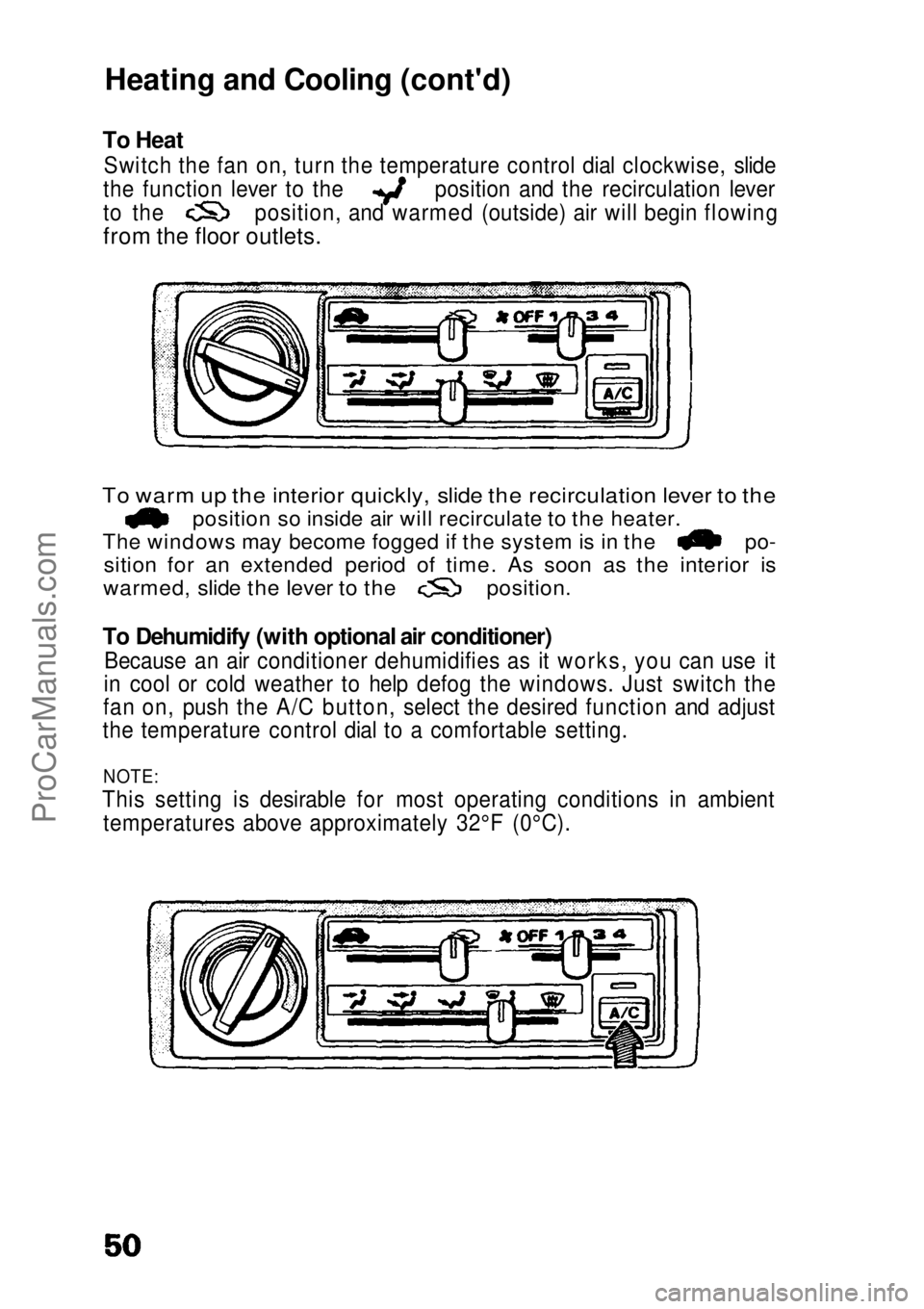
Switch the fan on, turn the temperature control dial clockwise, slide the function lever to the position and the recirculation lever
to the position, and warmed (outside) air will begin flowing
from the floor outlets.
To warm up the interior quickly, slide the recirculation lever to the
position so inside air will recirculate to the heater.
The windows may become fogged if the system is in the po-
sition for an extended period of time. As soon as the interior is
warmed, slide the lever to the position.
To Dehumidify (with optional air conditioner)
Because an air conditioner dehumidifies as it works, you can use it
in cool or cold weather to help defog the windows. Just switch the
fan on, push the A/C button, select the desired function and adjust
the temperature control dial to a comfortable setting.
NOTE:
This setting is desirable for most operating conditions in ambient temperatures above approximately 32°F (0°C).ProCarManuals.comMain Menu s t
Page 52 of 136
To Defrost
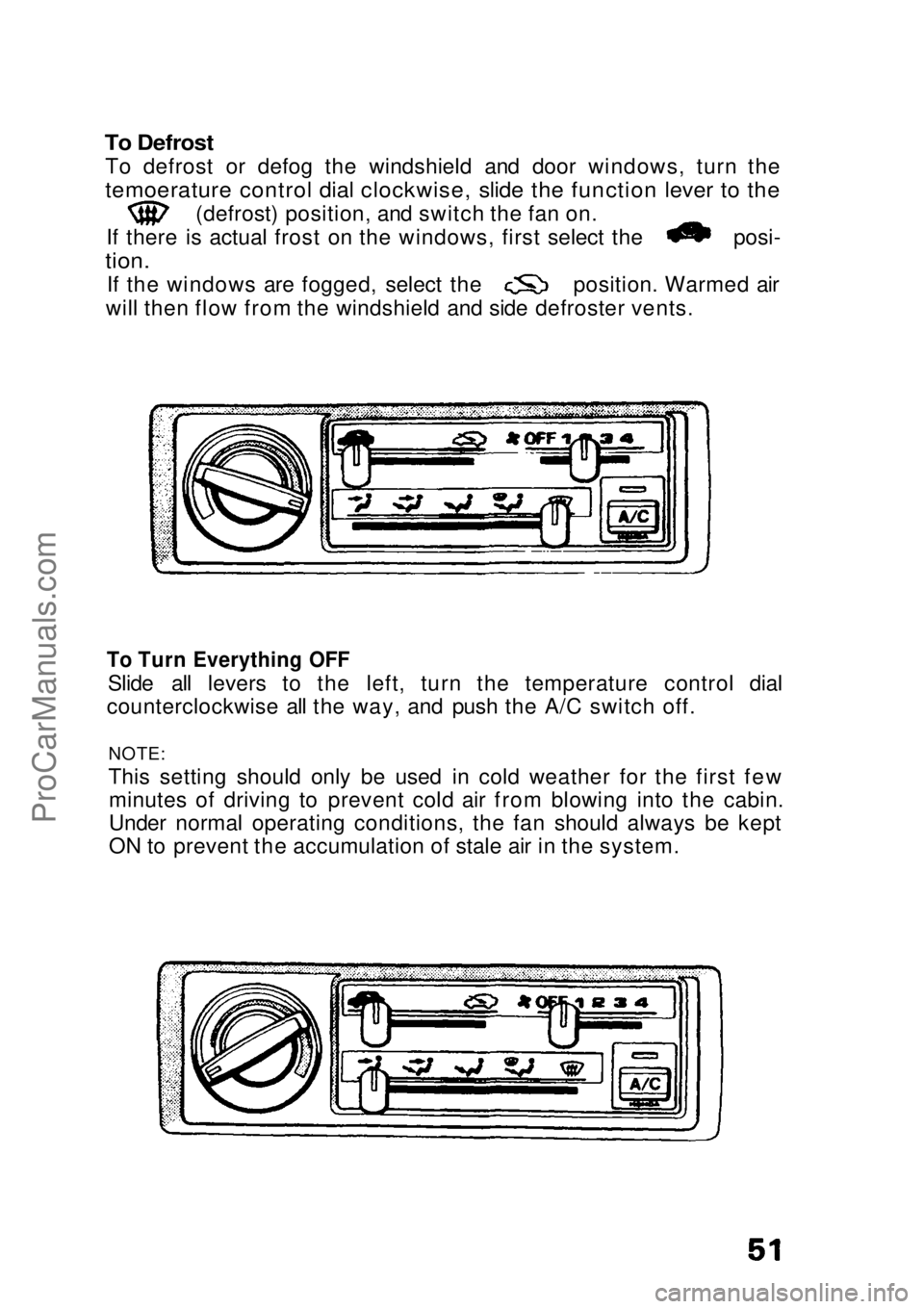
To defrost or defog the windshield and door windows, turn the
temoerature control dial clockwise, slide the function lever to the
(defrost) position, and switch the fan on.
If there is actual frost on the windows, first select the posi-
tion.
If the windows are fogged, select the position. Warmed air
will then flow from the windshield and side defroster vents.
To Turn Everything OFF
Slide all levers to the left, turn the temperature control dial
counterclockwise all the way, and push the A/C switch off.
NOTE:
This setting should only be used in cold weather for the first fewminutes of driving to prevent cold air from blowing into the cabin.
Under normal operating conditions, the fan should always be kept
ON to prevent the accumulation of stale air in the system.ProCarManuals.comMain Menu s t
Page 54 of 136
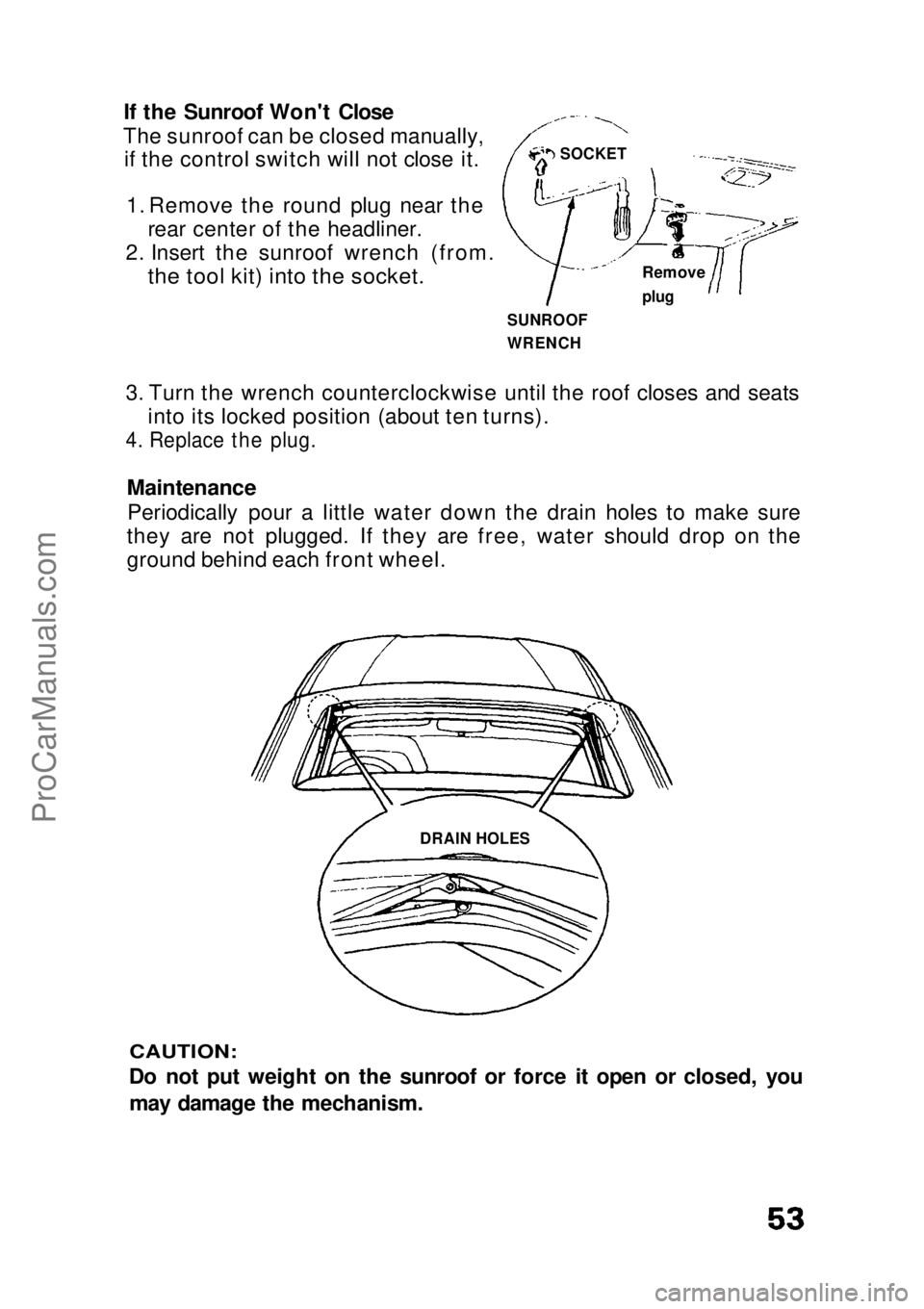
If the Sunroof Won't Close
The sunroof can be closed manually, if the control switch will not close it.
1. Remove the round plug near the rear center of the headliner.
2. Insert the sunroof wrench (from.
the tool kit) into the socket.
SUNROOF
WRENCH
3. Turn the wrench counterclockwise until the roof closes and seats into its locked position (about ten turns).
4. Replace the plug.
Maintenance
Periodically pour a little water down the drain holes to make sure
they are not plugged. If they are free, water should drop on the
ground behind each front wheel.
CAUTION:
Do not put weight on the sunroof or force it open or closed, you
may damage the mechanism.
DRAIN HOLESSOCKET
Remove
plugProCarManuals.comMain Menu s t
Page 55 of 136

For proper operation of your car's emission controls, your engine is
designed to use unleaded fuel only.
CAUTION:
Using leaded or even low-lead gasoline could damage some of your
emission controls, and also void their coverage under the emission
controls warranty.
Use gasoline from pumps labeled unleaded, with a pump octane
number of 86 or higher. The pump octane number is an average of
the Research (R) octane and Motor (M) octane numbers. Use of a lower octane gasoline can cause persistent, heavy "spark knock" (ametallic rapping noise), which can lead to engine damage if severe.
CAUTION:
If you notice steady spark knock while holding a steady speed on a
level road, try changing brands of gasoline. If the spark knock persists, consult your Honda dealer. Failure to do so is considered
misuse, and misuse is not covered under the New Car Warranty.
Occasionally you may notice light spark knock while accelerating or
driving up hills. This is no cause for concern, it simply means your
engine is running at its most economical.
Gasoline Containing AlcoholIf you decide to use a gasoline containing alcohol ("gasohol"), be
sure its octane rating is at least as high as that recommended for
unleaded gasoline. There are two types of "gasohol": that
containing ethanol, and that containing methanol. Do not use
gasohol that contains more than 10% ethanol. Do not use gasoline
containing methanol (methyl or wood alcohol) that does not also contain cosolvents and corrosion inhibitors for methanol. Never use
gasoline containing more than 5% methanol, even if it has cosolvents and corrosion inhibitors.
NOTE.
Fuel system damage or vehicle performance problems resulting
from the use of such fuels is not covered under the new car warranties. Honda cannot endorse the use of fuels containing methanol since evidence of their suitability is as yet incomplete. Before purchasing fuel from an unfamiliar station, try to confirm
whether the fuel contains alcohol, of what kind, and how much. If
you notice any undesirable operating symptoms after using a
gasoline that contains alcohol; or one that you think contains alcohol, switch to an unleaded gasoline, as recommended above.
GasolineProCarManuals.comMain Menu s t
Page 58 of 136
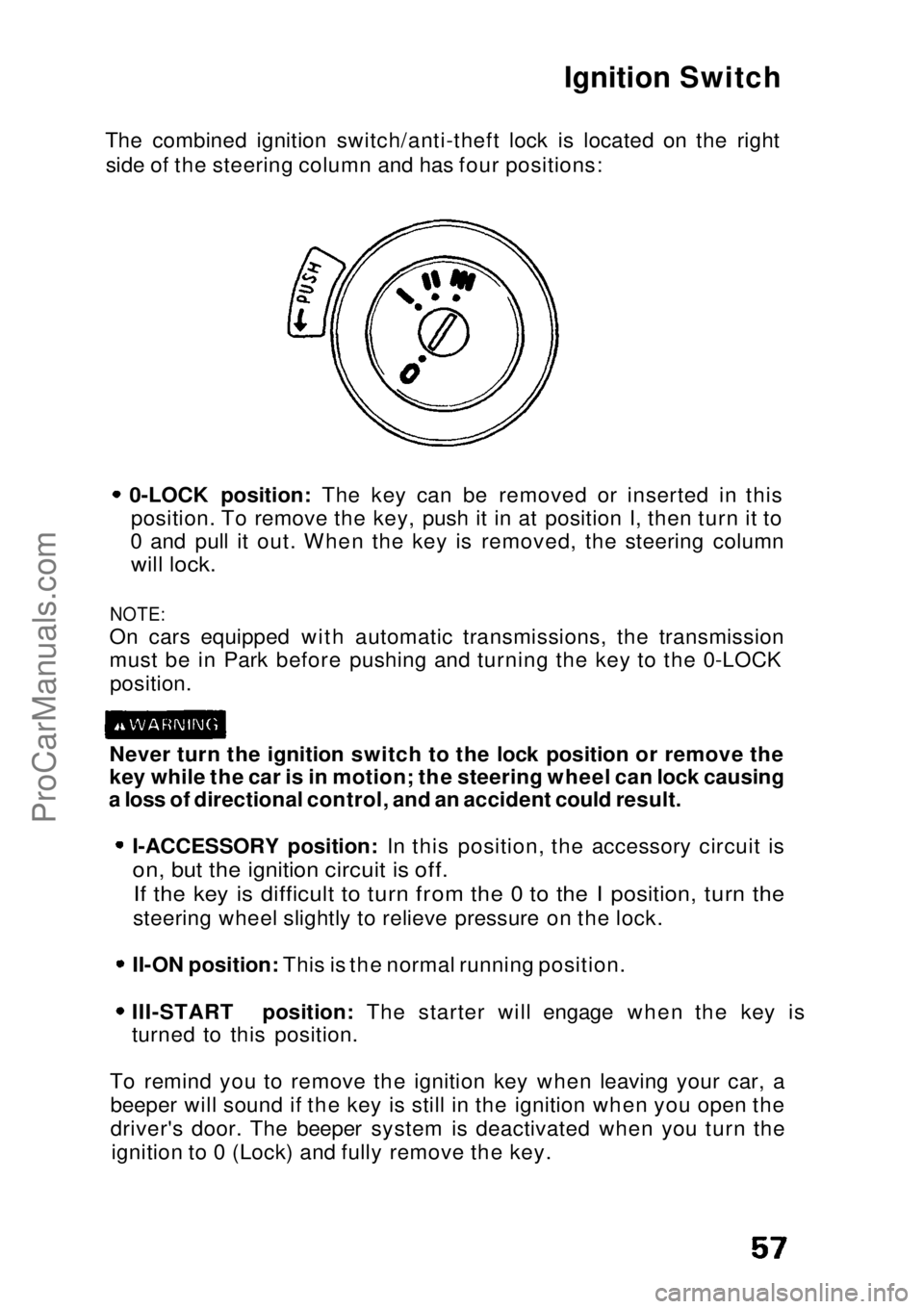
Ignition Switch
The combined ignition switch/anti-theft lock is located on the right side of the steering column and has four positions: 0-LOCK position: The key can be removed or inserted in this
position. To remove the key, push it in at position I, then turn it to
0 and pull it out. When the key is removed, the steering column
will lock.
NOTE:
On cars equipped with automatic transmissions, the transmission
must be in Park before pushing and turning the key to the 0-LOCK
position.
Never turn the ignition switch to the lock position or remove the
key while the car is in motion; the steering wheel can lock causing
a loss of directional control, and an accident could result. I-ACCESSORY position: In this position, the accessory circuit is
on, but the ignition circuit is off.
If the key is difficult to turn from the 0 to the I position, turn the
steering wheel slightly to relieve pressure on the lock. II-ON position: This is the normal running position.
III-START position: The starter will engage when the key is
turned to this position.
To remind you to remove the ignition key when leaving your car, a beeper will sound if the key is still in the ignition when you open the
driver's door. The beeper system is deactivated when you turn the ignition to 0 (Lock) and fully remove the key.ProCarManuals.comMain Menu s t
Page 61 of 136
Engine Exhaust Gas Warning
A properly maintained car is your best protection against exhaust
gas entering the passenger compartment.
The exhaust system should be thoroughly inspected by a compe-
tent mechanic whenever:
The car is raised for oil change.You notice a change in the sound of the exhaust. The exhaust system or the rear or underside of the car is
damaged.
Avoid breathing exhaust gases. They contain carbon monoxide,
which is a colorless, odorless gas that can cause loss of con-
sciousness and eventual death. If you suspect that exhaust gas is entering the passenger compartment, have the cause deter-mined and corrected as soon as possible. If you must driveunder these conditions, drive only with all windows fully open. Do not drive with the hatch/trunk lid open. An open hatch/trunk
may draw exhaust gases into the passenger compartment. If
you must drive with the hatch/trunk open, drive only with all the
windows wide open. Do not run the engine in confined areas, such as garages, any
longer than necessary to move the car in or out.
If you must sit in a parked car with the engine running for more
than a short time, adjust the heating/ventilation system as
follows:
1.Set the function lever to the position.
2.Set the temperature control dial for best comfort. 3.Set the recirculation lever to the position.
4.Turn the fan to the highest speed.
NOTE:
To insure proper operation of the car's ventilation system, keep the
front air inlet clear of snow, mud, leaves or other obstructions.ProCarManuals.comMain Menu s t
Page 62 of 136
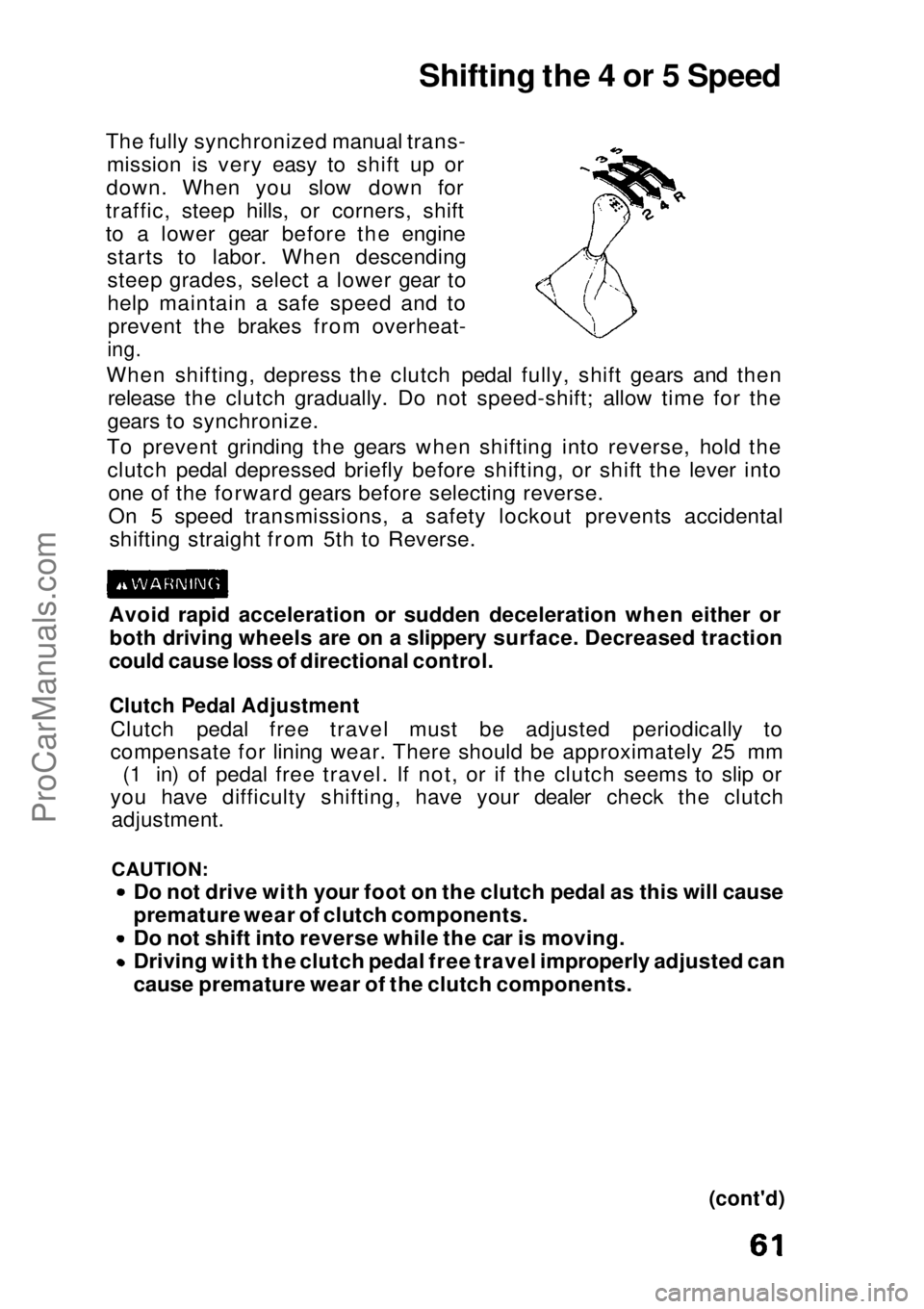
Shifting the 4 or 5 Speed
The fully synchronized manual trans- mission is very easy to shift up or
down. When you slow down for
traffic, steep hills, or corners, shift
to a lower gear before the engine starts to labor. When descendingsteep grades, select a lower gear to
help maintain a safe speed and toprevent the brakes from overheat-
ing.
When shifting, depress the clutch pedal fully, shift gears and then release the clutch gradually. Do not speed-shift; allow time for the
gears to synchronize.
To prevent grinding the gears when shifting into reverse, hold the clutch pedal depressed briefly before shifting, or shift the lever into one of the forward gears before selecting reverse.
On 5 speed transmissions, a safety lockout prevents accidentalshifting straight from 5th to Reverse.
Avoid rapid acceleration or sudden deceleration when either or both driving wheels are on a slippery surface. Decreased traction
could cause loss of directional control.
Clutch Pedal Adjustment
Clutch pedal free travel must be adjusted periodically to
compensate for lining wear. There should be approximately 25 mm (1 in) of pedal free travel. If not, or if the clutch seems to slip or
you have difficulty shifting, have your dealer check the clutch adjustment.
CAUTION:
Do not drive with your foot on the clutch pedal as this will cause
premature wear of clutch components.
Do not shift into reverse while the car is moving. Driving with the clutch pedal free travel improperly adjusted can
cause premature wear of the clutch components.
(cont'd)ProCarManuals.comMain Menu s t
Page 63 of 136
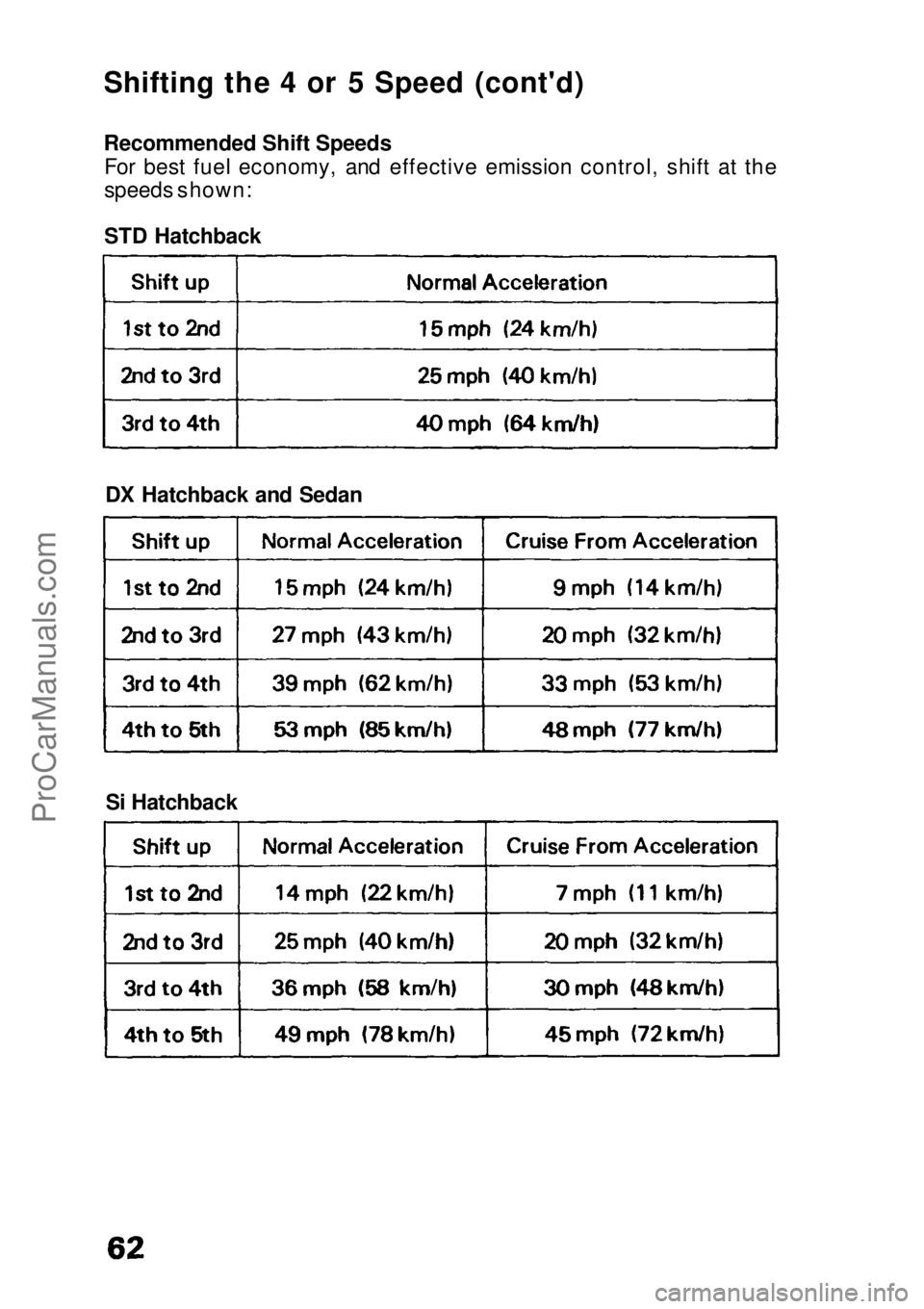
Shifting the 4 or 5 Speed (cont'd)
Recommende
d
Shift Speeds
For best fuel economy, and effective emission control, shift at the
speeds shown:
STD Hatchback
DX Hatchback and Sedan
Si Hatchback
ProCarManuals.comMain Menu s t