lock HONDA CIVIC 1991 Owner's Manual
[x] Cancel search | Manufacturer: HONDA, Model Year: 1991, Model line: CIVIC, Model: HONDA CIVIC 1991Pages: 136, PDF Size: 1.33 MB
Page 53 of 136
Sunroof (Si Hatchback)
Sunroof
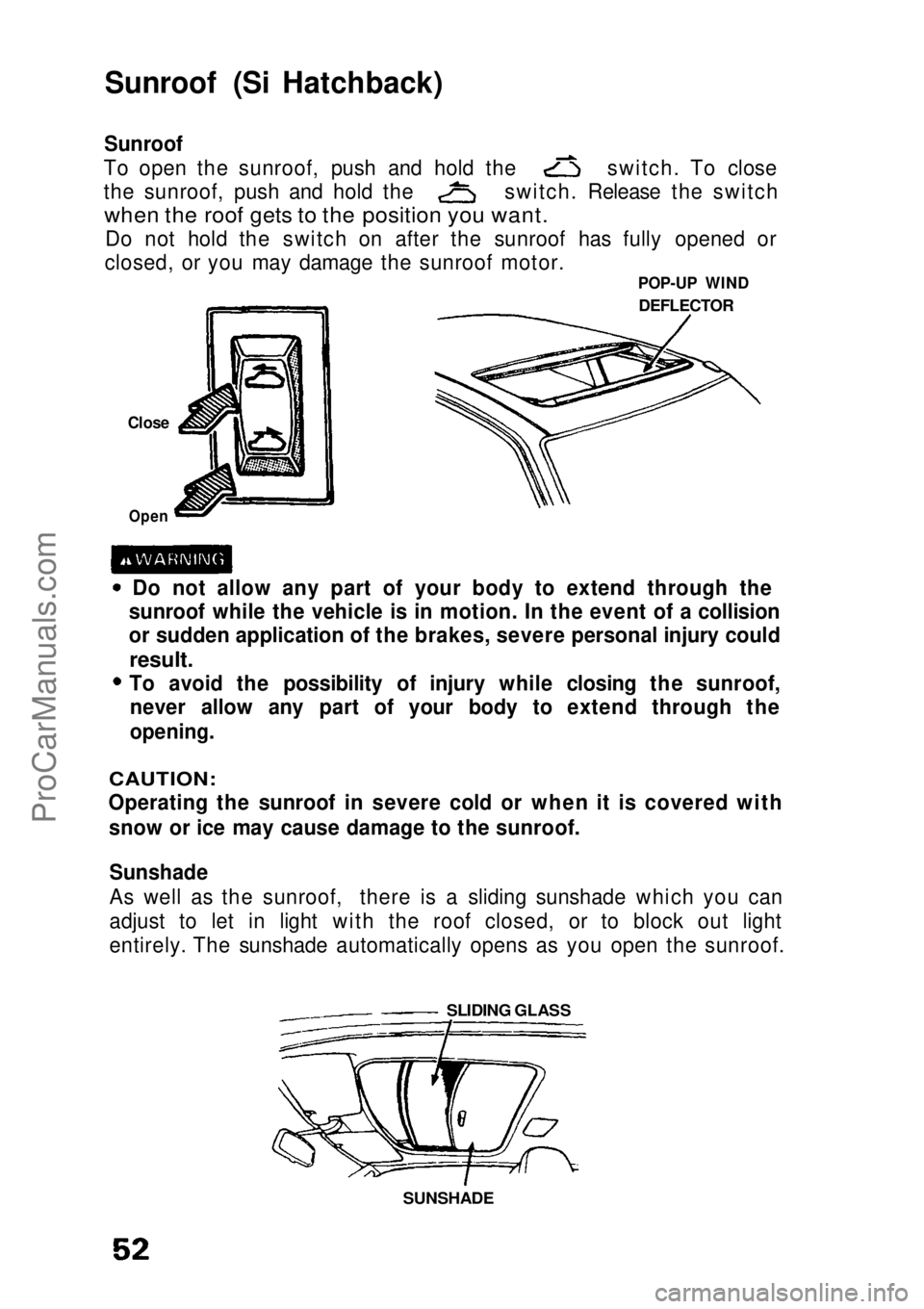
To open the sunroof, push and hold the switch. To close
the sunroof, push and hold the switch. Release the switch
when the roof gets to the position you want.
Do not hold the switch on after the sunroof has fully opened or
closed, or you may damage the sunroof motor.
Do not allow any part of your body to extend through the
sunroof while the vehicle is in motion. In the event of a collision
or sudden application of the brakes, severe personal injury could
result.
To avoid the possibility of injury while closing the sunroof,
never allow any part of your body to extend through the
opening.
CAUTION:
Operating the sunroof in severe cold or when it is covered with
snow or ice may cause damage to the sunroof.
Sunshade
As well as the sunroof, there is a sliding sunshade which you can
adjust to let in light with the roof closed, or to block out light
entirely. The sunshade automatically opens as you open the sunroof. POP-UP WIND
DEFLECTOR
Close
Open
SLIDING GLASS
SUNSHADE
ProCarManuals.comMain Menu s t
Page 54 of 136
If the Sunroof Won't Close
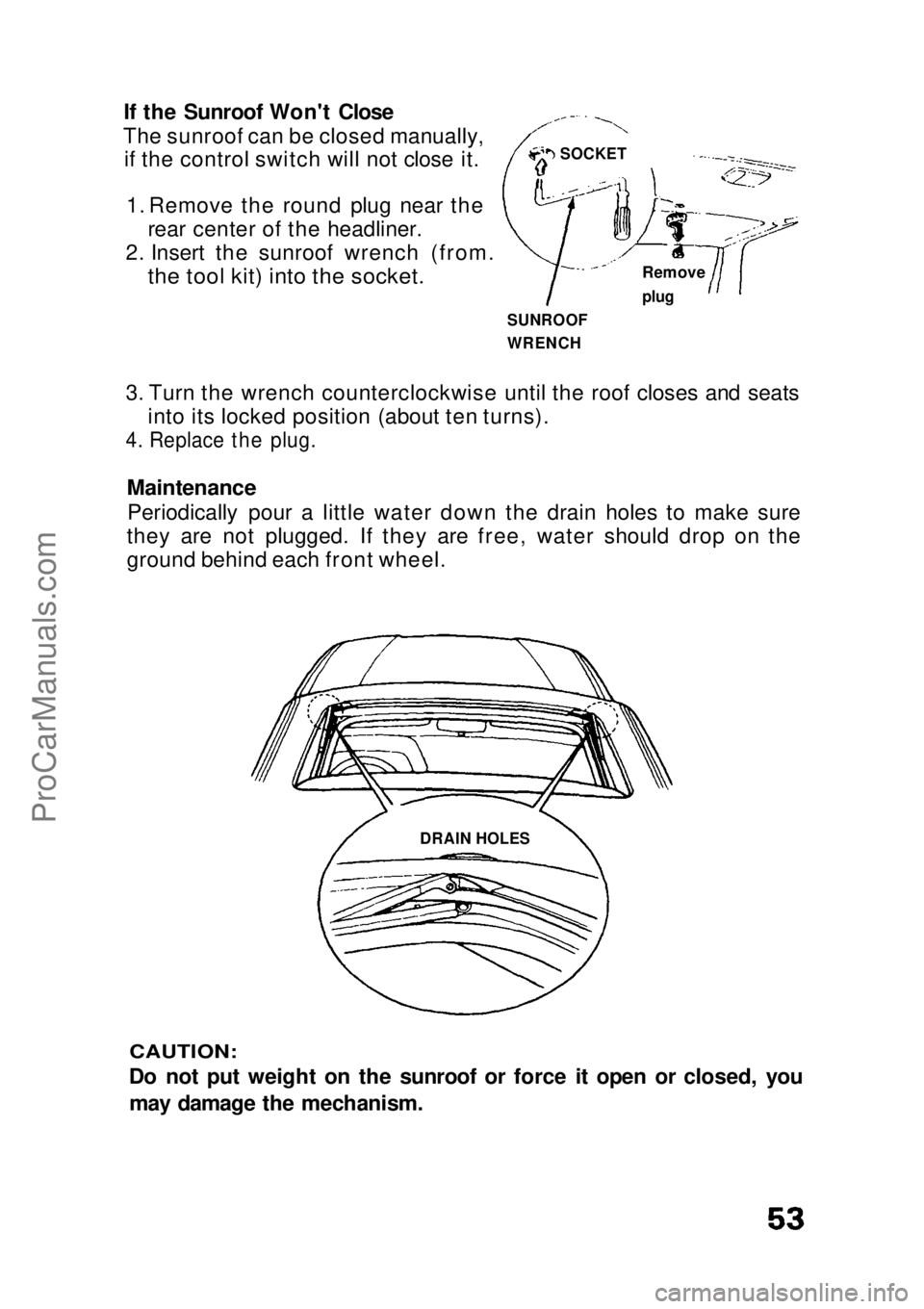
The sunroof can be closed manually, if the control switch will not close it.
1. Remove the round plug near the rear center of the headliner.
2. Insert the sunroof wrench (from.
the tool kit) into the socket.
SUNROOF
WRENCH
3. Turn the wrench counterclockwise until the roof closes and seats into its locked position (about ten turns).
4. Replace the plug.
Maintenance
Periodically pour a little water down the drain holes to make sure
they are not plugged. If they are free, water should drop on the
ground behind each front wheel.
CAUTION:
Do not put weight on the sunroof or force it open or closed, you
may damage the mechanism.
DRAIN HOLESSOCKET
Remove
plugProCarManuals.comMain Menu s t
Page 56 of 136
Operation In Foreign Countries
In order to comply with U.S. Federal Emissions Regulations, you
must use unleaded fuels of the recommended octane rating. These
fuels may not be available in other countries. If you intend taking
your car outside the U.S. or Canada, write to American Honda Consumer Affairs (stating the year and model of your car) at the
address below for information regarding modifications you may need to have done.
American Honda Motor Co., Inc.
Consumer Affairs
1919 Torrance Blvd.
Torrance, CA 90501-2722
Fuel Filler Door and Cap
Gasoline is extremely flammable and is explosive under certain
conditions. Perform this operation in a wel-ventilated area with
the engine stopped. Do not smoke or allow open flames or sparks in the area or where gasoline is stored.
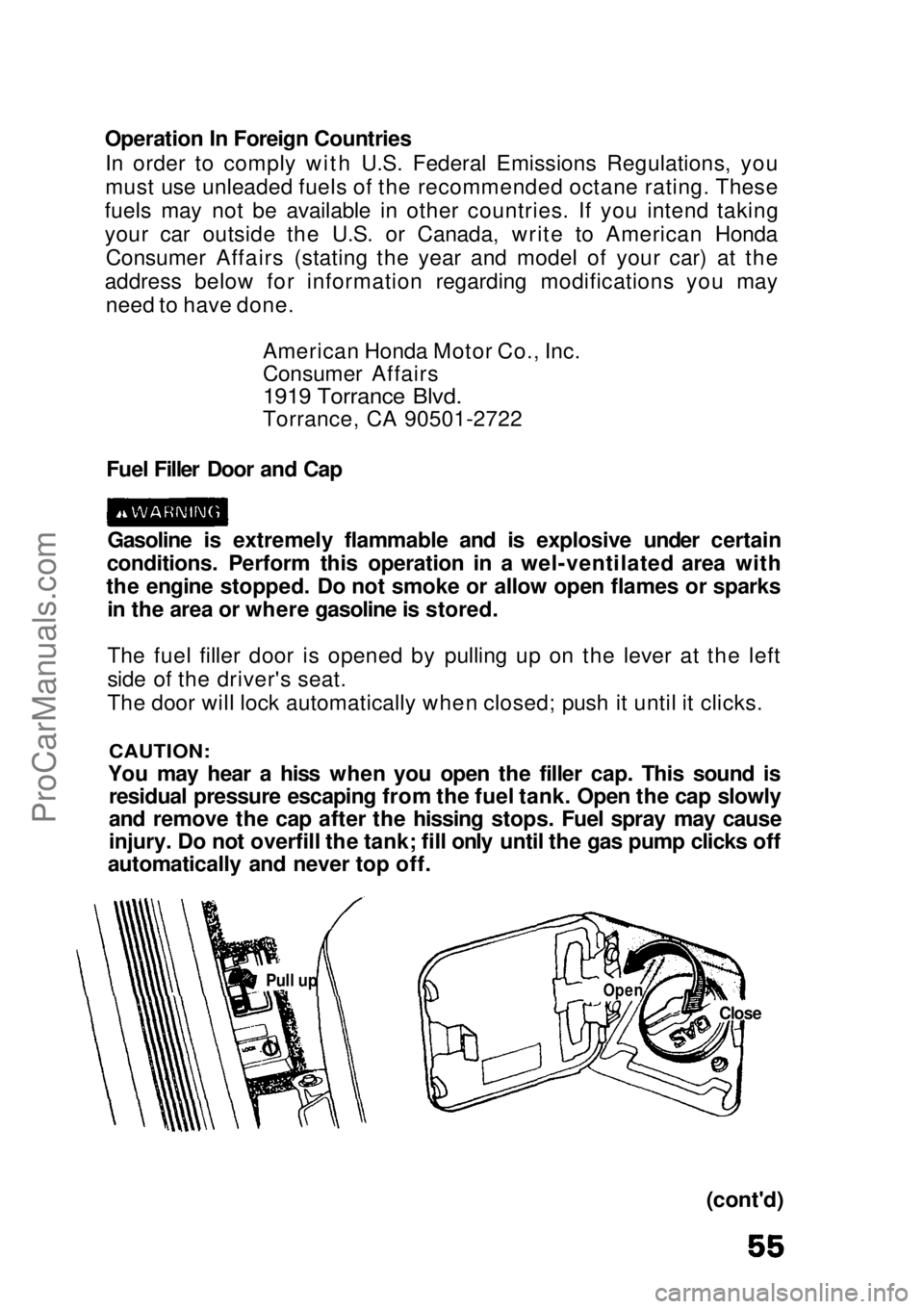
The fuel filler door is opened by pulling up on the lever at the left
side of the driver's seat.
The door will lock automatically when closed; push it until it clicks.
CAUTION:
You may hear a hiss when you open the filler cap. This sound is residual pressure escaping from the fuel tank. Open the cap slowly
and remove the cap after the hissing stops. Fuel spray may cause
injury. Do not overfill the tank; fill only until the gas pump clicks off
automatically and never top off.
(cont'd)
Pull up
Close
OpenProCarManuals.comMain Menu s t
Page 58 of 136
Ignition Switch
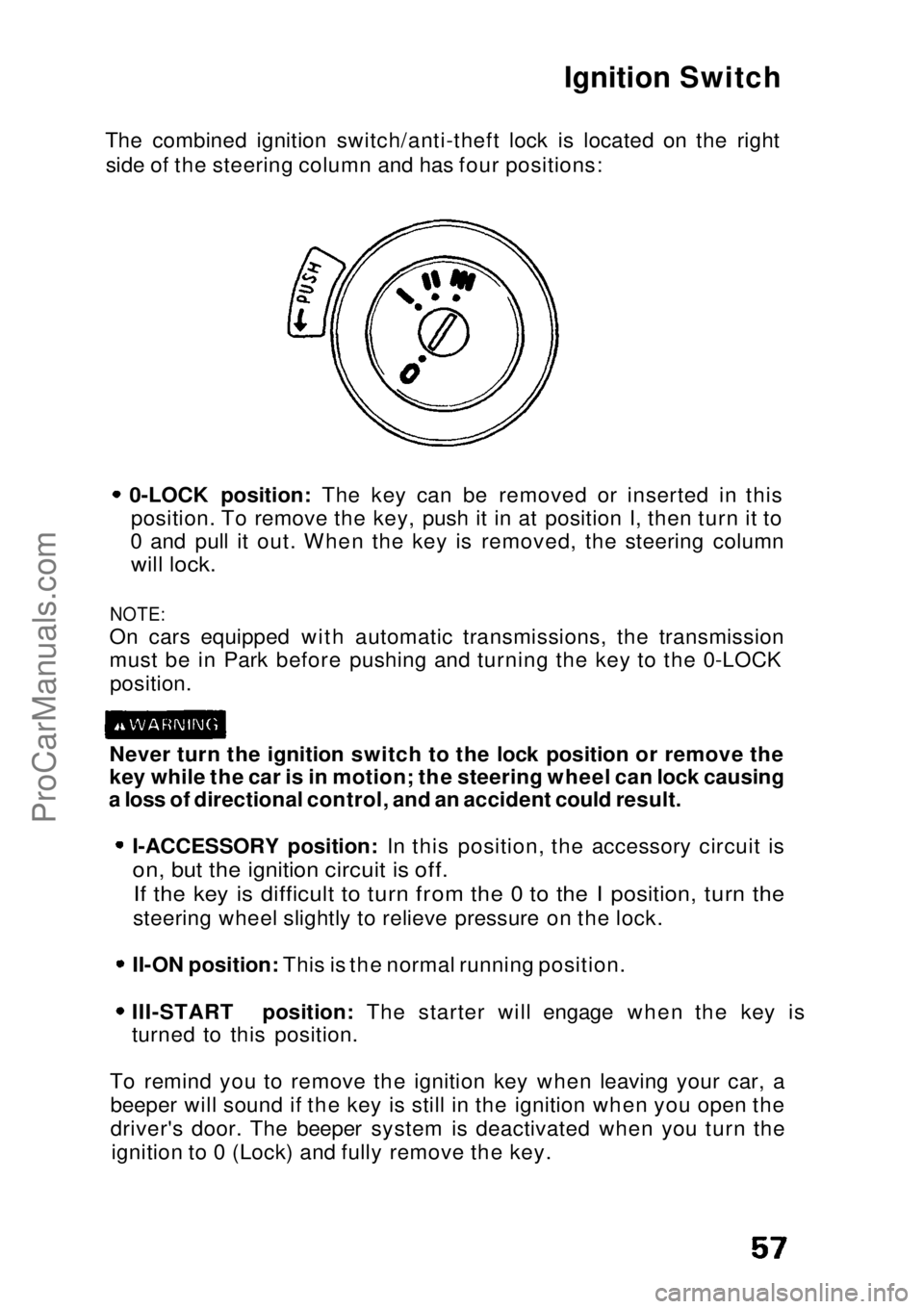
The combined ignition switch/anti-theft lock is located on the right side of the steering column and has four positions: 0-LOCK position: The key can be removed or inserted in this
position. To remove the key, push it in at position I, then turn it to
0 and pull it out. When the key is removed, the steering column
will lock.
NOTE:
On cars equipped with automatic transmissions, the transmission
must be in Park before pushing and turning the key to the 0-LOCK
position.
Never turn the ignition switch to the lock position or remove the
key while the car is in motion; the steering wheel can lock causing
a loss of directional control, and an accident could result. I-ACCESSORY position: In this position, the accessory circuit is
on, but the ignition circuit is off.
If the key is difficult to turn from the 0 to the I position, turn the
steering wheel slightly to relieve pressure on the lock. II-ON position: This is the normal running position.
III-START position: The starter will engage when the key is
turned to this position.
To remind you to remove the ignition key when leaving your car, a beeper will sound if the key is still in the ignition when you open the
driver's door. The beeper system is deactivated when you turn the ignition to 0 (Lock) and fully remove the key.ProCarManuals.comMain Menu s t
Page 60 of 136
Safety Items
Before driving away, check that: The doors are closed properly.
The mirrors are properly adjusted, and the windows clean.
The driver and passengers are wearing properly adjusted seat
belts.
The head restraints are properly adjusted.
The warning and indicator lights are operating properly. The brake pedal feels normal.
All luggage and cargo is secured.
Nothing is interfering with the driver's feet or blocking vision to
the rear.
While driving remember to: Always drive defensively; expect the unexpected.Reduce your speed during night hours and bad weather.Follow at a safe distance; don't tailgate. Get off the highway when you are tired; stop and take a rest.
When stopping for repairs: Park the car well off the road.
Turn on the hazard warning flasher. Use flares or other warning devices to warn other motorists.
After parking your car: Apply the parking brake and shift to first gear if equipped with
manual transmission, or PARK on automatic transmission equip-ped cars.
Make sure the sunroof and windows are closed and the doors are
locked.
If parked on a hill:
1. Turn the front wheels away from the curb if facing uphill.
2. Turn the front wheels toward the curb if facing downhill.
Never leave children unattended in a parked car. Take your keys.ProCarManuals.comMain Menu s t
Page 62 of 136
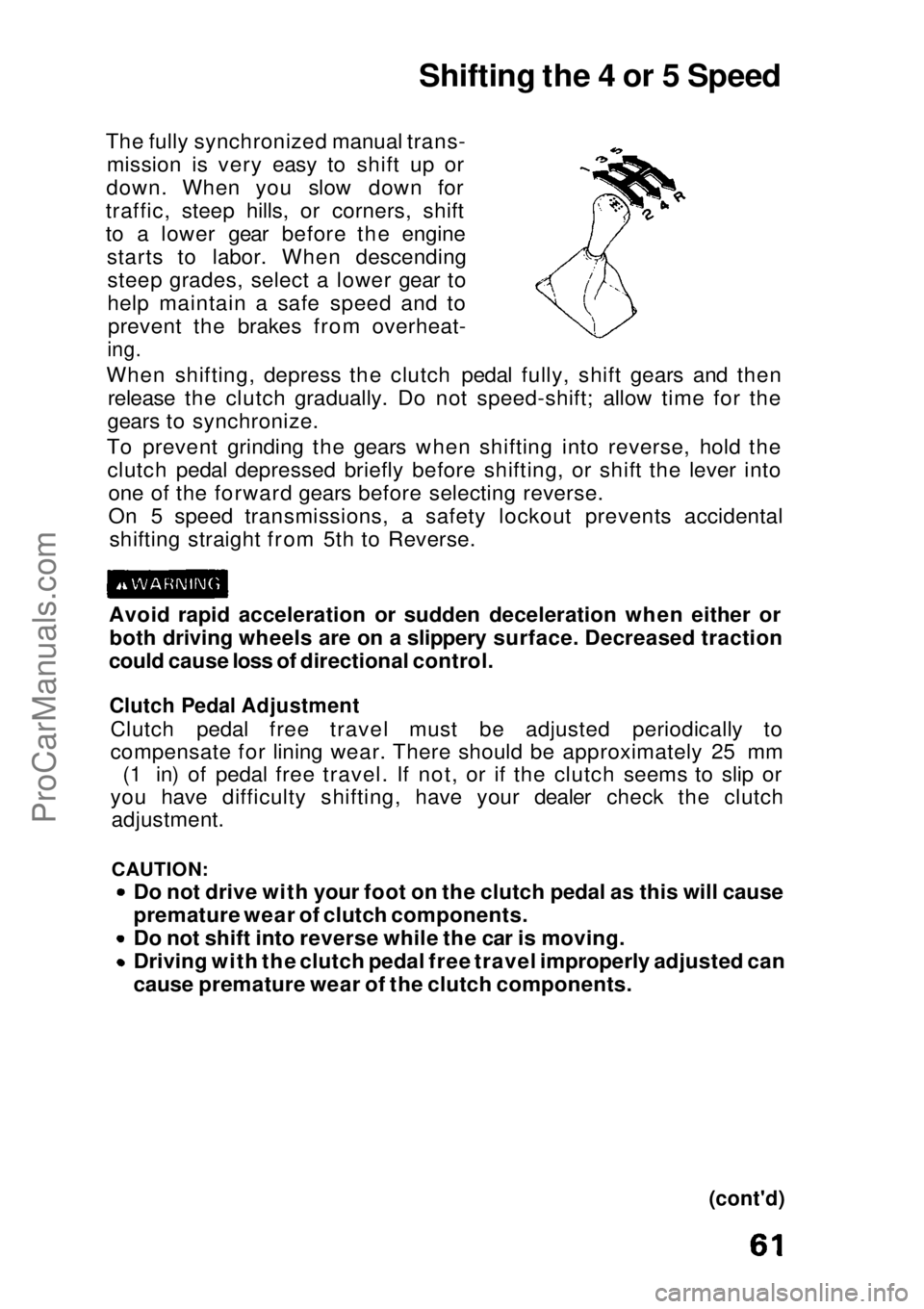
Shifting the 4 or 5 Speed
The fully synchronized manual trans- mission is very easy to shift up or
down. When you slow down for
traffic, steep hills, or corners, shift
to a lower gear before the engine starts to labor. When descendingsteep grades, select a lower gear to
help maintain a safe speed and toprevent the brakes from overheat-
ing.
When shifting, depress the clutch pedal fully, shift gears and then release the clutch gradually. Do not speed-shift; allow time for the
gears to synchronize.
To prevent grinding the gears when shifting into reverse, hold the clutch pedal depressed briefly before shifting, or shift the lever into one of the forward gears before selecting reverse.
On 5 speed transmissions, a safety lockout prevents accidentalshifting straight from 5th to Reverse.
Avoid rapid acceleration or sudden deceleration when either or both driving wheels are on a slippery surface. Decreased traction
could cause loss of directional control.
Clutch Pedal Adjustment
Clutch pedal free travel must be adjusted periodically to
compensate for lining wear. There should be approximately 25 mm (1 in) of pedal free travel. If not, or if the clutch seems to slip or
you have difficulty shifting, have your dealer check the clutch adjustment.
CAUTION:
Do not drive with your foot on the clutch pedal as this will cause
premature wear of clutch components.
Do not shift into reverse while the car is moving. Driving with the clutch pedal free travel improperly adjusted can
cause premature wear of the clutch components.
(cont'd)ProCarManuals.comMain Menu s t
Page 65 of 136
Shifting the Automatic
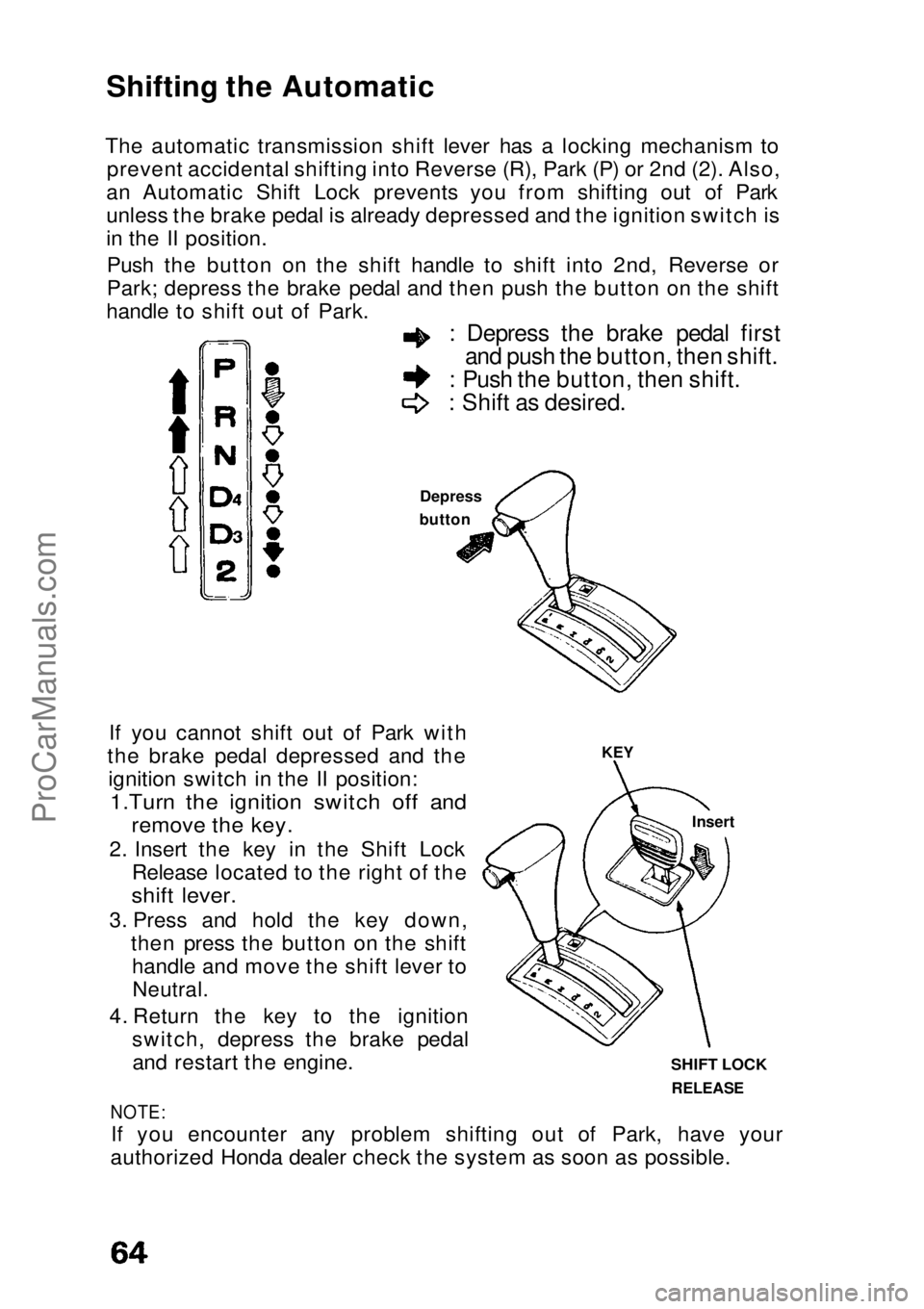
The automatic transmission shift lever has a locking mechanism to prevent accidental shifting into Reverse (R), Park (P) or 2nd (2). Also,
an Automatic Shift Lock prevents you from shifting out of Park
unless the brake pedal is already depressed and the ignition switch is
in the II position.
Push the button on the shift handle to shift into 2nd, Reverse or
Park; depress the brake pedal and then push the button on the shift
handle to shift out of Park. : Depress the brake pedal first
and push the button, then shift.
: Push the button, then shift.
: Shift as desired.
Depress
button
SHIFT LOCK
RELEASE
KEY
Insert
If you cannot shift out of Park with
the brake pedal depressed and the ignition switch in the II position:
1.Turn the ignition switch off and
remove the key.
2. Insert the key in the Shift Lock Release located to the right of the
shift lever.
3. Press and hold the key down, then press the button on the shifthandle and move the shift lever to
Neutral.
4. Return the key to the ignition switch, depress the brake pedaland restart the engine.
NOTE:
If you encounter any problem shifting out of Park, have your
authorized Honda dealer check the system as soon as possible.ProCarManuals.comMain Menu s t
Page 66 of 136

Operating Tips
For smoother operation, apply the brakes when shifting from
Neutral or Park to a forward or reverse gear.
When parking: bring the car to a stop with the foot brake, hold the brake on and shift into Park, set the hand brake and then turn off
the engine.
NOTE:
Your 4 speed automatic transmission is equipped with a torque
converter lock-up clutch. Because of this, you may notice what
feels like an extra shift as the clutch engages.
CAUTION:
Shift into P only after the car has come to a complete stop.
Shift into or out of R only after the car has come to a complete
stop.
Do not "rev-up" the engine when the brake is on and the shift
lever is in D4, D3, 2 or R.
When stopped on a hill, use the brakes to hold your position, not
the accelerator pedal.
Do not shift from N or P into D4, D3, 2 or R when the engine is
above idle speed. Before shifting into gear, make sure your foot is firmly on the brake pedal. Do not rest your hand on the shift lever or push the shift button
while driving.
(cont'd)ProCarManuals.comMain Menu s t
Page 75 of 136
Engine Oil and Filter
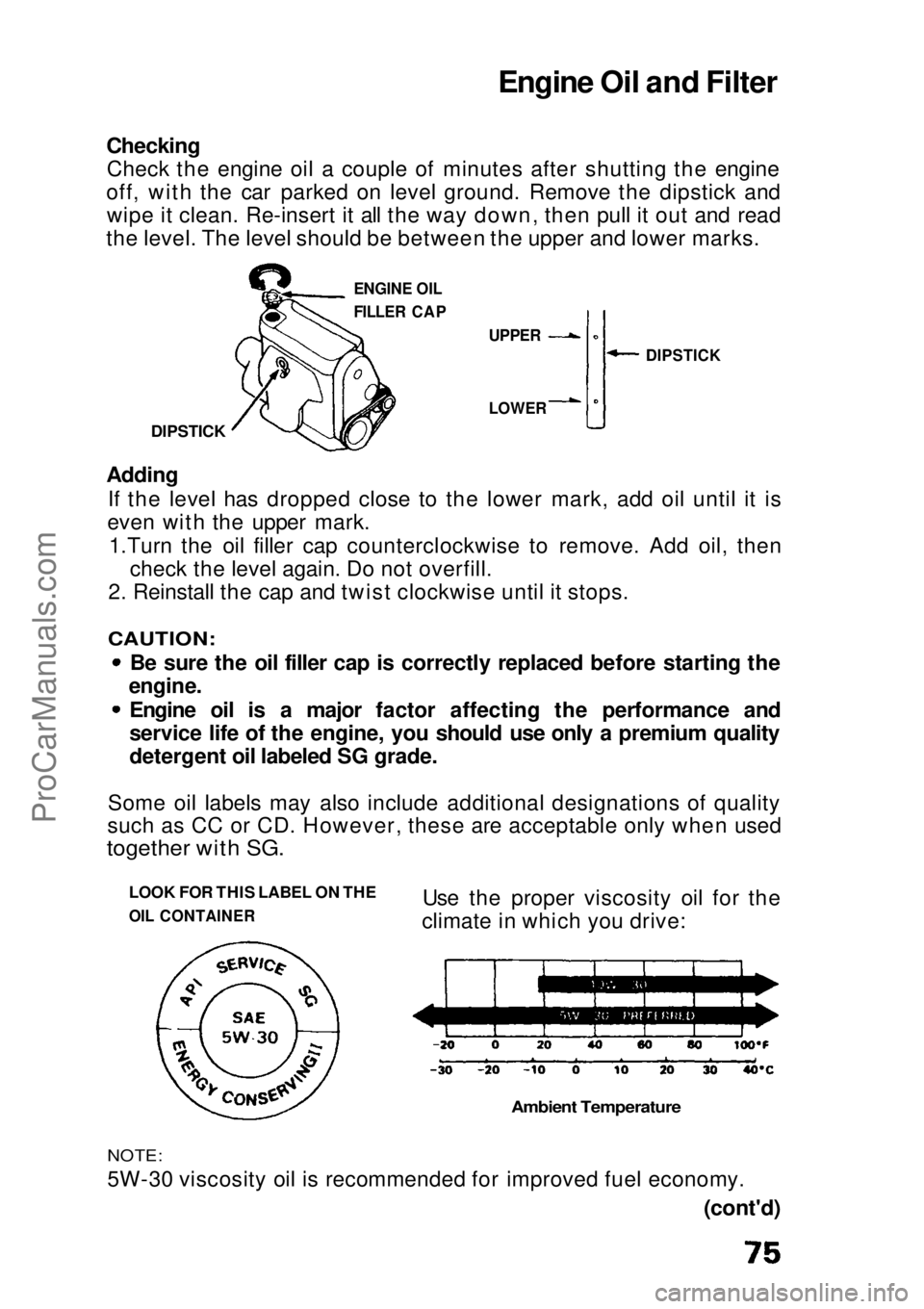
Checking
Check the engine oil a couple of minutes after shutting the engine
off, with the car parked on level ground. Remove the dipstick and wipe it clean. Re-insert it all the way down, then pull it out and read
the level. The level should be between the upper and lower marks.
DIPSTICK
ENGINE OIL
FILLER CAP
Adding
If the level has dropped close to the lower mark, add oil until it is
even with the upper mark.
1.Turn the oil filler cap counterclockwise to remove. Add oil, then check the level again. Do not overfill.
2. Reinstall the cap and twist clockwise until it stops.
CAUTION:
Be sure the oil filler cap is correctly replaced before starting the
engine.
Engine oil is a major factor affecting the performance and
service life of the engine, you should use only a premium quality
detergent oil labeled SG grade.
Some oil labels may also include additional designations of quality
such as CC or CD. However, these are acceptable only when used
together with SG.
LOOK FOR THIS LABEL ON THE
OIL CONTAINER
Use the proper viscosity oil for the
climate in which you drive:
Ambient Temperature
NOTE:
5W-30 viscosity oil is recommended for improved fuel economy.
(cont'd)
DIPSTICK
LOWER UPPERProCarManuals.comMain Menu s t
Page 76 of 136
Engine Oil and Filter (cont'd)
Fuel Efficient Oil For the best fuel economy from your car, it is recommended that
you use a fuel efficient SG grade oil. This oil is usually identified by
the words such as: "Energy Conserving II," "Gas Saving," and "Fuel Saving," etc.
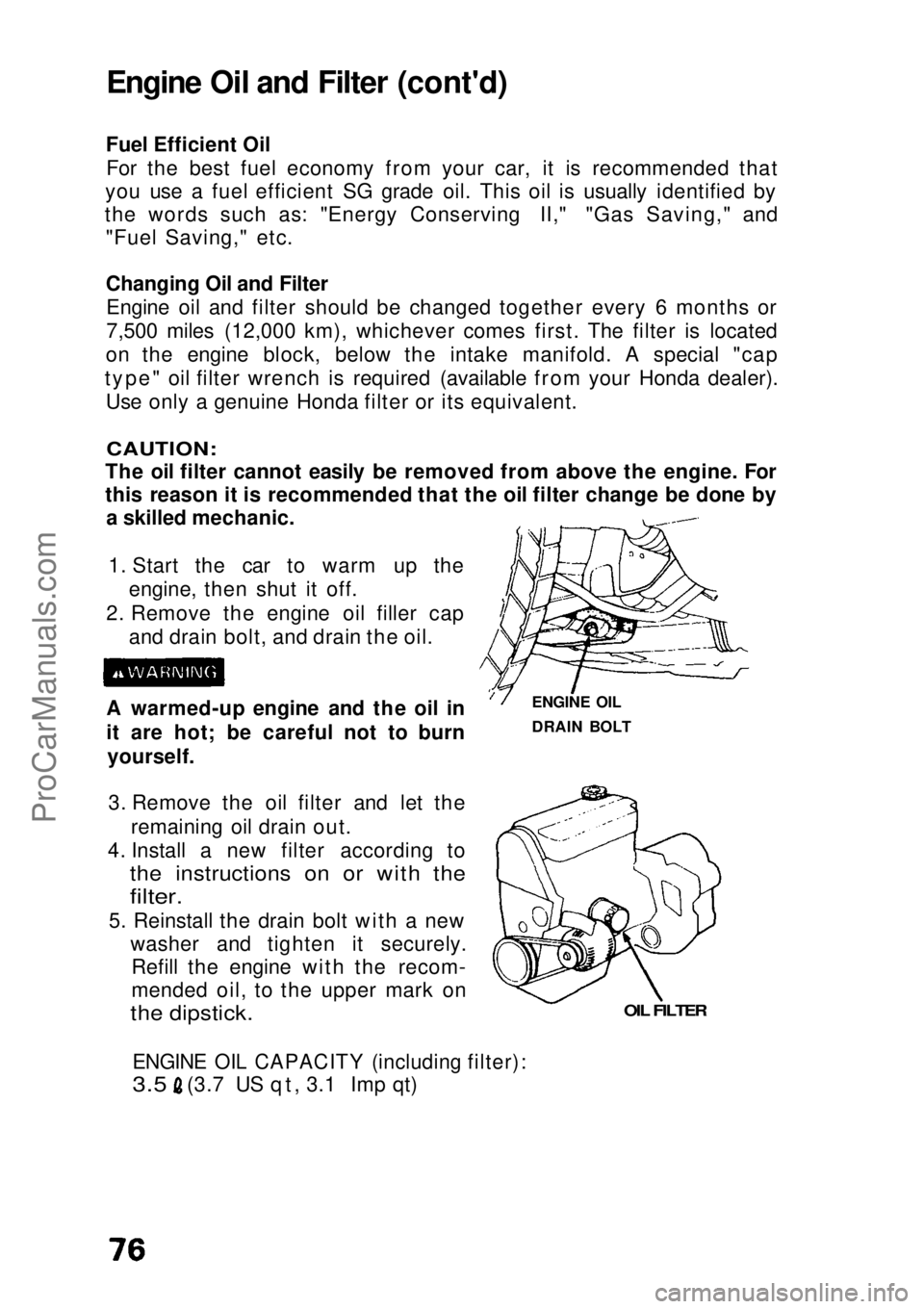
Changing Oil and Filter
Engine oil and filter should be changed together every 6 months or
7,500 miles (12,000 km), whichever comes first. The filter is located
on the engine block, below the intake manifold. A special "cap
type" oil filter wrench is required (available from your Honda dealer). Use only a genuine Honda filter or its equivalent.
CAUTION:
The oil filter cannot easily be removed from above the engine. For
this reason it is recommended that the oil filter change be done by a skilled mechanic.
1. Start the car to warm up the engine, then shut it off.
2. Remove the engine oil filler cap and drain bolt, and drain the oil.
A warmed-up engine and the oil in
it are hot; be careful not to burn yourself.
3. Remove the oil filter and let the remaining oil drain out.
4. Install a new filter according to
the instructions on or with the
filter.
5. Reinstall the drain bolt with a new washer and tighten it securely.Refill the engine with the recom-
mended oil, to the upper mark on
the dipstick.
ENGINE OIL CAPACITY (including filter):
3.5
(3.7 US qt, 3.1 Imp qt)
OIL FILTER
ENGINE OIL
DRAIN BOLTProCarManuals.comMain Menu s t