catalytic converter HONDA CIVIC 1991 Owners Manual
[x] Cancel search | Manufacturer: HONDA, Model Year: 1991, Model line: CIVIC, Model: HONDA CIVIC 1991Pages: 136, PDF Size: 1.33 MB
Page 110 of 136
Jump Starting
To start a car with a dead battery, use another battery of the samevoltage, and the proper jumper cables.
Procedures other than those below could cause injury or
damage from battery acid spray, explosion or charging system
overload.
Never connect the jumper cable directly to the negative post of
the "dead" battery.
Never allow the two cars to touch each other. Never allow the jumper cable clamps to touch each other.
Never lean over the battery when making connections.
Never attempt to jump start a vehicle with a frozen battery. The
battery could rupture and explode. If you suspect a frozenbattery, remove the vent caps and check the fluid. If there
seems to be no fluid, or if you see ice, do not attempt a jump
start until the fluid thaws.
CAUTION:
If jumper cables are connected backwards, the car's main fuse
may blow.
1.Turn off all lights, heater and other electrical loads, set parking brake, and shift the transmission to Neutral or Park.
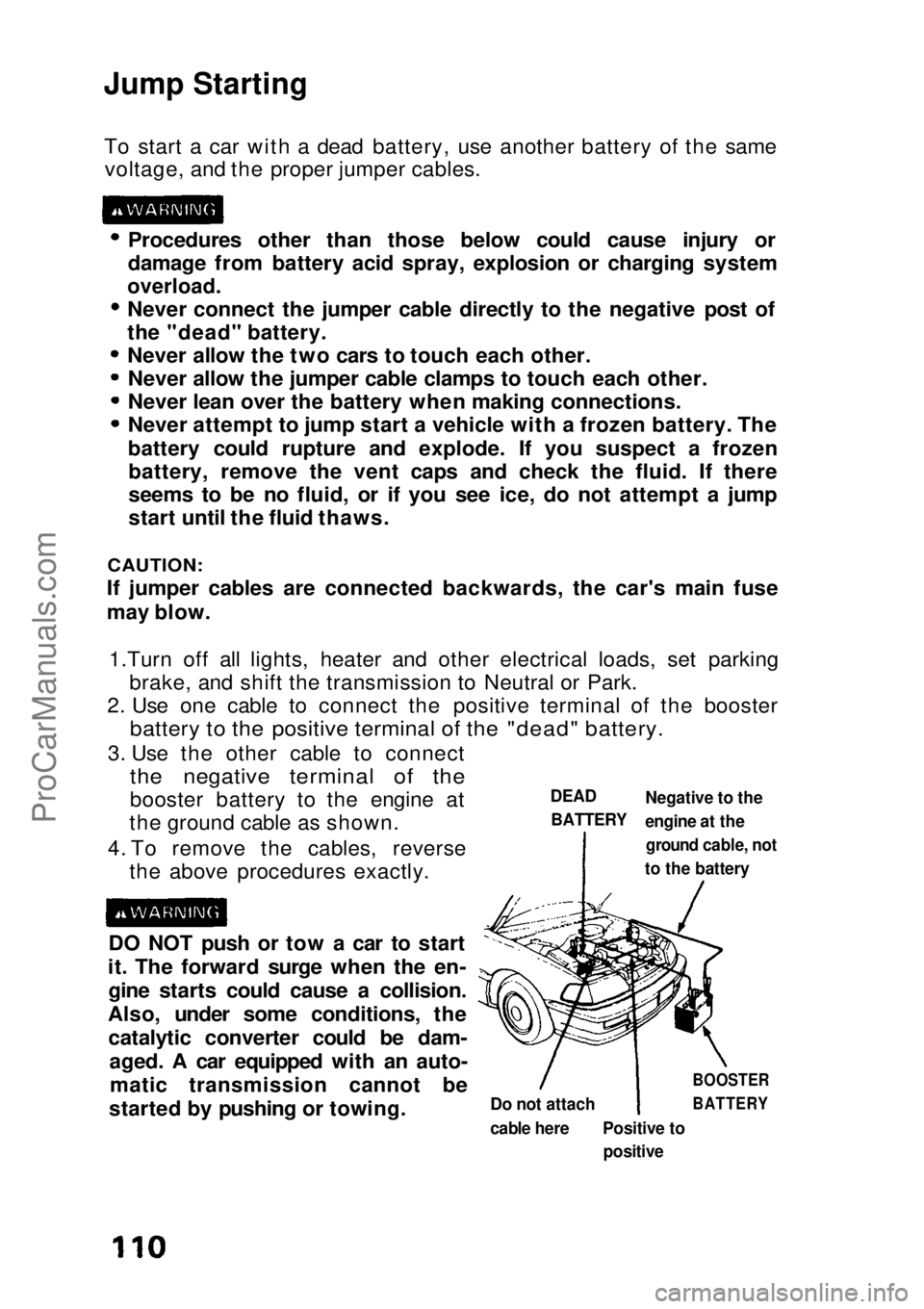
2. Use one cable to connect the positive terminal of the booster
battery to the positive terminal of the "dead" battery.
3. Use the other cable to connect
the negative terminal of the
booster battery to the engine at
the ground cable as shown.
4. To remove the cables, reverse the above procedures exactly.
DO NOT push or tow a car to start
it. The forward surge when the en- gine starts could cause a collision.
Also, under some conditions, the catalytic converter could be dam- aged. A car equipped with an auto-matic transmission cannot be
started by pushing or towing.
DEAD
BATTERY
Negative to the
engine at the
ground cable, not
to the battery
Do not attach
cable here
Positive to
positive
BOOSTER
BATTERYProCarManuals.comMain Menu s t
Page 125 of 136
Evaporative Emission Control System
The Evaporative Emission Control System is designed to prevent
fuel vapors from escaping into the atmosphere. Fuel vapors from the fuel tank are directed into the charcoal
canister where they are adsorbed and stored while the engine is stopped or idling. When the coolant temperature rises to a certain
value, the vapors are drawn into the engine through the throttlebody and the intake manifold during normal engine operation.
Engine Exhaust Emission Controls
The engine exhaust emission control systems are designed to control combustion during idle, acceleration, cruise, and deceleration.
These systems are entirely separate from the crankcase and evaporative emission control systems described previously.
HONDA PGM-FI System
The PGM-FI system consists of three independent sub-systems; Air Intake, Electronic Control and Fuel Control, thus allowing moreaccurate control of air/fuel ratios under all operating conditions.
The Electronic Control Unit (ECU) detects the amount of air
drawn into the cylinders and determines the amount of fuel to be injected to provide the optimum air/fuel ratio for all engine needs.
Ignition Timing Control System
This system automatically controls the ignition timing to reduce
the amount of HC and NOx.
Catalytic Converter
Three Way Catalyst
The catalyst is used to convert hydrocarbons (HC), carbon monoxide (CO) and oxides of nitrogen (NOx) in the exhaust gas,
to carbon dioxide (CO 2
), dinitrogen (N 2
) and water vapor.
Exhaust Gas Recirculation (EGR) (California automatic models except EX Sedan)
The EGR system is designed to control the formation of oxides of nitrogen (NOx) caused when fuel mixture burns at high
temperature. It works by recirculating exhaust gas through the EGR valve and intake manifold into the combustion chambers
where it reduces peak temperature by diluting the air/fuel mixture.ProCarManuals.comMain Menu s t
Page 126 of 136
Catalytic Converter
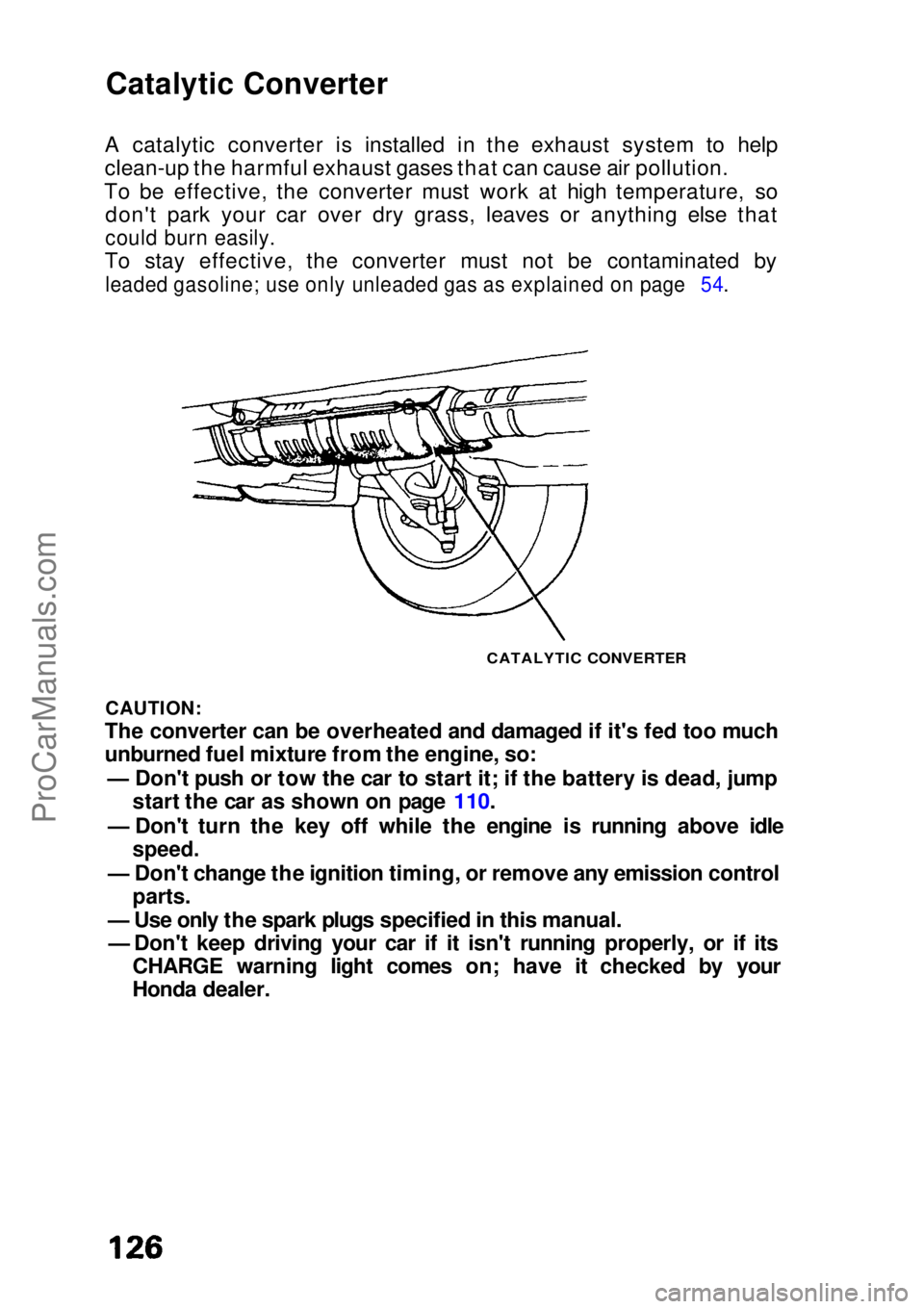
A catalytic converter is installed in the exhaust system to help
clean-up the harmful exhaust gases that can cause air pollution.
To be effective, the converter must work at high temperature, so don't park your car over dry grass, leaves or anything else that
could burn easily.
To stay effective, the converter must not be contaminated by
leaded gasoline; use only unleaded gas as explained on page 54.
CAUTION:
The converter can be overheated and damaged if it's fed too much
unburned fuel mixture from the engine, so:
— Don't push or tow the car to start it; if the battery is dead, jump start the car as shown on page 110.
— Don't turn the key off while the engine is running above idle
speed.
— Don't change the ignition timing, or remove any emission control
parts.
— Use only the spark plugs specified in this manual. — Don't keep driving your car if it isn't running properly, or if its CHARGE warning light comes on; have it checked by your
Honda dealer.
CATALYTIC CONVERTERProCarManuals.comMain Menu s t
Page 129 of 136
Index
Battery
Charging System Warning Light.............................................. 30
Jump Starting ........................ 110
Maintenance............................. 89
Specification (Hatchback).... 116
Specification (Sedan)............ 119
Beeper System Fasten Seat Belt Beeper(Sedan).................................. 11
(Hatcback)............................ 15
Belts, Seat............. See "Seat Belts"
Body Repair.................................. 102
Brake Warning Light...................... 31 Brakes
Brake Failure Warning Light.... 31
Brake Fluid................................ 84
Brake System Design.............. 83
Brake Wear Indicators............. 84
Parking Brake........................... 42
Parking Brake Warning Light.. 31
Break-in Period................................. 2
Bulb
Replacement............................
92
Specification (Hatchback)....
117
Specification (Sedan)............
120
Buzzer........... See
"Beeper System"
Capacities (Hatchback)............... 115 Capacities (Sedan)....................... 118
Care and Cleaning.......................... 99
Catalytic Converter..................... 126 Certification Label....................... 121
Chains, Tires...................................
95
Check Engine
Warning Light......... 31
Child Proof Door Locks...................
5
Child Restraint
System................. 21
Cigarette Lighter............................ 44
Clock............................................... 42
Clutch Pedal Adjustment.............. 61
Compact Spare Tire.................... 104
Coolant Temperature Gauge ........
28
Cooling (with
A/C).........................
49
Cooling System..............................
80
Crankcase Emission Control
System................................... 124
Cruise Control Operation.................................. 39
Indicator.................................... 31
Defogger........................................ 34
Defroster........................................ 51
Doors
Child Proof Door Locks............. 5
Locks........................................... 3
Power Locks.............................. 4
Emergency
Changing a Flat Tire............... 105
Hazard Warning System ......... 37If Your Car Gets Stuck.......... 112
Jump Starting........................ 110
Shoulder Belt Buckle............. 113
Towing.................................... 111
Warning and Indicator Lights.. 29
Emission Controls........................ 124
Engine
Coolant...................................... 80
Coolant Temperature Gauge... 28
Exhaust Controls................... 125Identification Number............ 12
1
Oil and
Filter.............................. 76
OH Pressure Warning Light..... 30
Specification (Hatchback).... 116
Air Conditioner
Operation.................................. 47
Service...................................... 98
Air Filter.......................................... 86
Air Pressure, Tires......................... 94
Antifreeze.. See "Radiator Coolant" Anti-theft Steering Column Lock System ..................................... 57
Appearance Care........................ 100
Ashtrays......................................... 44
Automatic Seat Belt...................... 10
Automatic Transmission
Driving Technique.................... 66
Fluid........................................... 79
Operation.................................. 64
(cont'd)ProCarManuals.comMain Menu s t