cooling HONDA CIVIC 1991 Owners Manual
[x] Cancel search | Manufacturer: HONDA, Model Year: 1991, Model line: CIVIC, Model: HONDA CIVIC 1991Pages: 136, PDF Size: 1.33 MB
Page 27 of 136
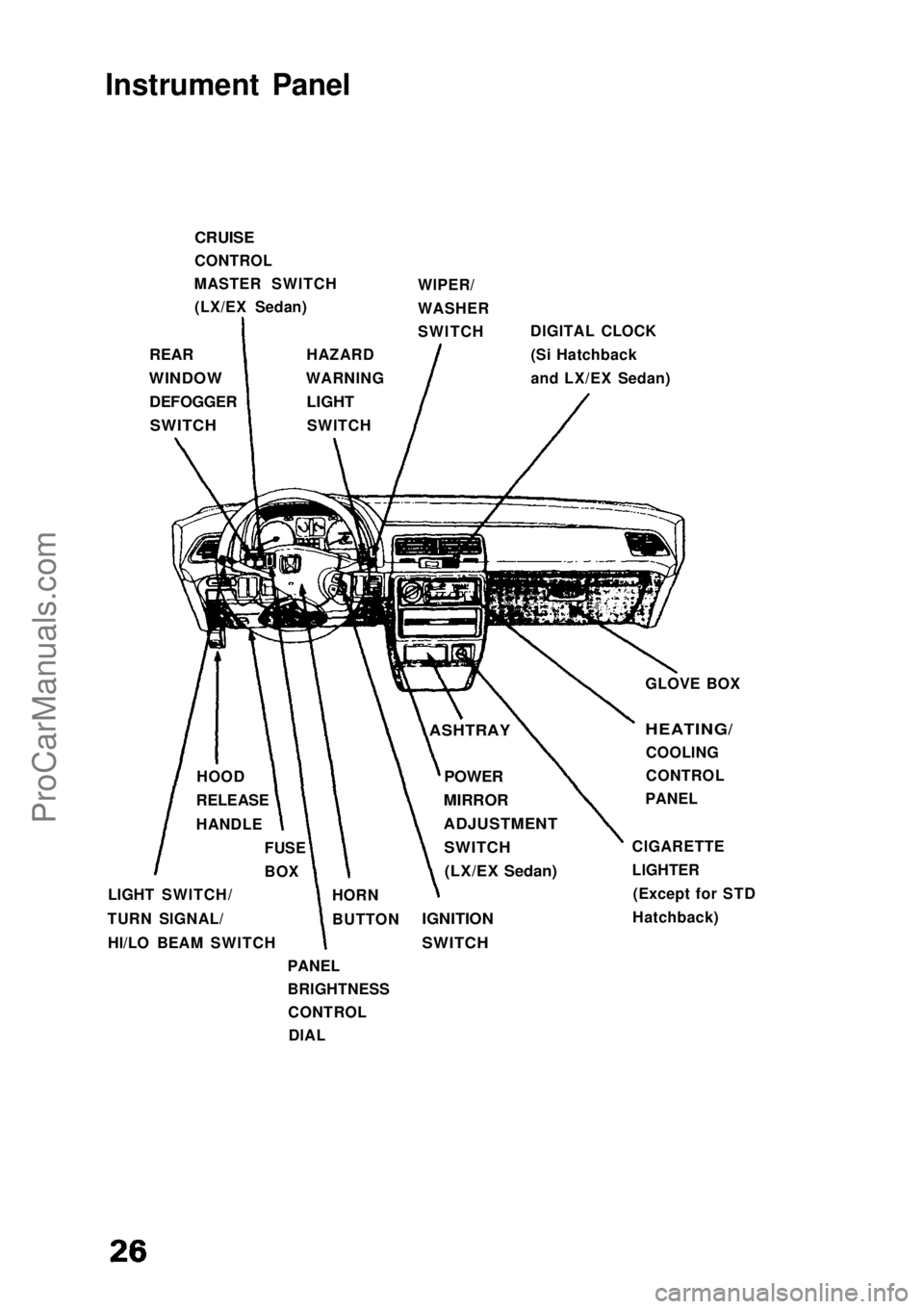
Instrument Panel
CRUISE
CONTROL
MASTER SWITCH (LX/EX Sedan) WIPER/
WASHER
SWITCH
DIGITAL CLOCK
(Si Hatchback
and LX/EX Sedan)
REAR
WINDOW
DEFOGGER
SWITCH
HAZARD
WARNING
LIGHT
SWITCH
GLOVE BOX
ASHTRAY
HEATING/
COOLING
CONTROL
PANEL
CIGARETTE
LIGHTER (Except for STD
Hatchback)
POWER
MIRROR
ADJUSTMENT
SWITCH
(LX/EX Sedan)
IGNITION
SWITCH
HORN
BUTTON
PANEL
BRIGHTNESS CONTROLDIAL
LIGHT SWITCH/
TURN SIGNAL/ HI/LO BEAM SWITCH FUSE
BOX
HOOD
RELEASE
HANDLEProCarManuals.comMain Menu s t
Page 46 of 136
Heating and Cooling
The vents, heater and air conditioner are combined in one system;
adjusting four basic controls to different settings can provide a full range of interior temperatures for safe and comfortable driving.
Air conditioner: optional
Ventilation
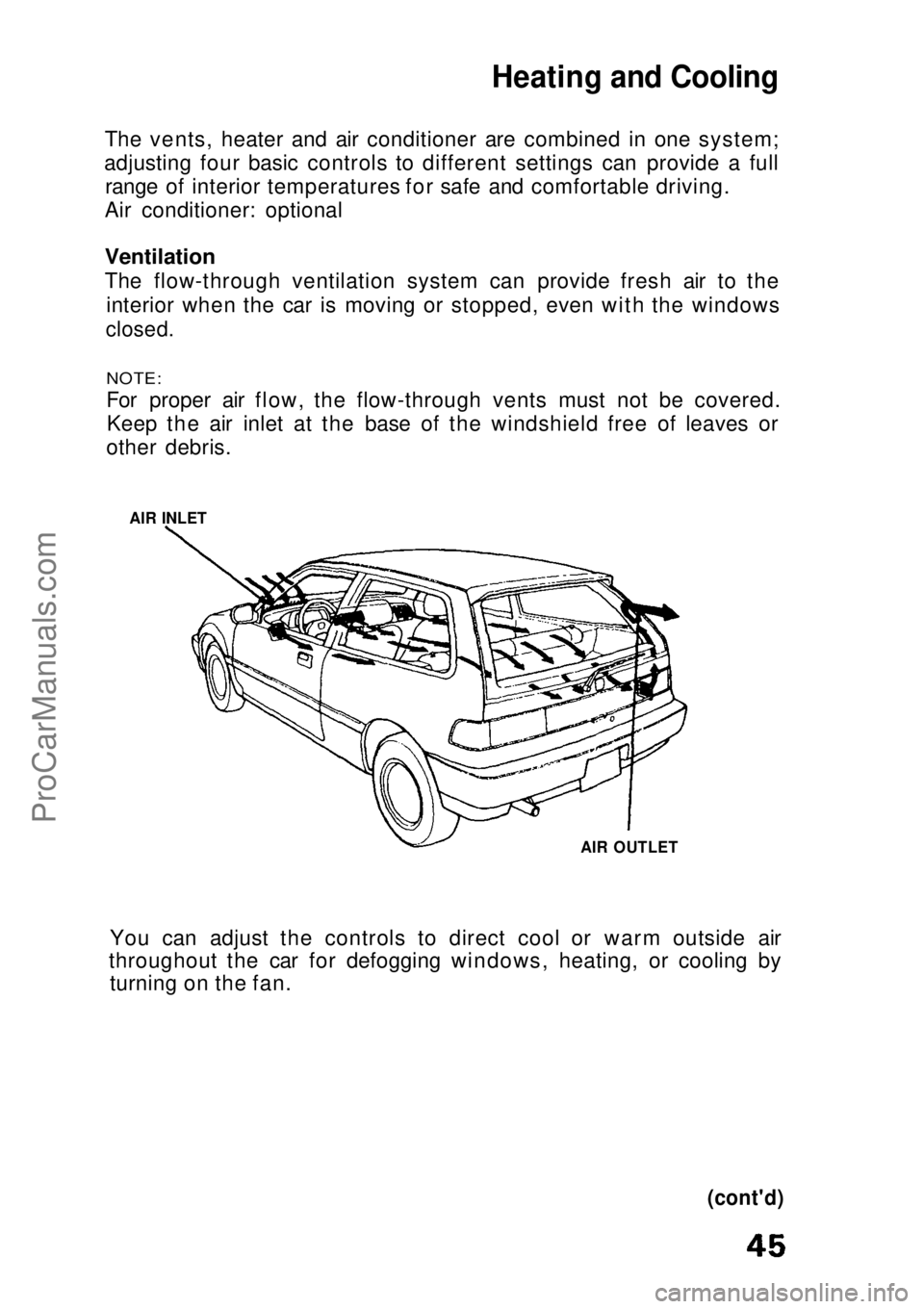
The flow-through ventilation system can provide fresh air to the
interior when the car is moving or stopped, even with the windows
closed.
NOTE:
For proper air flow, the flow-through vents must not be covered.Keep the air inlet at the base of the windshield free of leaves or
other debris.
You can adjust the controls to direct cool or warm outside air
throughout the car for defogging windows, heating, or cooling by turning on the fan.
(cont'd)
AIR OUTLET
AIR INLETProCarManuals.comMain Menu s t
Page 47 of 136
Heating and Cooling (cont'd)
Dash Vents
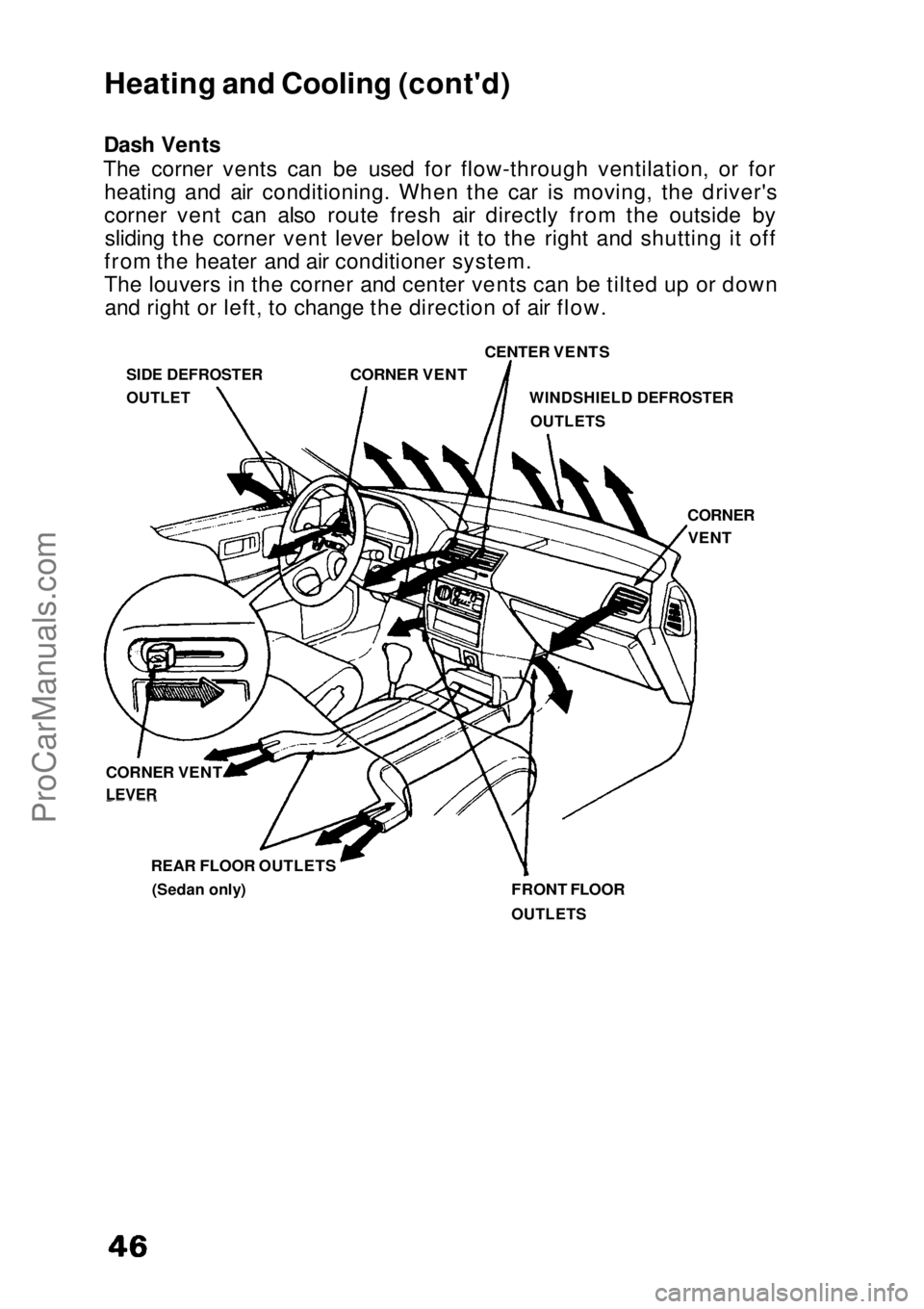
The corner vents can be used for flow-through ventilation, or for heating and air conditioning. When the car is moving, the driver's
corner vent can also route fresh air directly from the outside bysliding the corner vent lever below it to the right and shutting it off
from the heater and air conditioner system.
The louvers in the corner and center vents can be tilted up or down and right or left, to change the direction of air flow.
SIDE DEFROSTER
OUTLET
CORNER VENT
WINDSHIELD DEFROSTER
OUTLETS
CENTER VENTS
CORNER
VENT
FRONT FLOOR
OUTLETS
REAR FLOOR OUTLETS
(Sedan only)
CORNER VENT
LEVERProCarManuals.comMain Menu s t
Page 49 of 136
Heating and Cooling (cont'd)
Recirculation Lever
Sliding the lever from the position to the position
shuts off outside air and recirculates the air inside the car. If the
heater or air conditioner is on, and you want to warm up or cool
down the interior more quickly, or keep smoke or dust out of the car without losing the heat or cool function, simply slide the lever to the position.
NOTE:
The windows may become fogged if the system is in the po-
sition for an extended period of time with the air conditioner off. As soon as the interior is warmed, slide the lever to the posi-
tion.
How to Use the Controls
To Ventilate
Turn the temperature control dial counterclockwise, slide the recirculation lever to the position and the function lever to
the position. Switch the fan on and outside air will flow
through the corner and center vents. To change air distribution,
slide the function lever to the position, and outside air will
also flow from the floor level outlet at the heater.
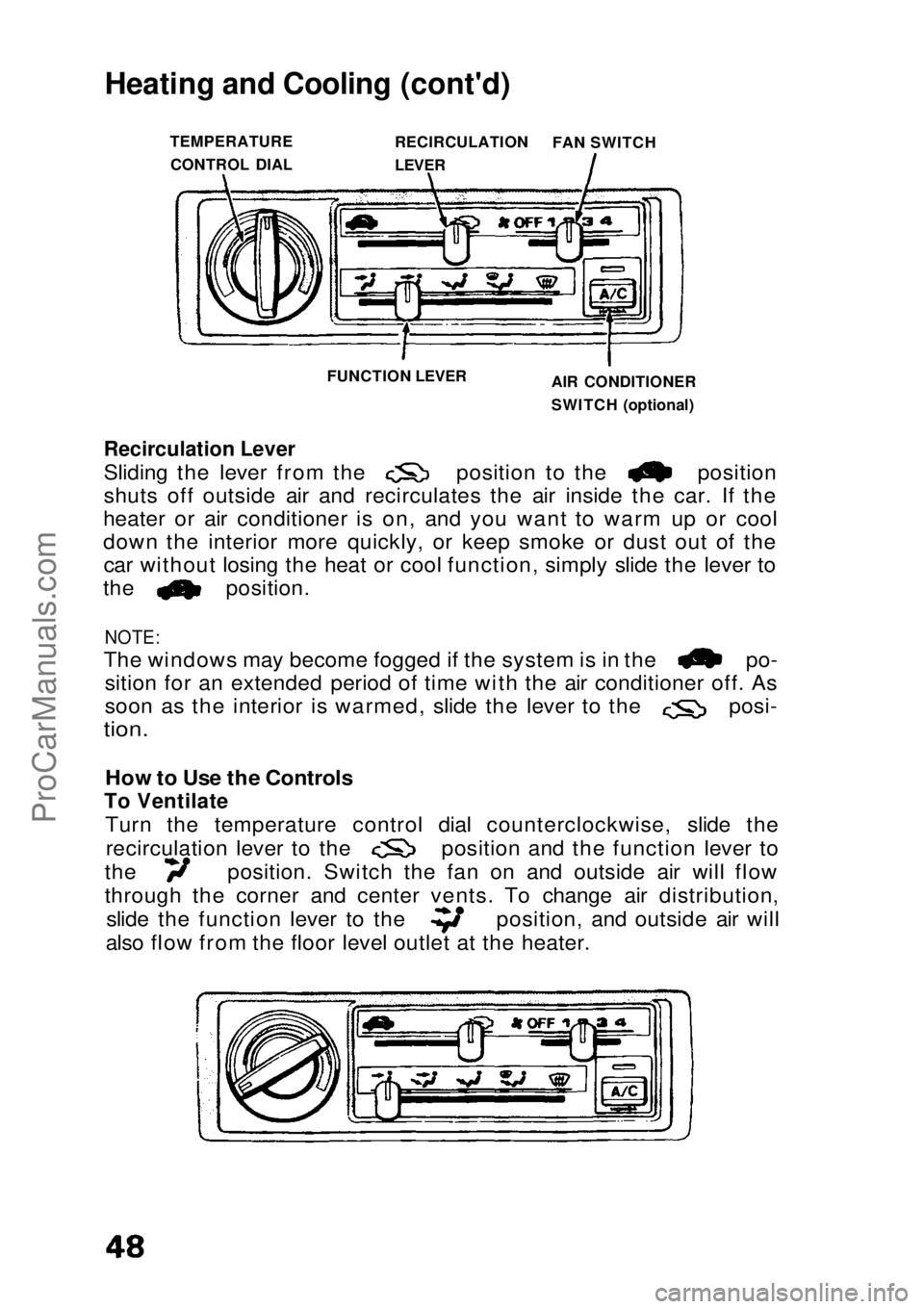
TEMPERATURE
CONTROL DIAL RECIRCULATION
LEVER
FAN SWITCH
FUNCTION LEVER AIR CONDITIONER
SWITCH (optional)ProCarManuals.comMain Menu s t
Page 50 of 136
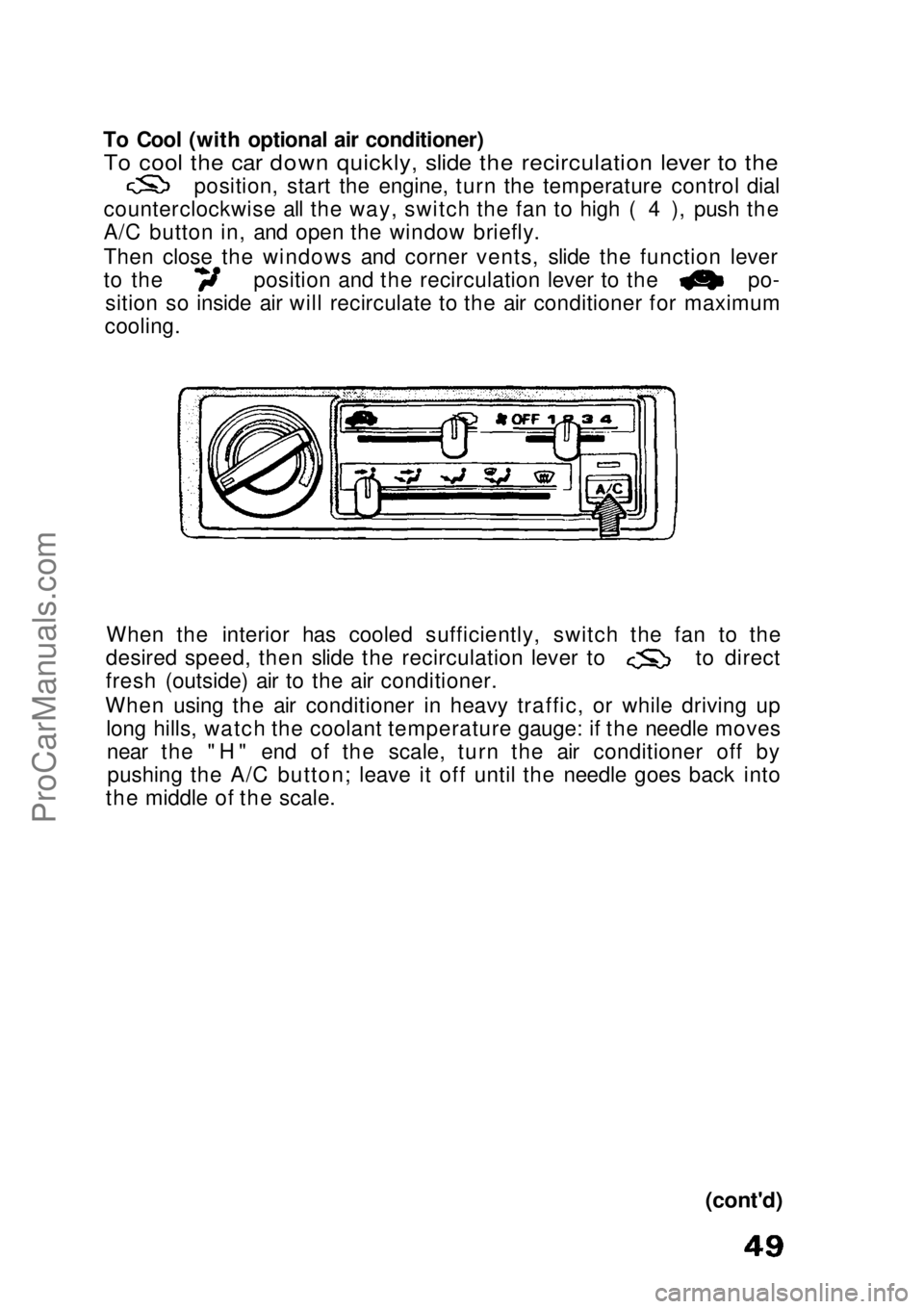
To Cool (with optional air conditioner)
To cool the car down quickly, slide the recirculation lever to the
position, start the engine, turn the temperature control dial
counterclockwise all the way, switch the fan to high ( 4 ), push the
A/C button in, and open the window briefly.
Then close the windows and corner vents, slide the function lever to the position and the recirculation lever to the po-
sition so inside air will recirculate to the air conditioner for maximum
cooling.
When the interior has cooled sufficiently, switch the fan to the desired speed, then slide the recirculation lever to to direct
fresh (outside) air to the air conditioner.
When using the air conditioner in heavy traffic, or while driving up long hills, watch the coolant temperature gauge: if the needle movesnear the "H" end of the scale, turn the air conditioner off bypushing the A/C button; leave it off until the needle goes back into
the middle of the scale.
(cont'd)ProCarManuals.comMain Menu s t
Page 51 of 136
Heating and Cooling (cont'd)
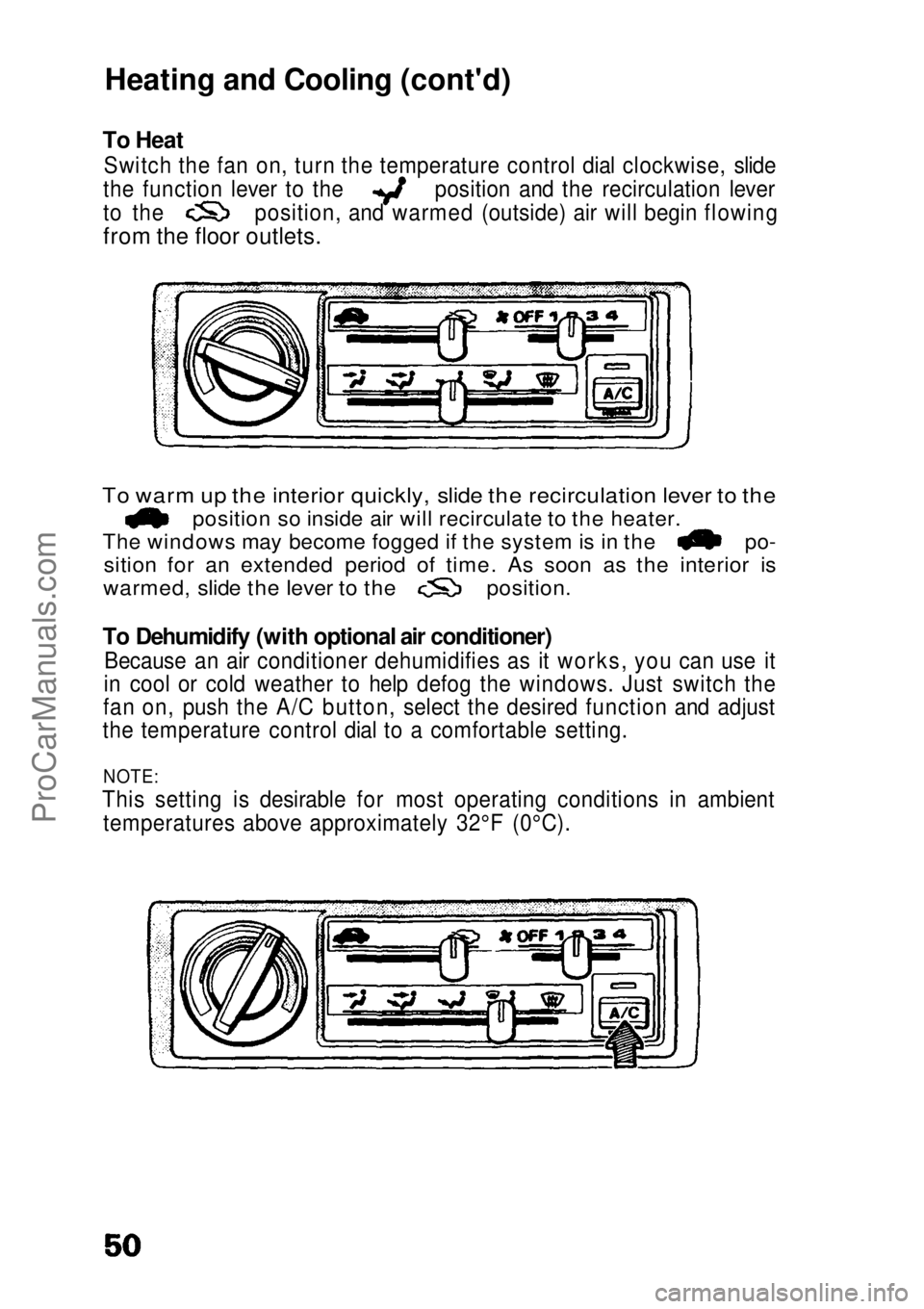
To Heat
Switch the fan on, turn the temperature control dial clockwise, slide the function lever to the position and the recirculation lever
to the position, and warmed (outside) air will begin flowing
from the floor outlets.
To warm up the interior quickly, slide the recirculation lever to the
position so inside air will recirculate to the heater.
The windows may become fogged if the system is in the po-
sition for an extended period of time. As soon as the interior is
warmed, slide the lever to the position.
To Dehumidify (with optional air conditioner)
Because an air conditioner dehumidifies as it works, you can use it
in cool or cold weather to help defog the windows. Just switch the
fan on, push the A/C button, select the desired function and adjust
the temperature control dial to a comfortable setting.
NOTE:
This setting is desirable for most operating conditions in ambient temperatures above approximately 32°F (0°C).ProCarManuals.comMain Menu s t
Page 80 of 136

Cooling System
The engine in your Honda contains a number of aluminum parts. Therefore, it requires an antifreeze/coolant specifically formulated
to protect the aluminum parts from corrosion. Failure to use asuitable antifreeze/coolant may seriously shorten the life of the
engine as the result of rapid corrosion damage. Some antifreeze/
coolants, although labelled for use in engines containing aluminum,may not provide adequate protection for your engine.
Therefore, use only a Honda RECOMMENDED antifreeze/coolant.
CHECK WITH YOUR AUTHORIZED HONDA DEALER.
For best corrosion protection, the mixture of coolant and water
must be maintained year-round at 50/50. Concentrations less than 50% coolant may not provide sufficient protection against
corrosion and freezing. Concentrations of greater than 60% coolant
will impair cooling efficiency and are not recommended. Low- mineral drinking water or distilled water should be mixed with the
antifreeze/coolant. Coolant loss should be replenished by a mixture
containing the proper concentration of antifreeze and water.Do not mix different antifreeze/coolants.
Do not use additional rust inhibitors or anti-rust products, as they
may not be compatible with the radiator coolant.
ENGINE DAMAGE CAUSED BY IMPROPER COOLANT USAGE IS
NOT COVERED BY THE NEW CAR WARRANTY.
Checking Coolant
Check the coolant level in the reserve tank when the engine is at
normal operating temperature.
Do not remove the radiator cap when the engine is hot; the
coolant is under pressure and could severely scald you.ProCarManuals.comMain Menu s t
Page 81 of 136
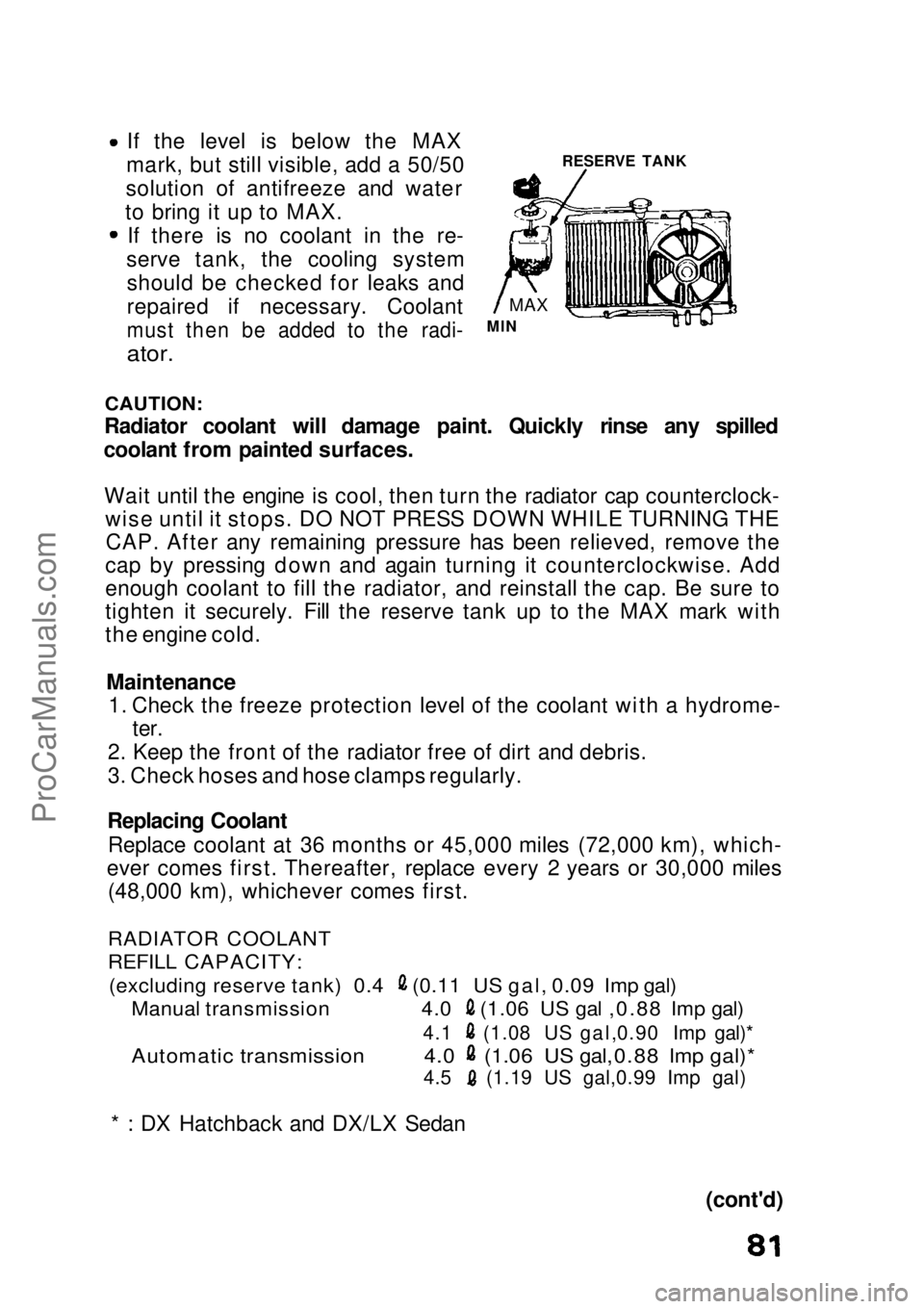
RESERVE TANKIf the level is below the MAX
mark, but still visible, add a 50/50
solution of antifreeze and water
to bring it up to MAX. If there is no coolant in the re-
serve tank, the cooling system should be checked for leaks and
repaired if necessary. Coolant
must then be added to the radi-
ator.
CAUTION:
Radiator coolant will damage paint. Quickly rinse any spilled
coolant from painted surfaces.
Wait until the engine is cool, then turn the radiator cap counterclock- wise until it stops. DO NOT PRESS DOWN WHILE TURNING THECAP. After any remaining pressure has been relieved, remove the
cap by pressing down and again turning it counterclockwise. Add
enough coolant to fill the radiator, and reinstall the cap. Be sure to
tighten it securely. Fill the reserve tank up to the MAX mark with
the engine cold.
Maintenance
1. Check the freeze protection level of the coolant with a hydrome- ter.
2. Keep the front of the radiator free of dirt and debris.
3. Check hoses and hose clamps regularly.
Replacing Coolant Replace coolant at 36 months or 45,000 miles (72,000 km), which-
ever comes first. Thereafter, replace every 2 years or 30,000 miles (48,000 km), whichever comes first.
(cont'd)
MAX
MIN
RADIATOR COOLANT
REFILL CAPACITY:
(excluding reserve tank) 0.4 (0.11 US gal, 0.09 Imp gal)
Manual transmission 4.0 (1.06 US gal ,0.88 Imp gal)
4.1 (1.08 US gal,0.90 Imp gal)*
Automatic transmission 4.0 (1.06 US gal,0.88 Imp gal)*
4.5 (1.19 US gal,0.99 Imp gal)
* : DX Hatchback and DX/LX Sedan
ProCarManuals.comMain Menu s t
Page 82 of 136
Cooling System (cont'd)
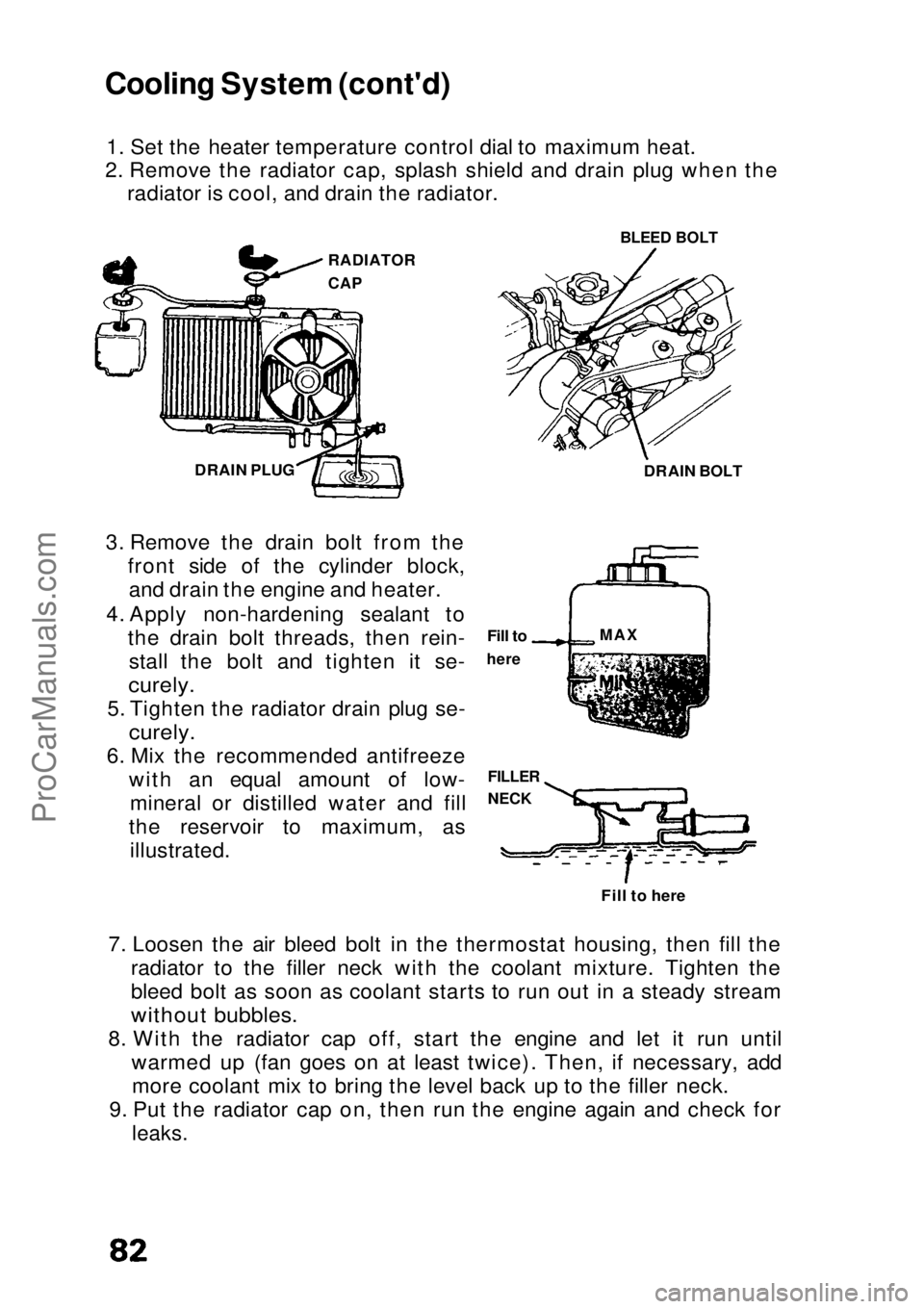
1. Set the heater temperature control dial to maximum heat.
2. Remove the radiator cap, splash shield and drain plug when the radiator is cool, and drain the radiator.
3. Remove the drain bolt from the front side of the cylinder block,and drain the engine and heater.
4. Apply non-hardening sealant to the drain bolt threads, then rein-stall the bolt and tighten it se-
curely.
5. Tighten the radiator drain plug se-
curely.
6. Mix the recommended antifreeze with an equal amount of low-mineral or distilled water and fill
the reservoir to maximum, as illustrated.
7. Loosen the air bleed bolt in the thermostat housing, then fill the radiator to the filler neck with the coolant mixture. Tighten the
bleed bolt as soon as coolant starts to run out in a steady stream
without bubbles.
8. With the radiator cap off, start the engine and let it run until warmed up (fan goes on at least twice). Then, if necessary, addmore coolant mix to bring the level back up to the filler neck.
9. Put the radiator cap on, then run the engine again and check for
leaks.
RADIATOR
CAP
BLEED BOLT
DRAIN BOLT
DRAIN PLUG
Fill to
here
FILLER
NECK
Fill to here
MAXProCarManuals.comMain Menu s t
Page 98 of 136
Air Conditioner Care
Condenser and Radiator
Check the engine radiator and the air conditioner condenser (in front
of the radiator) for accumulated dirt, insects or leaves. Carefully brush or hose them off to assure maximum cooling performance.
CAUTION:
Radiator and condenser fins are very thin and easily damaged; do
not bend them with the high water pressure or brush.
Compressor Drive Belt
Check the compressor belt tension monthly, during periods when
you use the air conditioner a lot.
If the engine has been running, some engine components may be
hot enough to burn you.
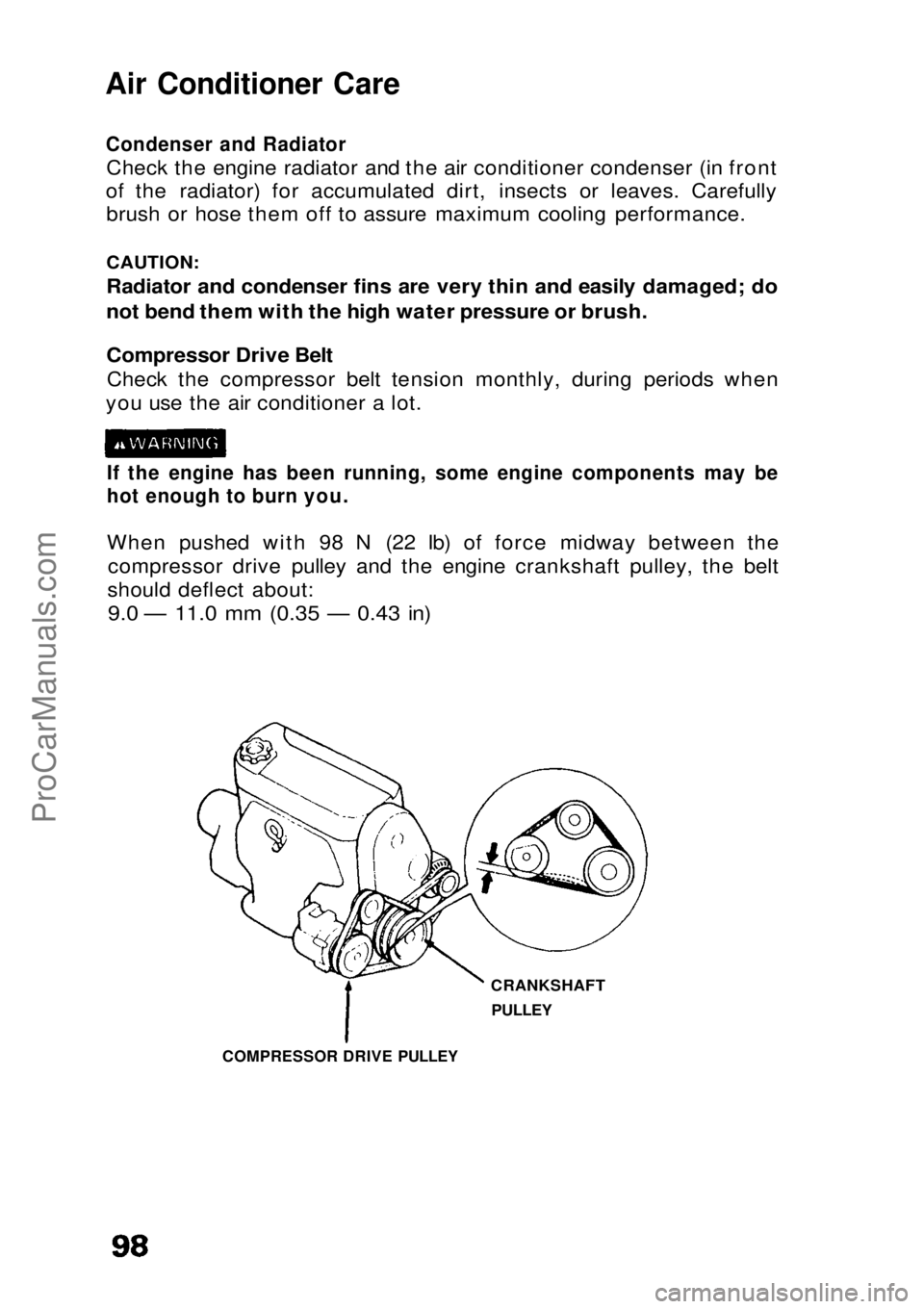
When pushed with 98 N (22 Ib) of force midway between thecompressor drive pulley and the engine crankshaft pulley, the belt
should deflect about:
9.0 — 11.0 mm (0.35 — 0.43 in)
CRANKSHAFTPULLEY
COMPRESSOR DRIVE PULLEYProCarManuals.comMain Menu s t