Fuel tank HONDA CIVIC 2002 7.G User Guide
[x] Cancel search | Manufacturer: HONDA, Model Year: 2002, Model line: CIVIC, Model: HONDA CIVIC 2002 7.GPages: 1139, PDF Size: 28.19 MB
Page 304 of 1139
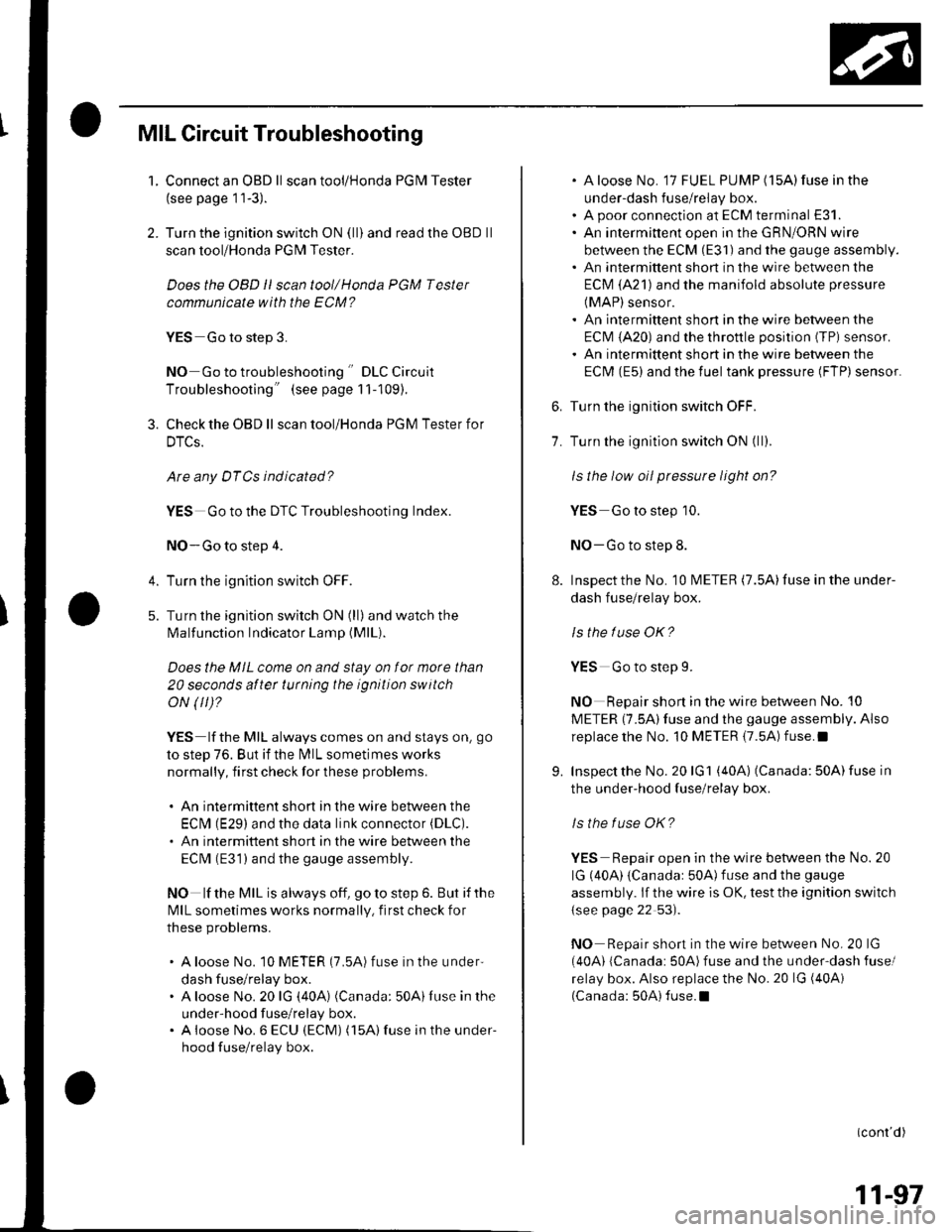
MIL Circuit Troubleshooting
1. Connect an OBD ll scan tool/Honda PGM Tester
(see page 11-3).
2. Turn the ignition switch ON (ll) and read the OBD ll
scan tool/Honda PGM Tester.
Does the OBD ll scan tool/Honda PGM Tester
communicate with the ECM?
YES Go to step 3.
NO Go to troubleshooting " DLC Circuit
Troubleshooting" (see page 11-109).
3. Check the OBD ll scan tool/Honda PGM Testerfor
DTCs.
Are any DTCs ind icated?
YES Go to the DTC Troubleshooting Index.
NO-Go to step 4.
4. Turn the ignition switch OFF.
5. Turn the ignition switch ON (ll)and watch the
lMalfunction Indicator Lamp (MlL).
Does the MIL come on and stay on for more than
20 seconds aftet turning the ignition switch
oN (tr)?
YES lf the MIL always comes on and stays on, go
to step 76. But if the lMlL sometimes works
normally, first check for these problems.
. An intermittent short in the wire between the
ECIM (E29) and the data link connector (DLC).
. An intermittent short in the wire between the
ECM (E31) and the gauge assembly.
NO lf the MIL is always off, go to step 6. But if the
lvllL sometimes works normally, first check for
these problems.
. A loose No. 10 METER (7.5A) fuse in the under
dash fuse/relay box.. A loose No. 20 lG (40A) (Canada: 50A)Iuse in the
under-hood fuse/relay box.. A ioose No. 6 ECU (ECM) (15A) fuse in the under-
hood fuse/relay box.
. A loose No. 17 FUEL PUMP (15A)fuse in the
under-dash fuse/relay box.. A poor connection at ECM terminal E31.. An intermittent open in the GRN/ORN wire
between the ECM (E31) and the gauge assembly.. An intermittent short in the wire between the
ECM (A21) and the manifold absolute pressure
(MAP) sensor.. An intermittent short in the wire between the
ECI\4 (A20) and the throttle posilion (TPi sensor.. An intermittent short in the wire between the
ECM (E5) and the fuel tank pressure (FTP) sensor.
6. Turn the ignition switch OFF.
7. Turn the ignition switch ON (ll).
ls the low oil pressure light on?
YES Go to step 10.
NO-Go to step 8.
8. Inspectthe No. 10 l\4ETER (7.5A)fuse inthe under-
dash fuse/relay box.
ls the luse OK?
YES Go to step L
NO Repair shon in the wire between No. 10
METER (7.5A)fuse and the gauge assembly. Also
replacethe No. 10 METER {7.5A) fuse.l
9. Inspect the No. 20 lG1 (40A) (Canada: 50A) fuse in
the under-hood fuse/relay box.
ls the f use OK?
YES Repair open in the wire between the No. 20
lG (40A) {Canadar 50A)fuse and the gauge
assembly. lf the wire is OK, test the ignition switch
{see page 22 53).
NO Repair short in the wire between No. 20 lG
(40A) lCanada: 50A)fuse and the under'dash fusel
relay box. Also replace the No.20 lG (40Ai
(Canada: 50A) fuse.I
(conr'd)
11-97
Page 313 of 1139
PGM-FI System
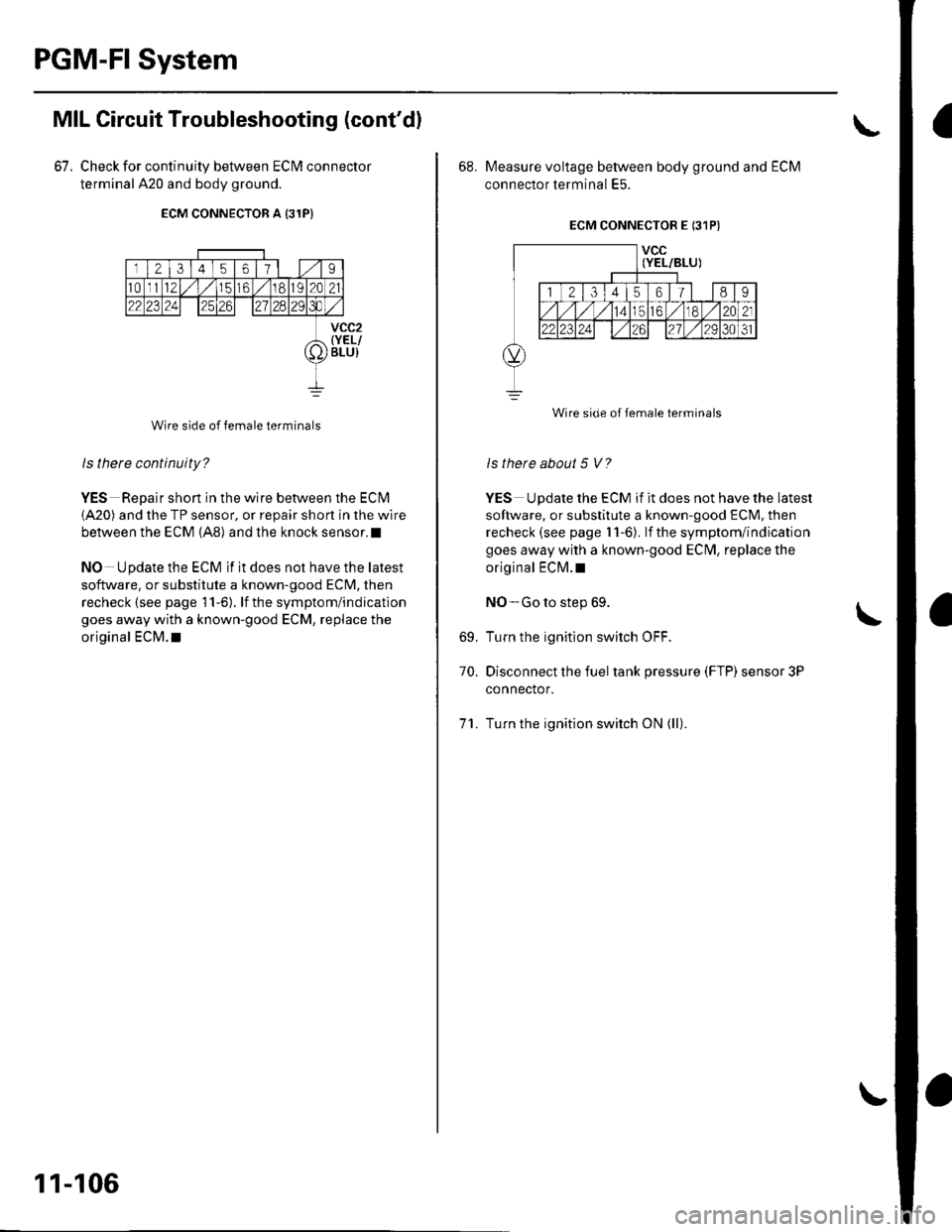
67.
MIL Circuit Troubleshooting (cont'd)
Check for continuity between ECIM connector
terminal A20 and body ground.
ECM CONNECTOR A (31P)
rl2l3145ot/9
10t1121,/ 1,/1516ta,92A21
22 '3241 12526n
o
Wire side of female terminals
ls there continuity?
YES Repair shon in the wire between the ECN4
{A20) and the TP sensor, or repair short in the wire
between the ECM (A8) and the knock sensor. t
NO Update the ECM if it does not have the latest
software. or substitute a known-good ECM, then
recheck (see page l1-6). lf the symptom/indication
goes away with a known-good ECM, replace the
original ECM.t
vcc2{YEL/BLU}
11-106
68. Measure voltage between body ground and ECM
connector terminal E5.
ECM CONNECTOR E (31PI
Is there about 5 V?
YES U pdate the ECM if it does not have the latest
software, or substitute a known-good ECM, then
recheck (see page 11-6). lf the symptom/indication
goes away with a known-good EClvl, replace the
original ECM.t
NO-Go to step 69.
Turn the ignition switch OFF.
Disconnect the fuel tank pressure (FTP) sensor 3P
connector.
Turn the ignition switch ON (ll).
69.
70.
11.
Wire side of female terminals
Page 347 of 1139
Fuel Supply System
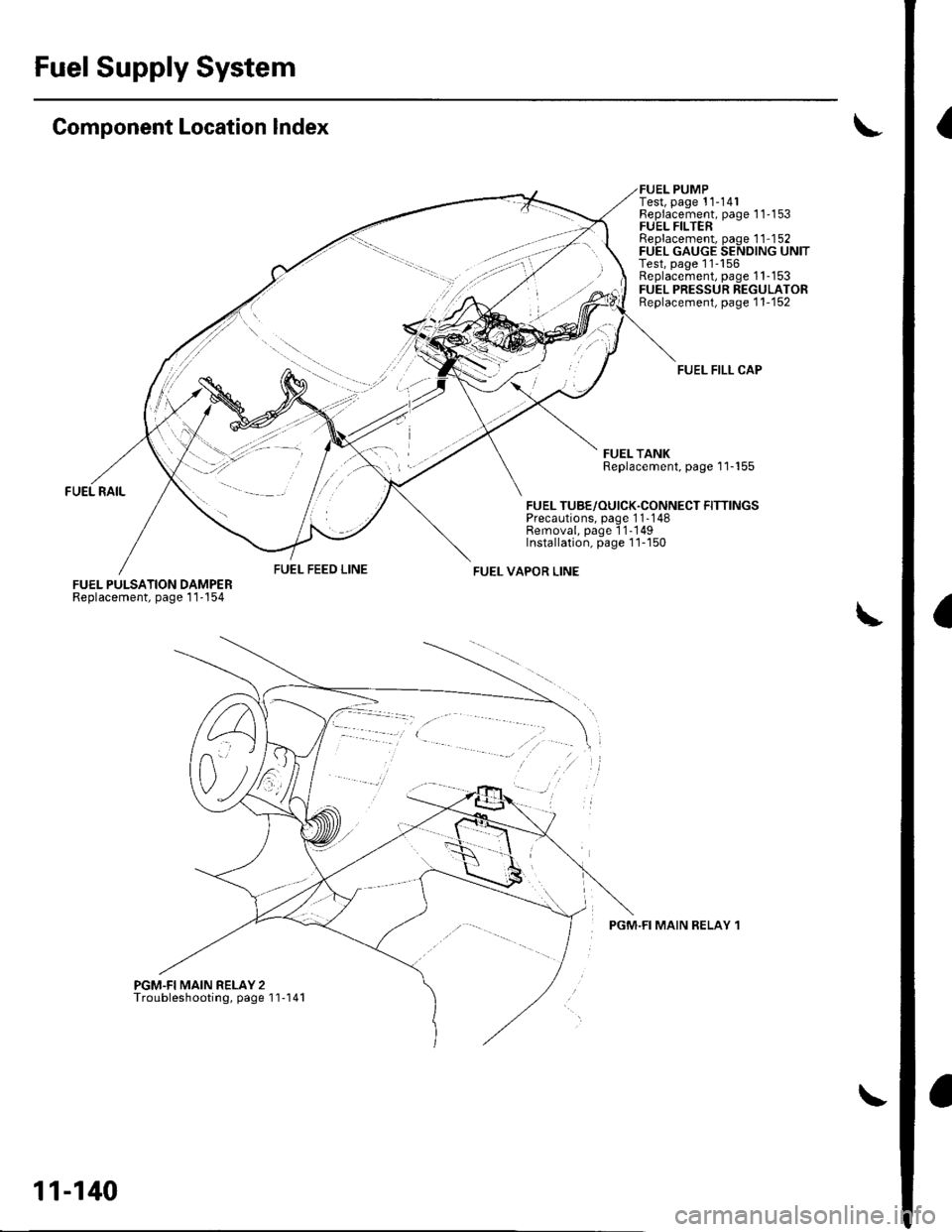
{
a
Component Location Index
FUEL FEED LINEFUEL PULSATION DAMPERReplacement, page 1 1'154
PGM.FI MAIN RELAY 2Troubleshooting, page'l'l-141
FUEL TUBE/OUICK.CONNECT FITTINGSPrecautions, page 1 1-148Removal, page 11-'149Installation, page 1 1-'l50
FUEL VAPOR LINE
i../
PUMPTest, page 11-141
FUEL FILL CAP
FUEL TANKReplacement, page'l 1-155
PGM.FI MAIN RELAY 1
Fleplacement, page 1 1'1 53FUEL FILTERReplacement, page 1 1-1 52FUEL GAUGE SENDING UNITTest, page 11-156Replacement, page 1 1-153FUEL PRESSUN REGULATORReplacement, page'1 1-'152
11-140
Page 351 of 1139
FuelSupply System
Fuel Pressure Relieving
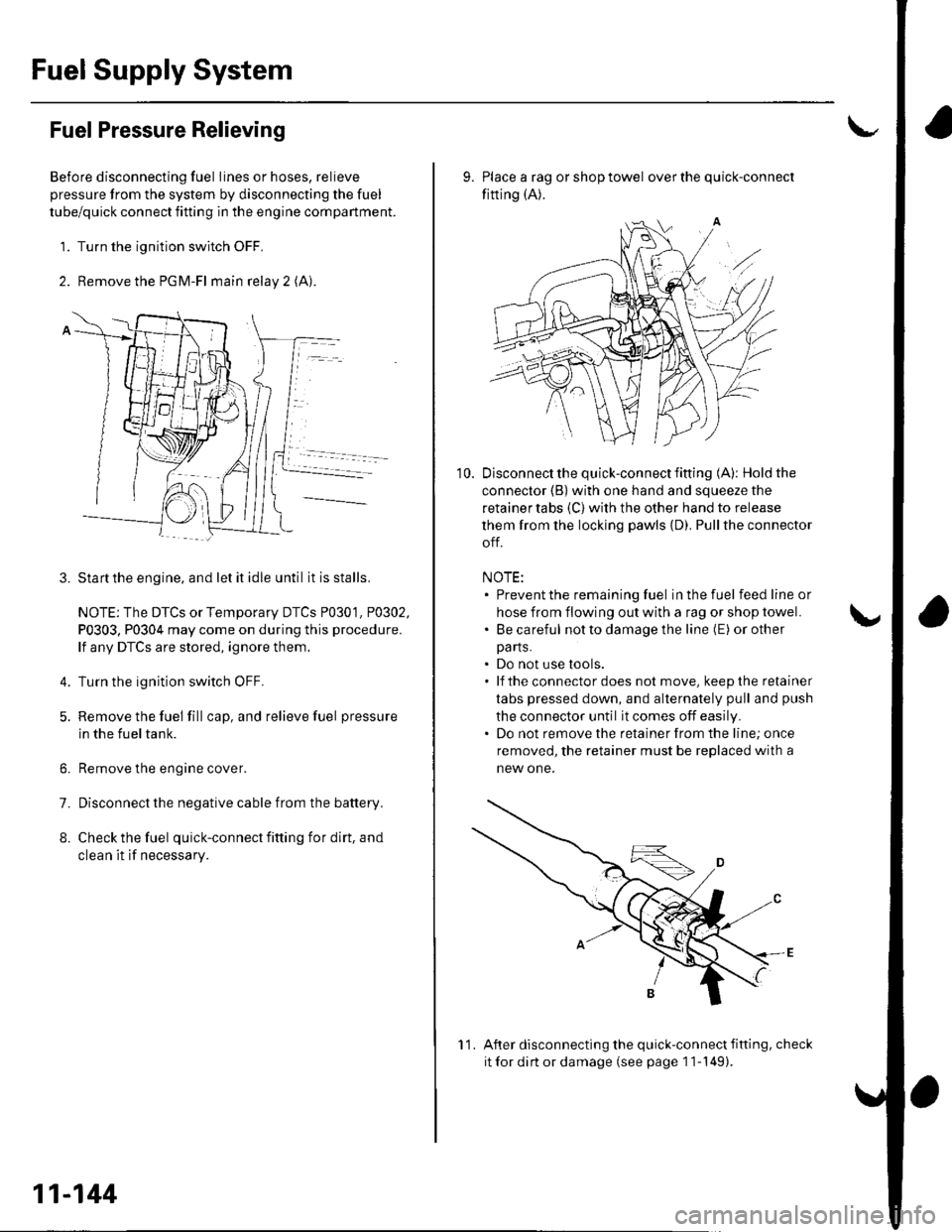
Before disconnecting fuel lines or hoses, relieve
pressure from the system by disconnecting the fuel
tube/quick connect fitting in the engine compartment.
1. Turn the ignition switch OFF,
2. Remove the PGM-Fl main relay 2 (A).
Startthe engine, and let it idle until it is stalls.
NOTE: The DTCS or Temporary DTCS P0301. P0302,
P0303, P0304 may come on during this procedure.
lf any DTCS are stored, ignore them.
Turn the ignition switch OFF.
Remove the fuel fill cap, and relieve fuel pressure
in the fueltank.
Remove the engine cover.
Disconnect the negative cable from the battery.
Check the fuel quick-connect fitting for dirt, and
clean it if necessary.
3.
4.
6.
7.
8.
11-144
11
10.
9. Place a rag or shop towel over the quick-connect
fitting (A).
Disconnect the quick-connect fifting (A): Hold the
connector (B) with one hand and squeeze the
retainer tabs (C) with the other hand to release
them from the locking pawls {D). Pullthe connector
off.
NOTE:. Prevent the remaining fuel in the fuel feedlineor
hose from flowing out with a rag or shop towel.. Be careful notto damage the line (E) or other
pa rts.. Do not use tools.. lf theconnectordoes not move, keepthe retainer
tabs pressed down, and alternately pull and push
the connector until it comes off easily.. Do not remove the retainer from the line; once
removed, the retainer must be replaced with a
new one.
After disconnecting the quick-connect fifting, check
it for dirt or damage (see page 1 1-149).
Page 355 of 1139
Fuel Supply System
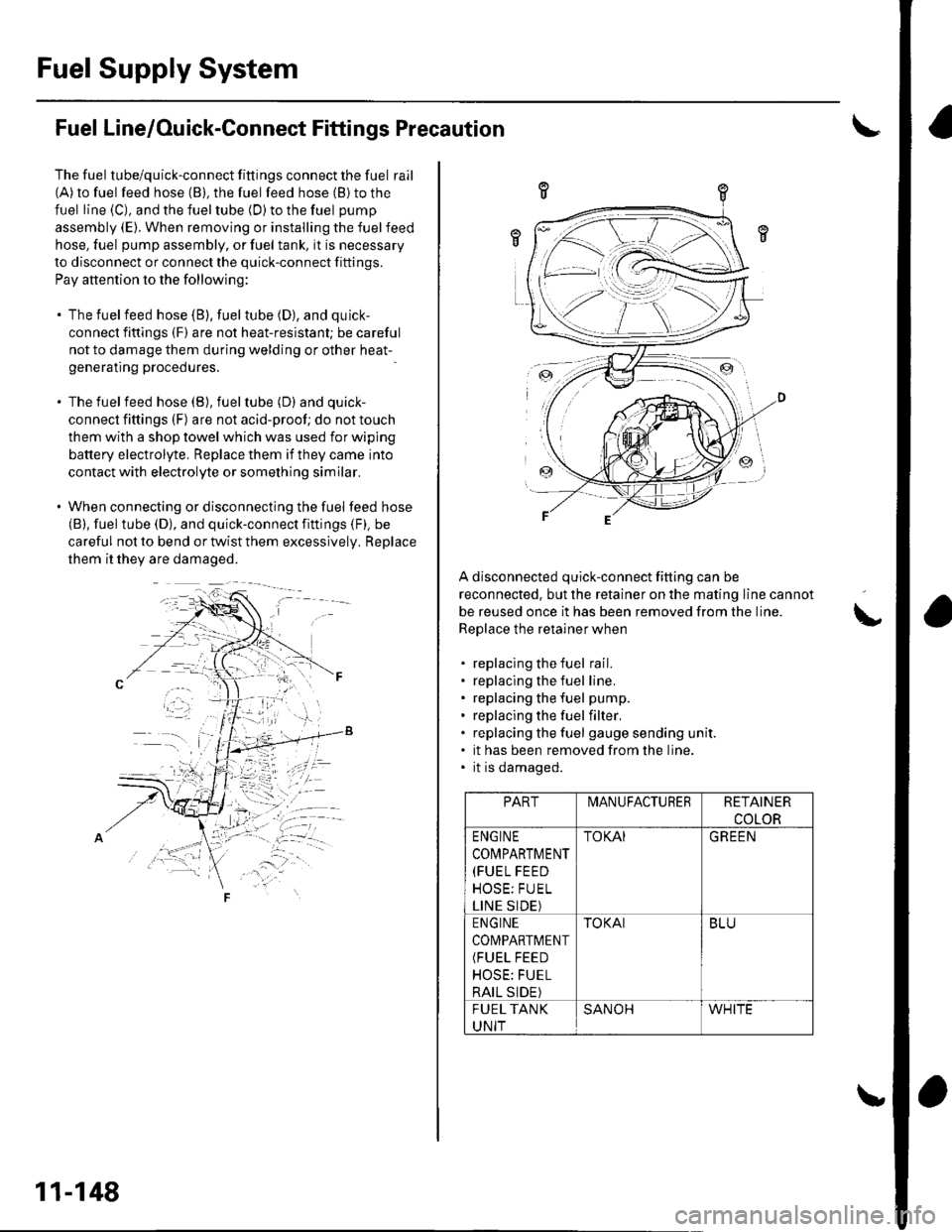
Fuel Line/Ouick-Connect Fittings Precaution
The fuel tube/quick-connect fittings connect the fuel rail(A)to fuel feed hose (B), the fuel feed hose (B) to the
fuel line (C), and the fueltube (D) to the fuel pump
assembly (E). When removing or installing the fuelfeed
hose, fuel pump assembly, or fuel tank, it is necessary
to disconnect or connect the quick-connect fittings.
Pay attention to the following:
. The fuel feed hose (B), fuel tube (D), and quick-
connect fittings (F) are not heat-resistanU be careful
not to damage them during welding or other heat-
generalrng proceoures.
. The fuelfeed hose (B), fueltube (D) andquick-
connect fittings (F) are not acid-proof; do not touch
them with a shop towel which was used for wiping
battery electrolyte. Replace them if they came into
contact with electrolyte or something similar.
. When connecting or disconnecting the fuel feed hose(B), fuel tube (D), and quick'connect fittings (F). be
careful not to bend or twist them excessivelv. ReDlace
them it they are damaged.
11-148
A disconnected quick-connect fitting can be
reconnected, but the retainer on the mating line cannot
be reused once it has been removed from the line.
Replace the retainer when
. replacing the fuel rail.. replacing the fuel line.. replacing the fuel pump.
. replacing the fuel filter,. replacing the fuel gauge sending unit.. it has been removed from the line.. it is damaged.
PARTI\4ANUFACTUREBRETAINER
COLOR
E NG INE
COI\4PARTMENT(FUEL FEED
HOSE; FU EL
LINE SIDE)
TOKAIGREEN
EN G INE
COIVIPARTMENT(FUEL FEED
HOSE: FUEL
RAIL SIDE)
TOKAIBLU
FUEL TANK
UNIT
SANOHWHITE
I
Page 360 of 1139
Fuel Pump/Fuel Gauge Sending Unit Replacement
SpecialTools Required
Fuel sender wrench 07XAA-001010A
1.Relieve the fuel pressure (see page 11-144).
Remove the fuel fill cap.
Remove the seat cushion (see page 20-80).
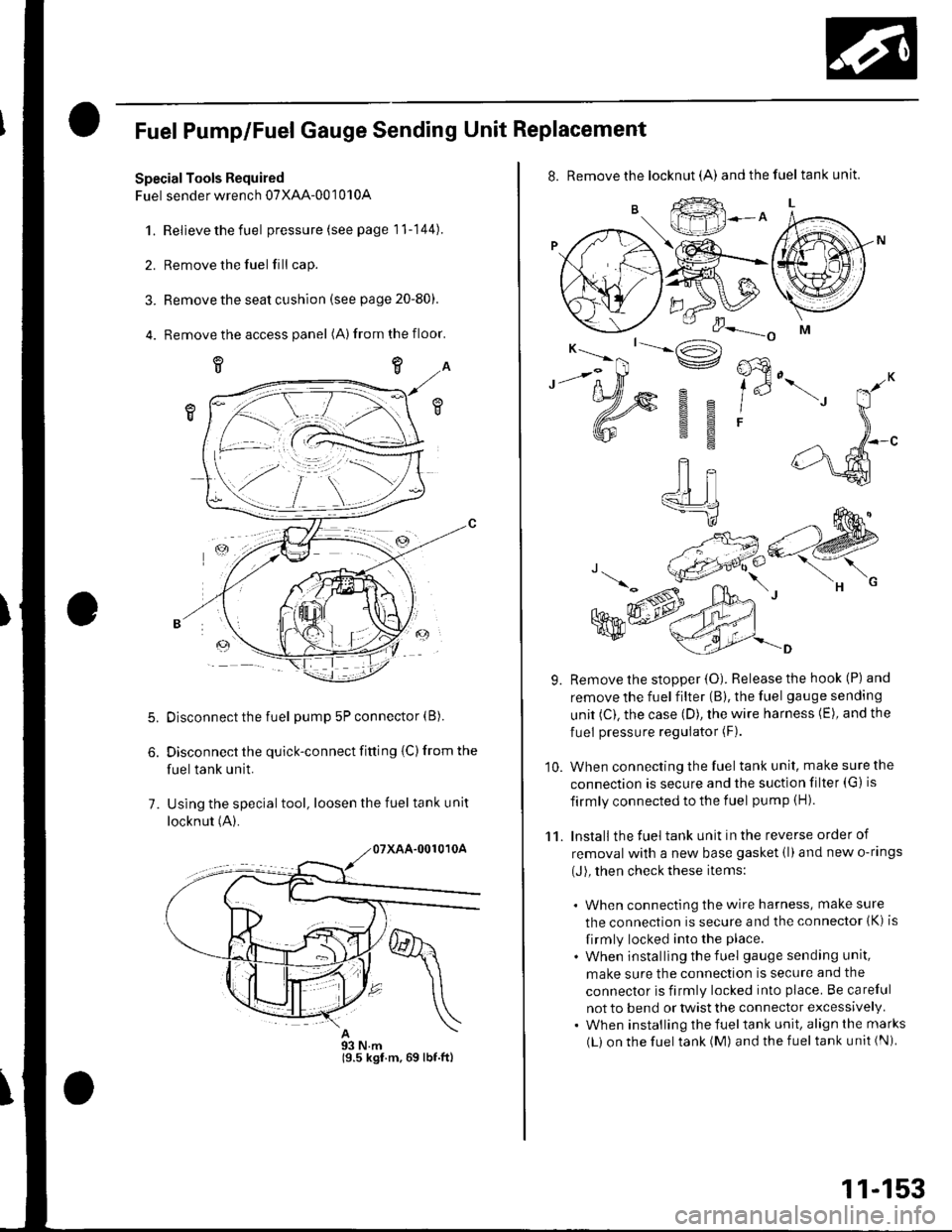
Remove the access panel (A)from the floor.
5.
7.
Disconnect the fuel pump 5P connector (B).
Disconnect the quick-connect fitting {C) from the
fuel tank unit.
Using the special tool, loosen the fuel tank unit
locknut (A).
93 N.m19.5 kgf.m,69 lbf.ftl
11-153
8. Remove the locknut (A) andthefuel tankunit.
9. Remove the stopper {O). Release the hook (P) and
remove the fuel filter (B), the fuel gauge sending
unit (C). the case (D), the wire harness (E), and the
fuel pressure regulator (F).
10. When connecting the fuel tank unit, make sure the
connection is secure and the suction filter (G) is
firmly connected to the f uel pump (H).
11. Install the fuel tank unit in the reverse order of
removal with a new base gasket (l)and new o-rings
(J), then check these items:
. When connecting the wire harness, make sure
the connection is secure and the connector (K) is
firmly locked into the place.
. When installing the f uel gauge sending unit,
make sure the connection is secure and the
connector is firmly locked into place. Be careful
not to bend or twist the connector excessively.. When installing the fueltank unit, align the marks
(L) on the fuel tank (M) and the fuel tank unit (Ni
Page 362 of 1139
Fuel Tank Replacement
Relievethefuel pressure (see page 11-144).
Drain the fuel tank: Remove the fuel pump (see page 1 1-153). Using a hand pump, hose, and container suitable for
gasoline. draw the fuel from the fuel tank.
Jack up the vehicle, and suppon it with safety stands.
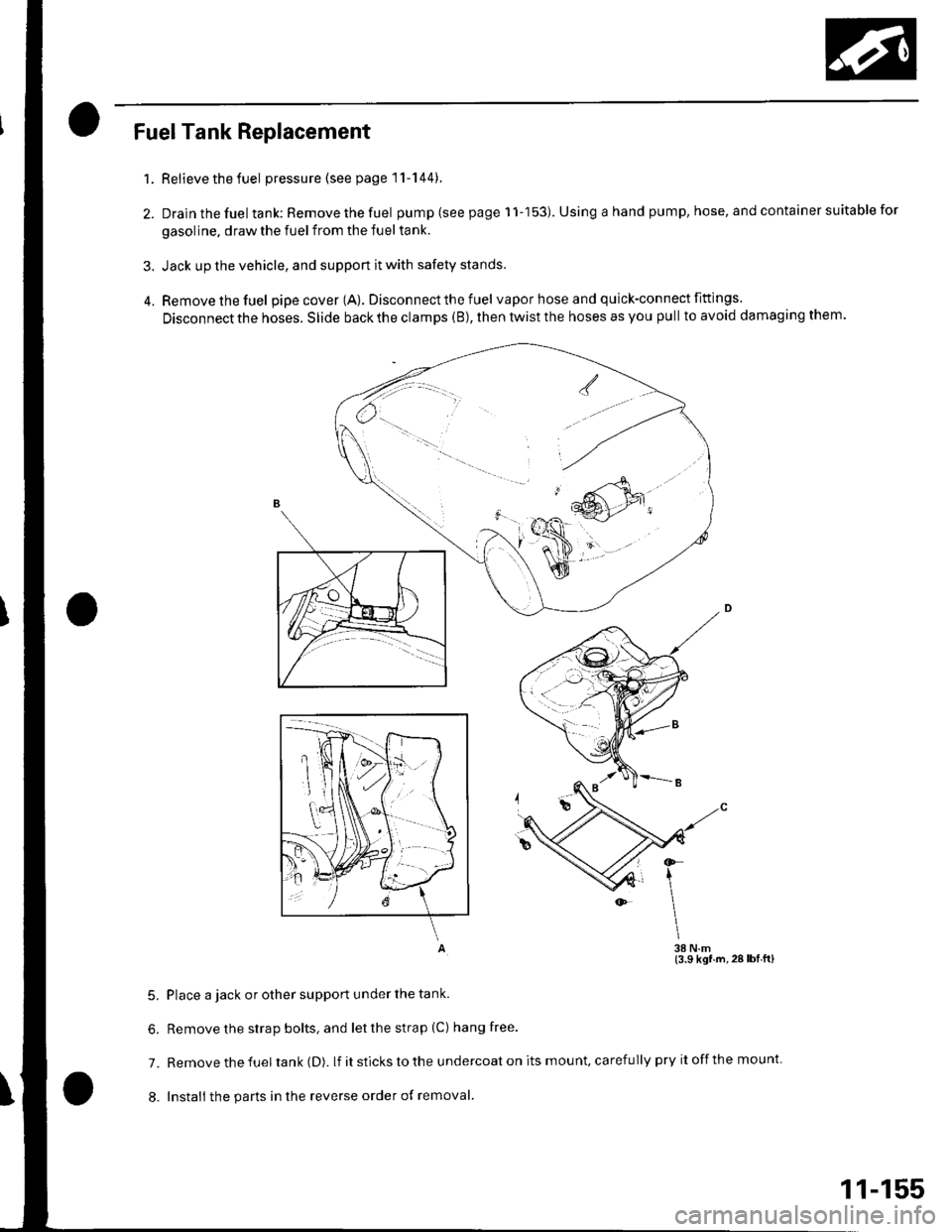
Remove the fuel pipe cover (A). Disconnect the fuel vapor hose and quick-connect fittings.
Disconnect the hoses. Slide back the clamps (B), then twist the hoses as you pull to avoid damaging them.
A 38 N.m(3.9 ksf.m,28lbfft)
5. Place a jack or other support under the tank.
6. Removethe strap bolts, and letthestrap (C) hangfree.
7. Remove the fuel tank (D). lf itstickstothe undercoaton its mount, carefully pry itoffthe mount
8. Install the parts in the reverse order of removal.
1.
2.
3.
(}
\
11-155
Page 364 of 1139
10. Checkthatthe pointerof thefuel gauge indicates"F".
. lf the pointer does not indicate "F", replace the
ga uge.. lf the pointer indicates "F", inspect the fuel
gauge sending unit.
NOTE: The pointer of the fuel gauge retu rns to the
bottom of the gauge dial when the ignition switch
is OFF, regardless of the fuel level. -
11. Relieve the fuel pressure (see page 11-144\.
12. Remove the fuelfill cap.
13. Disconnect the quick-connect fittings from the fuel
pump.
14. Using the special tool, loosen the fuel tank unit
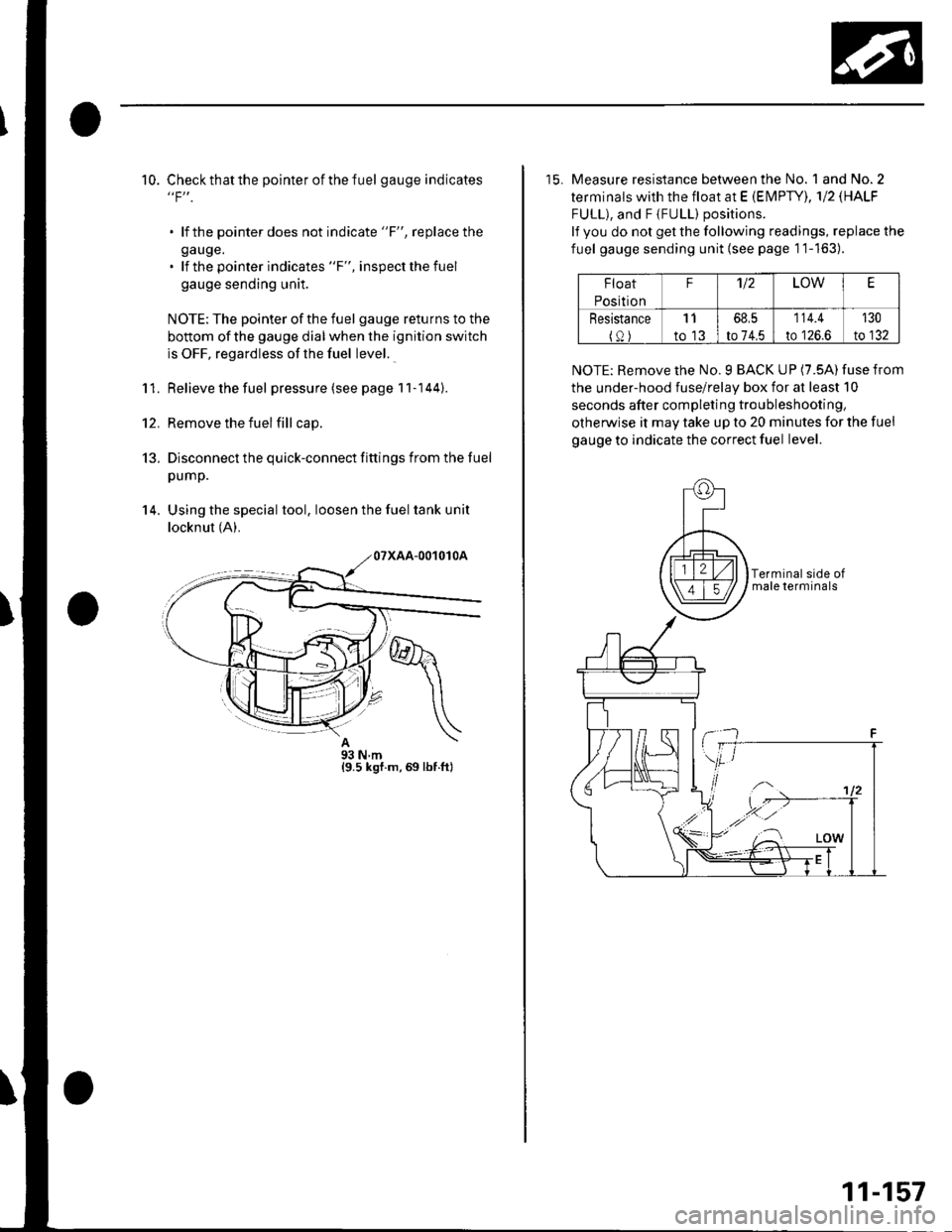
locknut (A).
A93Nm{9.5 ksf.m,69 lbf.ft}
15. Measure resistance between the No. 1 and No.2
terminals with the float at E (EN4PTY), 'l12 \HALF
FULL), and F {FULL) positions.
lf you do not get the following readings, replace the
fuel gauge sending unit {see page 1'1-163).
Float
Position
F'U2LOWE
Resistance
{0)
11
to 13
68,5
to 74.5
114.4
to 126.6
130
to 132
NOTE: Remove the No. 9 BACK UP (7.5A) fuse from
the under-hood fuse/relay box for at least 10
seconds after completing troubleshooting,
otherwise it may take up to 20 minutes for the fuel
gauge to indicate the correct fuel level.
11-157
Page 377 of 1139
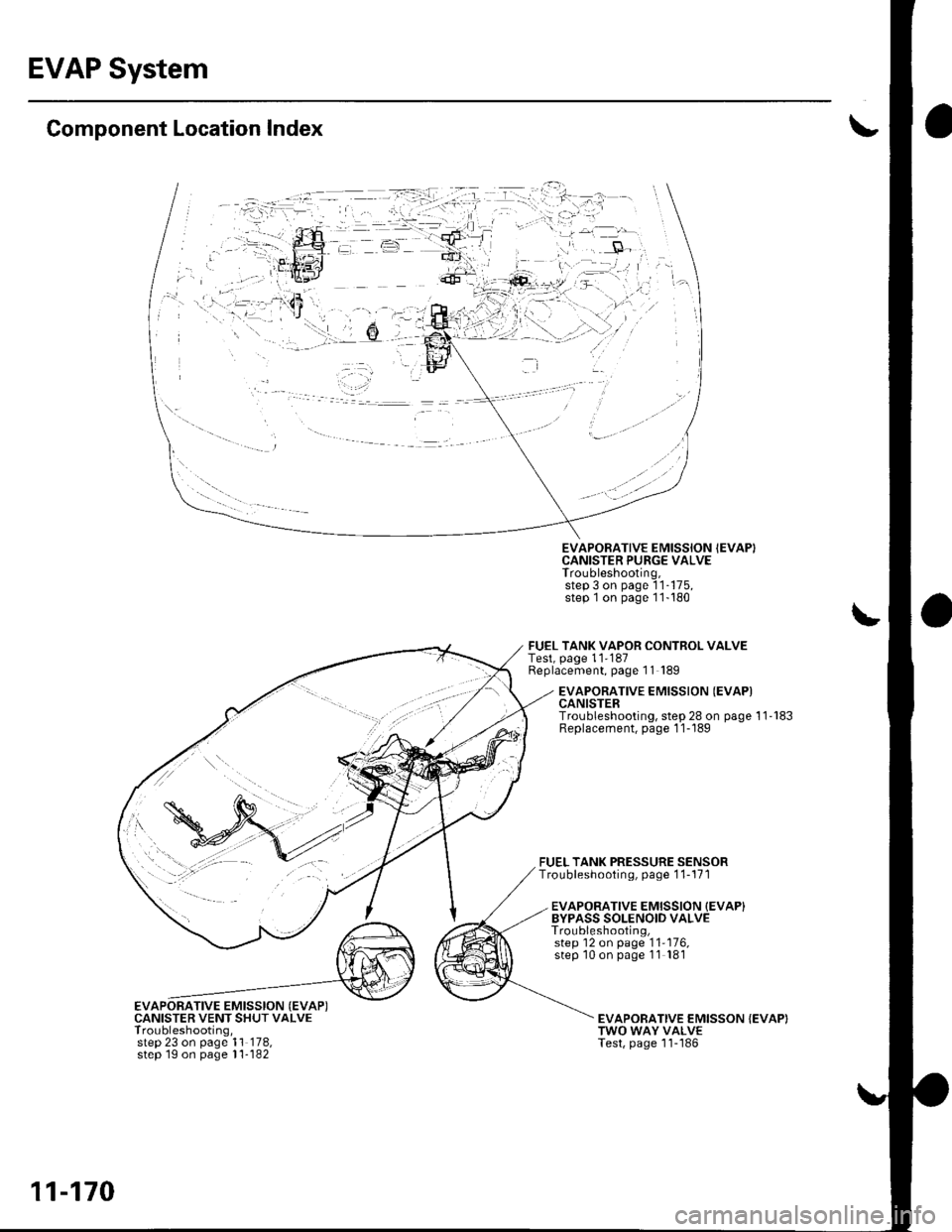
EVAP System
Component Location Index
EVAPORATIVE EMISSION {EVAP)CANISTER VENT SHUT VALVETroubleshooting,step 23 on page 1'l 178,step 1g on page l1- 182
EVAPORATIVE EMISSION IEVAPICANISTER PURGE VALVETroubleshooting,step 3 on page 'l1-175,
step 1on page 11-180
FUEL TANK VAPOR CONTROL VALVETest, page 11'187Replacement, page 11 189
FUEL TANK PRESSURE SENSORTroubleshooting, page 1 1-171
EVAPORATIVE EMISSION {EVAPICANISTERTroubleshooting, step 28 on page 11'183Replacement, page 1 1-189
EVAPORATIVE EMISSION {EVAP}BYPASS SOLENOID VALVETroubleshooting,step 12 on page '11'176,
step '10 on page 11 181
EVAPOBATIVE EMISSON {EVAP)TWO WAY VALVETest, page 'l1-'186
11-170
Page 378 of 1139
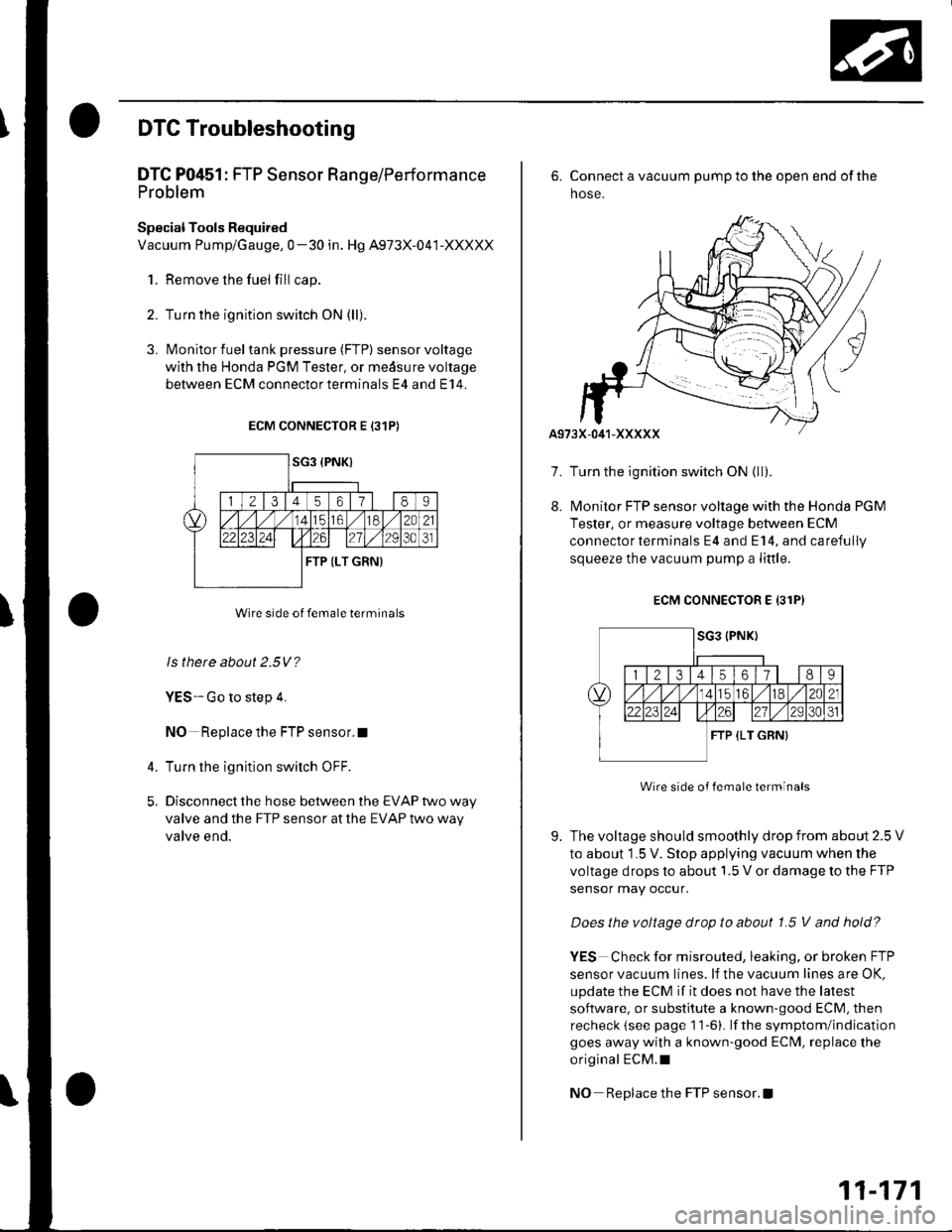
DTC Troubleshooting
DTC P0451: FTP Sensor Range/Performa nce
Problem
Special Tools Required
Vacuum Pump/Gauge, 0-30 in. Hg A973X-041-XXXXX
1. Remove the fuel fill cap.
2. Turn the ignition switch ON (ll)
3. l\4onitor fuel tank pressure (FTP) sensorvoltage
with the Honda PGM Tester, or medsure voltage
between ECM connectorterminals E4 and E14.
ECM CONNECTOR E 131P)
Wire side of female terminals
ls there about 2.5V?
YES-Go to step 4.
NO Replace the FTP sensor.I
Turn the ignition switch OFF.
Disconnect the hose between the EVAP two way
valve and the FTP sensor at the EVAP two way
valve end.
4.
5.
7.
8.
6. Connect a vacuum pump to the open end of the
hose.
Turn the ignition switch ON {ll).
l\4onitor FTP sensor voltage with the Honds PGM
Tester, or measure voltage between ECM
connector terminals E4 and E14, and carefully
squeeze the vacuum pump a little.
ECM CONNECTOR E 13lPI
Wire side of lemale terminals
The voltage should smoothly drop from about 2.5 V
to about 1.5 V. Stop applying vacuum when the
voltage drops to about 1.5 V or damage to the FTP
sensor may occur.
Does the voltage drop to about 1.5 V and hold?
YES Check for misrouted, leaking, or broken FTP
sensor vacuum lines. lf the vacuum lines are OK,
update the ECM if it does not have the latest
software. or substitute a known-good ECM, then
recheck (see page 1 1-6). lf the symptom/indication
goes away with a known-good ECM, replace the
original ECM.I
NO Replace the FTP sensor. !
9.
11-171