Fuel tank HONDA CIVIC 2002 7.G Owner's Manual
[x] Cancel search | Manufacturer: HONDA, Model Year: 2002, Model line: CIVIC, Model: HONDA CIVIC 2002 7.GPages: 1139, PDF Size: 28.19 MB
Page 379 of 1139
EVAP System
DTC Troubleshooting (cont'd)
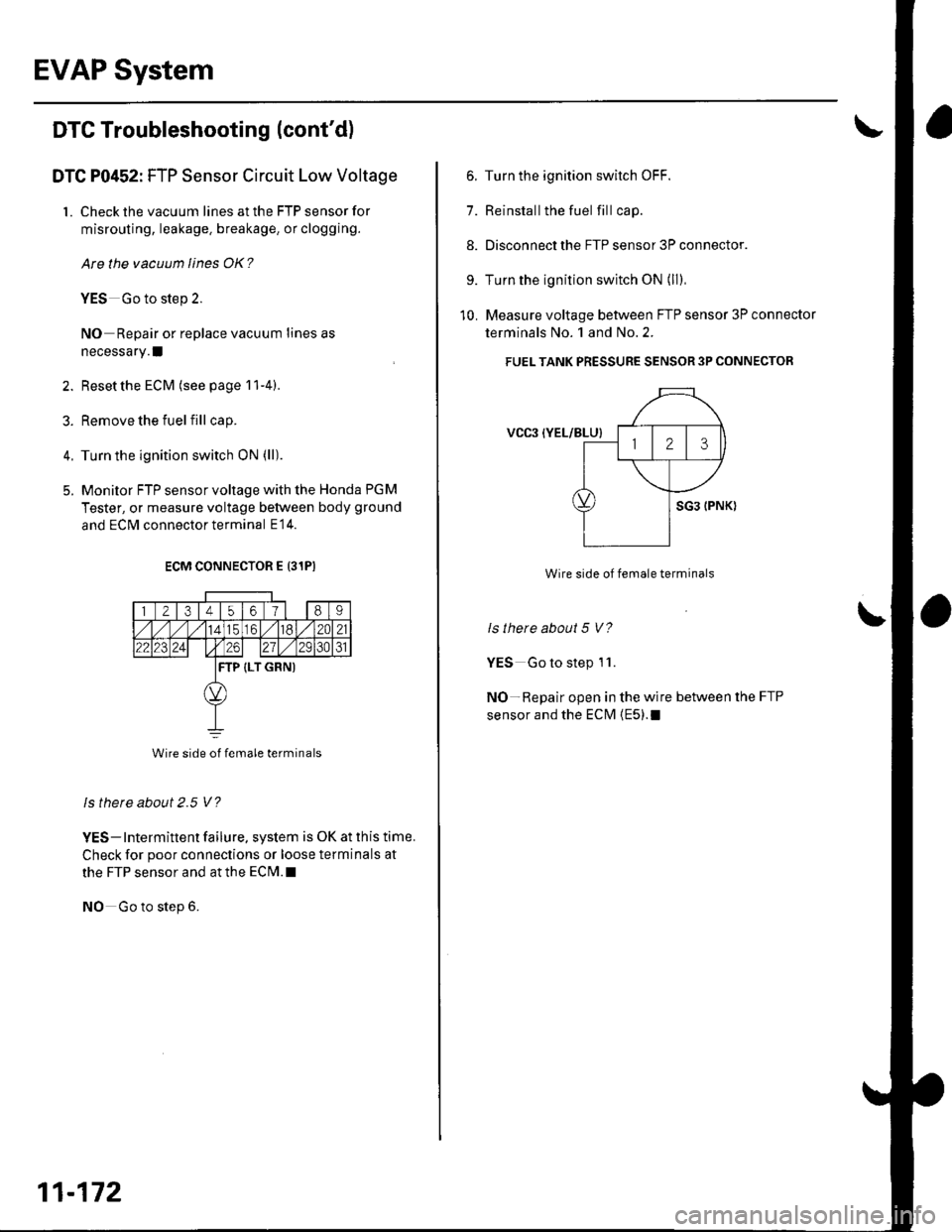
DTC P0452: FTP Sensor Circuit Low Voltage
1. Check the vacuum lines at the FTP sensor for
misrouting, leakage. breakage, or clogging.
Are the vacuum lines OK?
YES Go to step 2.
NO Repair or replace vacuum lines as
necessary. I
2. Reset the ECM (see page 11-4).
3. Remove the fuelfill cap.
4. Turn the ignition switch ON (ll)
5. Monitor FTP sensor voltage with the Honda PGM
Tester, or measure voltage between body ground
and ECM connector terminal E14.
ECM CONNECTOR E 131PI
1 2t3t45o/89
././114tc61./182C21
22123241 t26271/ 2931
TP (LT GRN)
Wire side of female terminals
ls thete about 2.5 V?
YES- Intermittent failure, system is OK at this time.
Check for poor connections or loose terminals at
the FTP sensor and at the ECrM.l
NO Go to step 6.
11-172
6. Turn the ignition switch OFF.
7. Reinstallthe fuel fill cap.
8. Disconnect the FTP sensor 3P connector.
9. Turn the ignition switch ON (ll)
10. Measure voltage between FTP sensor 3P connector
terminals No. 1 and No.2.
FUEL TANK PRESSURE SENSOR 3P CONNECTOR
VCgl {YEL/BLU}
Wire side of female terminals
ls there about 5 V?
YES Go to step 1 '1.
NO-Repair open in the wire between the FTP
sensor and the ECM {E5).1
Page 380 of 1139
't2.
13.
14.
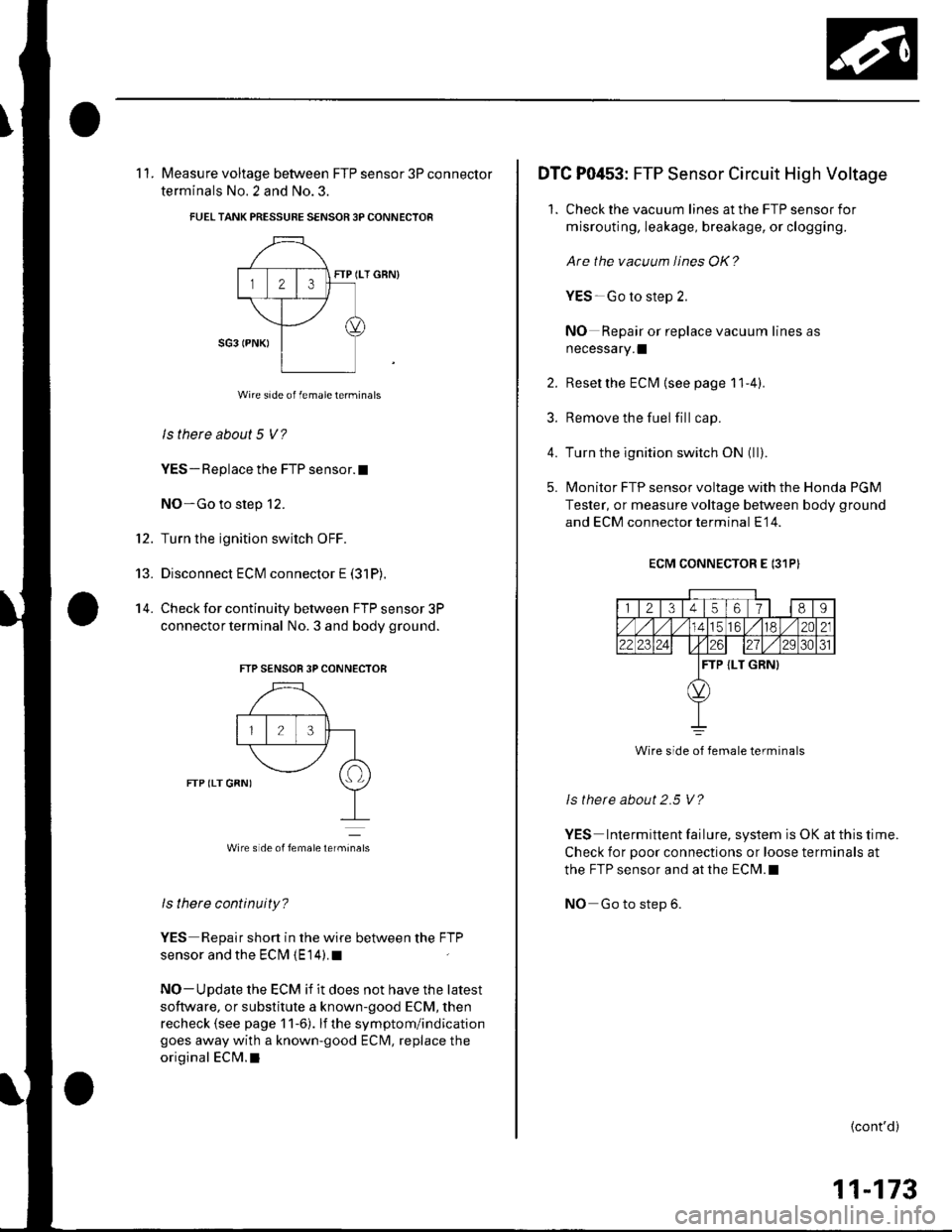
11. Measure voltage between FTP sensor 3P connector
terminals No. 2 and No.3.
FUELTANK PRESSUBE SENSOR 3P CONNECTOR
FTP (LT GBN)
Wire side of femaleterminals
ls there about 5 V?
YES - Replace the FTP sensor. t
NO-Go to step 12.
Turn the ignition switch OFF.
Disconnect ECM connector E (31P),
Check for continuity between FTP sensor 3P
connector terminal No. 3 and body ground.
FTP SENSOR 3P CONNECTOB
FTP (LT GRNI
Wire side of femalelerminats
ls there continuity?
YES Repair short in the wire between the FTP
sensor and the ECI\4 {E14).I
NO-Update the ECM if it does not have the latest
software, or substitute a known-good ECM, then
recheck (see page 1 1-6). lf the symptom/indicationgoes away with a known-good EClvl, replace the
original ECM.I
DTC P0453: FTP Sensor Circuit High Voltage
1. Check the vacuum lines at the FTP sensor for
misrouting, leakage, breakage, or clogging.
Are the vacuum lines OK?
YES-Go to step 2.
NO Repair or replace vacuum lines as
necessary.I
2. Reset the ECM {see page 11'4).
3. Remove the fuel fill cap.
4. Turn the ignition switch ON (ll).
5. lvlonitor FTP sensor voltage with the Honda PGM
Tester, or measure voltage between body ground
and ECM connector terminal E'14.
ECM CONNECTOR E 131PI
112134567I9
56/ t182C21
242il./29 3031
TP {LT GRN}
Wire side of female terminals
Is there about 2.5 V?
YES Intermittent failure, system is OK at this time.
Check for poor connections or loose terminals at
the FTP sensor and at the ECM.I
NO Go to step 6.
{cont'd)
11-173
Page 382 of 1139
DTC Pl456: EVAP Control(Fuel Tank Svstem)
System Leakage
The fuel system is designed to allow specified
maximum vacuum and pressure conditions. Do not
deviate from the vacuum and pressure tests as
indicated in these procedures. Excessive pressure/
vacuum would damage the EVAP components or cause
eventual fuel tank failure.
Special Tools Required
Vacuum Pump/Gauge, 0-30 in. Hg A973X-041-XXXXX
This is a two-trip code. Once cleared, it cannot be
reproduced in one trip. Also, cenain specific driving
and ambient conditions must occur before the ECM will
complete the system checks. Additional test drives may
still not meet the specific conditions needed to
reproduce the code.
Follow these troubleshooting procedures carefully to
ensure the integrity of the system and to confirm the
cause of the problem or code.
NOTE: Fresh fuel has a higher volatility that createsgreater pressure/vacuum. The optimum condltlon for
testing is fresh fuel, and must be less than a full tank. lf
possible, to assist in leak detection, add 1 gallon of
fresh fuel to the tank (as long as it will not fill the tank).just before starting these procedures.
Fuel Fill Cap Check
1. Check the fuel fill cap (the cap must say "lf not
tightened 3 clicks check engine light may come
on" ).
ls the proper luel till cap installed and properly
tightened?
YES Go to step 2.
NO- Replace or tighten the cap.I
2. Check the fuel fill cap seal.
ls the tuel fill cap seal missing or damaged?
YES- Replace the fuel fill cap.I
NO The fuelfill cap is OK. Go to step 3.
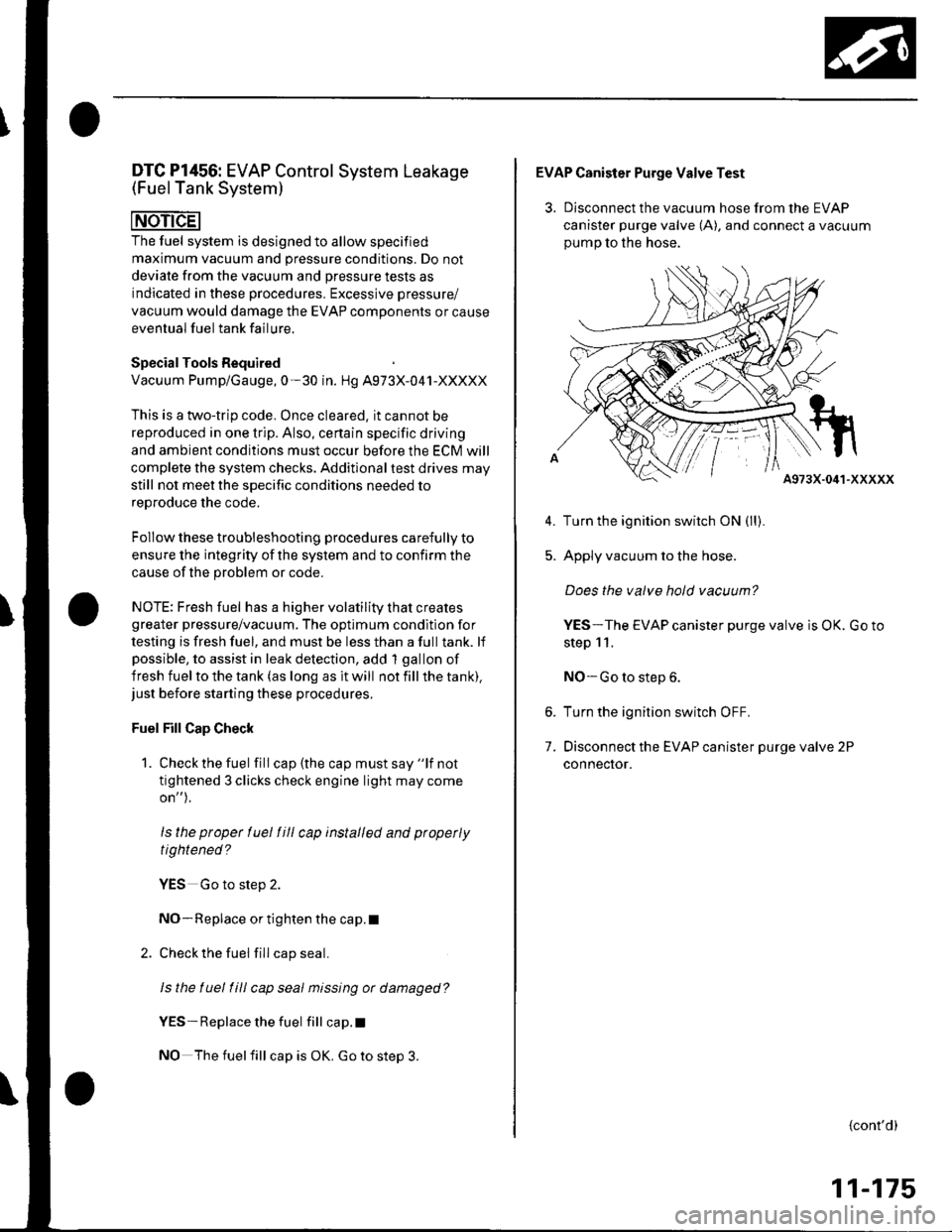
EVAP Canister Purge Valve Test
3. Disconnect the vacuum hose from the EVAP
canister purge valve (A), and connect a vacuum
oumo to the hose.
A973X-041-XXXXX
Turn the ignition switch ON (ll).
Apply vacuum to the hose.
Does the valve hold vacuum?
YES-The EVAP canister purge valve is OK. Go to
step 11.
NO-Go to step 6.
Turn the ignition switch OFF.
Disconnect the EVAP canister purge valve 2P
connecror.
5.
7.
{cont'd)
11-175
Page 385 of 1139
EVAP System
DTC Troubleshooting (cont'dl
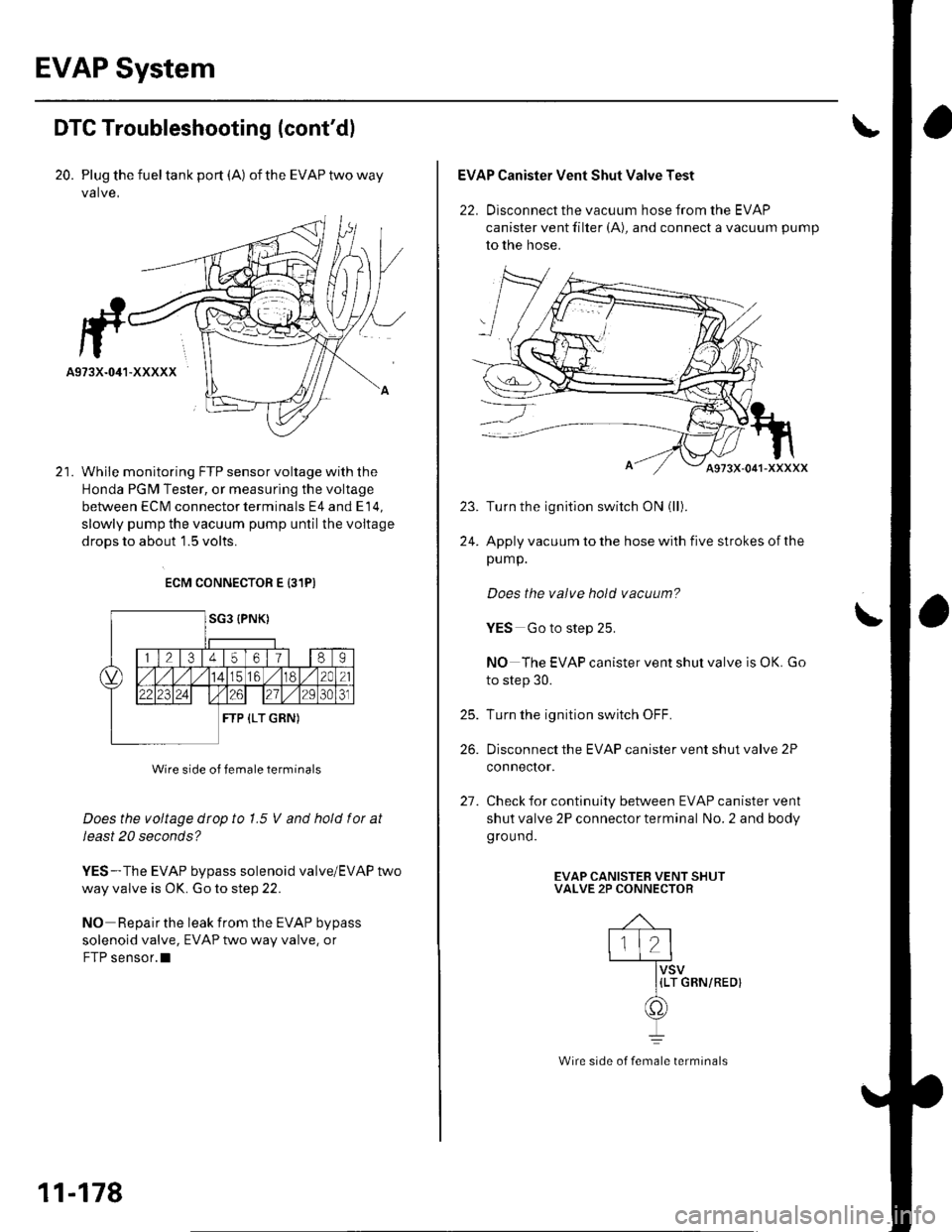
20. Plug the fueltank port (A) oftheEVAPtwoway
valve,
While monitoring FTP sensor voltage with the
Honda PGM Tester, or measuring the voltage
between ECM connector terminals E4 and E 14,
slowly pump the vacuum pump until the voitage
droDS to about 1.5 volts.
ECM CONNECTOR E {31PI
Wire side of female terminals
Does the voltage dtop to 1.5 V and hold fot at
Ieast 20 seconds?
YES-The EVAP bypass solenoid valve/EVAP two
way valve is OK. Go to step 22.
NO Repair the leak from the EVAP bypass
solenoid valve, EVAP two way valve. or
FTP sensor.l
11-178
Wire side of female terminals
EVAP Canister Vent Shut Valve Test
22. Disconnect the vacuum hose from the EVAP
canister vent filter (A), and connect a vacuum pump
to the hose.
Turn the ignitlon switch ON (ll).
Apply vacuum to the hose with five strokes of the
pump.
Does the valve hold vacuum?
YES Go to step 25.
NO The EVAP canister vent shut valve is OK. Go
to step 30.
Turn the ignition switch OFF.
Disconnect the EVAP canister vent shut valve 2P
conneclor.
Check for continuity between EVAP canister vent
shut valve 2P connector terminal No. 2 and body
ground.
EVAP CANISTEB VENT SHUTVALVE 2P CONNECTOR
{LT GRN/REOI
\
25.
26.
21.
Page 386 of 1139
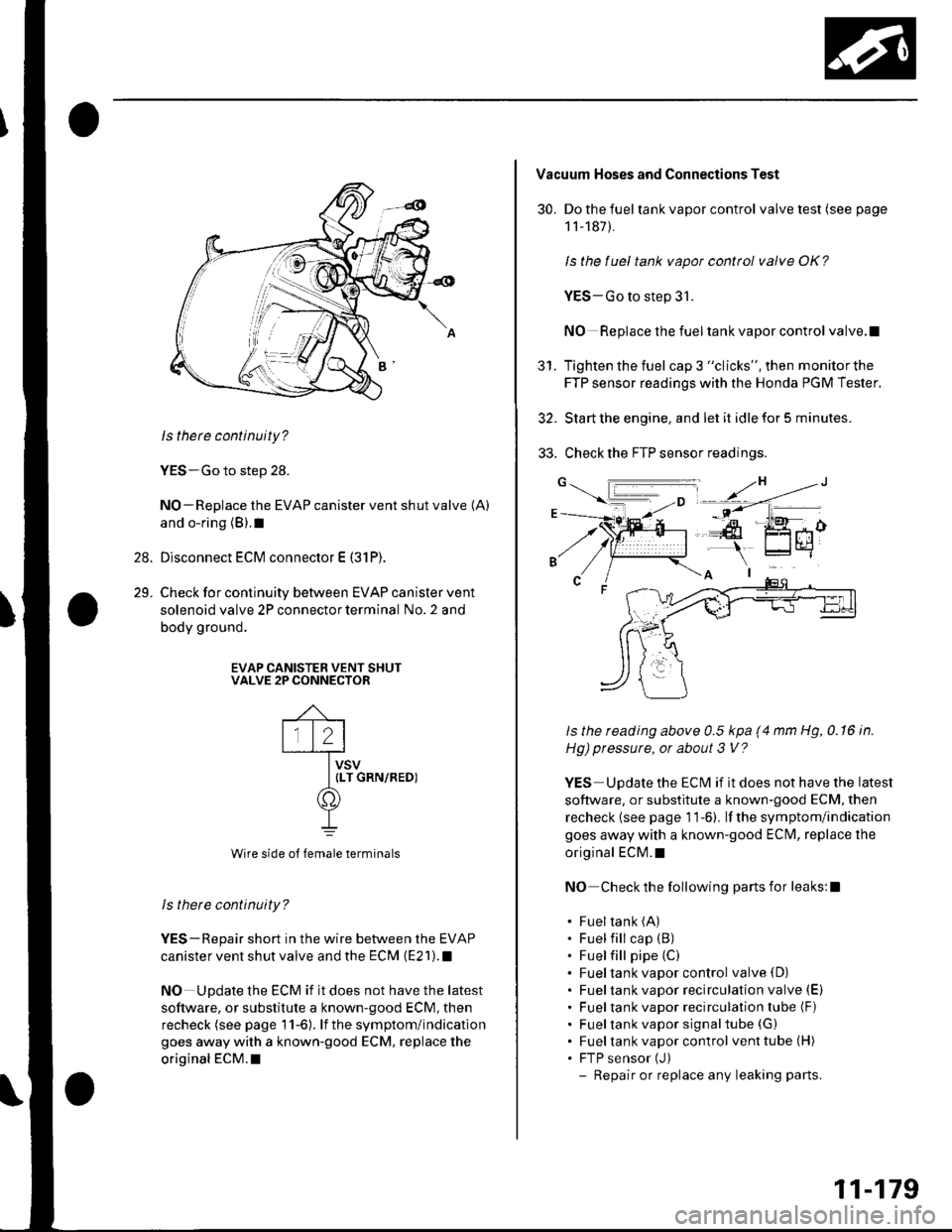
28.
29.
ls thete continuity?
YES-Go to step 28.
NO-Replace the EVAP canister vent shut valve (A)
and o-ring (B).1
Disconnect ECM connector E (31P).
Check for continuity between EVAP canister vent
solenoid valve 2P connector terminal No. 2 and
body ground.
EVAP CANISTER VENT SHUTVALVE 2P CONNECTOR
Wire side o{ female terminals
ls there continuity?
YES-Repair short in the wire between the EVAP
canister vent shut valve and the ECM (E21).1
NO Update the ECM if it does not have the latest
soflware, or substitute a known-good ECM, then
recheck (see page 11-6). lf the symptom/indication
goes away with a known-good ECM, replace the
original ECM.I
30.
Vacuum Hoses and Connections Test
Do the fuel tank vapor control valve test (see page
1 1-187).
ls the fuel tank vapot control valve OK?
YES-Go to step 31.
NO Replace the fueltank vapor control valve.l
Tighten the fuel cap 3 "clicks", then monitorthe
FTP sensor readings with the Honda PGM Tester.
Start the engine. and let it idle for 5 minutes.
Check the FTP sensor readings.
ls the reading above 0.5 kpa (4 mm Hg, 0.16 in.
Hg) pressure, or about 3 V?
YES Update the ECM if it does not have the latest
software, or substitute a known-good ECM, then
recheck {see page 1 1-6). lf the symptom/indication
goes away with a known-good ECfvl, replace the
original ECM.t
NO Check the following parts for leaks:l
. Fueltank (A)
. Fuel fill cap (B)
. Fuel fill pipe (C)
. Fueltank vapor control valve(D). Fueltank vapor recirculation valve (E)
. Fueltank vapor recirculation tube (F)
. Fueltank vapor signaltube (G)
. Fueltank vapor control venttube(H). FTP sensor (J)
- Repair or replace any leaking parts.
5t.
11-179
Page 387 of 1139
EVAP System
DTC Troubleshooting (cont'd)
DTC Pl457: EVAP Control System(EVAP Canister System)
Leakage
The fuel system is designed to allow specified
maximum vacuum and pressure conditions. Do not
deviate from the vacuum and pressure tests as
indicated in these procedures. Excessive pressure/
vacuum would damage the EVAP components or
cause eventual fuel tank system failure.
SpecialTools Required
Vacuum pump/gauge, 0-30 in.Hg A973X-041-XXXXX
This is a two-trip code. Once cleared, it cannot be
reproduced in one trip. Also, certain specific driving
and ambient conditions must occur before the ECfM will
complete the system checks, Additional test drives may
still not meet the specific conditions needed to16^r^.1' '^6 rh6 ^^.16
Follow these troubleshooting procedures carefully to
ensure the integrity of the system and to confirm the
cause of the problem or code.
NOTE: Fresh fuel has a higher volatility lhat creates
greater pressure/vacuum. The optimum condition for
testing is fresh fuel, and there must be less than a full
tank. lf possible, to assist in leak detection, add I gallon
of fresh fuel to the tank (as long as it will not fill the
tank), just before starting these procedures.
EVAP Canister Purge Valve Test
1. Disconnect the vacuum hose from the EVAP
canister purge valve (A), and connect a vacuumpump to the hose.
11-180
4973X-041-XXXXX
ECM CONNECTOR A I24P'
Wire side of lemale terminals
4.
7.
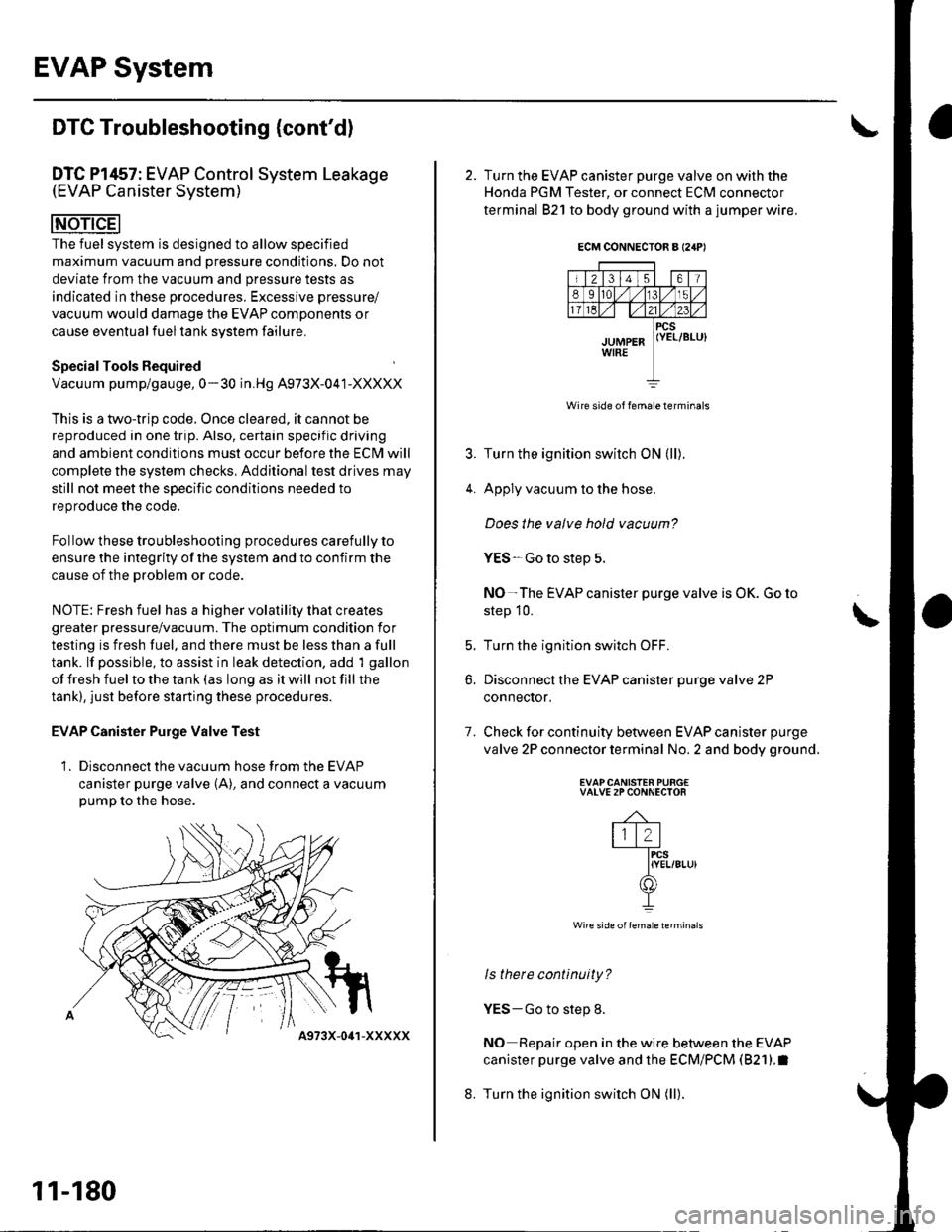
2. Turn the EVAP canister purge valve on with the
Honda PGM Tester, or connect ECM connector
terminal 821 to body ground with a jumper wire.
Turn the ignition switch ON (ll).
Apply vacuum to the hose.
Does the valve hold vacuum?
YES-Go to step 5.
NO-The EVAP canister purge valve is OK. Go to
step 10.
Turn the ignition switch OFF.
Disconnect the EVAP canister purge valve 2P
conneclor,
Check for continuity between EVAP canister purge
valve 2P connector terminal No. 2 and body ground.
EVAPCANISTEN PURG€VALVE 2P CONNECTOR
-4-
lll2l-fircs
IYEL/8Lu)(f])
I
Wire side offemale lerminals
ls there continuity?
YES-Go to step 8.
NO Repair open in the wire between the EVAP
canister purge valve and the ECM/PCM (821).I
Turn the ignition switch ON (ll).
t
b.
8.
Page 391 of 1139
EVAP System
DTC Troubleshooting (cont'dl
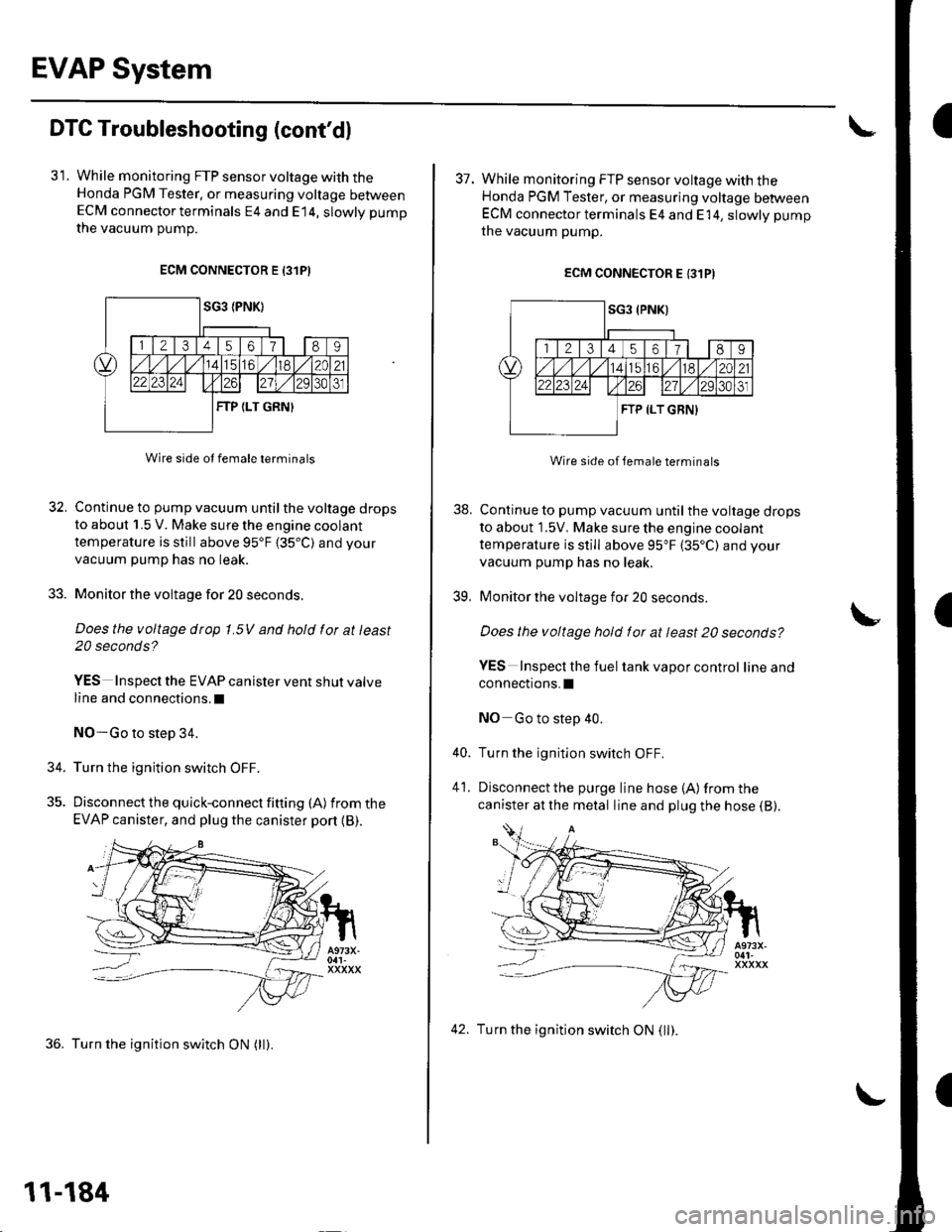
31. While monitoring FTP sensor voltage with theHonda PGM Tester, or measuring voltage betweenECM connector terminals E4 and E14, slowly pump
the vacuum oumD.
ECM CONNECTOR E 13lPI
Wire side ot female terminals
32. Continue to pump vacuum until the voltage drops
to about 1.5 V. Make sure the engine coolant
temperature is still above 95'F 135.C) and your
vacuum pump has no leak.
33. Monitor the voltage for 20 seconds.
Does the voltage drop 1.5V and hold for at least
20 seconds?
YES Inspect the EVAP canister vent shut valve
line and connections.l
NO-Go to step 34.
34. Turn the ignition switch OFF.
35. Discon nect the quick-con nect fitting (A) fromthe
EVAP canister, and plug the canister port {B).
36. Turn the ignition switch ON (ll).
11-184
42. Turn the ignition switch ON (ll).
I
38.
39.
37. While monitoring FTP sensor voltage with theHonda PGM Tester, or measuring voltage betweenECM connector terminals E4 and E 14, slowly pump
the vacuum pump.
ECM CONNECTOR E {31PI
Wire side of lemale terminals
Continue to pump vacuum until the voltage drops
to about 1.5V. Make sure the engine coolant
temperature is still above 95"F (35"C) and your
vacuum pump has no leak.
Monitor the voltage for 20 seconds
Does the voltage hold for at least 20 seconds?
YES Inspecl the fuel tank vapor control lineand
connections.I
NO Go to step 40.
Turn the ignition switch OFF.
Disconnect the purge line hose {A) from the
canister at the metal line and plug the hose (B).
40.
41.
Page 392 of 1139
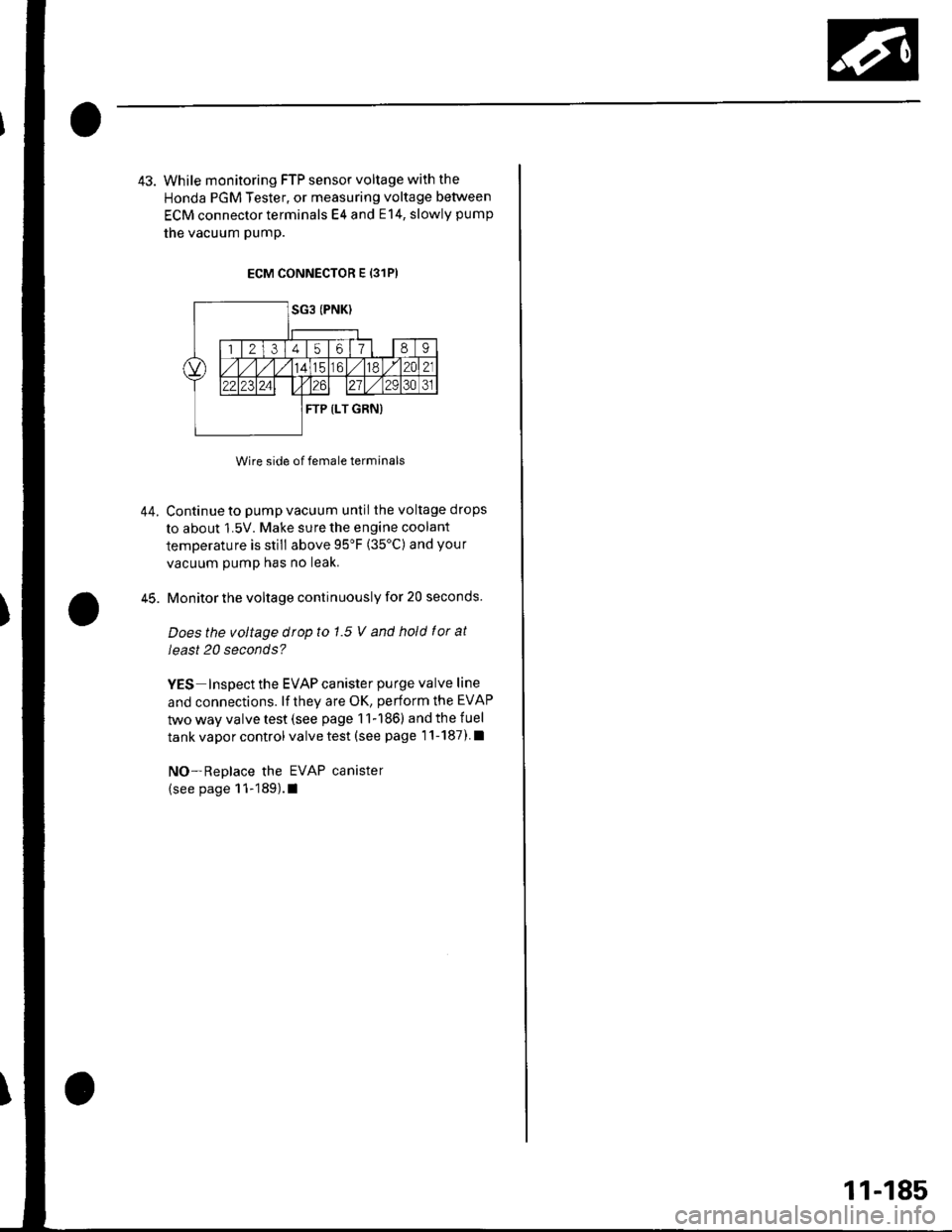
43. While monitoring FTP sensor voltage with the
Honda PGM Tester, or measuring voltage between
ECM connector terminals E4 and E14, slowly pump
the vacuum pump.
ECM CONNECTOR E {31P)
Wire side of female terminals
Continue to pump vacuum until the voltage drops
to about 1.5V. Make sure the engine coolant
temperature is still above 95'F (35'C) and your
vacuum pump has no leak.
Monitor the voltage continuously for 20 seconds.
Does the voltage drop to 1.5 V and hold f or at
least 20 seconds?
YES Inspect the EVAP canister purge valve line
and connections. lf they are OK, perform the EVAP
two way valve test (see page 11-186) and the fuel
tank vapor control valve test (see page 1'l-187) l
NO-Replace the EVAP canister
(see page 11-189).1
44.
45.
11-185
Page 394 of 1139
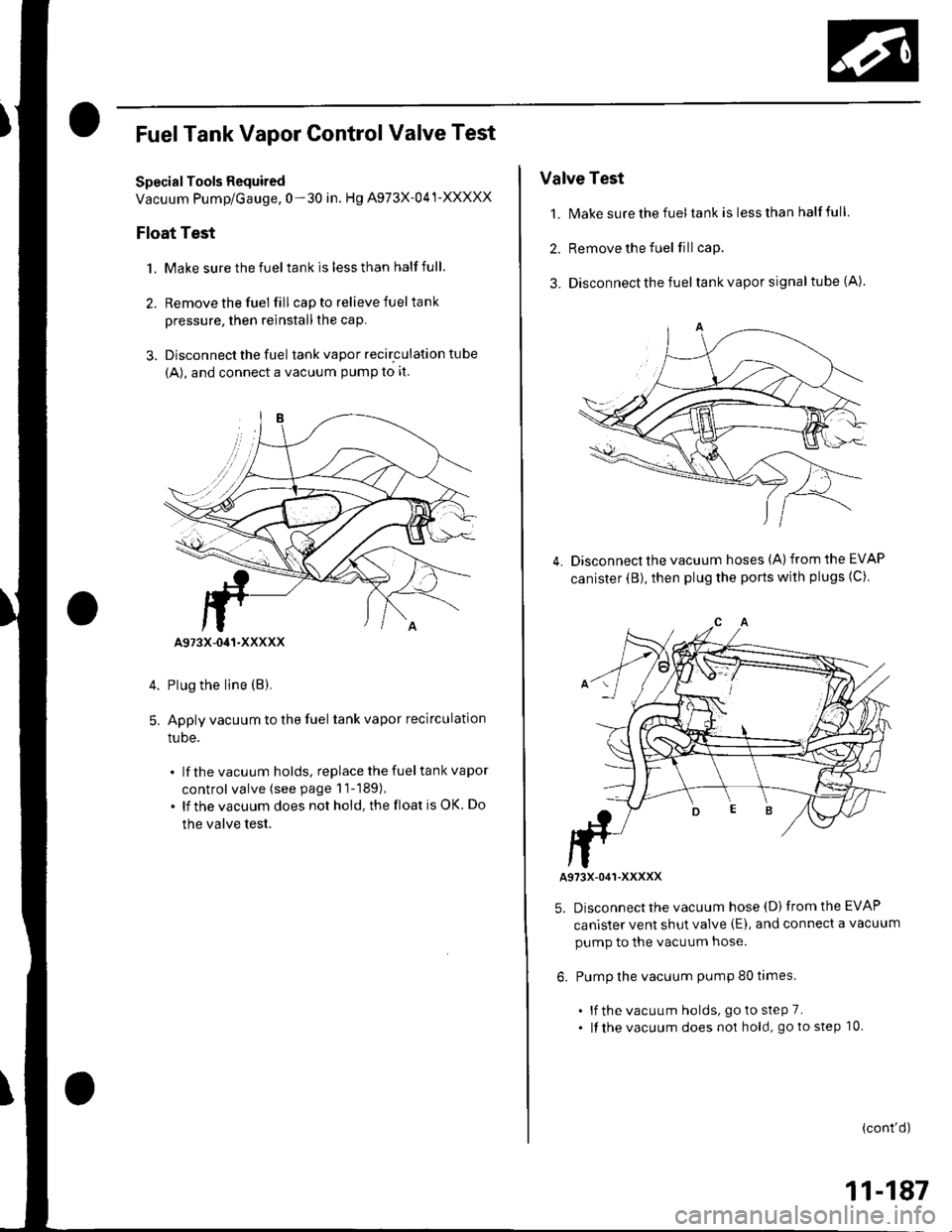
FuelTank Vapor Control Valve Test
Special Tools Required
Vacuum Pump/Gauge, 0-30 in. Hg A973X-041-XXXXX
Float Test
1. Make sure the fuel tank is less than half full.
2. Remove the fuel fill cap to relieve fuel tank
pressure, then reinstall the cap.
3. Disconnect the fuel tank vapor recirculation tube
{A), and connect a vacuum PumP to it.
Plug the line (B).
Apply vacuum to the fuel tank vapor recirculation
tuDe.
lf the vacuum holds, replace the fuel tank vapor
control valve (see page 11-189).
lf the vacuum does not hold, the float is OK. Do
the valve test.
5.
A973X-041-XXXXX
Valve Test
1. N4ake sure the fuel tank is less than half full
2. Remove the fuel fill cap.
3. Disconnect the fuel tank vapor signal tube (A).
Disconnect the vacuum hoses (A) from the EVAP
canister (B), then plug the ports with plugs (C)4.
A973X-O41-XXXXX
5. Disconnect the vacuum hose (D) from the EVAP
canister vent shut valve (E), and connect a vacuum
pump to the vacuum hose.
6. Pump the vacuum pump 80 times.
. lf the vacuum holds, goto steP 7.. lf the vacuum does no1 hold, go to step 10.
(cont'd)
11-187
Page 395 of 1139
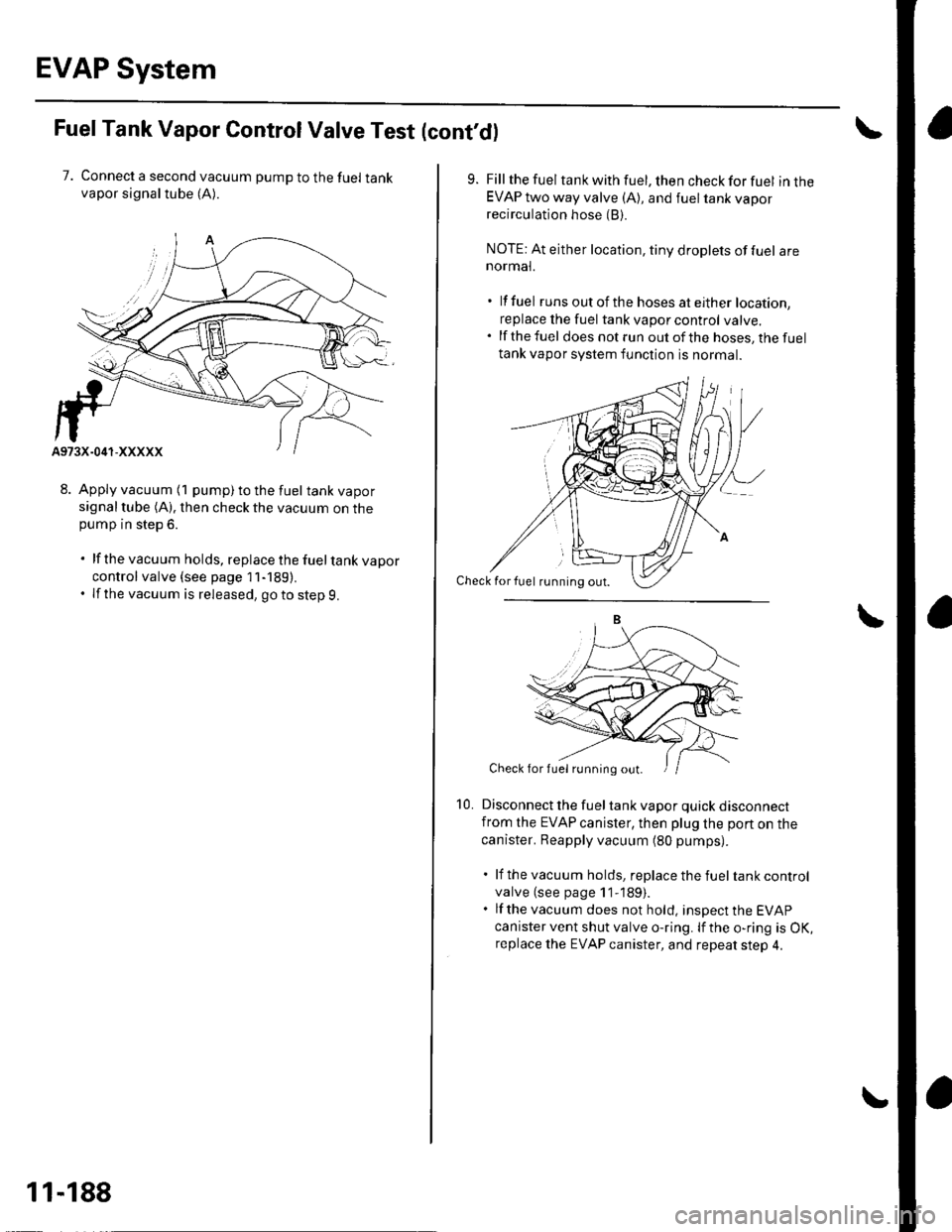
EVAP System
FuelTank Vapor ControlValve Test (cont'd)
7. Connect a second vacuum pump to the fuel tankvapor signaltube (A).
8. Apply vacuum (1 pump) to the fuel tank vaporsignal tube (A). then check the vacuum on thepump in step 6.
. lf the vacuum holds, replace the fueltank vapor
control valve {see page 11-189).. If the vacuum is released, goto step 9.
11-188
10.
Fill the fuel tank with fuel, then check for fuel in theEVAP two way valve (A), and fuel tank vaporrecirculation hose (B).
NOTE: At either location, tiny droplets of fuel arenormal.
. lf fuel runs out of th e hoses at either location,
replace the fuel tank vapor control valve..lfthefuel does not run out of the hoses, the fuel
tank vapor system function is normal.
Disconnect the fuel tank vapor quick disconnectfrom the EVAP canister, then plug lhe port on the
canister. Reapply vacuum (80 pumps).
. lf the vacuum holds, replace the fuel tank control
valve (see page 1 1-189).. lf the vacuum does not hold, insDect the EVAP
canister vent shut valve o-ring. lf the o-ring is OK,replace the EVAP canister, and repeat step 4.
Check for fuel rirnning out.
Check for fuel running out.