ground HONDA CIVIC 2002 7.G User Guide
[x] Cancel search | Manufacturer: HONDA, Model Year: 2002, Model line: CIVIC, Model: HONDA CIVIC 2002 7.GPages: 1139, PDF Size: 28.19 MB
Page 83 of 1139
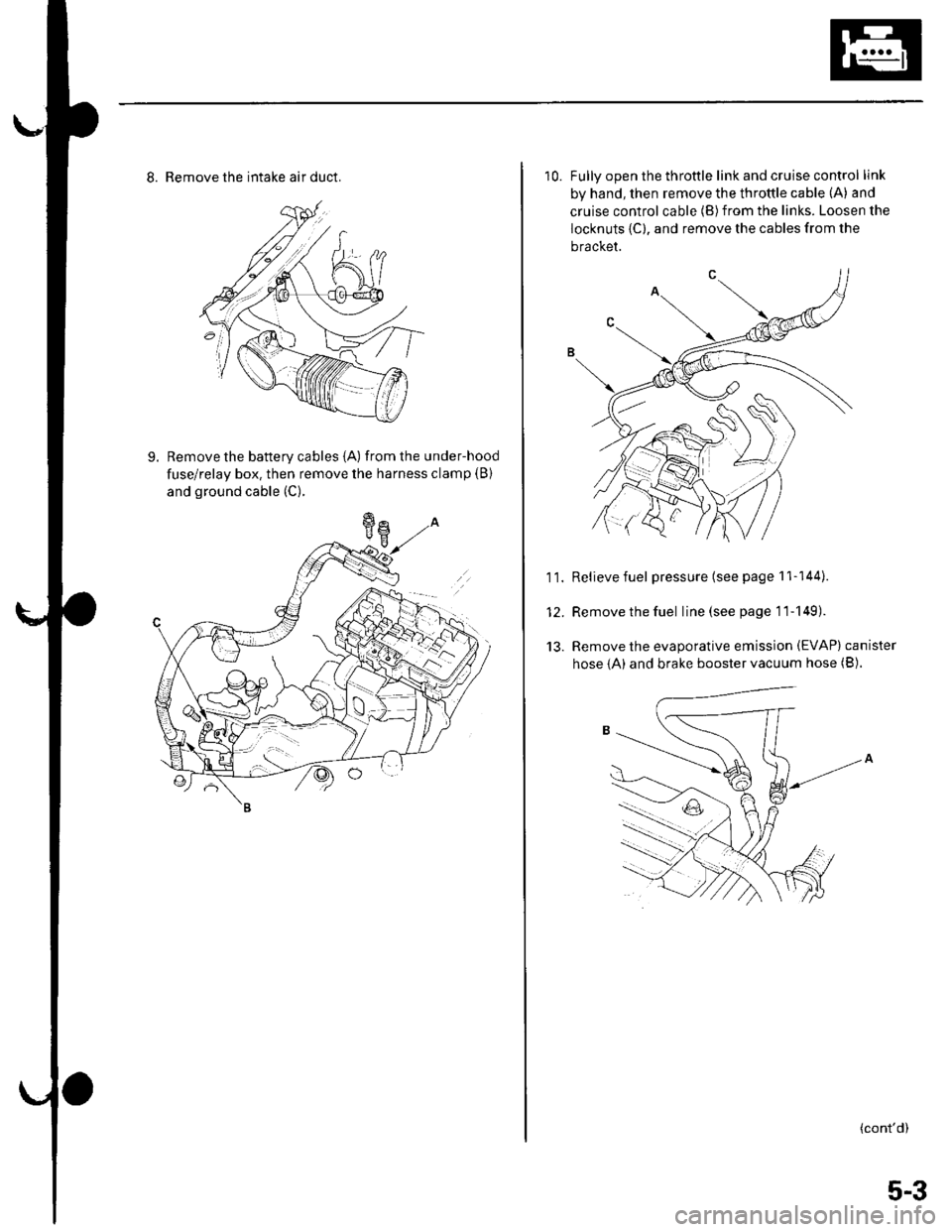
8. Remove the intake air duct.
9. Remove the battery cables {A) fromthe under-hood
fuse/relay box. then remove the harness clamp (B)
and ground cable (C).
10. Fullv ooen the throttle link and cruise control link
by hand, then remove the throttle cable (A) and
cruise control cable (B)from the links. Loosen the
locknuts {C), and remove the cables from the
bracket.
11. Relievefuel pressure (see page 11-144).
12. Remove the fuel line(seepagell-149).
13. Remove the evaporative emission (EVAP) canister
hose {A) and brake booster vacuum hose (B).
(cont'd)
5-3
Page 94 of 1139
Engine Assembly
Engine Installation {cont'dl
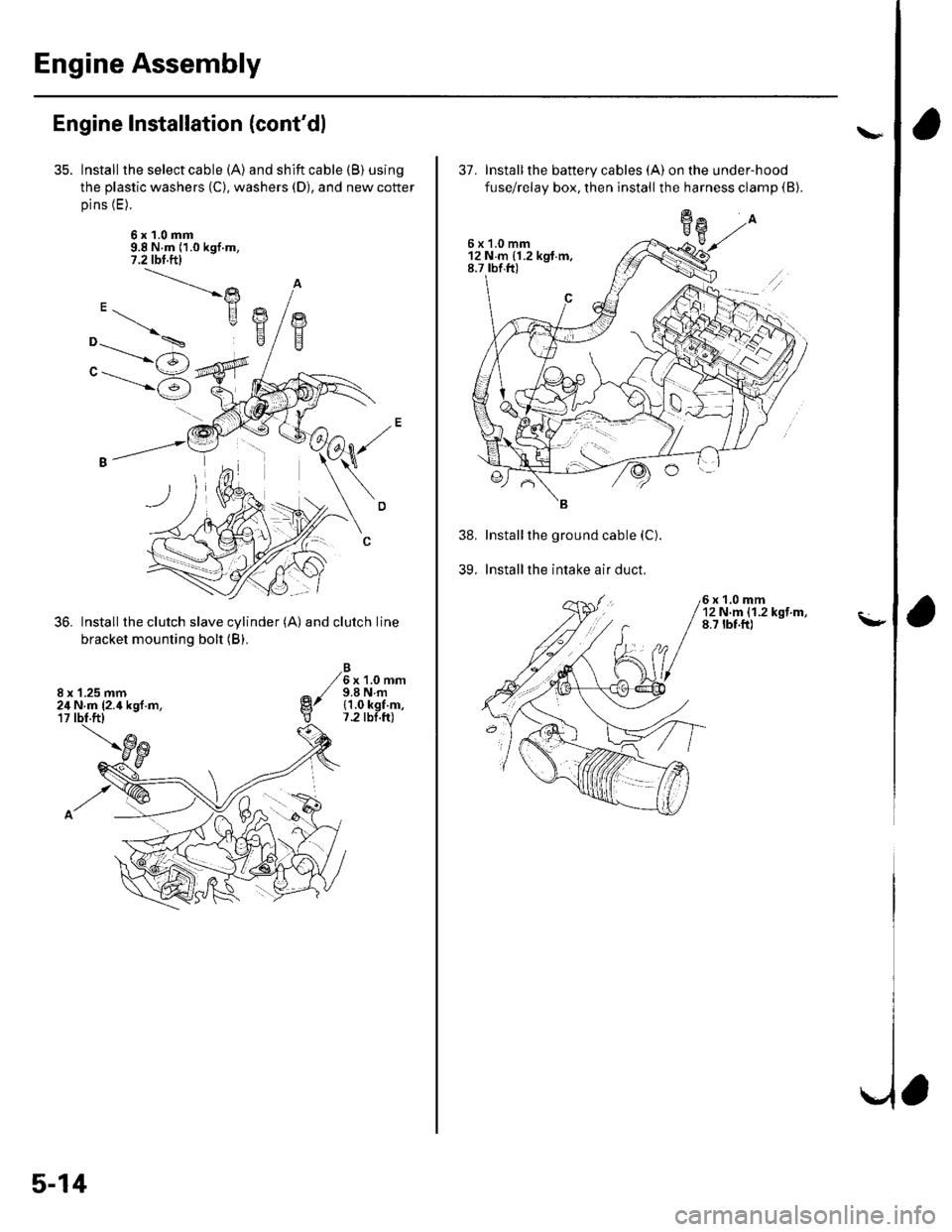
Install the select cable (A) and shift cable (B) using
the plastic washers (C), washers (D), and new cotter
pins (E).
6x1.0mm9.8 N.m (1.0 kgf.m,7.2 tbl.ftl
Install the clutch slave cylinder (A) and clutch line
bracket mounting bolt (B).
6x1.0mm9.8 N.m{1.0 kgf.m,7.2 tbt.ft)
"-.----->)
"------'6
8 x '1.25 mm24 N.m (2.4 kgl.m,
5-14
37. Installthe battery cables (A) on the under-hood
fuse/relay box, then install the harness clamp (B).
Installthe ground cable (C).
Installthe intake air duct.
6x1.0mm12Nm{1.2kgf.m,8.7 tbf.ft)
39.
\"
\-
a
6x1.0mm12Nm{1.2kgt.m,8.7 rbf.ft)
Page 108 of 1139
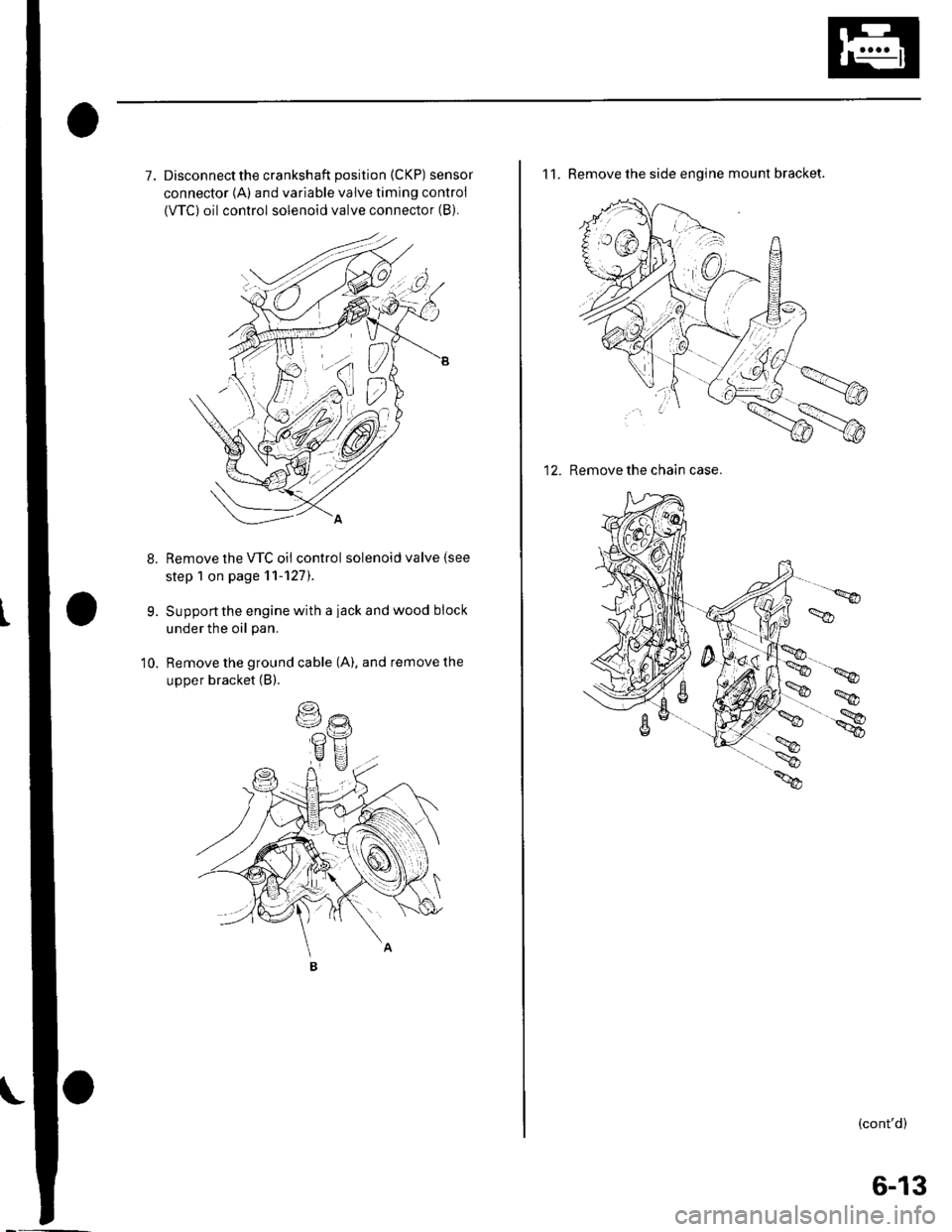
7. Disconnectthe crankshaft position (CKP) sensor
connector {A) and variable valve timing control
{VTC) oil control solenoid valve connector (B).
Remove the VTC oil control solenoid valve (see
step 1 on page 11-127).
Support the engine with a iack and wood block
under the oil pan.
Remove the ground cable (A). and remove the
upper bracket (B).
9.
10.
11. Remove the side engine mount bracket.
12. Remove the chain case.
(cont'd)
6-13
Page 113 of 1139
Gylinder Head
Cam Chain Installation (cont'd)
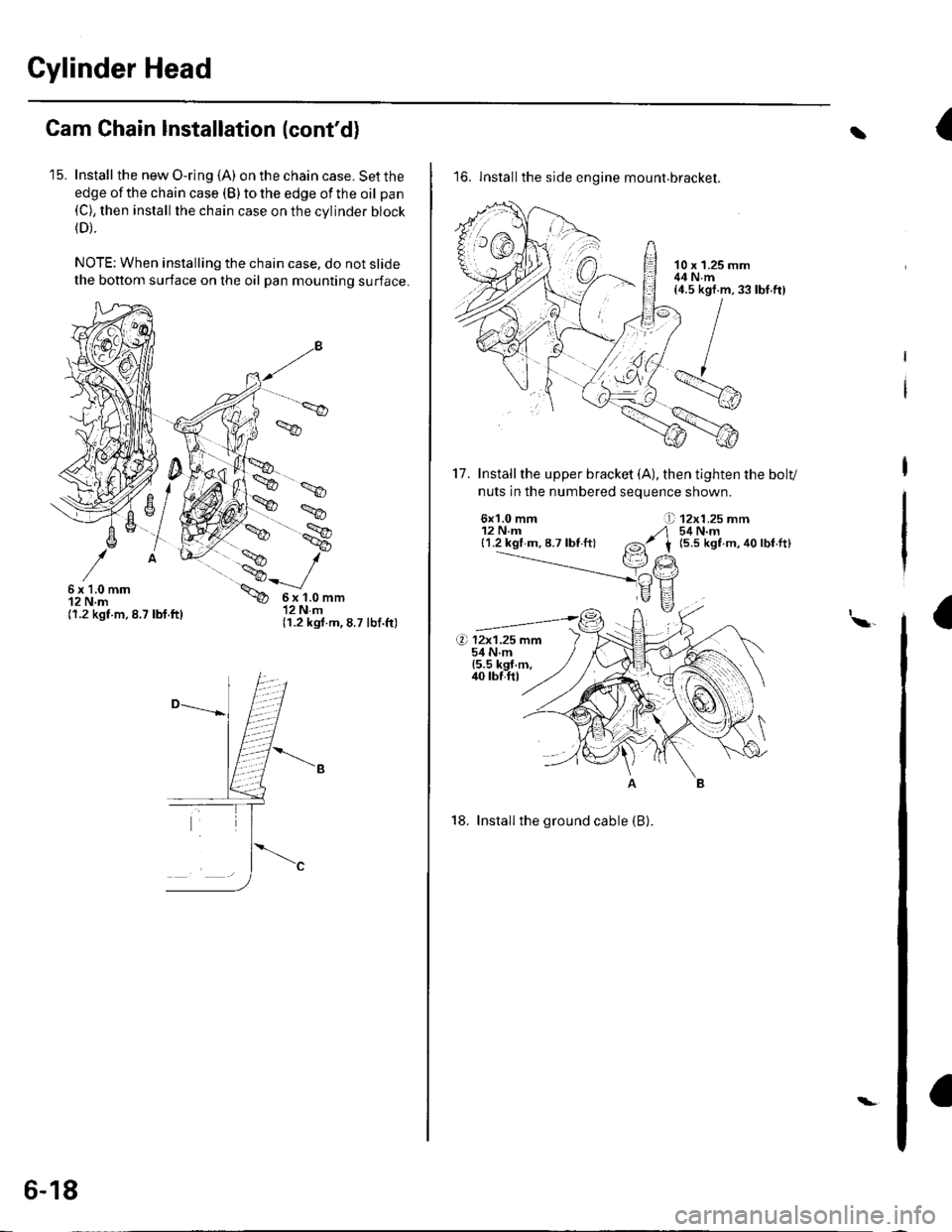
'15. Install the new O-ring (A) on the chain case. Set the
edge of the chain case (B) to the edge of the oil pan(C), then install the chain case on the cvlinder block(D).
NOTE: When installing the chain case, do not slide
the bottom surface on the oil pan mounting surface.
',.9
6x1.0mm12 N.m(1.2 kgt.m.8.7 lbf.ft)
6x1.0mm12Nm(1.2 kgf.m,8.7 lbf.ft)
6-18
\-
{t
16. lnstallthe side engine mount.bracket.
17. Installthe upper bracket (A), then tighten the bolv
nuts in the numbered seouence shown.
6x1.0 mm12 N.m{1.2 kgl m, 8.7 lbf ft}
12x1.25 mm54 N.m(5.5 kgt m, 40 lbf.ft)
I\a
18. Install the ground cable (B).
rbf.ft)
Page 170 of 1139
Engine Lubrication
Oil Pressure Switch Test
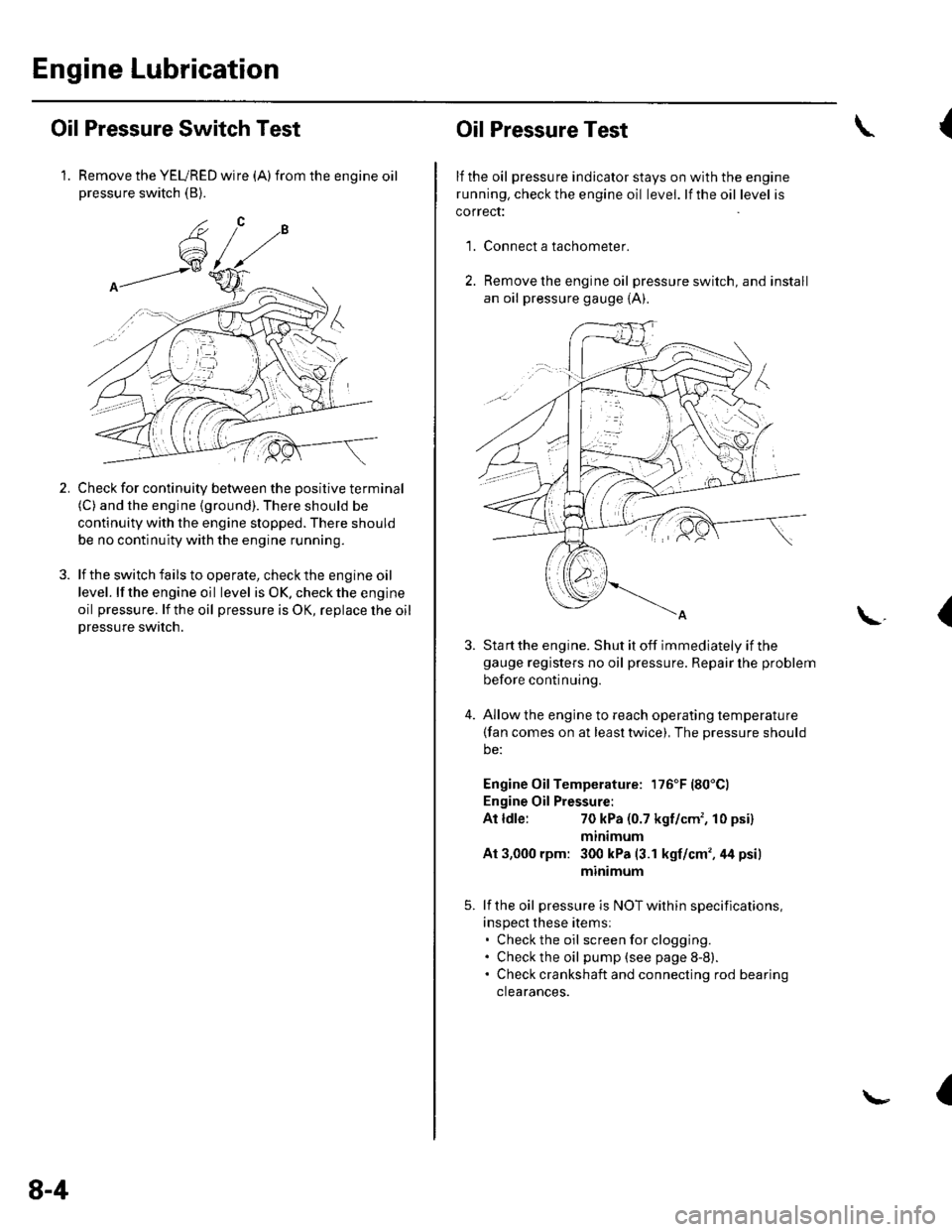
1. Remove the YEURED wire (A)from the engine oilpressure switch (B).
Check for continuity between the positive terminal(C) and the engine (ground). There should be
continuity with the engine stopped. There should
be no continuity with the engine running.
lf the switch fails to operate, check the engine oil
level. lf the engine oil level is OK. check the engine
oil pressure. lf the oil pressure is OK, replace lhe oil
Dressure switch.
2.
8-4
Oil Pressure Test
lf the oil pressure indicator stays on with the engine
running. check the engine oil level. lf the oil level is
correct:
Connect a tachometer.
Remove the engine oil pressure switch, and install
an oil pressure gauge {A).
{
'1.
\.(
4.
Sta rt the engine. Shut it off immediately if thegauge registers no oil pressure. Repair lhe problem
before continuing.
Allow the engine to reach operating temperature(fan comes on at least twice), The pressure should
be:
Engine Oil Temperature: 176'F (80'Cl
Engine Oil Pressure:
At ldle:70 kPa (0.7 kgf/cm', 10 psi)
mtntmum
At 3,000 rpm: 300 kPa (3.1 kgf/cm',44 psi)
minimum
lf the oil pressure is NOT within specifications,
inspect these items:. Check the oil screenforclogging.. Check the oil pump (see page 8-8).. Check crankshaft and connecting rod bearing
clearances.
I
Page 194 of 1139
Cooling System
Fan Motor Test
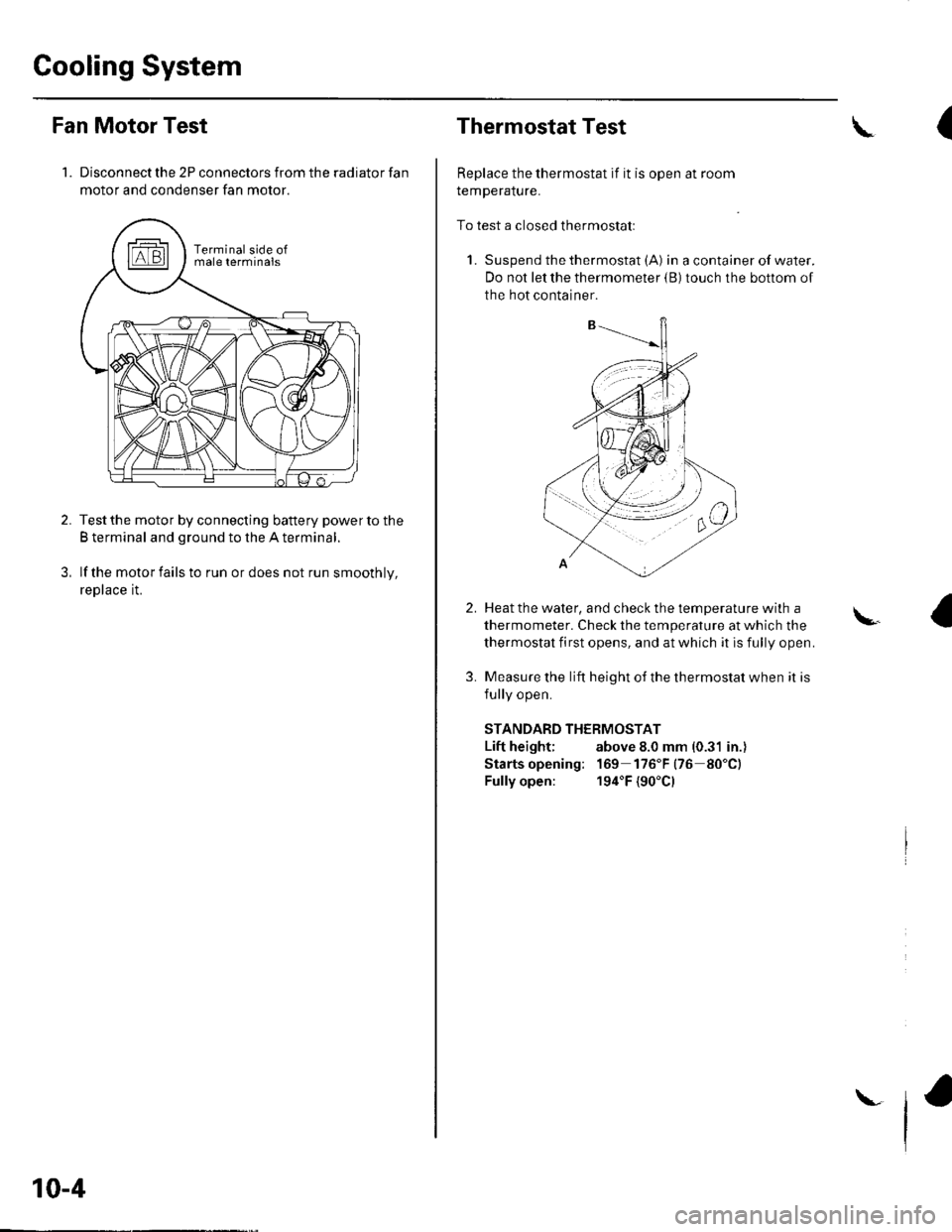
1. Disconnect the 2P connectors from the radiator fan
motor and condenser fan motor.
Test the motor by connecting battery power to the
B terminal and ground to the A terminal.
lf the motor fails to run or does not run smoothly,
reptace rL
10-4
\
Thermostat Test
Replace the thermostat if it is open at room
remperalure.
To test a closed thermostatl
1. Suspend the thermostat (A) in a container of water.
Do not let the thermometer {B) touch the bottom of
the hot container.
(\
2.
3.
Heat the water, and check the temDerature with a
thermometer. Check the temperature at which the
thermostat first opens, and at which it is fully open.
Measure the lift height of the thermostat when it is
fullv ooen.
STANDARD THERMOSTAT
Lift height; above 8.0 mm (0.31 in.)
Starts opening: 169 176"F(76 80"C)
Fully open: 194"F {90'Cl
\.
Page 202 of 1139
Fan Controls
Symptom Troubleshooting Index
Before performing any troubleshooting procedures check:. Fuses. Grounds. Cleanliness and tightness of all connectors
\{
\,4
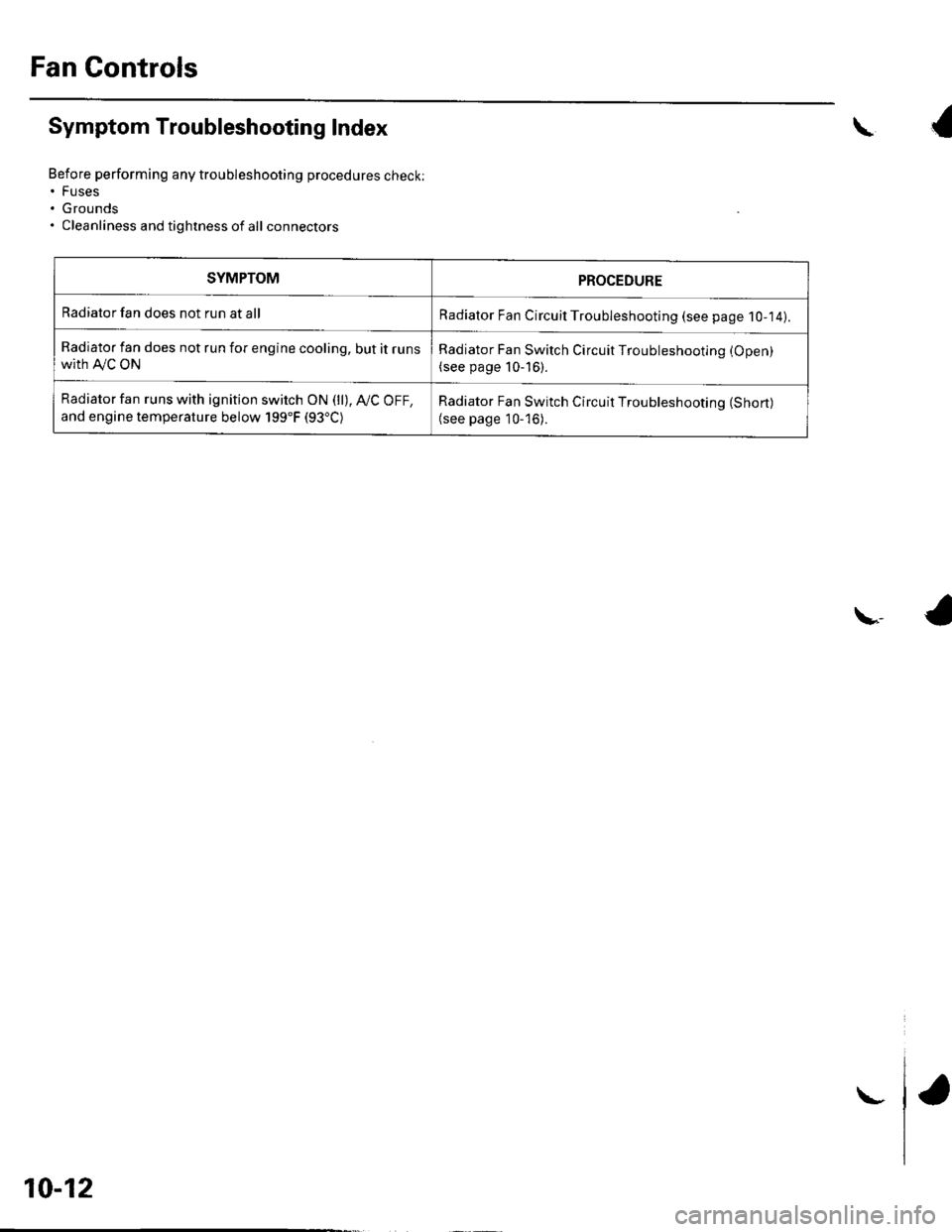
SYMPTOMPROCEDURE
Radiator fan does not run at allRadiator Fan Circuil Troubleshooting (see page 1O-14).
Radiator fan does not run for engine cooling, but it runswith A,/C ON
Radiator Fan Switch Circuit Troubleshooting (Open)
(see page 10-16).
Radiator fan runs with ignition switch ON (ll), Ay'C OFF,
and engine temperature below 199"F (93"C)Radiator Fan Switch Circuit Troubleshooting (Short)
(see page 10-'16).
10-12
\-
Page 204 of 1139
Fan Gontrols
Radiator Fan Circuit Troubleshooting
1. Check the No. 4 (20A) fuse in the under-hood
fuse/relay box, and the No. 14 (10A) fuse in the
under-dash fuse/relay box.
ls the tuse (s) OK?
YES-Go to step 2.
NO- Replace the fuse (s) and recheck.l
2. Remove the radiator fan relay from the under-hood
fuse/relay box, and test it (see page 22-51).
ls the relay OK?
YES Go to step 3.
NO Replace the radiator fan relay. t
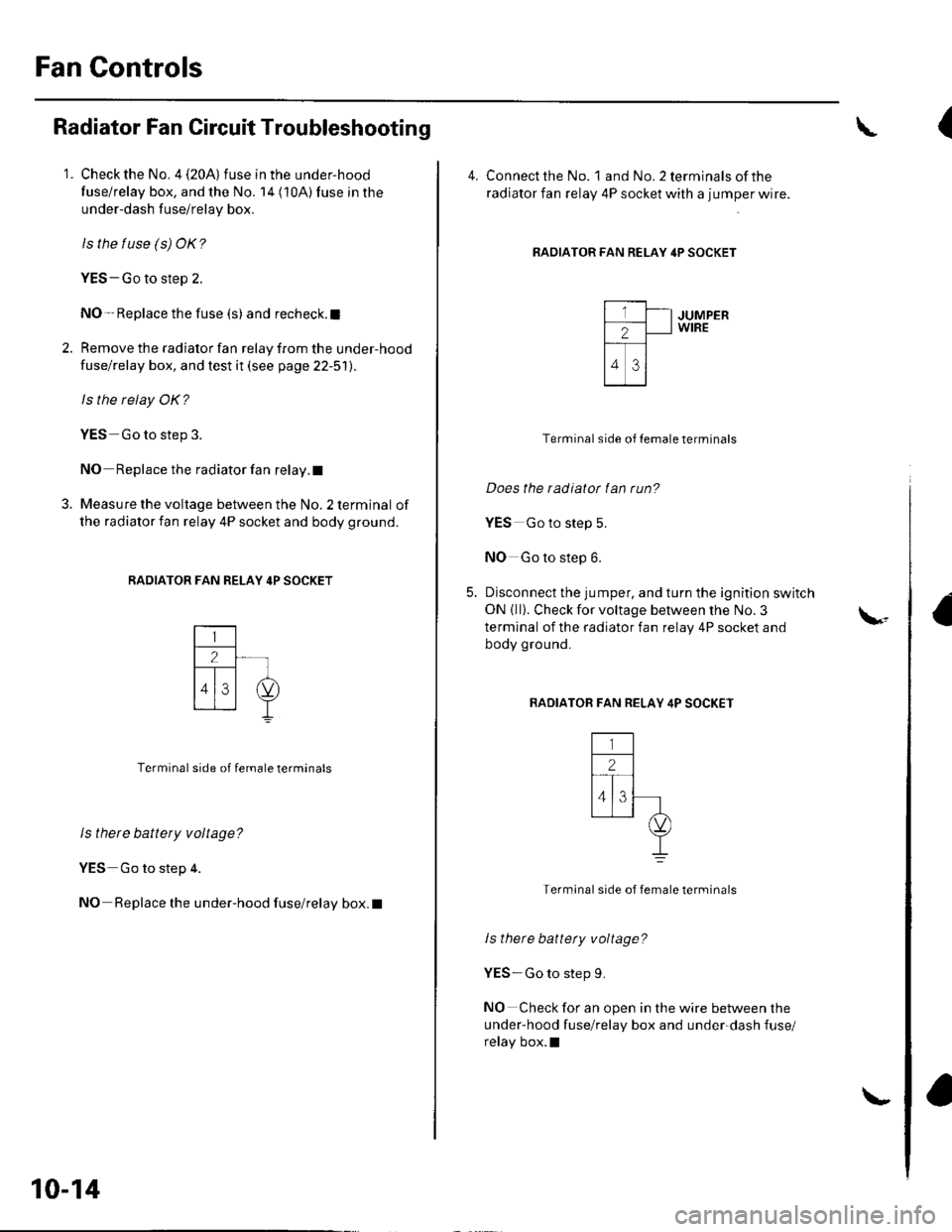
3. Measure the voltage between the No. 2 terminal of
the radiator fan relay 4P socket and body ground.
RADIATOR FAN RELAY 4P SOCKET
Terminal side of female terminals
ls there battery voltage?
YES Go to step 4.
NO Replace the under-hood fuse/relay box. I
10-14
\-
(
4. Connect the No. landNo.2terminalsofthe
radiator fan relay 4P socket with a jumper wire.
RADIATOR FAN RELAY 4P SOCKET
JUMPERWIRE
Terminal side of Iemale terminals
Does the radiatot fan run?
YES Go to step 5.
NO Go to step 6.
Disconnect the jumper, and turn the ignition switch
ON { ll}. Check for voltage between the No. 3
terminal of the radiator fan relay 4P socket and
body ground.
BADIATOB FAN RELAY 4P SOCKET
Termlnal side of female terminals
ls there battety voltage?
YES-Go to step 9.
NO Check for an open in the wire between the
under-hood fuse/relay box and under-dash fuse/
relay box.l
\-
Page 205 of 1139
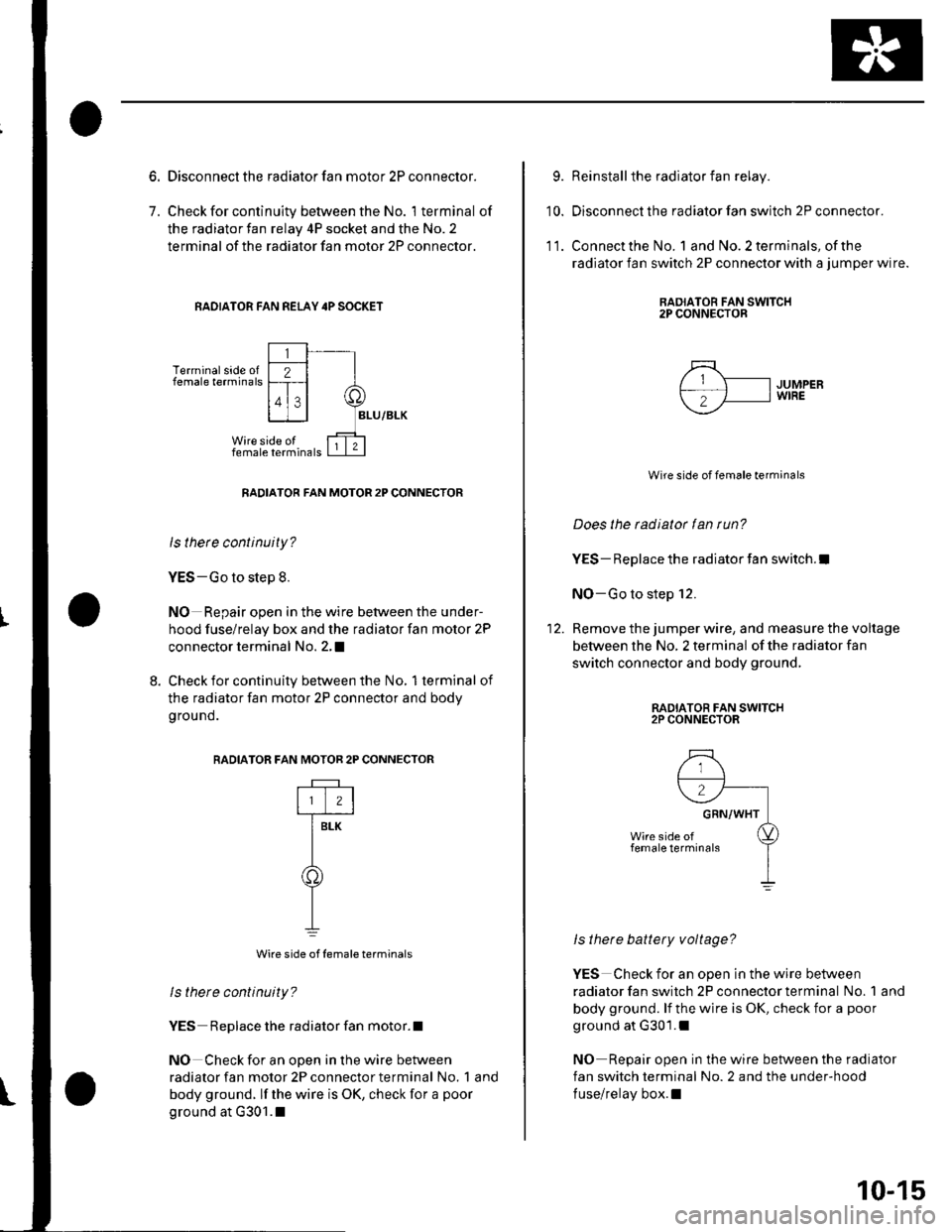
7.
Disconnect the radiator fan motor 2P connector.
Check for continuity between the No. 1 terminal of
the radiator fan relay 4P socket and the No. 2
terminal of the radiator fan motor 2P connector.
RAOIATOR FAN REI-AY 4P SOCKET
Terminal side offemale terminals
RADIATOR FAN MOTOR 2P CONNECTOR
ls thete continuity?
YES-Go to step 8.
NO Repair open in the wire between the under-
hood fuse/relay box and the radiator fan motor 2P
connector terminal No. 2,I
8. Check for continuity between the No, 1terminal of
the radiator fan motor 2P connector and bodv
g rou nd.
RADIATOR F
Wire side of female terminals
ls there continuity?
YES Replace the radiator fan motor.l
NO Check for an open in the wire between
radiator fan motor 2P connector terminal No. 1 and
body ground. lf the wire is OK, check for a poor
ground at G301.1
AN MOTOR 2P CONNECTOR
rftr
T-
Y
9.
10.
Reinstall the radiator fan relay.
Disconnect the radiator fan switch 2P connector.
Connect the No. 1 and No. 2 terminals, of the
radiator fan switch 2P connector with a jumper wire.
RAOIATOR FAN SWITCH2P CONNECTOR
11.
5\- IJUMPERf-; 'fl I wrRE
--
Wire side of female terminals
Does the radiator fan run?
YES- Replace the radiator fan switch.l
NO-Go to step 12.
Remove the jumper wire, and measure the voltage
between the No, 2 terminal of the radiator fan
switch connector and body ground,
RADIATOR FAN SWITCH2P CONNECTOR
ls there battery voltage?
YES Check for an open in the wire between
radiator fan switch 2P connector terminal No. 1 and
body ground. lf the wire is OK, check for a poor
ground at G301.1
NO Repair open in the wire between the radiator
fan switch terminal No. 2 and the under-hood
fuse/relay box.l
10-15
Page 206 of 1139
Fan Controls
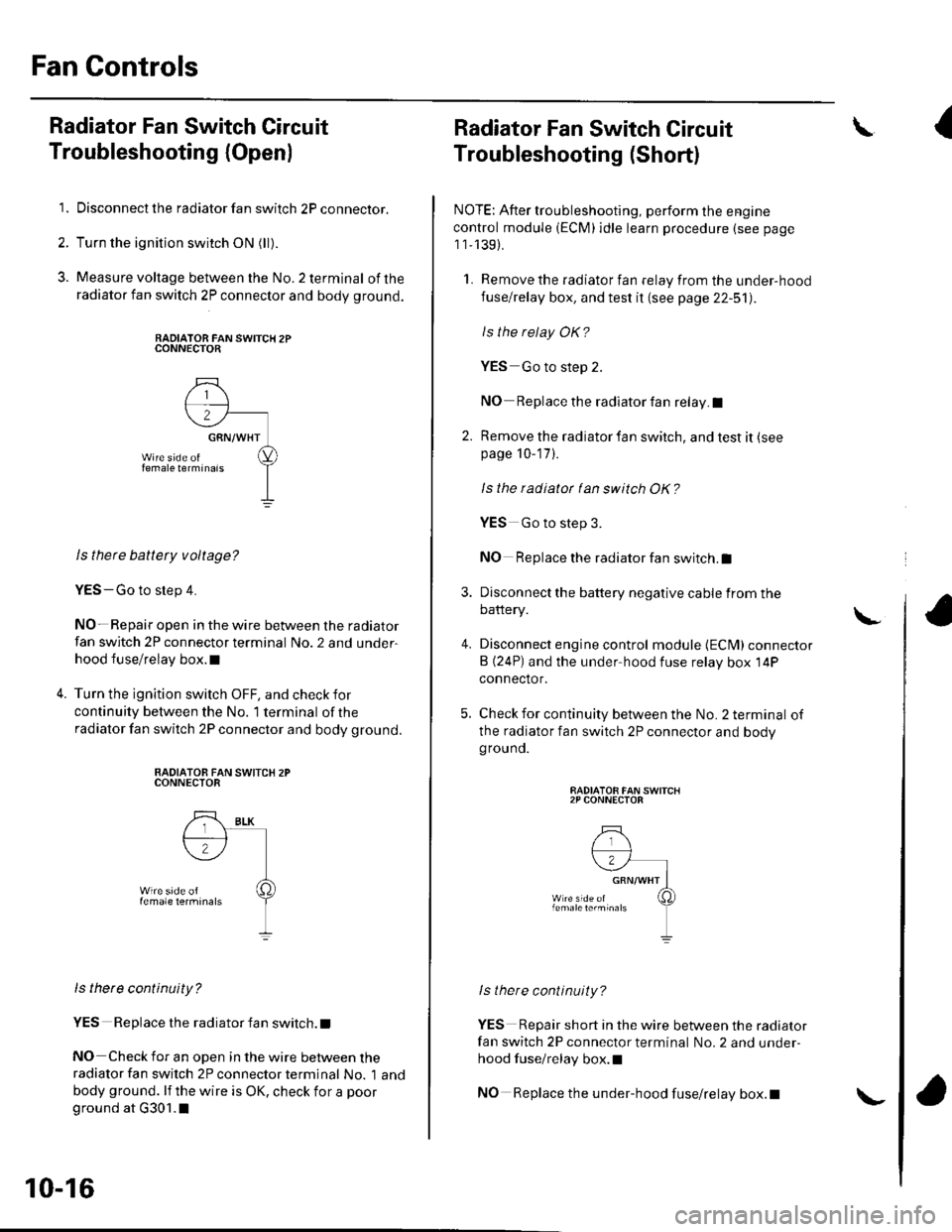
Radiator Fan Switch Circuit
Troubleshooting (Openl
1. Disconnect the radiator fan switch 2P connector.
2. Turn the ignition switch ON (ll).
3. Measure voltage between the No.2 terminal ofthe
radiator fan switch 2P connector and body ground.
RADIATOR FAN SWITCH 2PCONNECTOR
ls there battety voltage?
YES-Go to step 4.
NO- Repair open in the wire between the radiator
fan switch 2P connector terminal No. 2 and under-
hood fuse/relay box.l
Turn the ignition switch OFF, and check for
continuity between the No. '1 terminal of the
radiator fan switch 2P connector and body ground.
RADIATOB FAN SWITCX 2PCONNECTOR
ls there continuity?
YES Replace the radiator fan switch. t
NO Check for an open in the wire between theradiator fan switch 2P connector terminal No. 1 and
body ground. lf the wire is OK, check for a poor
ground at G301.1
10-16
\-
Radiator Fan Switch Circuit
Troubleshooting (Short)
NOTE: After troubleshooting, perform the engine
control module (ECM)idle learn procedure (see page
1 1,139).
1. Remove the radiator fan relay from the under-hood
fuse/relay box, and test it (see page 22-51).
ls the relay OK?
YES Go to step 2.
NO Replace the radiator fan relay.I
2. Remove the radiator fan switch, and test it (see
page 10-17 ).
Is the radiatot tan switch OK?
4.
YES Go to step 3.
NO Replace the radiator fan switch.I
Disconnect the battery negative cable from the
battery.
Disconnect engine control module {ECM) connector
B (24P) and the under hood fuse relay box 14P
connector.
Check for continuity between the No. 2 terminal of
the radiator fan switch 2P connector and bodygrouno.
RADIATOR FAN SWITCH2P CONNECTOR
lstnere continuity?
YES Repair short in the wire between the radiator
fan switch 2P connector terminal No. 2 and under-
hood fuse/relay box.l
NO Replace the under-hood fuse/relay box.t
\I
\