radiator HONDA CIVIC 2002 7.G Repair Manual
[x] Cancel search | Manufacturer: HONDA, Model Year: 2002, Model line: CIVIC, Model: HONDA CIVIC 2002 7.GPages: 1139, PDF Size: 28.19 MB
Page 371 of 1139
Intake Air System
Throttle Cable Removal/lnstallation
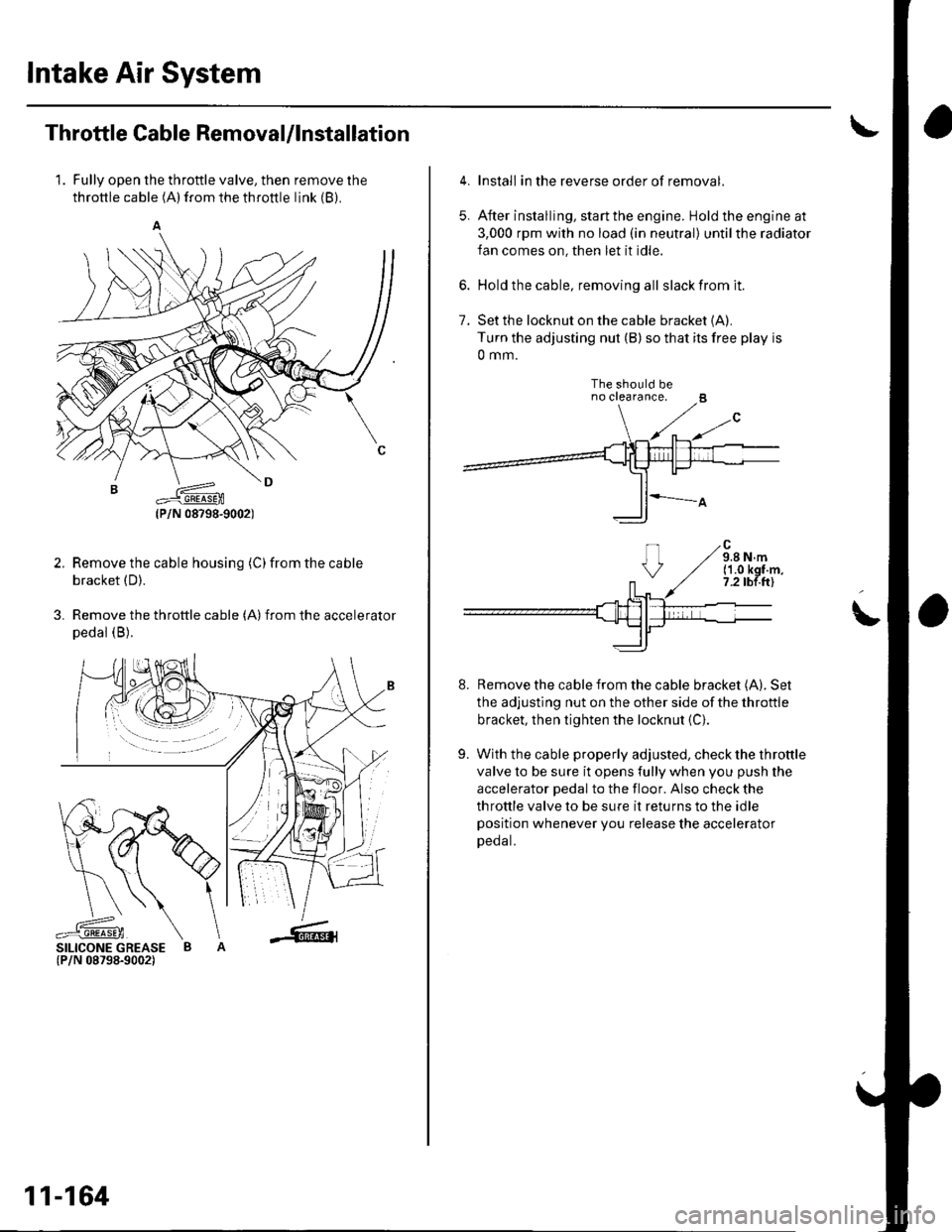
1. Fully open the throttle valve, then remove the
throttle cable (A) from the throttle link (B).
Remove the cable housing (C)from the cable
bracket (D).
Remove the throttle cable (A)from the accelerator
pedal (B).
2.
3.
SILICONE GREASE B(P/N 08798-9002)
(P/N 08?98-9002)
11-164
5.
Install in the reverse order of removal.
After installing, start the engine. Hold the engine at
3,000 rpm with no load (in neutral) untilthe radiator
fan comes on, then let it idle.
Hold the cable, removing all slack from it.
Set the locknut on the cable bracket {A).Turn the adjusting nut (B) so that its free play is
0 mm.
The should beno crearance.
Remove the cable from the cable bracket (A). Set
the adjusting nut on the other side of the throttle
bracket, then tighten the locknut {C}.
With the cable properly adjusted, check the throttle
valve to be sure it opens fully when you push the
accelerator pedal to the floor. Also check the
throttle valve to be sure it returns to the idle
position whenever you release the accelerator
Deoat.
7.
!
8.
9.
('1.0 kgf.m,7.2 tbf.ftl
Page 374 of 1139
Catalytic Converter System
DTC Troubleshooting
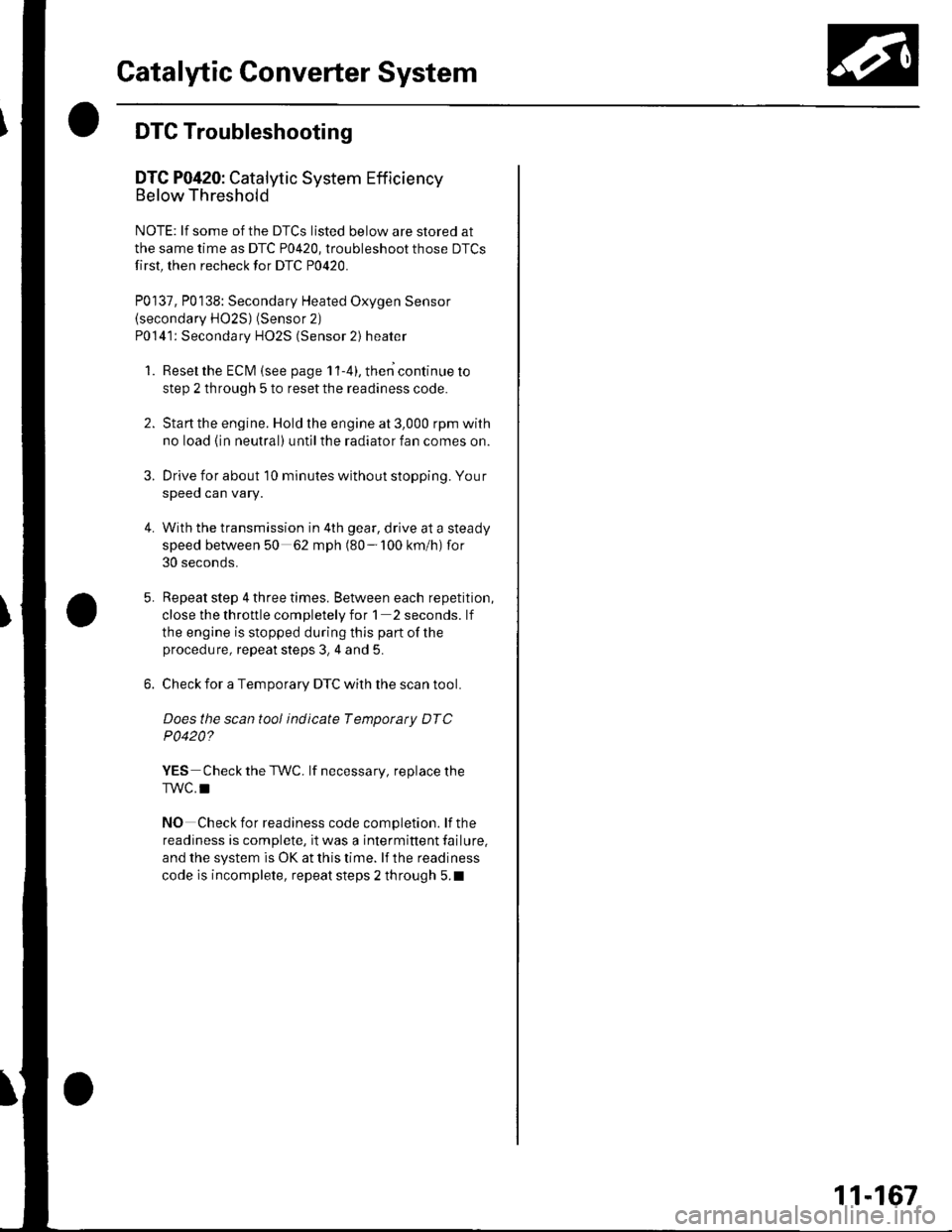
DTC P0420: Catalytic System Efficiency
Below Threshold
NOTE: lf some of the DTCS listed below are stored at
the same time as DTC P0420, troubleshoot those DTCS
first, then recheck for DTC P0420.
P0137, P0138: Secondary Heated Oxygen Sensor(secondary HO2S) (Sensor 2)
P0141: Secondary HO2S (Sensor 2) heater
1. Reset the ECM {see page 1'l-4}, then continue to
step 2 through 5 to reset the readiness code.
2. Start the engine. Hold the engine at 3,000 rpm with
no load (in neutral) untilthe radiator fan comes on.
Drive for about l0 minutes without stopping. Your
speeo can vary.
With the transmission in 4th gear, drive at a steady
speed between 50 62 mph (80-'100 km/h) for
30 seconds.
Repeat step 4 three times. Between each repetition,
close the throttle completely for 1 2 seconds. lf
the engine is stopped during this part of the
procedure, repeat steps 3, 4 and 5.
Check for a Temporary DTC with the scan tool.
Does the scan tool indicate Temporaty DTC
P0420?
YES Check the TWC. lf necessary, replace the
TWC.I
NO Check for readiness code completion. lfthe
readiness is complete, it was a interminent failure,
and the system is OK at this time. lf the readiness
code is incomplete, repeat steps 2 through 5.1
4.
11-167
Page 375 of 1139
PCV System
DTC Troubleshooting
DTC P1505: PCV Air Leakage
1. Reset the ECM (see page 11-4).
2. Start the engine. Hold the engine at 3,000 rpm with
no load (in neutral) until the radiator fan comes on
3. Let the engine idle tor al least 40 seconds with the
throttle fully closed.
4. Check for a DTC P1505 with the scan tool
ls DTC P1505 indicated?
YES-Check these parts for vacuum leaks l
. PCV valve. PCV hose. EVAP canister purge valve
. Throttle body. Brake booster hose
NO - Intermittent failure, system is OK at this
time.l
11-168
Page 773 of 1139
21-2
z t-'5
z t-o
z t-o
21-8
21-9
21-10
21-11
21-14
z t- to
HVAC (Heating, Ventilation, and Air Gonditioningl
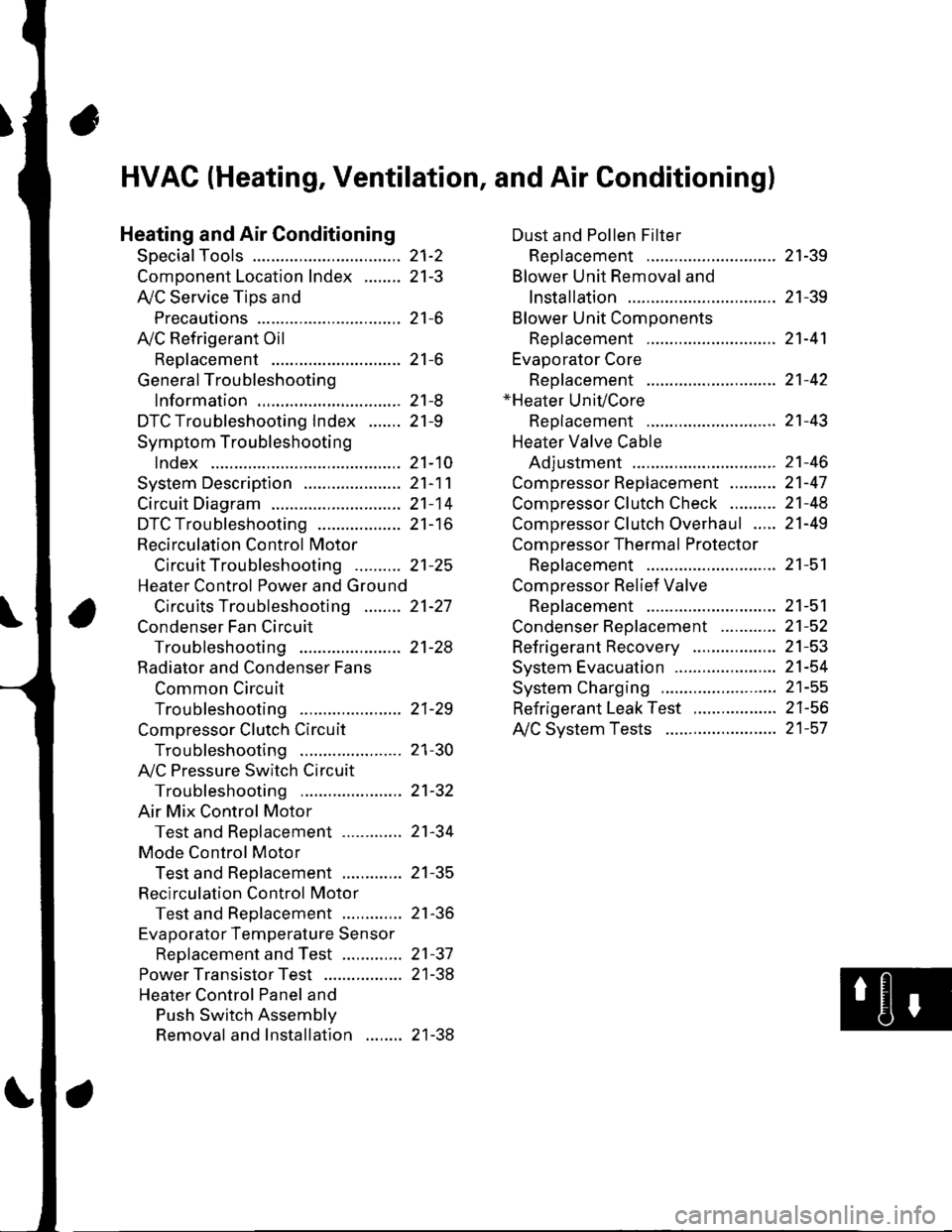
Heating and Air Conditioning
SpecialTools
Comoonent Location lndex ........
A/C Service Tios and
Precautions
A,/C Refrigerant Oil
ReDlacement
General Troubleshooting
lnformation
DTC Troubleshooting Index .......
Symptom Troubleshooting
1ndex..............
System Description .....................
Circuit Diagram
DTC Troubleshooting ..................
Recirculation Control Motor
CircuitTroubleshooting .......... 21-25
Heater Control Power and Ground
Circuits Troubleshooting ........ 21-27
Condenser Fan Circuit
Troubleshooting ...................... 21-28
Radiator and Condenser Fans
Common Circuit
Troubfeshooting ...................... 21-29
Compressor Clutch Circuit
Troubleshooting ...................... 21-30
A,/C Pressure Switch Circuit
Troubleshooting ...................... 21-32
Air Mix Control Motor
Test and Reolacement ............. 21-34
Mode Control Motor
Test and Replacement ............. 21-35
Recirculation Control Motor
Test and Reolacement ............. 21-36
Evaporator Temperature Sensor
Reolacement and Test ............. 21-31
Power Transistor Test ................. 21 -38
Heater Control Panel and
Push Switch Assemblv
Removal and Installation ........ 21-38
Dust and Pollen Filter
Reolacement ..21-39
Blower Unit Removal and
lnstallation ...... 21-39
Blower Unit Comoonents
ReDlacement ............................ 21-41
Evaporator Core
Reolacement ..21-42*Heater Unit/Core
ReDlacement ..21-43
Heater Valve Cable
Adjustment .....21-46
CompressorReplacement .......... 21-47
Comoressor Clutch Check .......... 21-48
Comoressor Clutch Overhaul ..... 21-49
Compressor Thermal Protector
Reo1acement ............................ 21-51
Comoressor Relief Valve
Reolacement ............................ 21-51
Condenser Reolacement ............ 21-52
Refrigerant Recovery .................. 21-53
System Evacuation ...................... 21-54
System CharginS ......................... 21-55
Refrigerant LeakTest .................. 21-56
A,/C Svstem Tests ........................ 21-57
Page 776 of 1139
Heating and Air Conditioning
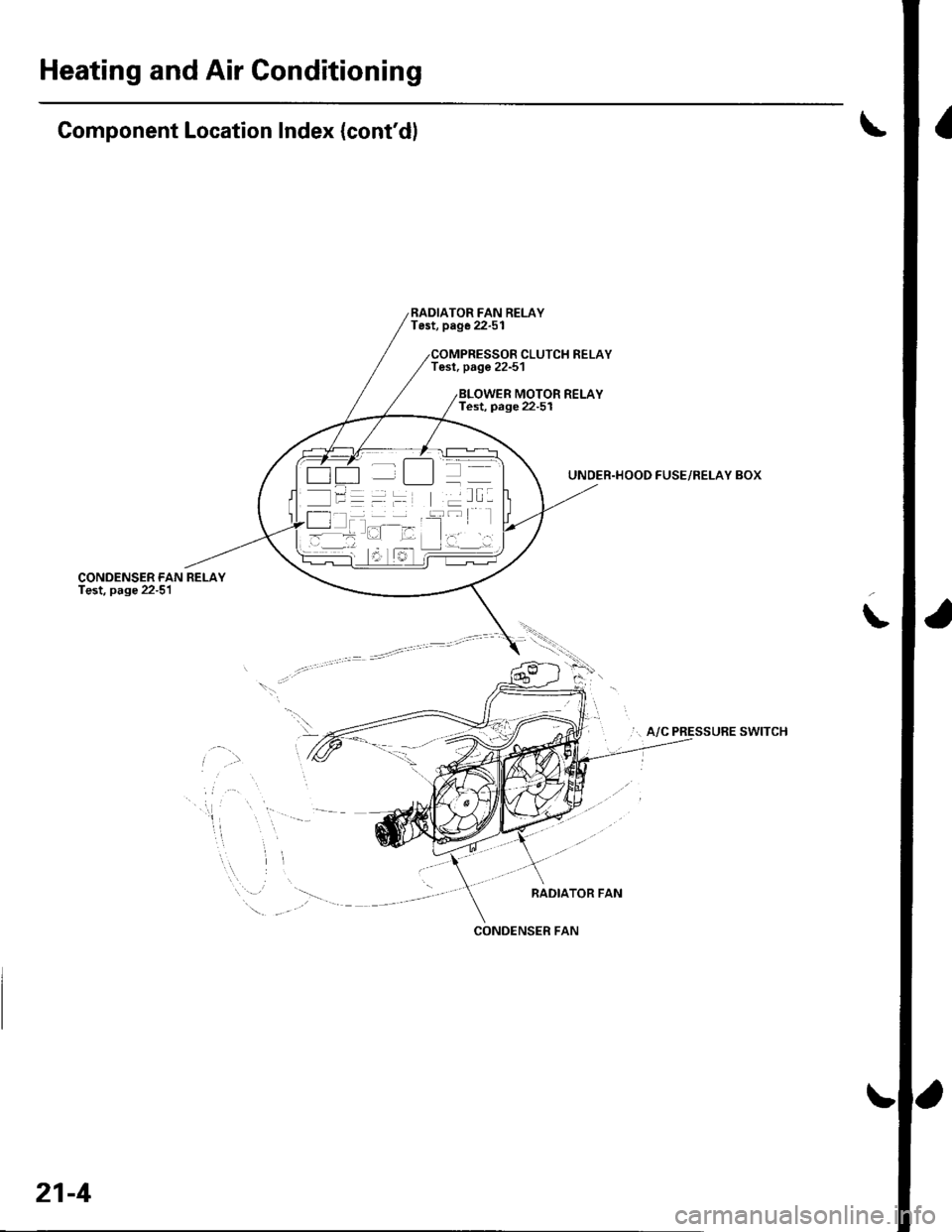
Component Location Index (cont'dl
CONDENSER FANTest, page 22-51
RADIATOR FAN RELAYTest, page 22-51
Tesl, page 22-51CLUTCH RELAY
MOTOR RELAYTest, page 22-5I
UNDER.HOOD FUSE/RELAY BOX
... A/C PRESSURE SWITCH
RADIATOR FAN
\
.\
-
'-t t_]]l
/l I T I --::--
l- -l -
CONOENSER FAN
21-4
Page 782 of 1139
Heating and Air Conditioning
{
a
a
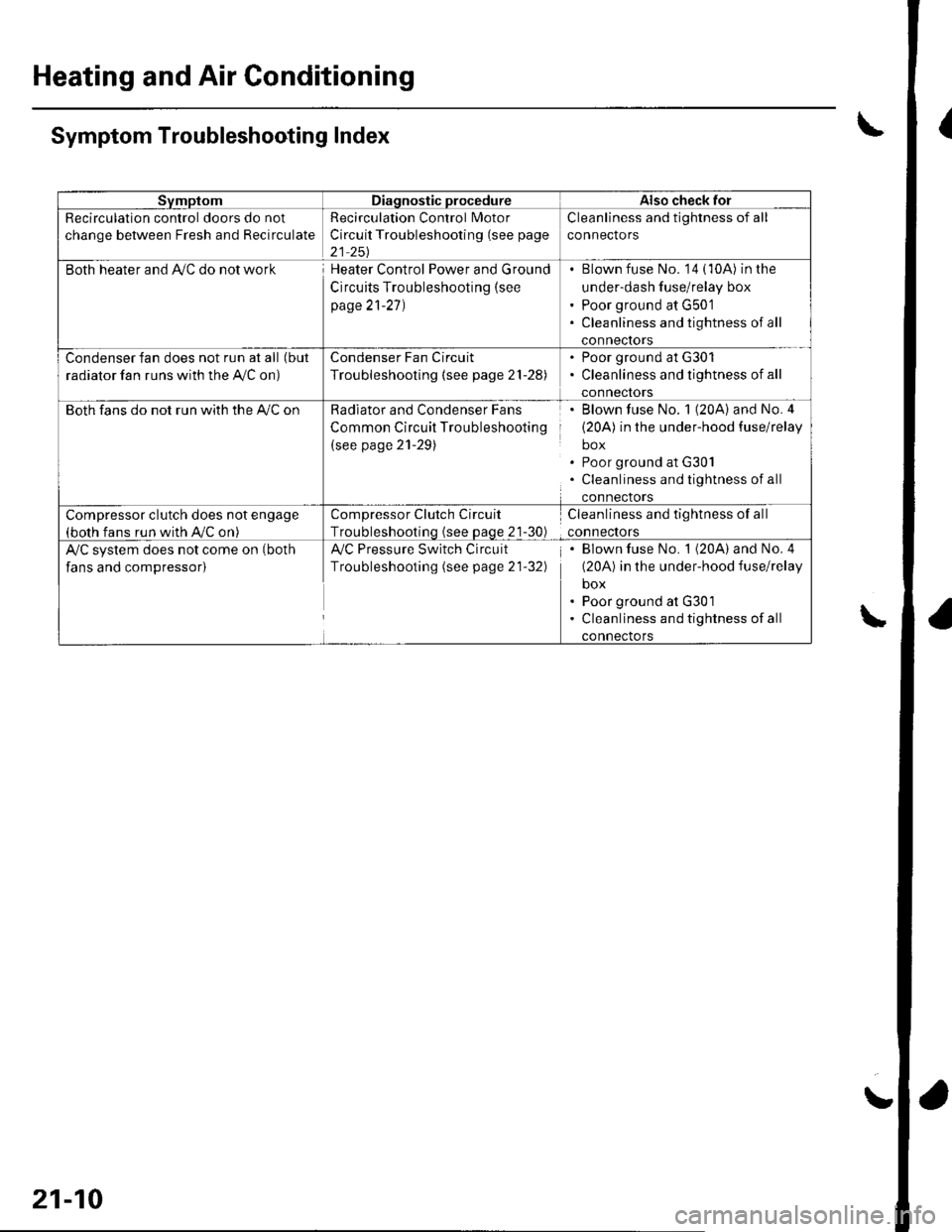
SvmptomDiagnostic procedureAlso check for
Recirculation control doors do not
change between Fresh and Recirculate
Recirculation Control Motor
Circuit Troubleshooting (see page
21 251
Cleanliness and tightness of all
connectors
Both heater and Ay'C do not workHeater Control Power and Ground
Circuits Troubleshooting (see
page 21-27)
Blown fuse No. '14 (10A) in the
under-dash fuse/relay box
Poor ground at G501
Cleanliness and tightness of all
conneclors
Condenser fan does not run at all (but
radiator fan runs with the Ay'C on)
Condenser Fan Circuit
Troubleshooting {see page 21-28)
. Poor ground at G301. Cleanliness and tightness of all
connectors
Both fans do not run with the A,/C onRadiator and Condenser Fans
Common Circuit Troubleshooting
(see page 21-29)
Blown fuse No. 1 (20A) and No.4
(20A) in the under-hood fuse/relay
box
Poor ground at G30l
Cleanliness and tightness of all
connectors
Compressor clutch does not engage(both fans run with A,/C on)
Compressor Clutch Circuit
Troubleshootinq (see Daqe 21-30)
Cleanliness and tightness of all
connectors
A/C system does not come on (both
fans and compressor)
Ay'C Pressure Switch Circuit
Troubleshooting (see page 21-32)
Blown fuse No. 1 (20A) and No. 4
(20A) in the under-hood fuse/relay
box
Poor ground at G301
Cleanliness and tightness of all
connectors
\Symptom Troubleshooting Index
\
21-10
!
Page 799 of 1139
Heating and Air Conditioning
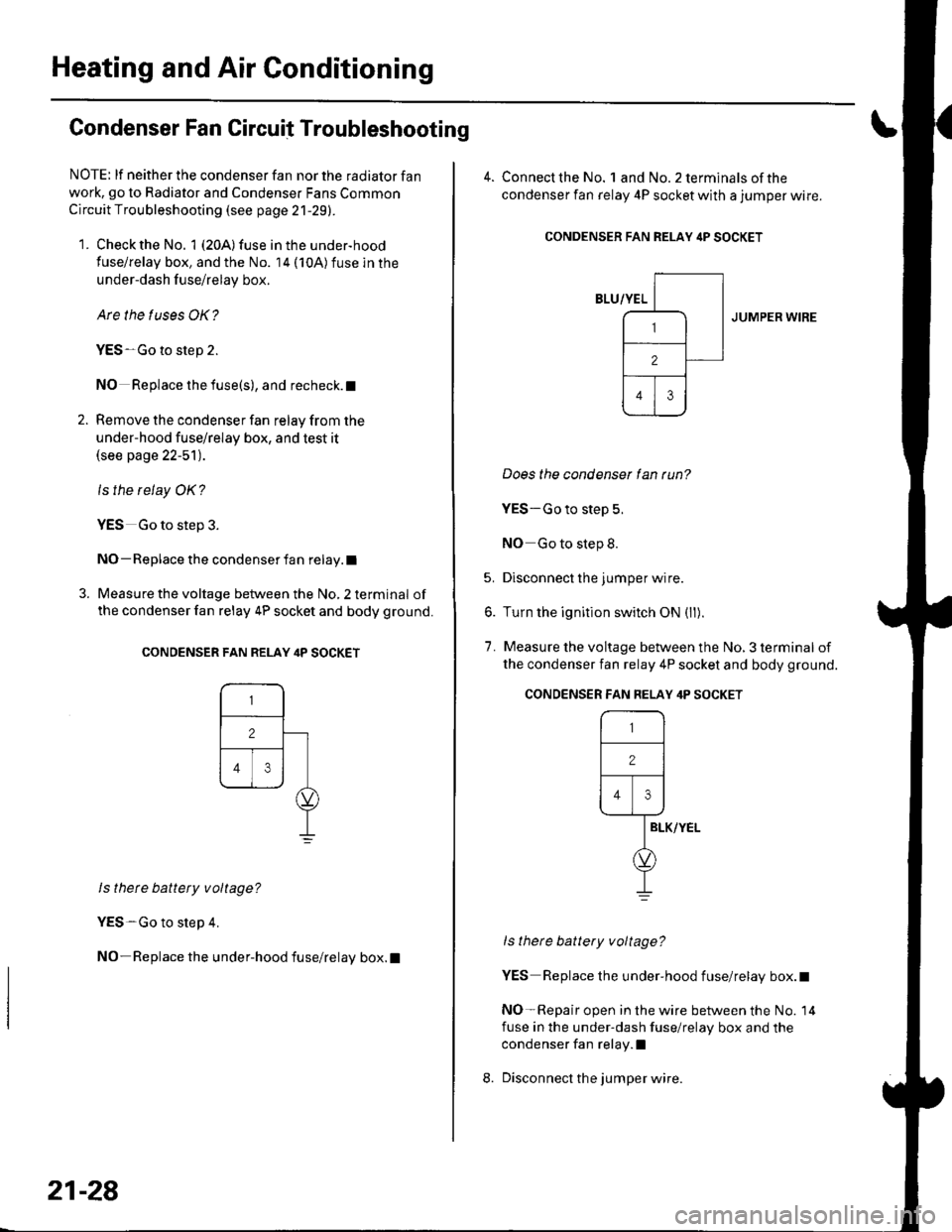
Condenser Fan Circuit Troubleshooting
NOTE: lf neither the condenser fan nor the radiator fan
work, go to Radiator and Condenser Fans Common
Circuit Troubleshooting (see page 21-29).
1. Check the No. 1 (20A) fuse in the under-hood
fuse/relay box, and the No. 14 (10A)fuse in the
under-dash f use/relay box.
Are the tuses OK?
YES-Go to step 2.
NO Replace the fuse(s), and recheck. t
2. Remove the condenser fan relay from the
under-hood fuse/relay box, and test it(see page 22-51).
ls the relay OK?
YES Go to step 3.
NO- Replace the condenser fan relay.l
3. Measure the voltage between the No, 2 terminal of
the condenser fan relay 4P socket and body ground.
CONDENSER FAN RELAY ilP SOCKET
ls thete battery voltage?
YES-Go to step 4.
NO-Replace the under-hood fuse/relay box.l
21-28
4. Connect the No. landNo.2terminalsof the
condenser fan relay 4P socket with a jumper wire.
CONDENSER FAN RELAY itP SOCKET
JUMPER WIRE
Does the condenser lan tun?
YES-Go to step 5.
NO Go to step 8.
5. Disconnect the jumper wire.
6. Turn the ignition switch ON (ll).
7. Measure the voltage between the No, 3 terminal of
the condenser fan relay 4P socket and body ground.
ls there battery voltage?
YES Replace the under-hood fuse/relay box.t
NO-Repair open in the wire between the No. 14
fuse in the under-dash fuse/relay box and the
condenser fan relay.l
Disconnect the jumper wire.
CONDENSER FAN FELAY 4P SOCKET
r-,_-l
12 |
Flr\----1--rl
IELK/YEL
d,
I
Page 800 of 1139
9.
10.
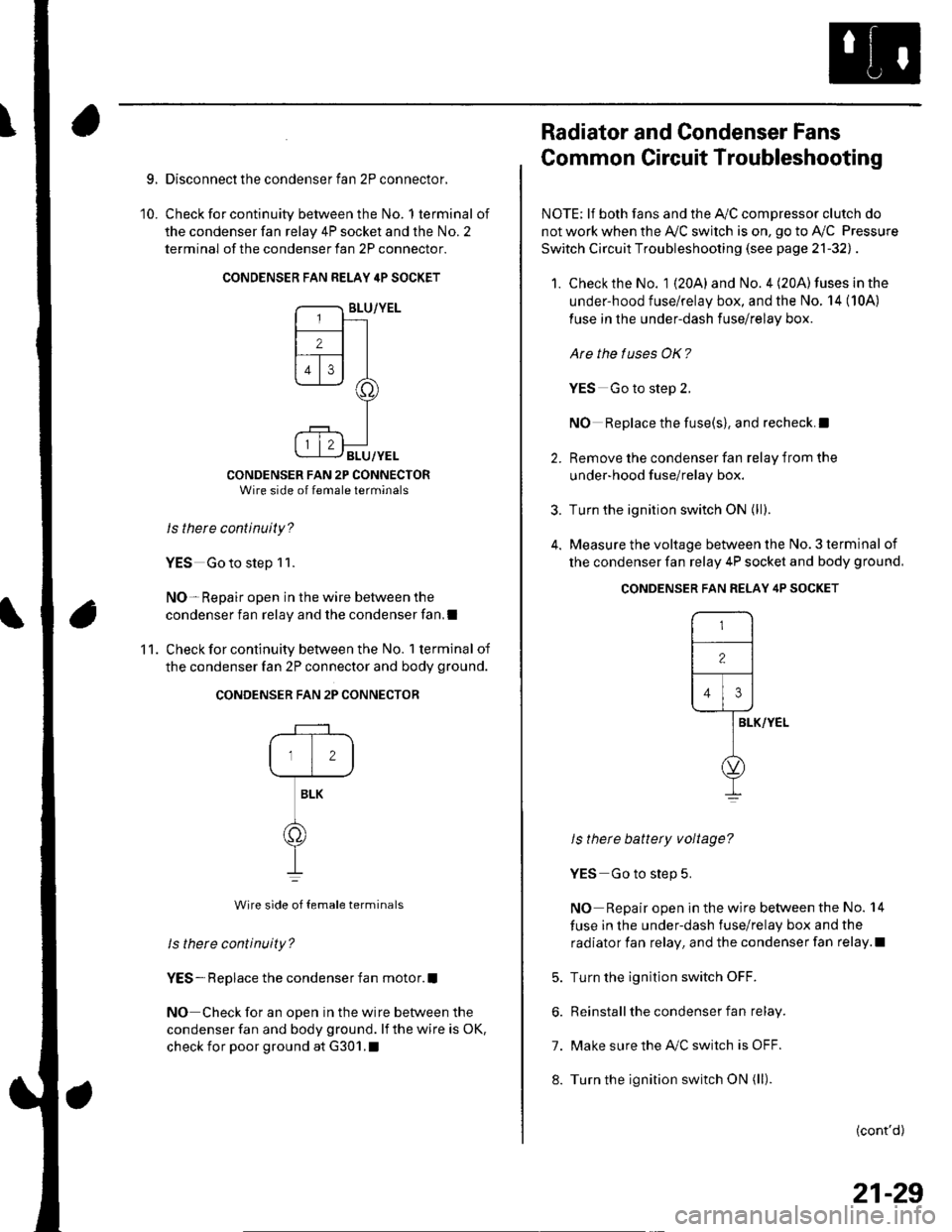
Disconnect the condenser fan 2P connector,
Check for continuity between the No. 1 terminal of
the condenser fan relay 4P socket and the No. 2
terminal of the condenser fan 2P connector.
CONDENSER FAN RELAY 4P SOCKET
CONDENSER FAN 2P CONNECTORWire side of female terminals
Is there continuity?
YES Go to step 1 1.
NO- Repair open in the wire between the
condenser fan relay and the condenser fan,I
Check for continuity between the No. 1 terminal of
the condenser fan 2P connector and body ground.
CONDENSER FAN 2P CONNECTOR
12
BLK
o
Wire side of {emale terminals
ls there continuity?
YES- Replace the condenser fan motor.I
NO Check for an open in the wire between the
condenser fan and body ground. lf the wire is oK,
check for poor ground at G301.1
'11 .
Radiator and Condenser Fans
Common Circuit Troubleshooting
NOTE; lf both fans and the Ay'C compressor clutch do
not work when the Ay'C switch is on, go to Ay'C Pressure
Switch Circuit Troubleshooting (see page 21-32l, .
1. Check the No. 1 {20A} and No. 4 (20A) fuses in the
under-hood fuse/relay box, and the No. 14 (10A)
fuse in the under-dash fuse/relay box.
Are the tuses OK?
YES Go to steD 2.
NO Replace the fuse(s), and recheck.l
2. Remove the condenser fan relav from the
under-hood f use/relay box.
3. Turn the ignition switch ON (ll;.
4. Measure the voltage between the No. 3 terminal of
the condenser fan relay 4P socket and body ground.
ls there battery voltage?
YES Go to step 5.
NO Repair open in the wire between the No. 14
fuse in the under-dash fuse/relay box and the
radiator fan relay, and the condenser fan relay.l
5. Turn the ignition switch OFF.
6. Reinstall the condenser fan relay.
7. Make sure the IVC switch is OFF.
8. Turn the ignition switch ON (ll).
(cont'd)
CONDENSER FAN RELAY 4P SOCKET
r-,
-l
12lf---r---
l,l,l
lar-vver-
l
o
I
21-29
Page 801 of 1139
Heating and Air Conditioning
Radiator and Condenser Fans
Common
(cont'dl
Circuit Troubleshooting
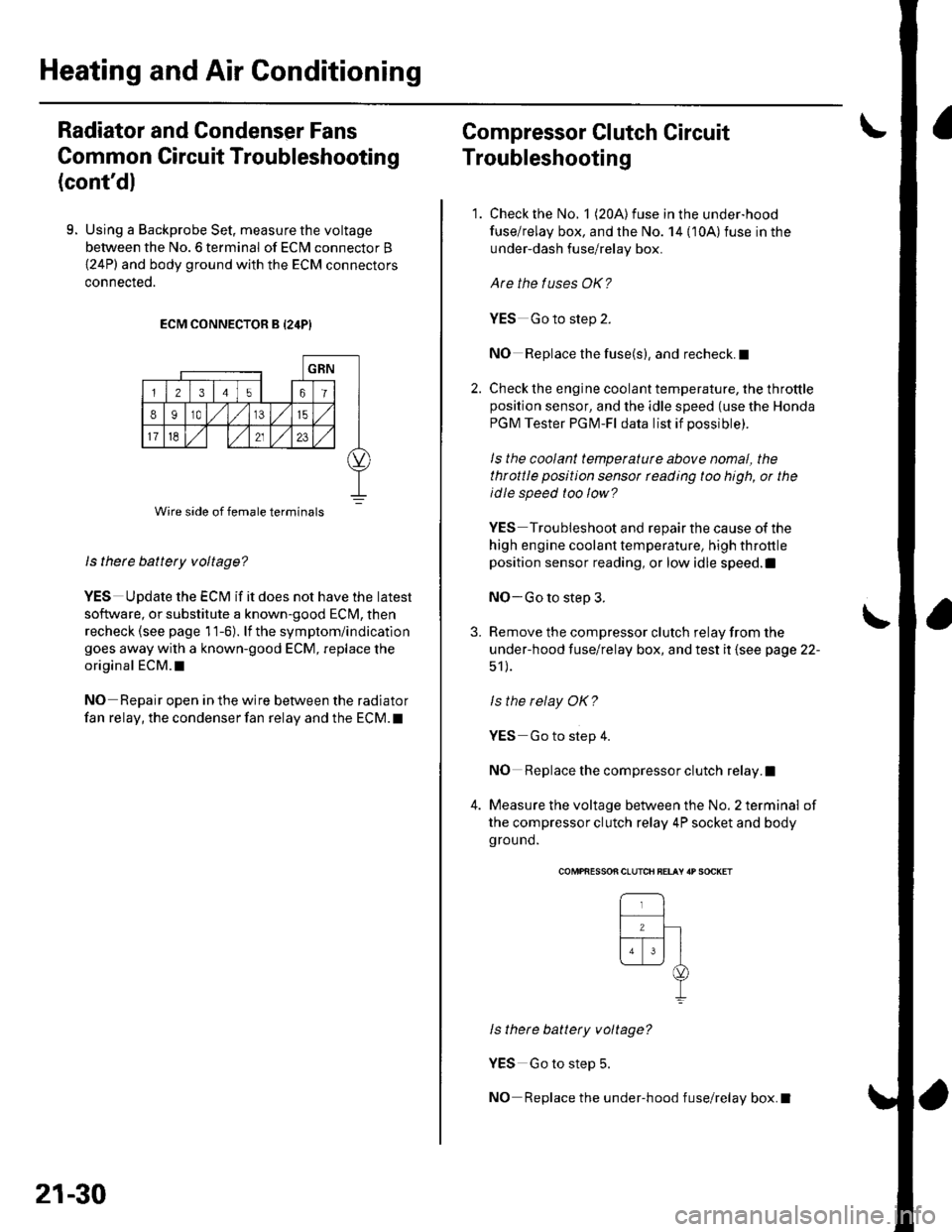
9. Using a Backprobe Set, measure the voltage
between the No. 6 terminal of ECN4 connector B
{24P) and body ground with the ECM connectors
connecteo.
ECM CONNECTOR B {24P}
ls there battery voltage?
YES UDdate the ECM if it does not have the latest
so{tware, or substitute a known-good ECM, then
recheck (see page 11-6). lf the symptom/indication
goes away with a known-good ECM, replace the
original ECM.I
NO Repair open in the wire between the radiator
fan relay, the condenser fan relay and the ECM. t
Wire side of female terminals
21-30
Compressor Clutch Circuit
Troubleshooting
1. Check the No. 1 (20A) fuse in the under-hood
fuse/relay box, and the No. 14 {10A)fuse in the
under-dash fuse/relay box.
Are the tuses OK?
YES Go to step 2.
NO Replace the fuse(s), and recheck.I
2. Check the engine coolant temperature, the throttleposition sensor, and the idle speed (use the Honda
PGM Tester PGM-Fl data list if possible).
ls the coolant temperaturc above nomal, the
throttle position sensor rcading too high, or the
idle speed too low?
YES Troubleshoot and repair the cause of the
high engine coolant temperature, high throttle
position sensor reading, or low idle speed.l
NO-Go to step 3.
3. Remove the compressor clutch relay from the
under-hood fuse/relay box, and test it (see page 22-
51 ).
ls the relay OK?
YES Go to step 4.
NO Replace the compressor clutch relay.I
4. Measure the voltage between the No. 2 terminal of
the compressor clutch relay 4P socket and body
ground.
\
COMPfiESSON CLUTCH BELAY 'P SOCKET
ls there battery voltage?
YES Go to step 5.
NO Replace the under-hood fuse/relay box.I
Page 814 of 1139
Heater Unit/Core Replacement
SRS components are located in this area. Review the
SRS component locations (see page 23'13), and
precautions and procedures (see page 23-14) in the SRS
section before performing repairs or service.
1. Make sure you have the anti-theft code forthe radio,
then write down the freouencies for the radio's
Dreset buttons.
4.
Disconnect the negative cable from the battery,
Disconnect the suction and receiver lines from the
evaporator core (see page 21-42).
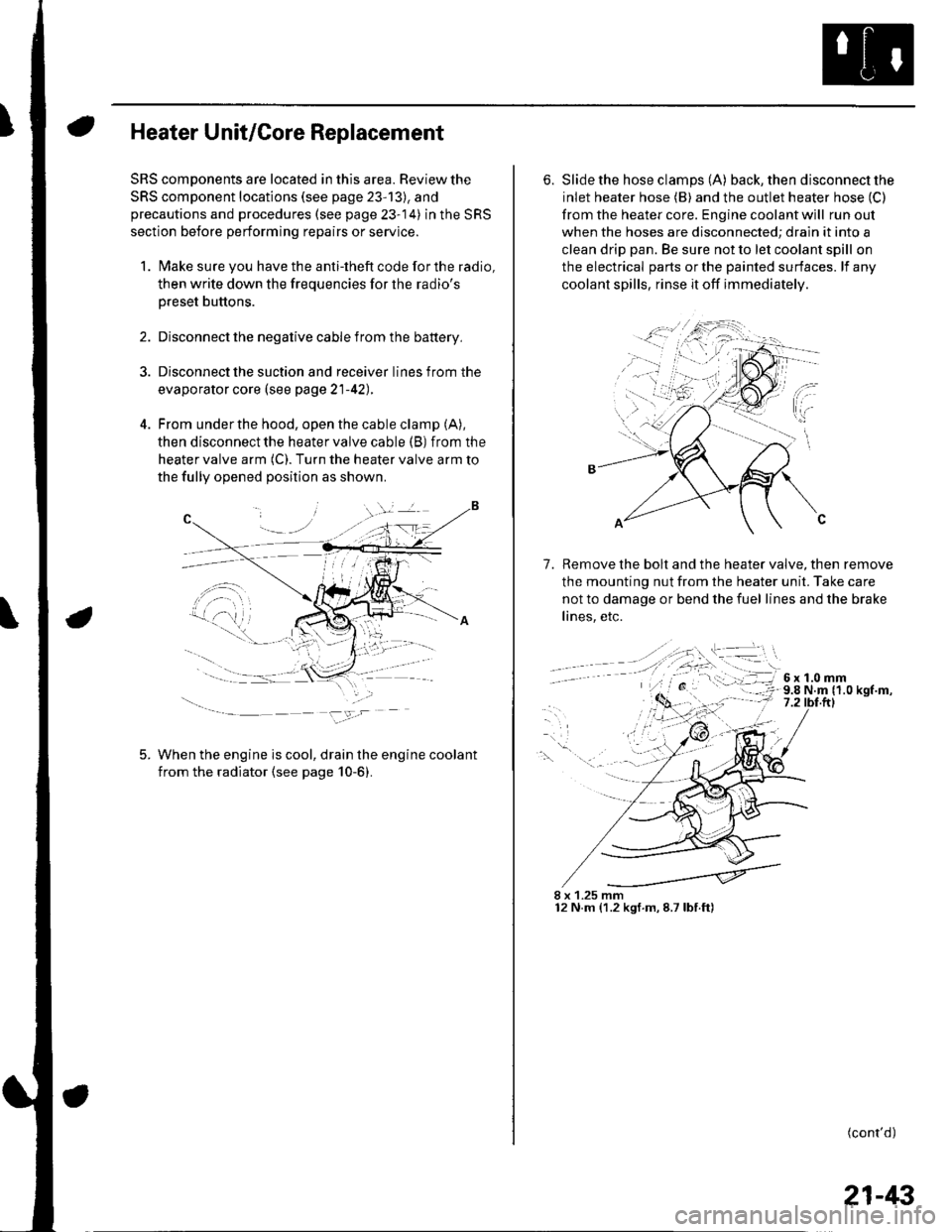
From under the hood, open the cable clamp (A),
then disconnect the heater valve cable (B) from the
heater valve arm (C). Turn the heater valve arm to
the fully opened position as shown
When the engine is cool, drain the engine coolant
from the radiator (see page 10-6).
6. Slide the hose clamps (A) back, the n d isconnect the
inlet heater hose (B) and the outlet heater hose (C)
from the heater core. Engine coolant will run out
when the hoses are disconnected; drain it into a
clean drip pan. Be sure not to let coolant spill on
the electrical parts or the painted surfaces. lf any
coolant spills, rinse it off immediately.
Remove the bolt and the heater valve, then remove
the mounting nut from the heater unit. Take care
not to damage or bend the fuel lines and the brake
lines, etc.
7.
8 x 1.25 mm12 N.m (1.2 kgf.m,8.7lbf.ft)
(cont'd)
21-43