Body HONDA CIVIC 2003 7.G Owners Manual
[x] Cancel search | Manufacturer: HONDA, Model Year: 2003, Model line: CIVIC, Model: HONDA CIVIC 2003 7.GPages: 1139, PDF Size: 28.19 MB
Page 387 of 1139
EVAP System
DTC Troubleshooting (cont'd)
DTC Pl457: EVAP Control System(EVAP Canister System)
Leakage
The fuel system is designed to allow specified
maximum vacuum and pressure conditions. Do not
deviate from the vacuum and pressure tests as
indicated in these procedures. Excessive pressure/
vacuum would damage the EVAP components or
cause eventual fuel tank system failure.
SpecialTools Required
Vacuum pump/gauge, 0-30 in.Hg A973X-041-XXXXX
This is a two-trip code. Once cleared, it cannot be
reproduced in one trip. Also, certain specific driving
and ambient conditions must occur before the ECfM will
complete the system checks, Additional test drives may
still not meet the specific conditions needed to16^r^.1' '^6 rh6 ^^.16
Follow these troubleshooting procedures carefully to
ensure the integrity of the system and to confirm the
cause of the problem or code.
NOTE: Fresh fuel has a higher volatility lhat creates
greater pressure/vacuum. The optimum condition for
testing is fresh fuel, and there must be less than a full
tank. lf possible, to assist in leak detection, add I gallon
of fresh fuel to the tank (as long as it will not fill the
tank), just before starting these procedures.
EVAP Canister Purge Valve Test
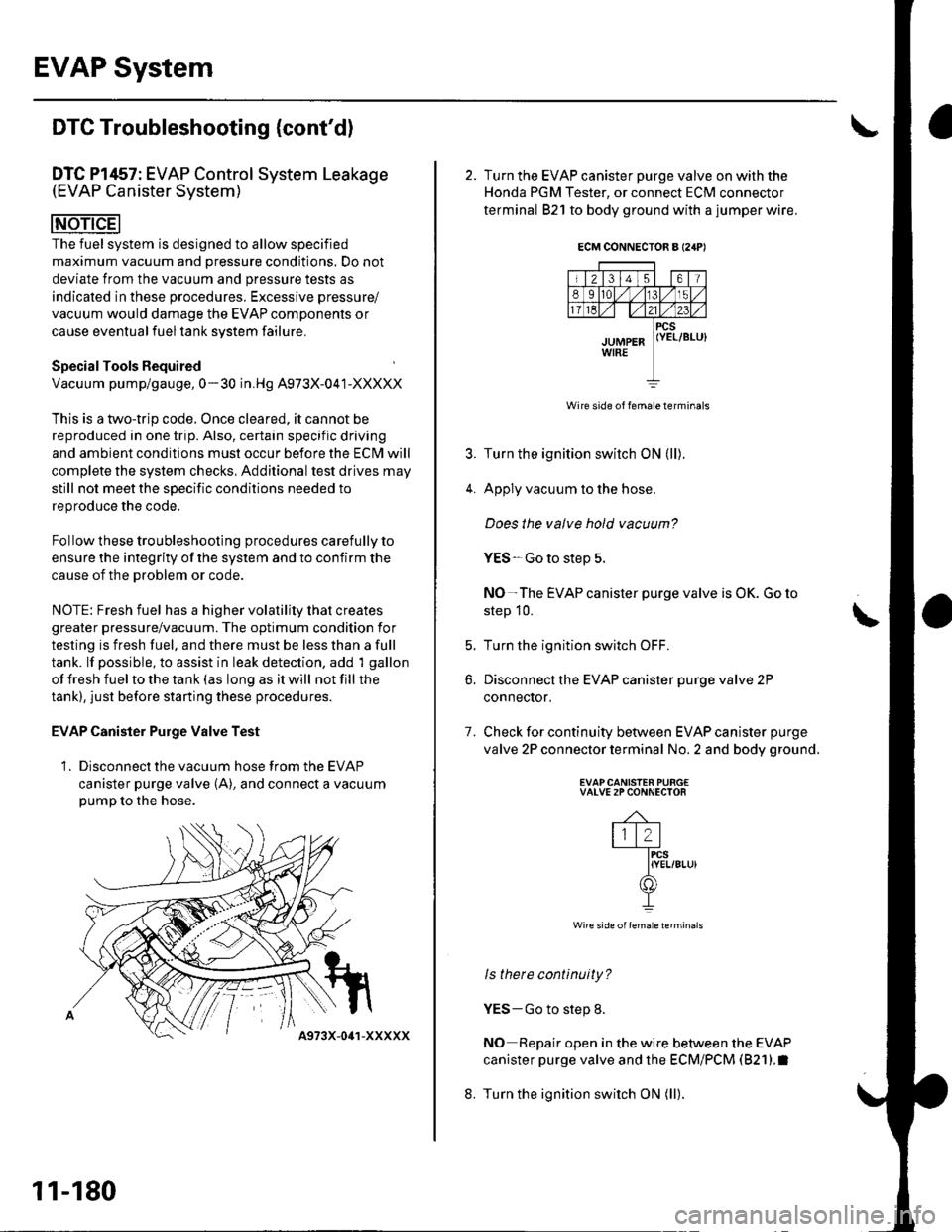
1. Disconnect the vacuum hose from the EVAP
canister purge valve (A), and connect a vacuumpump to the hose.
11-180
4973X-041-XXXXX
ECM CONNECTOR A I24P'
Wire side of lemale terminals
4.
7.
2. Turn the EVAP canister purge valve on with the
Honda PGM Tester, or connect ECM connector
terminal 821 to body ground with a jumper wire.
Turn the ignition switch ON (ll).
Apply vacuum to the hose.
Does the valve hold vacuum?
YES-Go to step 5.
NO-The EVAP canister purge valve is OK. Go to
step 10.
Turn the ignition switch OFF.
Disconnect the EVAP canister purge valve 2P
conneclor,
Check for continuity between EVAP canister purge
valve 2P connector terminal No. 2 and body ground.
EVAPCANISTEN PURG€VALVE 2P CONNECTOR
-4-
lll2l-fircs
IYEL/8Lu)(f])
I
Wire side offemale lerminals
ls there continuity?
YES-Go to step 8.
NO Repair open in the wire between the EVAP
canister purge valve and the ECM/PCM (821).I
Turn the ignition switch ON (ll).
t
b.
8.
Page 388 of 1139
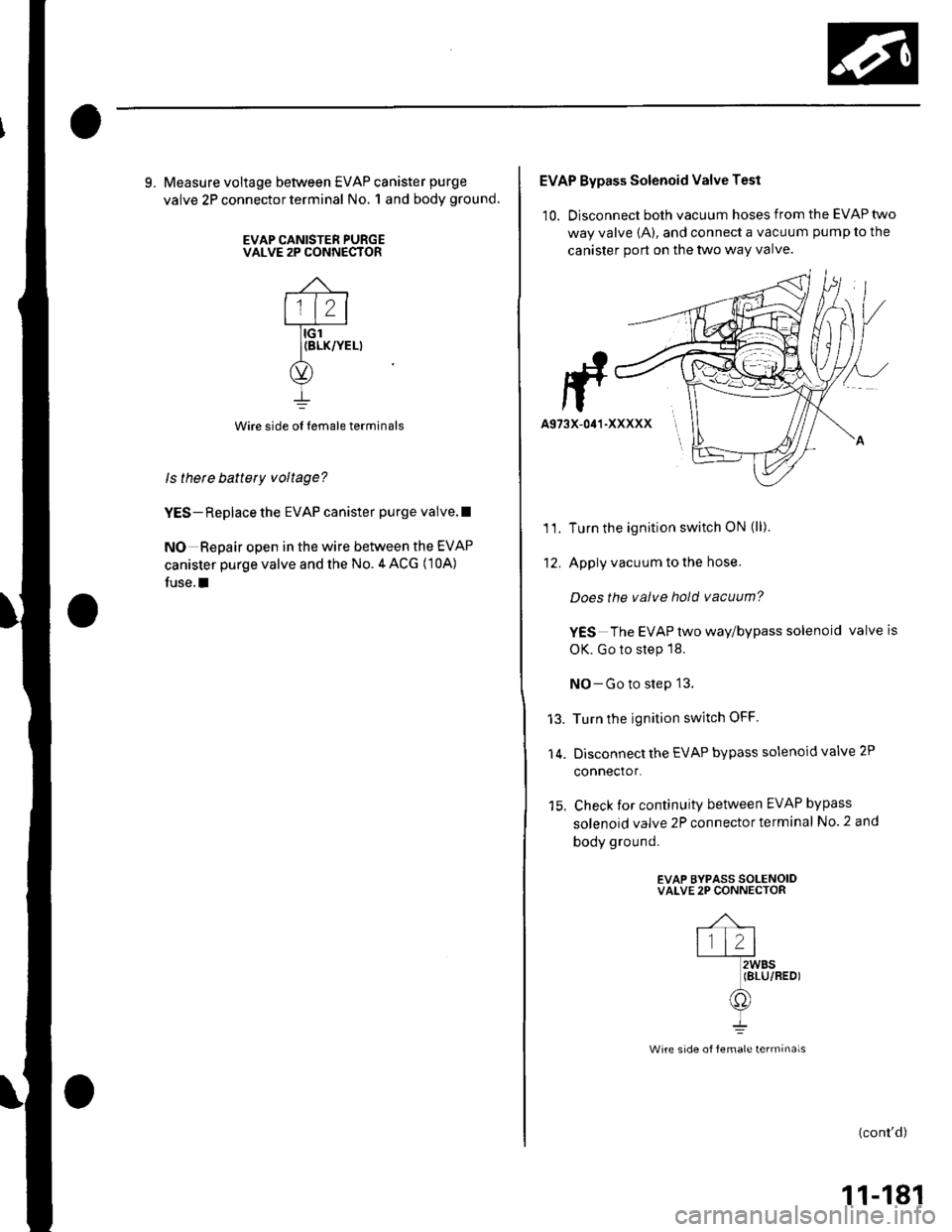
9. Measure voltage between EVAP canister purge
valve 2P connector terminal No. 1 and body ground.
EVAP CANISTER PURGEVALVE 2P CONNECTOR
Wire side oI lemale terminals
ls thete battery voltage?
YES- Replace the EVAP canister purge valve.l
NO Repair open in the wire between the EVAP
canister purge valve and the No.4 ACG (10A)
fuse.I
EVAP Bypass Solenoid Valve Test
10. Disconnect both vacuum hoses from the EVAP two
way valve {A), and connect a vacuum pump to the
canister port on the two way valve.
Turn the ignition switch ON (ll).
Apply vacuum to the hose.
Does the valve hold vacuum?
YES The EVAP two way/bypass solenoid valveis
OK. Go to step 18.
NO-Go to step 13.
Turn the ignition switch OFF.
Disconnect the EVAP bypass solenoid valve 2P
connector.
Check for continuity between EVAP bypass
solenoid valve 2P connector terminal No. 2 and
body ground.
EVAP BYPASS SOLENOIDVALVE 2P CONNECTOR
11.
'It
14.
(cont'd)
11-181
Wire side of female terminals
Page 389 of 1139
EVAP System
to.
't7.
DTC Troubleshooting (cont'd)
ls there continuity?
YES Go to step 16.
NO- Replace the EVAP two waylbypass solenoidvalve (A).1
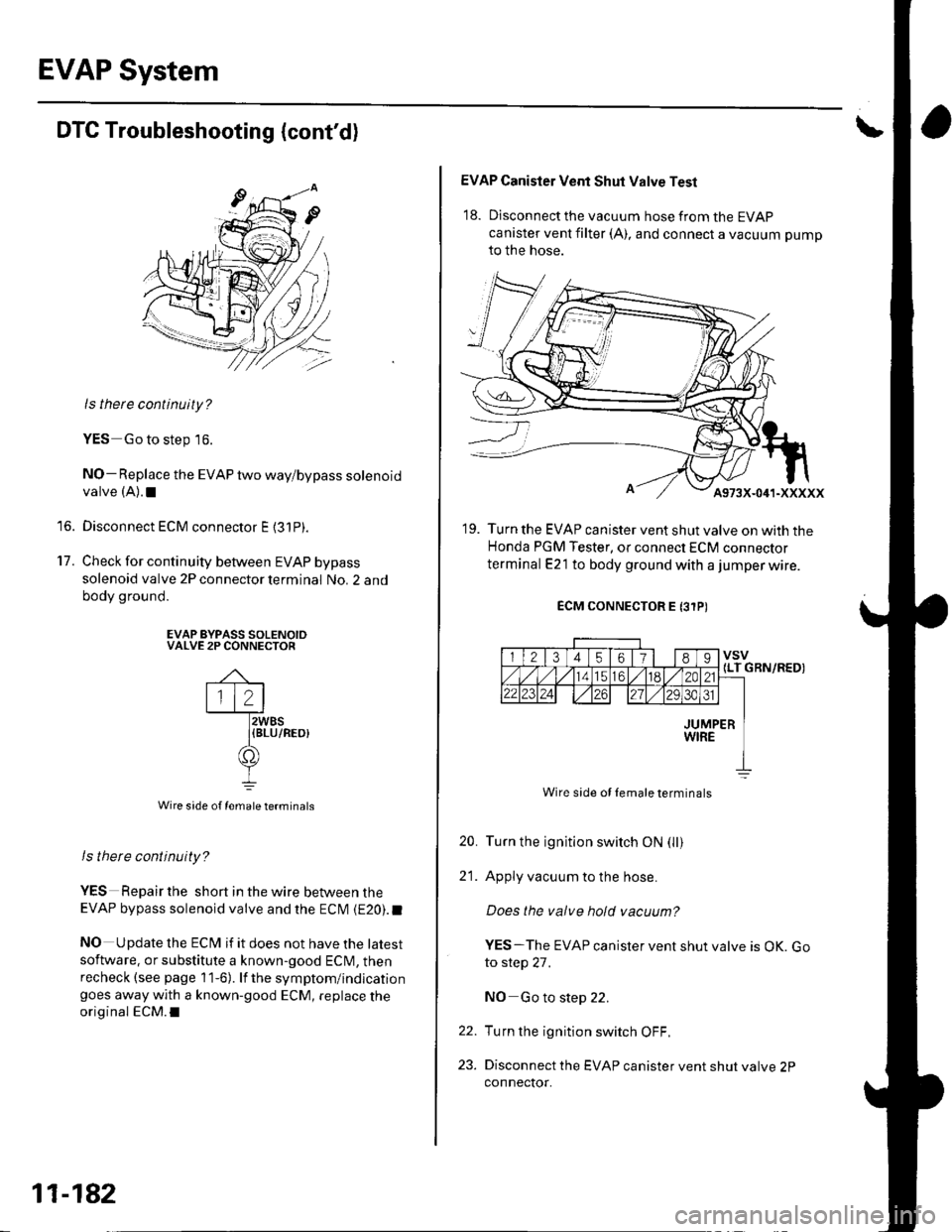
Disconnect ECM connector E {31P).
Check for continuity between EVAP bypass
solenoid valve 2P connector terminal No. 2 and
body ground.
ls there continuity?
YES Repair the short in the wire between theEVAP bypass solenoid valve and the ECM {E20). f
NO Update the ECI\4 if it does not have the latest
software. or substitute a known-good EClvl, thenrecheck (see page 11-6). lf the symptom/indlcationgoes away with a known-good ECM, replace theoriginal ECM.I
EVAP BYPASS SOLENOIDVALVE 2P CONNECTOR
\,
lll2lI t-l2WBS
-[BLU/REo)())
I
Wire side of female terminals
11-182
EVAP Canisler Vent Shut Valve Test
18. Disconnect the vacuum hose from the EVAP
canister vent filter (A), and connect a vacuum pump
to the hose.
19. Turn the EVAP canister vent shut valve on with theHonda PGM Tester, or connect ECM connector
terminal E21 to body ground with a jumper wire.
ECM CONNECTOR E (3TP)
112134589vsv{LT (1/15tal/la2A21
z3lz4zil./m31
JUMPERWIRE
Wire side ol lemale terminals
Turn the ignition switch ON (ll)
Apply vacuum to the hose.
Does the valve hold vacuum?
YES-The EVAP canister vent shut valve is OK. Goto step 27.
NO Go to step 22.
Turn the ignition switch OFF.
Disconnect the EVAP canister vent shut valve 2Pconnector.
GBN/RED)
20.
21.
22.
23.
Page 390 of 1139
25.
26.
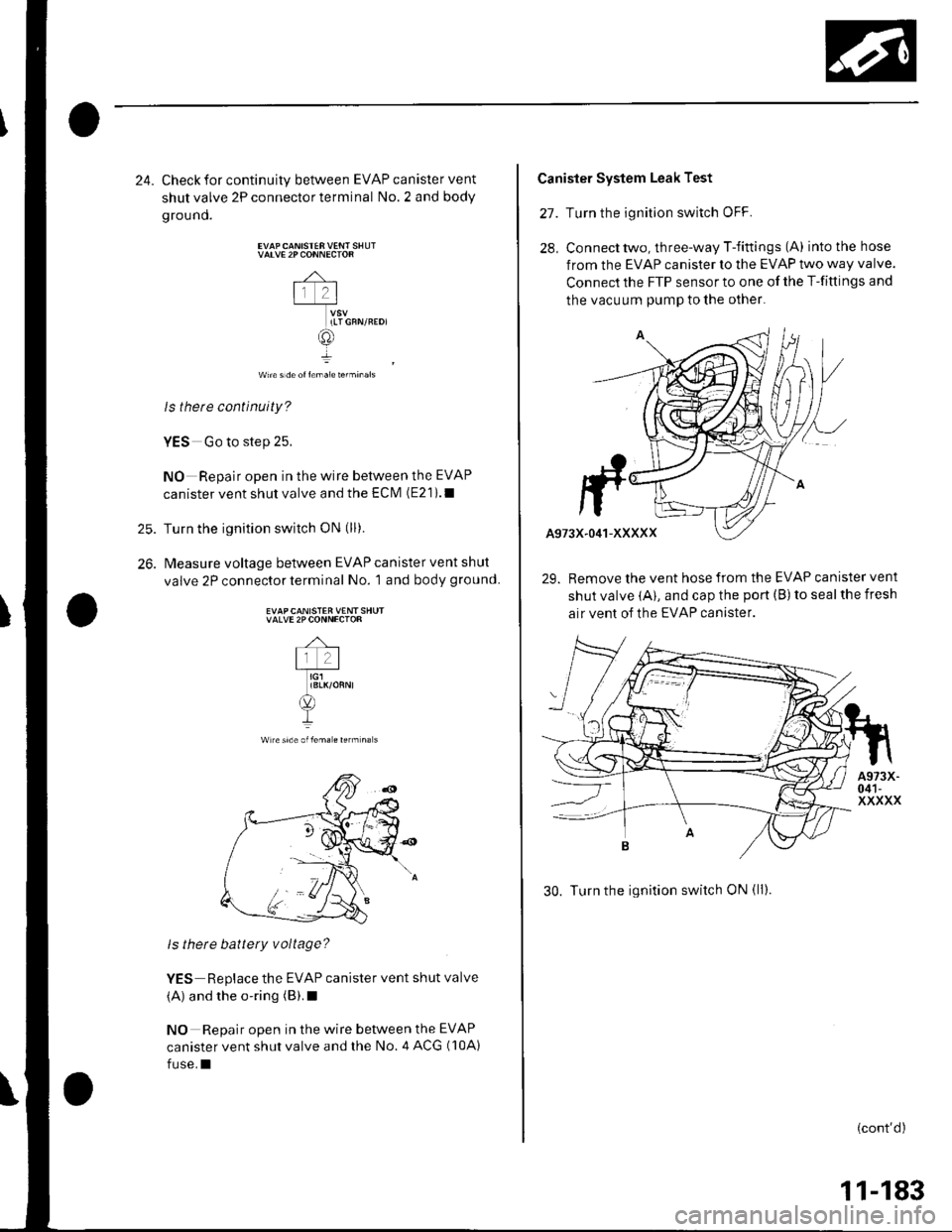
24. Check for continuity between EVAP canister vent
shutvalve 2Pconnectorterminal No.2 and body
ground.
VATVE 2P CONNECTOR
-4-
lr 2l-T_*u
ILTGFN/REDI
@
wn€ s de ol l€ma1e terminals
ls therc continuity?
YES Go to step 25.
NO Repair open in the wire between the EVAP
canister vent shut valve and the ECIVI (E21).1
Turn the ignition switch oN (ll).
Measure voltage between EVAP canister vent shut
valve 2P connector terminal No. 1 and body ground.
EVAPCANISTER VENT SHUTVALVE 2PCONNECTOR
Wlreside oflem. € rerm na s
ls there battery voltage?
YES Replace the EVAP canister vent shut valve
(A) and the o-ring (B).I
NO Repair open in the wire between the EVAP
canister vent shut valve and the No. 4 ACG (10A)
fuse.I
Canister System Leak Test
27. Turn the ignition switch oFF.
28, Connecttwo, three-way T-fittings (A) intothehose
from the EVAP canister to the EVAP two way valve.
Connect the FTP sensor to one of the T-fittings and
the vacuum pump to the othel
29. Remove the vent hose from the EVAP canister vent
shut valve (A), and cap the port (B) to seal the fresh
air vent of the EVAP canister.
30. Turn the ignition switch ON (ll).
(cont'd)
11-183
Page 504 of 1139
Steering
Steering Lock Replacement
NOTE: Do not try to re-key a replacement steering lock.
lf necessary, re-key the other locks.
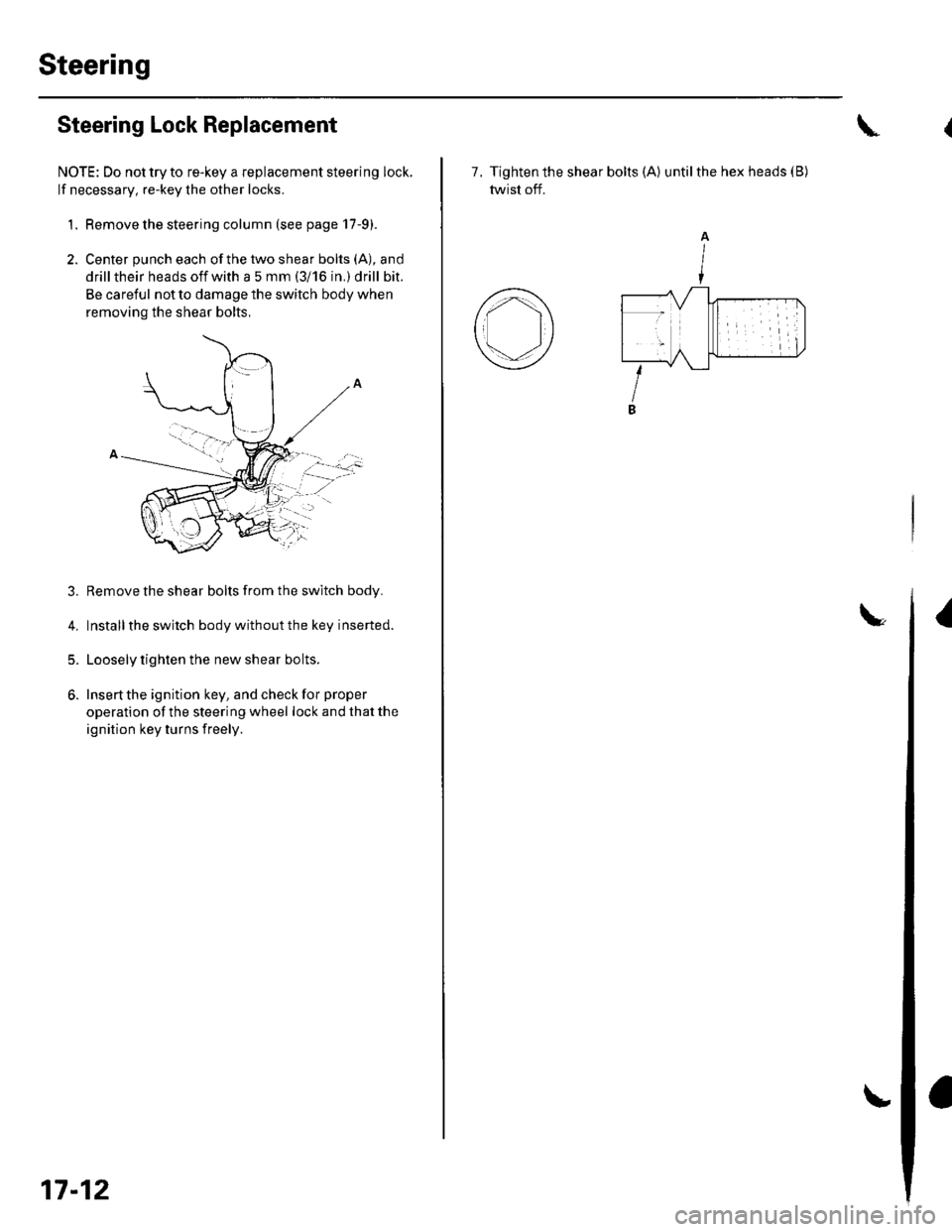
1. Remove the steering column (see page 17-9).
2. Center punch each ofthe two shear bolts (A), and
drill their heads off with a 5 mm (3i 16 in.) drill bit.
Be careful not to damage the switch body when
removing the shear bolts,
3. Remove the shear bolts from the switch body.
4. Installthe switch body without the key inserted.
5. Loosely tighten the new shear bolts.
6. Insert the ignition key, and check for proper
operation of the steering wheel lock and that the
ignition key turns freely.
:..'-":'
17-12
7. Tighten the shear bolts (A) untilthe hex heads (B)
twist off.
I
A
I
Page 510 of 1139
How to Troubleshoot EPS DTCs
The troubleshooting flowchart procedures assume that
the cause of the problem is still present and the EPS
indicator is still on, Following the flowchart when the
EPS indicator does not come on can result in incorrect
diagnosis.
The connector iliustrations show the female terminal
connectors with a single outline and the male terminal
connectors with a double outline.
1. Ouestion the customer about the conditions when
the problem occured, and try to reproduce the
same conditions for troubleshooting. Find out
when the EPS indicator came on, such as while
turning. afterturning, when the vehicle was at a
ce rta in speed, etc.
2. When the EPS indicator does not come on during
the test drive, but troubleshooting is done based on
the DTC, check for loose connectors, poor terminal
contact. etc in the affected circuit, before you start
troubleshooting.
3. After trou bleshooting, clear the DTC and test-drive
the vehicle. Be sure the EPS indicator does not
come on.
How to Retrieve EPS DTCs
Honda PGM Tester Method:
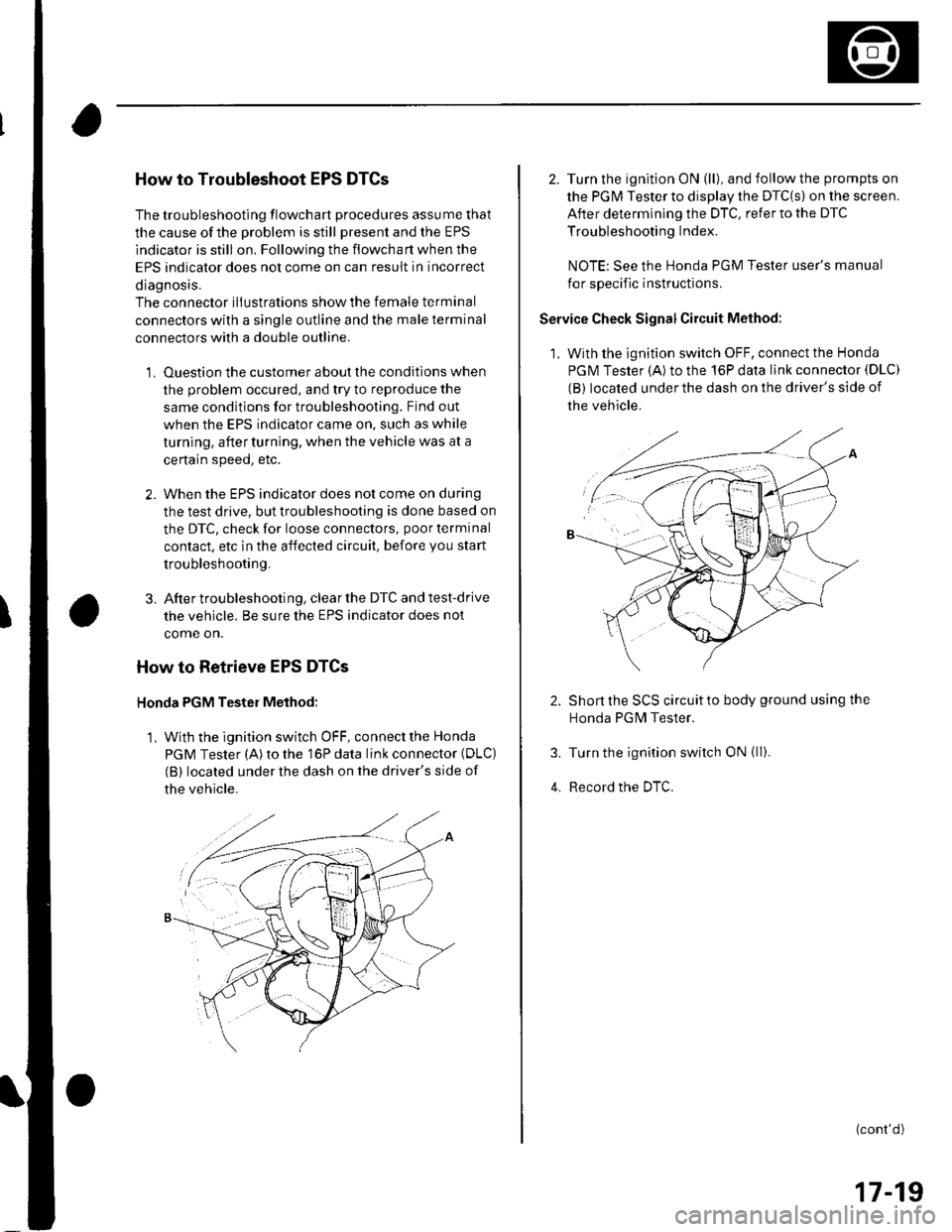
1, With the ignition switch OFF, connect the Honda
PGM Tester (A) to the 16P data link connector (DLC)
(B) located under the dash on the driver's side of
the vehicle.
2. Turn the ignition ON (ll), and follow the prompts on
the PGM Tester to display the DTC(s) on the screen.
After determining the DTC, refer to the DTC
Troubleshooting Index.
NOTE: See the Honda PGM Tester user's manual
for specific instructions.
Service Check Signal Circuit Method:
1. With the ignition switch OFF, connect the Honda
PGM Tester (A)to the 16P data link connector (DLC)
(B) located under the dash on the driver's side of
the vehicle.
Short the SCS circuit to body ground using the
Honda PGN4 Tester.
Turn the ignition switch ON {ll).
Record the DTC.
(cont'd)
17-19
Page 511 of 1139
EPS Components
General Troubleshooting Information (cont'dl
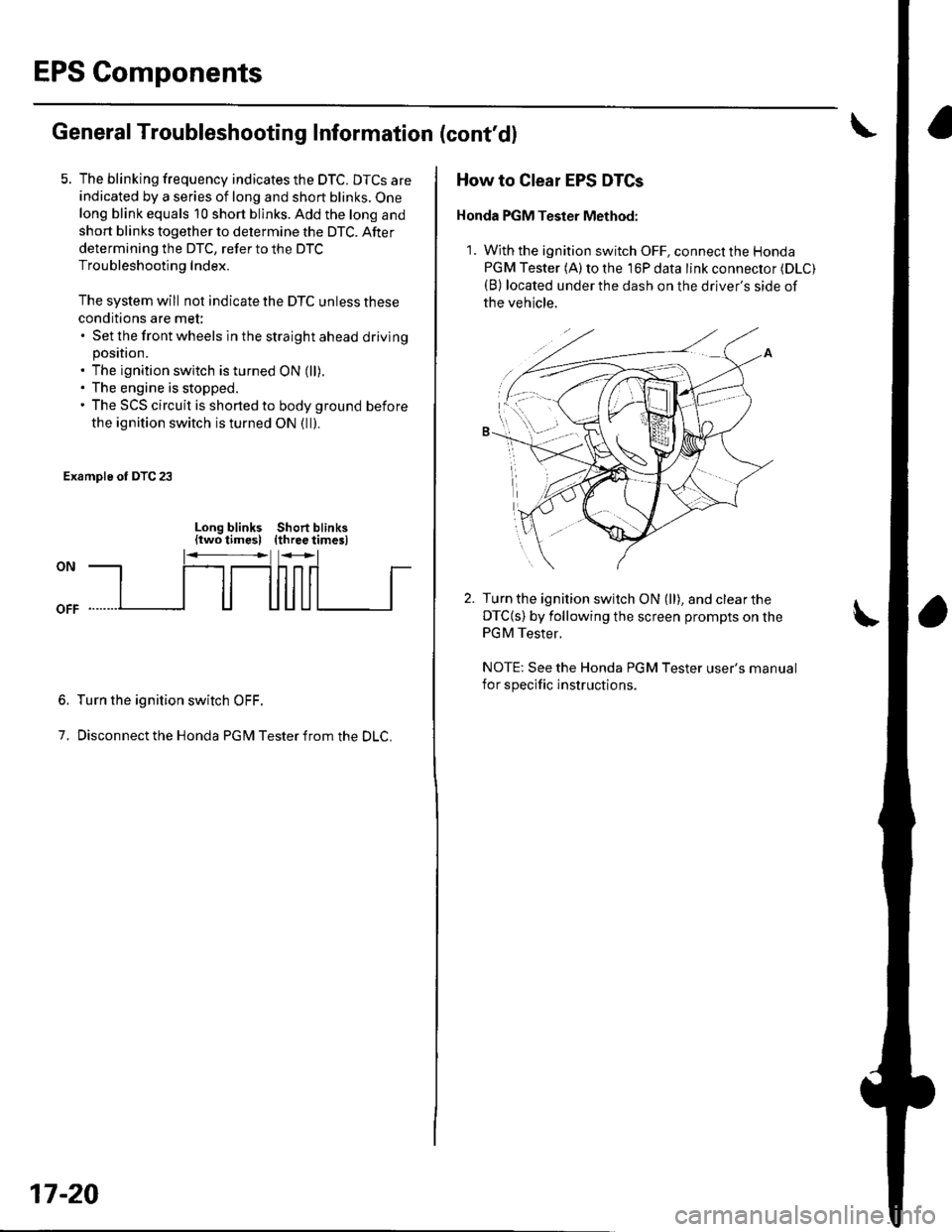
5. The blinking frequency indicates the DTC. DTCS are
indicated by a series of long and short blinks. One
long blink equals 10 short blinks. Add the long and
short blinks together to determine the DTC. After
determining the DTC, refer to the DTC
Troubleshooting Index.
The system will not indicate the DTC unless these
conditions are met:. Set the front wheels in the straight ahead drivingposition.. The ignition switch is turned ON (ll).. The engine is stopped.. The SCS circuit is shorted to body ground before
the ignition switch is turned ON (ll).
Example of DTC 23
Long blinks Short blinks(two times) (three timesl
6.
7.
Turn the ignition switch OFF.
Disconnect the Honda PGM Tester from the DLC.
17-20
How to Clear EPS DTCs
Honda PGM Tesler Method:
1. With the ignition switch OFF, connect the Honda
PGM Tester (A) to the 16P data link connector (DLC)
(B) located under the dash on the driver's side of
the vehicle.
Turn the ignition switch ON (ll), and clear the
DTC{s) by following the screen prompts on the
PGM Tester.
NOTE: See the Honda PGM Tester user's manual
for specific instructions.
Page 512 of 1139
Service Check Signal Circuit Method:
NOTE: Use this procedure when the PGM Tester
software does not match the yearlmodel vehicle you
are working on.
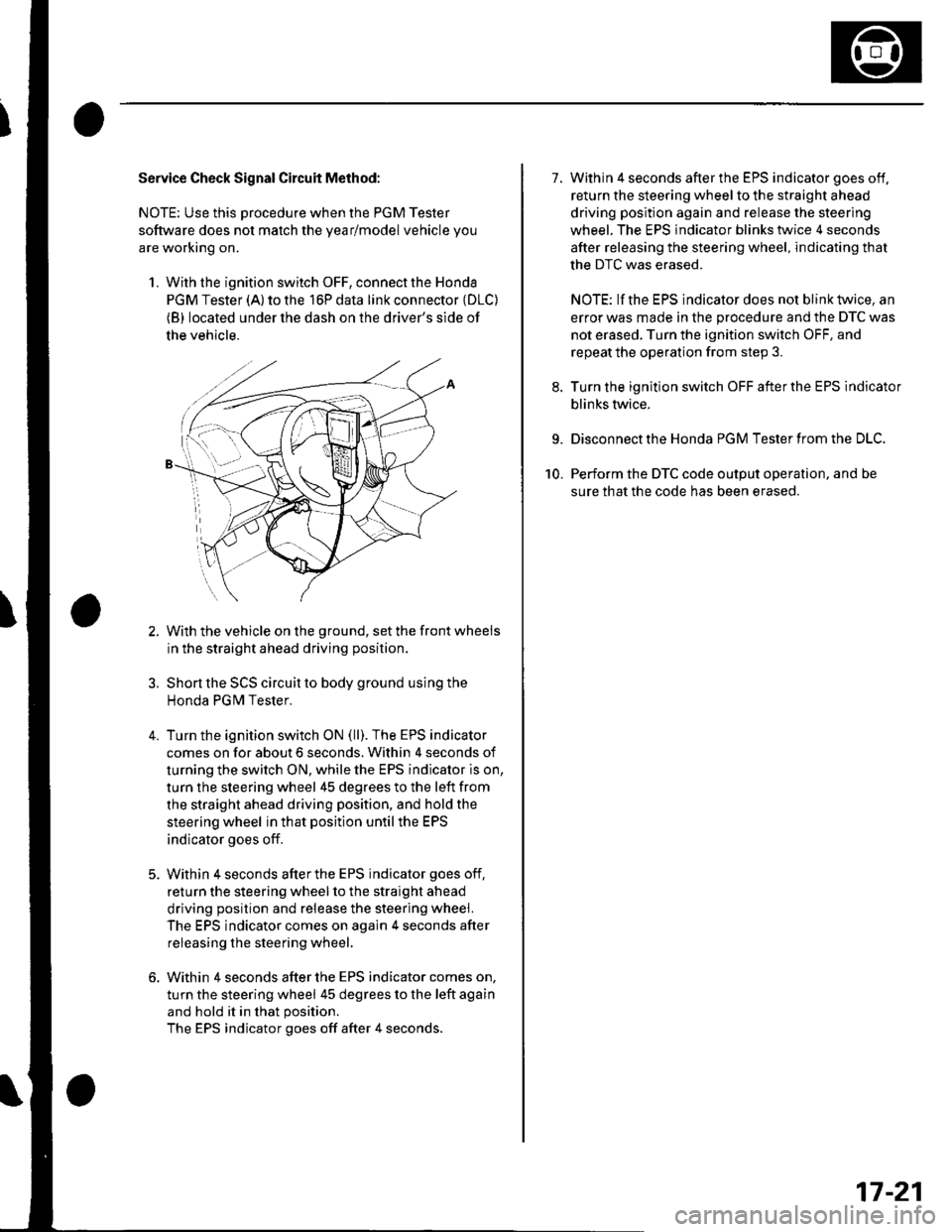
1. With the ignition switch OFF, connect the Honda
PGM Tester (A) to the 16P data link connector {DLC)(B) located under the dash on the driver's side of
the vehicle.
With the vehicle on the ground, set the front wheels
in the straight ahead driving position.
Short the SCS circuit to body ground using the
Honda PGM Tester.
Turn the ignition switch ON (ll). The EPS indicator
comes on for about 6 seconds. Within 4 seconds of
turning the switch ON, while the EPS indicator is on,
turn the steering wheel 45 degrees to the left from
the straight ahead driving position, and hold the
steering wheel in that position until the EPS
indicator goes off.
Within 4 seconds afterthe EPS indicator goes off,
return the steering wheel to the straight ahead
driving position and release the steering wheel.
The EPS indicator comes on again 4 seconds after
releasing the steering wheel,
Within 4 seconds after the EPS indicator comes on,
turn the steering wheel 45 degrees to the left again
and hold it in that position.
The EPS indicator goes off after 4 seconds.
4.
1.Within 4 seconds after the EPS indicator goes off,
return the steering wheel to the straight ahead
driving position again and release the steering
wheel. The EPS indicator blinks twice 4 seconds
after releasing the steering wheel, indicating that
the DTC was erased.
NOTE: If the EPS indicator does not blink twice, an
error was made in the procedure and the DTC was
not erased. Turn the ignition switch OFF, and
repeat the operation from step 3.
Turn the ignition switch OFF afterthe EPS indicator
blinks twice.
9. Disconnect the Honda PGM Tester from the DLC.
10. Perform the DTC code output operation, and be
sure that the code has been erased.
17-21
Page 519 of 1139
EPS Components
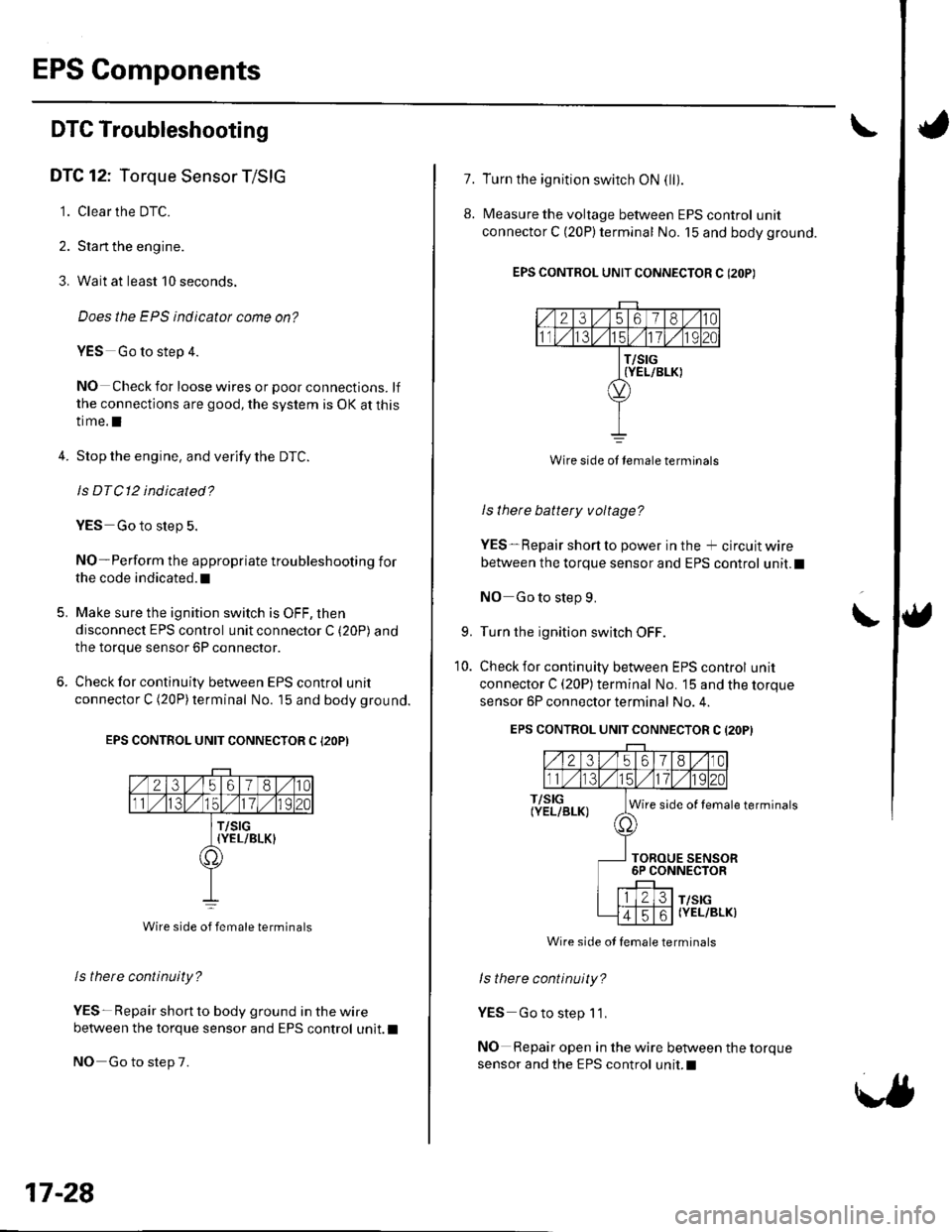
DTC Troubleshooting
DTC 12: Torque Sensor T/SIG
1. Clear the DTC.
2. Stan the engine.
3. Wait at least 10 seconds.
Does the EPS indicatot come on?
YES Go to step 4.
NO Check for loose wires or poor connections. lf
the connections are good, the system is OK at this
time.l
4.Stop the engine, and verify the DTC.
ls DTC12 indicated?
YES Go to slep 5.
NO-Perform the appropriate troubleshooting for
the code indicated. t
Make sure the ignition switch is OFF, then
disconnect EPS control unit connector C (20P) and
the torque sensor 6P connector.
Check for continuity between EPS control unit
connector C (20P)terminal No. 15 and body ground.
EPS CONTROL UNIT CONNECTOR C {2OP)
Wire side of female terminals
ls there continuity?
YES- Repair short to body ground in the wire
between the torque sensor and EPS control unit.l
NO Go to step 7.
5.
17-28
1.
8.
Turn the ignition switch ON (ll).
Measure the voltage between EPS control unit
connector C (20P)terminal No. 15 and body ground.
EPS CONTROL UNIT CONNECTOR C (2OP)
2356180
T/SIG{YEL/BLK)
Wire side ot lemale terminals
I s there battery v oltage?
YES-Repair short to power in the + circuit wire
between the torque sensor and EPS control unit.l
NO Go to step 9.
Turn the ignition switch OFF.
Check for continuity between EPS control unit
connector C (20P) terminal No. 15 and the torque
sensor 6P connector terminal No. 4.
EPS CONTROL UNIT CONNECTOR C (2OPI
\9.
10.
T/SIG(YEL/BLK)Wire side of female terminals
TOROUE SENSOR6P CONNECTOR
T/SIG(YEL/BLK)
ls there continuity?
YES Go to step 1'1,
NO Repair open in the wire between the torque
sensor and the EPS control unit.I
Wire side ot female terminals
Page 520 of 1139
'I 1.Substitute a known-good EPS control unit, and
connect the all disconnected connectors.
Sta rt the engine.
Does the EPS indicator come on?
YES Go to step 13.
NO Check for loose EPS control unitconnectors. lf
necessary, replace the EPS control unit and
retest.l
Stop the engine, and verify the DTC.
ls DTCl2 indicated?
YES Check for loose torque sensor connectors.
lf necessary, substitute a known-good steering
gearbox and recheck.l
NO-Perform the appropriate troubleshooting for
the code indicated. !
12.
13.
DTC 16: Torque Sensor VT3 and W6
1. Clear the DTC.
2. Start the engine.
3. Wait at least 10 seconds.
Does the EPS indicator come on?
YES Go to step 4.
NO Check for loose wires or poor connnections. lf
the connections are good, the system is OK at this
time.l
4. Stop the engine, and verify the DTC.
ls DTC16 indicated?
YES-Go to step 5.
NO Perform the appropriate troubleshooting for
the code indicated. t
5. Make sure the ignition switch is OFF, then
disconnect EPS control unit connector C (20P) and
the torque sensor 6P connector.
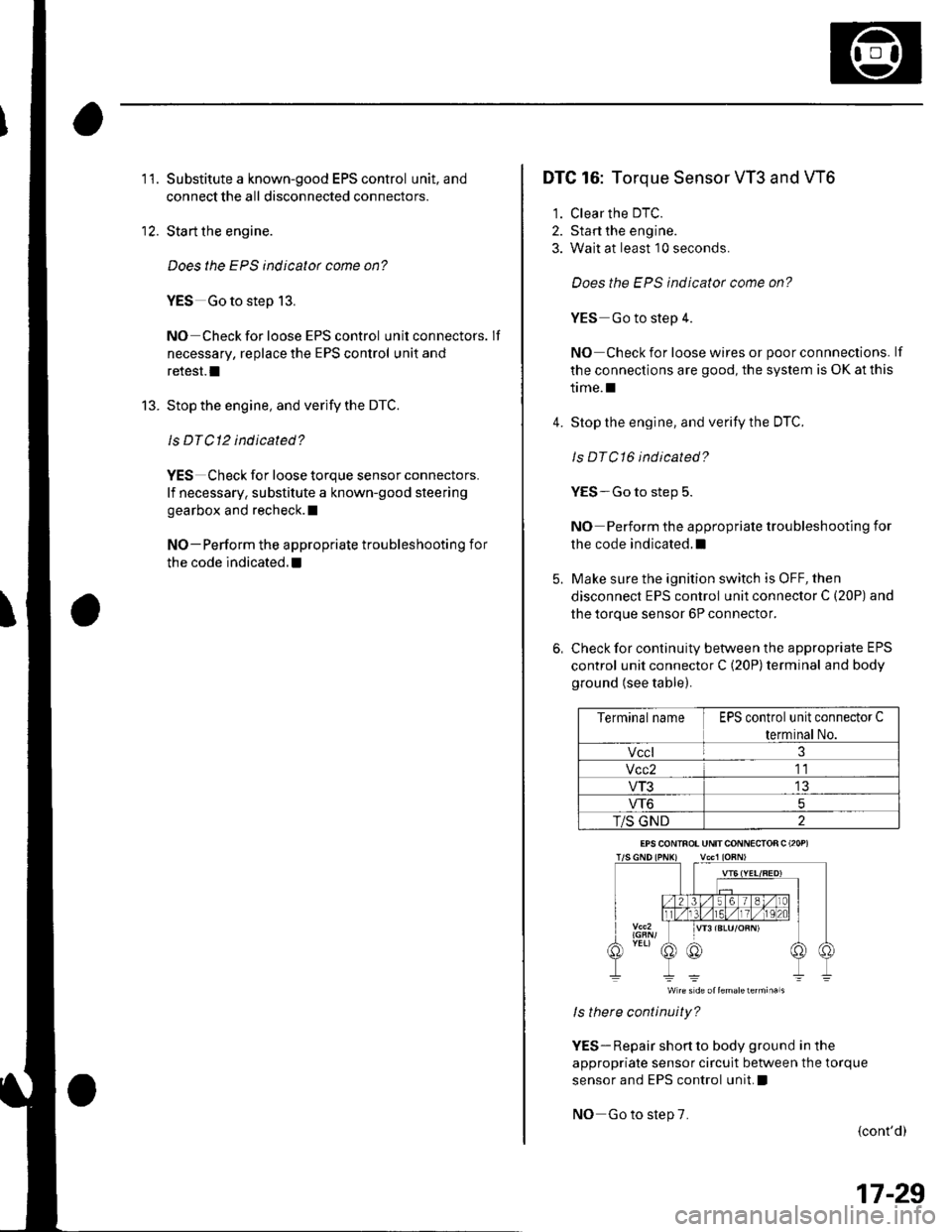
6, Check for continuity between the appropriate EPS
control unit connector C (20P) terminal and body
ground (see table).
Terminal nameEPS control unit connector C
terminal No.
Vccl3
Vcc211
VT313
VT65
T/S GND2
W re s d€ oltemalelermi.als
ls there continuity?
YES- Repair short to body ground in the
appropriate sensor circuit between the torque
sensor and EPS control unit, !
NO Go to step 7.
{cont'd)
EPS CONINOT UNITCONNECIOR C (2OP)
17-29