valve HONDA CIVIC 2003 7.G Workshop Manual
[x] Cancel search | Manufacturer: HONDA, Model Year: 2003, Model line: CIVIC, Model: HONDA CIVIC 2003 7.GPages: 1139, PDF Size: 28.19 MB
Page 391 of 1139
EVAP System
DTC Troubleshooting (cont'dl
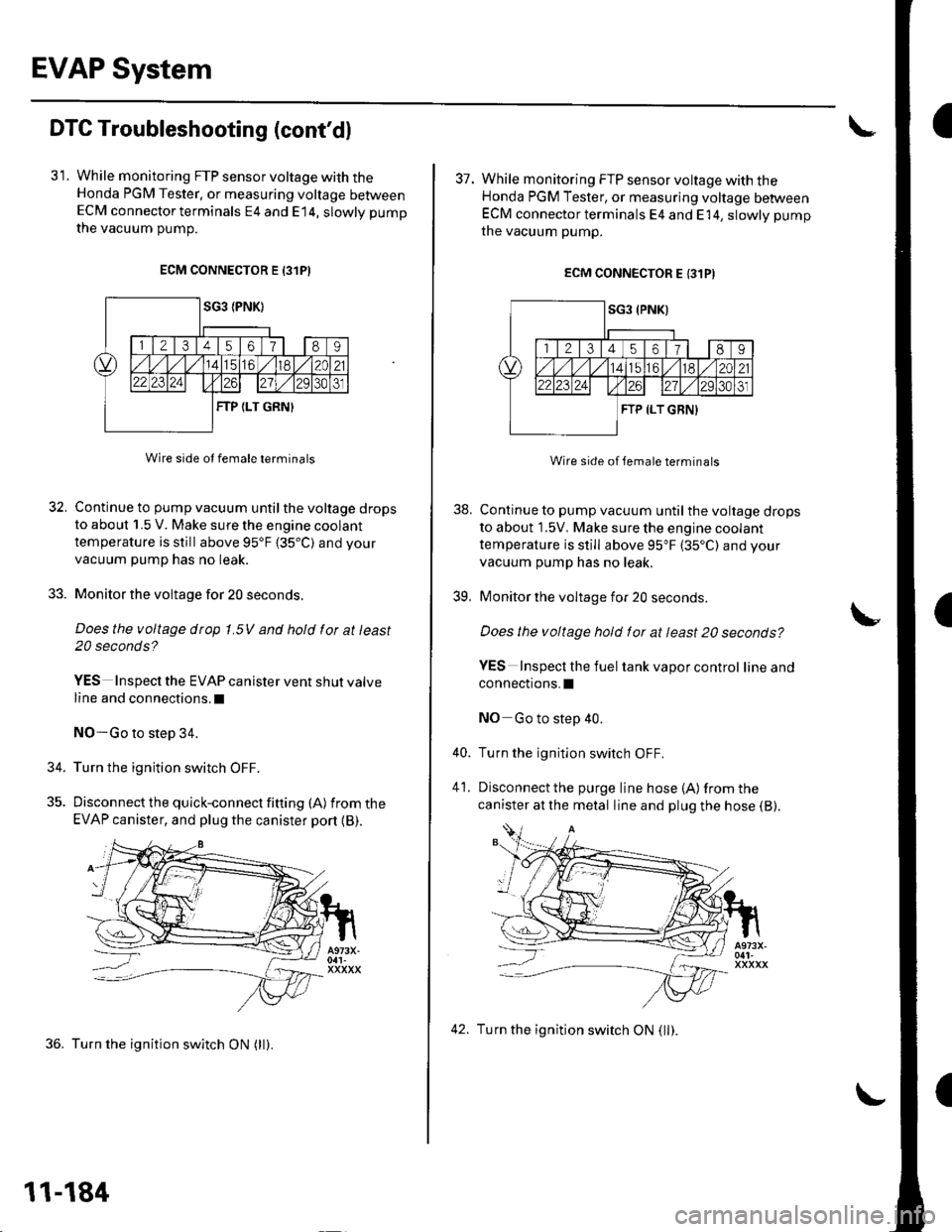
31. While monitoring FTP sensor voltage with theHonda PGM Tester, or measuring voltage betweenECM connector terminals E4 and E14, slowly pump
the vacuum oumD.
ECM CONNECTOR E 13lPI
Wire side ot female terminals
32. Continue to pump vacuum until the voltage drops
to about 1.5 V. Make sure the engine coolant
temperature is still above 95'F 135.C) and your
vacuum pump has no leak.
33. Monitor the voltage for 20 seconds.
Does the voltage drop 1.5V and hold for at least
20 seconds?
YES Inspect the EVAP canister vent shut valve
line and connections.l
NO-Go to step 34.
34. Turn the ignition switch OFF.
35. Discon nect the quick-con nect fitting (A) fromthe
EVAP canister, and plug the canister port {B).
36. Turn the ignition switch ON (ll).
11-184
42. Turn the ignition switch ON (ll).
I
38.
39.
37. While monitoring FTP sensor voltage with theHonda PGM Tester, or measuring voltage betweenECM connector terminals E4 and E 14, slowly pump
the vacuum pump.
ECM CONNECTOR E {31PI
Wire side of lemale terminals
Continue to pump vacuum until the voltage drops
to about 1.5V. Make sure the engine coolant
temperature is still above 95"F (35"C) and your
vacuum pump has no leak.
Monitor the voltage for 20 seconds
Does the voltage hold for at least 20 seconds?
YES Inspecl the fuel tank vapor control lineand
connections.I
NO Go to step 40.
Turn the ignition switch OFF.
Disconnect the purge line hose {A) from the
canister at the metal line and plug the hose (B).
40.
41.
Page 392 of 1139
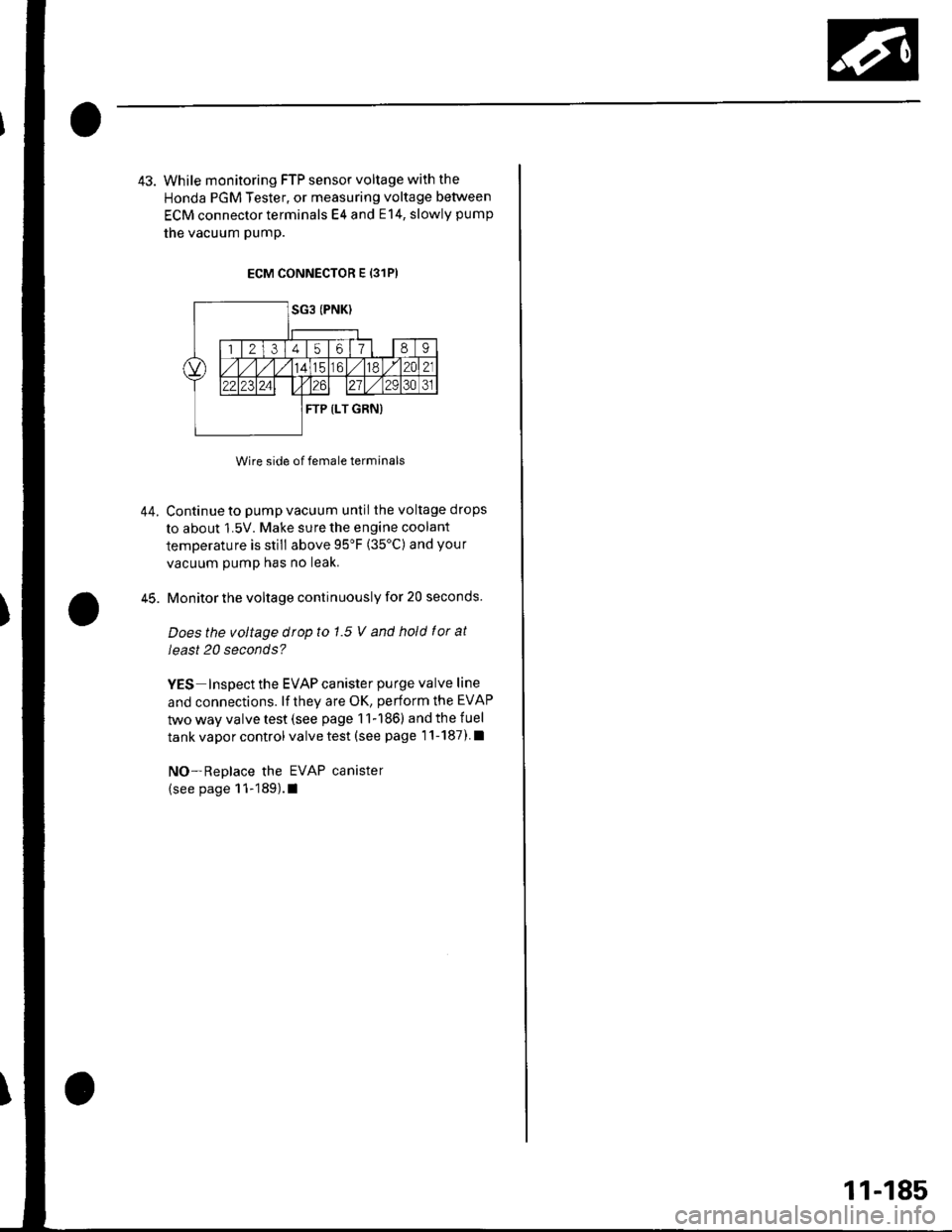
43. While monitoring FTP sensor voltage with the
Honda PGM Tester, or measuring voltage between
ECM connector terminals E4 and E14, slowly pump
the vacuum pump.
ECM CONNECTOR E {31P)
Wire side of female terminals
Continue to pump vacuum until the voltage drops
to about 1.5V. Make sure the engine coolant
temperature is still above 95'F (35'C) and your
vacuum pump has no leak.
Monitor the voltage continuously for 20 seconds.
Does the voltage drop to 1.5 V and hold f or at
least 20 seconds?
YES Inspect the EVAP canister purge valve line
and connections. lf they are OK, perform the EVAP
two way valve test (see page 11-186) and the fuel
tank vapor control valve test (see page 1'l-187) l
NO-Replace the EVAP canister
(see page 11-189).1
44.
45.
11-185
Page 393 of 1139
EVAP System
EVAP Two Way Valve Test
Special Tools Required. Vacuum pump/Gauge,0-30 in. Hg
A973X-041-XXXXX. Vacuum/Pressure cauge.0-4 in. Hg 07JAZ-0010008
1. Remove the fuelfill cap.
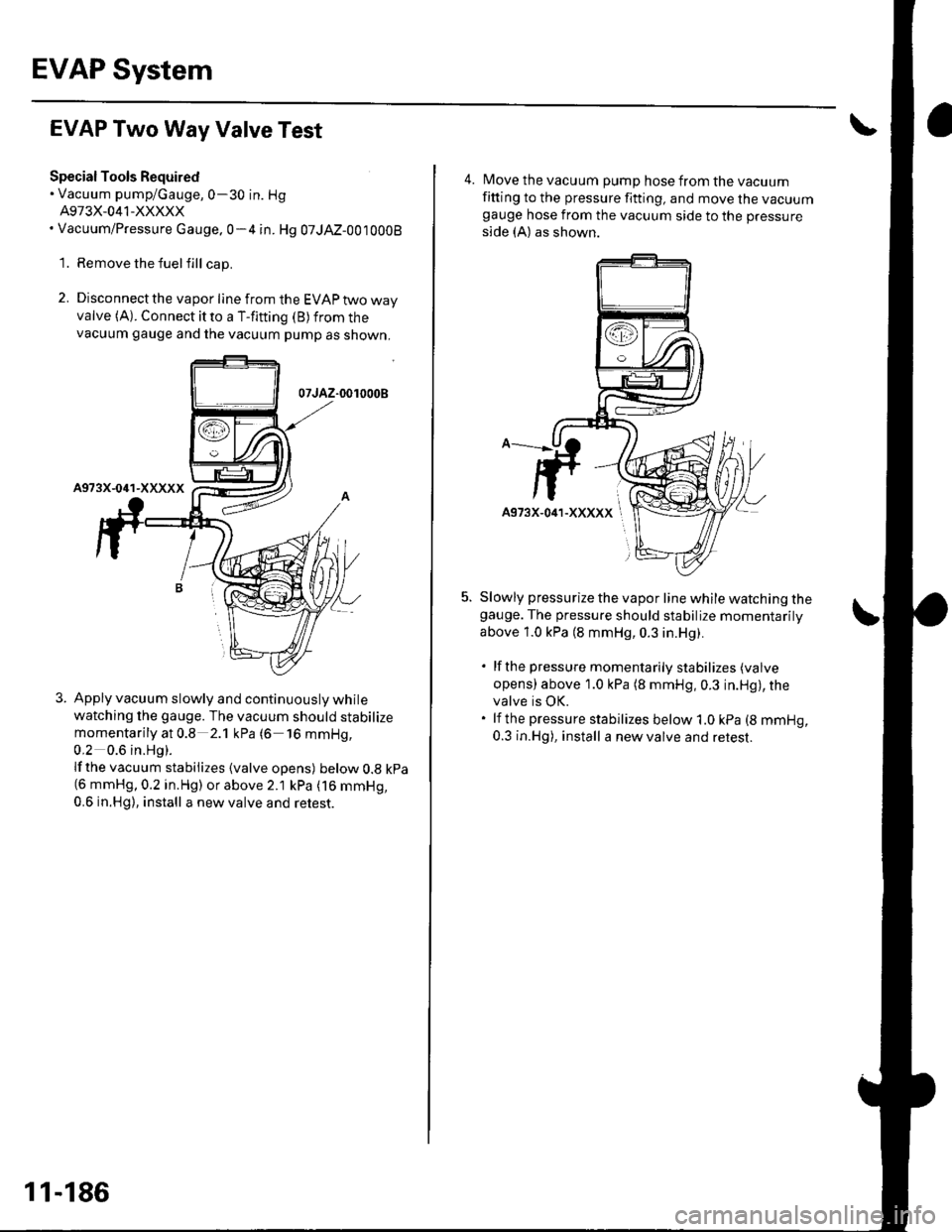
2. Disconnect the vapor line from the EVAP two wayvalve (A). Connect it to a T-fitting (B) from thevacuum gauge and the vacuum pump as shown,
07JAZ-0010008
Apply vacuum slowly and continuously while
watching the gauge. The vacuum should stabilize
momentarily at 0.8 2.1 kPa (6 16 mmHg,
0,2 0.6 in.Hg).
lf the vacuum stabilizes {valve opens) below 0.8 kpa(6 mmHg,0.2 in.Hg) or above 2.1 kPa (16 mmHg,
0.6 in.Hg), install a new valve and retest.
11-186
4. Move the vacuum pump hose from the vacuumfitting to the pressure fitting, and move the vacuumgauge hose from the vacuum side to the pressure
side (A) as shown.
Slowly pressurize the vapor line while watching thegauge. The pressure should stabilize momentarilV
above 1.0 kPa (8 mmHg, 0.3 in.Hg).
. lfthe pressure momentarily stabilizes (valve
opens) above 1.0 kPa (8 mmHg,0.3 in.Hg), thevalve is OK.. lf the pressure stabilizes below 1.0 kPa (8 mmHg,
0.3 in.Hg), install a new valve and retest.
Page 394 of 1139
FuelTank Vapor Control Valve Test
Special Tools Required
Vacuum Pump/Gauge, 0-30 in. Hg A973X-041-XXXXX
Float Test
1. Make sure the fuel tank is less than half full.
2. Remove the fuel fill cap to relieve fuel tank
pressure, then reinstall the cap.
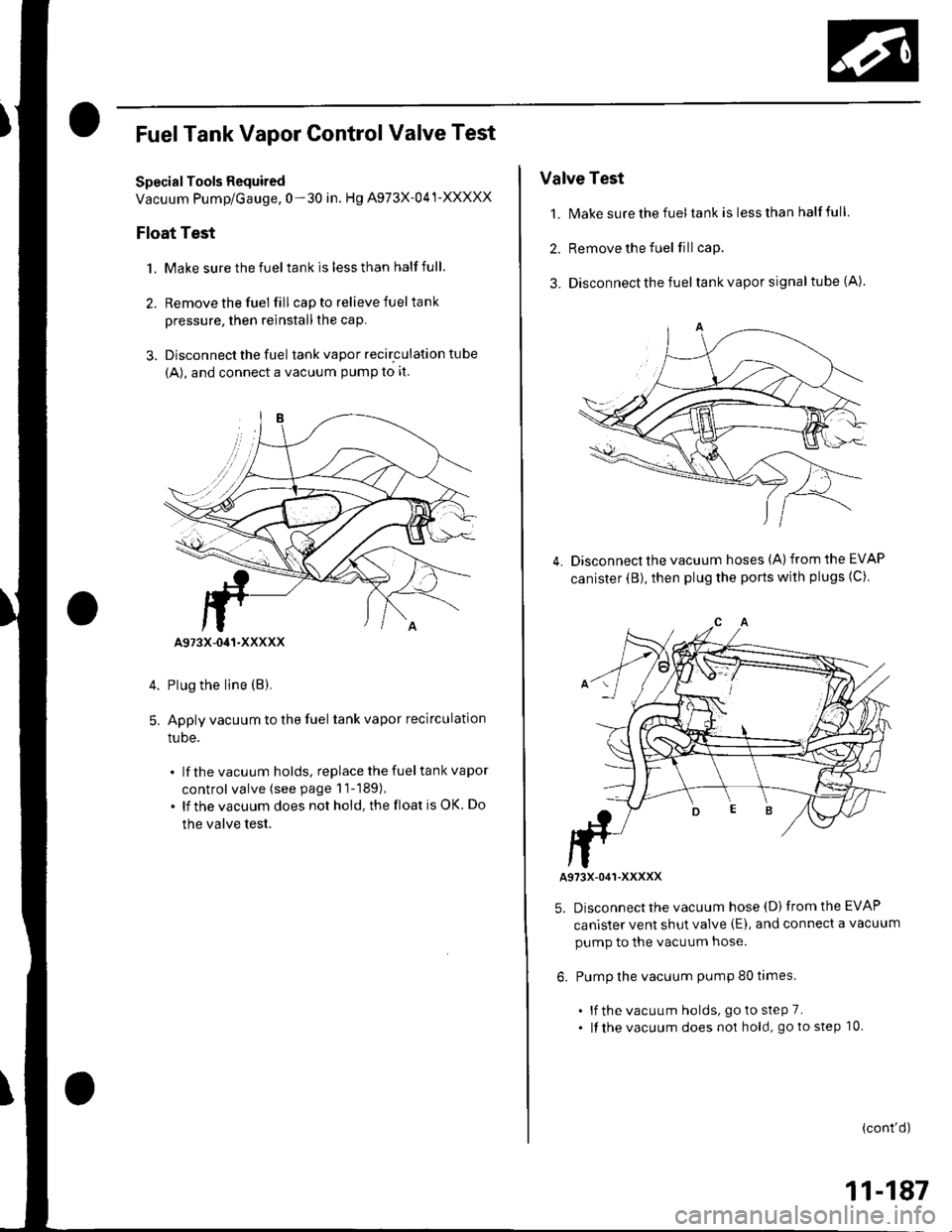
3. Disconnect the fuel tank vapor recirculation tube
{A), and connect a vacuum PumP to it.
Plug the line (B).
Apply vacuum to the fuel tank vapor recirculation
tuDe.
lf the vacuum holds, replace the fuel tank vapor
control valve (see page 11-189).
lf the vacuum does not hold, the float is OK. Do
the valve test.
5.
A973X-041-XXXXX
Valve Test
1. N4ake sure the fuel tank is less than half full
2. Remove the fuel fill cap.
3. Disconnect the fuel tank vapor signal tube (A).
Disconnect the vacuum hoses (A) from the EVAP
canister (B), then plug the ports with plugs (C)4.
A973X-O41-XXXXX
5. Disconnect the vacuum hose (D) from the EVAP
canister vent shut valve (E), and connect a vacuum
pump to the vacuum hose.
6. Pump the vacuum pump 80 times.
. lf the vacuum holds, goto steP 7.. lf the vacuum does no1 hold, go to step 10.
(cont'd)
11-187
Page 395 of 1139
EVAP System
FuelTank Vapor ControlValve Test (cont'd)
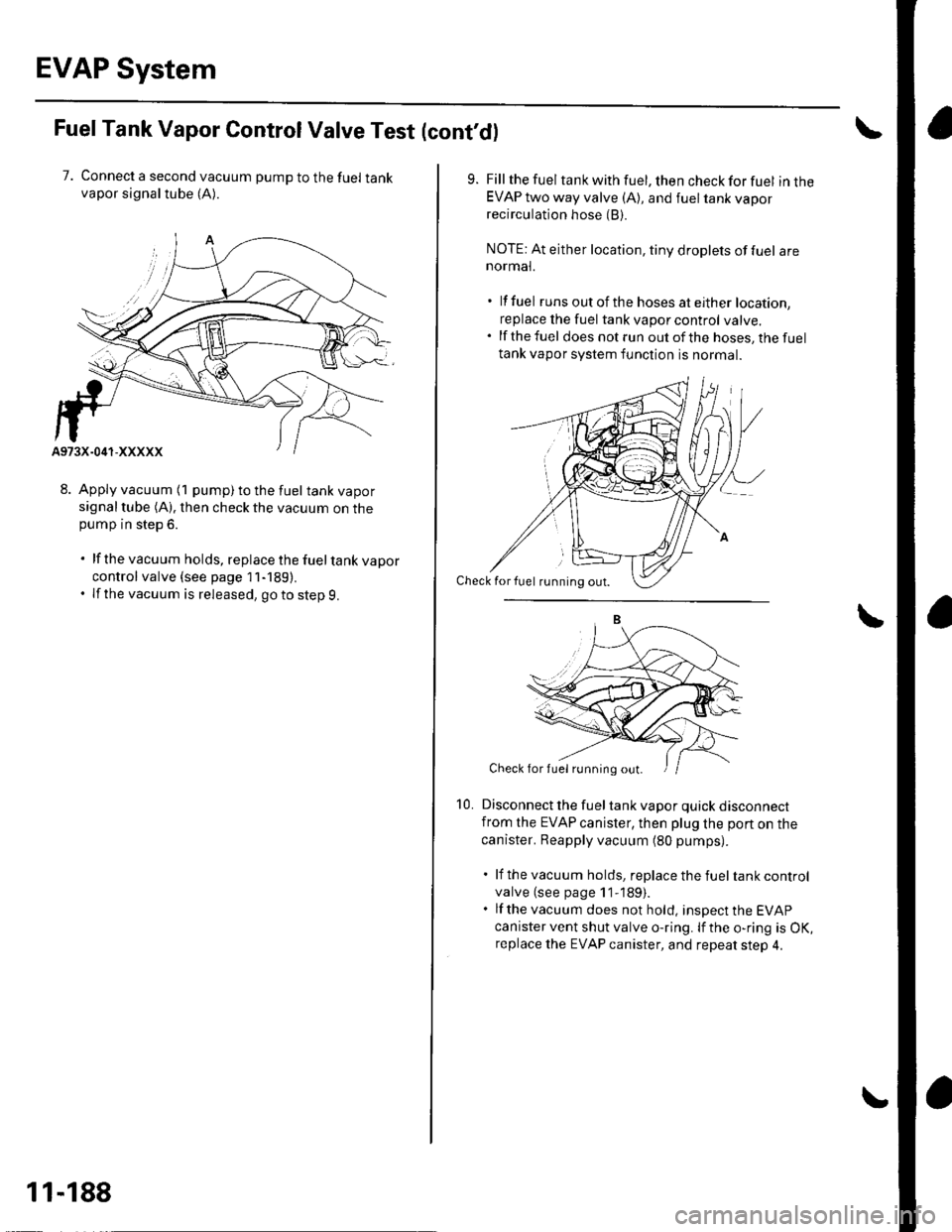
7. Connect a second vacuum pump to the fuel tankvapor signaltube (A).
8. Apply vacuum (1 pump) to the fuel tank vaporsignal tube (A). then check the vacuum on thepump in step 6.
. lf the vacuum holds, replace the fueltank vapor
control valve {see page 11-189).. If the vacuum is released, goto step 9.
11-188
10.
Fill the fuel tank with fuel, then check for fuel in theEVAP two way valve (A), and fuel tank vaporrecirculation hose (B).
NOTE: At either location, tiny droplets of fuel arenormal.
. lf fuel runs out of th e hoses at either location,
replace the fuel tank vapor control valve..lfthefuel does not run out of the hoses, the fuel
tank vapor system function is normal.
Disconnect the fuel tank vapor quick disconnectfrom the EVAP canister, then plug lhe port on the
canister. Reapply vacuum (80 pumps).
. lf the vacuum holds, replace the fuel tank control
valve (see page 1 1-189).. lf the vacuum does not hold, insDect the EVAP
canister vent shut valve o-ring. lf the o-ring is OK,replace the EVAP canister, and repeat step 4.
Check for fuel rirnning out.
Check for fuel running out.
Page 396 of 1139
EVAP Canister Replacement
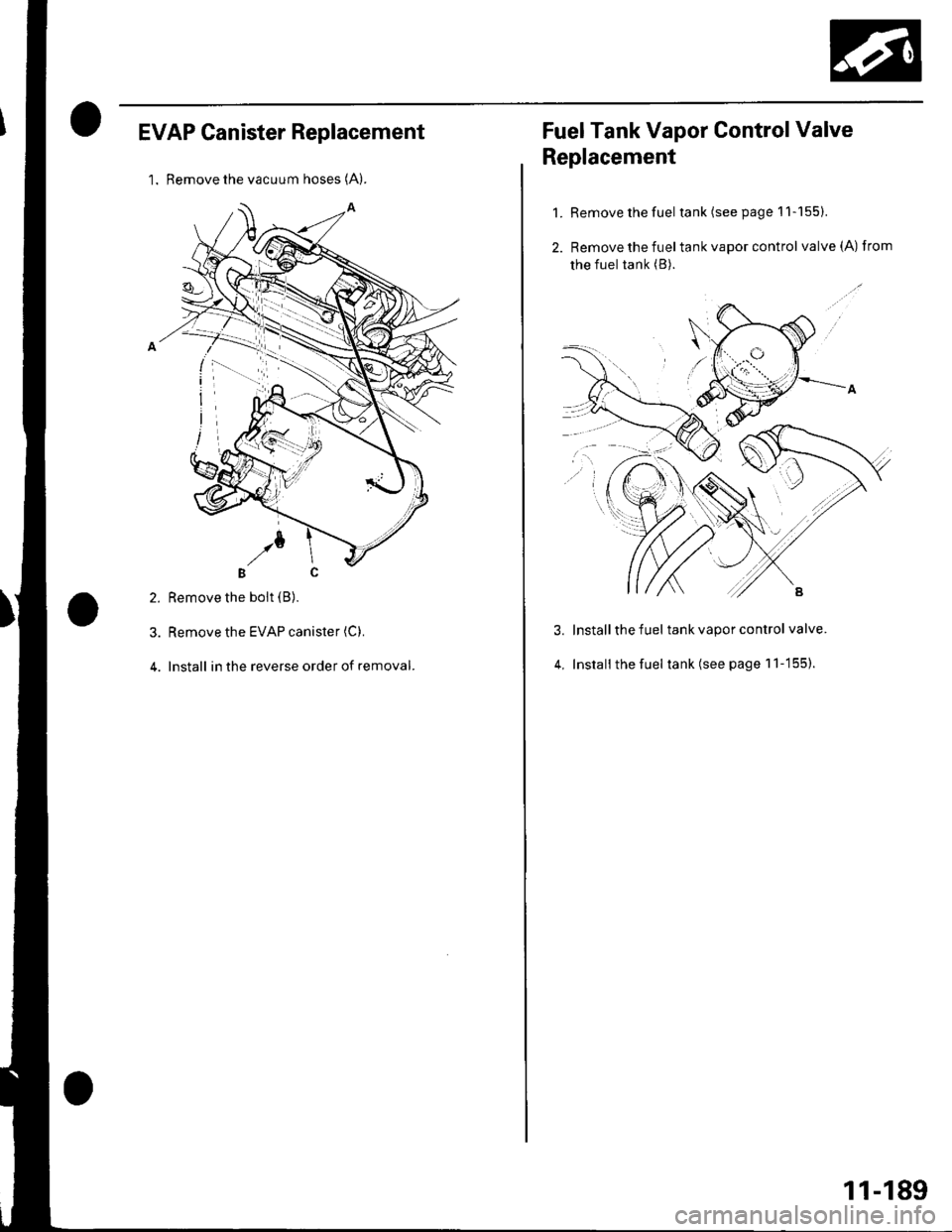
l. Remove the vacuum hoses (A).
2. Remove the boit (B).
3. Remove the EVAP canister (C).
4. Install in the reverse order of removal.
Fuel Tank Vapor Control Valve
Replacement
1. Remove the fuel tank(seepagell-155).
2. Remove the fueltank vapor control valve(A) from
the fuel tank (B).
Install the fuel tank vapor control valve.
Install the fuel tank (see page 1 'l -155).
3.
4,
11-189
Page 543 of 1139
EPS Components
Steering Gearbox Removal (cont'd)
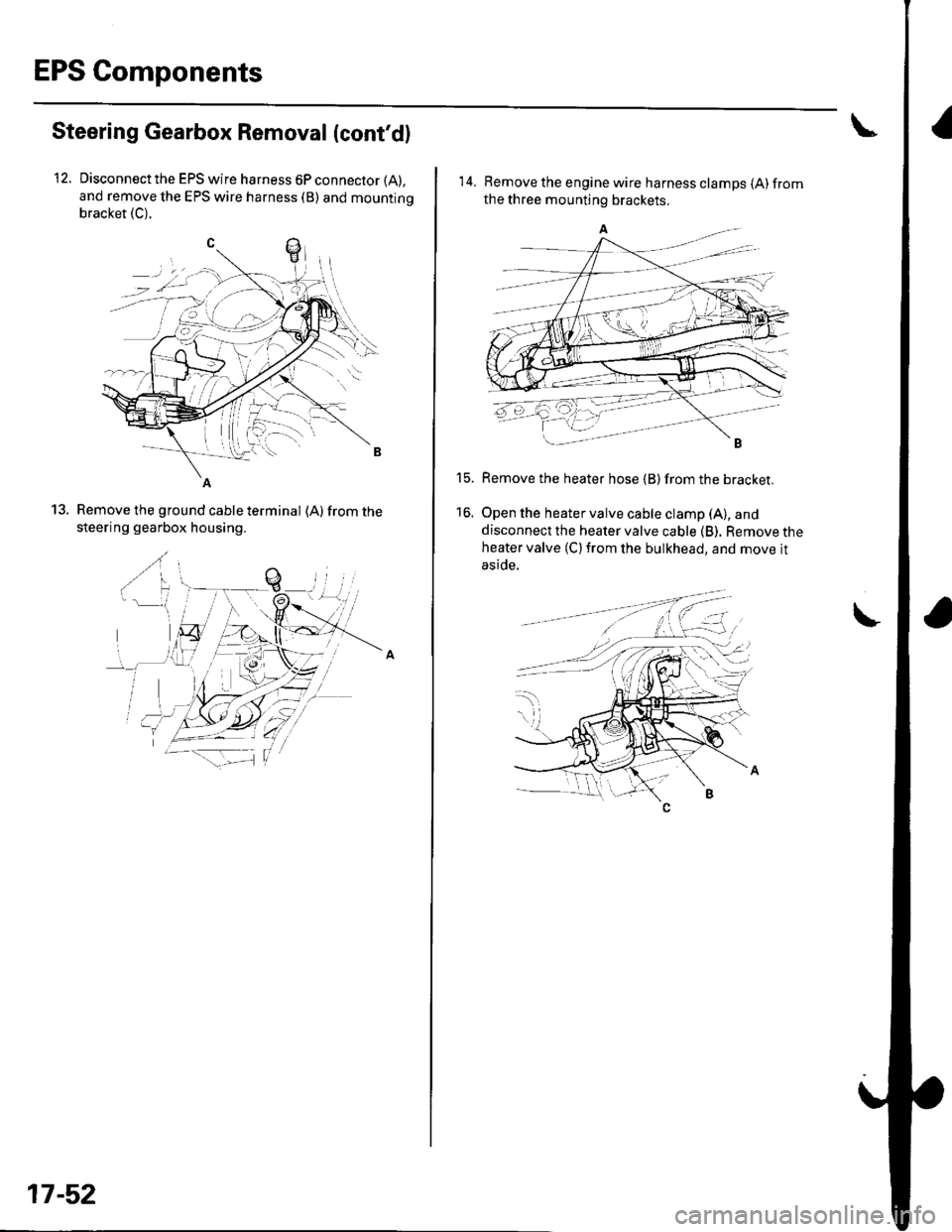
Disconnect the EPS wire harness 6P connector (A),
and remove the EPS wire harness (B) and mountino
bracket (C).
12.
Remove the ground cable terminal (A) from the
steering gearbox housing.
..(
.,/ a
b-H\
ry T,-.lt'^ \
'" \--
13.
_-1..1.-'
-a--zii F--_1
17-52
14. Remove the engine wire harness clamps {A)fromthe three mounting brackets.
Remove the heater hose {B) from the bracket.
Open the heater valve cable clamp (A), and
disconnect the heater valve cable (B). Remove theheater valve (C) from the bulkhead, and move jt
aside.
t5.
16.
I
Page 555 of 1139
EPS Components
Steering Gearbox Installation (cont'd)
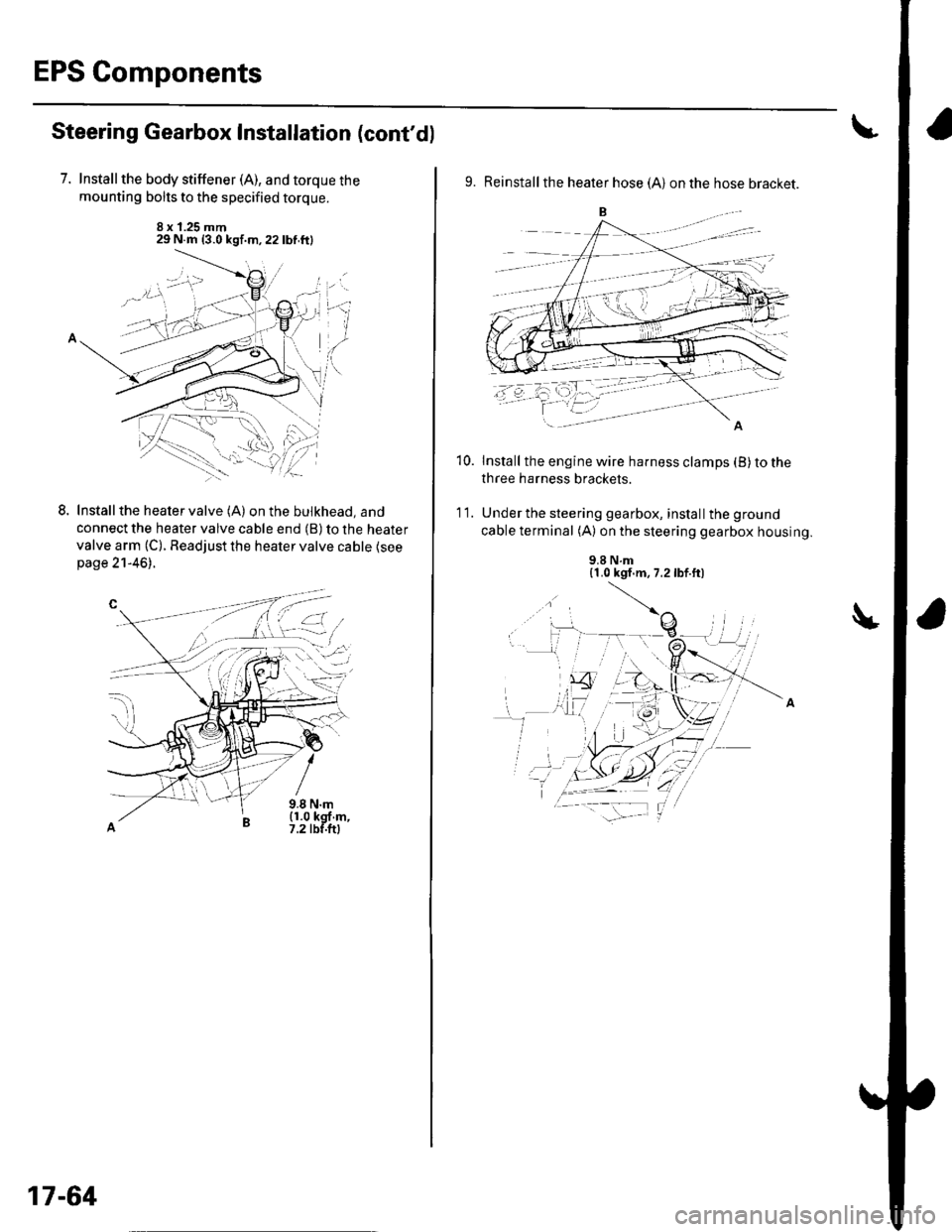
7. Installthe body stiffener (A), and torque the
mounting bolts to the specified torque.
8 x 1.25 mm29 N.m {3.0 kgf.m,22lbf.ftl
LInstall the heater valve (A) on the bulkhead, and
connect the heater valve cable end (B) to the heater
valve arm (C). Readjust the heater valve cable {seepage 21-46).
9.8 N.m(1.0 kgf m,7.2 tbf.ftl
L-t ,:.i.t'
17-64
9. Reinstall the heater hose (A) on the hose bracket.
Install the engine wire harness clamps (B) to the
three harness brackets.
Under the steering gearbox, install the ground
cable terminal (A) on the steering gearbox housing.
10.
'I t.
9.8 N.m{1.0 kgf.m, 7.2lbf.ft)
Page 613 of 1139
Gonventional Brake Components
IBrake Booster Test
Functional Test
1. With the engine stopped, press the brake pedal
several times to deplete the vacuum reservoir, thenpress the pedal hard, and hold itfor 15 seconds. lfthe pedal sinks, either the master cylinder is
bypassing internally, or the brake system (master
cylinder, lines. modulator, or calipers) is leaking.
2. Start the engine with the brake pedal pressed. lf thepedal sinks slightly, the vacuum booster is workingproperly. lf the pedal height does not vary, thebooster or check valve is faulty.
3. With the engine running, press the brake pedal
lightly. lfthe brake pedal sinks more than 1O mm
{3/8 in, ) in 3 minutes, the master cylinder is faulty.A slight change in pedal height when the Ay'C
compressor cycles on and off is normal. (The A,/C
compressor load changes the vacuum available tothe booster.)
Leak Test
1. Press the brake pedal with the engine running, thenstop the engine. lf the pedal height does not vary
while pressed for 30 seconds, the vacuum boosteris OK. lf the pedal rises, the booster is faulty.
2. With the engine stopped, press the brake pedal
several times using normal pressure. When thepedal is first pressed, it should oe row.
On consecutive applications, the pedal height
should gradually rise. lfthe pedal position does notvarv, check the booster check valve.
19-18
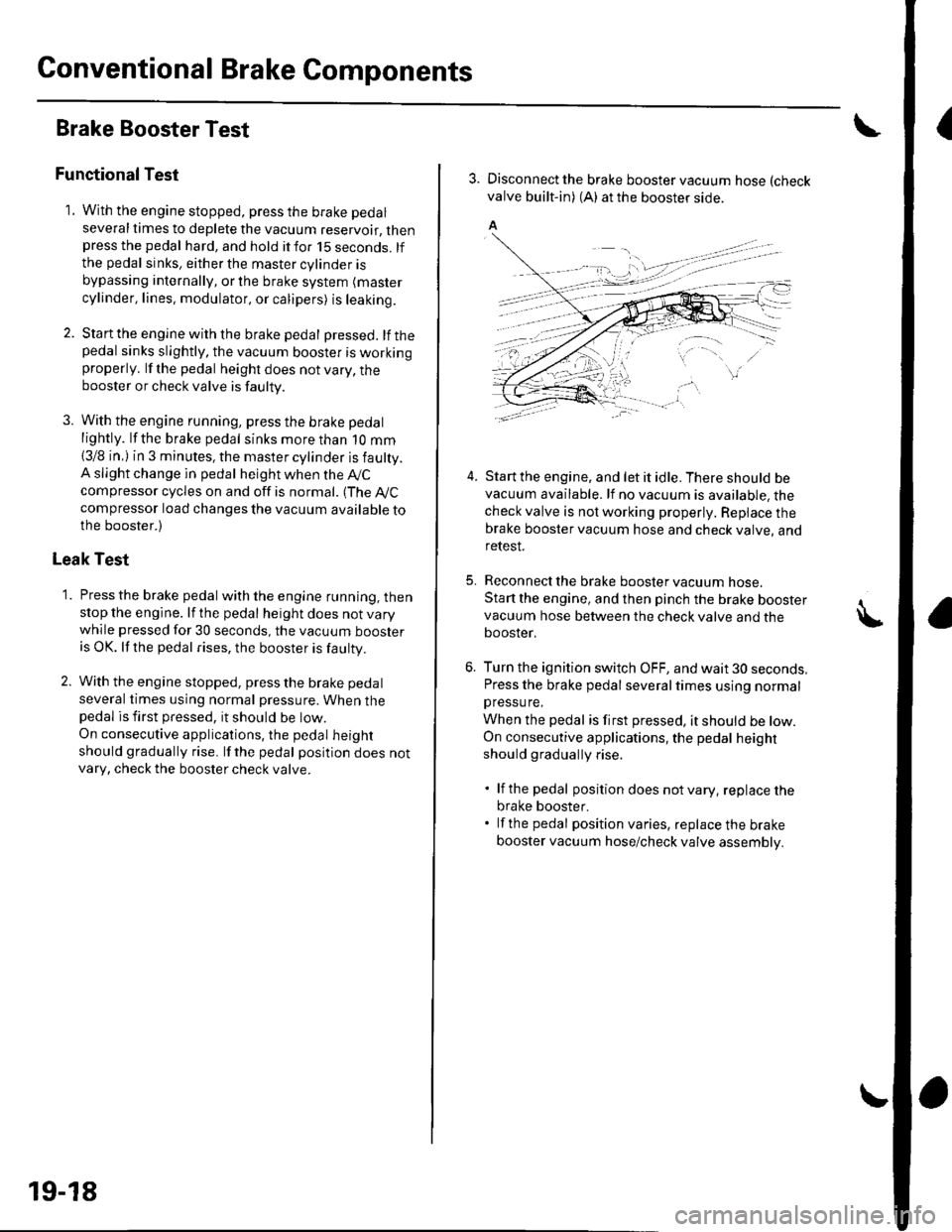
3. Disconnect the brake booster vacuum hose (check
valve built-in) (A) at the booster side.
5.
4.Start the engine, and let it idle. There should bevacuum available. lf no vacuum is available, thecheck valve is not working properly. Repiace thebrake booster vacuum hose and check valve, andrelesI.
Reconnect the brake booster vacuum nose.
Start the engine, and then pinch the brake boostervacuum hose between the check valve and thebooster,
Turn the ignition switch OFF, and wait 30 seconds,Press the brake pedal several times using normalpressu re,
When the pedal is first pressed, it should be low.On consecutive applications, the pedal height
should gradually rise.
. lf the pedal position does notvary, replacethe
brake booster.. lf the pedal position varies, replace the brake
booster vacuum hose/check valve assembly.
Page 619 of 1139
Conventional Brake Components
{Brake Hoses and Lines Inspection
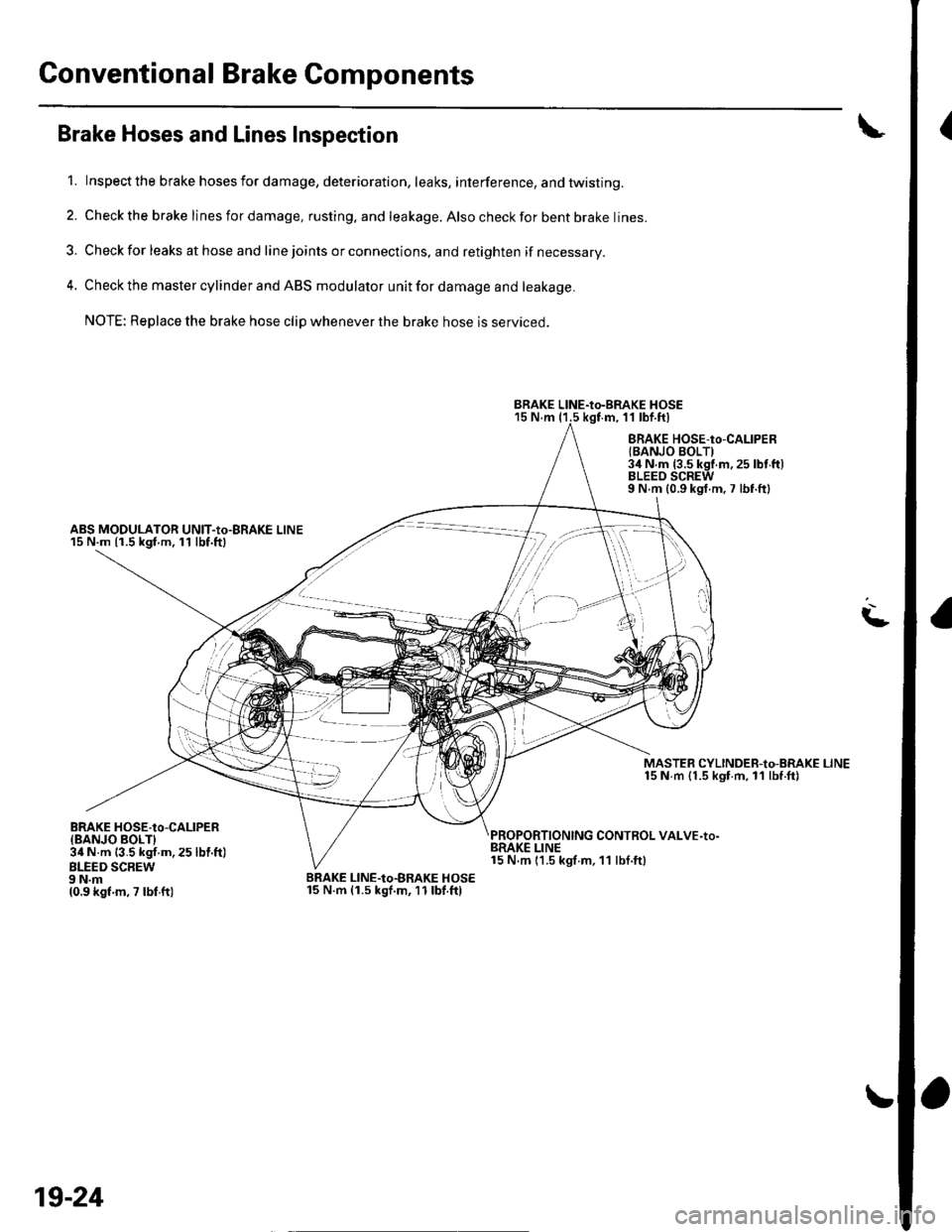
1. Inspect the brake hosesfordamage, deterioration, leaks, interference, andtwisting.
2. Check the brake lines for damage, rusting. and leakage. Also check for bent brake lines.
3. Check for leaks at hose and line joints or connections, and retighten if necessary.
4. Check the master cylinder and ABS modulator unit for damage and leakage.
NOTE: Replace the brake hose clip whenever the brake hose is serviced.
15 N.m (1.5 kgf.m, 11 lbf.ftl
ABS MODULATOR UNIT-Io-BRAKE LINE15 N.m {1.5 kgf m.11 lbf.ftl
BRAKE HOSE-to-CALIPERlBANJO BOLTI3il N.m {3.5 kgf.m.25 lbt'ft)BLEEO SCREW9 N.m {0.9 kgf.m,7 lbf.ftl
MASTER CYLINDEB-to-BRAKE LINE15 N m {1.5 kgt.m, ll lbf.ft)
CONTROL VALVE-to-
L
BRAKE HOSE.tO-CALIPER{BANJO BOLTI34 N.m {3.5 kgf.m, 25 lbl.ft)BLEED SCBEW9 N.m10.9 kgf.m, 7 lbf ft)
BRAKE LINE15 N.m 11.5 kgf m, 11 lbf.ft)
BRAKE LINE-Io-BRAKE HOSE15 N.m (1.5 kgf.m,11lbf.ftl
BRAKE LINE-to-BRAKE HOSE
t''/,i'i'
,/ ,l
t t,.. -)
19-24