valve HONDA CIVIC 2003 7.G Manual Online
[x] Cancel search | Manufacturer: HONDA, Model Year: 2003, Model line: CIVIC, Model: HONDA CIVIC 2003 7.GPages: 1139, PDF Size: 28.19 MB
Page 366 of 1139
Intake Air System
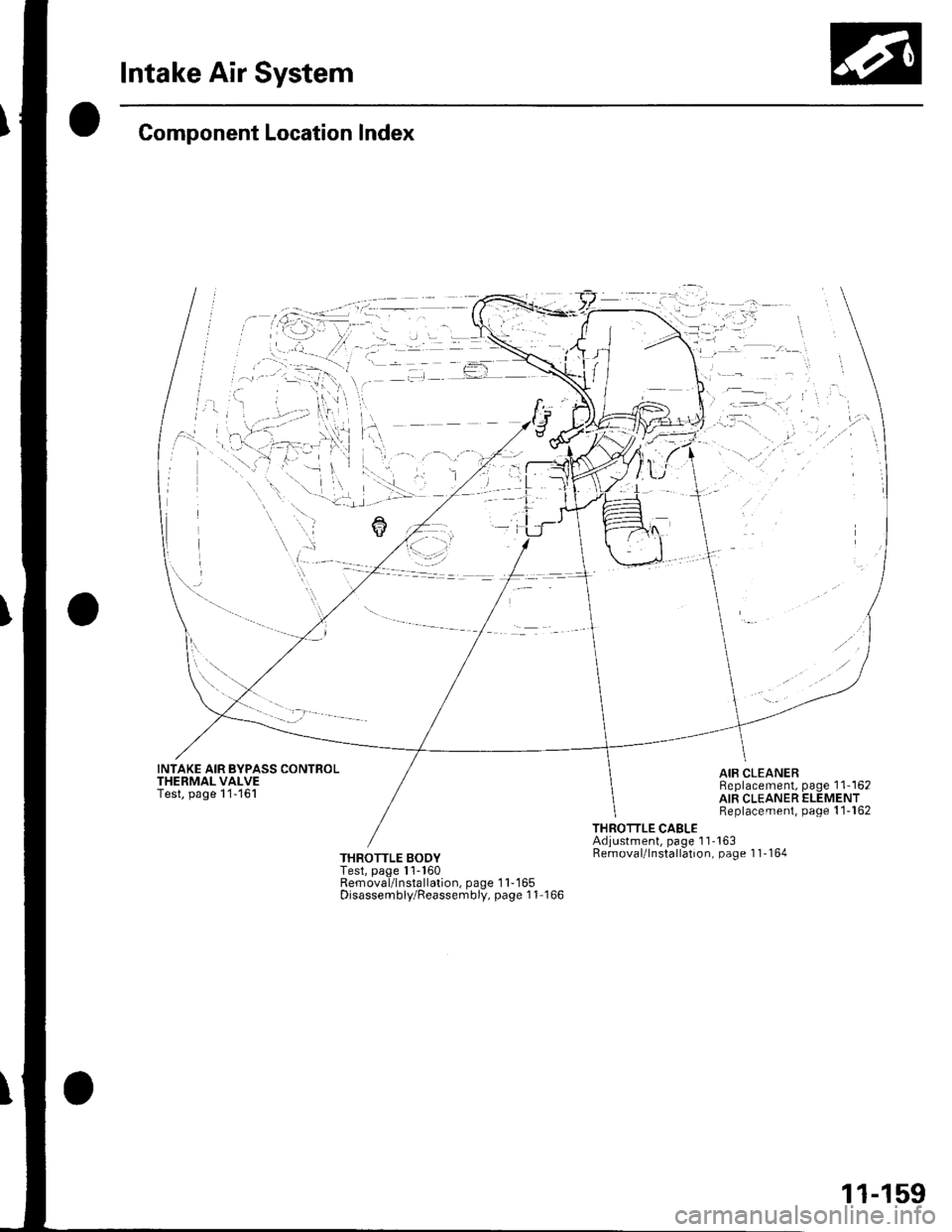
Component Location Index
INTAKE AIR BYPASS CONTROLTHERMAL VALVETest, page 1'1-161
i l.
AIR CLEANERReplacement, page 1 1'162AIR CLEANER ELEMENTReplacement, page 1 1-162
THROTTLE CABLEAdjustment, page 1 1-163Removal/lnstallation, page 1 1-164THROTTLE BODYTest, page l'l-160Removal/lnstallation, page 1 1-165Disassembly/Reassembly, page 1 1 166
11-159
Page 367 of 1139
Intake Air System
Throttle Body Test
NOTE:. Do not adjust the throttle stop screw. lt is preset at the
factory.. lf the malfunction indicator lamp (MlL) has been
reported on, check for diagnostic trouble codes(DLCS) (see page 11 3).
1. With the engine off, check the throttle cable
movement. The cable should move without binding
or sticking.
. lf lhe cable moves OK, goto step 2.. lf the cable binds or sticks, check it and its routing.. lf the cable isfaulty, reroute itor replace itand
adjust it (see page 11-163), then go to step 2.
2. l\4ove the throttle lever by hand to see if the throftle
valve and/or shaft are too loose or too tight.
. lf there is excessive play in the throttle valve
shaft, or any binding in the throttle valve at the
fully closed position, replace the throttle body.. lf thethrottlevalve and shaft are OK, goto step3.
3. Connect the scan toolto the DLC.
Turn the ignition switch ON (ll).
Check the throttle position with the scan tool. The
reading should be about 10% when the throttle is
fully closed and about 90% when the throttle is fully
openeo.
. lf the throttle position is correct, the throttle body
is OK.. lf thethrottle position is notcorrect, replace the
throttle body.
5.
11-160
!
Page 368 of 1139
Intake Air Bypass GontrolThermalValve Test
Special Tools Required
Vacuum Pump/Gauge,0 30 in. Hg A973X-041-XXXXX
1. Stan the engine. Then let it idl€.
NOTE: The engine coolant temperature must be
below 149'F (65'C).
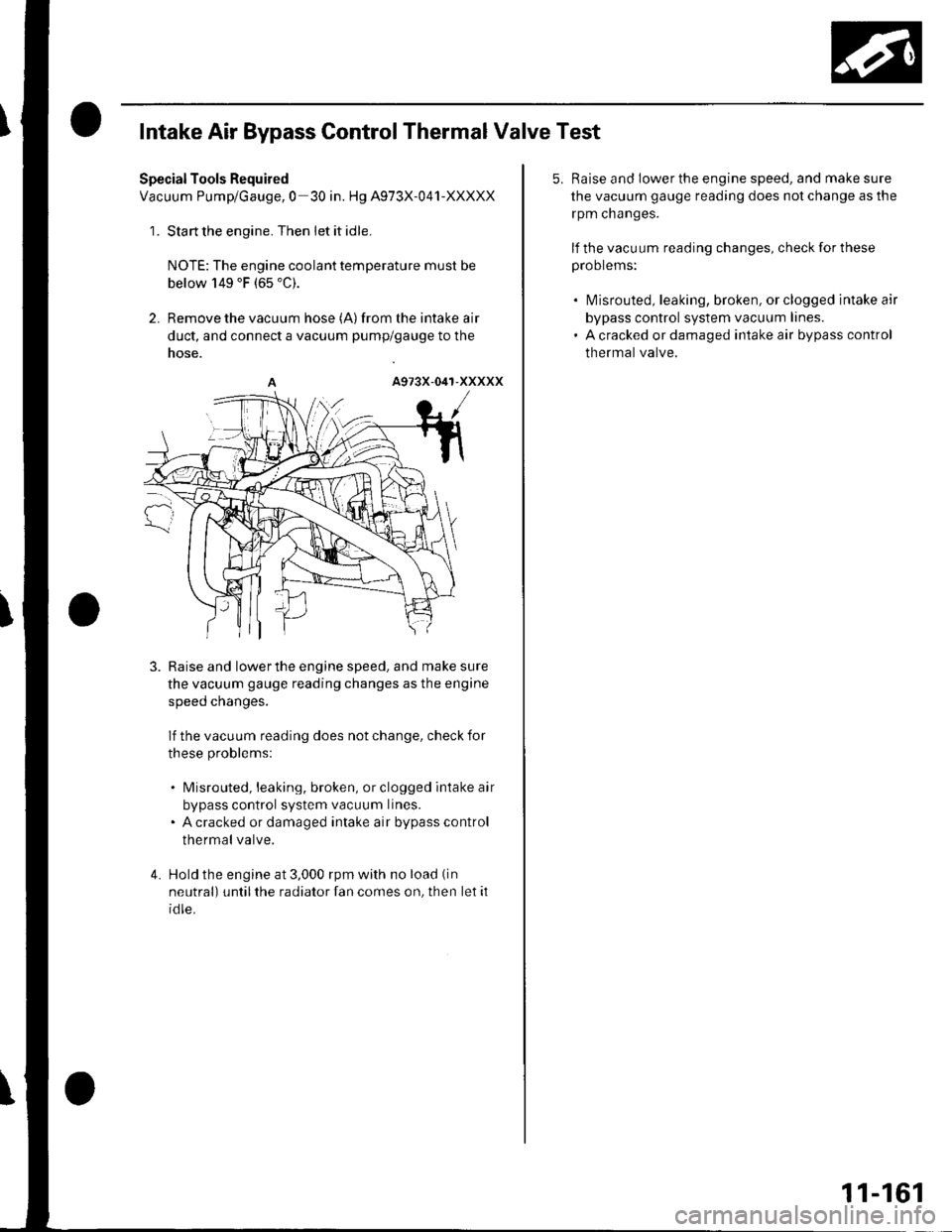
2. Remove the vacuum hose (A)from the intake air
duct, and connect a vacuum pump/gauge to the
nose.
3. Raise and lowerthe engine speed. and make sure
the vacuum gauge reading changes as the engine
speeo cnanges.
lf the vacuum reading does not change, check for
these problems:
. Misrouted, leaking, broken, or clogged intake air
bypass control system vacuum lines.. A cracked or damaged intake air bypass control
thermal valve.
4. Hold the engine at 3,000 rpm with no load (in
neutral) until the radiator fan comes on, then let it
id le.
5. Raise and lower the engine speed, and make sure
the vacuum gauge reading does not change as the
rpm cnanges.
lf the vacuum reading changes, check for these
proorems:
. l\4isrouted, leaking, broken, or clogged intake air
bypass control system vacuum lines.. A cracked or damaged intake air bypass control
thermal valve.
11-161
Page 370 of 1139
Throttle Cable Adjustment
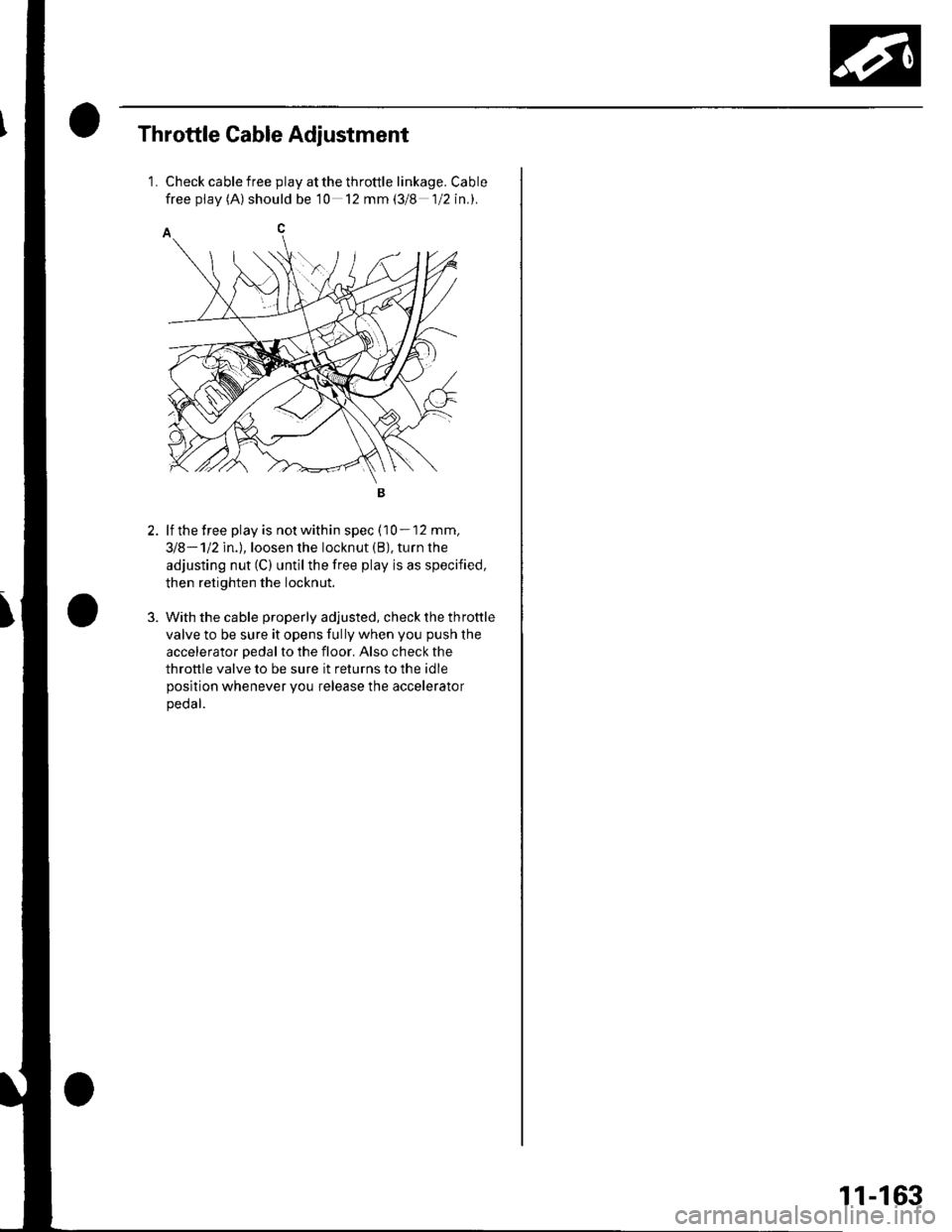
1.Check cable free play at the throttle linkage. Cable
free pf av (A) should be 10 12 mm (3/8 1/2 in.).
lf the free play is not within spec (10 - 12 mm,
318-112ln.l,loosen the locknut (B), turn the
adjusting nut (C) untilthe free play is as specified,
then retighten the locknut.
With the cable properly adjusted, check the throttle
valve to be sure it opens fully when you push the
accelerator pedal to the floor. Also check the
throttle valve to be sure it returns to the idle
position whenever you release the accelerator
peoar.
11-163
Page 371 of 1139
Intake Air System
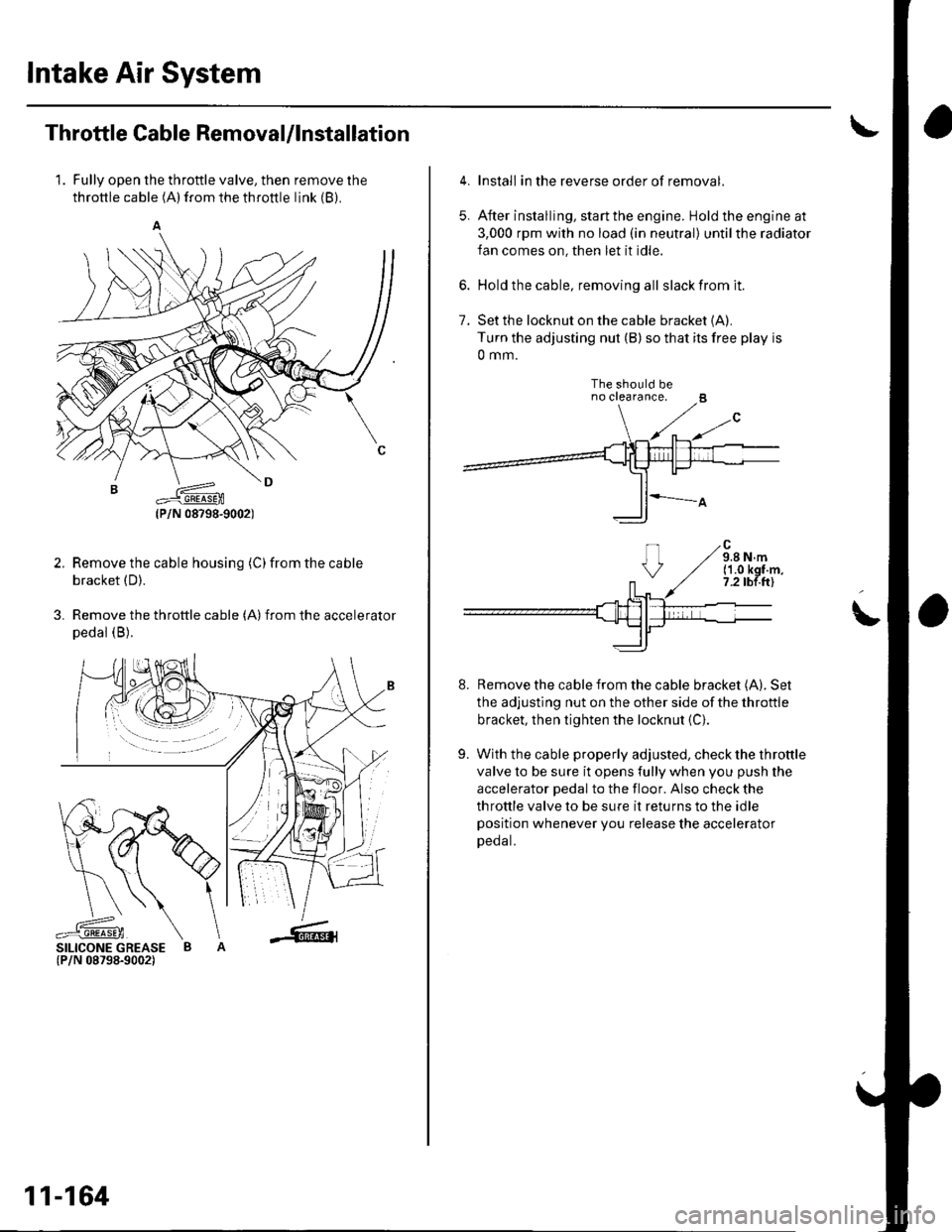
Throttle Cable Removal/lnstallation
1. Fully open the throttle valve, then remove the
throttle cable (A) from the throttle link (B).
Remove the cable housing (C)from the cable
bracket (D).
Remove the throttle cable (A)from the accelerator
pedal (B).
2.
3.
SILICONE GREASE B(P/N 08798-9002)
(P/N 08?98-9002)
11-164
5.
Install in the reverse order of removal.
After installing, start the engine. Hold the engine at
3,000 rpm with no load (in neutral) untilthe radiator
fan comes on, then let it idle.
Hold the cable, removing all slack from it.
Set the locknut on the cable bracket {A).Turn the adjusting nut (B) so that its free play is
0 mm.
The should beno crearance.
Remove the cable from the cable bracket (A). Set
the adjusting nut on the other side of the throttle
bracket, then tighten the locknut {C}.
With the cable properly adjusted, check the throttle
valve to be sure it opens fully when you push the
accelerator pedal to the floor. Also check the
throttle valve to be sure it returns to the idle
position whenever you release the accelerator
Deoat.
7.
!
8.
9.
('1.0 kgf.m,7.2 tbf.ftl
Page 372 of 1139
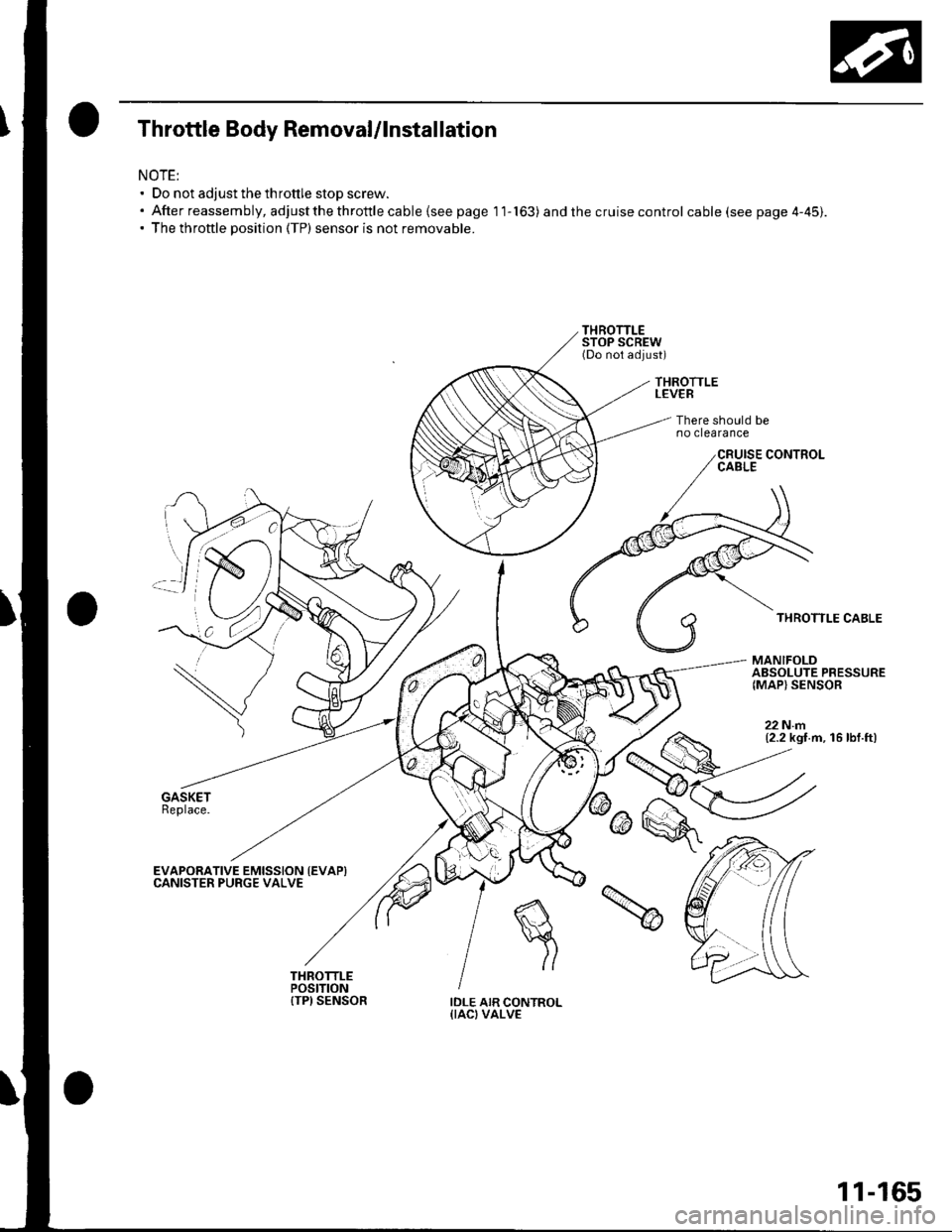
Throttle Body Removal/lnstallation
NOTE:' Do not adjust the throttle stop screw.. Afterreassembly,adjustthethrottlecable{seepagell-163) and the cruise control cable (see page 4-45).. The throttle position (TP) sensor is not removable.
THROTTLELEVER
There should beno clearance
THROTTLE CABLE
MANIFOLDABSOLUTE PRESSURE{MAP} SENSOR
22Nm(2.2 kgt.m, 16 lbf.ft)
EVAPORATIVE EMISSION {EVAPICANISTER PURGE VALVE
IDLE AIR CONTROL{IACI VALVE
11-165
Page 373 of 1139
Intake Air System
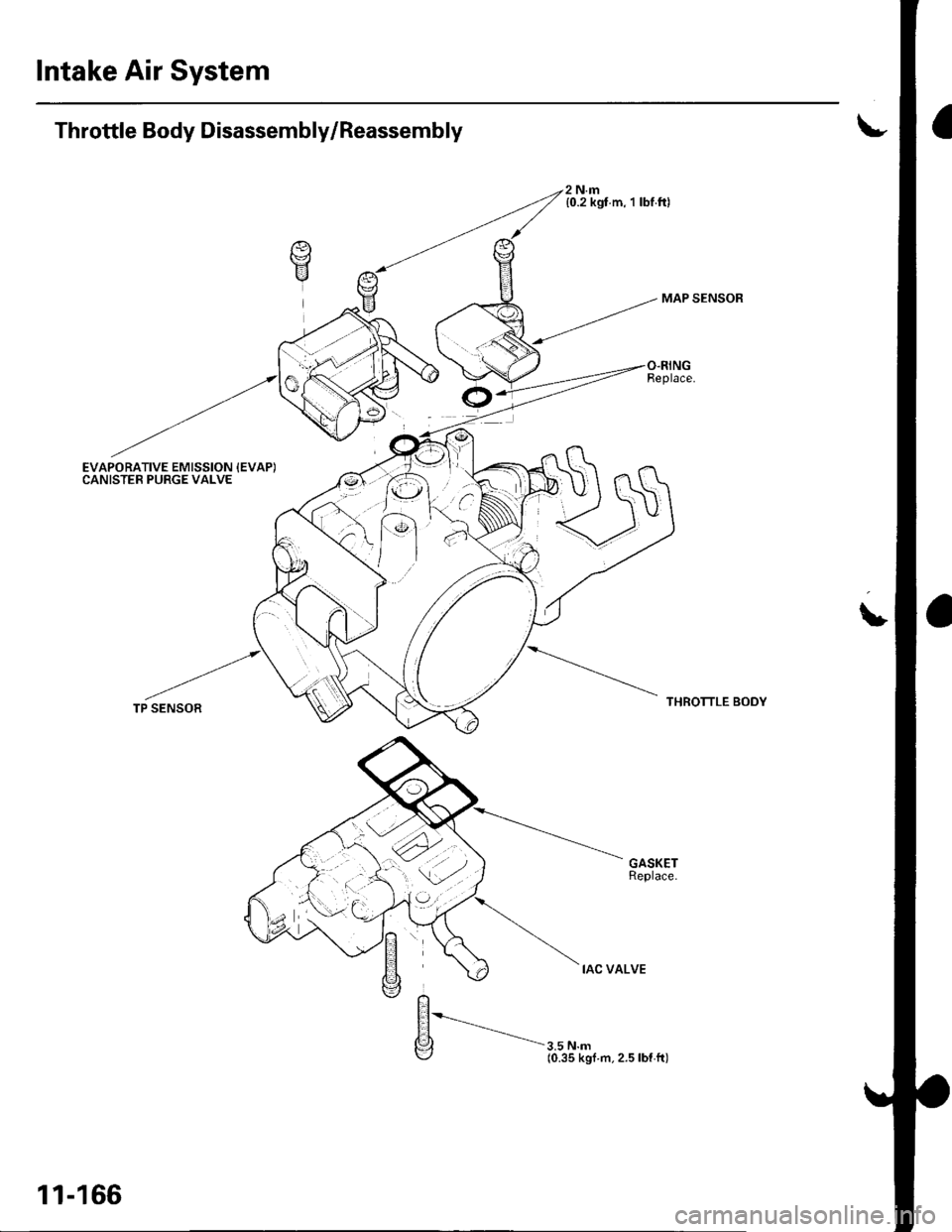
Throttle Body Disassembly/Reassembly
EVAPORATIVE EMISSION {EVAP)CANISTER PURGE VALVE
A
V
2 N.m{0.2 kgt m, 1 lbf.ft)
3.5 N.m(0.35 kgf m.2.5lbf ft)
MAP SENSOR
THROTTLE BODY
L
TP SENSOR
11-166
Page 375 of 1139
PCV System
DTC Troubleshooting
DTC P1505: PCV Air Leakage
1. Reset the ECM (see page 11-4).
2. Start the engine. Hold the engine at 3,000 rpm with
no load (in neutral) until the radiator fan comes on
3. Let the engine idle tor al least 40 seconds with the
throttle fully closed.
4. Check for a DTC P1505 with the scan tool
ls DTC P1505 indicated?
YES-Check these parts for vacuum leaks l
. PCV valve. PCV hose. EVAP canister purge valve
. Throttle body. Brake booster hose
NO - Intermittent failure, system is OK at this
time.l
11-168
Page 376 of 1139
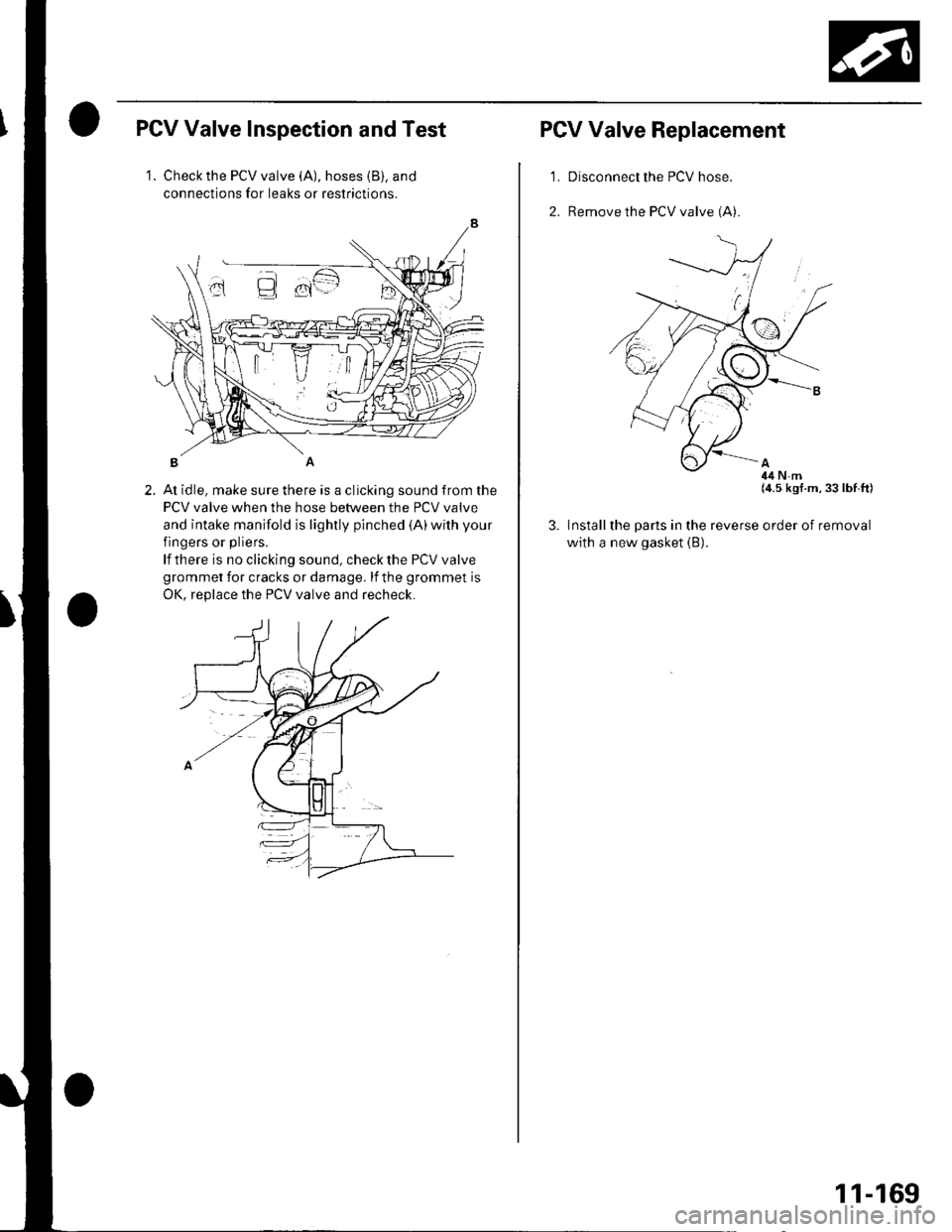
PCV Valve Inspection and Test
2.
1. Check the PCV valve (A), hoses {B), and
connections for leaks or restrictions.
At idle, make sure there is a clicking sound from the
PCV valve when the hose between the PCV valve
and intake manifold is lightly pinched {A)with your
fingers or pliers.
lf there is no clicking sound, check the PCV valve
grommet for cracks or damage. lf the grommet is
OK. reDlace the PCV valve and recheck.
PCV Valve Replacement
'LDisconnect the PCV hose.
Remove the PCV valve (A).
3. Install
with a
(4.5 kgf.m,33 lbf.ft)
the parts in the reverse order of removal
new gasket (B).
11-169
Page 377 of 1139
EVAP System
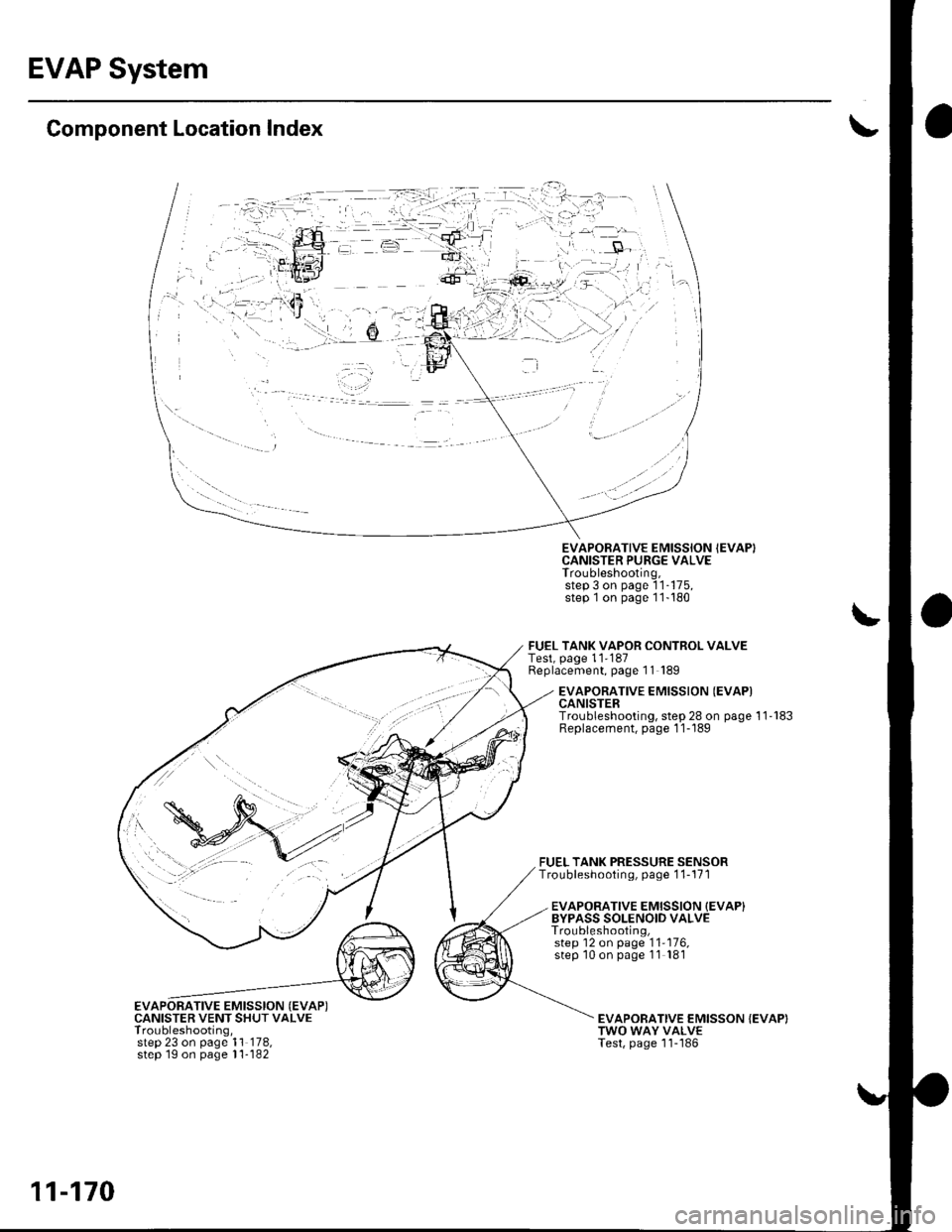
Component Location Index
EVAPORATIVE EMISSION {EVAP)CANISTER VENT SHUT VALVETroubleshooting,step 23 on page 1'l 178,step 1g on page l1- 182
EVAPORATIVE EMISSION IEVAPICANISTER PURGE VALVETroubleshooting,step 3 on page 'l1-175,
step 1on page 11-180
FUEL TANK VAPOR CONTROL VALVETest, page 11'187Replacement, page 11 189
FUEL TANK PRESSURE SENSORTroubleshooting, page 1 1-171
EVAPORATIVE EMISSION {EVAPICANISTERTroubleshooting, step 28 on page 11'183Replacement, page 1 1-189
EVAPORATIVE EMISSION {EVAP}BYPASS SOLENOID VALVETroubleshooting,step 12 on page '11'176,
step '10 on page 11 181
EVAPOBATIVE EMISSON {EVAP)TWO WAY VALVETest, page 'l1-'186
11-170