parking brake HONDA CIVIC 2003 7.G User Guide
[x] Cancel search | Manufacturer: HONDA, Model Year: 2003, Model line: CIVIC, Model: HONDA CIVIC 2003 7.GPages: 1139, PDF Size: 28.19 MB
Page 562 of 1139
Front and Rear Suspension
WheelAlignment
The suspension can be adjusted for front camber, front
toe, and rear toe. However, each of these adjustments
are interrelated to each other. For example, when you
adjust the toe, the camber changes. Therefore, you
must adjust the front wheel alignment whenever you
adjust the camber or toe.
Pre-Alignment Checks
For proper inspection and adjustment of the wheel
alignment, do these checks:
1. Release the parking brake to avoid an incorrect
measurement.
Make sure the suspension is not modified.
Check the tire size and tire pressure
Tire size:
Front/rear: 195/60R15
Tire pressure:
Front: 230 kPa {2.3 kgf/cm',33 psil
Rear: 210 kPa |'2.1 kgf/cm', 30 psi)
Check the runout of the wheels and tires.
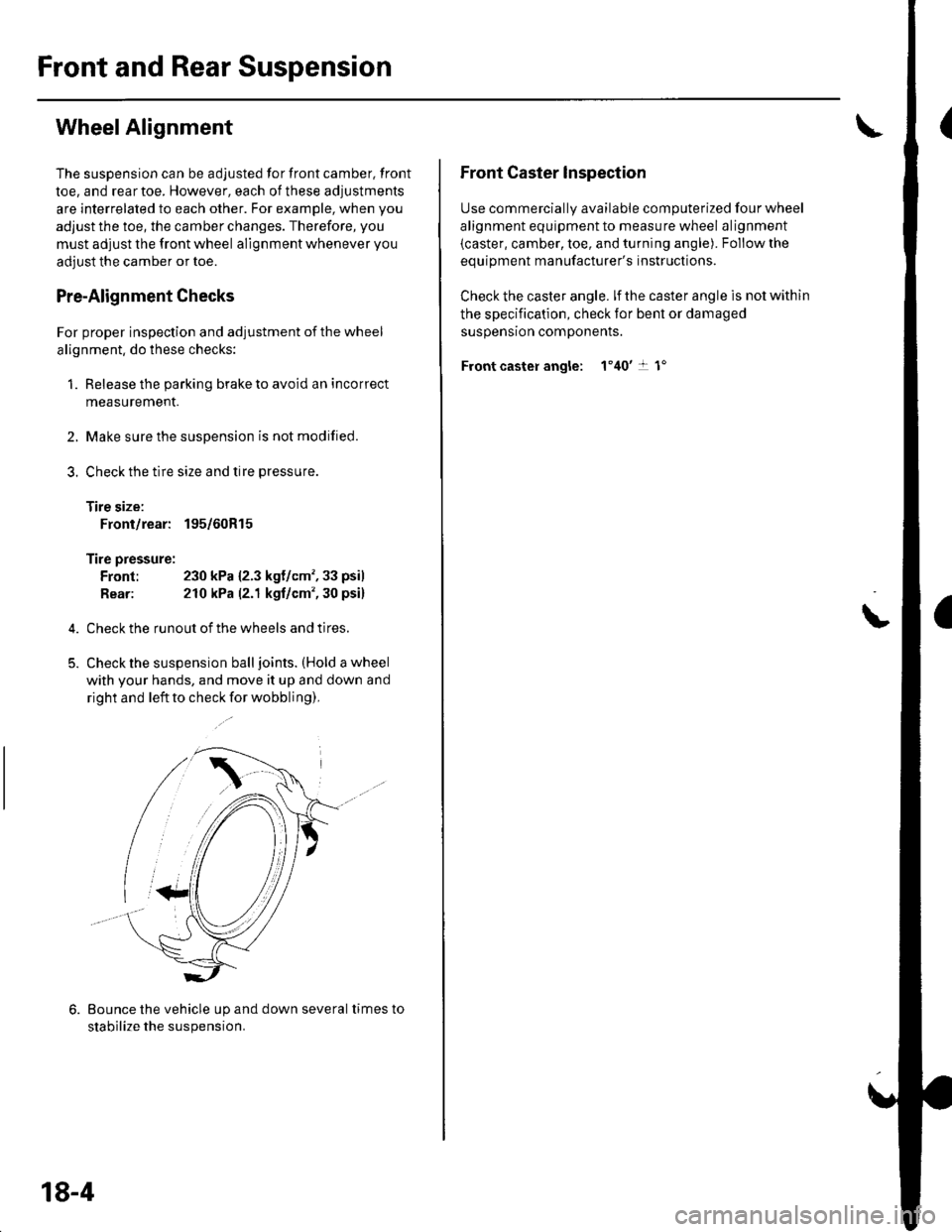
Check the suspension ball joints. (Hold a wheel
with your hands, and move it up and down and
right and left to check for wobbling),
2.
3.
Bounce the vehicle up and down several times to
stabilize the suspension.
18-4
Front Caster lnspection
Use commerciallv available comDuterized four wheel
alignment equipment to measure wheel alignment
(caster, camber, toe, and turning angle). Follow the
eouioment manufacturer's instructions.
Check the caster angle. lf the caster angle is not within
the specification, check for bent or damaged
susoensron comoonents.
Front caster angle: 1'40't 1"
\
Page 565 of 1139
Front Toe Inspection/Adjustment
Use commercially-available computerized four wheel
alignment equipment to measure wheel alignment(caster, camber, toe, and turning angle). Follow the
equipment manufacturer's instructions,
1. Center the steering wheel spokes.
2. Checkthetoe. lf it is not with in the specif ication, go
to step 3.
Front toe-in: 0 t 3 mm {0 t 0.12 in.)
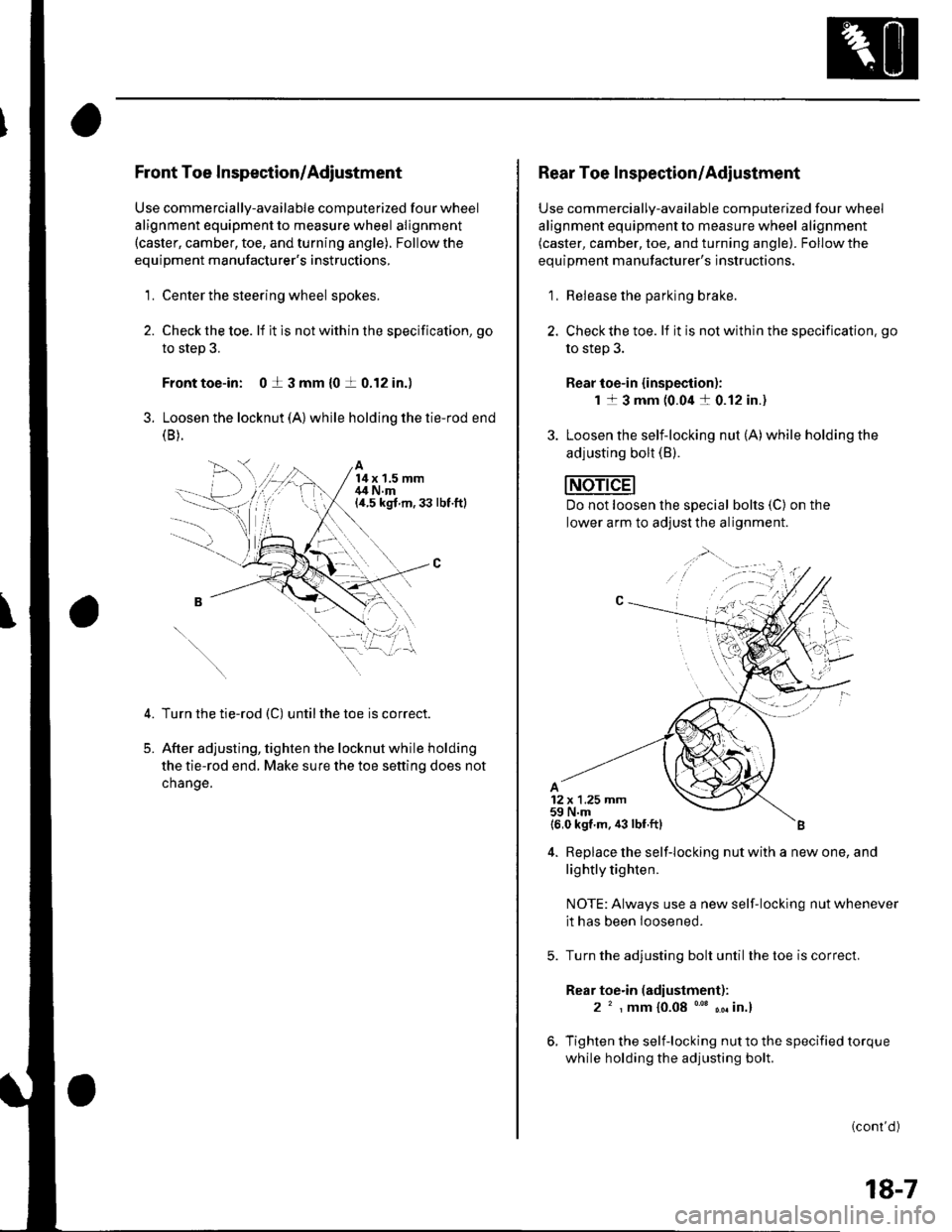
3. Loosen the locknut (A) while holding the tie-rod end(B ).
A14x 1.5 mm,14 N.m(a.5 kgt m,33 lbt.ftl
5.
Turn the tie-rod (C) untilthe toe is correct.
After adjusting, tighten the locknut while holding
the tie-rod end. Make sure the toe setting does not
change.
1,;
Rear Toe Inspection/Adiustment
Use commercially-available computerized four wheel
alignment equipment to measure wheel alignment(caster, camber, toe, and turning angle). Follow the
equipment manufacturer's instructions.
1, Release the parking brake.
2. Checkthe toe. lf it is not within the specification. go
to step 3.
Rear toe-in {inspection):
1 1 3 mm (0.04 a 0.12 in.)
3. Loosen the self-locking nut (A)while holding the
adjusting bolt (B).
Do not loosen lhe special bolts (C) on the
lower arm to adjust the alignment.
4. Replace the self-locking nut with a new one, and
lightly tighten.
NOTE: Always use a new self-locking nut whenever
it has been loosened.
Turn the adjusting bolt until the toe is correct.
Rear toe.in (adiustment):
2 ' , mm {0.08 "' ,. in.}
Tighten the self-locking nut to the specified torque
while holding the adjusting bolt.
(cont'd )
18-7
Page 585 of 1139
1.Raise the rear of the vehicle, and support it with
safety stands in the proper location (see page 'l-8).
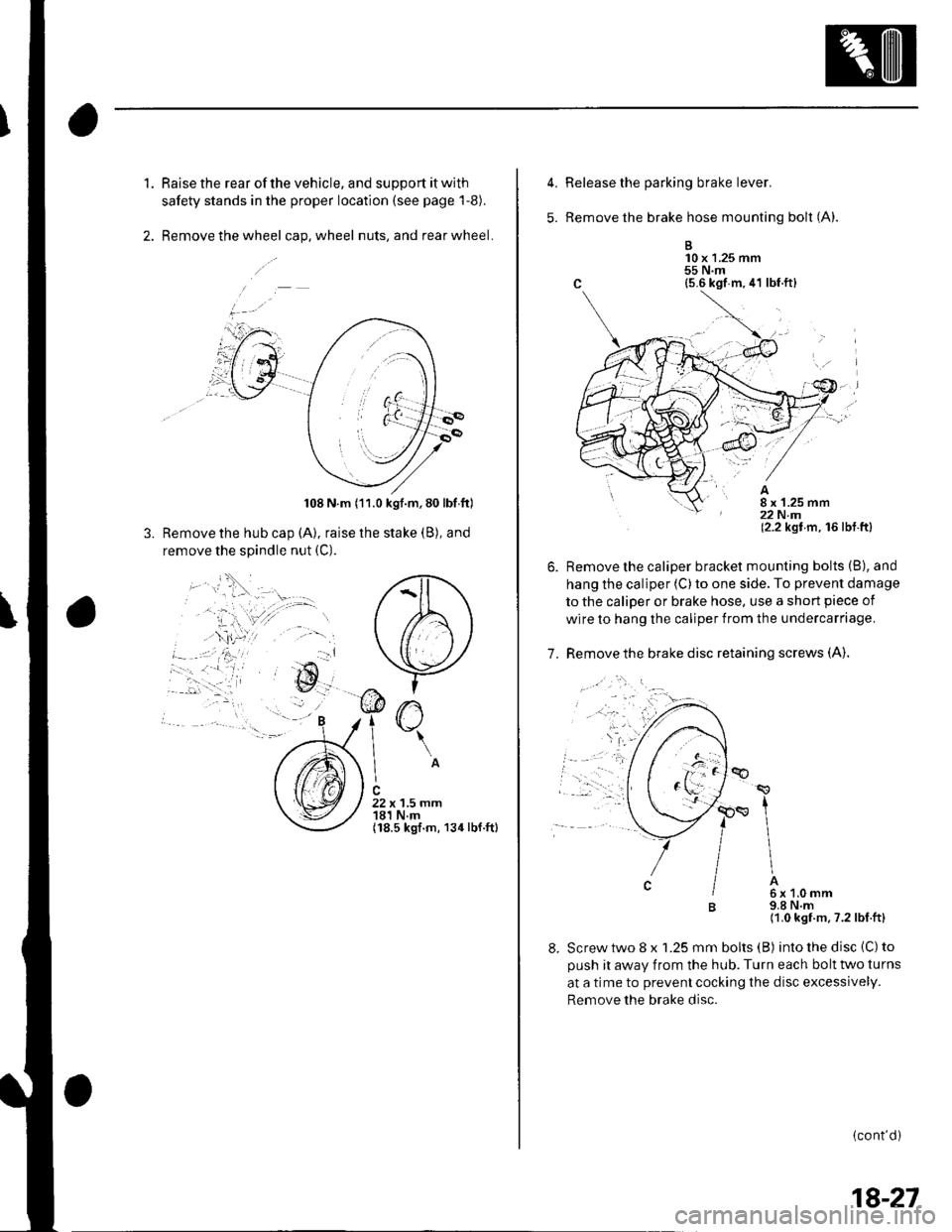
Remove the wheel cap. wheel nuts, and rear wheel.
108 N.m (11.0 kgf.m,80 lbf ftl
Remove the hub cap (A), raise the stake (B), and
remove the spindle nut (C).
O
\A
22 x 1,5 mm181 N.m(18.5 kgf.m, 134lbf.ftl
5.
7.
Release the parking brake lever.
Remove the brake hose mounting bolt (A).
B10 x 1.25 mm55NmC {5.6 kgf m.41 lbf.ft}
(2.2 kgt m, 16lbt.ftl
Remove the caliper bracket mounting bolts (B), and
hang the caliper (C) to one side. To prevent damage
to the caliper or brake hose, use a short piece of
wire to hang the caliper from the undercarriage.
Remove the brake disc retaining screws (A).
Screw two 8 x 1.25 mm bolts (B) into the disc {C) to
oush it awav from the hub. Turn each bolt two turns
at a time to prevent cocking the disc excessively.
Remove the brake disc.
(cont'd)
ap
t
\
IA6x1.0mm9.8 N.m(1.0 kgf.m, ?.2lbf.ftl
18-27
Page 586 of 1139
Rear Suspension
Hub Bearing Unit Replacement
(cont'd)
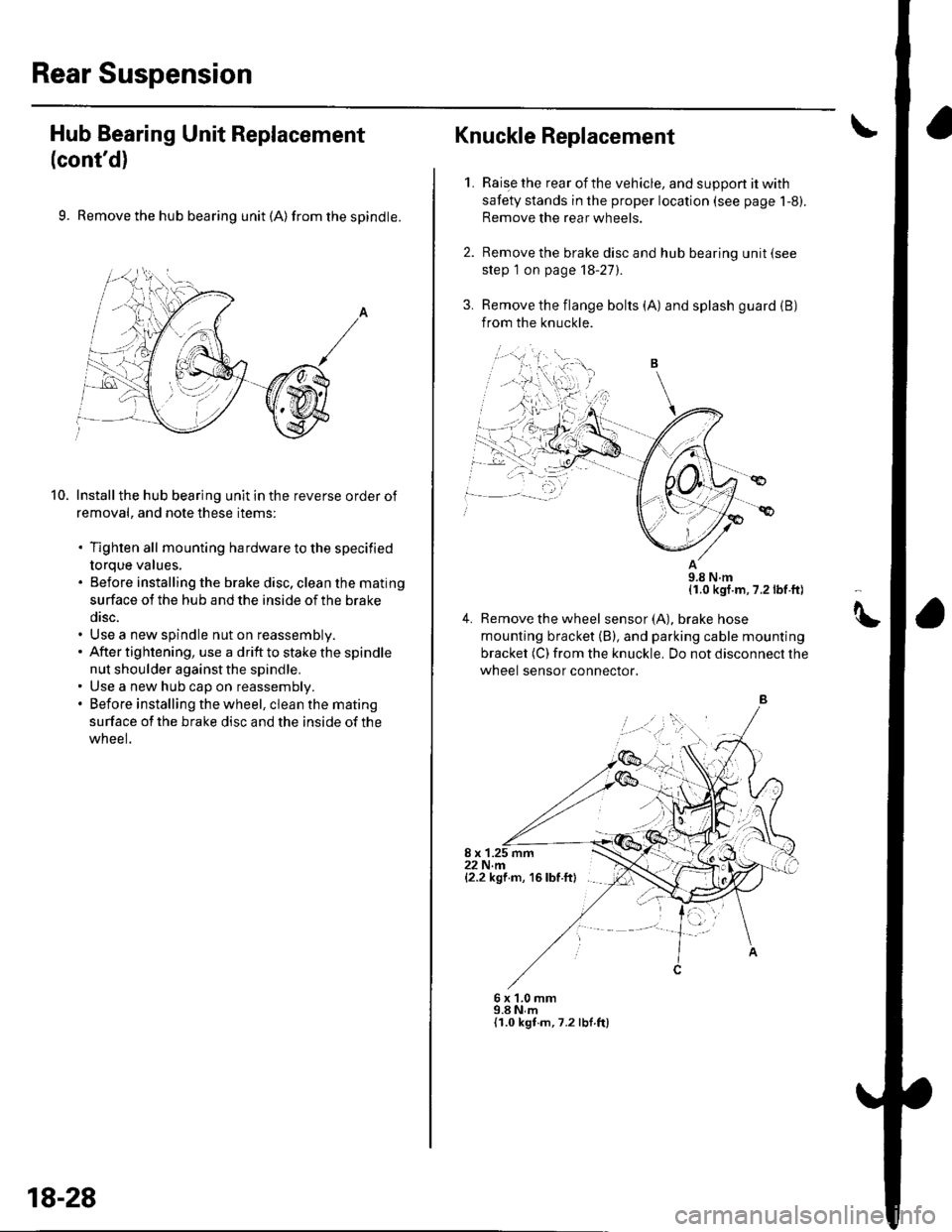
9. Remove the hub bearing unit (A) from the spindle.
Install the hub bearing unit in the reverse order of
removal, and note these items:
. Tighten all mounting hardware to the specified
torque values,. Before installing the brake disc, clean the mating
surface ot the hub and the inside of the brake
disc.. Use a new spindle nut on reassembly.. After tightening, use a drift to stake the spindle
nut shoulder against the spindle.. Use a new hub cap on reassembly.. Before installing the wheel, clean the mating
surface of the brake disc and the inside of the
wneel.
10.
,=,,,
18-28
Raise the rear of the vehicle, and suppon it with
safety stands in the proper location (see page 1-8).
Remove the rear wheels.
Remove the brake disc and hub bearing unit (see
step 1 on page 18-27).
Remove the flange bolts (A) and splash guard (B)
from the knuckle.
11.0 kgf.m, 7.2 lbf ft)
4. Remove the wheel sensor(A), braKe nose
mounting bracket (B), and parking cable mounting
bracket (C) from the knuckle. Do not disconnect the
wheel sensor connector.
8 x 1.25 mm22 N.m{2.2 kgf m, 16 lbf ftl
Knuckle Replacement
1.
6x1.0mm9.8 N,m{I.0 kgt.m,7.2 lbf ft)
tt
Page 596 of 1139
Brakes
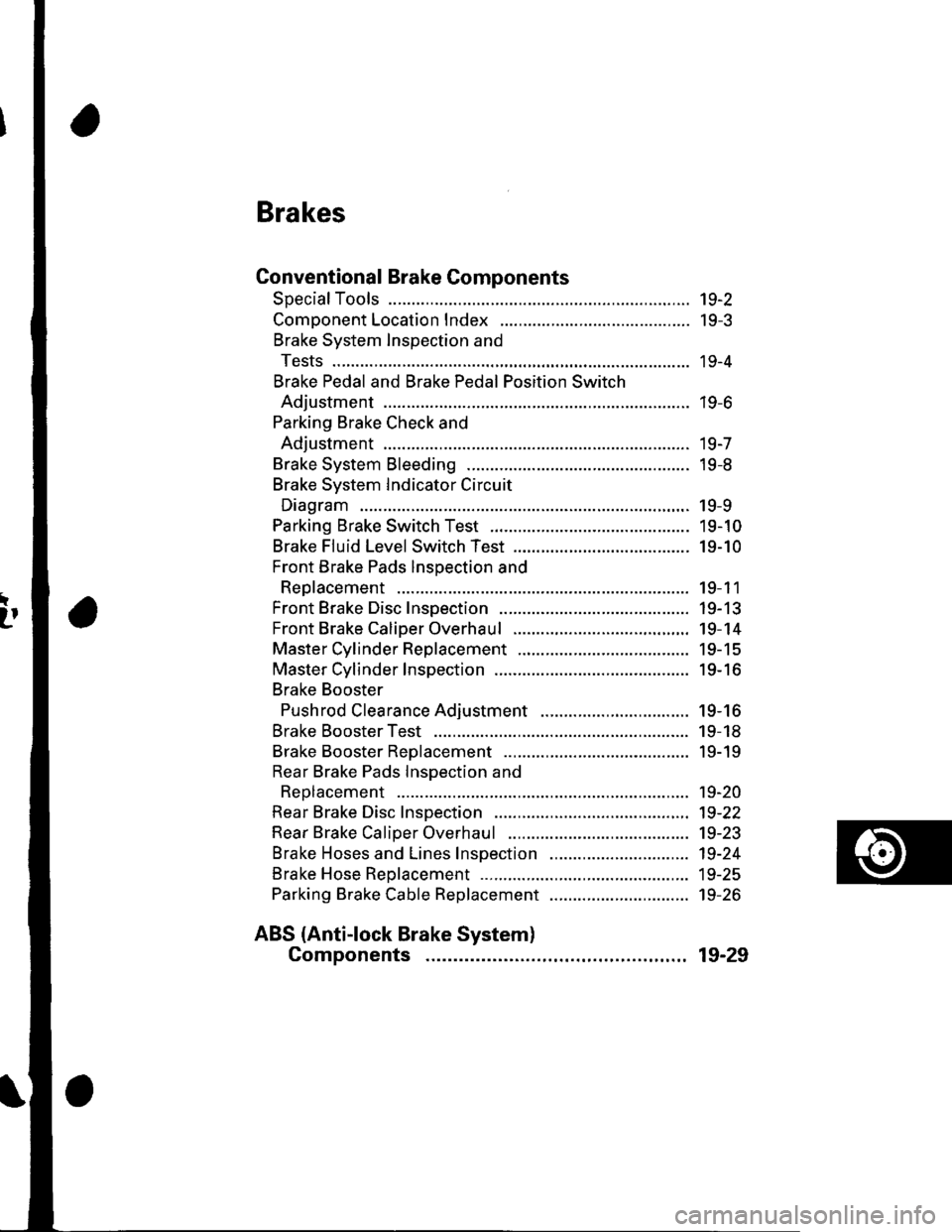
Conventional Brake Components
Special Tools ... ..... ... l9-2
Component Location Index ......................................... 19-3
Brake System Inspection and
Tests ............... .......... 19-4
Brake Pedal and Brake Pedal Position Switch
Adjustment .............. 19-6
Parking Brake Check and
Adjustment .............. 19-7
Brake System Bleeding ...................... 19-8
Brake System Indicator Circuit
Diagram ................... 19-9
Parking Brake Switch Test ................. 19-10
Brake Fluid Level Switch Test ...................................... 19-10
Front Brake Pads lnsoection and
Replacement ........... 19-11
Front Brake Disc Inspection ............... 19-13
Front Brake Calioer Overhaul ...................................... 19-14
Master Cylinder Replacement ........... 19-15
Master Cylinder Inspection ................ 19-16
Brake Booster
Pushrod Clearance Adjustment ................................ 19-16
Brake BoosterTest ................... .......... 19-18
Brake Booster Reolacement .............. 19-19
Rear Brake Pads Inspection and
Reolacement ........... 19-20
Rear Brake Disc Inspection ................ 19-22
Rear Brake Caliper Overhaul ....................................... 19-23
Brake Hoses and Lines Insoection .... 19-24
Brake Hose Reolacement ................... 19-25
Parking Brake Cable Replacement .............................. 19-26
ABS (Anti-lock Brake System)
Gomponents ... 19-29
Page 598 of 1139
Component Location Index
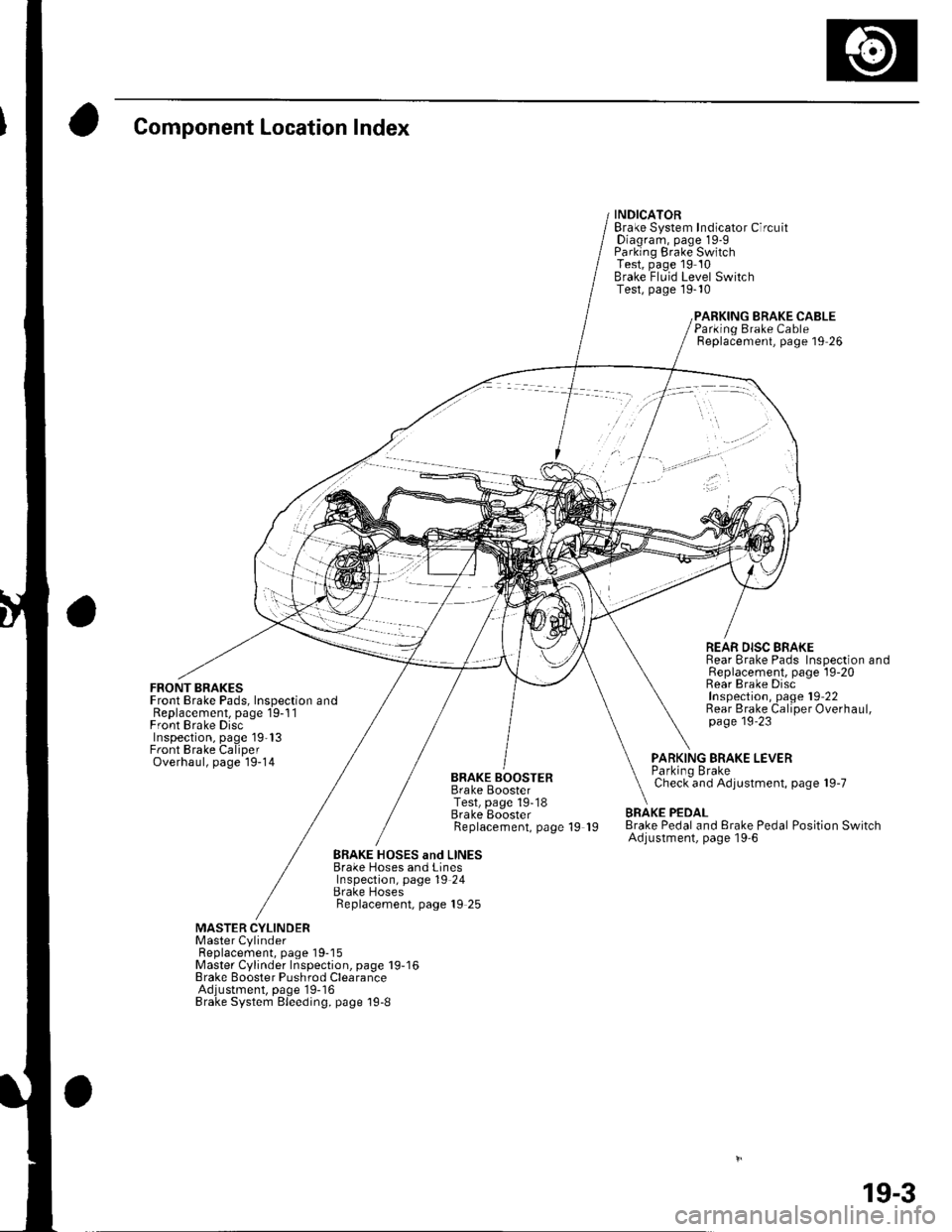
FRONT BRAKESFront Brake Pads, Inspection andReplacement, page 19-1 1Front Brake DiscInspection, page 19'13Front Brake CaliperOverhaul, page 19-14
INDICATORBrake System Indicator CircuitDiagram, page 19-9Parking Brake SwitchTest, page 19 10Brake Fluid Level SwitchTest, page 19-10
BRAKE CABLE
BRAKE BOOSTERBrake BoosterTest, page 19-18Brake EoosterReplacement, page 19 19
Parking Brake CableReplacement, page 19 26
REAR DISC BRAKERear Brake Pads Inspection andReplacement, page l9-20Rear Brake DiscInspection, page 19'22Rear Brake Caliper Overhaul,page 19'23
PARKING BRAKE LEVERParkino BrakeCheck and Adjustment, page 19-7
BRAKE PEDALBrake Pedal and Erake Pedal Position SwitchAdjustment, page l9-6
BRAKE HOSES and LINESBrake Hoses and LinesInspection, page 19 24Brake HosesReplacement, page 19 25
MASTER CYLINDERMaster CylinderFl6^1.^6m6nr ^2^o 1O-18Master Cylinder Inspection, page 19-16Brake Booster Pushrod ClearanceAdjustment, page'19-16Brake System Bleeding, page 19-8
19-3
Page 599 of 1139
Gonventional Brake Components
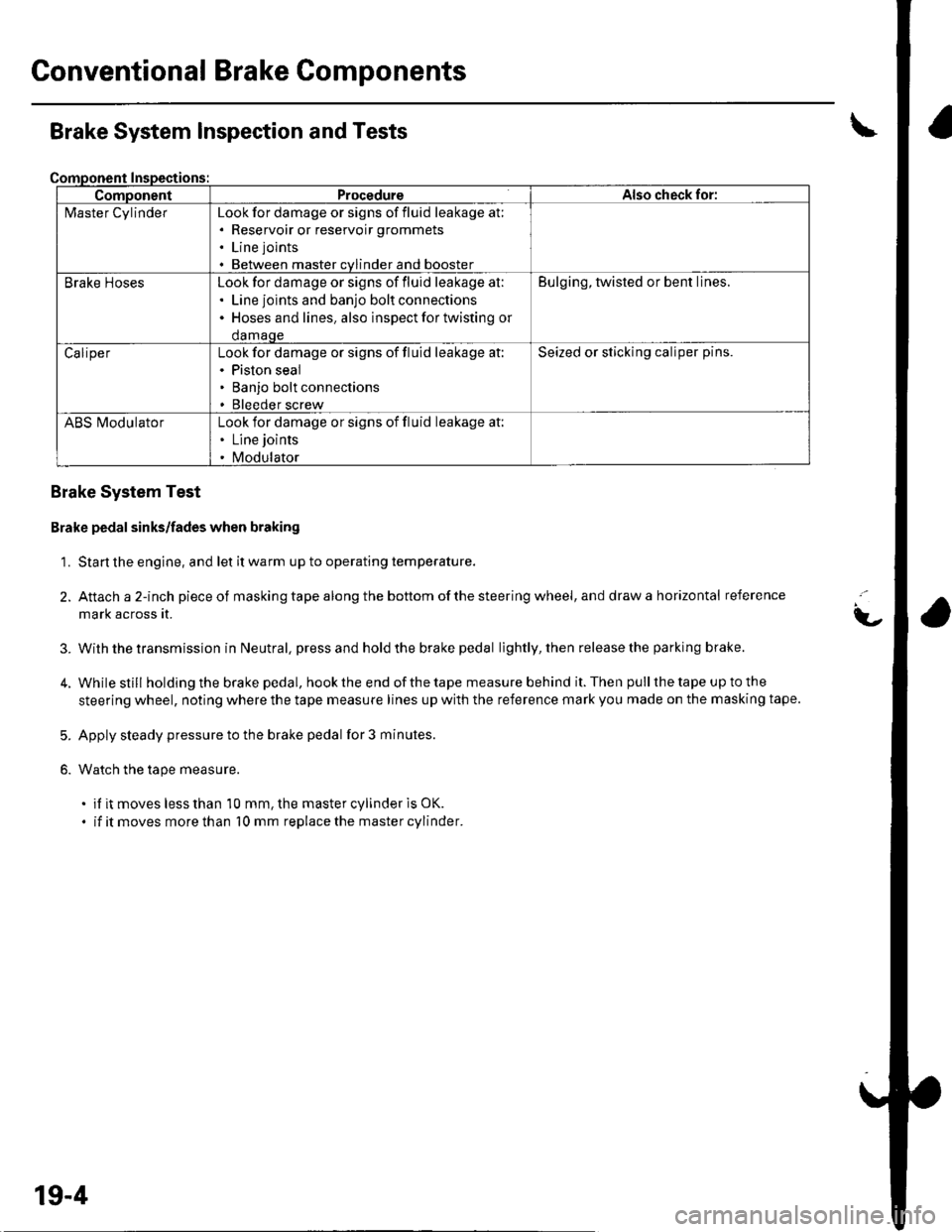
ComponentProcedureAlso check for:
l\4aster CylinderLook for damage or signs of fluid leakage at;. Reservoir or reservoir grommets
. Line joints
. Between master cvlinder and booster
Brake HosesLook for damage or signs of fluid leakage at:. Line joints and banjo bolt connections. Hoses and lines. also inspect for twisting or
damaqe
Bulging, twisted or bent lines.
CaliperLook for damage or signs of fluid leakage at:. Piston seal. Banjo bolt connections. Bleeder screw
Seized or sticking caliper pins.
ABS l\ilodulatorLook for damage or signs of fluid leakage at:. Line joints
. Modulator
Brake System Inspection and Tests
Brake System Test
Brake pedal sinks/fades when braking
1. Start the engine, and let it warm up to operating temperature.
2. Attach a 2-inch pieceof masking tape along the bottom of the steering wheel, and draw a horizontal reference
mark across it.
With the transmission in Neutral, press and hold the brake pedal lightly, then release the parking brake.
While still holding the brake pedal, hook the end of the tape measure behind it. Then pull the tape up to the
steering wheel, noting where the tape measure lines up with the reference mark you made on the masking tape.
Apply steady pressure to the brake pedal for 3 minutes.
Watch the tape measure.
. if it moves less than 10 mm, the master cylinder is OK.
. if it moves more than 10 mm replace the master cylinder.
t-
3.
5.
6.
19-4
Page 602 of 1139
Parking Brake Check and Adiustment
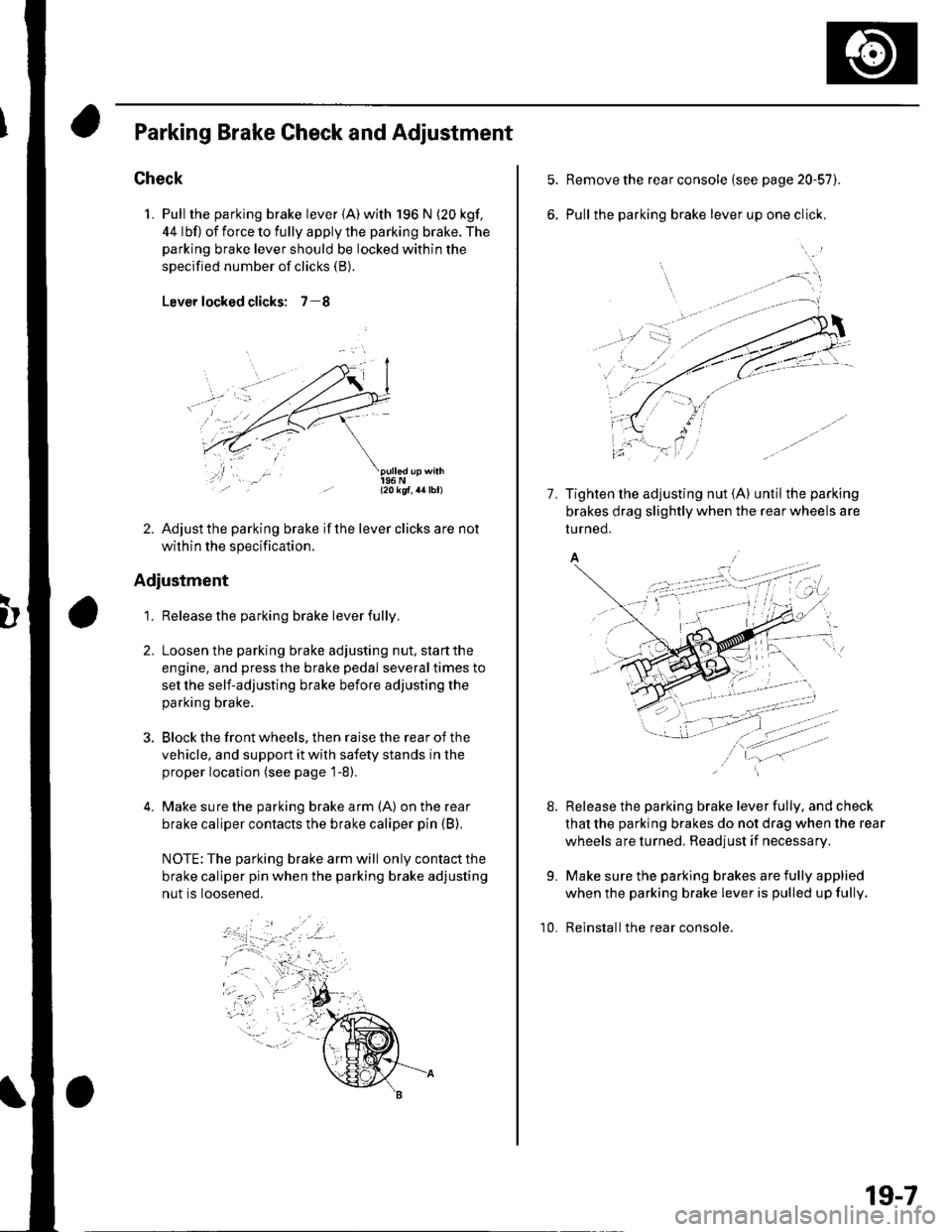
Check
1. Pull the parking brake lever {A) with 196 N (20 kgf,
44 lbf) of force to fully apply the parking brake. The
parking brake lever should be locked within the
specified number of clicks (B).
Lever locked clicks: 7-8
- l2okqf, a4lbl)
2. Adjust the parking brake if the lever clicks are not
within the specification.
Adjustment
1. Release the parking brake lever fully.
Loosen the parking brake adjusting nut, start the
engine, and press the brake pedal several times to
set the self-adjusting brake before adjusting the
parking brake.
Block the front wheels, then raise the rear of the
vehicle, and support it with safety stands in the
proper location (see page 1-8).
Make sure the parking brake arm (A) on the rear
brake caliper contacts the brake caliper pin (B),
NOTE: The parking brake arm will only contact the
brake caliper pin when the parking brake adjusting
nut is loosened.
Remove the rear console {see page 20-57).
Pull the parking brake lever up one click,
7, Tighten the adjusting nut {A} until the parking
brakes drag slightly when the rear wheels are
tu rned.
A/
Release the parking brake lever fully, and check
that the parking brakes do not drag when the rear
wheels are turned. Readjust if necessary.
Make sure the parking brakes are fully applied
when the parking brake lever is pulled up fully.
Reinstall the rear console.
8.
9.
10.
19-7
Page 605 of 1139
Conventional Brake Components
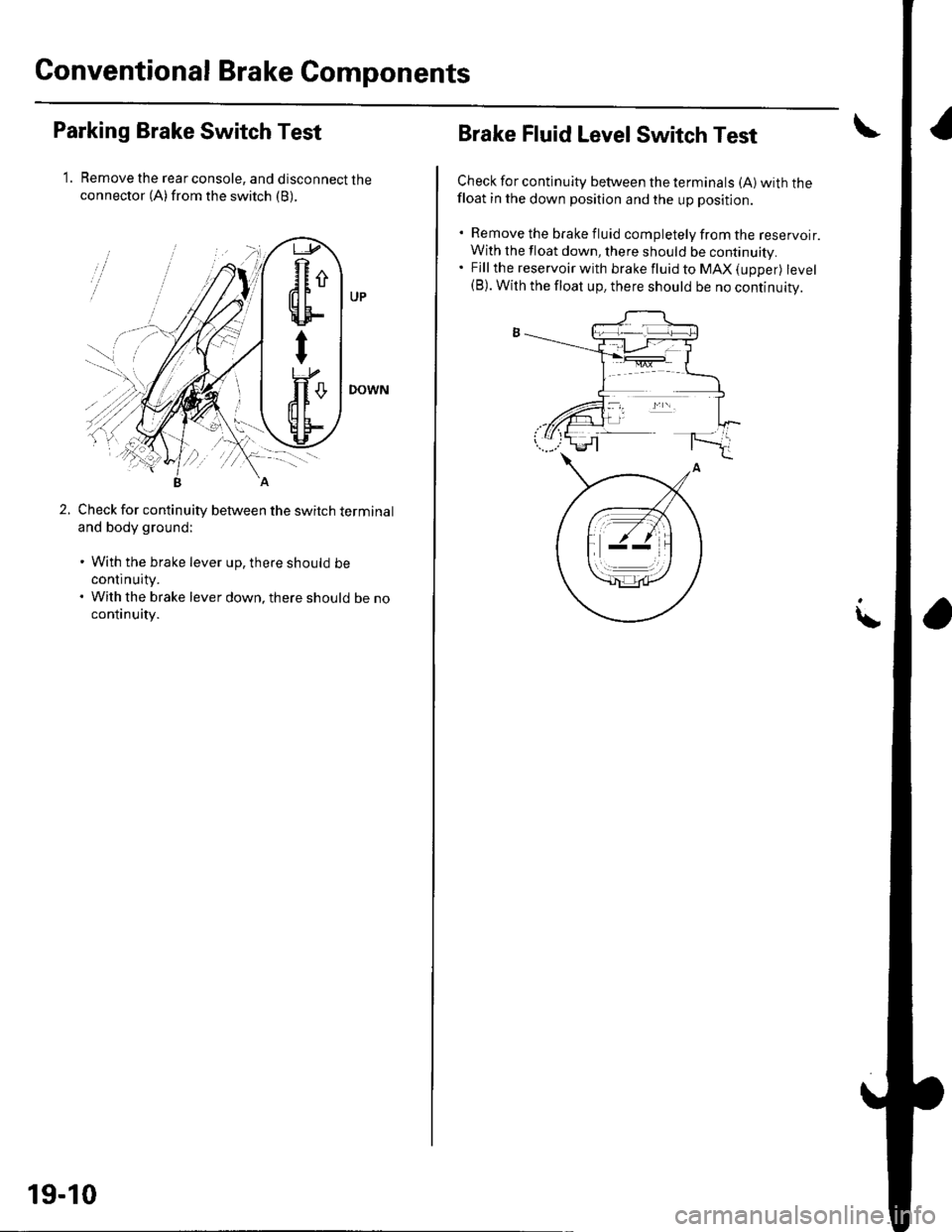
Parking Brake Switch Test
1. Remove the rear console, and disconnect theconnector (A)from the switch (B).
Check for continuity between the switch terminal
and body ground:
. With the brake lever up, there should be
continuity.. With the brake lever down, there should be no
continuity.
R
'dFu\!E!UF-
Y
19-10
Brake Fluid Level Switch Test
Check for continuity between the terminals (A) with thefloat in the down position and the up position.
. Remove the brake fluid completely from the reservoir.
With the float down, there should be continuity.. Fjllthe reservoir with brakefluidto MAX(upper) level(B). With the float up, there should be no continuity.
\
Page 616 of 1139
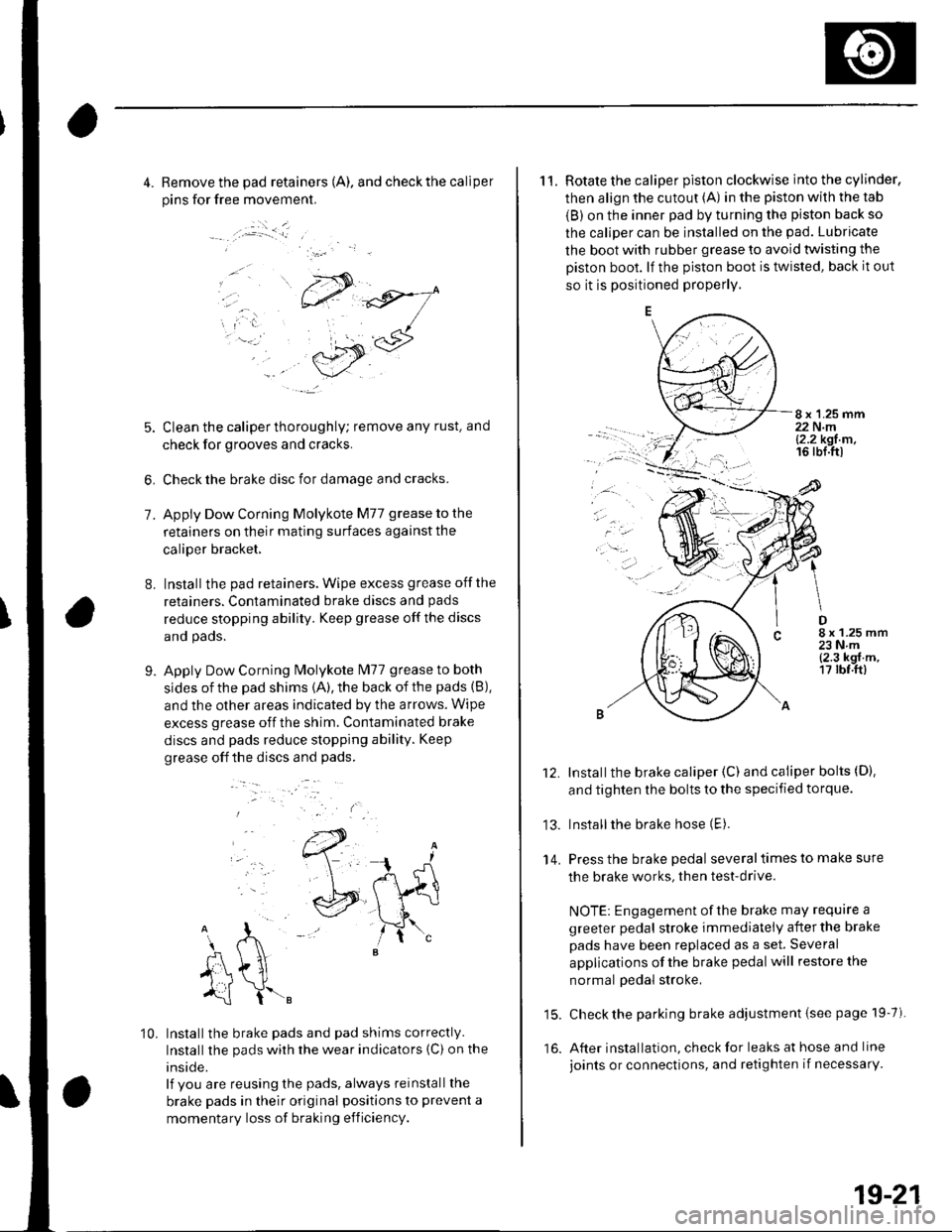
4. Remove the pad retainers (A). and check the caliper
pins for free movement.
:.i _ _l
7.
8.
5. Clean the caliper thoroughly; remove any rust. and
check for grooves and cracks.
6, Check the brake disc for damage and cracks.
Apply Dow Corning Molykote M77 grease to the
retainers on their mating surfaces against the
caliper bracket,
Installthe pad retainers. Wipe excess grease offthe
retainers. Contaminated brake discs and pads
reduce stopping ability. Keep grease off the discs
and pads.
Apply Dow Corning Molykote lvl77 grease to both
sides of the pad shims {A), the back of the pads (B),
and the other areas indicated by the arrows. Wipe
excess grease off the shim. Contaminated brake
discs and pads reduce stopping ability. Keep
grease off the discs and pads.
9.
..-.
10. Installthe brake pads and pad shims correctly.
Installthe pads wirh the wear indicators {C) on the
inside.
lf you are reusing the pads, always reinstall the
brake pads in their original positions to prevent a
momentary loss of braking efficiency.
11. Rotate the caliper piston clockwise into the cylinder,
then align the cutout (A) in the piston with the tab
{B) on the inner pad by turning the piston back so
the caliper can be installed on the pad. Lubricate
the boot with rubber grease to avoid twisting the
Diston boot. lf the piston boot is twisted, back it out
so it is positioned properly.
8 x 1.25 mm22 N.ml2.2 kgt m,16 rbl.ttl
.ar
D8 x 1.25 mm23Nm{2.3 kgf.m,17 rbf.ft)
13.
14.
Installthe brake caliper (C) and caliper bolts (D).
and tighten the bolts to the specified torque.
Installthe brake hose (E).
Press the brake pedal several times to make sure
the brake works, then test-drive.
NOTE: Engagement of the brake may require a
greeter pedal stroke immediately after the brake
pads have been replaced as a set. Several
applications of the brake pedal will restore the
normal pedal stroke,
15. Check the parking brake adjustment {see page 19-7).
16. After installation, check for leaks at hose and line
joints or connections, and retighten if necessarY.
19-21