400 HONDA CIVIC 2003 7.G Workshop Manual
[x] Cancel search | Manufacturer: HONDA, Model Year: 2003, Model line: CIVIC, Model: HONDA CIVIC 2003 7.GPages: 1139, PDF Size: 28.19 MB
Page 5 of 1139
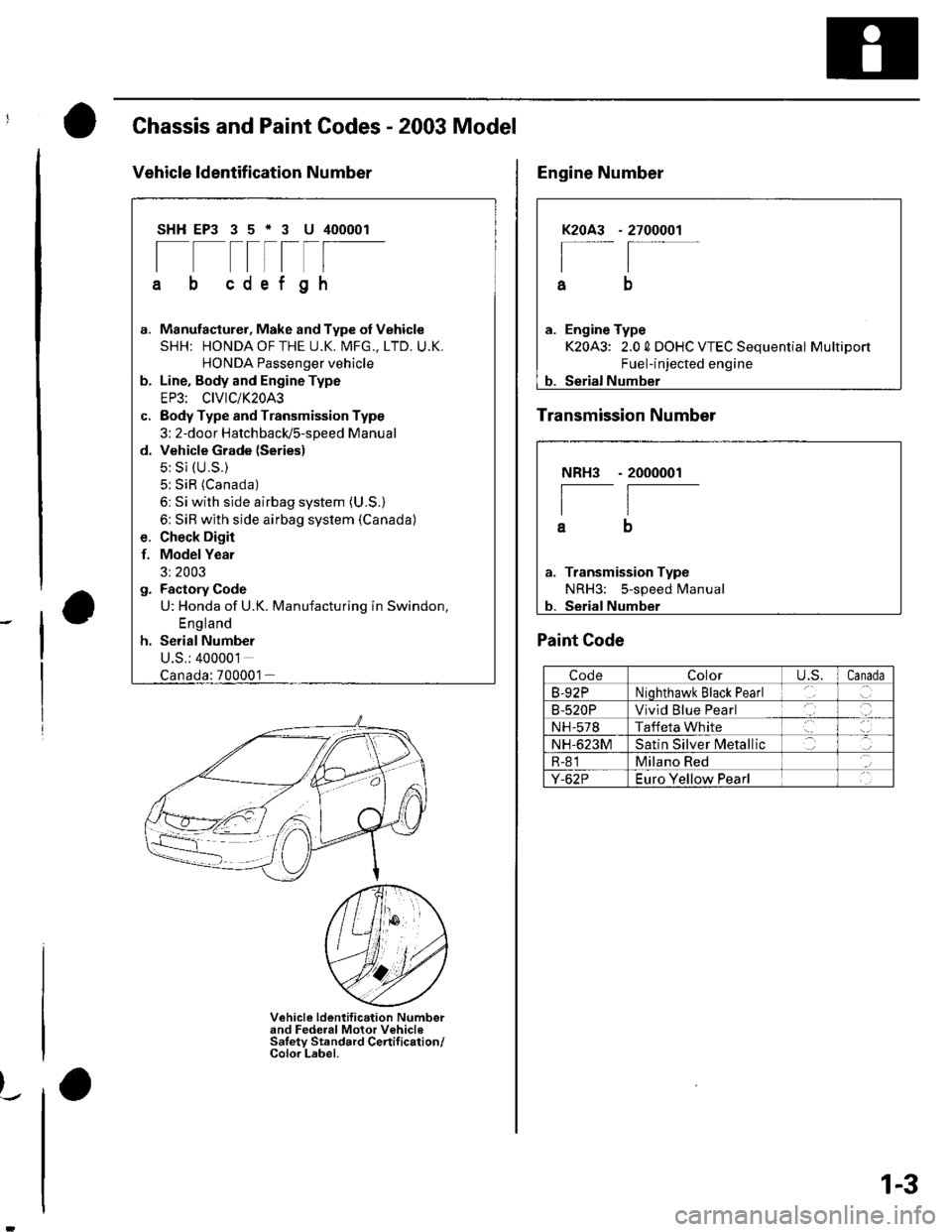
Chassis and Paint Codes - 2003 Model
Vehicle ldentif ication Number
SHHEP3 35*3 U 400001
[--t-rlF
cdef gh
G.
d.
Manufacturer, Make and Type of Vehicle
SHH: HONDAOFTHE U.K. MFG., LTD. U.K.
HONDA Passenger vehicle
Line. Body and Engine Type
EP3: CIVIC/K20A3
Body Type and Transmission Type
3: 2-door HatchbacldS-speed Manual
Vehicle Grade (Series)
5: Si (U.S.)
5: SiR (Canada)
6: Si with side airbag system (U.S.)
6: SiR with side airbag system (Canada)
Check Digir
Model Year
3: 2003
Factory Code
U: Honda of U.K. Manufacturing in Swindon,
England
Serial Number
U.S.: 400001
f.
:700001
Vehicle ldentification Numberand Federal Motor VehicleSaletv Standard Certif ication/Color Label.
)_.
2700001K2OA3
I
a
a. Engine Type
K20A3: 2.0 0 DOHC VTEC Sequential Multiport
Fuel-injected engine
b. Serial Number
Engine Number
Transmission Number
NRH3
I
a
Transmission Type
NRH3: 5-speed Manual
Serial Number
- 2000001
Paint Code
CodeColorU,S.Canada
B-92PNiohthawk Black Pearl
B-520PVivid Blue Pearl
NH-578Taffeta White
NH-623MSatin Silver N4etallic
R-81Milano Red
Y-62PEuro Yellow Pearl
1-3
Page 23 of 1139
L
v
2-11
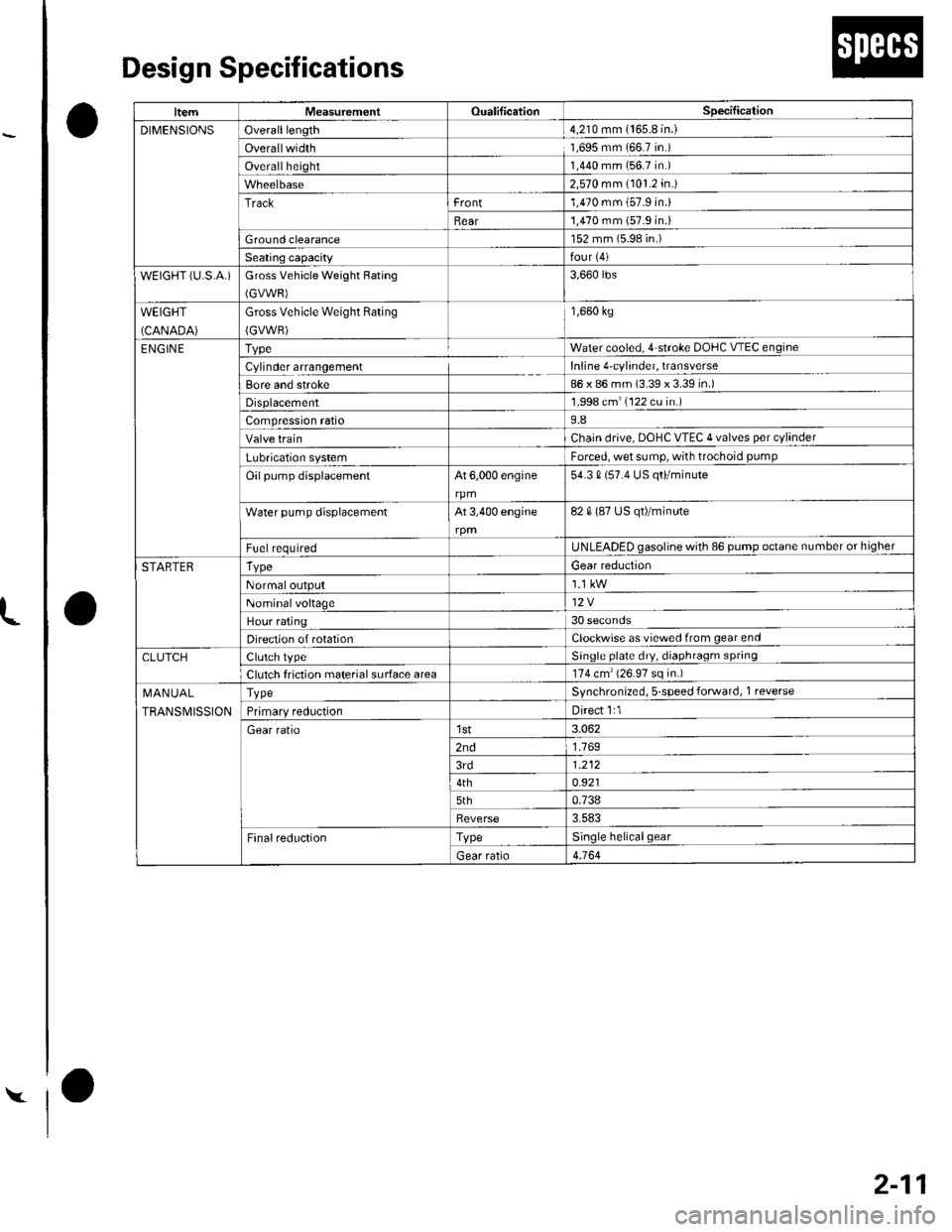
Design Specifications
O
o
o
|temMeasurementOualificationSpecilication
DIMENSIONSOveralllength4,210 mm {165.8 in.)
Overallwidth1,695 mm 166.7 in.)
Overallheight1,440 mm (56.7 in.)
2,570 mm (101.2 in.)
Trackrront1,470 mm (57.9 in.)
Rear'1,470 mm (57.9 in.i
Ground clearance152 mm (5.98 in.)
Seating capacityfour {4)
wEtGt-iT {u.s.A.)Gross Vehicle Weight Rating
(GVWR)
3,660 rbs
WEIGHT
(CANADA)
Gross Vehicle Weight Rating
{GVWR)
1,660 kg
ENGIN ETvpeWater cooled. 4 stroke DOHC V-EC engin(
Cylinder arrangementInline 4'cylinder, transverse
Bore and stroke86 x 86 mm (3.39 x 3.39 in.)
Displacement1,998 cm'(122 cu in.)
Compression ratio9.8
Valve trainChain drive. DOHC VTEC 4 valves per cylinder
Lubrication systemForced, wet sump, with trochoid pumP
Oil pump displacementAt 6,000 engine
rpm
54.3 0 (57.4 US qo/minute
Water pump displacementAt 3,400 engine82 0 (87 US qt)/minute
F!el requiredUNLEADED gasoline with 86 pump octane number or higher
STARTERTvpeGear reduction
Normaloutput
Nominalvoltage12V
Hour rating30 seconds
Direction of rotationClockwise as viewecl from gear end
CLUTCHClutch tvpeSinqle plate dry, diaphragm spring
Clutch friction material surface area174 cm'{26.97 sq in.)
I\,1AN UAL
TRANSMISSION
TvpeSvnchronized, s-speed forward, 1 reverse
Primarv reductionDirect 1:1
Gear ratiolst3.062
2nd1.769
3rd1.212
4th0.921
5th0.738
Reverse3.583
FinalreductionTypeSinole helicalgear
Gear ratio4.164
Page 37 of 1139
Engine Electrical
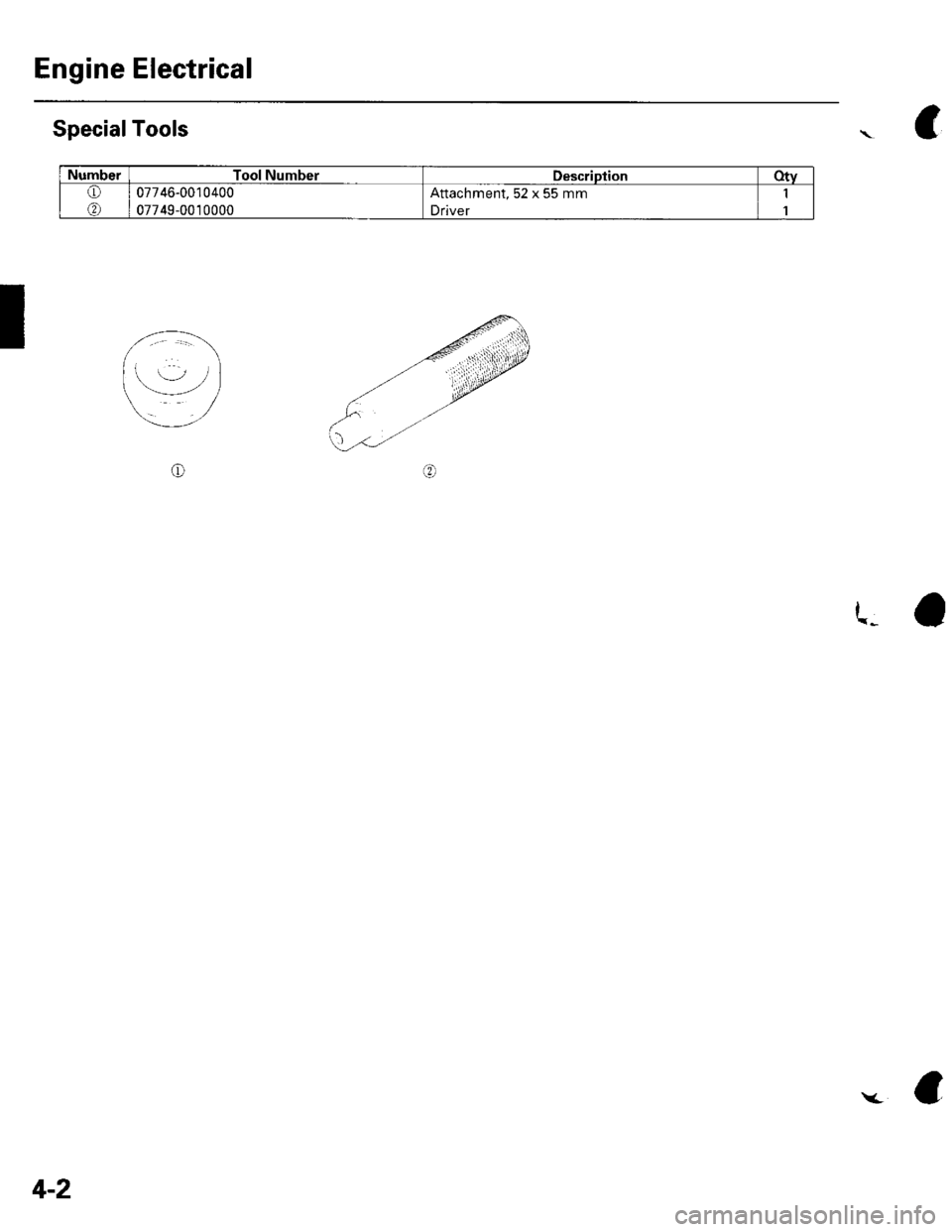
SpecialTools
I
NumberTool NumberDescriptionotv
o
@
07746-0010400
07749-0010000
Attachment, 52 x 55 mm
Driver
1
1
\C
4-2
(a
Page 40 of 1139
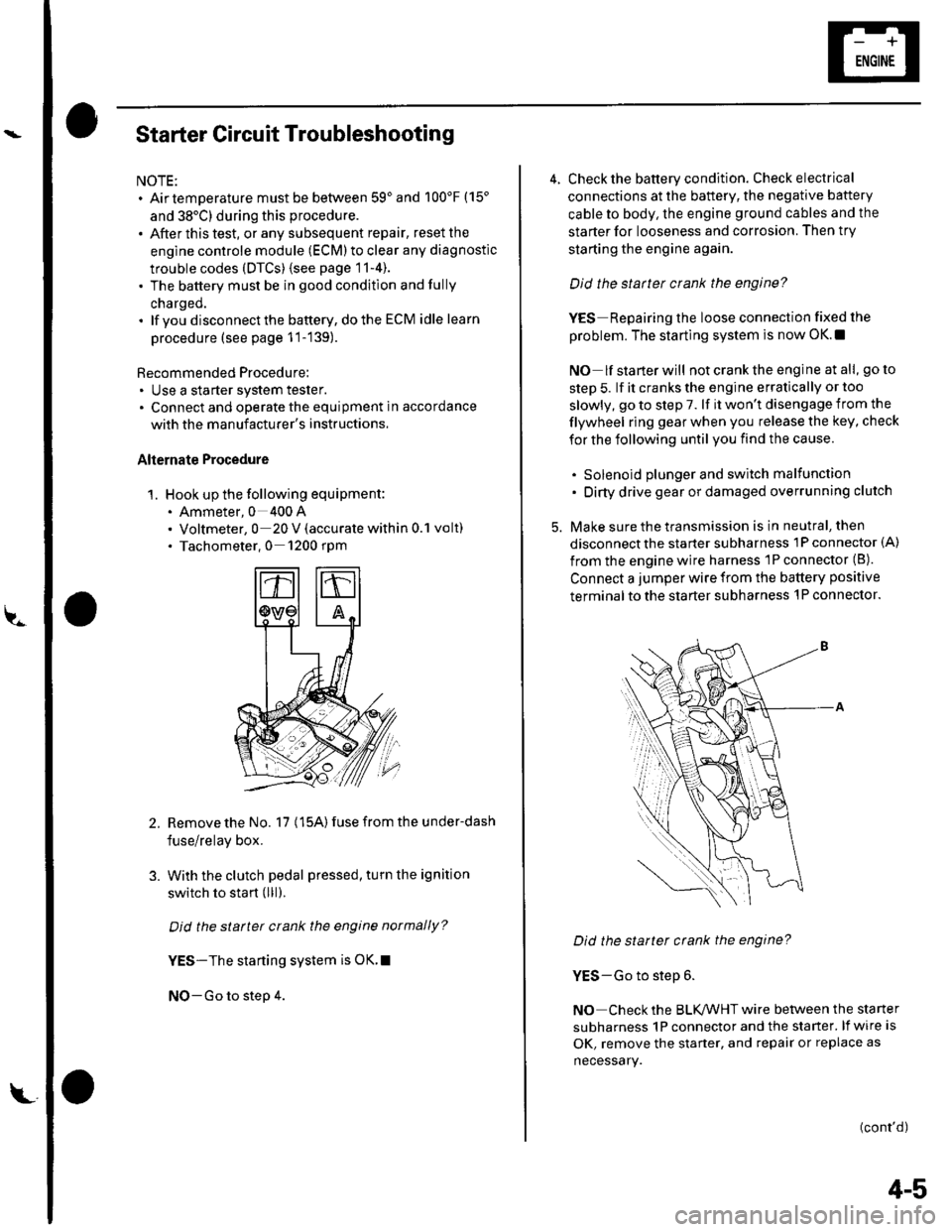
Starter Circuit Troubleshooting
NOTE:. Airtemperature must be between 59'and 100'F (15'
and 38'C) during this procedure.
. After this test, or any subsequent repair, reset the
engine controle module (ECM) to clear any diagnostlc
trouble codes (DTCS) {see page 11-4).. The battery must be in good condition and fully
charged.. lf you disconnect the baftery, do the ECM idle learn
procedure (see page 11-139).
Recommended Procedure:. Use a starter system tester.. Connect and operate the equipment in accordance
with the manuf acturer's instructions.
Alternate Procedure
1. Hook up the following equipment:. Ammeter, 0 400 A. Voltmeter, 0 20 V (accurate within 0.1 volt). Tachometer,0 1200 rpm
2.Remove the No. 17 (15A) fuse from the under-dash
fuse/relay box.
With the clutch pedal pressed, turn the ignition
switch to start (lll).
Did the starter crank the engine normally?
YES-The starting system is OK.I
NO-Go to step 4.
3.
L
4-5
4. Check the battery condition. Check electrical
connections at the battery, the negative baftery
cable to body, the engine ground cables and the
starter for looseness and corrosion. Then try
starting the engine again.
Did the statter crank the engine?
YES Repairing the loose connection fixed the
problem. The starting system is now OK.!
NO lf starterwill notcranktheengine atall, goto
step 5. lf it cranks the engine erratically or too
slowly, go to step 7. lf it won't disengage from the
flywheel ring gear when you release the key, check
for the following until you find the cause.
. Solenoid plunger and switch malfunction. Dirty drive gear or damaged overrunning clutch
5. Make sure the transmission is in neutral, then
disconnect the starter subharness 1P connector (A)
from the engine wire harness 'lP connector (B).
Connect a jumper wire from the battery positive
terminal to the starter subharness 'l P connector.
Did the starter crank the engine?
YES-Go to step 6.
NO Check the BLK,ANHT wire between the starter
subharness 1P connector and the starter. lf wire is
OK, remove the starter, and repair or replace as
necessary.
(cont'd)
Page 58 of 1139
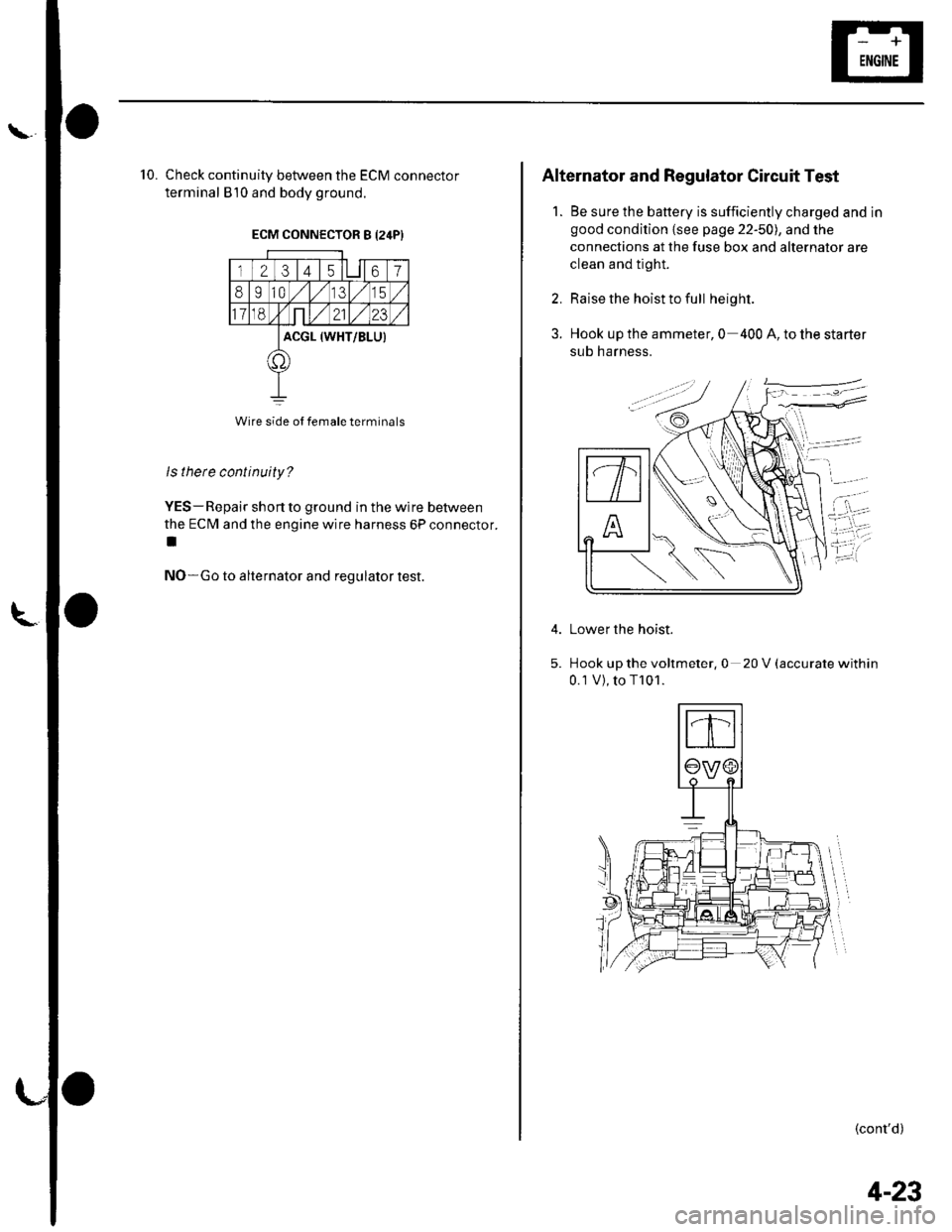
'10. Check continuity between the ECM connector
terminal 810 and body ground.
ECM CONNECTOR S I24PI
23 t4 t567
8I10,/1,/315
118,Nnt,/2123
ACGL (WHT/BLUI
t1'
Wire side ol female terminals
ls there continuity?
YES- Repair short to ground in the wire between
the ECM and the engine wire harness 6P connector.
t
NO-Go to alternator and regulator test.
Alternator and Regulator Circuit Test
1. Be sure the battery is sufficiently charged and in
good condition {see page 22-50), and the
connections at the fuse box and alternator are
clean and tight.
2. Raise the hoist to full height.
3. Hook up the ammeter, 0 400 A, to the starter
sub harness.
Lower the hoist.
Hook up the voltmeter, 0 20 V (accurate within
0.1V),toT101.
(cont'd)
4-23
Page 66 of 1139
L
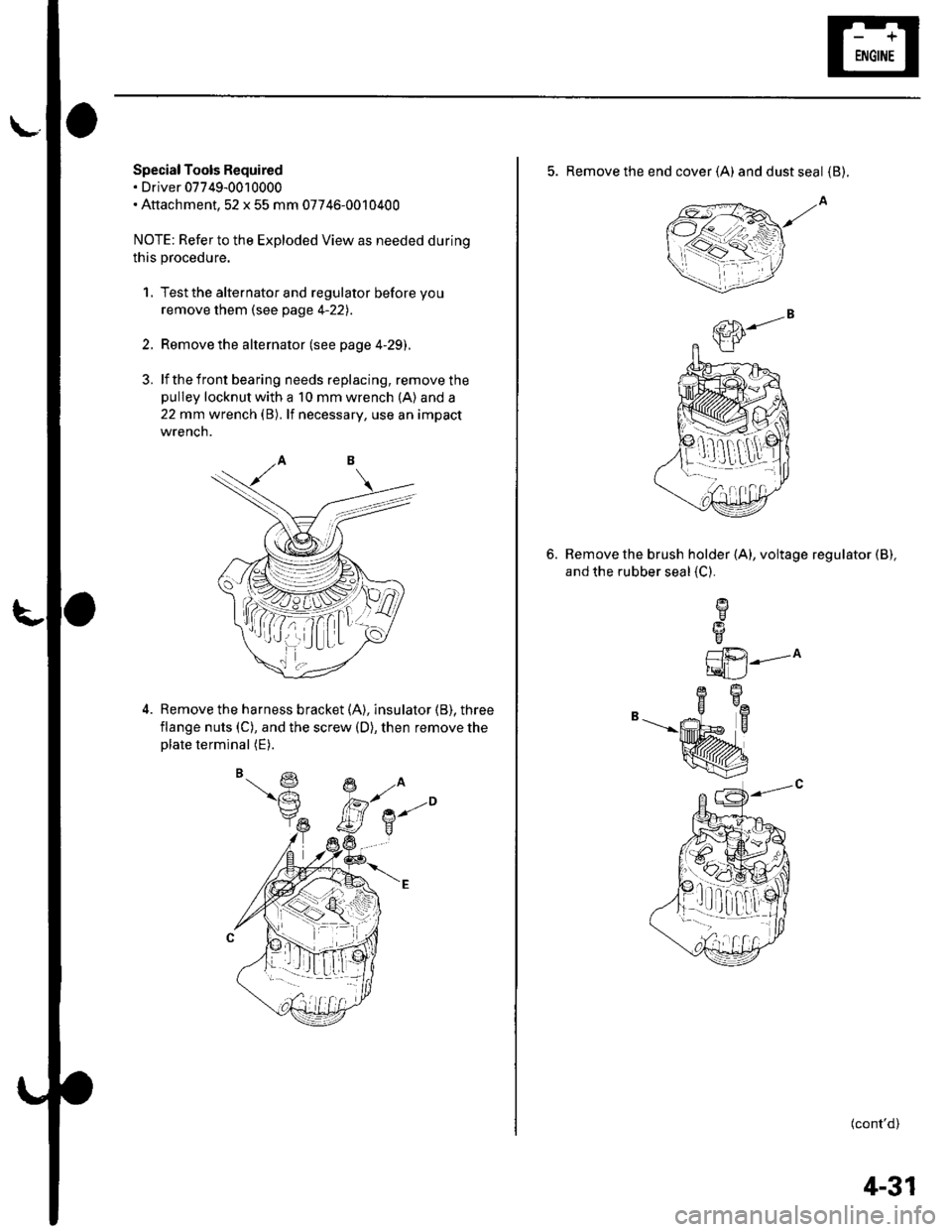
Special Tools Required. Driver 07749-0010000. Attachment,52 x 55 mm 07746-0010400
NOTE: Refer to the Exploded View as needed during
this procedure.
1, Test the alternator and regulator before you
remove them (see page 4-22l,.
2. Remove the alternator (see page 4-29).
3. lf the front bearing needs replacing, remove thepulley locknut with a 10 mm wrench (A) and a
22 mm wrench (B). lf necessary, use an impact
wrencn.
Remove the harness bracket (A), insulator (B). three
flange nuts (C), and the screw (D), then remove theplate terminal (E).
,( ( , tt I;r_ lLt
5. Remove the end cover (A) anddustseal {B).
Remove the brush holder (A), voltage regulator (B),
and the rubber seal {C}.
6.
L1i.21---^
tqLJ
B-"--|.
(cont'd)
1!q[-dr,:l
4-31
Page 68 of 1139
\-
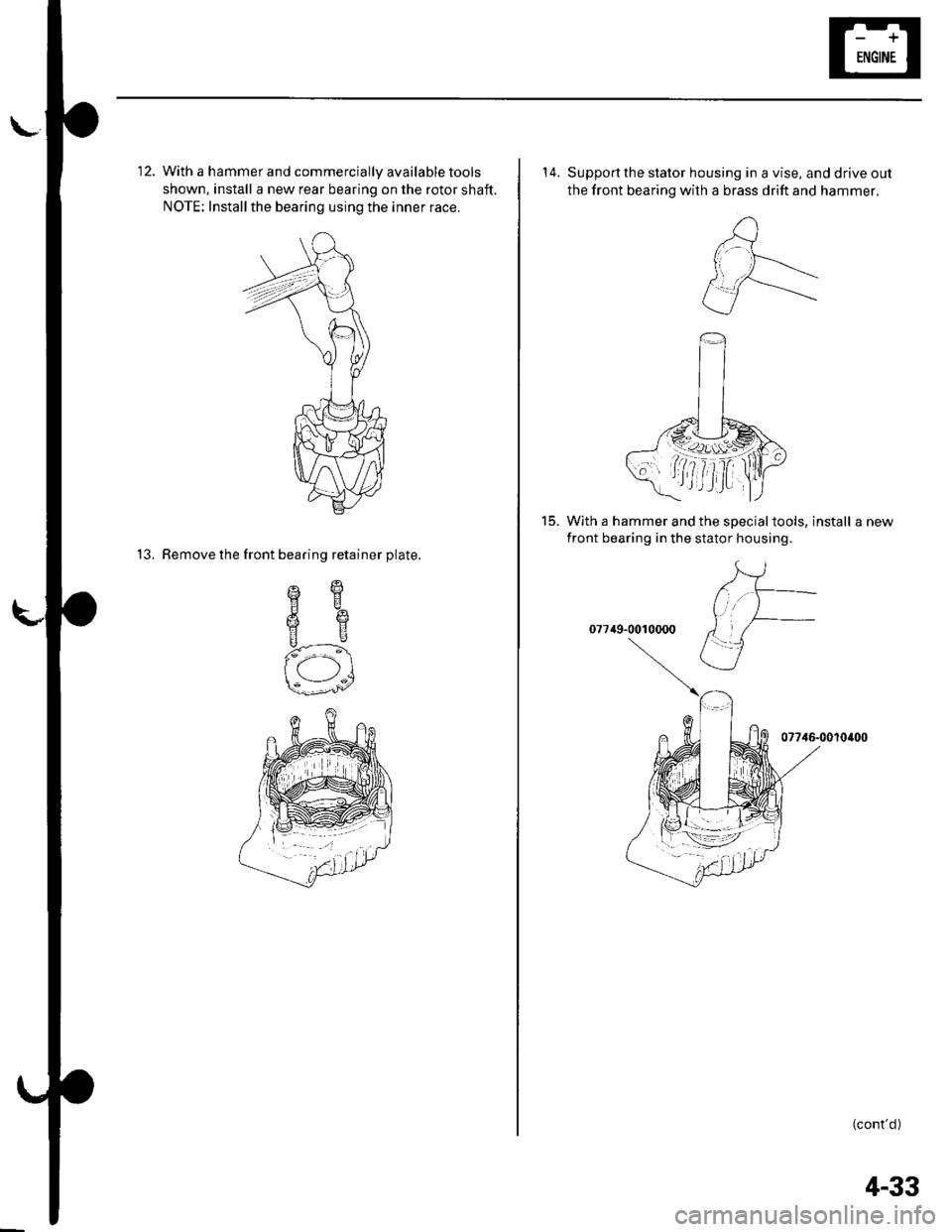
12. With a hammer and commercially available tools
shown, install a new rear bearing on the rotor shaft.
NOTE: Installthe bearing using the inner race.
13. Remove the front bearing retainer plate.
sqHE
6e
us
f-\
-:1s---'^/
14. Supportthe stator housing in a vise, and drive out
the front bearing with a brass drift and hammer.
15. With a hammer and the specialtools, install a new
front bearing in the stator housing.
07749-0010000
07746-0010400
(cont'd )
4-33
Page 102 of 1139
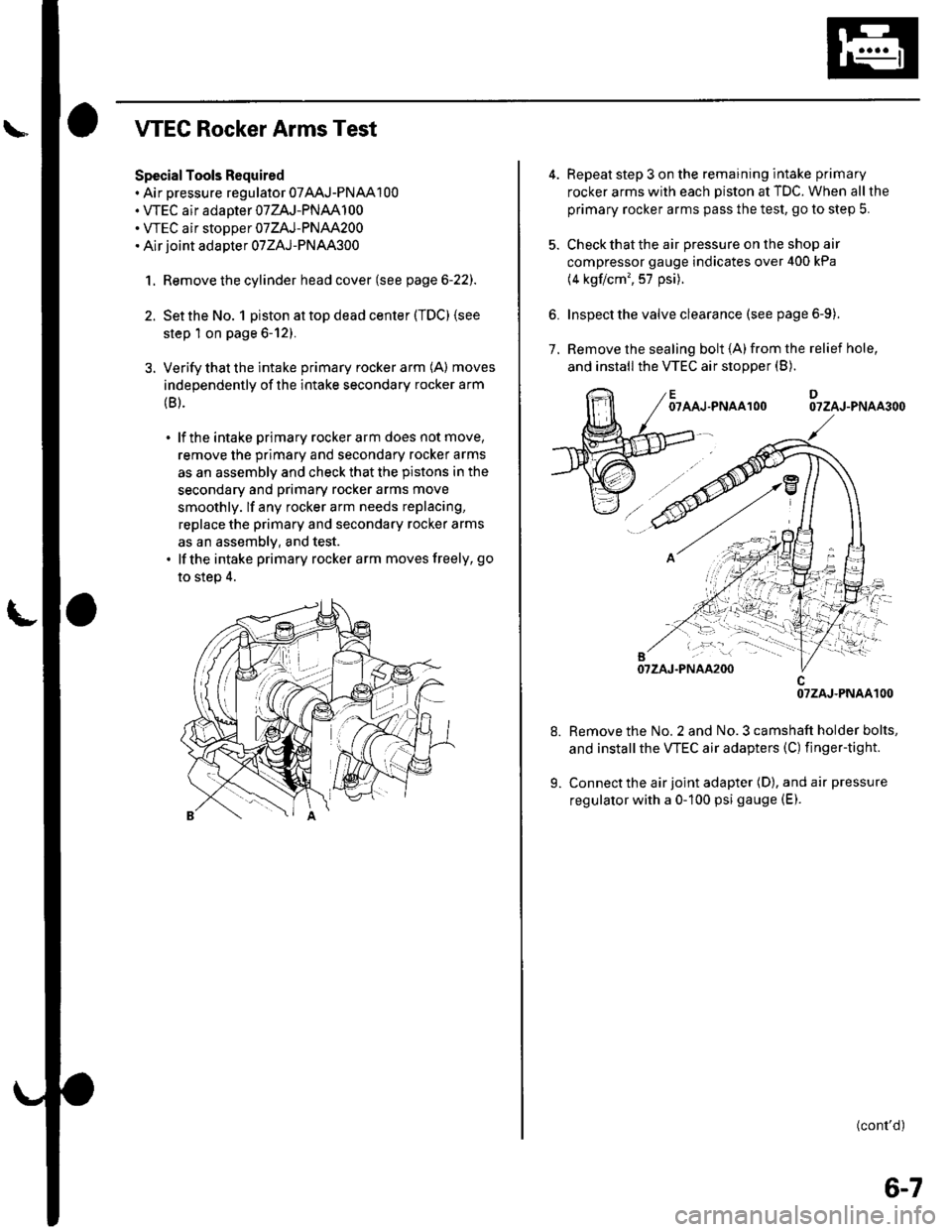
WEC Rocker Arms Test
Special Tools Required. Air pressure regulator 07AAJ-PNAA100. VTEC air adaoter 07ZAJ-PNAA100. WEC air stoDoer 07ZAJ-PNAA200. Air joint adapter 07ZAJ-PNAA300
1. Remove the cylinder head cover (see page 6-22).
2. Set the No. 1 piston at top dead center (TDC) (see
step 1 on page 6-12).
3. Verify that the intake primary rocker arm (A) moves
independently of the intake secondary rocker arm
(B).
. lf the intake primary rockerarm does not move,
remove the primary and secondary rocker arms
as an assembly and check that the pistons in the
secondary and primary rocker arms move
smoothly. lf any rocker arm needs replacing,
replace the primary and secondary rocker arms
as an assemblv, and test.. lfthe intake primary rocker arm moves freely, go
to step 4.
6.
Repeat step 3 on the remaining intake primary
rocker arms with each piston at TDC. When all the
primary rocker arms pass the test, go to step 5.
Check that the air pressure on the shop air
compressor gauge indicates over 400 kPa
(4 kgflcm', 57 psi).
Inspect the valve clearance (see page 6-9).
Remove the sealing bolt (A)from the relief hole,
and install the VTEC air stopper (B).7.
OTAAJ.PNAAlOODOTZAJ-PNAA3OO
Remove the No. 2 and No. 3 camshaft holder bolts,
and installthe VTEC air adapters (C) finger-tight.
Connect the air joint adapter (D), and air pressure
regulator with a 0-100 psi gauge (E).
(cont'd)
OTZAJ.PNAAlOO
6-7
Page 116 of 1139
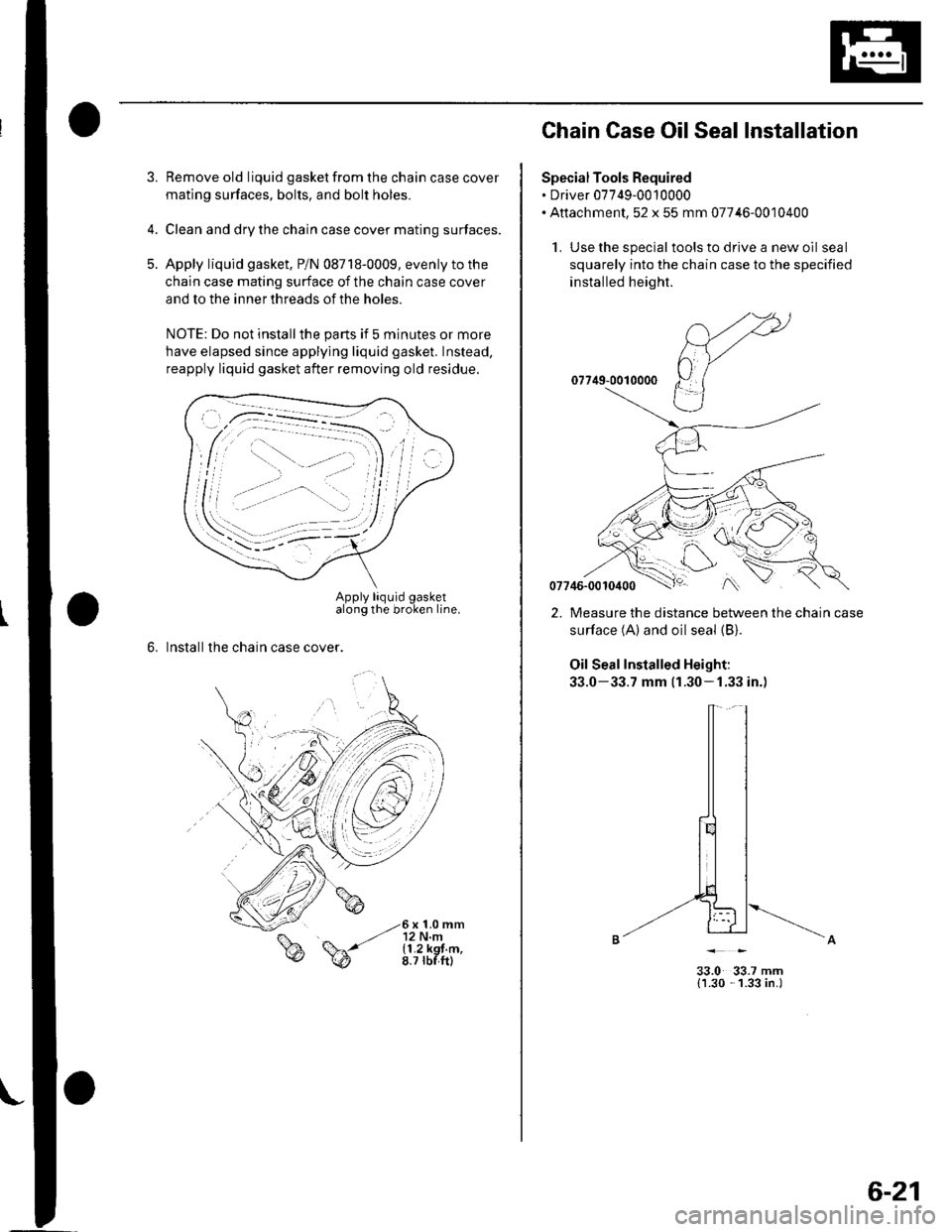
Remove old liquid gasket from the chain case cover
mating surfaces, bolts, and bolt holes.
Clean and dry the chain case cover mating surfaces.
Apply liquid gasket, P/N 08718-0009, evenly to the
chain case mating surface of the chain case cover
and to the inner threads of the holes.
NOTE: Do not installthe parts if 5 minutes or more
have elapsed since applying liquid gasket. Instead,
reapply liquid gasket after removing old residue.
6. Installthe chain case cover.
4.
6x1.0mm12 N.m{1.2 kgt.m,8.7 tbf.ft)
Apply liquid gasketalong the broken line.
Chain Case Oil Seal Installation
SpecialTools Required. Driver 07749-0010000. Attachment, 52 x 55 mm 07746-0010400
1. Use the special tools to drive a new ollseal
squarely into the chain case to the specified
installed height.
07749-0010000
2. Measure the distance between the chain case
surface (A) and oilseal 1B).
Oil Seal Installed Height:
33.0-33.7 mm (1.30- 1.33 in.)
33.0 33.7 mm{1.30 1.33 in.l
6-21
Page 155 of 1139
Cylinder Honing
Only a scored or scratched cylinder bore should be
noneo.
Measure the cylinder bores {see page 7-15).
lf the block is to be reused, hone the cylinders and
remeasure the bores.
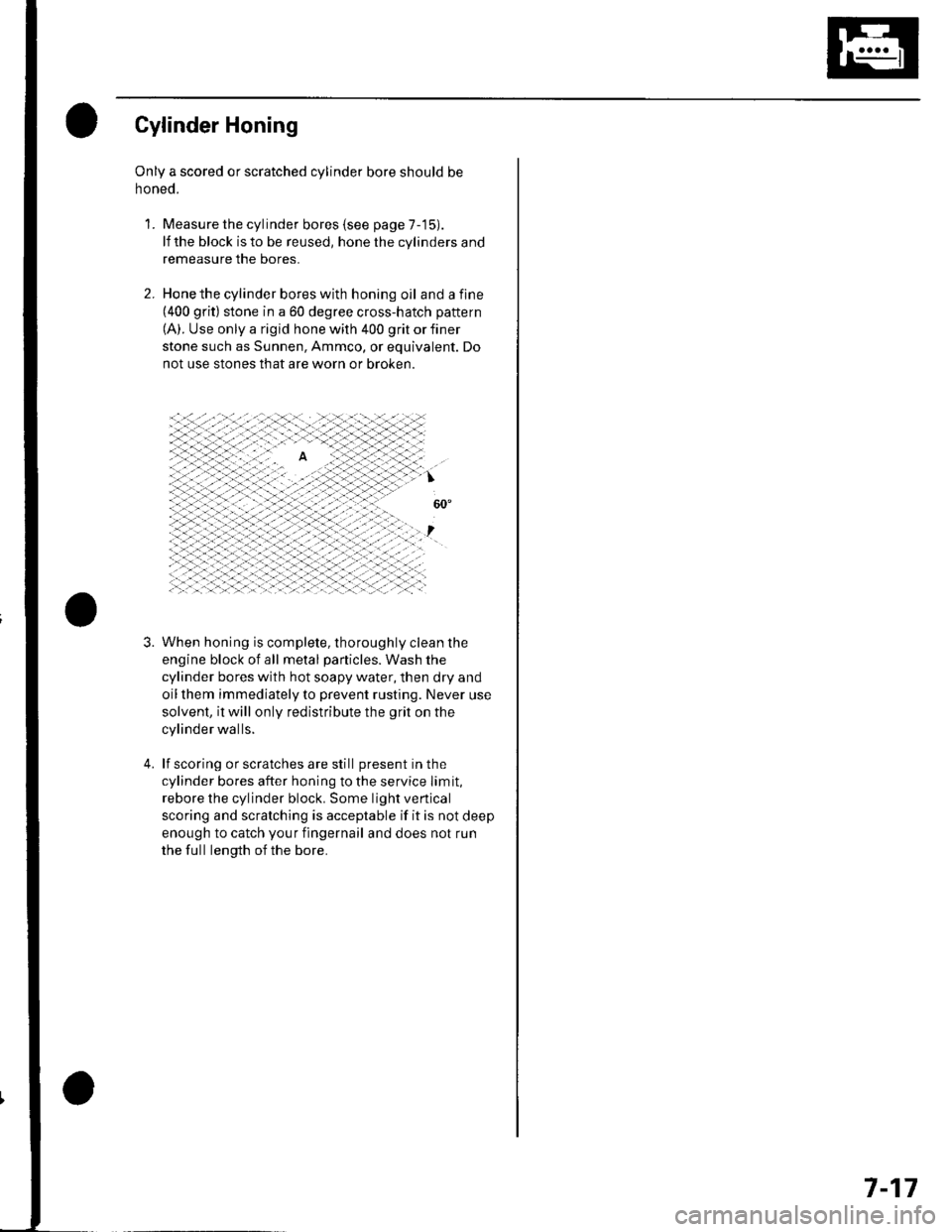
Hone the cylinder bores with honing oil and a fine(400 grit) stone in a 60 degree cross-hatch pattern
(A). Use only a rigid hone with 400 grit or finer
stone such as Sunnen, Ammco, or equivalent. Do
not use stones that are worn or broken.
When honing is complete, thoroughly clean the
engine block of all metal particles. Wash the
cylinder bores with hot soapy water, then dry and
oil them immediately to prevent rusting. Never use
solvent, it will only redistribute the grit on the
cylinder walls.
lf scoring or scratches are still present in the
cylinder bores after honing to the service limit,
rebore the cylinder block. Some light vertical
scoring and scratching is acceptable if it is not deep
enough to catch your fingernail and does not run
the full length of the bore.
'L
3.
7-17