Back up HONDA CIVIC 2012 9.G User Guide
[x] Cancel search | Manufacturer: HONDA, Model Year: 2012, Model line: CIVIC, Model: HONDA CIVIC 2012 9.GPages: 345, PDF Size: 9.02 MB
Page 38 of 345
37
uuAirbagsuAirbag System Components
Safe DrivingAirbags can pose serious hazards. To do their job, airbags must inflate with
tremendous force. So, while airbags help save lives, they can cause minor injuries,
sometimes even fatal ones if occupants are not wearing their seat belts properly and
sitting correctly.
What you should do: Always wear your seat belt properly, and sit upright and as
far back from the steering wheel as possible while allowing full control of the
vehicle. A front passenger should move their seat as far back from the dashboard as
possible.
Remember, however, that no safety system can prevent all injuries or deaths that
can occur in a severe crash, even when seat belts are properly worn and the airbags
deploy.
Do not place hard or sharp objects between yourself and a front airbag.
Carrying hard or sharp objects on your lap, or driving with a pipe or other sharp
object in your mouth, can result in injuries if your front airbag inflates.
Do not attach or place objects on the front airbag covers. Objects on the
covers marked ”SRS AIRBAG” could interfere with the proper operation of the
airbags or be propelled inside the vehicle and hurt someone if the airbags inflate.
■Important facts about your airbags1Important facts about your airbags
Do not attempt to deactivate your airbags. Together,
airbags and seat belts provide the best protection.
When driving, keep hands and arms out of the
deployment path of the front airbag by holding each
side of the steering wheel. Do not cross an arm over
the airbag cover.
Page 39 of 345
38
uuAirbagsuTypes of Airbags
Safe Driving
Types of Airbags
Your vehicle is equipped with three types of airbags: •Front airbags: Airbags in front of the driver's and front passenger's seats.
• Side airbags: Airbags in the driver's and front passenger's seat-backs.
• Side curtain airbags: Airbags above the side windows.
Each is discussed in the following pages.
Front Airbags (SRS)
The front SRS airbags inflate in a moderate to severe frontal collision to help protect
the head and chest of the driver and/or front passenger.
SRS (Supplemental Restraint System) indicates that the airbags are designed to
supplement seat belts, not replace them. Seat belts are the occupant's primary restraint system.
The front airbags are housed in the center of the steering wheel for the driver, and
in the dashboard for the front passenger. Both airbags are marked SRS AIRBAG.
■Housing Locations
1Types of Airbags
The airbags can inflate whenever the ignition switch
is in ON
(w .
1Front Airbags (SRS)
Dual-Stage, Multiple-Threshold Front Airbags (SRS)
Your vehicle is equipped with dual-stage, multiple-
threshold front airbags (SRS).
During a frontal crash severe enough to cause one or
both front airbags to deploy, the airbags can inflate
at different rates, depending on the severity of the
crash, whether or not the seat belts are latched, and/
or other factors. Frontal airbags are designed to
supplement the seat belts to help reduce the
likelihood of head and chest injuries in frontal crashes.
Page 43 of 345
42
uuAirbagsuSide Airbags
Safe Driving
Side Airbags
The side airbags help protect the upper torso of the driver or a front passenger
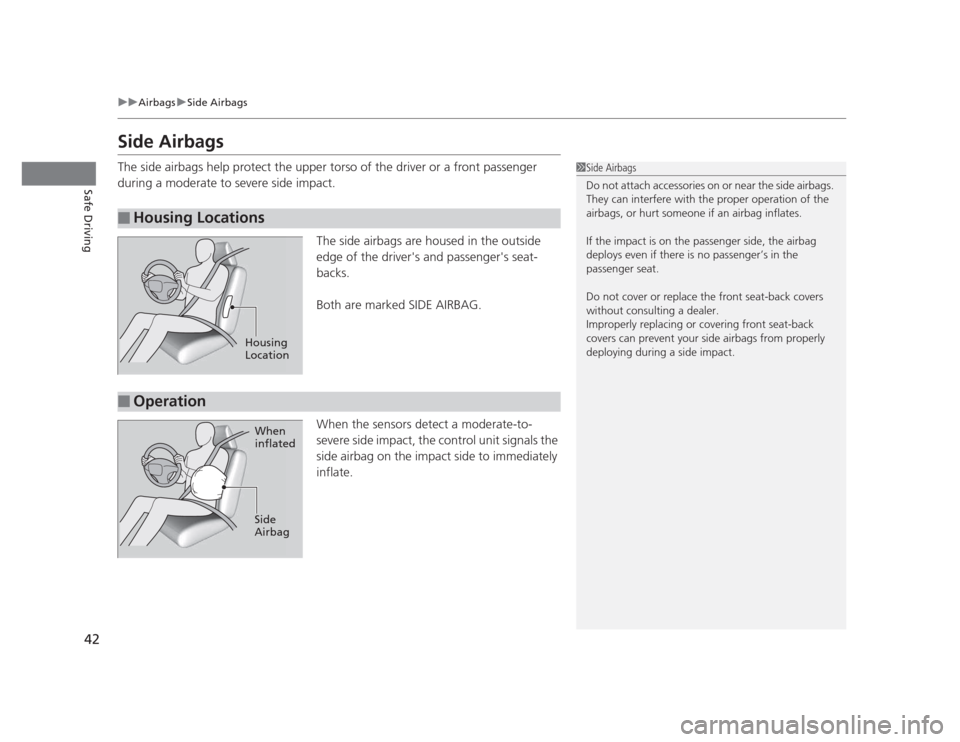
during a moderate to severe side impact.The side airbags are housed in the outside
edge of the driver's and passenger's seat-
backs.
Both are marked SIDE AIRBAG.
When the sensors detect a moderate-to-
severe side impact, the control unit signals the
side airbag on the impact side to immediately
inflate.
■Housing Locations
1Side Airbags
Do not attach accessories on or near the side airbags.
They can interfere with the proper operation of the
airbags, or hurt someone if an airbag inflates.
If the impact is on the passenger side, the airbag
deploys even if there is no passenger’s in the
passenger seat.
Do not cover or replace the front seat-back covers
without consulting a dealer.
Improperly replacing or covering front seat-back
covers can prevent your side airbags from properly
deploying during a side impact.
Housing
Location
■Operation
When
inflated
Side
Airbag
Page 45 of 345
uuAirbagsuSide Airbags
44
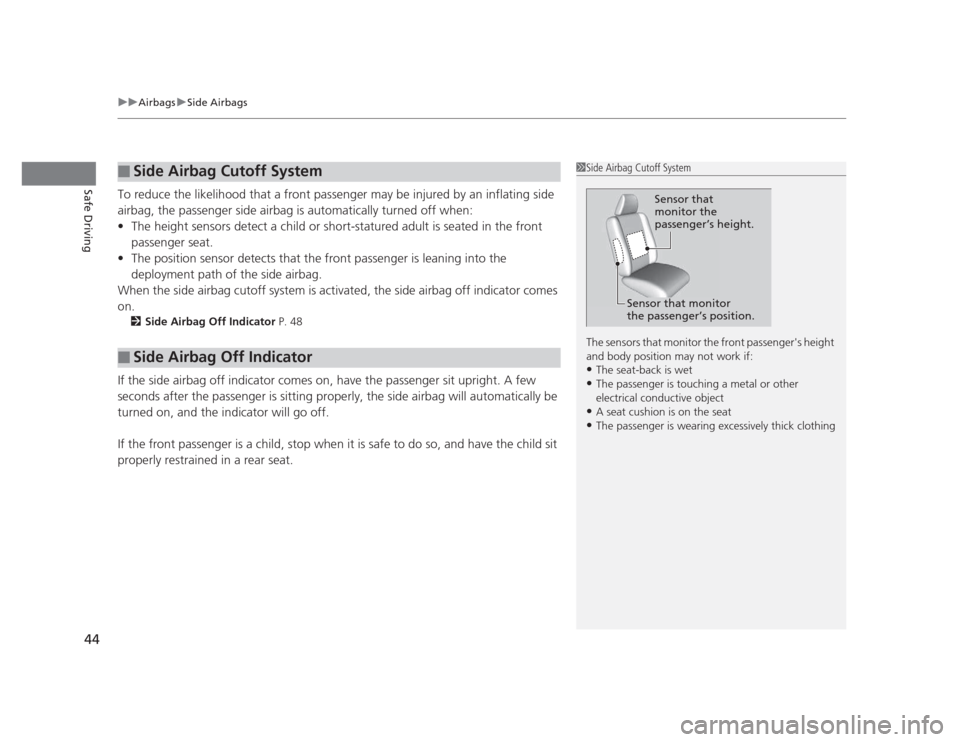
Safe DrivingTo reduce the likelihood that a front passenger may be injured by an inflating side
airbag, the passenger side airbag is automatically turned off when: • The height sensors detect a child or short-statured adult is seated in the front
passenger seat.
• The position sensor detects that the front passenger is leaning into the
deployment path of the side airbag.
When the side airbag cutoff system is activated, the side airbag off indicator comes
on. 2 Side Airbag Off Indicator P. 48
If the side airbag off indicator comes on, have the passenger sit upright. A few
seconds after the passenger is sitting properly, the side airbag will automatically be
turned on, and the indicator will go off.
If the front passenger is a child, stop when it is safe to do so, and have the child sit
properly restrained in a rear seat.
■Side Airbag Cutoff System
■Side Airbag Off Indicator
1Side Airbag Cutoff System
The sensors that monitor the front passenger's height
and body position may not work if: • The seat-back is wet
• The passenger is touching a metal or other
electrical conductive object
• A seat cushion is on the seat
• The passenger is wearing excessively thick clothing
Sensor that
monitor the
passenger’s height.
Sensor that monitor
the passenger’s position.
Page 46 of 345
45
uuAirbagsuSide Curtain Airbags
Safe Driving
Side Curtain Airbags
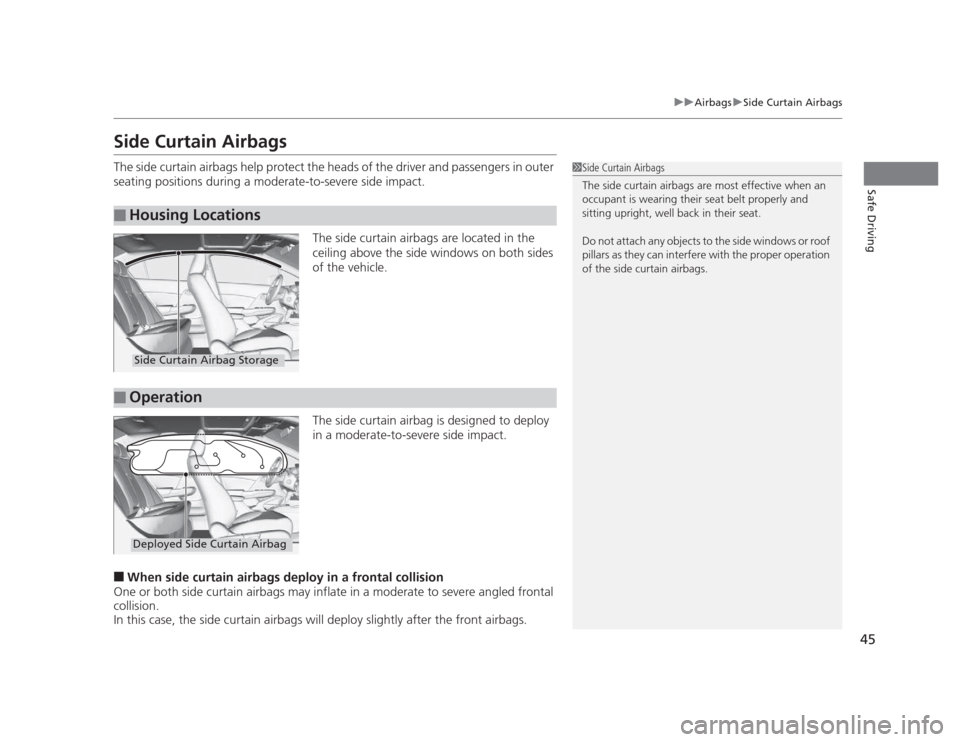
The side curtain airbags help protect the heads of the driver and passengers in outer
seating positions during a moderate-to-severe side impact.The side curtain airbags are located in the
ceiling above the side windows on both sides
of the vehicle.
The side curtain airbag is designed to deploy
in a moderate-to-severe side impact.
■ When side curtain airbags deploy in a frontal collision
One or both side curtain airbags may inflate in a moderate to severe angled frontal
collision.
In this case, the side curtain airbags will deploy slightly after the front airbags.
■Housing Locations
1Side Curtain Airbags
The side curtain airbags are most effective when an
occupant is wearing their seat belt properly and
sitting upright, well back in their seat.
Do not attach any objects to the side windows or roof
pillars as they can interfere with the proper operation
of the side curtain airbags.
Side Curtain Airbag Storage
■Operation
Deployed Side Curtain Airbag
Page 48 of 345
Continued47
uuAirbagsuAirbag System Indicators
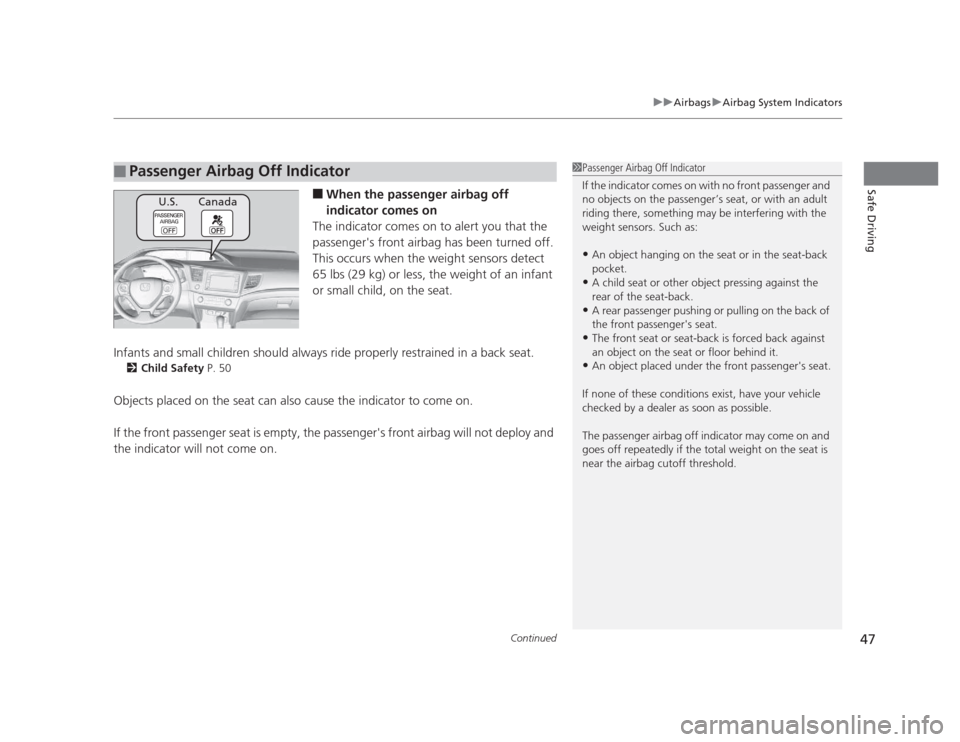
Safe Driving■When the passenger airbag off
indicator comes on
The indicator comes on to alert you that the
passenger's front airbag has been turned off.
This occurs when the weight sensors detect
65 lbs (29 kg) or less, the weight of an infant
or small child, on the seat.
Infants and small children should always ride properly restrained in a back seat. 2 Child Safety P. 50
Objects placed on the seat can also cause the indicator to come on.
If the front passenger seat is empty, the passenger's front airbag will not deploy and
the indicator will not come on.
■Passenger Airbag Off Indicator1Passenger Airbag Off Indicator
If the indicator comes on with no front passenger and
no objects on the passenger’s seat, or with an adult
riding there, something may be interfering with the weight sensors. Such as: • An object hanging on the seat or in the seat-back pocket.
• A child seat or other object pressing against the
rear of the seat-back.
• A rear passenger pushing or pulling on the back of
the front passenger's seat.
• The front seat or seat-back is forced back against
an object on the seat or floor behind it.
• An object placed under the front passenger's seat.
If none of these conditions exist, have your vehicle
checked by a dealer as soon as possible.
The passenger airbag off indicator may come on and
goes off repeatedly if the total weight on the seat is
near the airbag cutoff threshold.
U.S. Canada
Page 53 of 345
52
uuChild SafetyuSafety of Infants and Small Children
Safe Driving
Safety of Infants and Small Children
An infant must be properly restrained in a rear-facing, reclining child seat until the
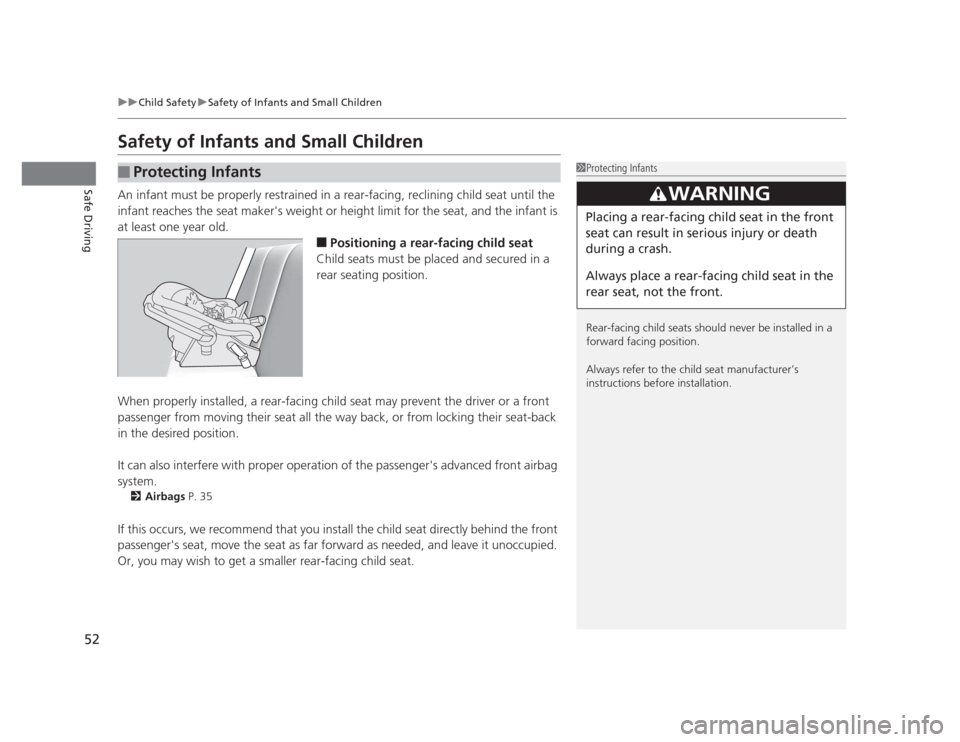
infant reaches the seat maker's weight or height limit for the seat, and the infant is at least one year old.■Positioning a rear-facing child seat
Child seats must be placed and secured in a
rear seating position.
When properly installed, a rear-facing child seat may prevent the driver or a front
passenger from moving their seat all the way back, or from locking their seat-back
in the desired position.
It can also interfere with proper operation of the passenger's advanced front airbag system. 2 Airbags P. 35
If this occurs, we recommend that you install the child seat directly behind the front
passenger's seat, move the seat as far forward as needed, and leave it unoccupied.
Or, you may wish to get a smaller rear-facing child seat.
■Protecting Infants1Protecting Infants
Rear-facing child seats should never be installed in a
forward facing position.
Always refer to the child seat manufacturer’s
instructions before installation.
3WARNING
Placing a rear-facing child seat in the front
seat can result in serious injury or death
during a crash.
Always place a rear-facing child seat in the
rear seat, not the front.
Page 54 of 345
Continued53
uuChild SafetyuSafety of Infants and Small Children
Safe DrivingIf a child is at least one year old and within the weight range indicated by the child
seat manufacturer, the child should be properly restrained in a firmly secured
forward-facing child seat.
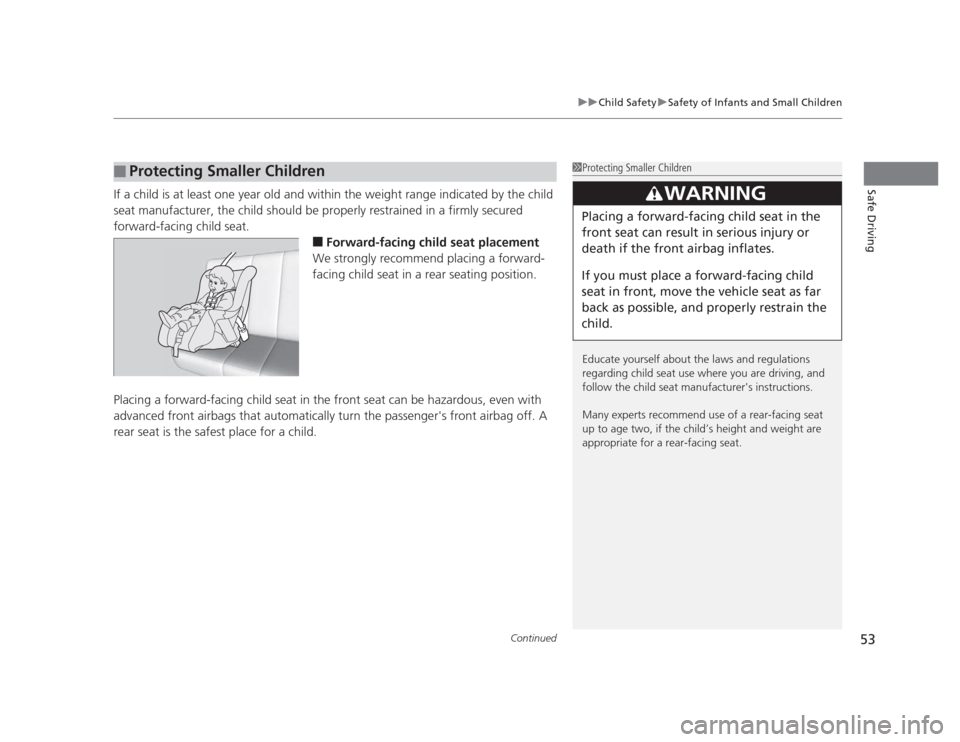
■Forward-facing child seat placement
We strongly recommend placing a forward-
facing child seat in a rear seating position.
Placing a forward-facing child seat in the front seat can be hazardous, even with
advanced front airbags that automatically turn the passenger's front airbag off. A
rear seat is the safest place for a child.
■Protecting Smaller Children1Protecting Smaller Children
Educate yourself about the laws and regulations
regarding child seat use where you are driving, and
follow the child seat manufacturer's instructions.
Many experts recommend use of a rear-facing seat
up to age two, if the child’s height and weight are
appropriate for a rear-facing seat.
3WARNING
Placing a forward-facing child seat in the
front seat can result in serious injury or
death if the front airbag inflates.
If you must place a forward-facing child
seat in front, move the vehicle seat as far
back as possible, and properly restrain the
child.
Page 57 of 345
uuChild SafetyuSafety of Infants and Small Children
56
Safe Driving
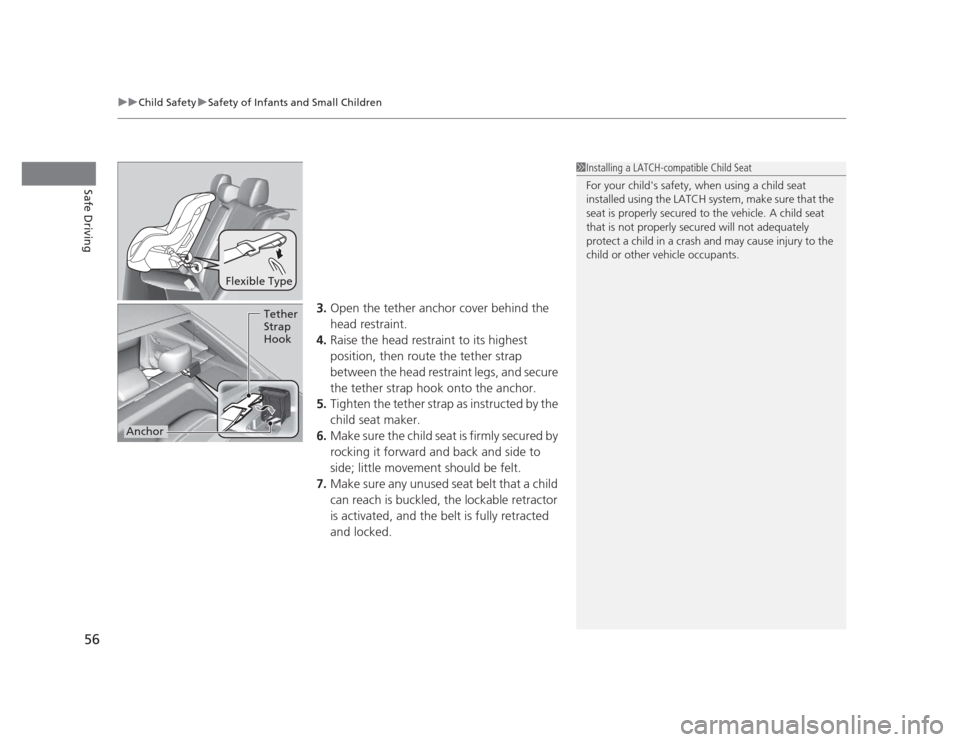
3. Open the tether anchor cover behind the
head restraint.
4. Raise the head restraint to its highest
position, then route the tether strap
between the head restraint legs, and secure
the tether strap hook onto the anchor.
5. Tighten the tether strap as instructed by the
child seat maker.
6. Make sure the child seat is firmly secured by
rocking it forward and back and side to
side; little movement should be felt.
7. Make sure any unused seat belt that a child
can reach is buckled, the lockable retractor
is activated, and the belt is fully retracted and locked.
Flexible Type
1Installing a LATCH-compatible Child Seat
For your child's safety, when using a child seat
installed using the LATCH system, make sure that the
seat is properly secured to the vehicle. A child seat
that is not properly secured will not adequately
protect a child in a crash and may cause injury to the
child or other vehicle occupants.
Tether
Strap
Hook
Anchor
Page 59 of 345
uuChild SafetyuSafety of Infants and Small Children
58
Safe Driving
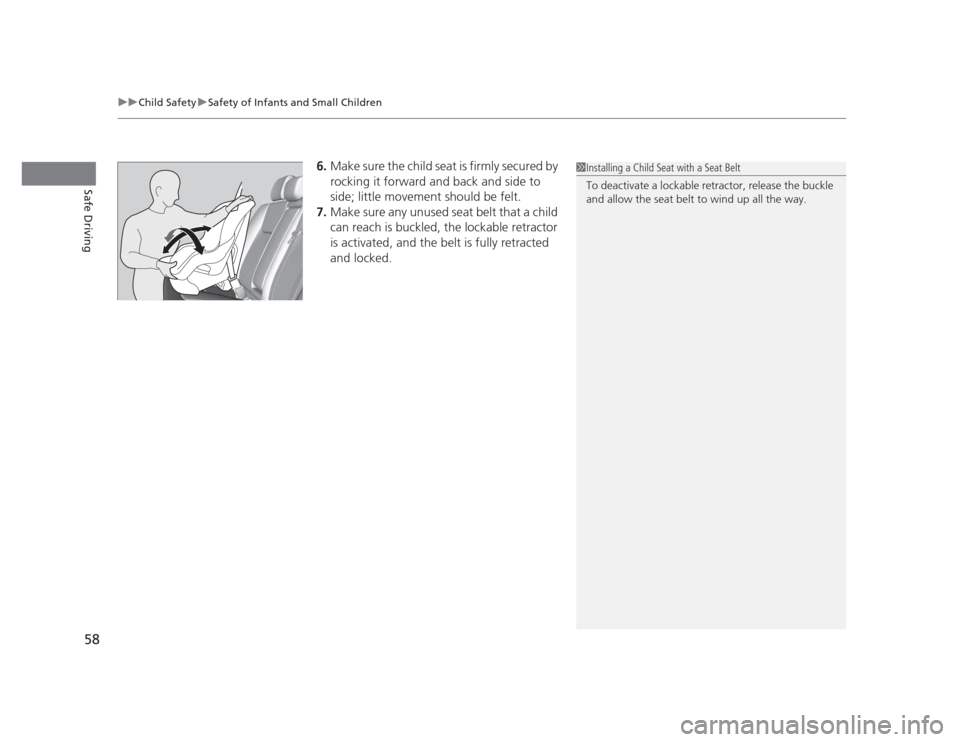
6. Make sure the child seat is firmly secured by
rocking it forward and back and side to
side; little movement should be felt.
7. Make sure any unused seat belt that a child
can reach is buckled, the lockable retractor
is activated, and the belt is fully retracted and locked.1Installing a Child Seat with a Seat Belt
To deactivate a lockable retractor, release the buckle
and allow the seat belt to wind up all the way.