transmission HONDA CIVIC 2013 9.G Owner's Guide
[x] Cancel search | Manufacturer: HONDA, Model Year: 2013, Model line: CIVIC, Model: HONDA CIVIC 2013 9.GPages: 367, PDF Size: 8.43 MB
Page 279 of 367
uuMaintenance Under the Hood uTransmission Fluid
278Maintenance
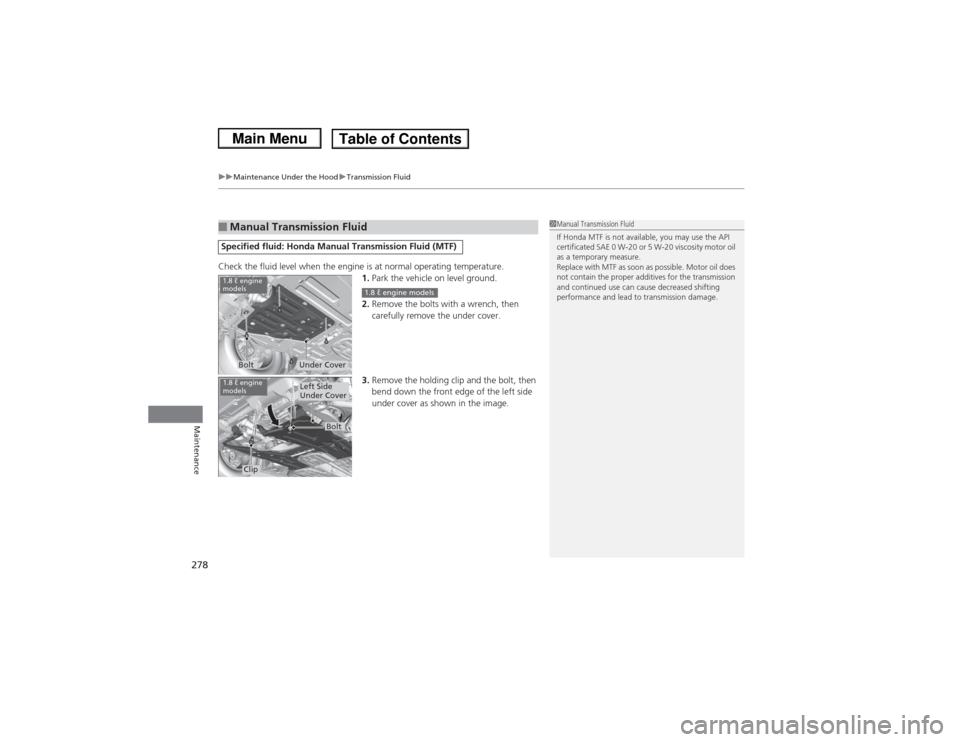
Check the fluid level when the engine is at normal operating temperature.
1.Park the vehicle on level ground.
2. Remove the bolts with a wrench, then
carefully remove the under cover.
3. Remove the holding clip and the bolt, then
bend down the front edge of the left side
under cover as shown in the image.■Manual Transmission FluidSpecified fluid: Honda Manual Transmission Fluid (MTF)
1Manual Transmission Fluid
If Honda MTF is not available, you may use the API
certificated SAE 0 W-20 or 5 W-20 viscosity motor oil
as a temporary measure.
Replace with MTF as soon as possible. Motor oil does
not contain the proper additives for the transmission
and continued use can cause decreased shifting
performance and lead to transmission damage.
Under Cover
Bolt
1.8 ℓ engine
models
1.8 ℓ engine models
Bolt
Clip
Left Side
Under Cover
1.8 ℓ engine
models
Page 280 of 367
279
uuMaintenance Under the Hood uTransmission Fluid
Maintenance
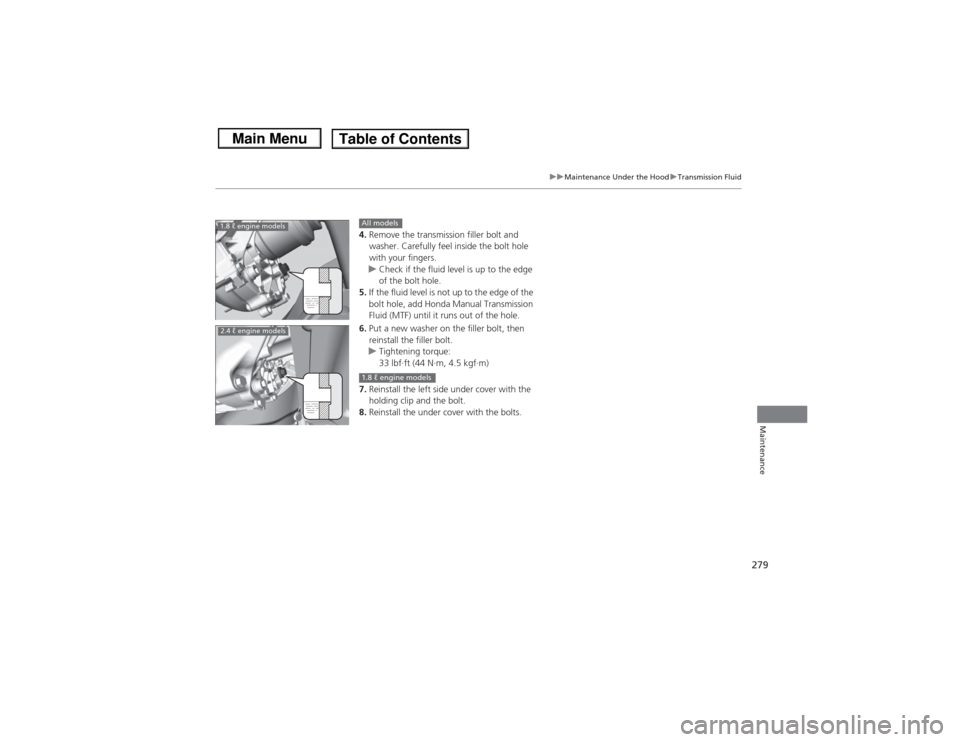
4. Remove the transmission filler bolt and
washer. Carefully feel inside the bolt hole
with your fingers.
u Check if the fluid level is up to the edge
of the bolt hole.
5. If the fluid level is not up to the edge of the
bolt hole, add Honda Manual Transmission
Fluid (MTF) until it runs out of the hole.
6. Put a new washer on the filler bolt, then
reinstall the filler bolt.
u Tightening torque:
33 lbf∙ft (44 N∙m, 4.5 kgf∙m)
7. Reinstall the left side under cover with the
holding clip and the bolt.
8. Reinstall the under cover with the bolts.
1.8 ℓ engine models
All models
2.4 ℓ engine models
1.8 ℓ engine models
Page 281 of 367
280
uuMaintenance Under the Hood uBrake/Clutch Fluid
Maintenance
Brake/Clutch FluidUse the same fluid for both the brakes and clutch.
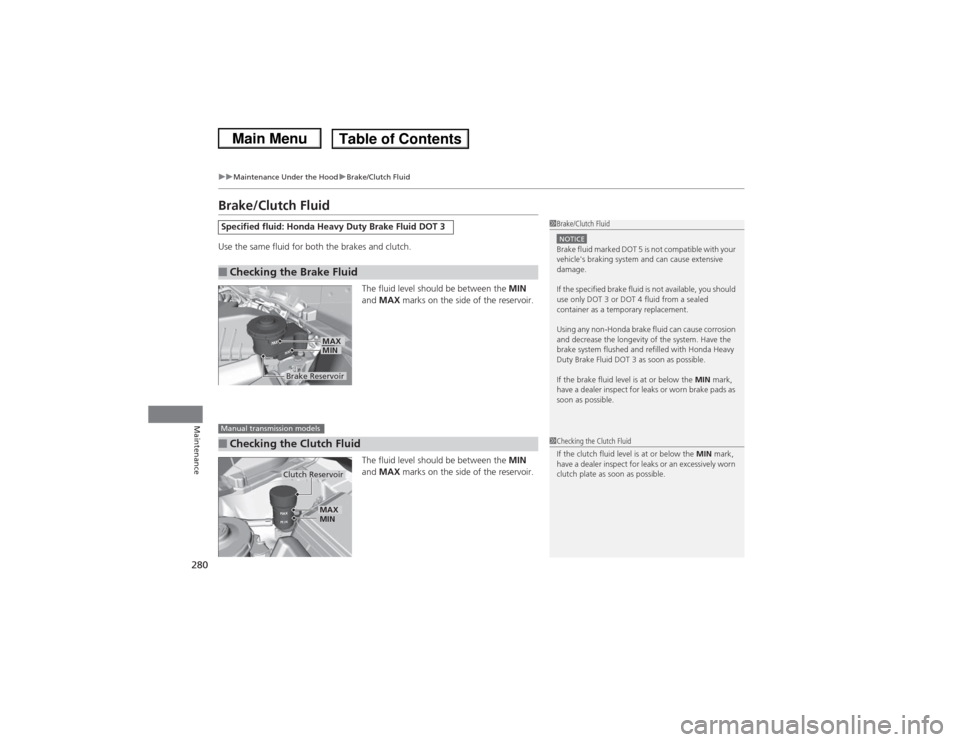
The fluid level should be between the MIN
and MAX marks on the side of the reservoir.
The fluid level should be between the MIN
and MAX marks on the side of the reservoir.Specified fluid: Honda Heavy Duty Brake Fluid DOT 3■Checking the Brake Fluid
1Brake/Clutch FluidNOTICEBrake fluid marked DOT 5 is not compatible with your
vehicle's braking system and can cause extensive
damage.
If the specified brake fluid is not available, you should
use only DOT 3 or DOT 4 fluid from a sealed
container as a temporary replacement.
Using any non-Honda brake fluid can cause corrosion
and decrease the longevity of the system. Have the
brake system flushed and refilled with Honda Heavy
Duty Brake Fluid DOT 3 as soon as possible.
If the brake fluid level is at or below the MIN mark,
have a dealer inspect for leaks or worn brake pads as
soon as possible.
Brake Reservoir
MINMAX
■Checking the Clutch FluidManual transmission models
1 Checking the Clutch Fluid
If the clutch fluid level is at or below the MIN mark,
have a dealer inspect for leaks or an excessively worn
clutch plate as soon as possible.
Clutch Reservoir
MIN
MAX
Page 316 of 367
315
Continued
Handling the Unexpected
If a Tire Goes FlatChanging a Flat TireIf a tire goes flat while driving, grasp the steering wheel firmly, and brake gradually
to reduce speed. Then, stop in a safe place. Replace the flat tire with a compact
spare tire. Go to a dealer as soon as possible to have the full-size tire repaired or
replaced.
1.Park the vehicle on firm, level, and non-slippery surface and apply the parking
brake.
2. Put the shift lever in
(P.
2. Put the shift lever in (R.
3. Turn on the hazard warning lights and turn the ignition switch to LOCK
(0.
Models with compact spare tire
1Changing a Flat Tire
Periodically check the tire pressure of the compact
spare. It should be set to the specified pressure.
Specified Pressure: 60 psi (420 kPa, 4.2 kgf/cm
2)
When driving with the compact spare tire, keep the
vehicle speed under 50 mph (80 km/h). Replace with
a full-size tire as soon as possible.
The compact spare tire and wheel in your vehicle are
specifically for this model.
Do not use them with another vehicle.
Do not use another type of compact spare tire or
wheel with your vehicle.
Do not mount tire chains on a compact spare tire.
If a chain-mounted front tire goes flat, remove one of
the full-size rear tires and replace it with the compact
spare tire. Remove the flat front tire and replace it
with the full-size tire that was removed from the rear.
Mount the tire chains on the front tire.
Do not use a puncture-repairing agent on a flat tire,
as it can damage the tire pressure sensor.
U.S. models
Automatic transmission modelsManual transmission modelsAll models
Page 335 of 367
334Handling the Unexpected
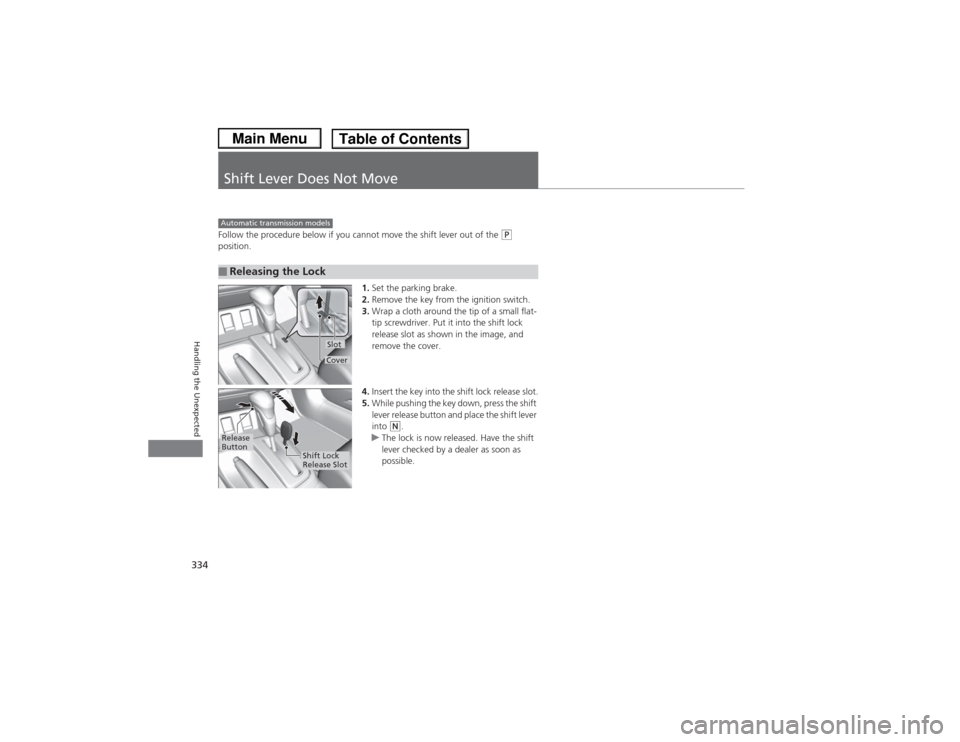
Shift Lever Does Not MoveFollow the procedure below if you cannot move the shift lever out of the
(P
position.
1.Set the parking brake.
2. Remove the key from the ignition switch.
3. Wrap a cloth around the tip of a small flat-
tip screwdriver. Put it into the shift lock
release slot as shown in the image, and
remove the cover.
4. Insert the key into the shift lock release slot.
5. While pushing the key down, press the shift
lever release button and place the shift lever
into
(N.
u The lock is now released. Have the shift
lever checked by a dealer as soon as
possible.
■Releasing the LockAutomatic transmission models
SlotCover
Release
Button
Shift Lock
Release Slot
Page 340 of 367
339
uuIndicator, Coming On/Blinking uIf the Brake System Indicator Comes On
Handling the Unexpected
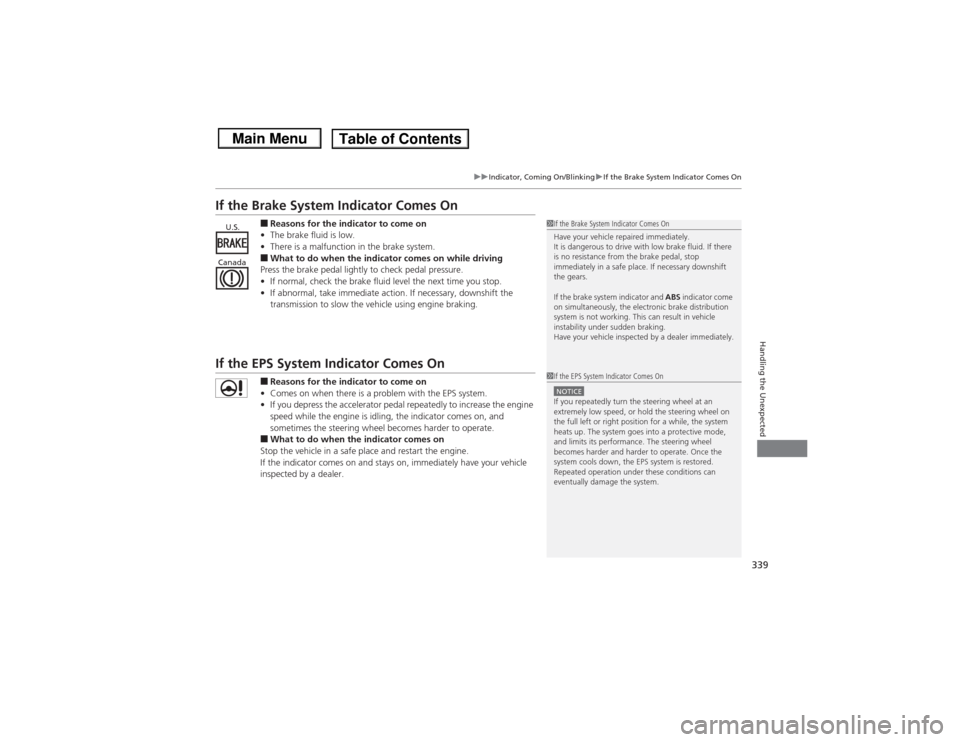
If the Brake System Indicator Comes On
■Reasons for the indicator to come on
• The brake fluid is low.
• There is a malfunction in the brake system.■What to do when the indicator comes on while driving
Press the brake pedal lightly to check pedal pressure.
• If normal, check the brake fluid level the next time you stop.
• If abnormal, take immediate action. If necessary, downshift the
transmission to slow the vehicle using engine braking.
If the EPS System Indicator Comes On
■Reasons for the indicator to come on
• Comes on when there is a problem with the EPS system.
• If you depress the accelerator pedal repeatedly to increase the engine
speed while the engine is idling, the indicator comes on, and
sometimes the steering wheel becomes harder to operate.■What to do when the indicator comes on
Stop the vehicle in a safe place and restart the engine.
If the indicator comes on and stays on, immediately have your vehicle
inspected by a dealer.
1 If the Brake System Indicator Comes On
Have your vehicle repaired immediately.
It is dangerous to drive with low brake fluid. If there
is no resistance from the brake pedal, stop
immediately in a safe place. If necessary downshift
the gears.
If the brake system indicator and ABS indicator come
on simultaneously, the electronic brake distribution
system is not working. This can result in vehicle
instability under sudden braking.
Have your vehicle inspected by a dealer immediately.
U.S.
Canada
1 If the EPS System Indicator Comes OnNOTICEIf you repeatedly turn the steering wheel at an
extremely low speed, or hold the steering wheel on
the full left or right position for a while, the system
heats up. The system goes into a protective mode,
and limits its performance. The steering wheel
becomes harder and harder to operate. Once the
system cools down, the EPS system is restored.
Repeated operation under these conditions can
eventually damage the system.
Page 345 of 367
344Handling the Unexpected
Emergency TowingCall a professional towing service if you need to tow your vehicle.■Flat bed equipment
The operator loads your vehicle on the back of a truck.
This is the best way to transport your vehicle.■Wheel lift equipment
The tow truck uses two pivoting arms that go under the front tires and lift them off
the ground. The rear tires remain on the ground. This is an acceptable way to
tow your vehicle.
1 Emergency TowingNOTICETrying to lift or tow your vehicle by the bumpers will
cause serious damage. The bumpers are not designed
to support the vehicle's weight.NOTICEImproper towing such as towing behind a
motorhome or other motor vehicle can damage the
transmission.
Never tow your vehicle with just a rope or chain.
It is very dangerous, since ropes or chains may shift
from side to side or break.
Page 346 of 367
345
Information
This chapter includes your vehicle's specifications, locations of identification numbers, and otherinformation required by regulation.
Specifications.................................... 346
Identification NumbersVehicle Identification Nu mber (VIN) ...... 350Engine Number and Transmission
Number...................................... 350Devices that Emit Radio Waves ....... 351
Reporting Safety Defects ................. 352Emissions Testing
Testing of Readiness Codes.............. 353
Warranty Coverages ........................ 355
Authorized Manuals ......................... 357
Customer Service Information ......... 358
Page 348 of 367
347
uuSpecifications u
Continued
Information
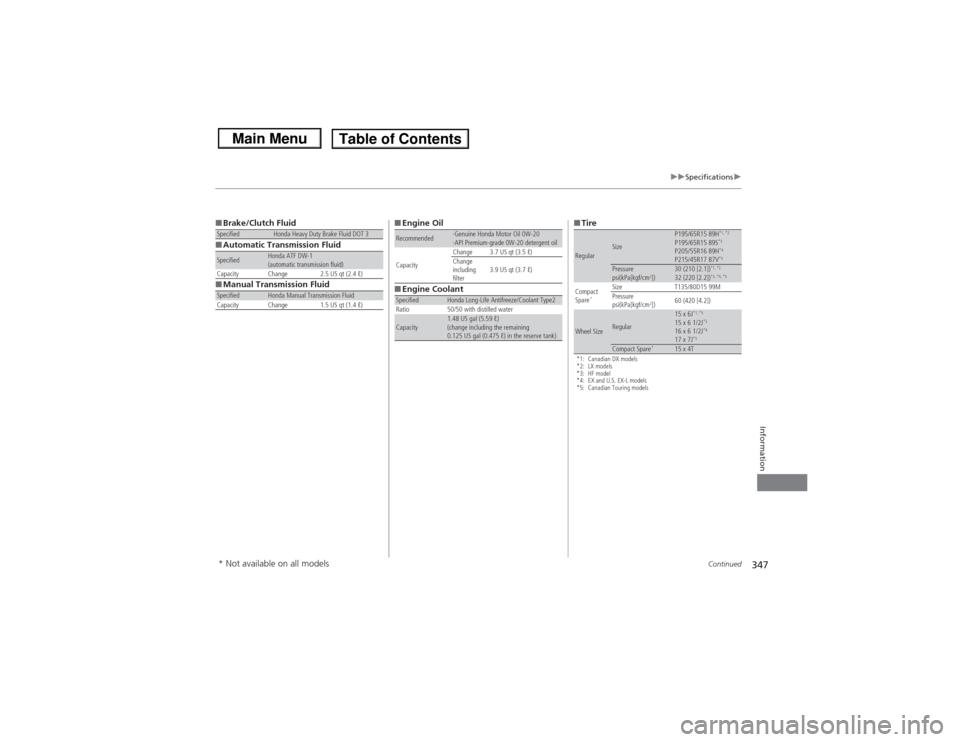
■Brake/Clutch Fluid
■ Automatic Transmission Fluid
■ Manual Transmission FluidSpecified
Honda Heavy Duty Brake Fluid DOT 3
Specified
Honda ATF DW-1
(automatic transmission fluid)
Capacity Change 2.5 US qt (2.4 ℓ)
Specified
Honda Manual Transmission Fluid
Capacity Change 1.5 US qt (1.4 ℓ)
■ Engine Oil
■ Engine CoolantRecommended
·Genuine Honda Motor Oil 0W-20
·API Premium-grade 0W-20 detergent oil
Capacity Change 3.7 US qt (3.5 ℓ)
Change
including
filter
3.9 US qt (3.7 ℓ)
Specified
Honda Long-Life Antifreeze/Coolant Type2
Ratio 50/50 with distilled water
Capacity
1.48 US gal (5.59 ℓ)
(change including the remaining
0.125 US gal (0.475 ℓ) in the reserve tank)
■ Tire*1: Canadian DX models
*2: LX models
*3: HF model
*4: EX and U.S. EX-L models
*5: Canadian Touring modelsRegular
Size
P195/65R15 89H
*1, *2
P195/65R15 89S
*3
P205/55R16 89H
*4
P215/45R17 87V
*5
Pressure
psi(kPa[kgf/cm
2])
30 (210 [2.1])
*1, *2
32 (220 [2.2])
*3, *4, *5
Compact
Spare
*
Size T135/80D15 99M
Pressure
psi(kPa[kgf/cm
2]) 60 (420 [4.2])
Wheel Size
Regular
15 x 6J
*1, *3
15 x 6 1/2J
*2
16 x 6 1/2J
*4
17 x 7J
*5
Compact Spare
*
15 x 4T
* Not available on all models
Page 350 of 367
349
uuSpecifications u
Information
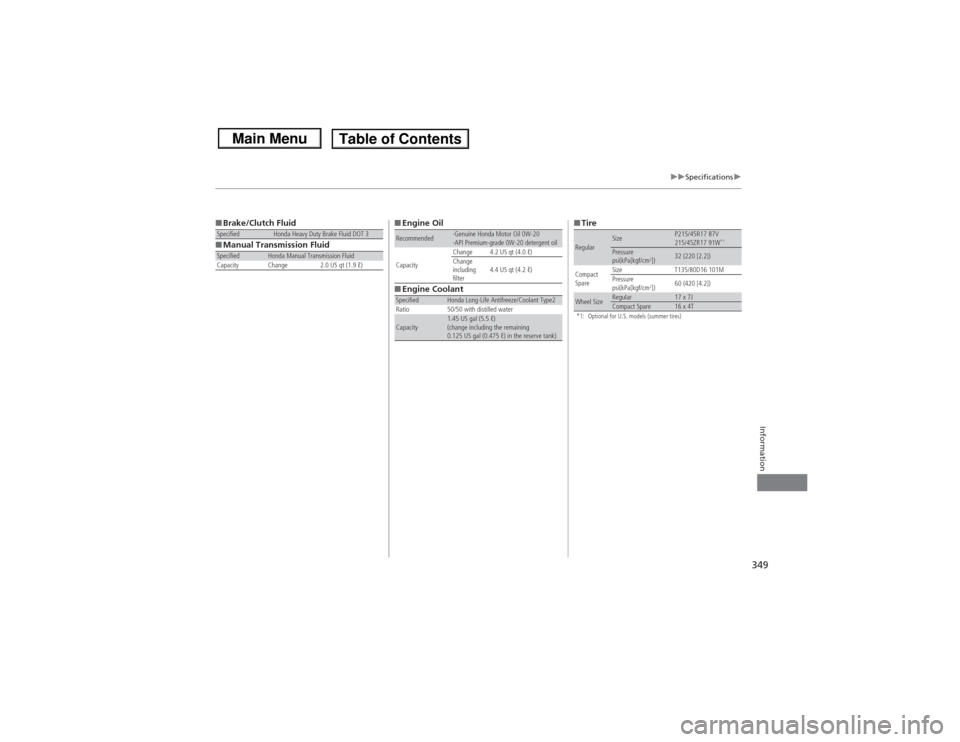
■Brake/Clutch Fluid
■ Manual Transmission FluidSpecified
Honda Heavy Duty Brake Fluid DOT 3
Specified
Honda Manual Transmission Fluid
Capacity Change 2.0 US qt (1.9 ℓ)
■ Engine Oil
■ Engine CoolantRecommended
·Genuine Honda Motor Oil 0W-20
·API Premium-grade 0W-20 detergent oil
Capacity Change 4.2 US qt (4.0 ℓ)
Change
including
filter
4.4 US qt (4.2 ℓ)
Specified
Honda Long-Life Antifreeze/Coolant Type2
Ratio 50/50 with distilled water
Capacity
1.45 US gal (5.5 ℓ)
(change including the remaining
0.125 US gal (0.475 ℓ) in the reserve tank)
■ Tire*1: Optional for U.S. models (summer tires)Regular
Size
P215/45R17 87V
215/45ZR17 91W
*1
Pressure
psi(kPa[kgf/cm
2])
32 (220 [2.2])
Compact
Spare Size
T135/80D16 101M
Pressure
psi(kPa[kgf/cm
2]) 60 (420 [4.2])
Wheel Size
Regular
17 x 7J
Compact Spare
16 x 4T