heating HONDA CIVIC 2016 10.G User Guide
[x] Cancel search | Manufacturer: HONDA, Model Year: 2016, Model line: CIVIC, Model: HONDA CIVIC 2016 10.GPages: 590
Page 188 of 590
187Continued
Controls
Heating System*
Using Automatic Heating
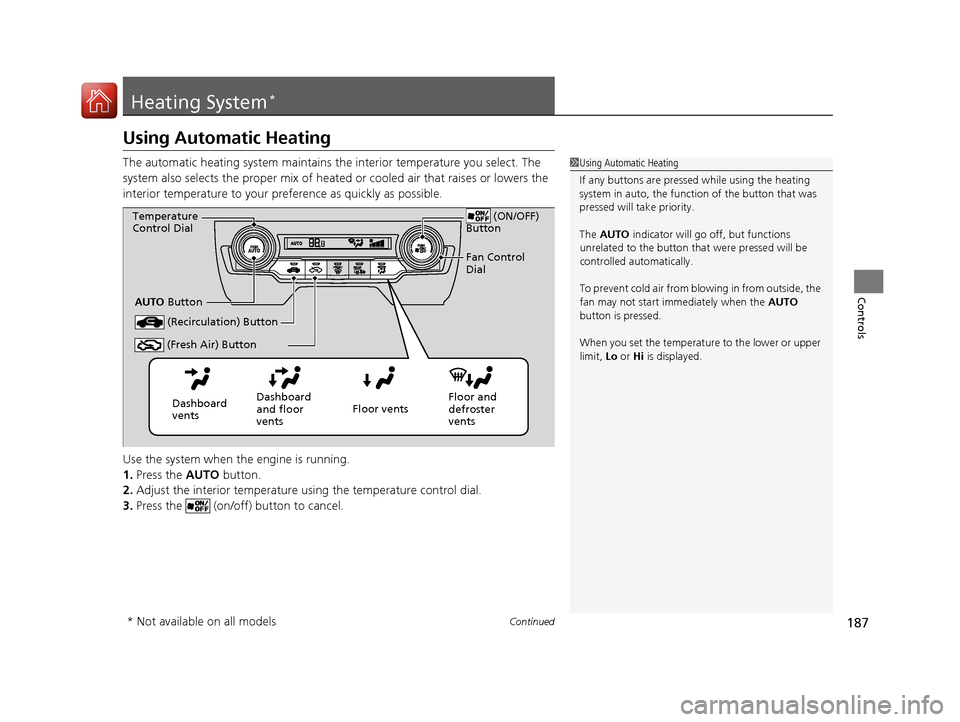
The automatic heating system maintains the interior temperature you select. The
system also selects the proper mix of heated or cooled air that raises or lowers the
interior temperature to your pr eference as quickly as possible.
Use the system when the engine is running.
1. Press the AUTO button.
2. Adjust the interior temperature us ing the temperature control dial.
3. Press the (on/off) button to cancel.1Using Automatic Heating
If any buttons are presse d while using the heating
system in auto, the function of the button that was
pressed will take priority.
The AUTO indicator will go off, but functions
unrelated to the button that were pressed will be
controlled automatically.
To prevent cold air from bl owing in from outside, the
fan may not start i mmediately when the AUTO
button is pressed.
When you set the temperat ure to the lower or upper
limit, Lo or Hi is displayed.
(ON/OFF)
Button
(Recirculation) Button
Floor and
defroster
vents
Floor vents
Dashboard
and floor
vents
Dashboard
vents
AUTO
Button
(Fresh Air) Button
Temperature
Control Dial Fan Control
Dial
* Not available on all models
16 CIVIC 4D-31TBA6000.book 187 ページ 2015年8月31日 月曜日 午後5時56分
Page 189 of 590
uuHeating System*uUsing Automatic Heating
188
Controls
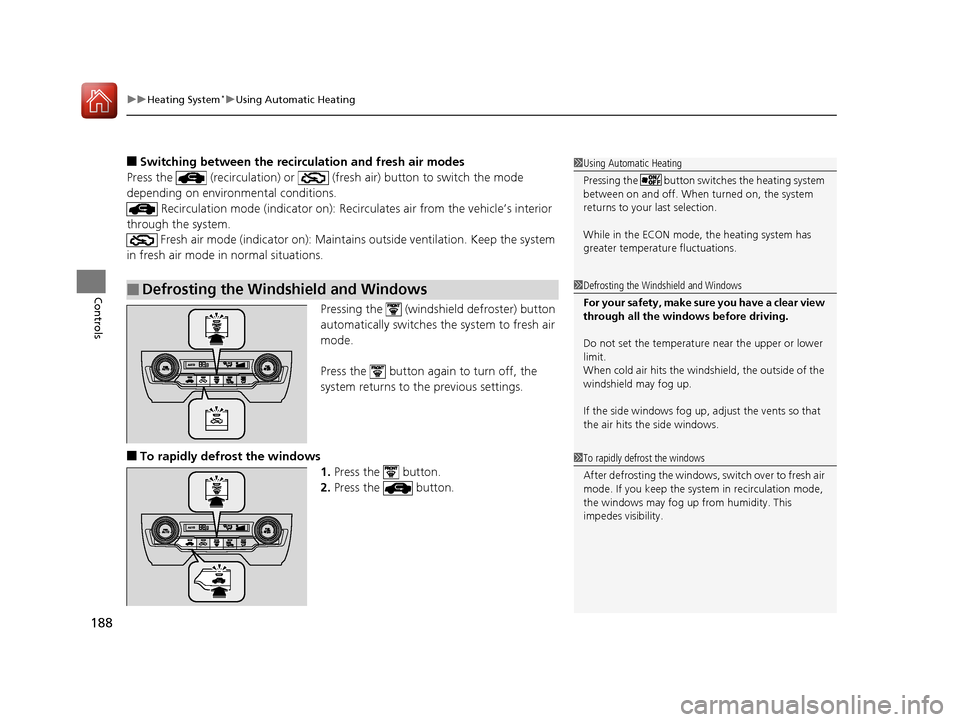
■Switching between the recirculation and fresh air modes
Press the (recirculation) or (fre sh air) button to switch the mode
depending on environmental conditions.
Recirculation mode (indicator on): Recirculates air from the vehicle’s interior
through the system. Fresh air mode (indicator on): Maintains outside ventilation. Keep the system
in fresh air mode in normal situations.
Pressing the (windshield defroster) button
automatically switches the system to fresh air
mode.
Press the button again to turn off, the
system returns to the previous settings.
■To rapidly defrost the windows 1.Press the button.
2. Press the button.
■Defrosting the Windshield and Windows
1Using Automatic Heating
Pressing the button switch es the heating system
between on and off. When turned on, the system
returns to your last selection.
While in the ECON mode, the heating system has
greater temperature fluctuations.
1 Defrosting the Windshield and Windows
For your safety, make sure you have a clear view
through all the windows before driving.
Do not set the temperatur e near the upper or lower
limit.
When cold air hits the winds hield, the outside of the
windshield may fog up.
If the side windows fog up, adjust the vents so that
the air hits th e side windows.
1To rapidly defrost the windows
After defrosting the windows, switch over to fresh air
mode. If you keep the syst em in recirculation mode,
the windows may fog up from humidity. This
impedes visibility.
16 CIVIC 4D-31TBA6000.book 188 ページ 2015年8月31日 月曜日 午後5時56分
Page 190 of 590
189
uuHeating System*uAutomatic Heating Sensors
Controls
Automatic Heating Sensors
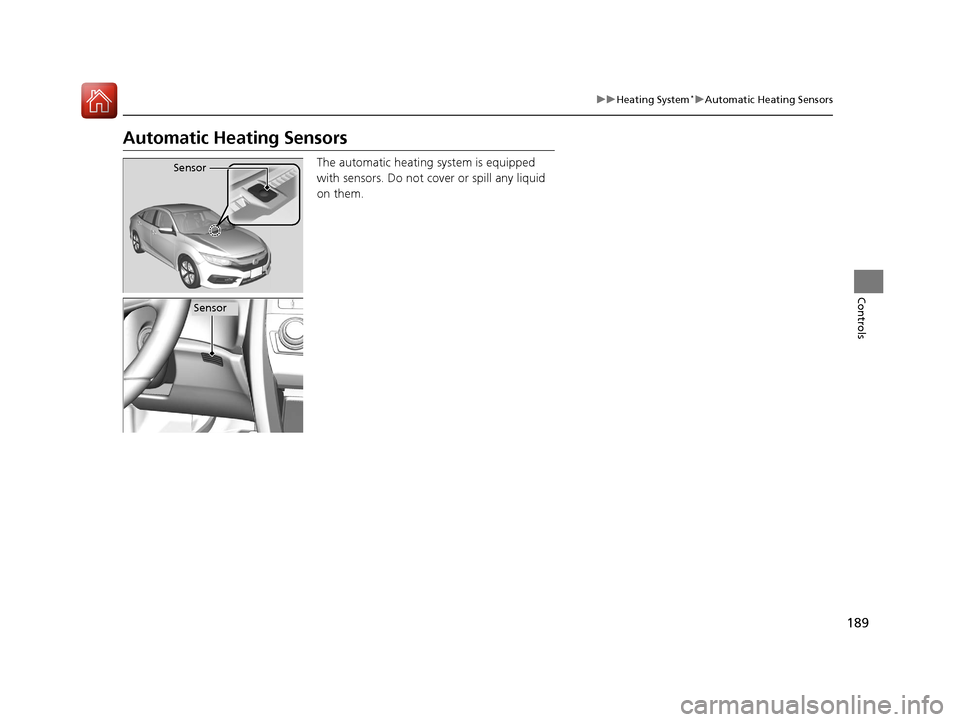
The automatic heating system is equipped
with sensors. Do not cover or spill any liquid
on them.Sensor
Sensor
16 CIVIC 4D-31TBA6000.book 189 ページ 2015年8月31日 月曜日 午後5時56分
Page 397 of 590
396
Driving
When Driving
Starting the Engine
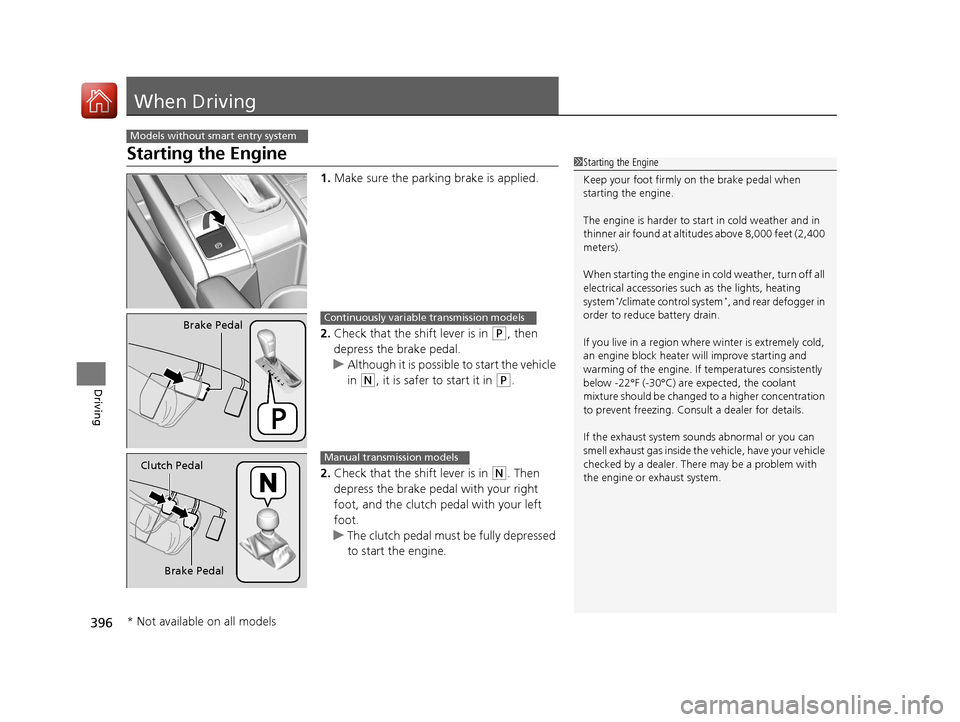
1.Make sure the parking brake is applied.
2. Check that the shift lever is in
(P, then
depress the brake pedal.
u Although it is possible to start the vehicle
in
(N, it is safer to start it in (P.
2. Check that the shift lever is in
(N. Then
depress the brake pedal with your right
foot, and the clutch pedal with your left
foot.
u The clutch pedal must be fully depressed
to start the engine.
Models without smart entry system
1Starting the Engine
Keep your foot firmly on the brake pedal when
starting the engine.
The engine is harder to st art in cold weather and in
thinner air found at altitudes above 8,000 feet (2,400
meters).
When starting the engine in cold weather, turn off all
electrical accessories such as the lights, heating
system
*/climate control system*, and rear defogger in
order to reduce battery drain.
If you live in a region where winter is extremely cold,
an engine block heater will improve starting and
warming of the engine. If temperatures consistently
below -22°F (-30°C) are expected, the coolant
mixture should be changed to a higher concentration
to prevent freezing. Cons ult a dealer for details.
If the exhaust system sounds abnormal or you can
smell exhaust gas inside the vehicle, have your vehicle
checked by a dealer. There may be a problem with
the engine or exhaust system.
Brake PedalContinuously variable transmission models
Brake Pedal
Clutch Pedal
Manual transmission models
* Not available on all models
16 CIVIC 4D-31TBA6000.book 396 ページ 2015年8月31日 月曜日 午後5時56分
Page 411 of 590
410
uuWhen Driving uECON Button
Driving
ECON Button
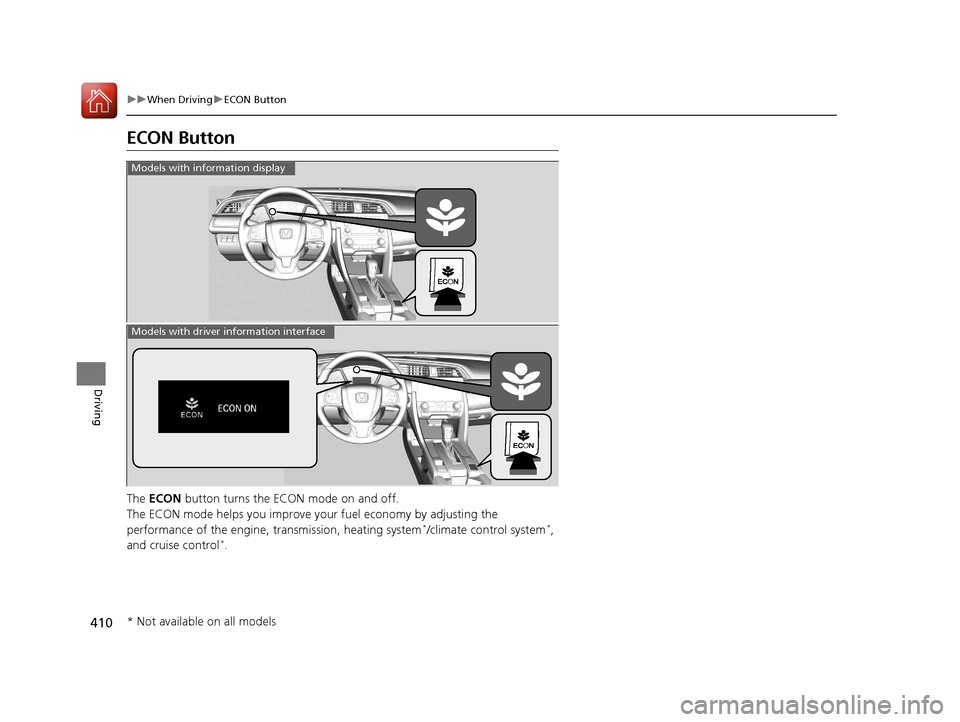
The ECON button turns the ECON mode on and off.
The ECON mode helps you improve your fuel economy by adjusting the
performance of the engine, transmission, heating system
*/climate control system*,
and cruise control*.
Models with info rmation display
Models with driver information interface
* Not available on all models
16 CIVIC 4D-31TBA6000.book 410 ページ 2015年8月31日 月曜日 午後5時56分
Page 476 of 590
475
Maintenance
This chapter discusses basic maintenance.
Before Performing MaintenanceInspection and Maintenance ............ 476
Safety When Performing Maintenance .... 477Parts and Fluids Used in Maintenance Service ........................................... 478
Maintenance Minder
TM..................... 479
Maintenance Under the Hood
Maintenance Items Un der the Hood .... 489Opening the Hood ........................... 491
Recommended Engine Oil ................ 492
Oil Check ......................................... 493
Adding Engine Oil ............................ 495
Changing the Engine Oil and Oil Filter..... 496
Engine Coolant ................................ 499
Transmission Fluid ............................ 501
Brake/Clutch
* Fluid .......................... 502
Refilling Window Wa sher Fluid......... 503
Replacing Light Bulbs ....................... 504
Checking and Maintaining Wiper
Blades .......................................... 514
Checking and Maintaining Tires
Checking Tires ................................. 516
Tire and Loading Information Label ..... 517Tire Labeling .................................... 517DOT Tire Quality Grading (U.S. Vehicles) ...... 519Wear Indicators................................ 521 Tire Service Life ................................ 521
Tire and Wheel Replacement ........... 522
Tire Rotation .................................... 523
Winter Tires ..................................... 524
Battery ............................................... 525
Remote Transmitter Care
Replacing the Button Battery ........... 527
Heating System
*/Climate Control
System* Maintenance .................... 529
Cleaning
Interior Care .................................... 530
Exterior Care.................................... 532
* Not available on all models
16 CIVIC 4D-31TBA6000.book 475 ページ 2015年8月31日 月曜日 午後5時56分
Page 517 of 590
516
Maintenance
Checking and Maintaining Tires
Checking Tires
To safely operate your vehicle, your tires must be of the proper type and size, in
good condition with adequate tread, and properly inflated.
■Inflation guidelines
Properly inflated tires provide the best combination of handling, tread life, and comfort.
Refer to the driver’s doorjamb label or spec ification’s page for the specified pressure.
Underinflated tires wear unevenly, adversely affect handling and fuel economy, and
are more likely to fail from overheating.
Overinflated tires make your vehicle ride harshly, are more prone to road hazards,
and wear unevenly.
Every day before you drive, look at each of the tires. If one looks lower than the
others, check the pressure with a tire gauge.
At least once a month or before long trips, use a gauge to measure the pressure in
all tires, including the spare
*. Even tires in good condition can lose 1 to 2 psi (10 to
20 kPa, 0.1 to 0.2 kgf/cm2) per month.
■Inspection guidelines
Every time you check inflation, also examine the tires and valve stems.
Look for:
• Bumps or bulges on the side or in the tread. Replace the tire if you find any cuts,
splits, or cracks in the si de of the tire. Replace it if you see fabric or cord.
• Remove any foreign objects and inspect for air leaks.
• Uneven tread wear. Have a deal er check the wheel alignment.
• Excessive tread wear.
2 Wear Indicators P. 521
•Cracks or other damage around valve stem.
1Checking Tires
Measure the air pressure when tires are cold. This
means the vehicle has been parked for at least three
hours, or driven less than 1 mile (1.6 km). If
necessary, add or releas e air until the specified
pressure is reached.
If checked when hot, tire pressure can be as much as
4–6 psi (30–40 kPa, 0.3–0.4 kgf/cm
2) higher than if
checked when cold.
Whenever tire pressure is adjusted, you must
calibrate the TPMS. 2 TPMS Calibration P. 446
Have a dealer check the tires if you feel a consistent
vibration while driving. Ne w tires and any that have
been removed and reinst alled should be properly
balanced.
Measure the spare tire pressure once a month or
before long trips.
3WARNING
Using tires that are excessively worn or
improperly inflated can cause a crash in
which you can be seriously hurt or killed.
Follow all instruction s in this owner’s
manual regarding ti re inflation and
maintenance.
U.S. models
* Not available on all models
16 CIVIC 4D-31TBA6000.book 516 ページ 2015年8月31日 月曜日 午後5時56分
Page 530 of 590
529
Maintenance
Heating System*/Climate Control System* Maintenance
Air Conditioning
To ensure proper and safe operation, the Society of Automotive Engineers (SAE
J2845) recommends that the refrigerant system only be serviced by trained and
certified technicians.
Never repair or replace the air conditio ning evaporator (cooling coil) with one
removed from a used or salvaged vehicle.
New replacement mobile air conditioning evaporators must be certified (and
labeled) as meeting SAE Standard J2842.
Dust and Pollen Filter
The heating system*/climate control system* is equipped with a dust and pollen filter
that collects pollen, dust, and other de bris in the air. The Maintenance MinderTM
messages will let you know when to replace the filter.
We recommend that you repl ace the dust and pollen filter sooner when using your
vehicle in areas with high concentrations of dust.
1 Heating System*/Climate Control System* Maintenance
NOTICE
Vented refrigerant is harmful to the environment.
To avoid refrigerant from venting, never replace the
evaporator with one removed from a used or
salvaged vehicle.
Refrigerant in your vehicle’s air conditioning system is
flammable and can be igni ted during servicing if
proper procedures are not followed.
The air conditioner labe l is found under the hood:
2 Safety Labels P. 71
2 Specifications P. 568, 570
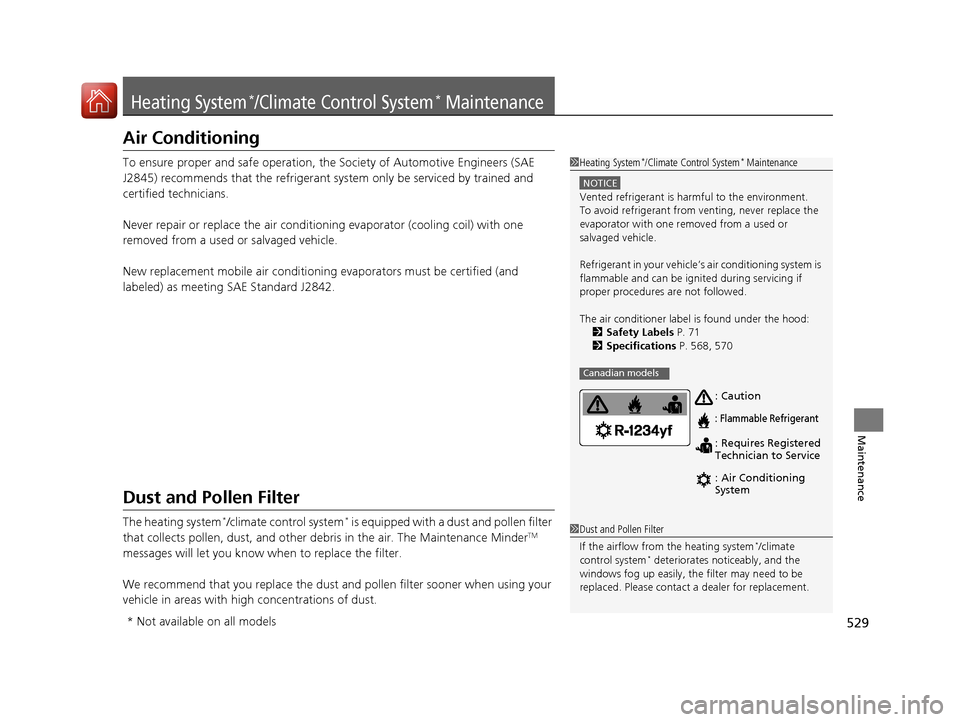
Canadian models
: Caution
: Flammable Refrigerant
: Requires Registered
Technician to Service
: Air Conditioning
System
1Dust and Pollen Filter
If the airflow from the heating system
*/climate
control system* deteriorates noticeably, and the
windows fog up easily, the filter may need to be
replaced. Please contact a dealer for replacement.
* Not available on all models
16 CIVIC 4D-31TBA6000.book 529 ページ 2015年8月31日 月曜日 午後5時56分
Page 536 of 590
535
Handling the Unexpected
This chapter explains how to handle unexpected troubles.
ToolsTypes of Tools .................................. 536
If a Tire Goes Flat
Changing a Flat Tire ......................... 537
Engine Does Not Start Checking the Engine ........................ 543
If the Smart Entry Remote Battery is Weak .......................................... 544
Emergency Engine Stop ................... 545
Jump Starting .................................... 546
Shift Lever Does Not Move .............. 549
Overheating
How to Handle Overheating ............. 550 Indicator, Coming On/Blinking
If the Low Oil Pressure Indicator Comes
On ............................................. 552
If the Charging System Indicator Comes
On ................................................. 552
If the Malfunction Indicator Lamp Comes
On or Blinks ................................... 553
If the Brake System Indicator (Red) Comes On or Blinks ................................... 554
If the Brake System Indicator (Red) Comes On or Blinks at the Same Time When the
Brake System Indicator (Amber) Comes
On ................................................. 555 If the Electric Power Steering (EPS) System
Indicator Comes On ....................... 556
If the Low Tire Pressure/TPMS Indicator Comes On or Blinks ....................... 557
Fuses Fuse Locations ................................. 558
Inspecting and Changing Fuses ........ 561
Emergency Towing ........................... 562
When You Cannot Unlock the Fuel Fill Door ................................................. 563
When You Cannot Open the Trunk.....564
Refueling ........................................... 565
16 CIVIC 4D-31TBA6000.book 535 ページ 2015年8月31日 月曜日 午後5時56分
Page 551 of 590
550
Handling the Unexpected
Overheating
How to Handle Overheating
Overheating symptoms are as follows:
•The temperature gauge pointer is at the mark or the engine suddenly loses
power.
• Steam or spray comes out of the engine compartment.
■First thing to do
1. Immediately park the vehicle in a safe place.
2. Turn off all accessories and turn on the hazard warning lights.
u No steam or spray present: Keep the engine running and open the hood.
u Steam or spray is present: Turn off the engine and wait until it subsides.
Then open the hood.
1 How to Handle Overheating
NOTICE
Continuing to drive with the temperature gauge
pointer at the mark may damage the engine.
3WARNING
Steam and spray from an overheated
engine can seriously scald you.
Do not open the hood if steam is coming
out.
H
H
16 CIVIC 4D-31TBA6000.book 550 ページ 2015年8月31日 月曜日 午後5時56分