fuel type HONDA CIVIC 2022 User Guide
[x] Cancel search | Manufacturer: HONDA, Model Year: 2022, Model line: CIVIC, Model: HONDA CIVIC 2022Pages: 700, PDF Size: 13.98 MB
Page 454 of 700
453
uuWhen Driving uAuto Idle Stop
Continued
Driving
Auto Idle Stop
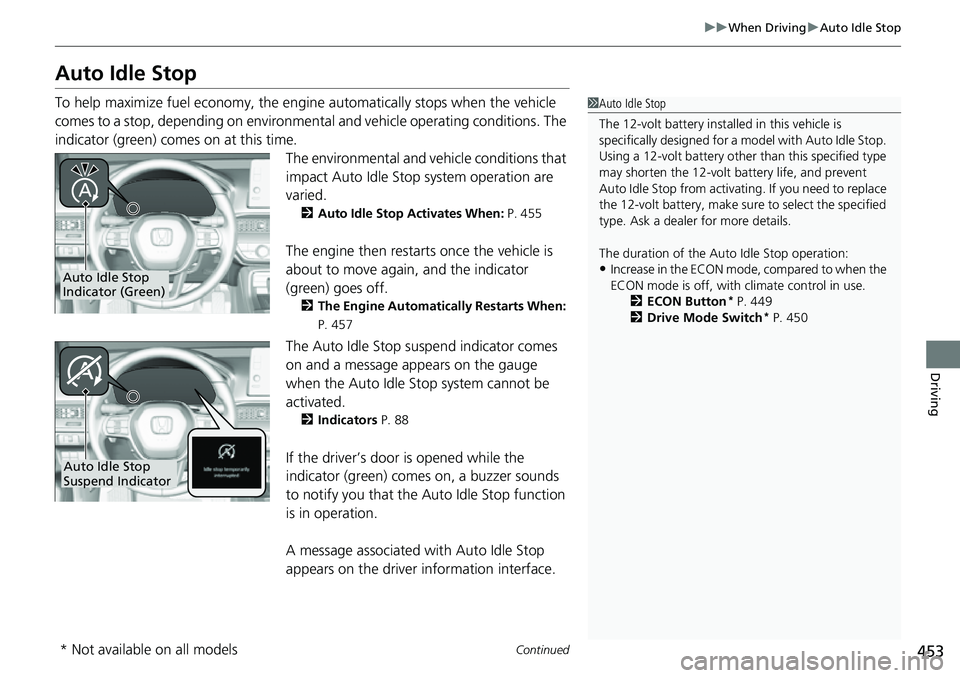
To help maximize fuel economy, the engine automatically stops when the vehicle
comes to a stop, depending on environmental and vehicle operating conditions. The
indicator (green) comes on at this time.
The environmental and vehicle conditions that
impact Auto Idle Stop system operation are
varied.
2Auto Idle Stop Activates When: P. 455
The engine then restarts once the vehicle is
about to move again, and the indicator
(green) goes off.
2The Engine Automatically Restarts When:
P. 457
The Auto Idle Stop suspend indicator comes
on and a message appears on the gauge
when the Auto Idle St op system cannot be
activated.
2 Indicators P. 88
If the driver’s door is opened while the
indicator (green) come s on, a buzzer sounds
to notify you that the Auto Idle Stop function
is in operation.
A message associated with Auto Idle Stop
appears on the driver information interface.
1 Auto Idle Stop
The 12-volt battery insta lled in this vehicle is
specifically designed for a m odel with Auto Idle Stop.
Using a 12-volt battery other than this specified type
may shorten the 12-volt ba ttery life, and prevent
Auto Idle Stop from activati ng. If you need to replace
the 12-volt battery, make sure to select the specified
type. Ask a dealer for more details.
The duration of the Au to Idle Stop operation:
•Increase in the ECON mode, compared to when the
ECON mode is off, with climate control in use.
2 ECON Button
* P. 449
2 Drive Mode Switch* P. 450
Auto Idle Stop
Indicator (Green)
Auto Idle Stop
Suspend Indicator
* Not available on all models
Page 583 of 700
582
Maintenance
Before Performing Maintenance
Inspection and Maintenance
For your safety, perform all listed inspections and maintenance to keep your vehicle
in good condition. If you become aware of an y abnormality (noise, smell, insufficient
brake fluid, oil residue on the ground, etc.), have your vehicle inspected by a dealer.
(Note, however, that service at a dealer is not mandatory to keep your warranties in
effect.)
■Routine inspections
Perform inspections before long distance tri ps, when washing the vehicle, or when
refueling.
2 Maintenance P. 31
■Periodic inspections
• Check the brake fluid level monthly.
2 Brake Fluid P. 608
•Check the tire pressure monthly. Examin e the tread for wear and foreign objects.
2Checking and Maintaining Tires P. 617
•Check the operation of the exterior lights monthly.
2 Replacing Light Bulbs P. 610
•Check the condition of the wiper bl ades at least every six months.
2Checking and Maintaining Wiper Blades P. 615
■Types of Inspection and Maintenance
1Inspection and Maintenance
Maintenance, replacement, or repair of
emissions control devices and systems may be
done by any automotive repair establishment or
individuals using parts that are “certified” to
EPA standards.
According to state and fede ral regulations, failure to
perform maintenance on the maintenance main
items marked with # will not void your emissions
warranties. However, all ma intenance services should
be performed in accordan ce with the intervals
indicated by the driver information interface.
2 Maintenance Service Items P. 590
If you want to perform complex maintenance tasks
that require more skills a nd tools, you can purchase a
subscription to the Service Express website at
www.techinfo.honda.com .
2 Authorized Manuals P. 688
If you want to perform ma intenance yourself, make
sure that you have the necessary tools and skills first.
After performing maintenanc e, update the records in
the separate maintenance booklet.
U.S. models
Page 599 of 700
598
uuMaintenance Under the Hood uRecommended Engine Oil
Maintenance
Recommended Engine Oil
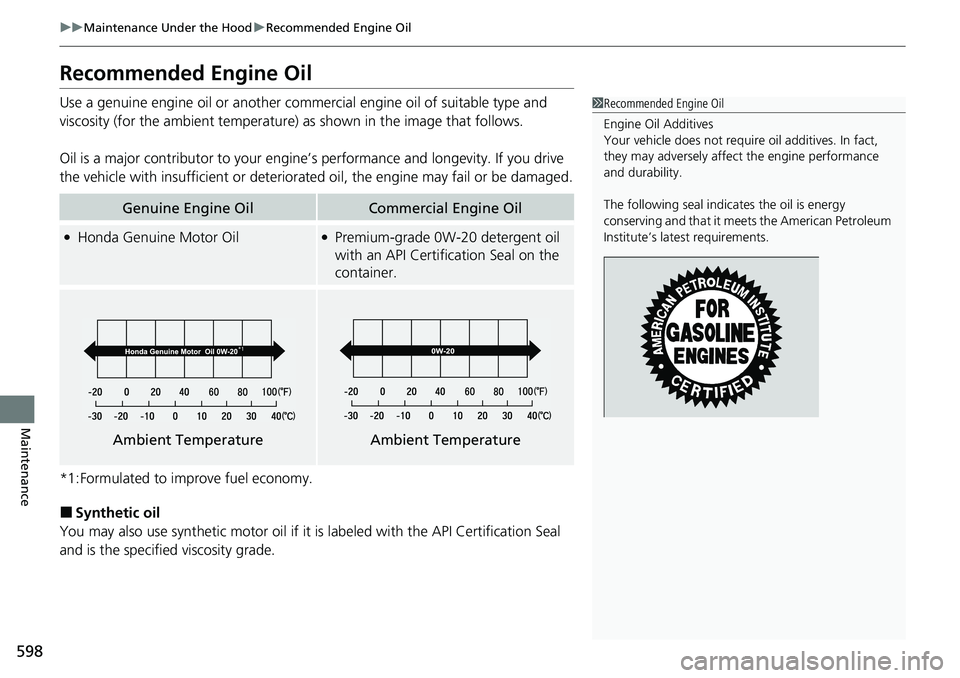
Use a genuine engine oil or another commercial engine oil of suitable type and
viscosity (for the ambient temperature) as shown in the image that follows.
Oil is a major contributor to your engine ’s performance and longevity. If you drive
the vehicle with insufficient or deteriorat ed oil, the engine may fail or be damaged.
*1:Formulated to improve fuel economy.
■Synthetic oil
You may also use synthetic motor oil if it is labeled with the API Certification Seal
and is the specified viscosity grade.
Genuine Engine OilCommercial Engine Oil
●Honda Genuine Motor Oil●Premium-grade 0W-20 detergent oil
with an API Certification Seal on the
container.
1 Recommended Engine Oil
Engine Oil Additives
Your vehicle does not require oil additives. In fact,
they may adversely affect the engine performance
and durability.
The following seal indicates the oil is energy
conserving and that it meets the American Petroleum
Institute’s late st requirements.
Ambient TemperatureAmbient Temperature
Page 606 of 700
605
uuMaintenance Under the Hood uEngine Coolant
Continued
Maintenance
Engine Coolant
This coolant is premixed with 50% an tifreeze and 50% water. Do not add any
straight antifreeze or water.
We recommend you check the engine coolant level every time you refuel. Check the
reserve tank first. If it is completely empty, also check the coolant level in the
radiator. Add the engine coolant accordingly.
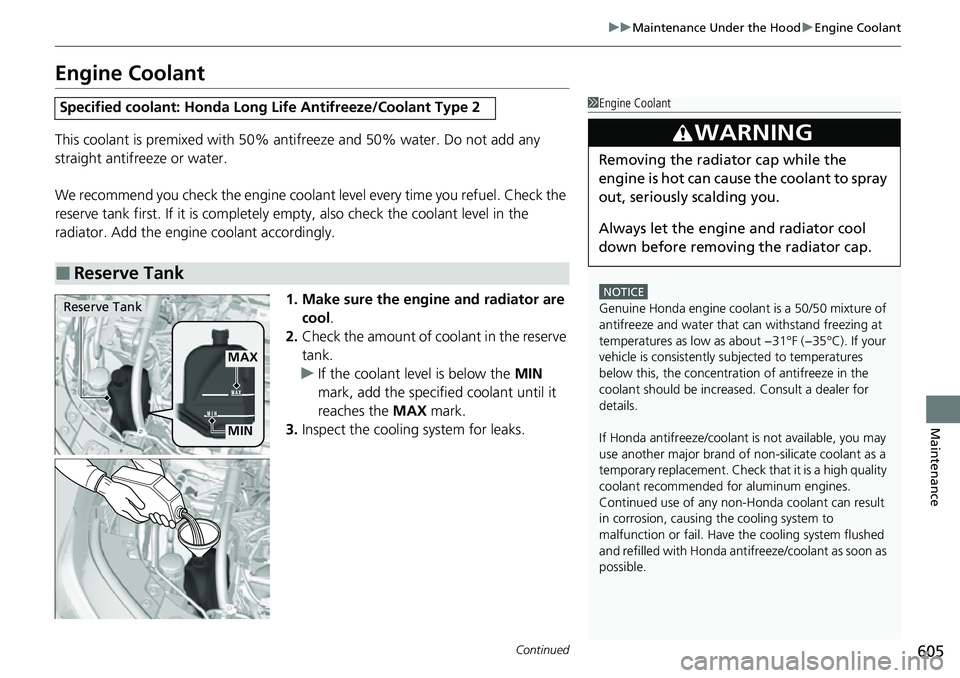
1. Make sure the engine and radiator are cool .
2. Check the amount of coolant in the reserve
tank.
u If the coolant level is below the MIN
mark, add the specified coolant until it
reaches the MAX mark.
3. Inspect the cooling system for leaks.
Specified coolant: Ho nda Long Life Antifreeze/Coolant Type 2
■Reserve Tank
1Engine Coolant
NOTICE
Genuine Honda engine coolan t is a 50/50 mixture of
antifreeze and water that can withstand freezing at
temperatures as low as about −31°F (−35°C). If your
vehicle is consistently subjected to temperatures
below this, the concentration of antifreeze in the
coolant should be increased. Consult a dealer for
details.
If Honda antifreeze /coolant is not available, you may
use another major brand of non-silicate coolant as a
temporary replacement. Check that it is a high quality
coolant recommended for aluminum engines.
Continued use of any non-Honda coolant can result
in corrosion, causing the cooling system to
malfunction or fail. Have the cooling system flushed
and refilled with Honda antifreeze/coolant as soon as
possible.
3WARNING
Removing the radiator cap while the
engine is hot can cause the coolant to spray
out, seriously scalding you.
Always let the engine and radiator cool
down before removing the radiator cap.
MAX
MIN
Reserve Tank
Page 618 of 700
617
Maintenance
Checking and Maintaining Tires
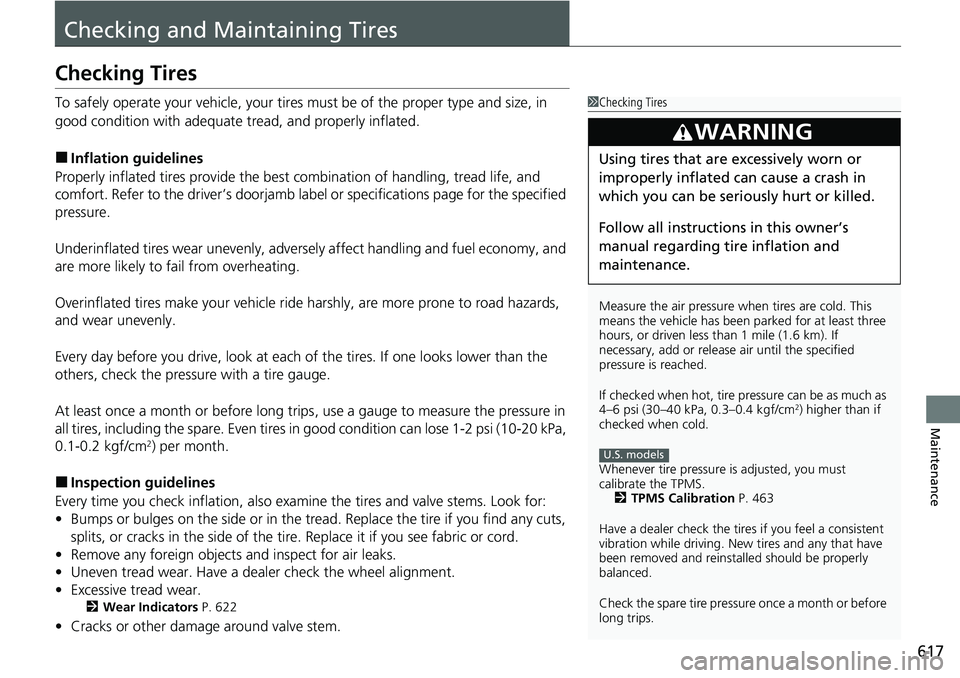
Checking Tires
To safely operate your vehicle, your tires must be of the proper type and size, in
good condition with adequate tread, and properly inflated.
■Inflation guidelines
Properly inflated tires provide the best combination of handling, tread life, and
comfort. Refer to the driver’s doorjamb labe l or specifications page for the specified
pressure.
Underinflated tires wear unev enly, adversely affect handling and fuel economy, and
are more likely to fail from overheating.
Overinflated tires make your vehicle ride ha rshly, are more prone to road hazards,
and wear unevenly.
Every day before you drive, look at each of the tires. If one looks lower than the
others, check the pressure with a tire gauge.
At least once a month or before long trips , use a gauge to measure the pressure in
all tires, including the spare. Even tires in good condition can lose 1-2 psi (10-20 kPa,
0.1-0.2 kgf/cm
2) per month.
■Inspection guidelines
Every time you check inflation, also examine the tires and valve stems. Look for:
• Bumps or bulges on the side or in the tread. Replace the tire if you find any cuts,
splits, or cracks in the side of the tire . Replace it if you see fabric or cord.
• Remove any foreign objects and inspect for air leaks.
• Uneven tread wear. Have a deal er check the wheel alignment.
• Excessive tread wear.
2 Wear Indicators P. 622
•Cracks or other damage around valve stem.
1Checking Tires
Measure the air pressure when tires are cold. This
means the vehicle has been parked for at least three
hours, or driven less than 1 mile (1.6 km). If
necessary, add or releas e air until the specified
pressure is reached.
If checked when hot, tire pressure can be as much as
4–6 psi (30–40 kPa, 0.3–0.4 kgf/cm
2) higher than if
checked when cold.
Whenever tire pressure is adjusted, you must
calibrate the TPMS. 2 TPMS Calibration P. 463
Have a dealer check the tires if you feel a consistent
vibration while driving. Ne w tires and any that have
been removed and reinst alled should be properly
balanced.
Check the spare tire pressu re once a month or before
long trips.
3WARNING
Using tires that are excessively worn or
improperly inflated can cause a crash in
which you can be seriously hurt or killed.
Follow all instruction s in this owner’s
manual regarding ti re inflation and
maintenance.
U.S. models
Page 640 of 700
639
Handling the Unexpected
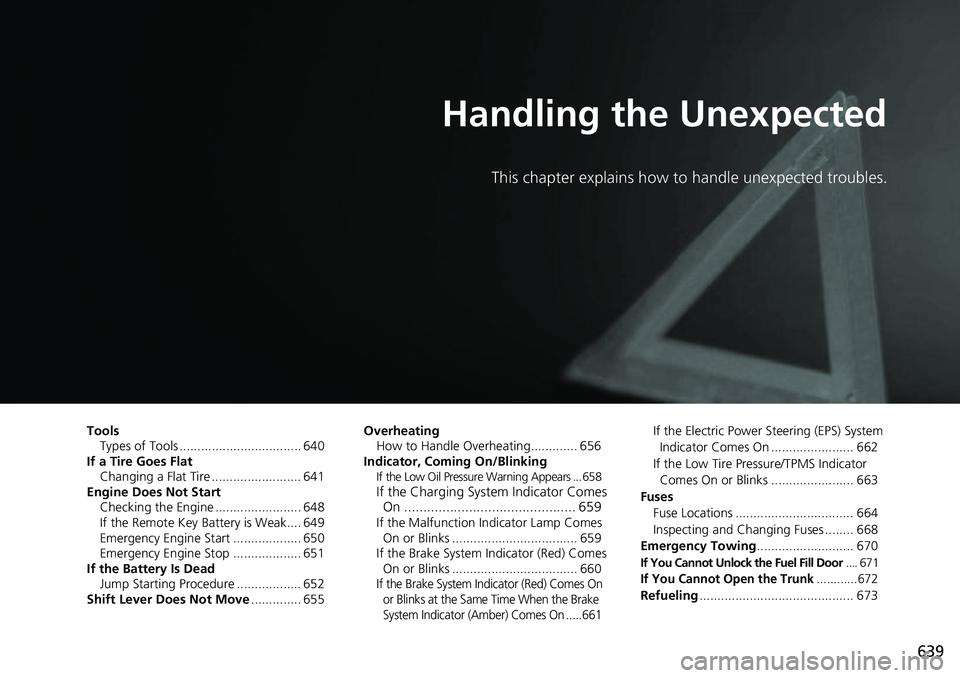
This chapter explains how to handle unexpected troubles.
ToolsTypes of Tools .................................. 640
If a Tire Goes Flat
Changing a Flat Tire ......................... 641
Engine Does Not Start Checking the Engine ........................ 648
If the Remote Key Battery is Weak.... 649
Emergency Engine Start ................... 650
Emergency Engine Stop ................... 651
If the Battery Is Dead Jump Starting Procedure .................. 652
Shift Lever Does Not Move .............. 655Overheating
How to Handle Overheating............. 656
Indicator, Coming On/Blinking
If the Low Oil Pressure Warning Appears ... 658If the Charging System Indicator Comes On ............................................. 659
If the Malfunction Indicator Lamp Comes
On or Blinks ................................... 659
If the Brake System Indicator (Red) Comes
On or Blinks ................................... 660
If the Brake System Indicator (Red) Comes On or Blinks at the Same Time When the Brake
System Indicator (Amber) Comes On .....661
If the Electric Power Steering (EPS) System
Indicator Comes On ....................... 662
If the Low Tire Pressure/TPMS Indicator Comes On or Blinks ....................... 663
Fuses Fuse Locations ................................. 664
Inspecting and Changing Fuses ........ 668
Emergency Towing ........................... 670
If You Cannot Unlock the Fuel Fill Door .... 671
If You Cannot Open the Trunk............672
Refueling........................................... 673
Page 674 of 700
673
Handling the Unexpected
Refueling
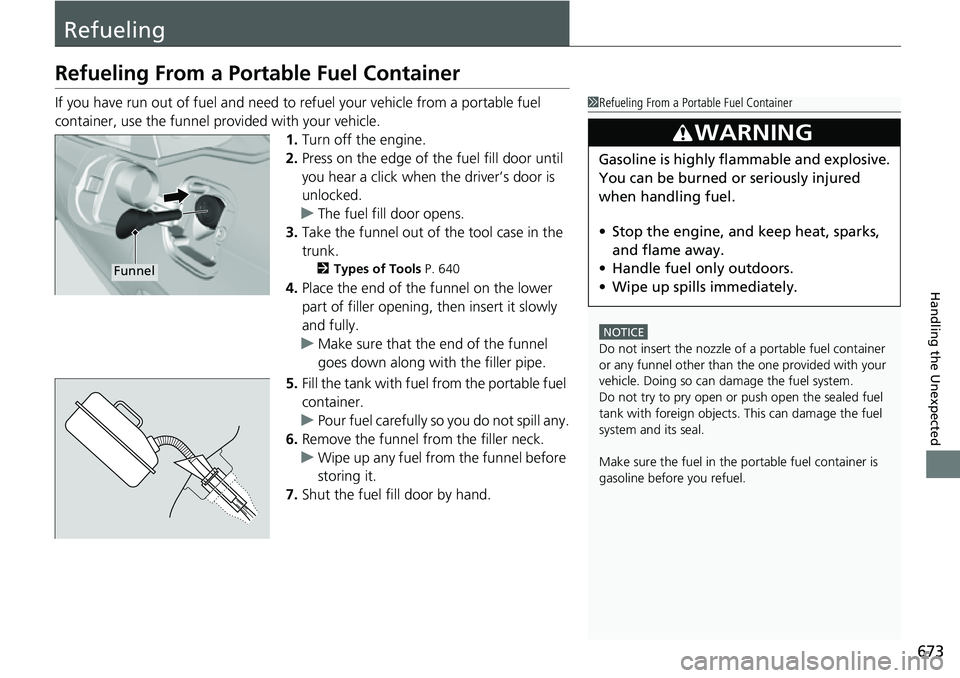
Refueling From a Portable Fuel Container
If you have run out of fuel and need to refuel your vehicle from a portable fuel
container, use the funnel provided with your vehicle.
1.Turn off the engine.
2. Press on the edge of the fuel fill door until
you hear a click when the driver’s door is
unlocked.
u The fuel fill door opens.
3. Take the funnel out of the tool case in the
trunk.
2 Types of Tools P. 640
4.Place the end of the funnel on the lower
part of filler opening, then insert it slowly
and fully.
u Make sure that the end of the funnel
goes down along with the filler pipe.
5. Fill the tank with fuel from the portable fuel
container.
u Pour fuel carefully so you do not spill any.
6. Remove the funnel from the filler neck.
u Wipe up any fuel from the funnel before
storing it.
7. Shut the fuel fill door by hand.
1Refueling From a Portable Fuel Container
NOTICE
Do not insert the nozzle of a portable fuel container
or any funnel other than the one provided with your
vehicle. Doing so can damage the fuel system.
Do not try to pry open or push open the sealed fuel
tank with foreign objects. This can damage the fuel
system and its seal.
Make sure the fuel in the portable fuel container is
gasoline before you refuel.
3WARNING
Gasoline is highly flammable and explosive.
You can be burned or seriously injured
when handling fuel.
• Stop the engine, and keep heat, sparks,
and flame away.
• Handle fuel only outdoors.
• Wipe up spills immediately.
Funnel
Page 677 of 700
676
Information
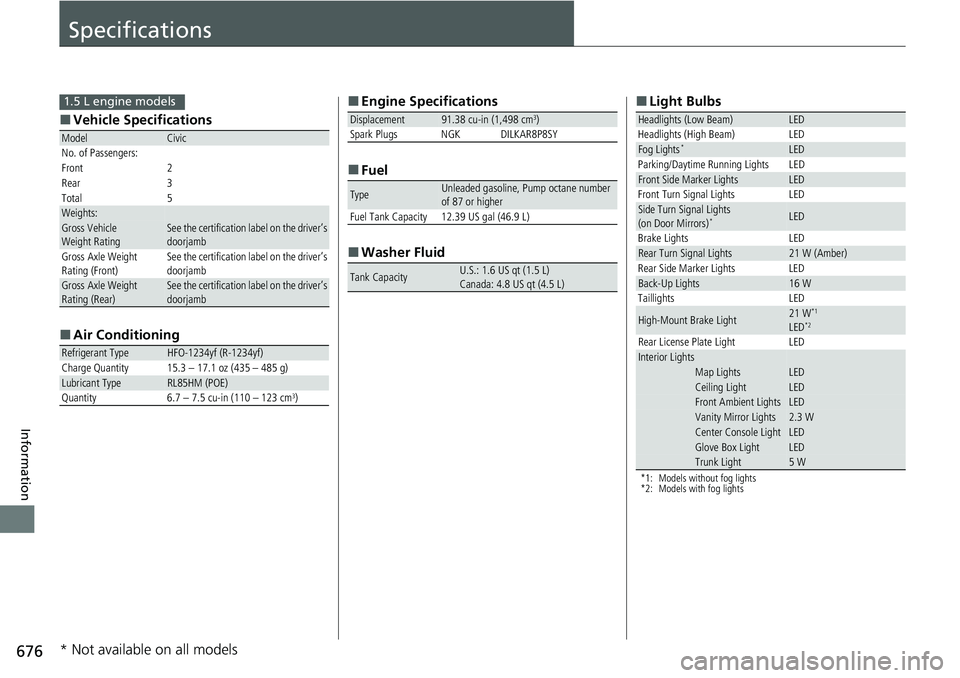
Specifications
■Vehicle Specifications
■ Air Conditioning
ModelCivic
No. of Passengers:
Front 2
Rear 3
Total 5
Weights:Gross Vehicle
Weight RatingSee the certification label on the driver’s
doorjamb
Gross Axle Weight
Rating (Front)See the certification label on the driver’s
doorjamb
Gross Axle Weight
Rating (Rear)See the certification label on the driver’s
doorjamb
Refrigerant TypeHFO-1234yf (R-1234yf)
Charge Quantity 15.3 – 17.1 oz (435 – 485 g)
Lubricant TypeRL85HM (POE)
Quantity 6.7 – 7.5 cu-in (110 – 123 cm3)
1.5 L engine models■ Engine Specifications
■ Fuel
■ Washer Fluid
Displacement91.38 cu-in (1,498 cm3)
Spark Plugs NGK DILKAR8P8SY
TypeUnleaded gasoline, Pump octane number
of 87 or higher
Fuel Tank Capacity 12.39 US gal (46.9 L)
Tank CapacityU.S.: 1.6 US qt (1.5 L)
Canada: 4.8 US qt (4.5 L)
■ Light Bulbs
*1: Models without fog lights
*2: Models with fog lights
Headlights (Low Beam)LED
Headlights (High Beam) LED
Fog Lights*LED
Parking/Daytime Running Lights LED
Front Side Marker LightsLED
Front Turn Signal Lights LED
Side Turn Signal Lights
(on Door Mirrors)*LED
Brake Lights LED
Rear Turn Signal Lights21 W (Amber)
Rear Side Marker Lights LED
Back-Up Lights16 W
Taillights LED
High-Mount Brake Light21 W*1
LED*2
Rear License Plate Light LEDInterior LightsMap LightsLEDCeiling LightLEDFront Ambient LightsLEDVanity Mirror Lights2.3 WCenter Console LightLEDGlove Box LightLEDTrunk Light5 W
* Not available on all models
Page 679 of 700
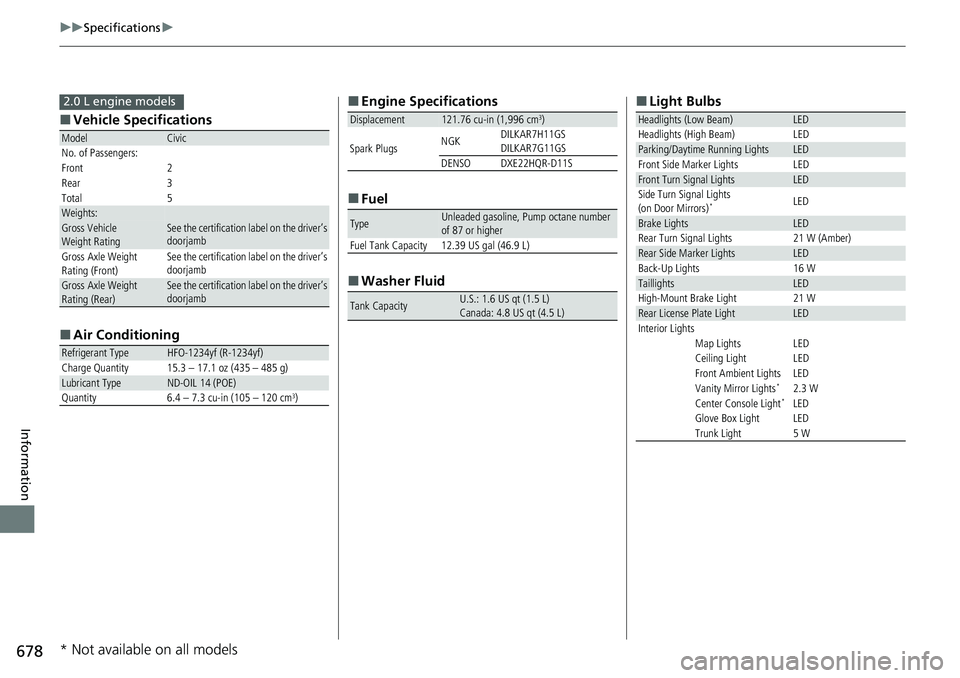
678
uuSpecifications u
Information
■
Vehicle Specifications
■ Air Conditioning
ModelCivic
No. of Passengers:
Front 2
Rear 3
Total 5
Weights:Gross Vehicle
Weight Rating See the certification label on the driver’s
doorjamb
Gross Axle Weight
Rating (Front)See the certification label on the driver’s
doorjamb
Gross Axle Weight
Rating (Rear)See the certification label on the driver’s
doorjamb
Refrigerant TypeHFO-1234yf (R-1234yf)
Charge Quantity 15.3 – 17.1 oz (435 – 485 g)
Lubricant TypeND-OIL 14 (POE)
Quantity 6.4 – 7.3 cu-in (105 – 120 cm3)
2.0 L engine models■ Engine Specifications
■ Fuel
■ Washer Fluid
Displacement121.76 cu-in (1,996 cm3)
Spark Plugs NGK
DILKAR7H11GS
DILKAR7G11GS
DENSO DXE22HQR-D11S
TypeUnleaded gasoline, Pump octane number
of 87 or higher
Fuel Tank Capacity 12.39 US gal (46.9 L)
Tank CapacityU.S.: 1.6 US qt (1.5 L)
Canada: 4.8 US qt (4.5 L)
■ Light Bulbs
Headlights (Low Beam)LED
Headlights (High Beam) LED
Parking/Daytime Running LightsLED
Front Side Marker Lights LED
Front Turn Signal LightsLED
Side Turn Signal Lights
(on Door Mirrors)
*LED
Brake LightsLED
Rear Turn Signal Lights 21 W (Amber)
Rear Side Marker LightsLED
Back-Up Lights 16 W
TaillightsLED
High-Mount Brake Light 21 W
Rear License Plate LightLED
Interior Lights Map Lights LED
Ceiling Light LED
Front Ambient Lights LED
Vanity Mirror Lights
*2.3 W
Center Console Light*LED
Glove Box Light LED
Trunk Light 5 W
* Not available on all models
Page 695 of 700
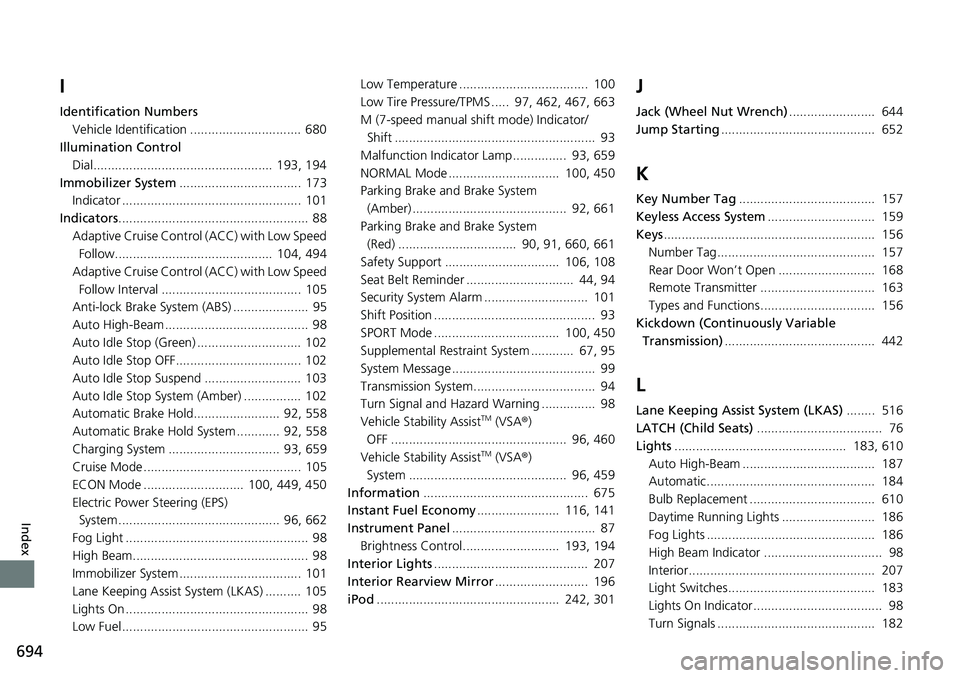
694
Index
I
Identification NumbersVehicle Identification ............................... 680
Illumination Control Dial.................................................. 193, 194
Immobilizer System .................................. 173
Indicator .................................................. 101
Indicators ..................................................... 88
Adaptive Cruise Control (ACC) with Low Speed Follow............................................ 104, 494
Adaptive Cruise Control (ACC) with Low Speed
Follow Interval ....................................... 105
Anti-lock Brake System (ABS) ..................... 95
Auto High-Beam ........................................ 98
Auto Idle Stop (Green) ............................. 102
Auto Idle Stop OFF................................... 102
Auto Idle Stop Suspend ........................... 103
Auto Idle Stop System (Amber) ................ 102
Automatic Brake Hold........................ 92, 558
Automatic Brake Hold System ............ 92, 558
Charging System ............................... 93, 659
Cruise Mode ............................................ 105
ECON Mode ............................ 100, 449, 450
Electric Power Steering (EPS) System ............................................. 96, 662
Fog Light ................................................... 98
High Beam................................................. 98
Immobilizer System .................................. 101
Lane Keeping Assist System (LKAS) .......... 105
Lights On ................................................... 98
Low Fuel .................................................... 95 Low Temperature .................................... 100
Low Tire Pressure/TPMS ..... 97, 462, 467, 663
M (7-speed manual shift mode) Indicator/
Shift ........................................................ 93
Malfunction Indicator Lamp............... 93, 659
NORMAL Mode ............................... 100, 450
Parking Brake a nd Brake System
(Amber) ........................................... 92, 661
Parking Brake a nd Brake System
(Red) ................................. 90, 91, 660, 661
Safety Support ................................ 106, 108
Seat Belt Reminder .............................. 44, 94
Security System Alarm ............................. 101
Shift Position ............................................. 93
SPORT Mode ................................... 100, 450
Supplemental Restraint System ............ 67, 95
System Message ........................................ 99
Transmission System.................................. 94
Turn Signal and Hazard Warning ............... 98
Vehicle Stability Assist
TM (VSA ®)
OFF ................................................. 96, 460
Vehicle Stability Assist
TM (VSA ®)
System ............................................ 96, 459
Information .............................................. 675
Instant Fuel Economy ....................... 116, 141
Instrument Panel ........................................ 87
Brightness Control........................... 193, 194
Interior Lights ........................................... 207
Interior Rearview Mirror .......................... 196
iPod ................................................... 242, 301
J
Jack (Wheel Nut Wrench) ........................ 644
Jump Starting ........................................... 652
K
Key Number Tag ...................................... 157
Keyless Access System .............................. 159
Keys ........................................................... 156
Number Tag............................................ 157
Rear Door Won’t Open ........................... 168
Remote Transmitter ................................ 163
Types and Functions................................ 156
Kickdown (Continuously Variable Transmission) .......................................... 442
L
Lane Keeping Assist System (LKAS) ........ 516
LATCH (Child Seats) ................................... 76
Lights ................................................ 183, 610
Auto High-Beam ..................................... 187
Automatic............................................... 184
Bulb Replacement ................................... 610
Daytime Running Lights .......................... 186
Fog Lights ............................................... 186
High Beam Indicator ................................. 98
Interior.................................................... 207
Light Switches......................................... 183
Lights On Indicator .................................... 98
Turn Signals ............................................ 182