tire type HONDA CIVIC 2022 User Guide
[x] Cancel search | Manufacturer: HONDA, Model Year: 2022, Model line: CIVIC, Model: HONDA CIVIC 2022Pages: 700, PDF Size: 13.98 MB
Page 618 of 700
617
Maintenance
Checking and Maintaining Tires
Checking Tires
To safely operate your vehicle, your tires must be of the proper type and size, in
good condition with adequate tread, and properly inflated.
■Inflation guidelines
Properly inflated tires provide the best combination of handling, tread life, and
comfort. Refer to the driver’s doorjamb labe l or specifications page for the specified
pressure.
Underinflated tires wear unev enly, adversely affect handling and fuel economy, and
are more likely to fail from overheating.
Overinflated tires make your vehicle ride ha rshly, are more prone to road hazards,
and wear unevenly.
Every day before you drive, look at each of the tires. If one looks lower than the
others, check the pressure with a tire gauge.
At least once a month or before long trips , use a gauge to measure the pressure in
all tires, including the spare. Even tires in good condition can lose 1-2 psi (10-20 kPa,
0.1-0.2 kgf/cm
2) per month.
■Inspection guidelines
Every time you check inflation, also examine the tires and valve stems. Look for:
• Bumps or bulges on the side or in the tread. Replace the tire if you find any cuts,
splits, or cracks in the side of the tire . Replace it if you see fabric or cord.
• Remove any foreign objects and inspect for air leaks.
• Uneven tread wear. Have a deal er check the wheel alignment.
• Excessive tread wear.
2 Wear Indicators P. 622
•Cracks or other damage around valve stem.
1Checking Tires
Measure the air pressure when tires are cold. This
means the vehicle has been parked for at least three
hours, or driven less than 1 mile (1.6 km). If
necessary, add or releas e air until the specified
pressure is reached.
If checked when hot, tire pressure can be as much as
4–6 psi (30–40 kPa, 0.3–0.4 kgf/cm
2) higher than if
checked when cold.
Whenever tire pressure is adjusted, you must
calibrate the TPMS. 2 TPMS Calibration P. 463
Have a dealer check the tires if you feel a consistent
vibration while driving. Ne w tires and any that have
been removed and reinst alled should be properly
balanced.
Check the spare tire pressu re once a month or before
long trips.
3WARNING
Using tires that are excessively worn or
improperly inflated can cause a crash in
which you can be seriously hurt or killed.
Follow all instruction s in this owner’s
manual regarding ti re inflation and
maintenance.
U.S. models
Page 619 of 700
618
uuChecking and Maintaining Tires uTire and Loading Information Label
Maintenance
Tire and Loading Information Label
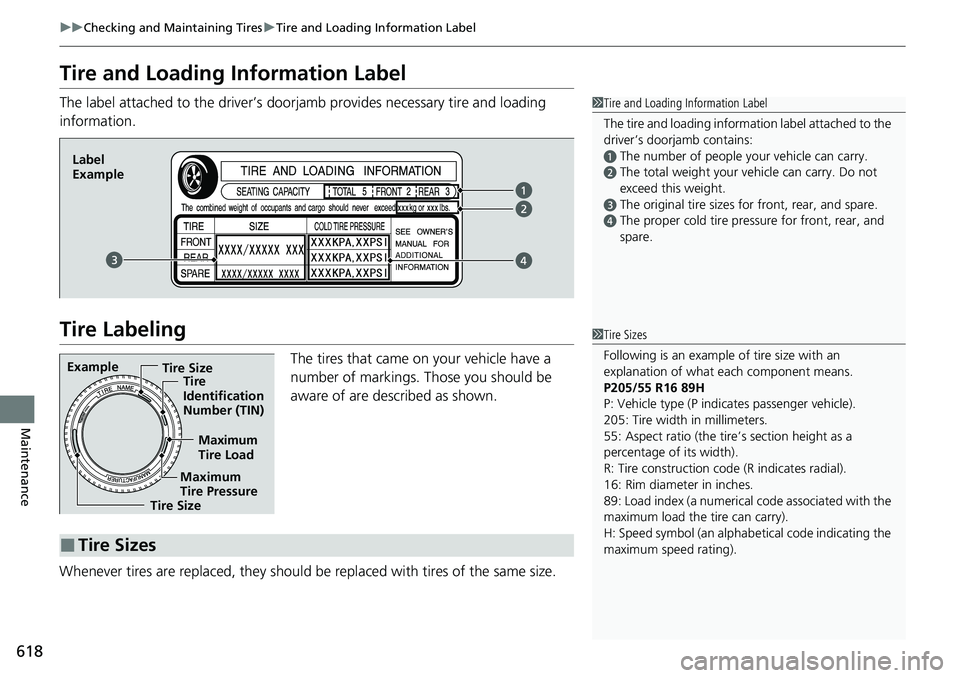
The label attached to the driver’s doorj amb provides necessary tire and loading
information.
Tire Labeling
The tires that came on your vehicle have a
number of markings. Those you should be
aware of are described as shown.
Whenever tires are replaced, they should be replaced with tires of the same size.
1 Tire and Loading Information Label
The tire and loading informat ion label attached to the
driver’s doorjamb contains:
aThe number of people your vehicle can carry.bThe total weight your vehicle can carry. Do not
exceed this weight.
cThe original tire sizes for front, rear, and spare.dThe proper cold tire pressure for front, rear, and
spare.
Label
Example
Example Tire Size
Tire
Identification
Number (TIN)
Maximum
Tire Load
Maximum
Tire Pressure
Tire Size
■Tire Sizes
1 Tire Sizes
Following is an example of tire size with an
explanation of what each component means.
P205/55 R16 89H
P: Vehicle type (P indi cates passenger vehicle).
205: Tire width in millimeters.
55: Aspect ratio (the tire’s section height as a
percentage of its width).
R: Tire construction code (R indicates radial).
16: Rim diameter in inches.
89: Load index (a numerical code associated with the
maximum load the tire can carry).
H: Speed symbol (an alphabe tical code indicating the
maximum speed rating).
Page 620 of 700
619
uuChecking and Maintaining Tires uTire Labeling
Maintenance
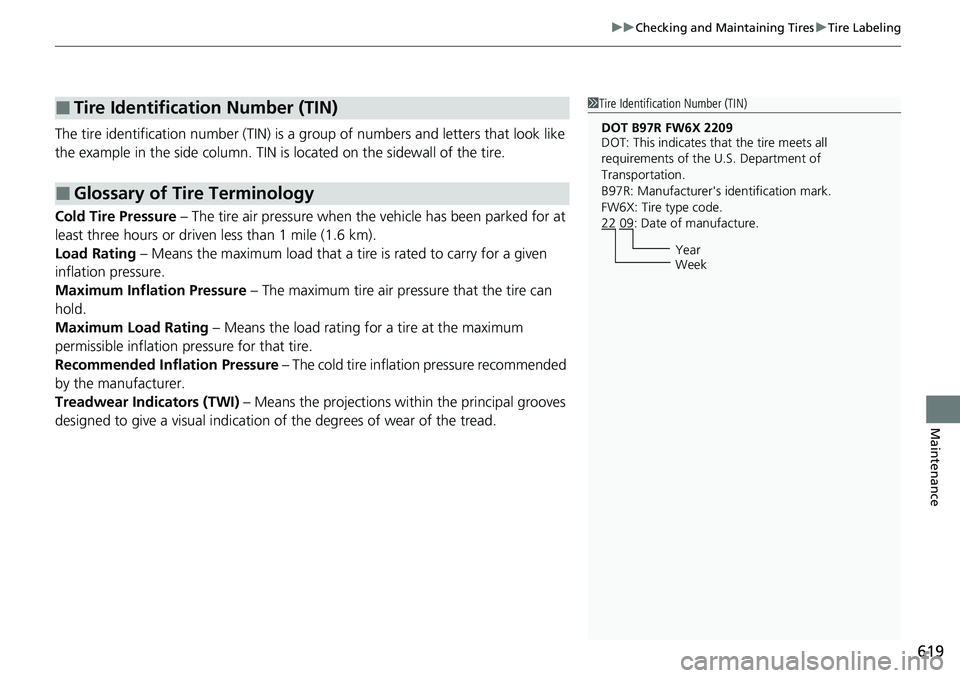
The tire identification number (TIN) is a group of numbers and letters that look like
the example in the side column. TIN is located on the sidewall of the tire.
Cold Tire Pressure – The tire air pressure when the vehicle has been parked for at
least three hours or driven less than 1 mile (1.6 km).
Load Rating – Means the maximum load that a ti re is rated to carry for a given
inflation pressure.
Maximum Inflation Pressure – The maximum tire air pressure that the tire can
hold.
Maximum Load Rating – Means the load rating for a tire at the maximum
permissible inflation pressure for that tire.
Recommended Inflation Pressure – The cold tire inflation pressure recommended
by the manufacturer.
Treadwear Indicators (TWI) – Means the projections within the principal grooves
designed to give a visual indication of the degrees of wear of the tread.
■Tire Identification Number (TIN)
■Glossary of Tire Terminology
1Tire Identification Number (TIN)
DOT B97R FW6X 2209
DOT: This indicates that the tire meets all
requirements of the U.S. Department of
Transportation.
B97R: Manufacturer's identification mark.
FW6X: Tire type code.
22 09: Date of manufacture.
Year
Week
Page 624 of 700
623
uuChecking and Maintaining Tires uTire and Wheel Replacement
Maintenance
Tire and Wheel Replacement
Replace your tires with radials of the same size, load range, speed rating, and
maximum cold tire pressure rating (as shown on the tire’s sidewall). Using tires of a
different size or construction can cause ce rtain vehicle systems such as the ABS and
Vehicle Stability Assist
TM (VSA ®) system to work incorrectly.
It is best to replace all four tires at the same time. If that isn’t possible, replace the
front or rear tires in pairs.
Make sure that the wheel’s specifications match those of the original wheels.
1 Tire and Wheel Replacement
3WARNING
Installing improper tires on your vehicle can
affect handling and stability. This can cause
a crash in which you can be seriously hurt or
killed.
Always use the size and type of tires
recommended in this owner’s manual.
Page 627 of 700
uuChecking and Maintaining Tires uWinter Tires
626
Maintenance
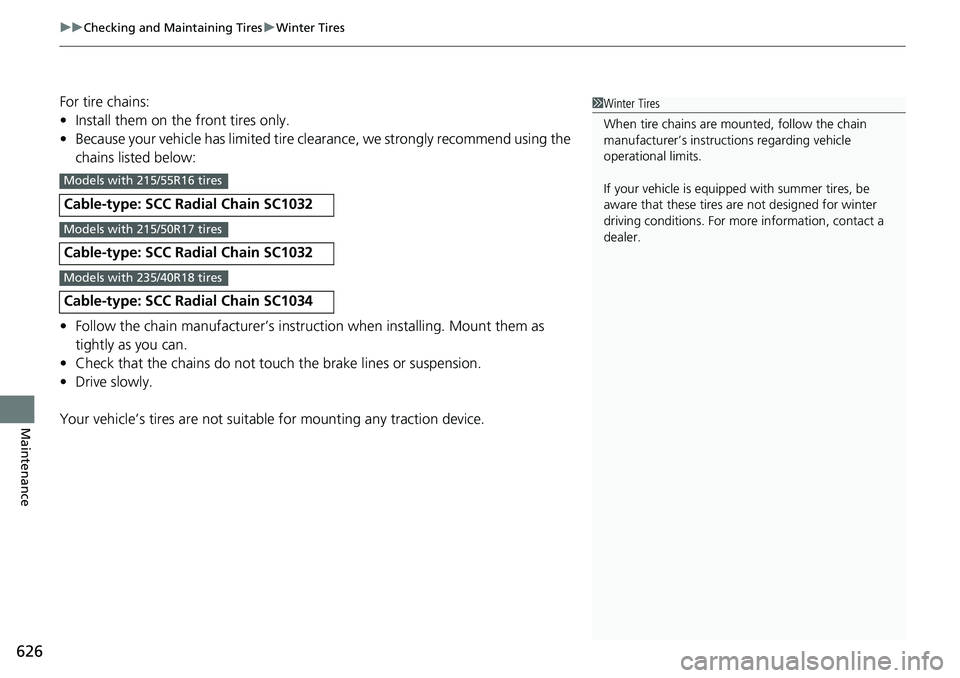
For tire chains:
• Install them on the front tires only.
• Because your vehicle has limited tire cl earance, we strongly recommend using the
chains listed below:
• Follow the chain manufacturer’s instruction when installing. Mount them as
tightly as you can.
• Check that the chains do not to uch the brake lines or suspension.
• Drive slowly.
Your vehicle’s tires are not suitable for mounting any traction device.
Cable-type: SCC Ra dial Chain SC1032
Cable-type: SCC Radial Chain SC1032
Cable-type: SCC Radial Chain SC1034
1Winter Tires
When tire chains are mounted, follow the chain
manufacturer’s instructi ons regarding vehicle
operational limits.
If your vehicle is equipp ed with summer tires, be
aware that these tires are not designed for winter
driving conditions. For more information, contact a
dealer.
Models with 215/55R16 tires
Models with 215/50R17 tires
Models with 235/40R18 tires
Page 629 of 700
628
uuBattery uCharging the Battery
Maintenance
Charging the Battery
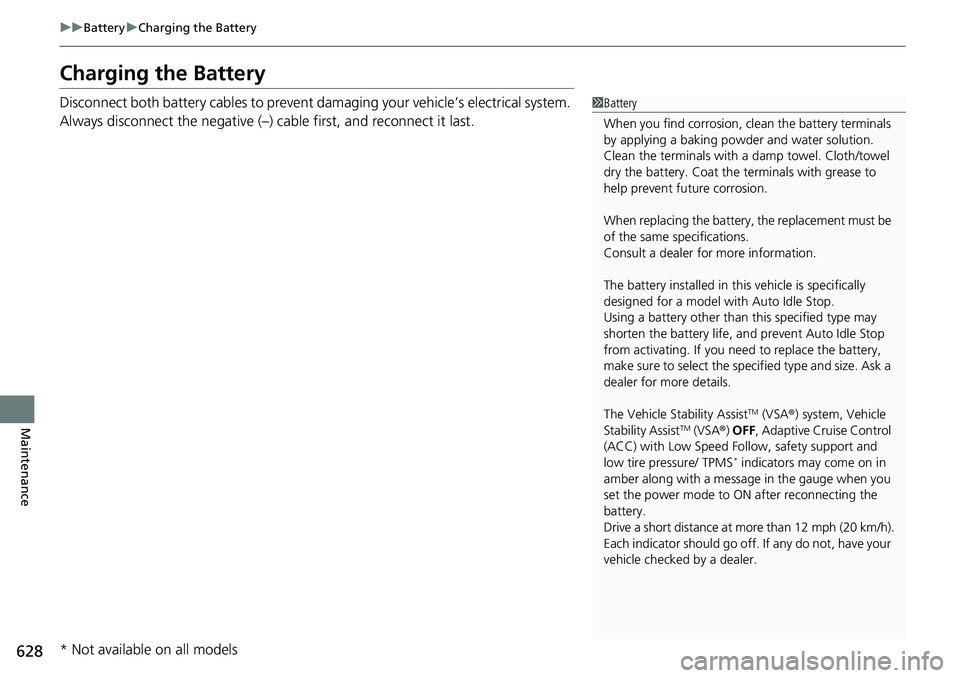
Disconnect both battery cables to prevent da maging your vehicle’s electrical system.
Always disconnect the negative (–) cable first, and reconnect it last.1 Battery
When you find corrosion, cl ean the battery terminals
by applying a baking powder and water solution.
Clean the terminals with a damp towel. Cloth/towel
dry the battery. Coat the terminals with grease to
help prevent future corrosion.
When replacing the battery, the replacement must be
of the same specifications.
Consult a dealer for more information.
The battery installed in this vehicle is specifically
designed for a model wi th Auto Idle Stop.
Using a battery other than this specified type may
shorten the battery life, a nd prevent Auto Idle Stop
from activating. If you need to replace the battery,
make sure to select the specified type and size. Ask a
dealer for more details.
The Vehicle Stability Assist
TM (VSA ®) system, Vehicle
Stability AssistTM (VSA ®) OFF , Adaptive Cruise Control
(ACC) with Low Speed Follow, safety support and
low tire pressure/ TPMS
* indicators may come on in
amber along with a message in the gauge when you
set the power mode to ON after reconnecting the
battery.
Drive a short distance at more than 12 mph (20 km/h).
Each indicator should go off. If any do not, have your
vehicle checked by a dealer.
* Not available on all models
Page 640 of 700
639
Handling the Unexpected
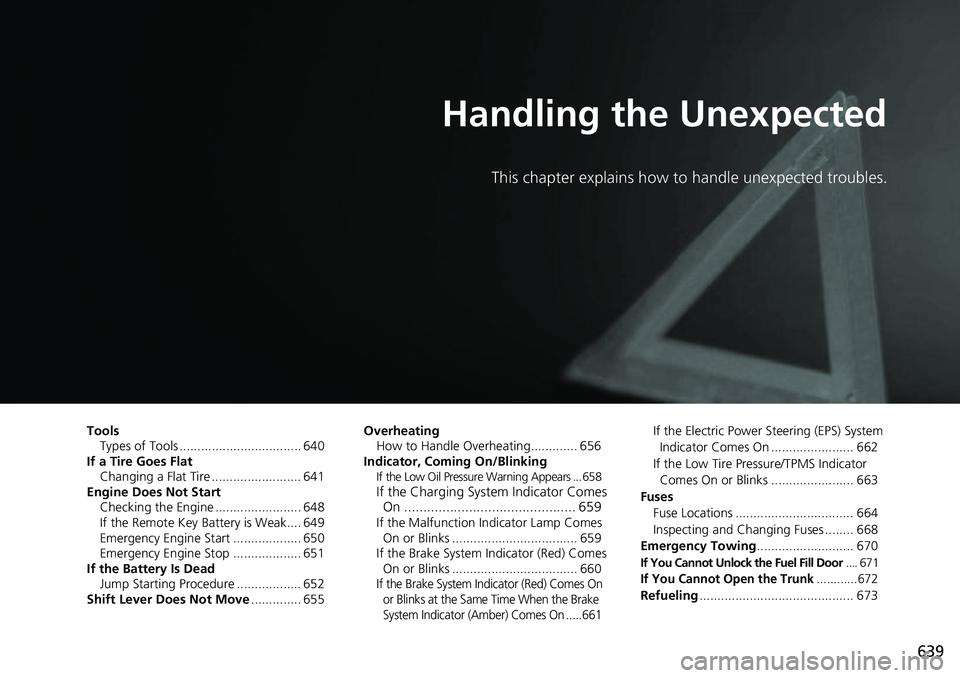
This chapter explains how to handle unexpected troubles.
ToolsTypes of Tools .................................. 640
If a Tire Goes Flat
Changing a Flat Tire ......................... 641
Engine Does Not Start Checking the Engine ........................ 648
If the Remote Key Battery is Weak.... 649
Emergency Engine Start ................... 650
Emergency Engine Stop ................... 651
If the Battery Is Dead Jump Starting Procedure .................. 652
Shift Lever Does Not Move .............. 655Overheating
How to Handle Overheating............. 656
Indicator, Coming On/Blinking
If the Low Oil Pressure Warning Appears ... 658If the Charging System Indicator Comes On ............................................. 659
If the Malfunction Indicator Lamp Comes
On or Blinks ................................... 659
If the Brake System Indicator (Red) Comes
On or Blinks ................................... 660
If the Brake System Indicator (Red) Comes On or Blinks at the Same Time When the Brake
System Indicator (Amber) Comes On .....661
If the Electric Power Steering (EPS) System
Indicator Comes On ....................... 662
If the Low Tire Pressure/TPMS Indicator Comes On or Blinks ....................... 663
Fuses Fuse Locations ................................. 664
Inspecting and Changing Fuses ........ 668
Emergency Towing ........................... 670
If You Cannot Unlock the Fuel Fill Door .... 671
If You Cannot Open the Trunk............672
Refueling........................................... 673
Page 642 of 700
641Continued
Handling the Unexpected
If a Tire Goes Flat
Changing a Flat Tire
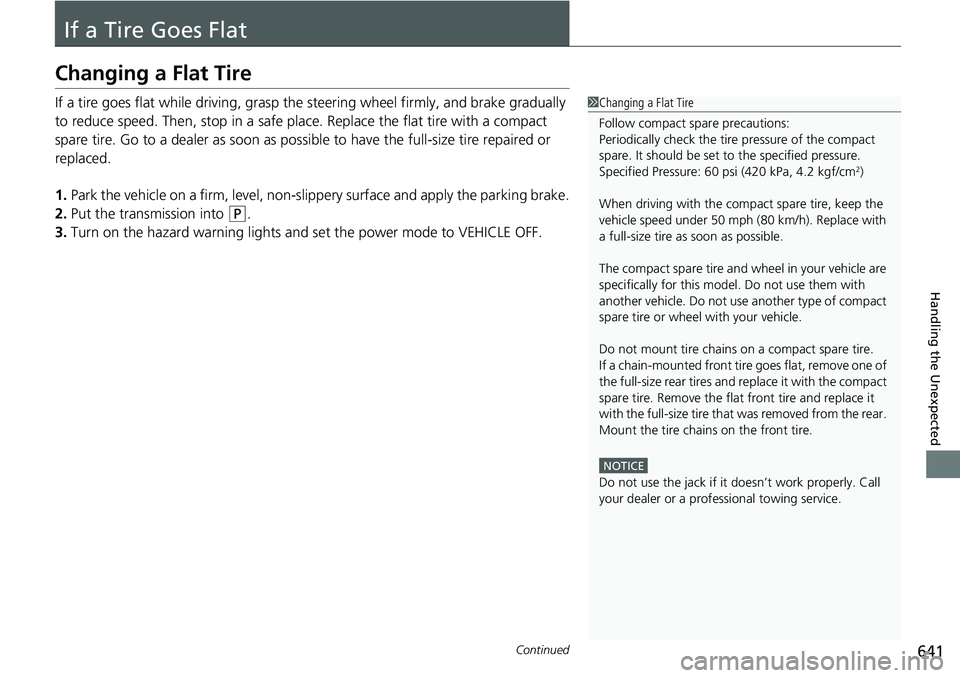
If a tire goes flat while driving, grasp the steering wheel firmly, and brake gradually
to reduce speed. Then, stop in a safe plac e. Replace the flat tire with a compact
spare tire. Go to a dealer as soon as possib le to have the full-size tire repaired or
replaced.
1. Park the vehicle on a firm, level, non-slippery surface and apply the parking brake.
2. Put the transmission into
(P.
3. Turn on the hazard warning lights an d set the power mode to VEHICLE OFF.
1Changing a Flat Tire
Follow compact spare precautions:
Periodically check the tire pressure of the compact
spare. It should be set to the specified pressure.
Specified Pressure: 60 psi (420 kPa, 4.2 kgf/cm
2)
When driving with the compact spare tire, keep the
vehicle speed under 50 mph (80 km/h). Replace with
a full-size tire as soon as possible.
The compact spare tire and wheel in your vehicle are
specifically for this model. Do not use them with
another vehicle. Do not us e another type of compact
spare tire or wheel with your vehicle.
Do not mount tire chains on a compact spare tire.
If a chain-mounted front tire goes flat, remove one of
the full-size rear tires and replace it with the compact
spare tire. Remove the flat front tire and replace it
with the full-size tire that was removed from the rear.
Mount the tire chains on the front tire.
NOTICE
Do not use the jack if it doesn’t work properly. Call
your dealer or a prof essional towing service.
Page 678 of 700
677
uuSpecifications u
Continued
Information
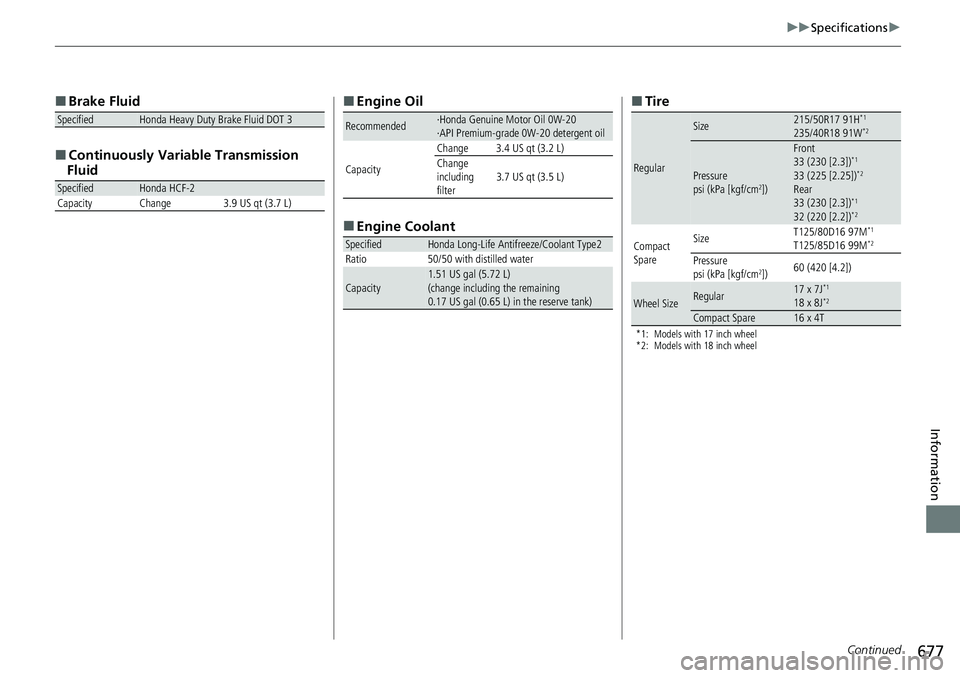
■
Brake Fluid
■ Continuously Variable Transmission
Fluid
SpecifiedHonda Heavy Duty Brake Fluid DOT 3
SpecifiedHonda HCF-2
Capacity Change 3.9 US qt (3.7 L)
■ Engine Oil
■ Engine Coolant
Recommended·Honda Genuine Motor Oil 0W-20
·API Premium-grade 0W-20 detergent oil
Capacity Change 3.4 US qt (3.2 L)
Change
including
filter
3.7 US qt (3.5 L)
SpecifiedHonda Long-Life Antifreeze/Coolant Type2
Ratio 50/50 with distilled water
Capacity1.51 US gal (5.72 L)
(change including the remaining
0.17 US gal (0.65 L) in the reserve tank)
■ Tire
*1: Models with 17 inch wheel
*2: Models with 18 inch wheel
Regular
Size215/50R17 91H*1
235/40R18 91W*2
Pressure
psi (kPa [kgf/cm2])
Front
33 (230 [2.3])*1
33 (225 [2.25])*2
Rear
33 (230 [2.3])*1
32 (220 [2.2])*2
Compact
Spare Size
T125/80D16 97M
*1
T125/85D16 99M*2
Pressure
psi (kPa [kgf/cm2])
60 (420 [4.2])
Wheel SizeRegular17 x 7J*1
18 x 8J*2
Compact Spare16 x 4T
Page 680 of 700
679
uuSpecifications u
Information
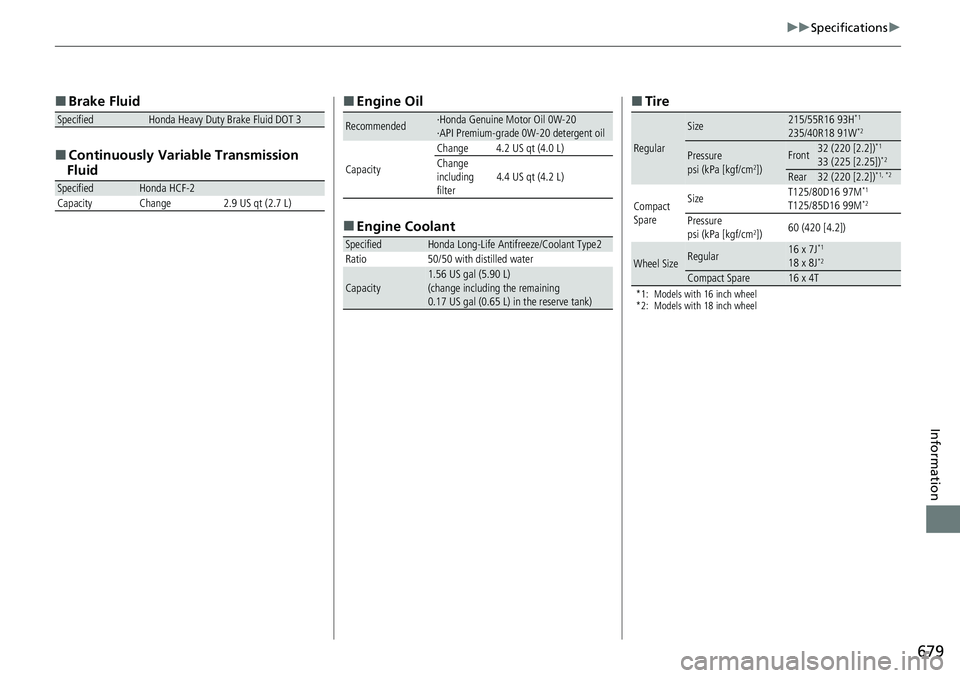
■
Brake Fluid
■ Continuously Variable Transmission
Fluid
SpecifiedHonda Heavy Duty Brake Fluid DOT 3
SpecifiedHonda HCF-2
Capacity Change 2.9 US qt (2.7 L)
■ Engine Oil
■ Engine Coolant
Recommended·Honda Genuine Motor Oil 0W-20
·API Premium-grade 0W-20 detergent oil
Capacity Change 4.2 US qt (4.0 L)
Change
including
filter
4.4 US qt (4.2 L)
SpecifiedHonda Long-Life Antifreeze/Coolant Type2
Ratio 50/50 with distilled water
Capacity1.56 US gal (5.90 L)
(change including the remaining
0.17 US gal (0.65 L) in the reserve tank)
■ Tire
*1: Models with 16 inch wheel
*2: Models with 18 inch wheel
Regular
Size215/55R16 93H*1
235/40R18 91W*2
Pressure
psi (kPa [kgf/cm2])Front32 (220 [2.2])*1
33 (225 [2.25])*2
Rear32 (220 [2.2])*1, *2
Compact
Spare Size
T125/80D16 97M
*1
T125/85D16 99M*2
Pressure
psi (kPa [kgf/cm2])60 (420 [4.2])
Wheel SizeRegular16 x 7J*1
18 x 8J*2
Compact Spare16 x 4T