ESP HONDA CIVIC COUPE 1998 User Guide
[x] Cancel search | Manufacturer: HONDA, Model Year: 1998, Model line: CIVIC COUPE, Model: HONDA CIVIC COUPE 1998Pages: 251, PDF Size: 2.04 MB
Page 140 of 251
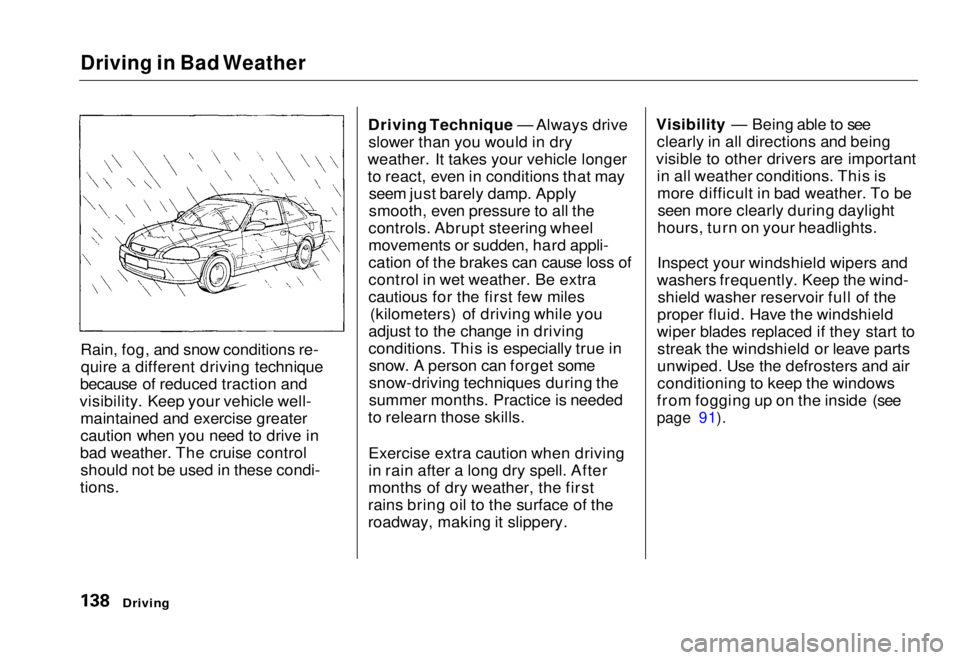
Driving in Bad Weather
Rain, fog, and snow conditions re-
quire a different driving technique
because of reduced traction and
visibility. Keep your vehicle well- maintained and exercise greater
caution when you need to drive in
bad weather. The cruise control should not be used in these condi-
tions. Driving Technique — Always drive
slower than you would in dry
weather. It takes your vehicle longer
to react, even in conditions that may seem just barely damp. Apply
smooth, even pressure to all the
controls. Abrupt steering wheel
movements or sudden, hard appli-
cation of the brakes can cause loss of
control in wet weather. Be extra
cautious for the first few miles (kilometers) of driving while you
adjust to the change in driving
conditions. This is especially true in snow. A person can forget some
snow-driving techniques during the
summer months. Practice is needed
to relearn those skills.
Exercise extra caution when driving
in rain after a long dry spell. After
months of dry weather, the first
rains bring oil to the surface of the
roadway, making it slippery. Visibility — Being able to see
clearly in all directions and being
visible to other drivers are important in all weather conditions. This ismore difficult in bad weather. To beseen more clearly during daylight
hours, turn on your headlights.
Inspect your windshield wipers and
washers frequently. Keep the wind- shield washer reservoir full of the
proper fluid. Have the windshield
wiper blades replaced if they start to streak the windshield or leave parts
unwiped. Use the defrosters and air
conditioning to keep the windows
from fogging up on the inside (see
page 91).
DrivingMain Menu Table of Contents s t
Page 200 of 251
Exterior Care
Washing
Frequent washing helps preserve
your vehicle's beauty. Dirt and grit can scratch the paint, while tree sap
and bird droppings can permanently
ruin the finish.
Wash your vehicle in a shady area, not in direct sunlight. If the vehicle is
parked in the sun, move it into the shade and let the exterior cool down
before you start.
Only use the solvents and cleaners
recommended in this Owner's
Manual.
Chemical solvents and strong cleaners
can damage the paint, metal, and
plastic on your vehicle.
Rinse the vehicle thoroughly with
cool water to remove loose dirt. Fill a bucket with cool water. Mix
in a mild detergent, such as
dishwashing liquid or a product
made especially for vehicle
washing.
Wash the vehicle using the water and detergent solution and a soft-
bristle brush, sponge, or soft cloth.
Start at the top and work your way down. Rinse frequently.
Check the body for road tar, treesap, etc. Remove these stains with
tar remover or turpentine. Rinse it off immediately so it does not
harm the finish. Remember to re-
wax these areas, even if the rest of the vehicle does not need waxing.
When you have washed and rinsed the whole exterior, dry it with a
chamois or soft towel. Letting itair-dry will cause dulling and water
spots.
As you dry the vehicle, inspect it for
chips and scratches that could allow
corrosion to start. Repair them with
touch-up paint (see page 201).
Waxing Always wash and dry the wholevehicle before waxing it. You should
wax your vehicle, including the metal
trim, whenever water sits on the surface in large patches. It should
form into beads or droplets after
waxing.
You should use a quality liquid or paste wax. Apply it according to the
instructions on the container. In
general, there are two types of
products:
Waxes — A wax coats the finish and protects it from damage by exposure
to sunlight, air pollution, etc. Youshould use a wax on your Honda
when it is new.
Appearance Care
NOTICEMain Menu Table of Contents s t
Page 204 of 251

Corrosion Protection, Body Repairs
Inspect and clean out the drain
holes in the bottom of the doors and body.
Check the floor coverings for
dampness. Carpeting and floor
mats may remain damp for a long
time, especially in winter. This dampness can eventually cause
the floor panels to corrode.
Use a high-pressure spray to clean
the underside of your vehicle. This
is especially important in areas
that use road salt in winter. It is
also a good idea in humid climates
and areas subject to salt air.
Vehicles equipped with ABS have a sensor and wiring at each wheel.
Be careful not to damage them.
Have the corrosion-preventive
coatings on the underside of your
vehicle inspected and repaired
periodically. Body Repairs
Body repairs can affect your vehicle's
resistance to corrosion. If your
vehicle needs repairs after a collision, pay close attention to the parts used
in the repair and the quality of the
work.
Make sure the repair facility uses
Genuine Honda replacement body
parts. Some companies make sheet
metal pieces that seem to duplicate
the original Honda body parts, but are actually inferior in fit, finish, and
corrosion resistance. Once installed,
they do not give the same high- quality appearance.
When reporting your collision to the
insurance company, tell them you
want Genuine Honda parts used in the repair. Although most insurers
recognize the quality of original
parts, some may try to specify that
the repairs be done with other
available parts. You should investi-
gate this before any repairs are
begun.
Take your vehicle to your authorized Honda dealer for inspection after the
repairs are completed. He can makesure that quality materials were used,
and that corrosion-preventive
coatings were applied to all repaired
and replaced parts.
Appearance CareMain Menu Table of Contents s t
Page 206 of 251
Compact Spare Tire
Your vehicle has a compact spare tire that takes up less space. Use this spare tire as a temporary replace-
ment only. Get your regular tire
repaired or replaced and put back on
your vehicle as soon as you can.
Check the inflation pressure of the
compact spare tire every time you
check the other tires. It should be
inflated to:
60 psi (420 kPa , 4.2 kgf/cm2)
Follow these precautions whenever
you are using the compact spare tire:
Do not exceed 50 mph (80 km/h)
under any circumstances.
This tire gives a harsher ride and less traction on some road sur-
faces than the regular tire. Use
greater caution while driving on
this tire.
Do not mount snow chains on the
compact spare.
The wheel of the compact spare tire is designed especially to fit
your vehicle. Do not use your spare tire on another vehicle
unless it is the same make and
model.
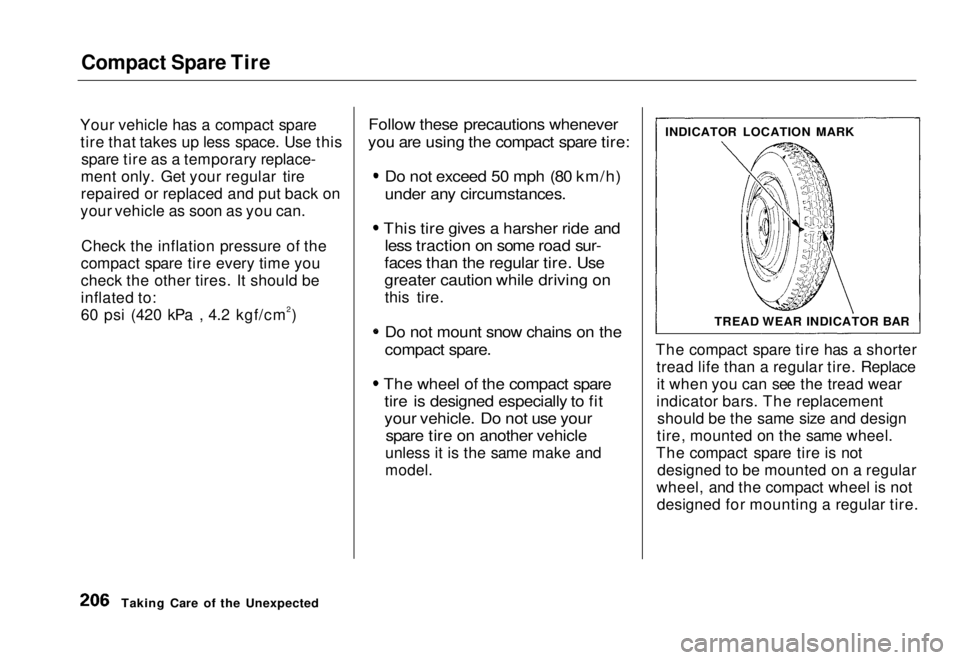
The compact spare tire has a shorter
tread life than a regular tire. Replaceit when you can see the tread wear
indicator bars. The replacement should be the same size and design
tire, mounted on the same wheel.
The compact spare tire is not designed to be mounted on a regular
wheel, and the compact wheel is not designed for mounting a regular tire.
Taking Care of the Unexpected INDICATOR LOCATION MARK
TREAD WEAR INDICATOR BARMain Menu Table of Contents s t
Page 235 of 251
Tire Information
Tire Size Designation
A tire's sidewall is marked with a tire size designation. You will need this
information when selecting replace-
ment tires for your vehicle. The
following explains what the letters and numbers in the tire size
designation mean.
(Example tire size designation)
P185/65R14 85S
P — Applicable vehicle type (tires
marked with the prefix "P" are
intended for use on passenger
vehicles; however, not all tires have this marking).
185 — Tire width in millimeters.
65 — Aspect ratio. The tire's section
height as a percentage of its width.
R — Tire construction code (Radial).
14 — Rim diameter in inches. 85 — Load Index, a numerical code
associated with the maximum load
the tire can carry.
S — Speed Symbol. See the speed
rating chart in this section foradditional information.
Wheel Size Designation
Wheels are also marked with important information that you need
if you ever have to replace one. The
following explains what the letters and numbers in the wheel size
designation mean.
(Example wheel size designation)
14 x 5J
14 — Ri
m diameter in inches.
5 — Rim width in inches.
J — Rim contour designation. Tire Speed Ratings
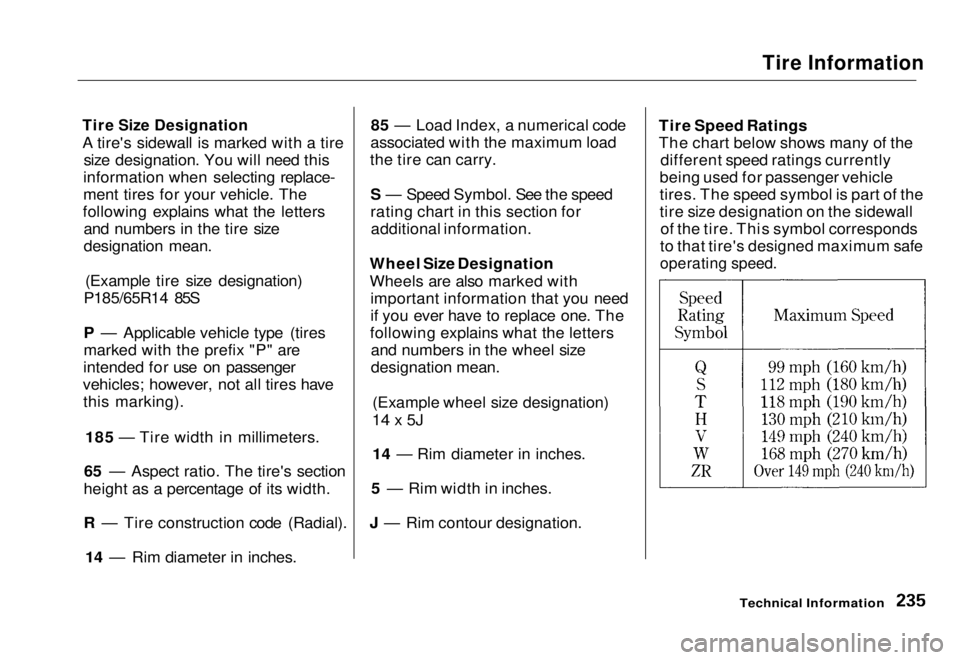
The chart below shows many of the
different speed ratings currently
being used for passenger vehicle
tires. The speed symbol is part of the
tire size designation on the sidewall of the tire. This symbol corresponds
to that tire's designed maximum safe
operating speed.
Technical InformationMain Menu Table of Contents s t
Page 237 of 251

Tire Information
Traction
The traction grades, from highest to lowest, are A, B, and C, and they
represent the tire's ability to stop on
wet pavement as measured under controlled conditions on specified
government test surfaces of asphaltand concrete. A tire marked C may
have poor traction performance.
Warning: The traction grade as- signed to this tire is based on brak-
ing (straight ahead) traction tests
and does not include cornering (turning) traction.
Temperature
The temperature grades are A (the highest), B, and C, representing the
tire's resistance to the generation of
heat and its ability to dissipate heat
when tested under controlled conditions on a specified indoor
laboratory test wheel. Sustained high
temperature can cause the material of the tire to degenerate and reduce
tire life, and excessive temperature can lead to sudden tire failure. The
grade C corresponds to a level of
performance which all passenger car tires must meet under the Federal
Motor Vehicle Safety Standard No. 109. Grades B and A represent
higher levels of performance on the laboratory test wheel than the
minimum required by law. Warning: The temperature grade for
this tire is established for a tire that
is properly inflated and not over-
loaded. Excessive speed, underinfla- tion, or excessive loading eitherseparately or in combination, can
cause heat build-up and possible tire
failure.
Technical InformationMain Menu Table of Contents s t