ECU HONDA CIVIC COUPE 1998 Owner's Manual
[x] Cancel search | Manufacturer: HONDA, Model Year: 1998, Model line: CIVIC COUPE, Model: HONDA CIVIC COUPE 1998Pages: 251, PDF Size: 2.04 MB
Page 156 of 251
Engine Oil
Adding Oil
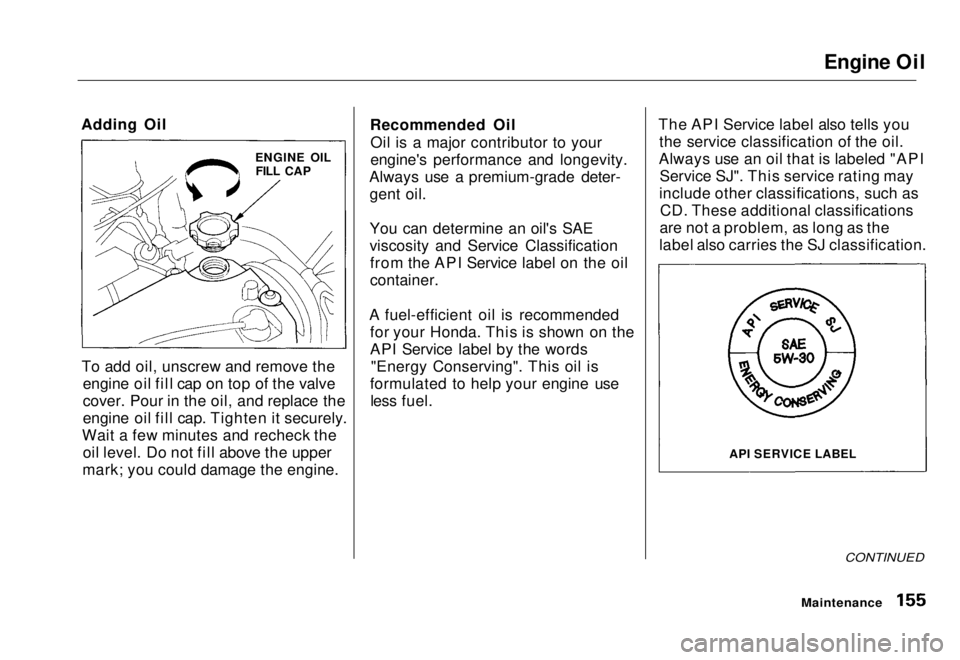
To add oil, unscrew and remove the engine oil fill cap on top of the valve
cover. Pour in the oil, and replace the
engine oil fill cap. Tighten it securely.
Wait a few minutes and recheck the oil level. Do not fill above the upper
mark; you could damage the engine. Recommended Oil
Oil is a major contributor to your
engine's performance and longevity.
Always use a premium-grade deter- gent oil.
You can determine an oil's SAE
viscosity and Service Classificationfrom the API Service label on the oil
container.
A fuel-efficient oil is recommended for your Honda. This is shown on the
API Service label by the words"Energy Conserving". This oil is
formulated to help your engine use less fuel. The API Service label also tells you
the service classification of the oil.
Always use an oil that is labeled "API Service SJ". This service rating may
include other classifications, such as CD. These additional classifications
are not a problem, as long as the
label also carries the SJ classification.
CONTINUED
Maintenance
ENGINE OIL
FILL CAP
API SERVICE LABELMain Menu Table of Contents s t
Page 166 of 251
Transmission Fluid
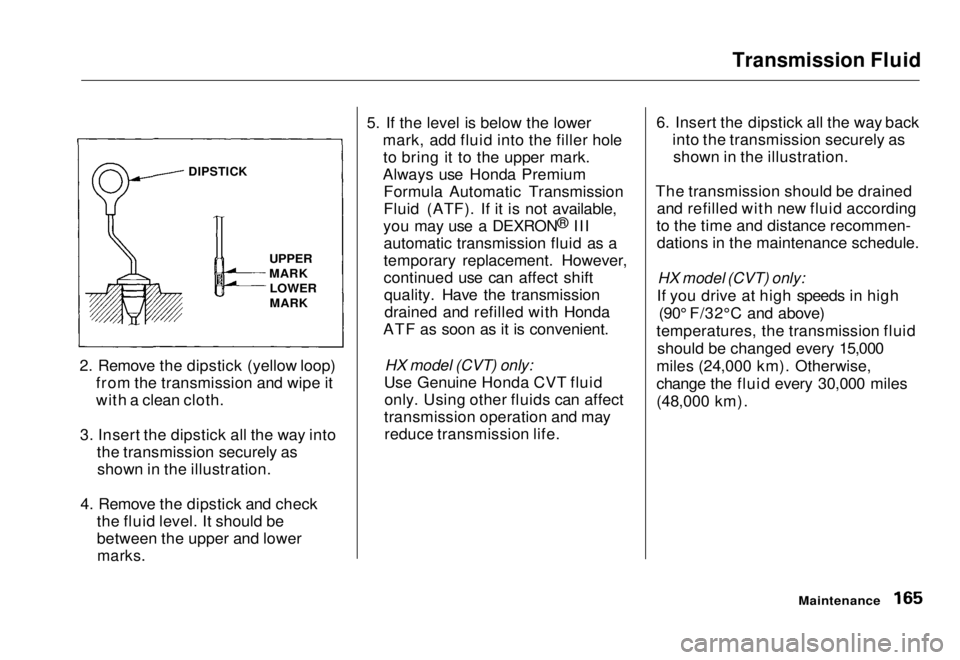
2. Remove the dipstick (yellow loop) from the transmission and wipe it
with a clean cloth.
3. Insert the dipstick all the way into the transmission securely asshown in the illustration.
4. Remove the dipstick and check the fluid level. It should be
between the upper and lower
marks.
5. If the level is below the lower
mark, add fluid into the filler holeto bring it to the upper mark.
Always use Honda Premium Formula Automatic Transmission
Fluid (ATF). If it is not available,
you may use a DEXRON ®
III
automatic transmission fluid as a
temporary replacement. However,
continued use can affect shift quality. Have the transmissiondrained and refilled with Honda
ATF as soon as it is convenient.
HX model (CVT) only:
Use Genuine Honda CVT fluid only. Using other fluids can affect
transmission operation and may reduce transmission life. 6. Insert the dipstick all the way back
into the transmission securely asshown in the illustration.
The transmission should be drained and refilled with new fluid according
to the time and distance recommen- dations in the maintenance schedule.
HX model (CVT) only:
If you drive at high speeds in high (90° F/32°C and above)
temperatures, the transmission fluid should be changed every 15,000
miles (24,000 km). Otherwise,
change the fluid every 30,000 miles
(48,000 km).
Maintenance
DIPSTICK
UPPER
MARK
LOWER
MARKMain Menu Table of Contents s t
Page 167 of 251
Transmission Fluid, Brake and Clutch Fluid
5-speed Manual Transmission
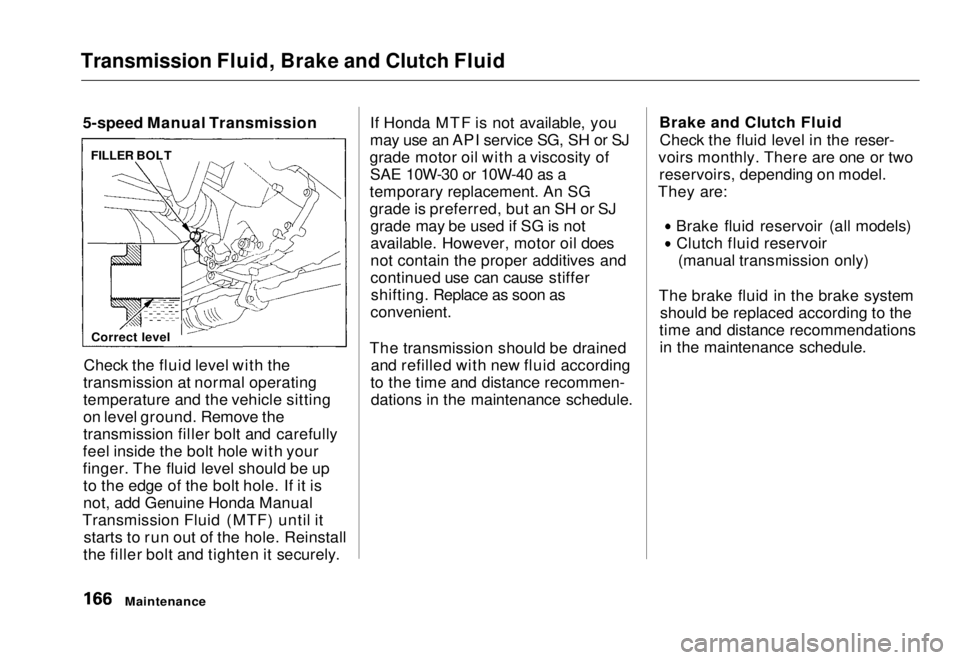
Check the fluid level with the
transmission at normal operating
temperature and the vehicle sitting
on level ground. Remove the
transmission filler bolt and carefully
feel inside the bolt hole with your
finger. The fluid level should be up to the edge of the bolt hole. If it is
not, add Genuine Honda Manual
Transmission Fluid (MTF) until it starts to run out of the hole. Reinstall
the filler bolt and tighten it securely. If Honda MTF is not available, you
may use an API service SG, SH or SJ
grade motor oil with a viscosity of SAE 10W-30 or 10W-40 as a
temporary replacement. An SG
grade is preferred, but an SH or SJ grade may be used if SG is not
available. However, motor oil does
not contain the proper additives and
continued use can cause stiffershifting. Replace as soon as
convenient.
The transmission should be drained and refilled with new fluid according
to the time and distance recommen- dations in the maintenance schedule. Brake and Clutch Fluid
Check the fluid level in the reser-
voirs monthly. There are one or two reservoirs, depending on model.
They are:
Brake fluid reservoir (all models)Clutch fluid reservoir (manual transmission only)
The brake fluid in the brake system should be replaced according to the
time and distance recommendations in the maintenance schedule.
Maintenance
FILLER BOLT
Correct levelMain Menu Table of Contents s t
Page 192 of 251
Lights
Replacing the Front Side Marker/
Turn Signal and Parking Light Bulb
1. If you are changing the bulb on the driver's side, start the engine,
turn the steering wheel all the way
to the right, and turn off theengine. If you are changing the
bulb on the passenger's side, turn
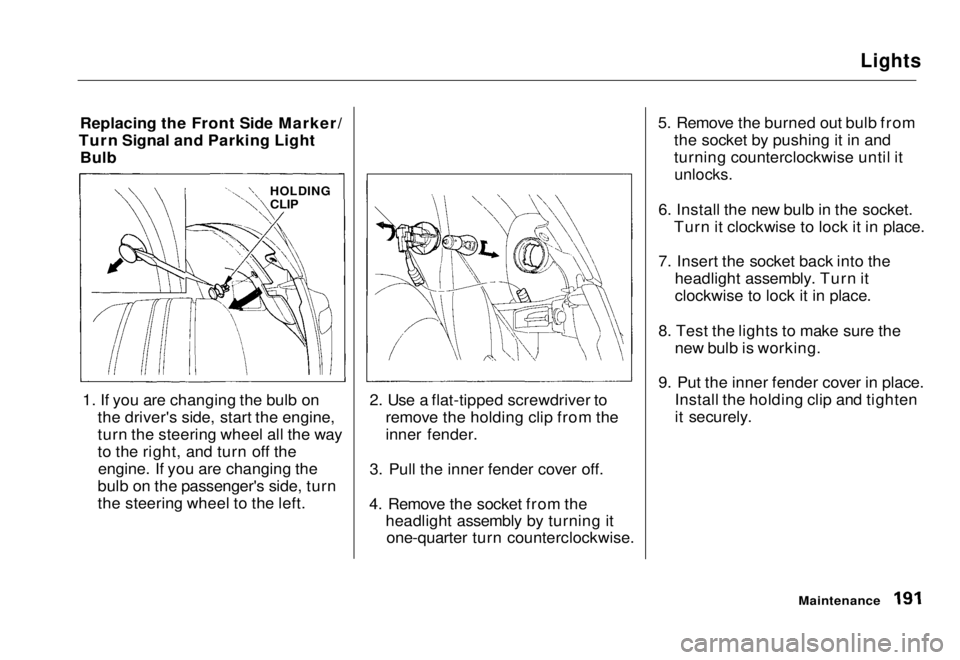
the steering wheel to the left. 2. Use a flat-tipped screwdriver to
remove the holding clip from the
inner fender.
3. Pull the inner fender cover off.
4. Remove the socket from the headlight assembly by turning itone-quarter turn counterclockwise. 5. Remove the burned out bulb from
the socket by pushing it in and
turning counterclockwise until it
unlocks.
6. Install the new bulb in the socket. Turn it clockwise to lock it in place.
7. Insert the socket back into the headlight assembly. Turn it
clockwise to lock it in place.
8. Test the lights to make sure the new bulb is working.
9. Put the inner fender cover in place. Install the holding clip and tighten
it securely.
Maintenance
HOLDING
CLIPMain Menu Table of Contents s t
Page 195 of 251
Lights
5. Pull the bulb straight out of its
socket.
Push the new bulb straight into
the socket until it bottoms.
6. Insert the socket back into the light assembly. Turn it clockwise
to lock it in place.
7. Test the lights to make sure the new bulb is working.
8. Reinstall the bulb holder assembly. Install the screw and tighten it
securely.
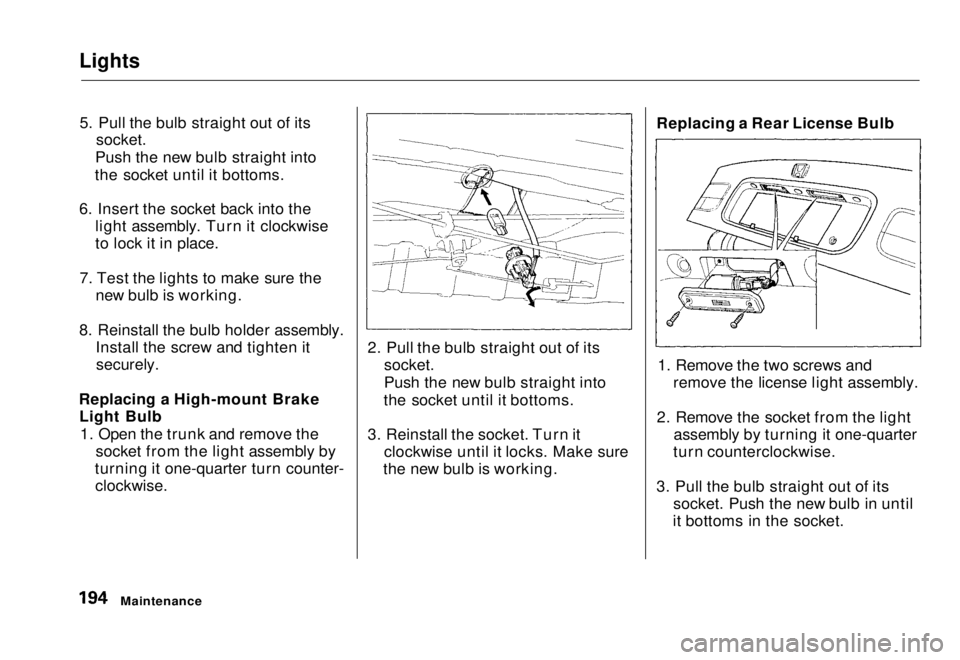
Replacing a High-mount Brake Light Bulb
1. Open the trunk and remove the socket from the light assembly by
turning it one-quarter turn counter-
clockwise.
2. Pull the bulb straight out of its
socket.
Push the new bulb straight into
the socket until it bottoms.
3. Reinstall the socket. Turn it clockwise until it locks. Make sure
the new bulb is working. Replacing a Rear License Bulb
1. Remove the two screws and remove the license light assembly.
2. Remove the socket from the light assembly by turning it one-quarter
turn counterclockwise.
3. Pull the bulb straight out of its socket. Push the new bulb in until
it bottoms in the socket.
MaintenanceMain Menu Table of Contents s t
Page 196 of 251
Lights
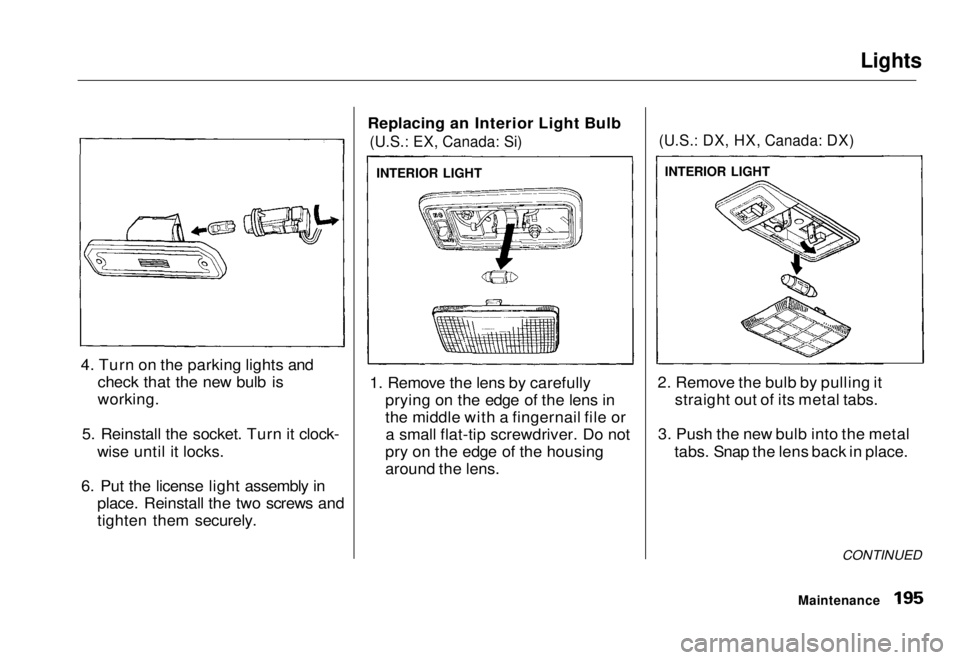
4. Turn on the parking lights and check that the new bulb is
working.
5. Reinstall the socket. Turn it clock- wise until it locks.
6. Put the license light assembly in place. Reinstall the two screws and
tighten them securely. Replacing an Interior Light Bulb
(U.S.: EX, Canada: Si)
1. Remove the lens by carefully prying on the edge of the lens in
the middle with a fingernail file ora small flat-tip screwdriver. Do not
pry on the edge of the housing
around the lens.
(U.S.: DX, HX, Canada: DX)
2. Remove the bulb by pulling it straight out of its metal tabs.
3. Push the new bulb into the metal tabs. Snap the lens back in place.
CONTINUED
Maintenance
INTERIOR LIGHT
INTERIOR LIGHTMain Menu Table of Contents s t
Page 203 of 251
Interior Care, Corrosion Protection
Windows Clean the windows, inside and out,
with a commercially-available glass cleaner. You can also use a mixture
of one part white vinegar to ten parts
water. This will remove the haze that builds up on the inside of the
windows. Use a soft cloth or paper towels to clean all glass and clear
plastic surfaces.
The rear window defogger wires are
bonded to the inside of the glass. Wiping vigorously up-and-down can
dislodge and break the defogger wires. When cleaning the rear window, use
gentle pressure and wipe side-to-side. Air Fresheners
If you want to use an air freshener/deodorizer in the interior of your
vehicle, it is best to use a solid type. Some liquid air fresheners contain
chemicals that may cause parts of
the interior trim and fabric to crackor discolor.
If you use a liquid air freshener,
make sure you fasten it securely so itdoes not spill as you drive. Corrosion Protection
Two factors normally contribute to causing corrosion in your vehicle:
1. Moisture trapped in body cavities. Dirt and road salt that collects in
hollows on the underside of the
vehicle stays damp, promoting corrosion in that area.
2. Removal of paint and protective coatings from the exterior and
underside of the vehicle.
Many corrosion-preventive measures
are built into your Honda. You can
help keep your vehicle from
corroding by performing some simple periodic maintenance:
Repair chips and scratches in the
paint as soon as you discover them.
CONTINUED
Appearance Care
NOTICEMain Menu Table of Contents s t
Page 210 of 251
Changing a Flat Tire
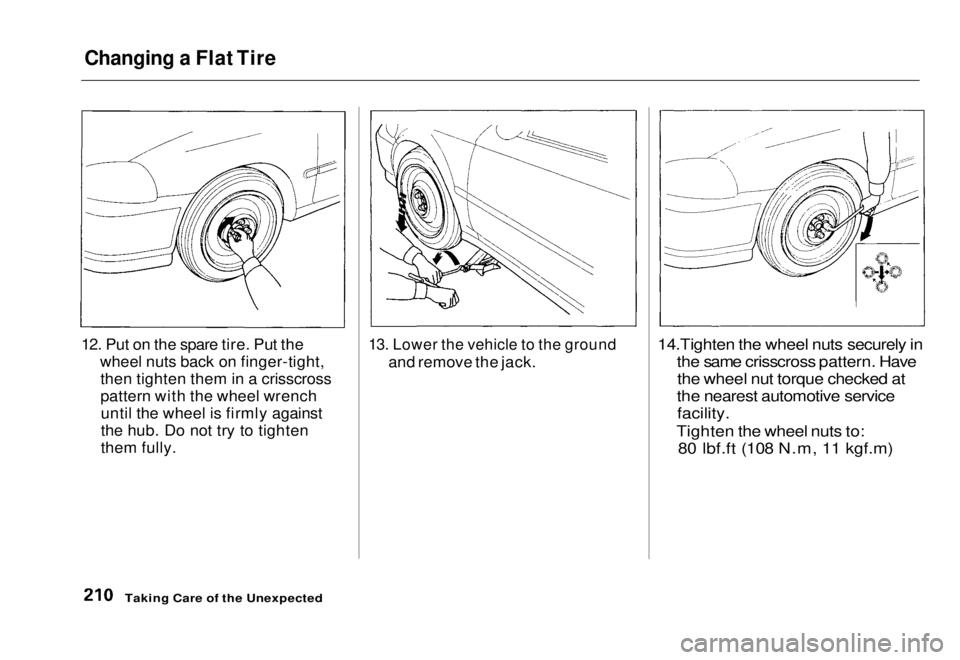
12. Put on the spare tire. Put the wheel nuts back on finger-tight,then tighten them in a crisscross
pattern with the wheel wrenchuntil the wheel is firmly against
the hub. Do not try to tighten
them fully.
13. Lower the vehicle to the ground
and remove the jack.
14.Tighten the wheel nuts securely in
the same crisscross pattern. Havethe wheel nut torque checked at
the nearest automotive service facility.
Tighten the wheel nuts to: 80 lbf.ft (108 N.m, 11 kgf.m)
Taking Care of the UnexpectedMain Menu Table of Contents s t
Page 211 of 251
Changing a Flat Tire
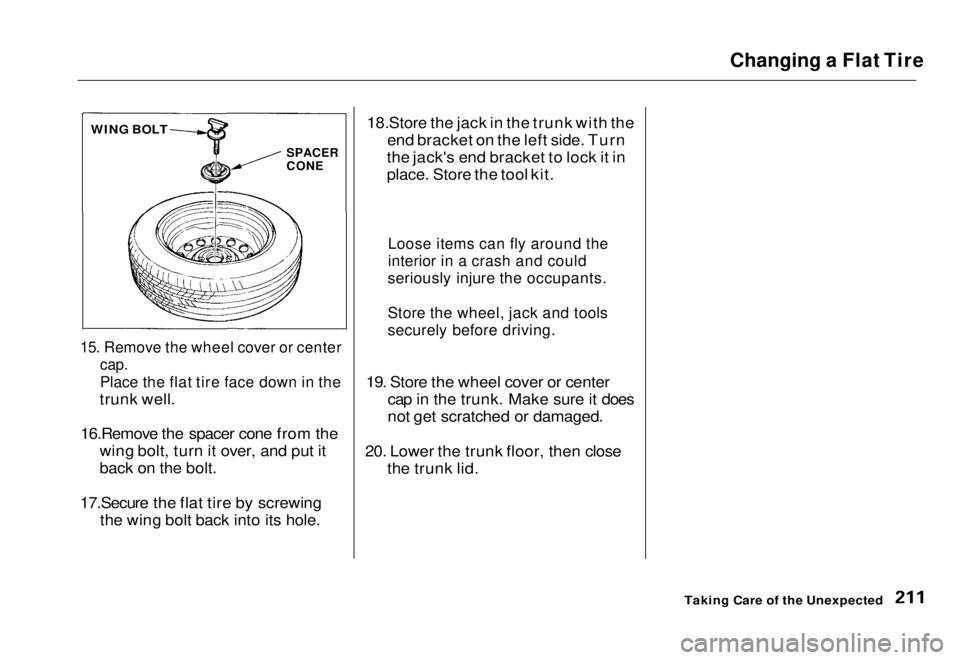
15. Remove the wheel cover or center
cap.
Place the flat tire face down in the
trunk well.
16.Remove the spacer cone from the wing bolt, turn it over, and put it
back on the bolt.
17.Secure the flat tire by screwing the wing bolt back into its hole. 18.Store the jack in the trunk with the
end bracket on the left side. Turn
the jack's end bracket to lock it in
place. Store the tool kit.
19. Store the wheel cover or center cap in the trunk. Make sure it does
not get scratched or damaged.
20. Lower the trunk floor, then close the trunk lid.
Taking Care of the Unexpected
WING BOLT
SPACER
CONE
Loose items can fly around the
interior in a crash and could
seriously injure the occupants.
Store the wheel, jack and tools
securely before driving.Main Menu Table of Contents s t