wheel HONDA CIVIC COUPE 1998 Owner's Guide
[x] Cancel search | Manufacturer: HONDA, Model Year: 1998, Model line: CIVIC COUPE, Model: HONDA CIVIC COUPE 1998Pages: 251, PDF Size: 2.04 MB
Page 142 of 251
Maintenance
This section explains why it is important to keep your vehicle well
maintained and to follow basic
maintenance safety precautions.
This section also includes Maintenance Schedules for normaldriving and severe driving conditions,
a Maintenance Record, and instruc-
tions for simple maintenance tasks
you may want to take care of yourself.
If you have the skills and tools to per-
form more complex maintenance tasks on your Honda, you may want
to purchase the Service Manual. See
page 219 for information on how to obtain a copy, or see your Honda
dealer.
Maintenance Safety....................... 142
Important Safety Precautions.. 143
Maintenance Schedule.................. 144
Maintenance Record..................... 151
Owner Maintenance Checks........ 153
Fluid Locations............................... 154
Engine Oil....................................... 155 Adding Oil................................... 155Recommended Oil..................... 155Synthetic Oil............................... 156
Additives..................................... 156
Changing the Oil and Filter...... 157
Cooling System.............................. 159
Adding Engine Coolant............. 159Replacing Engine Coolant........ 161
Windshield Washers..................... 164
Transmission Fluid........................ 164
Automatic
Transmission.......................... 164
5-speed Manual
Transmission.......................... 166
Brake and Clutch Fluid................. 166
Brake System............................. 167Clutch System............................ 167
Power Steering............................... 168
Air Cleaner Element...................... 169 Spark Plugs..................................... 171
Replacement............................... 171
Specifications............................. 172
Battery............................................ 173
Wiper Blades.................................. 175
Air Conditioning System............... 177 Drive Belts...................................... 178
Timing Belt..................................... 178
Tires................................................ 179 Inflation....................................... 179
Recommended Tire Pressures
for Normal Driving............ 180
Inspection................................... 181
Maintenance............................... 181
Tire Rotation.............................. 182
Replacing Tires and Wheels ....
183
Wheels an d
Tires....................... 184
Winter Driving........................... 184 Snow Tires.............................. 184
Tire Chains............................. 185
Lights.............................................. 186 Headlight Aiming...................... 188
Replacing Bulbs......................... 189
Storing Your Vehicle..................... 197
MaintenanceMain Menu s t
Page 169 of 251
Power Steering
On DX model with automatic-
transmission, HX and EX models in the
U.S., and DX and Si models in Canada
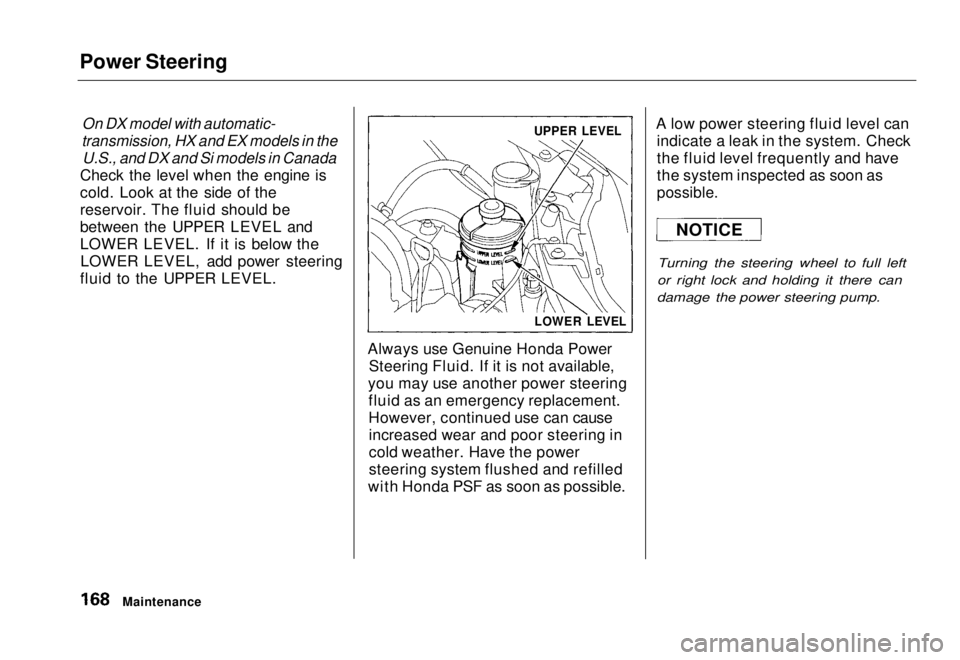
Check the level when the engine is
cold. Look at the side of the
reservoir. The fluid should be
between the UPPER LEVEL and
LOWER LEVEL. If it is below the LOWER LEVEL, add power steering
fluid to the UPPER LEVEL.
Always use Genuine Honda PowerSteering Fluid. If it is not available,
you may use another power steering fluid as an emergency replacement.
However, continued use can causeincreased wear and poor steering in
cold weather. Have the power
steering system flushed and refilled
with Honda PSF as soon as possible. A low power steering fluid level can
indicate a leak in the system. Check
the fluid level frequently and have
the system inspected as soon as
possible.
Turning the steering wheel to full left
or right lock and holding it there can
damage the power steering pump.
Maintenance
UPPER LEVEL
LOWER LEVEL
NOTICEMain Menu Table of Contents s t
Page 182 of 251
Tires
Inspection
Every time you check inflation, you should also examine the tires for
damage, foreign objects, and wear.
You should look for:
Bumps or bulges in the tread orside of the tire. Replace the tire if
you find either of these conditions.
Cuts, splits, or cracks in the side
of the tire. Replace the tire if you
can see fabric or cord.
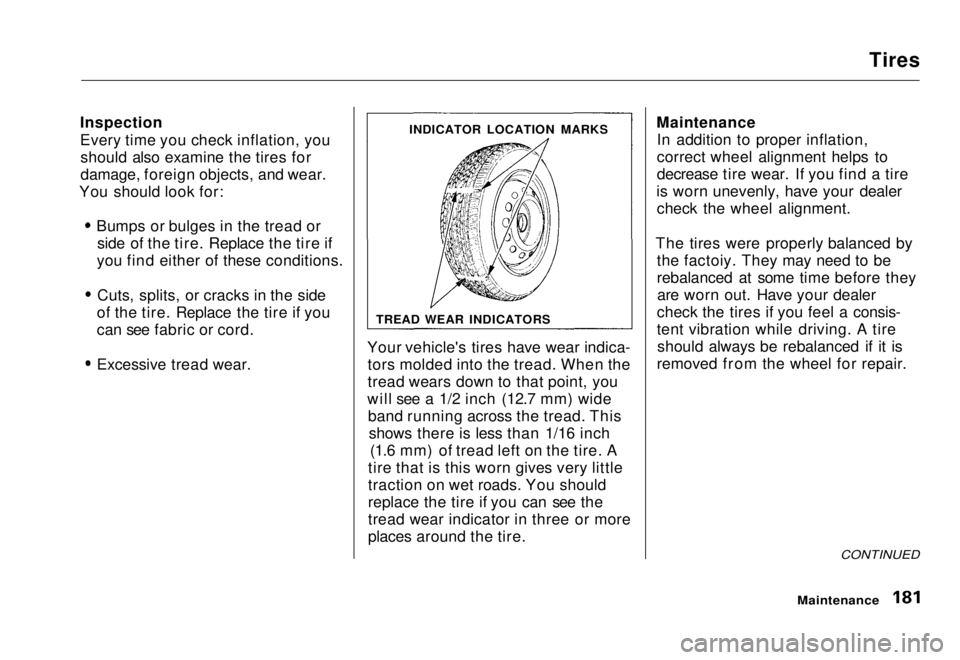
Excessive tread wear. Your vehicle's tires have wear indica-
tors molded into the tread. When the
tread wears down to that point, you
will see a 1/2 inch (12.7 mm) wide band running across the tread. Thisshows there is less than 1/16 inch (1.6 mm) of tread left on the tire. A
tire that is this worn gives very little
traction on wet roads. You should
replace the tire if you can see the
tread wear indicator in three or more
places around the tire. Maintenance
In addition to proper inflation,
correct wheel alignment helps to
decrease tire wear. If you find a tire
is worn unevenly, have your dealer check the wheel alignment.
The tires were properly balanced by the factoiy. They may need to be
rebalanced at some time before theyare worn out. Have your dealer
check the tires if you feel a consis-
tent vibration while driving. A tire should always be rebalanced if it is
removed from the wheel for repair.
CONTINUED
Maintenance
INDICATOR LOCATION MARKS
TREAD WEAR INDICATORSMain Menu Table of Contents s t
Page 183 of 251
Tires
Make sure the installer balances the
wheels when you have new tires installed. This increases riding
comfort and tire life. Your vehicle'soriginal tires were dynamic or "spin"
balanced at the factory. For best
results, have the installer perform a dynamic balance.
(HX)
Improper wheel weights can damage
your vehicle's aluminum wheels. Use only Genuine Honda wheel weights for
balancing.
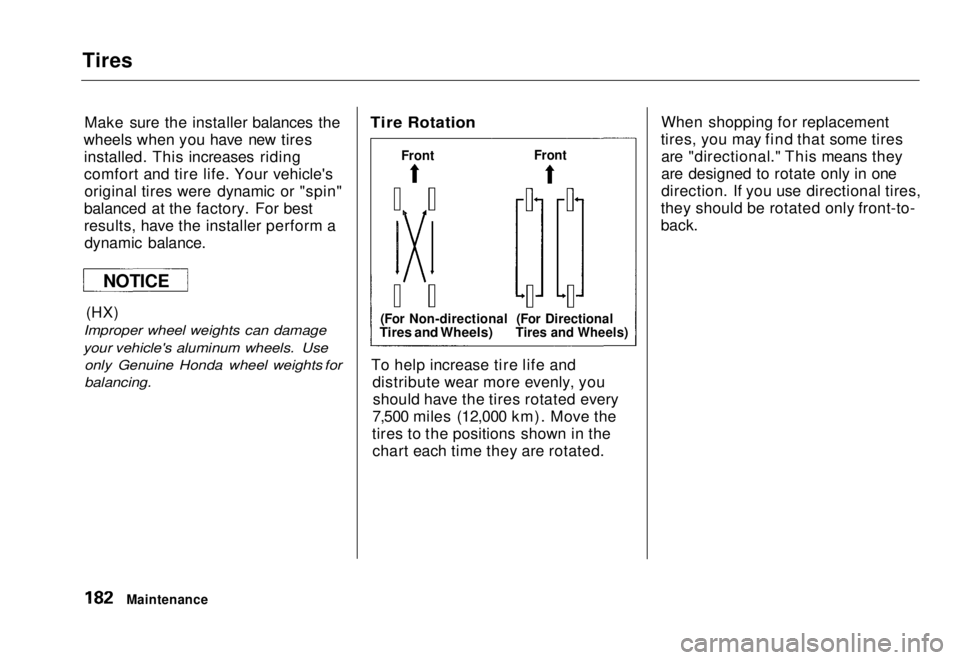
Tire Rotation
To help increase tire life and distribute wear more evenly, youshould have the tires rotated every
7,500 miles (12,000 km). Move the
tires to the positions shown in the chart each time they are rotated. When shopping for replacement
tires, you may find that some tires are "directional." This means they
are designed to rotate only in one
direction. If you use directional tires,
they should be rotated only front-to-
back.
Maintenance
NOTICE
Front
Front
(For Non-directional
Tires and Wheels)
(For Directional
Tires and Wheels)Main Menu Table of Contents s t
Page 184 of 251

Tires
Replacing Tires and Wheels
The tires that came with your vehicle were selected to match the performance capabilities of the
vehicle while providing the best combination of handling, ride
comfort, and long life. You should
replace them with radial tires of thesame size, load range, speed rating,
and maximum cold tire pressure
rating (as shown on the tire's sidewall). Mixing radial and bias-ply
tires on your vehicle can reduce its
braking ability, traction, and steering
accuracy.
It is best to replace all four tires at
the same time. If that is not possible
or necessary, then replace the two
front tires or the two rear tires as a
pair. Replacing just one tire can seriously affect your vehicle's han-
dling.
The ABS works by comparing the
speed of the wheels. When replacing
tires, use the same size originally supplied with the vehicle. Tire size
and construction can affect wheel speed and may cause the system to
work inconsistently.
If you ever need to replace a wheel,
make sure the wheel's specifications
match those of the original wheel
that came on your vehicle. Re-
placement wheels are available at
your Honda dealer.
Maintenance
Installing improper tires on your
vehicle can affect handling and
stability. This can cause a crash in which you can be seriously
hurt or killed.
Always use the size and type of
tires recommended in this owner's manual.Main Menu Table of Contents s t
Page 185 of 251
Tires
Wheels and Tires
Wheels:
(U.S.: DX, EX, Canada: Si)14x5J
(U.S.: HX)
14x51/2 JJ
Tires:
P185/65R1485S
See Tire Information o
n page 235 for
additional information about tire and
wheel size designations. See page 231 for information about DOT Tire
Quality Grading.
Winter Driving
Tires that are marked "M + S" or
"All Season" on the sidewall have an
all-weather tread design. They should be suitable for most winter
driving conditions. Tires without
these markings are designed for optimum traction in dry conditions.
They may not provide adequate performance in winter driving.For the best performance in snowy
or icy conditions, you should installsnow tires or tire chains. They may
be required by local laws under certain conditions.
Snow Tires
If you mount snow tires on your
Honda, make sure they are radial
tires of the same size and load range as the original tires. Mount snow
tires on all four wheels to balance
your vehicle's handling in all weather conditions. Keep in mind the traction
provided by snow tires on dry roads may not be as high as your vehicle's
original equipment tires. You should
drive cautiously even when the roads
are clear. Check with the tire dealer
for maximum speed recommenda-
tions.
MaintenanceMain Menu Table of Contents s t
Page 186 of 251
Tires
Tire Chains
Mount snow chains on your vehicle
when warranted by driving condi- tions or required by local laws. Makesure the chains are the correct size
for your tires. Install them only on
the front tires. If metal chains are
used, they must be SAE class "S".Cable type traction devices can also
be used.
When installing chains, follow the manufacturer's instructions and
mount them as tightly as you can.
Drive slowly with chains installed. If
you hear the chains contacting the body or chassis, stop and investigate
them. Make sure the chains areinstalled tightly, and that they are
not contacting the brake lines or
suspension. Remove the chains as
soon as you begin driving on cleared
roads.
Chains of the wrong size or that are
improperly installed can damage your
vehicle's brake lines, suspension, body,
and wheels. Stop driving if you hear the chains hitting any part of the
vehicles.
Maintenance
NOTICEMain Menu Table of Contents s t
Page 192 of 251
Lights
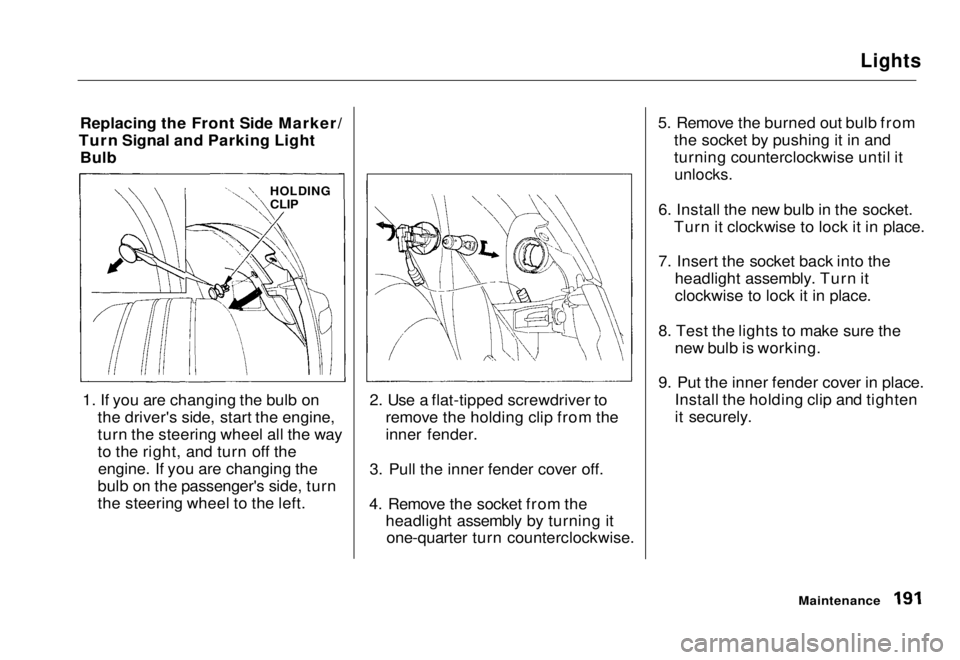
Replacing the Front Side Marker/
Turn Signal and Parking Light Bulb
1. If you are changing the bulb on the driver's side, start the engine,
turn the steering wheel all the way
to the right, and turn off theengine. If you are changing the
bulb on the passenger's side, turn
the steering wheel to the left. 2. Use a flat-tipped screwdriver to
remove the holding clip from the
inner fender.
3. Pull the inner fender cover off.
4. Remove the socket from the headlight assembly by turning itone-quarter turn counterclockwise. 5. Remove the burned out bulb from
the socket by pushing it in and
turning counterclockwise until it
unlocks.
6. Install the new bulb in the socket. Turn it clockwise to lock it in place.
7. Insert the socket back into the headlight assembly. Turn it
clockwise to lock it in place.
8. Test the lights to make sure the new bulb is working.
9. Put the inner fender cover in place. Install the holding clip and tighten
it securely.
Maintenance
HOLDING
CLIPMain Menu Table of Contents s t
Page 198 of 251
Storing Your Vehicle
If you need to park your vehicle for
an extended period (more than one
month), there are several things you should do to prepare it for storage.
Proper preparation helps prevent deterioration and makes it easier to
get your vehicle back on the road. If
possible, store your vehicle indoors.
Fill the fuel tank.Change the engine oil and filter (see page 157).
Wash and dry the exterior
completely.
Clean the interior. Make sure the
carpeting, floor mats, etc. are
completely dry.
Leave the parking brake off. Put
the transmission in Reverse (5- speed manual) or Park (automatic). Block the rear wheels.
If the vehicle is to be stored for a
longer period, it should be supported on jackstands so the
tires are off the ground.
Leave one window open slightly (if
the vehicle is being stored
indoors).
Disconnect the battery.
Support the front wiper bladearms with a folded towel or rag so
they do not touch the windshield.
To minimize sticking, apply a silicone spray lubricant to all door
and trunk seals. Also, apply a
vehicle body wax to the painted surfaces that mate with the door
and trunk seals. Cover the vehicle with a
"breathable" vehicle cover, one
made from a porous material such
as cotton. Nonporous materials, such as plastic sheeting, trap
moisture, which can damage the
paint.
If possible, run the engine for a
while periodically (preferably once a month).
If you store your vehicle for 12
months or longer, have your Honda dealer perform the inspections called
for in the 24 months/30,000 miles (48,000 km) maintenance schedule
(Normal Conditions) as soon as you
take it out of storage (see page 146).
The replacements called for in the maintenance schedule are riot
needed unless the vehicle has actually reached that time or mileage.
MaintenanceMain Menu Table of Contents s t
Page 199 of 251

Appearance Care
Regular cleaning and polishing of
your Honda helps to keep it "new" looking. This section gives you hintson how to clean your vehicle and
preserve its appearance: the paint,
brightwork, wheels and interior. Also included are several things you cando to help prevent corrosion.
Exterior Care.................................. 200 Washing...................................... 200
Waxing........................................ 200 Aluminum Wheels..................... 201 Paint Touch-up...........................201
Interior Care................................... 202 Carpeting.................................... 202
Fabric.......................................... 202
Vinyl............................................ 202 Seat Belts.................................... 202
Windows..................................... 203
Air Fresheners........................... 203
Corrosion Protection..................... 203
Body Repairs.................................. 204
Appearance CareMain Menu s t