ECU HONDA CIVIC COUPE 1999 User Guide
[x] Cancel search | Manufacturer: HONDA, Model Year: 1999, Model line: CIVIC COUPE, Model: HONDA CIVIC COUPE 1999Pages: 269, PDF Size: 2.42 MB
Page 33 of 269
Protecting Children
Installing a Rear-Facing Child Seat
with the Lap Belt
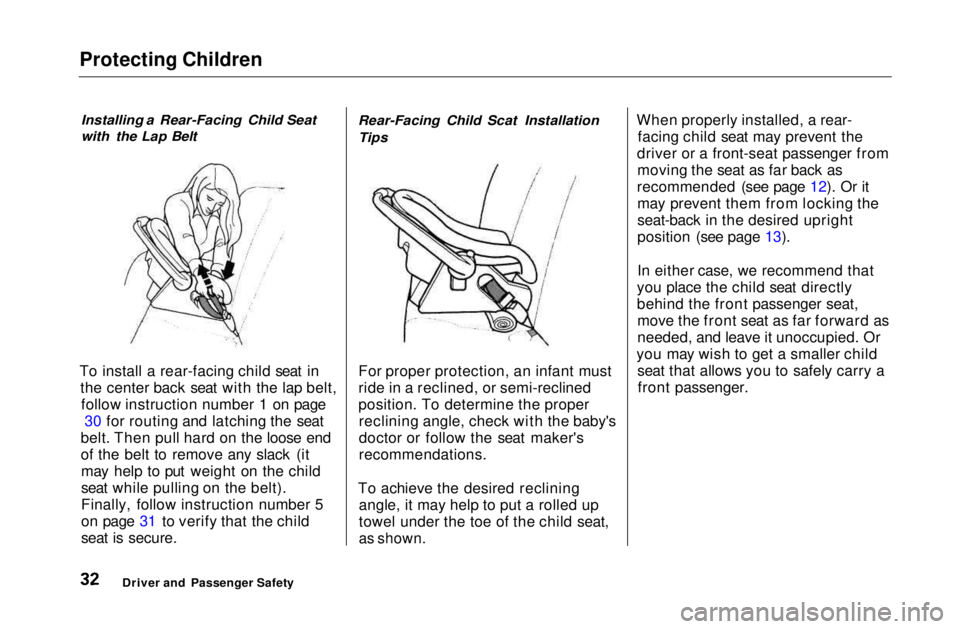
To install a rear-facing child seat in the center back seat with the lap belt,follow instruction number 1 on page 30 for routing and latching the seat
belt. Then pull hard on the loose end
of the belt to remove any slack (it may help to put weight on the child
seat while pulling on the belt).
Finally, follow instruction number 5
on page 31 to verify that the child
seat is secure.
Rear-Facing Child Scat Installation
Tips
For proper protection, an infant must
ride in a reclined, or semi-reclined
position. To determine the properreclining angle, check with the baby's
doctor or follow the seat maker's
recommendations.
To achieve the desired reclining angle, it may help to put a rolled up
towel under the toe of the child seat,
as shown.
When properly installed, a rear-
facing child seat may prevent the
driver or a front-seat passenger from moving the seat as far back as
recommended (see page 12). Or it may prevent them from locking the
seat-back in the desired upright
position (see page 13).
In either case, we recommend that
you place the child seat directly
behind the front passenger seat, move the front seat as far forward as
needed, and leave it unoccupied. Or
you may wish to get a smaller child seat that allows you to safely carry afront passenger.
Driver and Passenger SafetyMain Menu Table of Contents s t
Page 35 of 269
Protecting Children
If it is necessary to put a forward-
facing child seat in the front, move
the vehicle seat as far to the rear as possible, be sure the child seat is
firmly secured to the vehicle, and the child is properly strapped in the seat.
Installing a Child Seat with a Lap/
Shoulder Belt
The lap/shoulder belts in the outer back and front passenger seatingpositions have a locking mechanism
that must be activated to secure a
child seat.
The following pages provideinstructions on how to securea forward-facing child seat with
this type of seat belt.
See page 36 for how to secure a
forward-facing child seat in the
center back seat with the lap belt.
For tips on installing a forward-
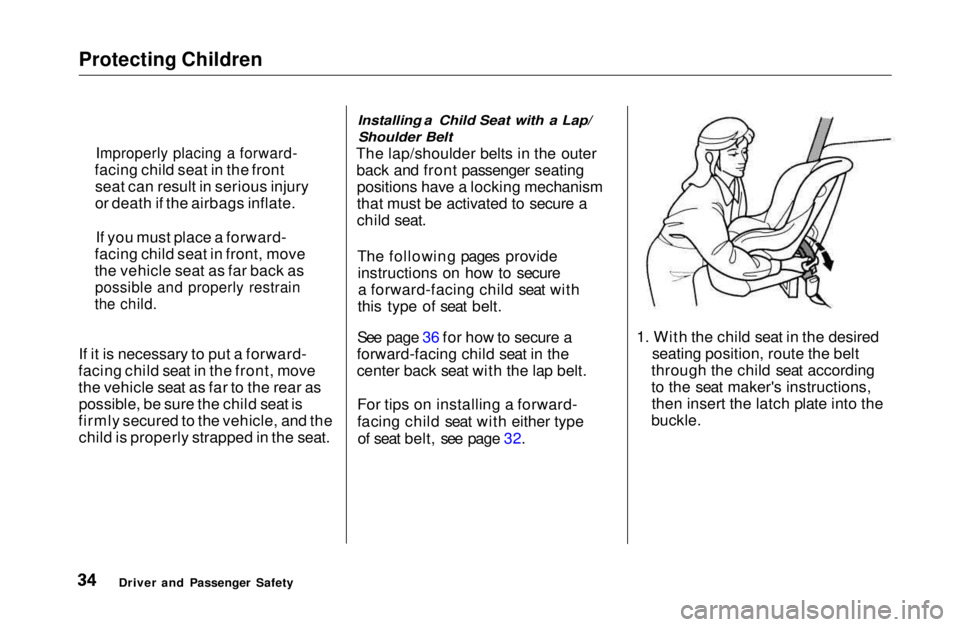
facing child seat with either typeof seat belt, see page 32. 1. With the child seat in the desired
seating position, route the belt
through the child seat according
to the seat maker's instructions, then insert the latch plate into the
buckle.
Driver and Passenger Safety
Improperly placing a forward-
facing child seat in the front seat can result in serious injury
or death if the airbags inflate.
If you must place a forward-
facing child seat in front, move
the vehicle seat as far back as
possible and properly restrain
the child.Main Menu Table of Contents s t
Page 36 of 269
Protecting Children
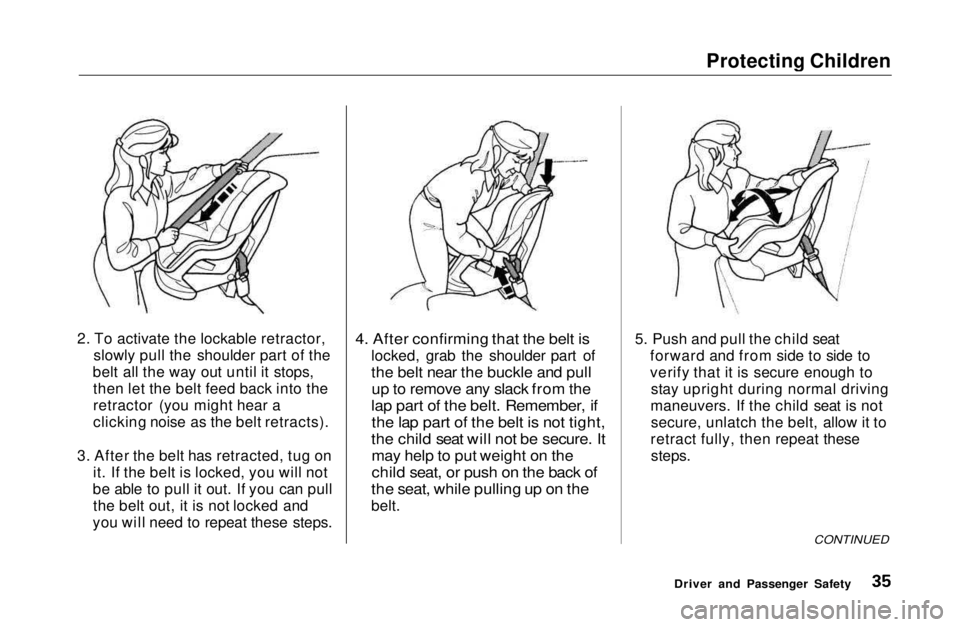
2. To activate the lockable retractor, slowly pull the shoulder part of the
belt all the way out until it stops, then let the belt feed back into the
retractor (you might hear a
clicking noise as the belt retracts).
3. After the belt has retracted, tug on it. If the belt is locked, you will not
be able to pull it out. If you can pull the belt out, it is not locked and
you will need to repeat these steps.
4. After confirming that the belt is
locked, grab the shoulder part of
the belt near the buckle and pullup to remove any slack from the
lap part of the belt. Remember, if
the lap part of the belt is not tight,
the child seat will not be secure. It
may help to put weight on the
child seat, or push on the back of
the seat, while pulling up on the
belt. 5. Push and pull the child seat
forward and from side to side to
verify that it is secure enough tostay upright during normal driving
maneuvers. If the child seat is not secure, unlatch the belt, allow it to
retract fully, then repeat these
steps.
CONTINUED
Driver and Passenger SafetyMain Menu Table of Contents s t
Page 37 of 269
Protecting Children
To deactivate the locking mechanism in order to remove a
child seat, unlatch the buckle,
unroute the seat belt, and let the belt
fully retract.
Installing a Child Seat with the Lap
Belt
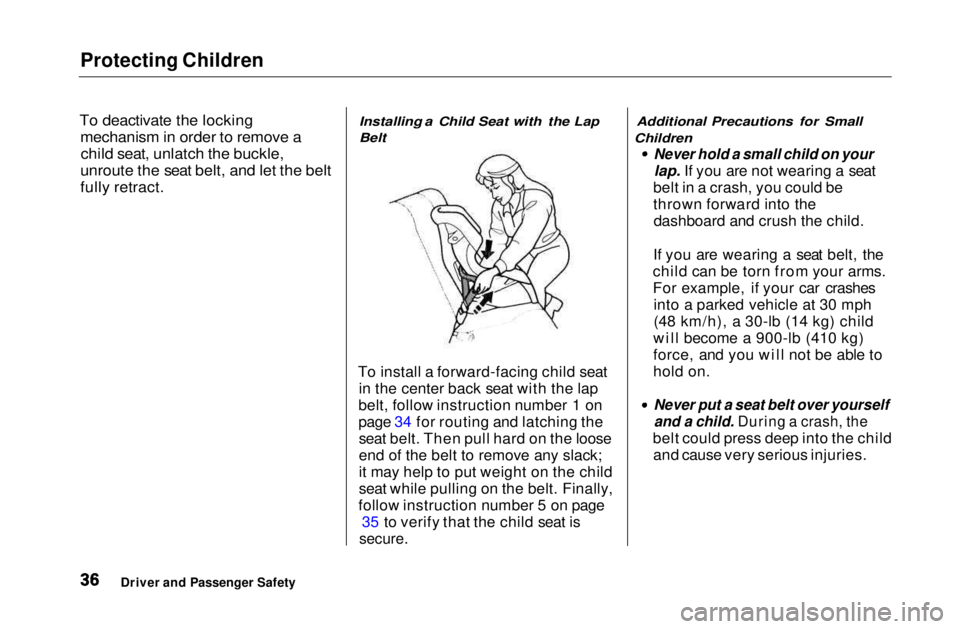
To install a forward-facing child seat in the center back seat with the lap
belt, follow instruction number 1 on
page 34 for routing and latching the seat belt. Then pull hard on the loose
end of the belt to remove any slack;
it may help to put weight on the child
seat while pulling on the belt. Finally,
follow instruction number 5 on page 35 to verify that the child seat is
secure.
Additional Precautions for Small
Children
Never hold a small child on your
lap. If you are not wearing a seat
belt in a crash, you could be
thrown forward into the dashboard and crush the child.
If you are wearing a seat belt, the
child can be torn from your arms.
For example, if your car crashes into a parked vehicle at 30 mph
(48 km/h), a 30-lb (14 kg) child
will become a 900-lb (410 kg)
force, and you will not be able to
hold on.
Never put a seat belt over yourself
and a child. During a crash, the
belt could press deep into the child and cause very serious injuries.
Driver and Passenger SafetyMain Menu Table of Contents s t
Page 41 of 269
Protecting Children
Physical Size
Physically, a child must be large
enough for the lap/shoulder belt to
properly fit over the hips, chest, and shoulder (see pages 15 and 21). If
the seat belt does not fit properly, the child should not sit in the front.
Maturity
To safely ride in front, a child must be able to follow the rules, includingsitting properly and wearing the seat
belt properly throughout a ride. If you decide that a child can safely
ride up front, be sure to: Carefully read the owner's manual
and make sure you understand all seat belt instructions and all safety
information. Move the vehicle seat to the rear-
most position.
Have the child sit up straight, back
against the seat, and feet on or
near the floor. Check that the child's seat belt is
properly positioned and secured. Supervise the child. Even mature
children sometimes need to be
reminded to fasten the seat belts
or sit properly. Using Child Seats with Tethers
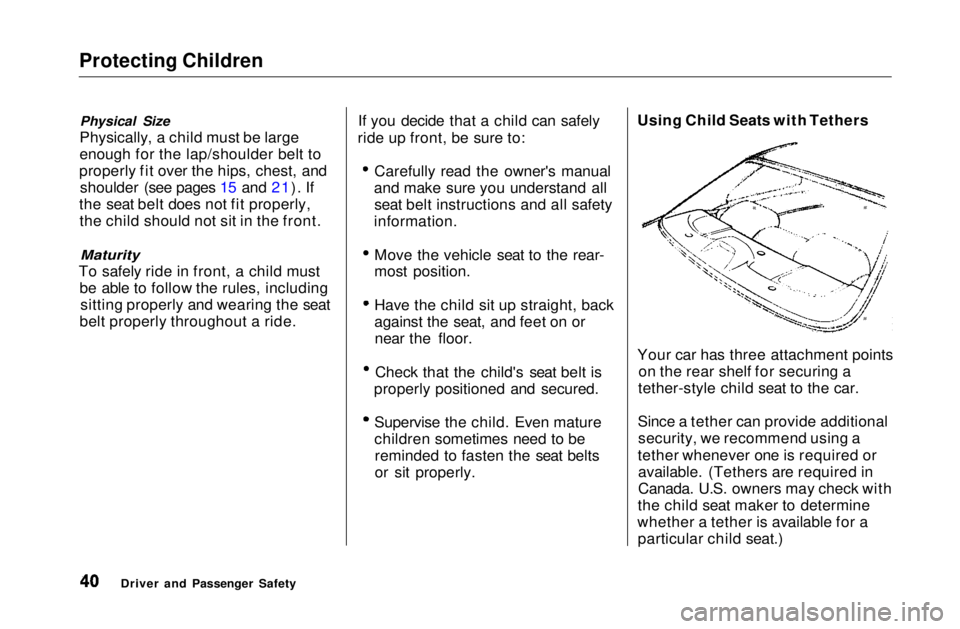
Your car has three attachment points
on the rear shelf for securing a
tether-style child seat to the car.
Since a tether can provide additional security, we recommend using a
tether whenever one is required or available. (Tethers are required in
Canada. U.S. owners may check with
the child seat maker to determine
whether a tether is available for a particular child seat.)
Driver and Passenger SafetyMain Menu Table of Contents s t
Page 43 of 269
Additional Information About Your Seat Belts
Seat Belt System Components
Your seat belt system includes lap/ shoulder belts in the front seats and
the outer back seats, and a lap belt in
the center back seat.
The system also includes alight on the instrument
panel to remind you and your
passengers to fasten your belts. If
the driver's seat belt is not fastened
before the ignition is turned ON (II),
the light will come on and a beeper
will also sound. The beeper will stop after a few seconds, but the light willstay on until the driver's seat belt is
fastened.
Lap/Shoulder Belt
This sea t
belt has a single belt that
goes over your shoulder, across your
chest and across your hips.
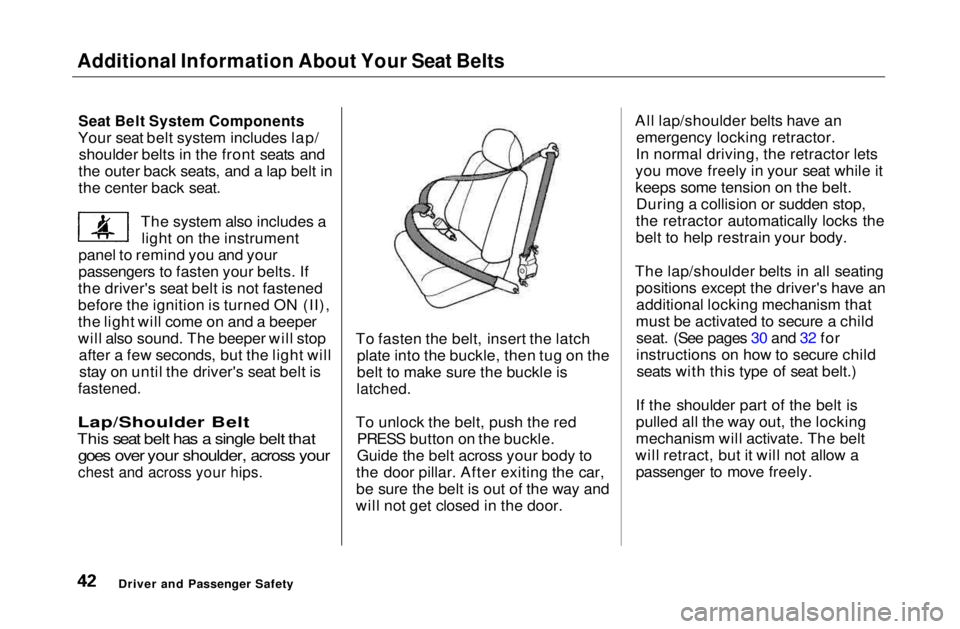
To fasten the belt, insert the latch
plate into the buckle, then tug on the
belt to make sure the buckle is
latched.
To unlock the belt, push the red PRESS button on the buckle.
Guide the belt across your body to
the door pillar. After exiting the car,
be sure the belt is out of the way and
will not get closed in the door. All lap/shoulder belts have an
emergency locking retractor.
In normal driving, the retractor lets
you move freely in your seat while it
keeps some tension on the belt. During a collision or sudden stop,
the retractor automatically locks the
belt to help restrain your body.
The lap/shoulder belts in all seating positions except the driver's have anadditional locking mechanism that
must be activated to secure a child seat. (See pages 30 and 32 for
instructions on how to secure childseats with this type of seat belt.)
If the shoulder part of the belt is
pulled all the way out, the locking
mechanism will activate. The belt
will retract, but it will not allow a passenger to move freely.
Driver and Passenger SafetyMain Menu Table of Contents s t
Page 66 of 269
Controls Near the Steering Wheel
Steering Wheel Adjustment
See page 18 for important safety
information about how to properly
position the steering wheel.
Make any steering wheel adjustment
before you start driving.
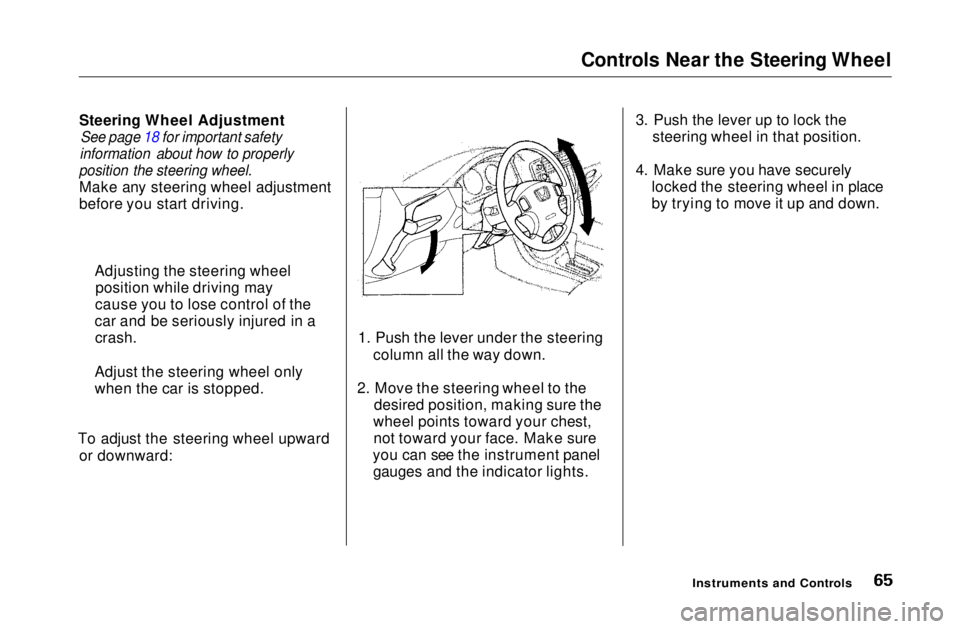
To adjust the steering wheel upward or downward: 1. Push the lever under the steering
column all the way down.
2. Move the steering wheel to the desired position, making sure the
wheel points toward your chest, not toward your face. Make sure
you can see the instrument panel gauges and the indicator lights. 3. Push the lever up to lock the
steering wheel in that position.
4. Make sure you have securely locked the steering wheel in place
by trying to move it up and down.
Instruments and Controls
Adjusting the steering wheel
position while driving may
cause you to lose control of the
car and be seriously injured in a crash.
Adjust the steering wheel only
when the car is stopped.Main Menu Table of Contents s t
Page 80 of 269
Folding Rear Seat, Power Windows
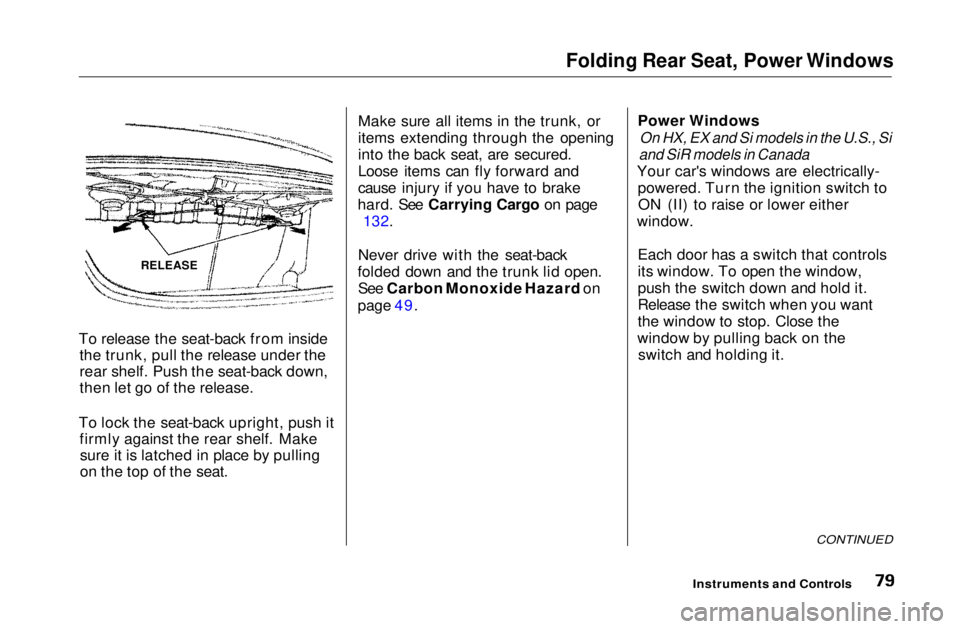
To release the seat-back from inside the trunk, pull the release under the
rear shelf. Push the seat-back down,
then let go of the release.
To lock the seat-back upright, push it firmly against the rear shelf. Makesure it is latched in place by pulling
on the top of the seat. Make sure all items in the trunk, or
items extending through the opening
into the back seat, are secured.
Loose items can fly forward and
cause injury if you have to brake
hard. See Carrying Cargo on page 132.
Never drive with the seat-back
folded down and the trunk lid open. See Carbon Monoxide Hazard on
page 49. Power Windows
On HX, EX and Si models in the U.S., Si
and SiR models in Canada
Your car's windows are electrically- powered. Turn the ignition switch toON (II) to raise or lower either
window.
Each door has a switch that controls
its window. To open the window,
push the switch down and hold it.
Release the switch when you want
the window to stop. Close the
window by pulling back on the switch and holding it.
CONTINUED
Instruments and Controls
RELEASEMain Menu Table of Contents s t
Page 127 of 269
Service Station Procedures
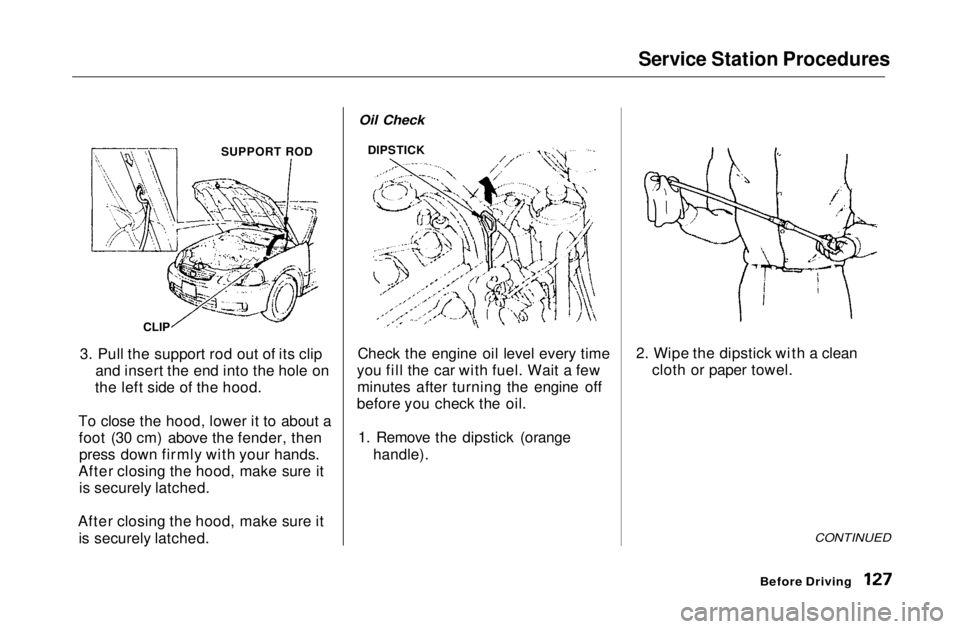
3. Pull the support rod out of its clip and insert the end into the hole on
the left side of the hood.
To close the hood, lower it to about a foot (30 cm) above the fender, thenpress down firmly with your hands.
After closing the hood, make sure it is securely latched.
After closing the hood, make sure it is securely latched. Check the engine oil level every time
you fill the car with fuel. Wait a few minutes after turning the engine off
before you check the oil.
1. Remove the dipstick (orange handle). 2. Wipe the dipstick with a clean
cloth or paper towel.
CONTINUED
Before Driving
SUPPORT ROD
CLIP
Oil Check
DIPSTICKMain Menu Table of Contents s t
Page 133 of 269
Carrying Cargo
Load Limit
The maximum load for your car is
850
lbs
(395 kg).
This figure includes the total weight
of all occupants, cargo, and
accessories.
To figure out how much cargo you
can carry:
Add up the weight of all occupants.
Subtract the total from 850 Ibs
(395 kg).
The final number is the total weight
of cargo you can carry.
Carrying Items in the Passenger
Compartment Store or secure all items that could
be thrown around and hurt
someone during a crash. Do not put any items on top of the
rear shelf. They can block your
view and be thrown around the car during a crash. Be sure items placed on the floor
behind the front seats cannot roll under the seats and interfere with
the driver's ability to operate the
pedals, or with the properoperation of the seats. Keep the glove box closed while
driving. If the lid is open, a
passenger could injure their knees during a crash or sudden stop.
Before Driving
Overloading or improper
loading can affect handling and
stability and cause a crash in
which you can be hurt or killed.
Follow all load limits and other
loading guidelines in this
manual.Main Menu Table of Contents s t