weight HONDA CIVIC COUPE 1999 User Guide
[x] Cancel search | Manufacturer: HONDA, Model Year: 1999, Model line: CIVIC COUPE, Model: HONDA CIVIC COUPE 1999Pages: 269, PDF Size: 2.42 MB
Page 133 of 269
Carrying Cargo
Load Limit
The maximum load for your car is
850
lbs
(395 kg).
This figure includes the total weight
of all occupants, cargo, and
accessories.
To figure out how much cargo you
can carry:
Add up the weight of all occupants.
Subtract the total from 850 Ibs
(395 kg).
The final number is the total weight
of cargo you can carry.
Carrying Items in the Passenger
Compartment Store or secure all items that could
be thrown around and hurt
someone during a crash. Do not put any items on top of the
rear shelf. They can block your
view and be thrown around the car during a crash. Be sure items placed on the floor
behind the front seats cannot roll under the seats and interfere with
the driver's ability to operate the
pedals, or with the properoperation of the seats. Keep the glove box closed while
driving. If the lid is open, a
passenger could injure their knees during a crash or sudden stop.
Before Driving
Overloading or improper
loading can affect handling and
stability and cause a crash in
which you can be hurt or killed.
Follow all load limits and other
loading guidelines in this
manual.Main Menu Table of Contents s t
Page 134 of 269

Carrying Cargo
Carrying Cargo in the Trunk or on
a Roof Rack Distribute cargo evenly on the
floor of the trunk, placing the
heaviest items on the bottom and as far forward as possible. If you fold down the back seat, tie
down items that could be thrown
about the car during a crash or
sudden stop. If you carry large items that
prevent you from closing the
hatch, exhaust gas can enter the
passenger area. To avoid the
possibility of carbon monoxide
poisoning, follow the instructions
on page 49. If you can carry any items on a
roof rack, be sure the total weight
of the rack and the items does not
exceed the maximum allowable
weight. Please contact your Honda dealer for further information.
Before DrivingMain Menu Table of Contents s t
Page 171 of 269
Engine Oil
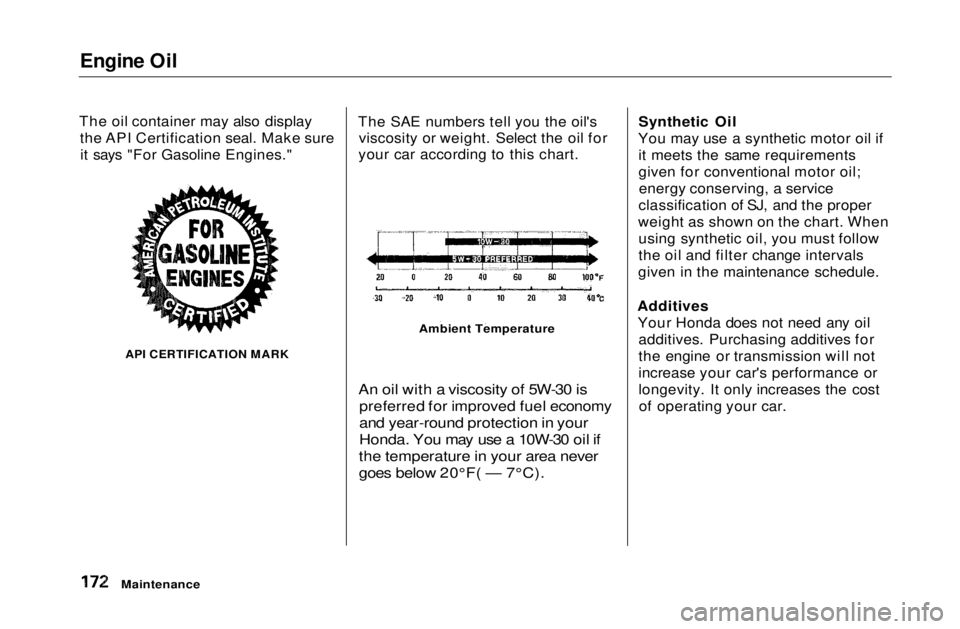
The oil container may also display the API Certification seal. Make sureit says "For Gasoline Engines."
API CERTIFICATION MARK The SAE numbers tell you the oil's
viscosity or weight. Select the oil for
your car according to this chart.
An oil with a viscosity of 5W-30 is
preferred for improved fuel economy
and year-round protection in your
Honda. You may use a 10W-30 oil if
the temperature in your area never
goes below 20°F( — 7°C).
Synthetic Oil
You may use a synthetic motor oil if it meets the same requirements
given for conventional motor oil;energy conserving, a service
classification of SJ, and the proper
weight as shown on the chart. When using synthetic oil, you must follow
the oil and filter change intervals
given in the maintenance schedule.
Additives Your Honda does not need any oil additives. Purchasing additives for
the engine or transmission will not
increase your car's performance or
longevity. It only increases the costof operating your car.
Maintenance
Ambient TemperatureMain Menu Table of Contents s t
Page 197 of 269
Tires
Make sure the installer balances the
wheels when you have new tires installed. This increases riding
comfort and tire life. Your car'soriginal tires were dynamic or "spin"
balanced at the factory. For best results, have the installer perform adynamic balance.
Improper wheel weights can damage
your car's aluminum wheels. Use only Genuine Honda wheel weights for
balancing.
Tire Rotation
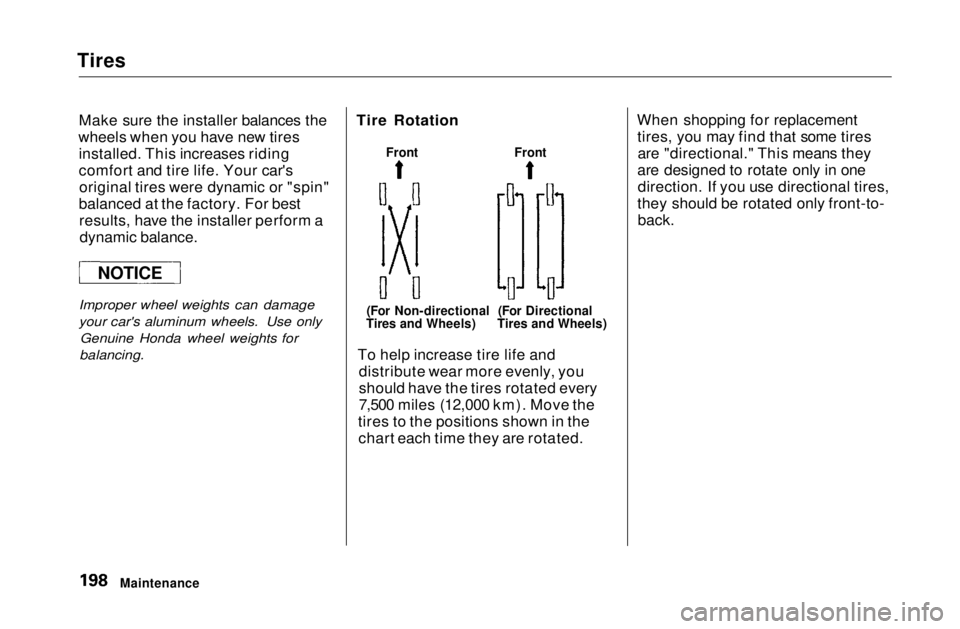
To help increase tire life anddistribute wear more evenly, you
should have the tires rotated every
7,500 miles (12,000 km). Move the
tires to the positions shown in the chart each time they are rotated. When shopping for replacement
tires, you may find that some tiresare "directional." This means they
are designed to rotate only in one direction. If you use directional tires,
they should be rotated only front-to- back.
Maintenance
NOTICE
Front
Front
(For Non-directional
Tires and Wheels) (For Directional
Tires and Wheels)Main Menu Table of Contents s t
Page 241 of 269
Emergency Towing
plugged into the accessory powersocket are turned off so they do not
run down the battery.
Trying to lift or tow your vehicle by
the bumpers will cause serious
damage. The bumpers are not designed to support the vehicle's
weight.
Taking Care of the Unexpected
The steering system can be
damaged if the steering wheel is locked. Leave the ignition switch in
Accessory (I), and make sure the steering wheel turns freely before
you begin towing.
NOTICE
NOTICEMain Menu Table of Contents s t