ECO mode HONDA CIVIC COUPE 1999 Owner's Manual
[x] Cancel search | Manufacturer: HONDA, Model Year: 1999, Model line: CIVIC COUPE, Model: HONDA CIVIC COUPE 1999Pages: 269, PDF Size: 2.42 MB
Page 145 of 269
Automatic Transmission (CVT)
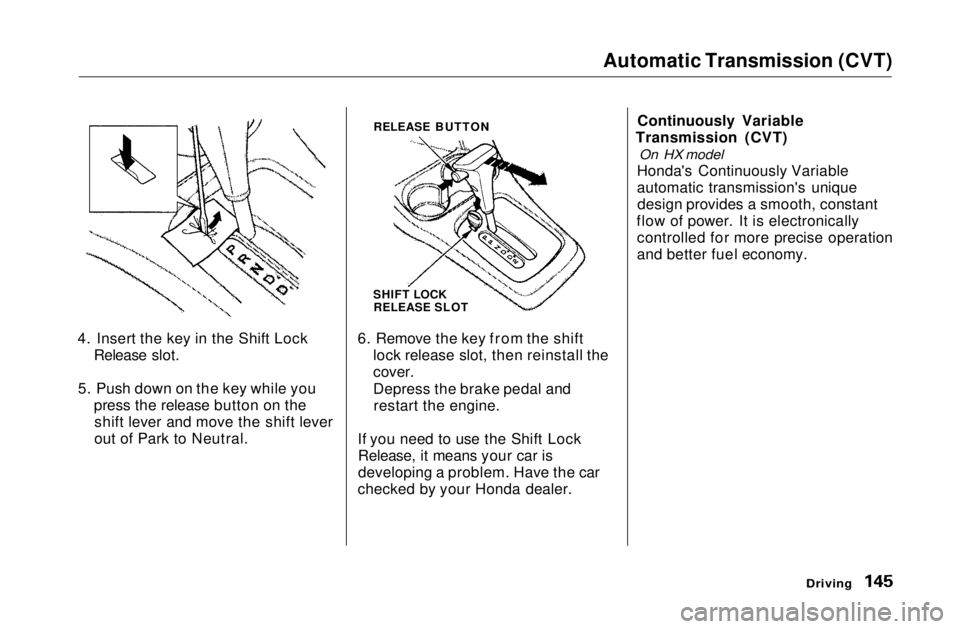
4. Insert the key in the Shift Lock Release slot.
5. Push down on the key while you press the release button on theshift lever and move the shift lever
out of Park to Neutral. RELEASE BUTTON
SHIFT LOCK RELEASE SLOT
6. Remove the key from the shift lock release slot, then reinstall the
cover.
Depress the brake pedal andrestart the engine.
If you need to use the Shift Lock Release, it means your car is
developing a problem. Have the car
checked by your Honda dealer. Continuously Variable
Transmission (CVT)
On HX model
Honda's Continuously Variable
automatic transmission's unique design provides a smooth, constant
flow of power. It is electronically controlled for more precise operation
and better fuel economy.
DrivingMain Menu Table of Contents s t
Page 176 of 269
Cooling System
Replacing Engine Coolant
The cooling system should be completely drained and refilled with
new coolant according to the timeand distance recommendations in
the maintenance schedule. Only use Genuine Honda Antifreeze/Coolant.
Draining the coolant requires access
to the underside of the car. Unless
you have the tools and knowledge,
you should have this maintenance done by a skilled mechanic. 1. Turn the ignition ON (II). Turnthe temperature control dial to
maximum heat. Turn off the
ignition and remove the key. Open
the hood. Make sure the engineand radiator are cool to the touch.
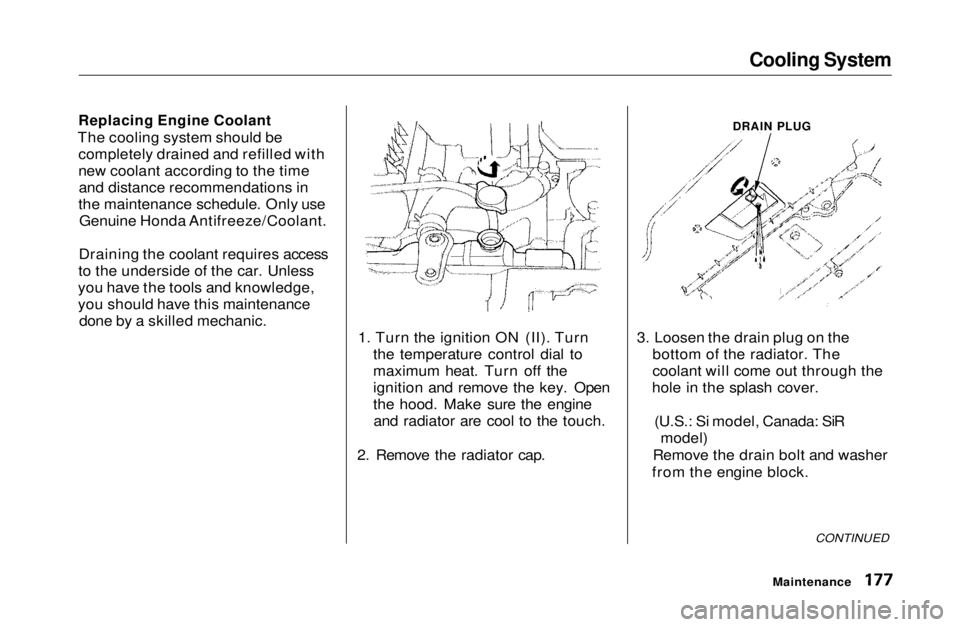
2. Remove the radiator cap. 3. Loosen the drain plug on the
bottom of the radiator. The
coolant will come out through the
hole in the splash cover.
(U.S.: Si model, Canada: SiR model)
Remove the drain bolt and washer
from the engine block.
CONTINUED
Maintenance
DRAIN PLUGMain Menu Table of Contents s t
Page 177 of 269
Cooling System
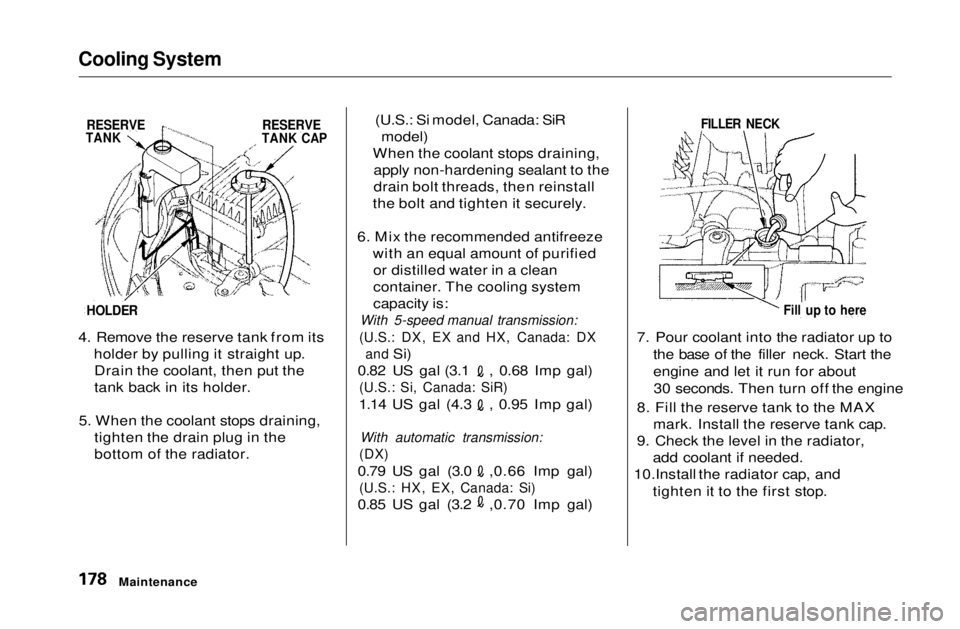
4. Remove the reserve tank from its
holder by pulling it straight up.Drain the coolant, then put the
tank back in its holder.
5. When the coolant stops draining, tighten the drain plug in the
bottom of the radiator. (U.S.: Si model, Canada: SiR
model)
When the coolant stops draining, apply non-hardening sealant to the
drain bolt threads, then reinstall
the bolt and tighten it securely.
6. Mix the recommended antifreeze with an equal amount of purifiedor distilled water in a clean
container. The cooling system
capacity is:
With 5-speed manual transmission:
(U.S.: DX, EX and HX, Canada: DX and
Si) 0.82 US gal (3.1 , 0.68 Imp gal)
(U.S.: Si, Canada: SiR)
1.14 US gal (4.3 , 0.95 Imp gal)
With automatic transmission:
(DX)
0.79 US gal (3.0 ,0.66 Imp gal)
(U.S.: HX, EX, Canada: Si)
0.85 US gal (3.2 ,0.70 Imp gal)7. Pour coolant into the radiator up to
the base of the filler neck. Start the
engine and let it run for about30 seconds. Then turn off the engine
8. Fill the reserve tank to the MAX mark. Install the reserve tank cap.
9. Check the level in the radiator, add coolant if needed.
10.Install the radiator cap, and
tighten it to the first stop.
Maintenance
RESERVE
TANK
RESERVE
TANK CAP
HOLDER
FILLER NECK
Fill up to hereMain Menu Table of Contents s t
Page 180 of 269
Transmission Fluid
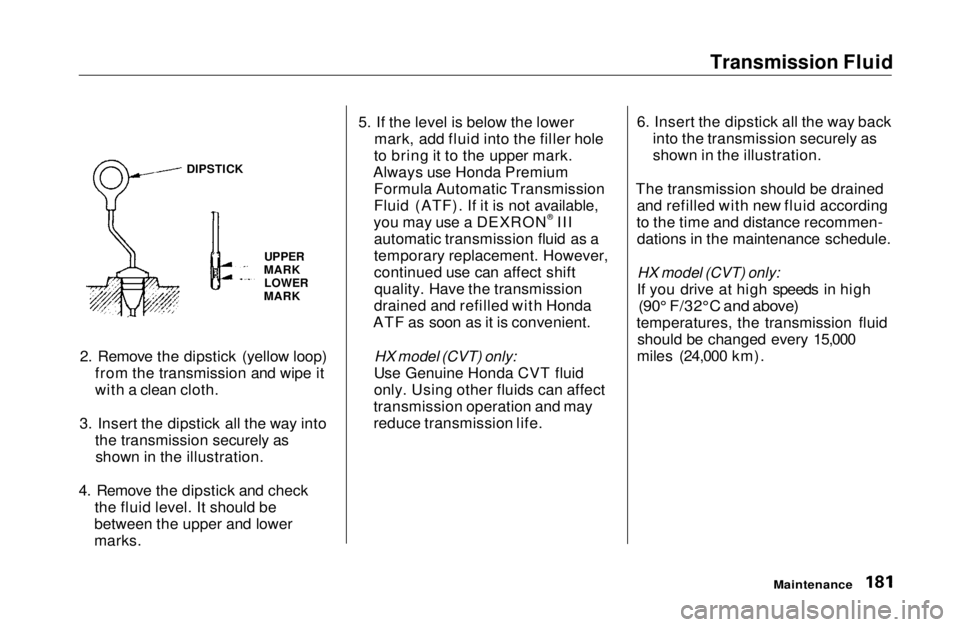
2. Remove the dipstick (yellow loop) from the transmission and wipe it
with a clean cloth.
3. Insert the dipstick all the way into the transmission securely asshown in the illustration.
4. Remove the dipstick and check the fluid level. It should be
between the upper and lower
marks. 5. If the level is below the lower
mark, add fluid into the filler hole
to bring it to the upper mark.
Always use Honda Premium Formula Automatic Transmission
Fluid (ATF). If it is not available,
you may use a DEXRON® III automatic transmission fluid as a
temporary replacement. However,
continued use can affect shiftquality. Have the transmission
drained and refilled with Honda
ATF as soon as it is convenient.
HX model (CVT) only:
Use Genuine Honda CVT fluid
only. Using other fluids can affect
transmission operation and may
reduce transmission life. 6. Insert the dipstick all the way back
into the transmission securely as
shown in the illustration.
The transmission should be drained and refilled with new fluid according
to the time and distance recommen- dations in the maintenance schedule.
HX model (CVT) only:
If you drive at high speeds in high
(90° F/32°C and above)
temperatures, the transmission fluid should be changed every 15,000
miles (24,000 km).
Maintenance
DIPSTICK
UPPER
MARK LOWER
MARKMain Menu Table of Contents s t
Page 181 of 269
Transmission Fluid, Brake and Clutch Fluid
5-speed Manual Transmission
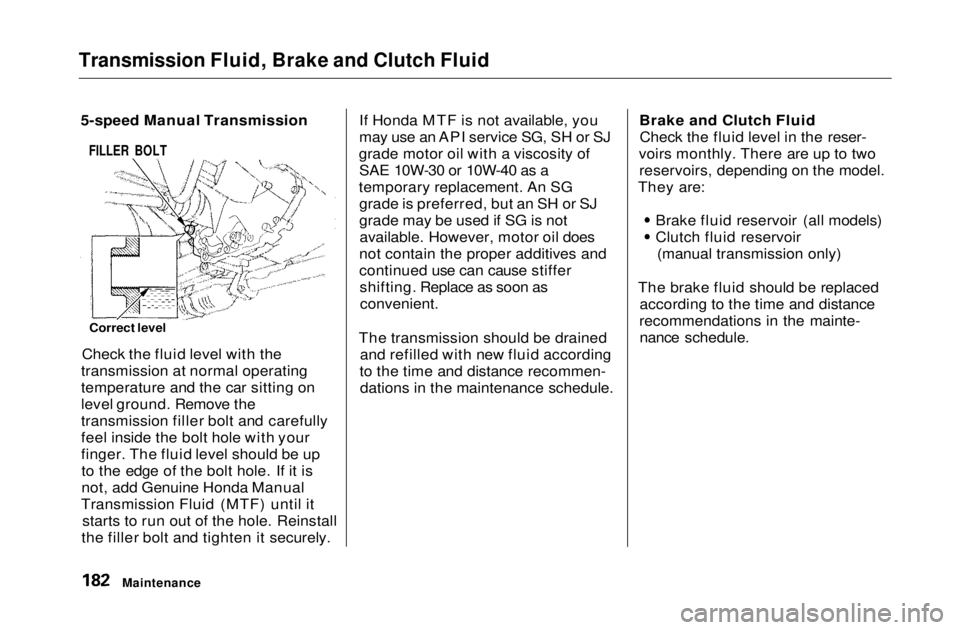
FILLER BOLT
Correct level
Check the fluid level with the
transmission at normal operating
temperature and the car sitting on
level ground. Remove the
transmission filler bolt and carefully
feel inside the bolt hole with your
finger. The fluid level should be up to the edge of the bolt hole. If it is
not, add Genuine Honda Manual
Transmission Fluid (MTF) until it starts to run out of the hole. Reinstall
the filler bolt and tighten it securely. If Honda MTF is not available, you
may use an API service SG, SH or SJ
grade motor oil with a viscosity of SAE 10W-30 or 10W-40 as a
temporary replacement. An SG grade is preferred, but an SH or SJ
grade may be used if SG is notavailable. However, motor oil does
not contain the proper additives and
continued use can cause stiffer shifting. Replace as soon asconvenient.
The transmission should be drained and refilled with new fluid according
to the time and distance recommen- dations in the maintenance schedule. Brake and Clutch Fluid
Check the fluid level in the reser-
voirs monthly. There are up to two reservoirs, depending on the model.
They are:
Brake fluid reservoir (all models) Clutch fluid reservoir
(manual transmission only)
The brake fluid should be replaced according to the time and distance
recommendations in the mainte- nance schedule.
MaintenanceMain Menu Table of Contents s t
Page 184 of 269
Air Cleaner Element
The air cleaner element should be replaced according to the time anddistance recommendations in the
maintenance schedule. Replacement
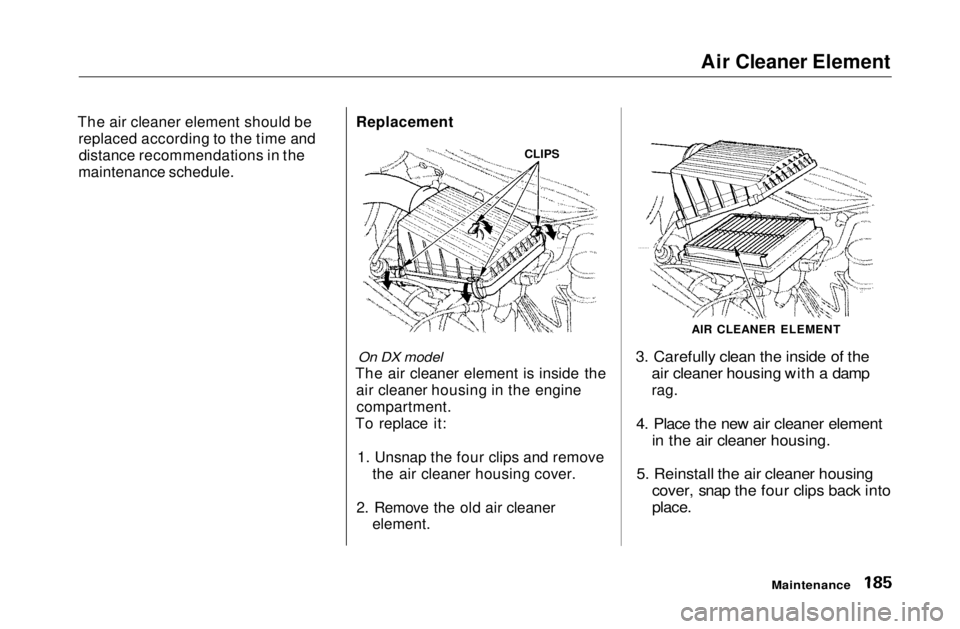
CLIPS
On DX model
The air cleaner element is inside the air cleaner housing in the enginecompartment.
To replace it:
1. Unsnap the four clips and remove the air cleaner housing cover.
2. Remove the old air cleaner element. AIR CLEANER ELEMENT
3. Carefully clean the inside of the air cleaner housing with a damp
rag.
4. Place the new air cleaner element in the air cleaner housing.
5. Reinstall the air cleaner housing cover, snap the four clips back into
place.
MaintenanceMain Menu Table of Contents s t
Page 185 of 269
Air Cleaner Element, Hood Latch
Replacement
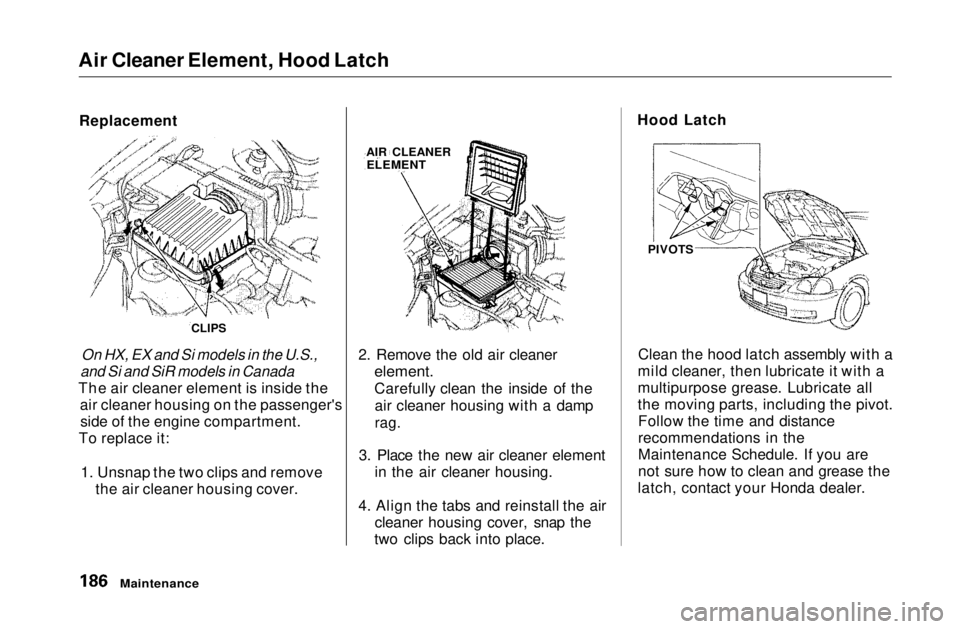
On HX, EX and Si models in the U.S.,
and Si and SiR models in Canada
The air cleaner element is inside the air cleaner housing on the passenger'sside of the engine compartment.
To replace it:
1. Unsnap the two clips and remove the air cleaner housing cover. 2. Remove the old air cleaner
element.
Carefully clean the inside of the
air cleaner housing with a damp
rag.
3. Place the new air cleaner element in the air cleaner housing.
4. Align the tabs and reinstall the air cleaner housing cover, snap the
two clips back into place. Hood Latch
Clean the hood latch assembly with a
mild cleaner, then lubricate it with a
multipurpose grease. Lubricate all
the moving parts, including the pivot. Follow the time and distance
recommendations in the
Maintenance Schedule. If you are
not sure how to clean and grease the
latch, contact your Honda dealer.
Maintenance
CLIPS
AIR CLEANER
ELEMENT
PIVOTSMain Menu Table of Contents s t
Page 232 of 269
Malfunction Indicator Lamp
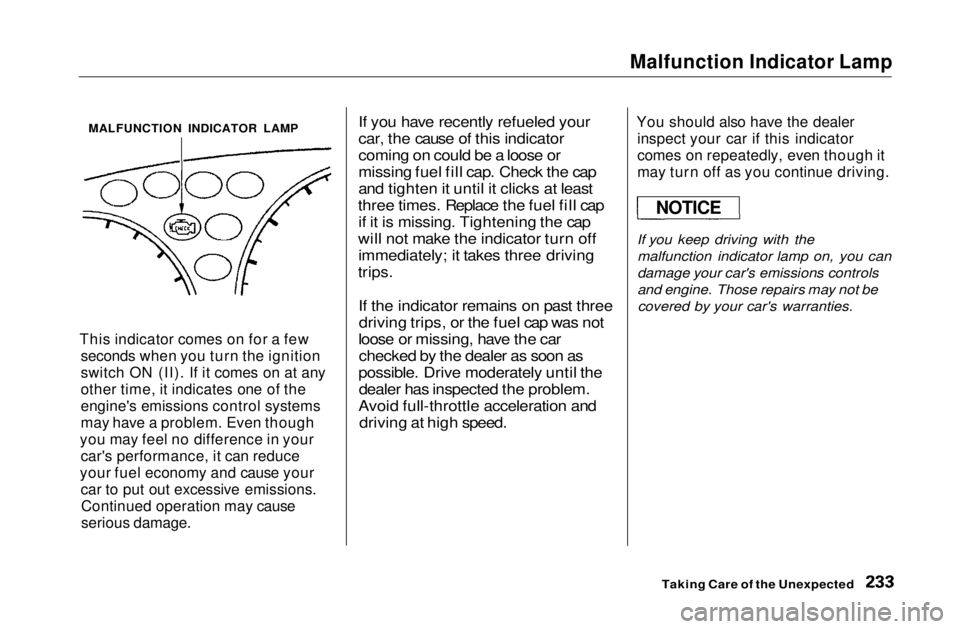
This indicator comes on for a few seconds when you turn the ignition
switch ON (II). If it comes on at any
other time, it indicates one of the
engine's emissions control systems
may have a problem. Even though
you may feel no difference in your car's performance, it can reduce
your fuel economy and cause your car to put out excessive emissions.Continued operation may cause
serious damage.
If you have recently refueled your
car, the cause of this indicator
coming on could be a loose or
missing fuel fill cap. Check the cap
and tighten it until it clicks at least
three times. Replace the fuel fill cap if it is missing. Tightening the cap
will not make the indicator turn off immediately; it takes three driving
trips.
If the indicator remains on past threedriving trips, or the fuel cap was not
loose or missing, have the car checked by the dealer as soon as
possible. Drive moderately until the dealer has inspected the problem.
Avoid full-throttle acceleration and driving at high speed.
You should also have the dealer
inspect your car if this indicator
comes on repeatedly, even though it
may turn off as you continue driving.
If you keep driving with the malfunction indicator lamp on, you can
damage your car's emissions controls
and engine. Those repairs may not becovered by your car's warranties.
Taking Care of the Unexpected
MALFUNCTION INDICATOR LAMP
NOTICEMain Menu Table of Contents s t
Page 269 of 269
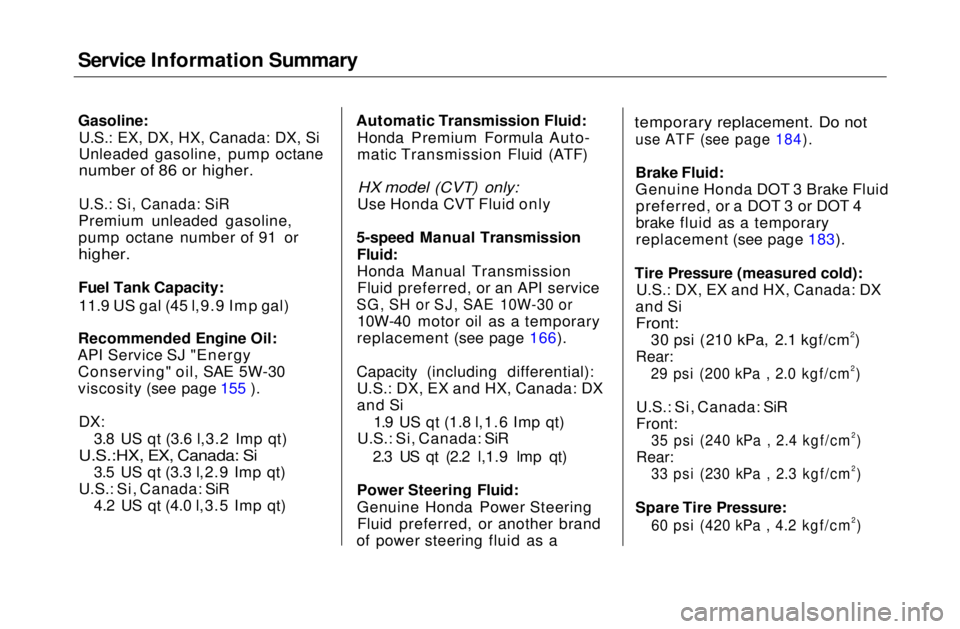
Service Information Summary
Gasoline:
U.S.: EX, DX, HX, Canada: DX, Si
Unleaded gasoline, pump octane
number of 86 or higher.
U.S.: Si, Canada: SiR
Premium unleaded gasoline,
pump octane number of 91 or
higher.
Fuel Tank Capacity:
11.9 US gal (45 l,9.9 Imp gal)
Recommended Engine Oil:
API Service SJ "Energy Conserving" oil, SAE 5W-30
viscosity (see page 155 ).
DX: 3.8 US qt (3.6 l,3.2 Imp qt)
U.S.:HX, EX, Canada: Si
3.5 US qt (3.3 l,2.9 Imp qt)
U.S.: Si, Canada: SiR 4.2 US qt (4.0 l,3.5 Imp qt) Automatic Transmission Fluid:
Honda Premium Formula Auto-
matic Transmission Fluid (ATF)
HX model (CVT) only:
Use Honda CVT Fluid only
5-speed Manual Transmission
Fluid:
Honda Manual TransmissionFluid preferred, or an API service
SG, SH or SJ, SAE 10W-30 or
10W-40 motor oil as a temporary
replacement (see page 166).
Capacity (including differential): U.S.: DX, EX and HX, Canada: DX
and Si
1.9 US qt (1.8 l,1.6 Imp qt)
U.S.: Si, Canada: SiR
2.3 US qt (2.2 l,1.9 lmp qt)
Power Steering Fluid:
Genuine Honda Power Steering Fluid preferred, or another brand
of power steering fluid as a
temporary replacement. Do not
use ATF (see page 184).
Brake Fluid:
Genuine Honda DOT 3 Brake Fluidpreferred, or a DOT 3 or DOT 4
brake fluid as a temporary
replacement (see page 183).
Tire Pressure (measured cold): U.S.: DX, EX and HX, Canada: DX
and Si
Front:
30 psi (210 kPa, 2.1 kgf/cm2)
Rear:
29 psi (200 kPa , 2.0 kgf/cm2)
U.S.: Si, Canada: SiR
Front:
35 psi (240 kPa , 2.4 kgf/cm2)
Rear:
33 psi (230 kPa , 2.3 kgf/cm2)
Spare Tire Pressure:
60 psi (420 kPa , 4.2 kgf/cm2)Main Menu s t