lock HONDA CIVIC COUPE 1999 Service Manual
[x] Cancel search | Manufacturer: HONDA, Model Year: 1999, Model line: CIVIC COUPE, Model: HONDA CIVIC COUPE 1999Pages: 269, PDF Size: 2.42 MB
Page 135 of 269
Driving
This section gives you tips on starting the engine under various
conditions, and how to operate the5-speed manual and automatic
transmissions. It also includes impor-
tant information on parking your car,
and the braking system. Preparing to Drive......................... 136
Starting the Engine........................ 137
Starting in Cold Weatherat High Altitude ..................... 137
5-speed Manual Transmission..... 138 Recommended Shift Points...... 139
Engine Speed Limiter............... 139
Automatic Transmission............... 140 Shift Lever Position Indicator.. 141
Shift Lever Positions................. 141
Engine Speed Limiter............... 144
Shift Lock Release..................... 144Continuously Variable Transmission (CVT)............. 145
Parking............................................ 149
Parking Tips............................... 149
The Braking System...................... 150 Brake Wear Indicators.............. 150
Brake System Design................ 151
Anti-lock Brakes........................ 151 Important SafetyReminders.......................... 152
ABS Indicator......................... 153
Driving in Bad Weather................ 154
Towing a Trailer............................ 155
DrivingMain Menu s t
Page 136 of 269
Preparing to Drive
You should do the following checks and adjustments every day before
you drive your car.
1. Make sure all windows, mirrors, and outside lights are clean and
unobstructed. Remove frost, snow,or ice.
2. Check that the hood and trunk are fully closed.
3. Visually check the tires. If a tire looks low, use a gauge to check its
pressure. 4. Check that any items you may be
carrying with you inside are stored
properly or fastened downsecurely.
5. Check the adjustment of the seat (see page 76).
6. Check the adjustment of the inside and outside mirrors (see
page 81).
7. Check the adjustment of the steering wheel (see page 65).
8. Make sure the doors are securely closed and locked. 9. Fasten your seat belt. Check that
your passengers have fastenedtheir seat belts (see page 8).
10.Turn the ignition switch ON (II). Check the indicator lights in the
instrument panel.
11.Start the engine (see page 137).
12. Check the gauges and indicator lights in the instrument panel (see
page 53).
DrivingMain Menu Table of Contents s t
Page 138 of 269
5-speed Manual Transmission
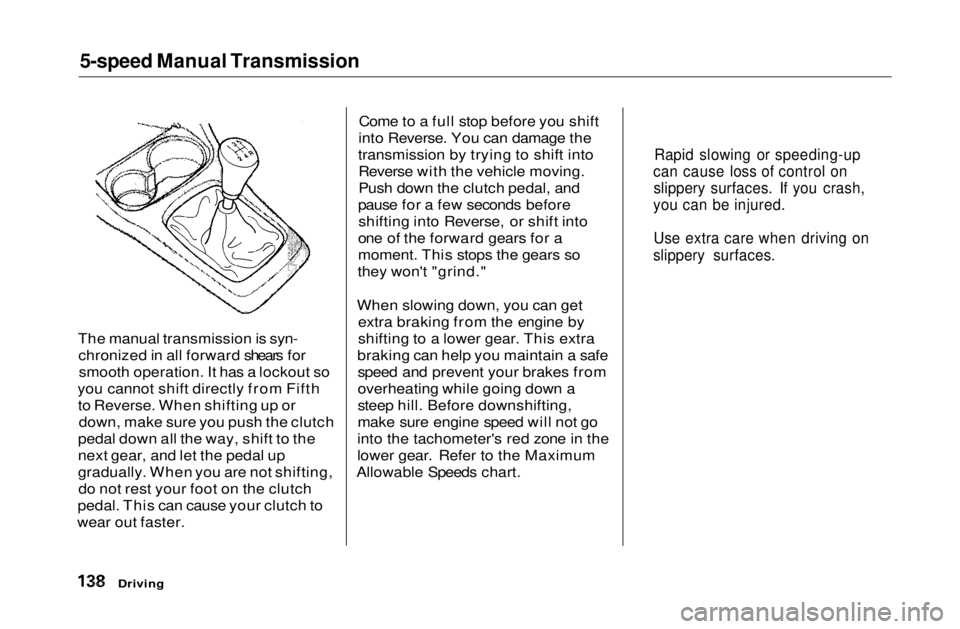
The manual transmission is syn- chronized in all forward shears forsmooth operation. It has a lockout so
you cannot shift directly from Fifth to Reverse. When shifting up or down, make sure you push the clutch
pedal down all the way, shift to the
next gear, and let the pedal up
gradually. When you are not shifting, do not rest your foot on the clutch
pedal. This can cause your clutch to
wear out faster. Come to a full stop before you shift
into Reverse. You can damage the
transmission by trying to shift into Reverse with the vehicle moving.
Push down the clutch pedal, and
pause for a few seconds before shifting into Reverse, or shift into
one of the forward gears for a
moment. This stops the gears so
they won't "grind."
When slowing down, you can get extra braking from the engine by
shifting to a lower gear. This extra
braking can help you maintain a safe speed and prevent your brakes from
overheating while going down a
steep hill. Before downshifting,
make sure engine speed will not go
into the tachometer's red zone in the
lower gear. Refer to the Maximum
Allowable Speeds chart.
Driving
Rapid slowing or speeding-up
can cause loss of control on slippery surfaces. If you crash,
you can be injured.
Use extra care when driving on
slippery surfaces.Main Menu Table of Contents s t
Page 140 of 269
Automatic Transmission
Your Honda's transmission has fourforward speeds, and is electronicallycontrolled for smoother shifting. It
also has a "lock-up" torque converter
for better fuel economy. You may
feel what seems like another shift
when the converter locks.
On vehicles with Continuously Variable
Transmission (CVT):
To operate your Honda's
Continuously Variable Transmission
(CVT), refer to the page 145 .
DrivingMain Menu Table of Contents s t
Page 142 of 269
Automatic Transmission
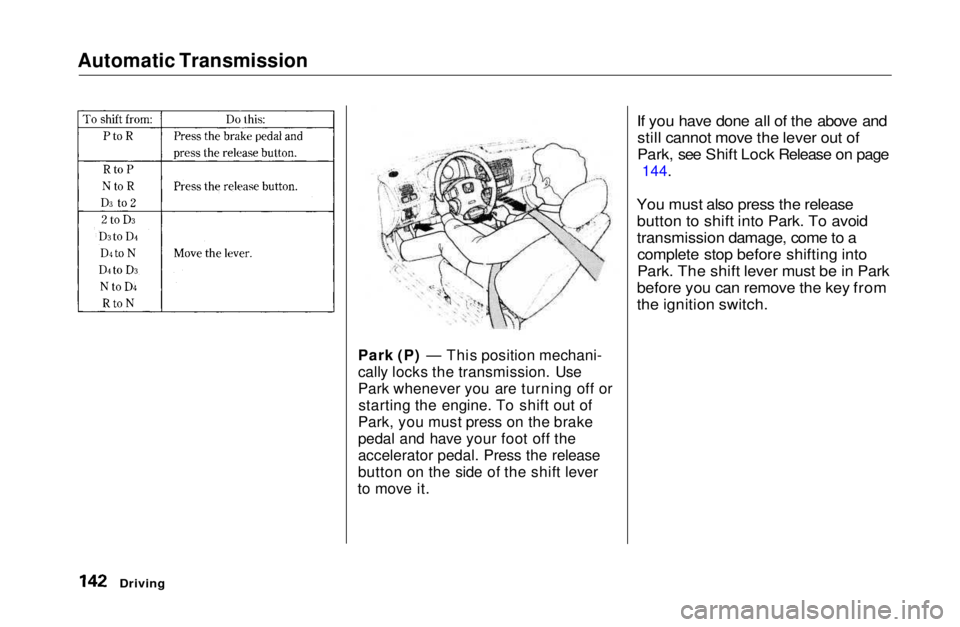
Park (P) — This position mechani-
cally locks the transmission. Use
Park whenever you are turning off orstarting the engine. To shift out of
Park, you must press on the brake
pedal and have your foot off the
accelerator pedal. Press the release
button on the side of the shift lever
to move it.
If you have done all of the above and
still cannot move the lever out of
Park, see Shift Lock Release on page
144.
You must also press the release button to shift into Park. To avoid
transmission damage, come to acomplete stop before shifting into
Park. The shift lever must be in Park
before you can remove the key from
the ignition switch.
DrivingMain Menu Table of Contents s t
Page 143 of 269
Automatic Transmission
Reverse (R) — To shift to Reverse
from Park, see the explanation under Park. To shift to Reverse from
Neutral, come to a complete stop and
then shift. Press the release button
before shifting into Reverse from
Neutral.
Neutral (N) — Use Neutral if youneed to restart a stalled engine, or if
it is necessary to stop briefly with
the engine idling. Shift to Park posi- tion if you need to leave the car forany reason. Press on the brake pedal
when you are moving the shift lever from Neutral to another gear.
Drive (D4) — Use this position for
your normal driving. The transmis- sion automatically selects a suitable
gear for your speed and acceleration.
You may notice the transmission shifting up at higher speeds when
the engine is cold. This helps the engine warm up faster. Drive (D3) —This position is similar
to D4, except only the first three
gears are selected. Use D3 to provide
engine braking when going down a
steep hill. D3 can also keep the
transmission from cycling between
third and fourth gears in stop-and-go
driving.
For faster acceleration when in D3 or
D4, you can get the transmission to automatically downshift by pushing
the accelerator pedal to the floor.
The transmission will shift down one or two gears, depending on your
speed.
Second (2) — To shift to Second,
press the release button on the side
of the shift lever. This position locks
the transmission in second gear. It does not downshift to first gear
when you come to a stop. Second
gives you more power when climbing,
and increased engine braking when
going down steep hills. Use second
gear when starting out on a slippery surface or in deep snow. It will help
reduce wheelspin.
DrivingMain Menu Table of Contents s t
Page 144 of 269
Automatic Transmission
Engine Speed Limiter
If you exceed the maximum speedfor the gear you are in, the enginespeed will enter into the tachometer's
red zone. If this occurs, you may
feel the engine cut in and out. This is
caused by a limiter in the engine's
computer controls. The engine will
run normally when you reduce the
RPM below the red zone.
Driving
Shift Lock Release
This allows you to move the shift lever out of Park if the normalmethod of pushing on the brake
pedal and pressing the release
button does not work.
1. Set the Parking brake.
2. Remove the key from the ignition
switch.
3. Put a cloth on the edge of the shift lock release slot cover next to theshift lever.
Use a small flat-tipped screwdriver or small metal plate (neither are
included in the tool kit) to remove
the cover. Carefully pry off the edge of the cover.Main Menu Table of Contents s t
Page 145 of 269
Automatic Transmission (CVT)
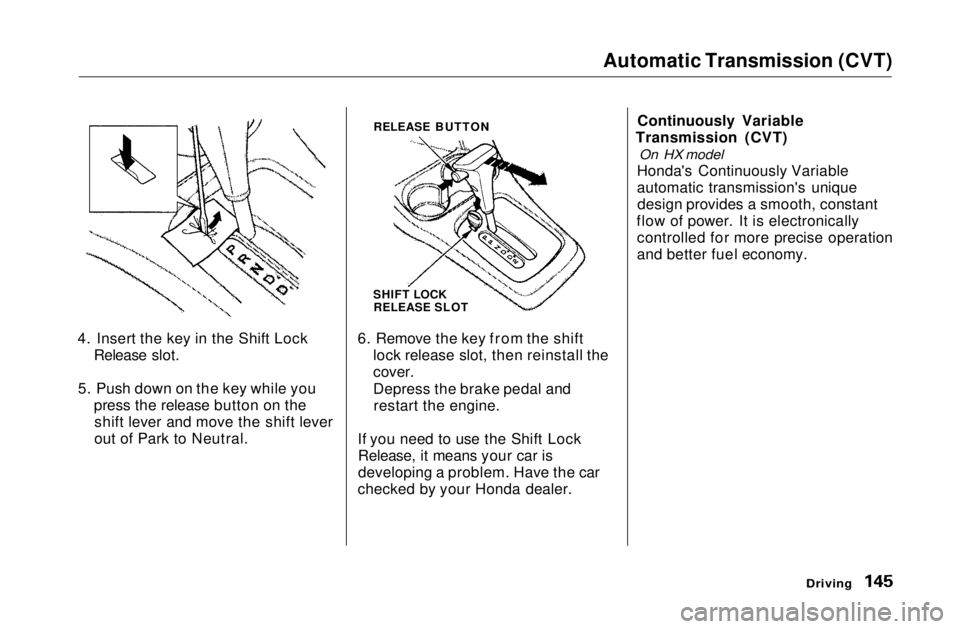
4. Insert the key in the Shift Lock Release slot.
5. Push down on the key while you press the release button on theshift lever and move the shift lever
out of Park to Neutral. RELEASE BUTTON
SHIFT LOCK RELEASE SLOT
6. Remove the key from the shift lock release slot, then reinstall the
cover.
Depress the brake pedal andrestart the engine.
If you need to use the Shift Lock Release, it means your car is
developing a problem. Have the car
checked by your Honda dealer. Continuously Variable
Transmission (CVT)
On HX model
Honda's Continuously Variable
automatic transmission's unique design provides a smooth, constant
flow of power. It is electronically controlled for more precise operation
and better fuel economy.
DrivingMain Menu Table of Contents s t
Page 147 of 269
Automatic Transmission (CVT)
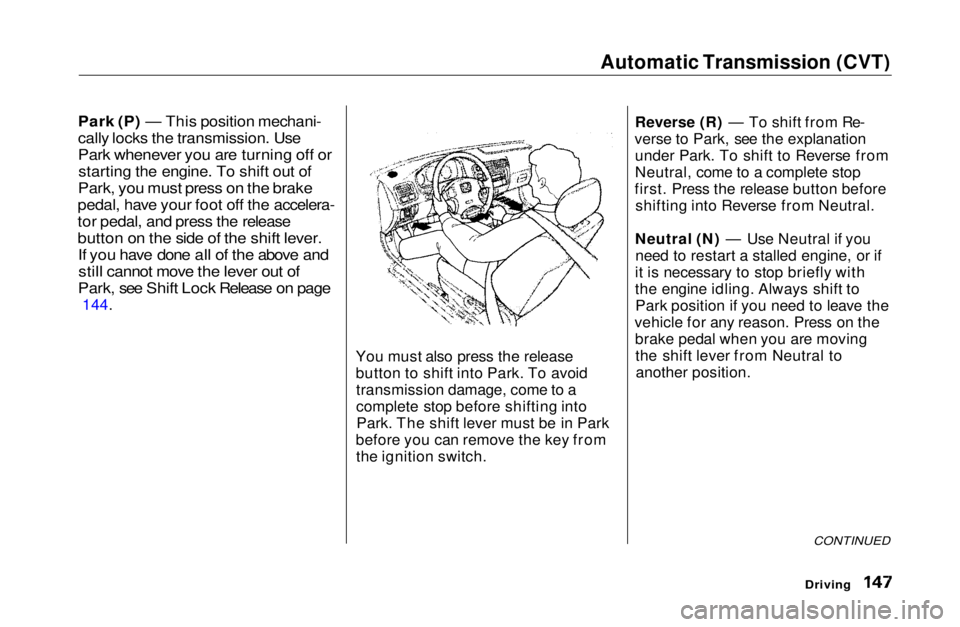
Park (P) — This position mechani-
cally locks the transmission. Use
Park whenever you are turning off or
starting the engine. To shift out of
Park, you must press on the brake
pedal, have your foot off the accelera-
tor pedal, and press the release
button on the side of the shift lever.
If you have done all of the above andstill cannot move the lever out of
Park, see Shift Lock Release on page
144.
You must also press the release
button to shift into Park. To avoidtransmission damage, come to a
complete stop before shifting intoPark. The shift lever must be in Park
before you can remove the key from the ignition switch. Reverse (R) — To shift from Re-
verse to Park, see the explanation under Park. To shift to Reverse from
Neutral, come to a complete stop
first. Press the release button before shifting into Reverse from Neutral.
Neutral (N) — Use Neutral if you need to restart a stalled engine, or if
it is necessary to stop briefly with
the engine idling. Always shift to Park position if you need to leave the
vehicle for any reason. Press on the brake pedal when you are movingthe shift lever from Neutral toanother position.
CONTINUED
DrivingMain Menu Table of Contents s t
Page 149 of 269
Parking
Always use the parking brake when
you park your car. The indicator on the instrument panel shows that theparking brake is not fully released; it
does not indicate that the parking
brake is firmly set. Make sure the parking brake is set firmly or your
car may roll if it is parked on an
incline.
If your car has an automatic
transmission, set the parking brake
before you put the transmission inPark. This keeps the car from
moving and putting pressure on the
parking mechanism in the
transmission — making it easier to
move the shift lever out of Park
when you want to drive away. If the car is facing uphill, turn the
front wheels away from the curb. If
you have a manual transmission, put it in first gear.
If the car is facing downhill, turn the
front wheels toward the curb. If you
have a manual transmission, put it in reverse gear.
Make sure the parking brake is fully
released before driving away.
Driving with the parking brake
partially set can overheat or damage
the rear brakes. Parking Tips Make sure the moonroof and the
windows are closed. Turn off the lights.
Place any packages, valuables, etc.,
in the trunk or take them with you. Lock the doors with the key or the
remote transmitter.
Never park over dry leaves, tall
grass, or other flammable materials. The three way catalytic
converter gets very hot, and could
cause these materials to catch on
fire.
DrivingMain Menu Table of Contents s t