ECU HONDA CIVIC COUPE 2014 9.G CNG Owners Manual
[x] Cancel search | Manufacturer: HONDA, Model Year: 2014, Model line: CIVIC COUPE, Model: HONDA CIVIC COUPE 2014 9.GPages: 46, PDF Size: 3.84 MB
Page 11 of 46
Before Driving
10
Driving
Storing Cargo in the Trunk
Do not put large, heavy or pointed objects in the trunk. When storing items,
properly secure them so that they do not move around while driving. The fuel
tank is located in the trunk, and although a partition separates the tank from the
cargo space, large items or loose items can damage the fuel tank and fuel system
components.
Towing a Trailer
Your vehicle is not designed to tow a trailer. Attempting to do so can void your
warranties.
2014 Civic CNG
Page 18 of 46
Refueling How to Refuel
17Continued
Driving
Refueling Procedure Example How to Refuel
NOTICE Using fast fill equipment at temperature below -4°F
(-20°C) may damage the fuel system, potentially
causing a leak.
Always observe all safety recommendations and
operating instructions on the refueling equipment.
Use a fuel filler nozzle that complies with ANSI/AGA
NGV-1-2008 standards.
The CNG filler nozzle mechanism may vary by
service station. Each nozzle standard has different
maximum pressure:P24
•- 2,400 psi (16,500 kPa)
P30
•- 3,000 psi (20,700 kPa)
P36
•- 3,600 psi (24,800 kPa)
The refueling steps shown in this manual are the
typical fast fill refueling procedure. You may need
to go through different steps at a station with slow
fill equipment or other types of equipment. Always
follow the instructions provided on site.
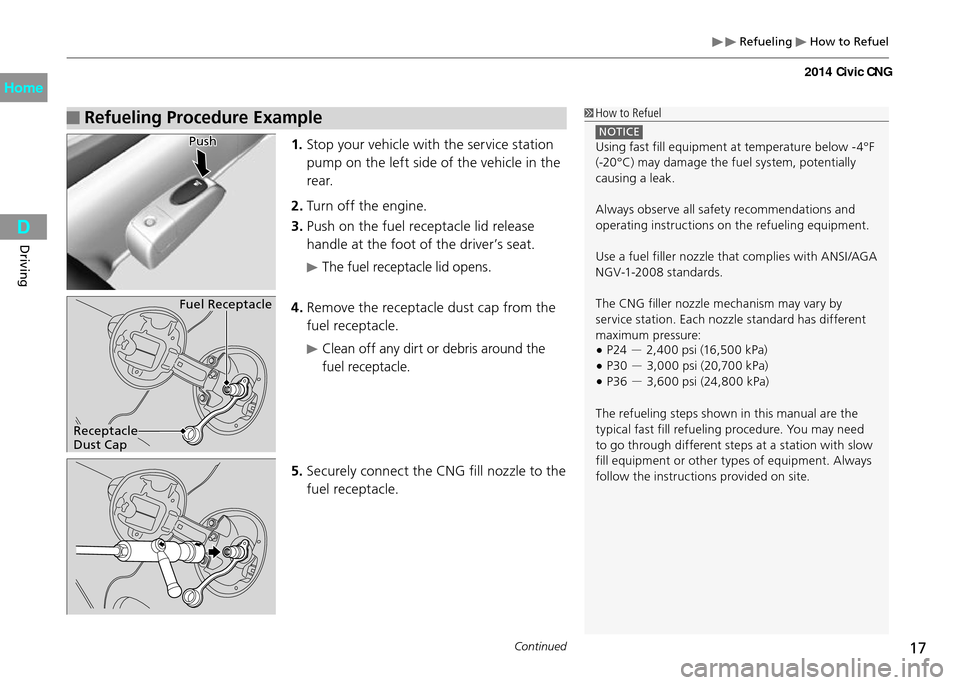
1. Stop your vehicle with the service station
pump on the left side of the vehicle in the
r e a r.
2. Turn off the engine.
3. Push on the fuel receptacle lid release
handle at the foot of the driver’s seat.
The fuel receptacle lid opens.
4. Remove the receptacle dust cap from the
fuel receptacle.
Clean off any dirt or debris around the
fuel receptacle.
5
. Securely connect the CNG fill nozzle to the
fuel receptacle.
Push
Fuel Receptacle
Receptacle
Dust Cap
2014 Civic CNG
Page 19 of 46
Refueling How to Refuel
18
Driving
How to Refuel
If you hear or see fuel/vapor leaking from the
nozzle-receptacle connection, stop refueling
immediately. Turn off the refueling station, remove
the nozzle, reconnect it to the receptacle, and begin
refueling again. Dirt or debris adhered to the inside
of the fuel receptacle can cause a gas leak. Remove
dirt or debris from the CNG filler nozzle with a
clean, dry rag.
If it continues to leak, have an authorized CNG
dealer inspect the sealing O-ring in the fuel
receptacle. It may be missing, damaged, or worn.
If you are not sure how to operate the refueling
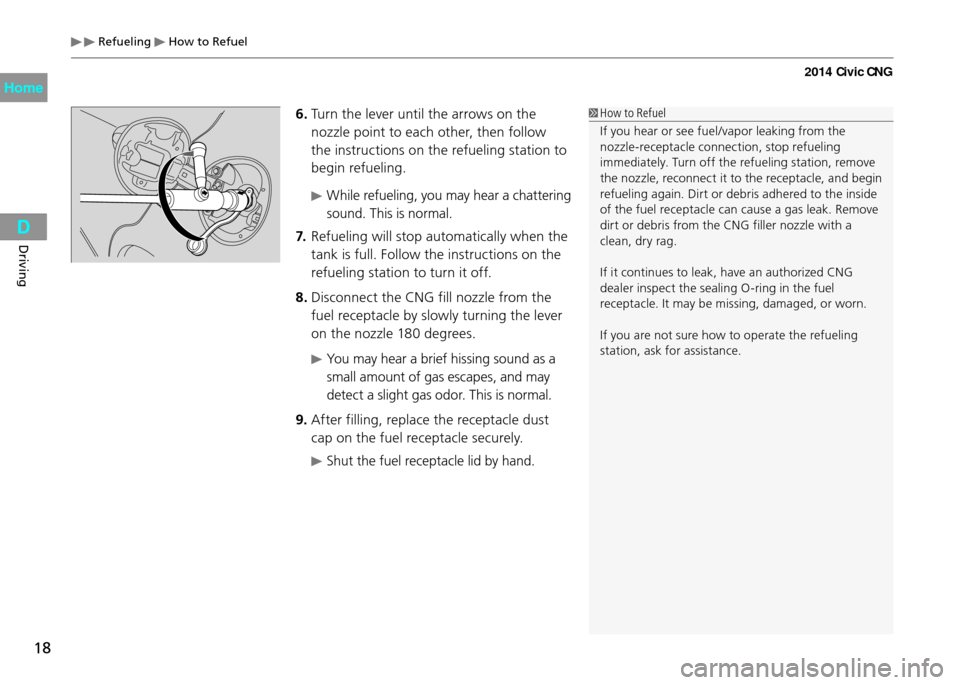
station, ask for assistance.6. Turn the lever until the arrows on the
nozzle point to each other, then follow
the instructions on the refueling station to
begin refueling.
While refueling, you may hear a chattering
sound. This is normal.
7. Refueling will stop automatically when the
tank is full. Follow the instructions on the
refueling station to turn it off.
8. Disconnect the CNG fill nozzle from the
fuel receptacle by slowly turning the lever
on the nozzle 180 degrees.
You may hear a brief hissing sound as a
small amount of gas escapes, and may
detect a slight gas odor. This is normal.
9. After filling, replace the receptacle dust
cap on the fuel receptacle securely.
Shut the fuel receptacle lid by hand.
2014 Civic CNG
Page 23 of 46
Maintenance Under the Hood
22
Maintenance
Transmission Fluid
Automatic Transmission Fluid
Specified fluid: Honda ATF DW-1 (automatic transmission fluid)
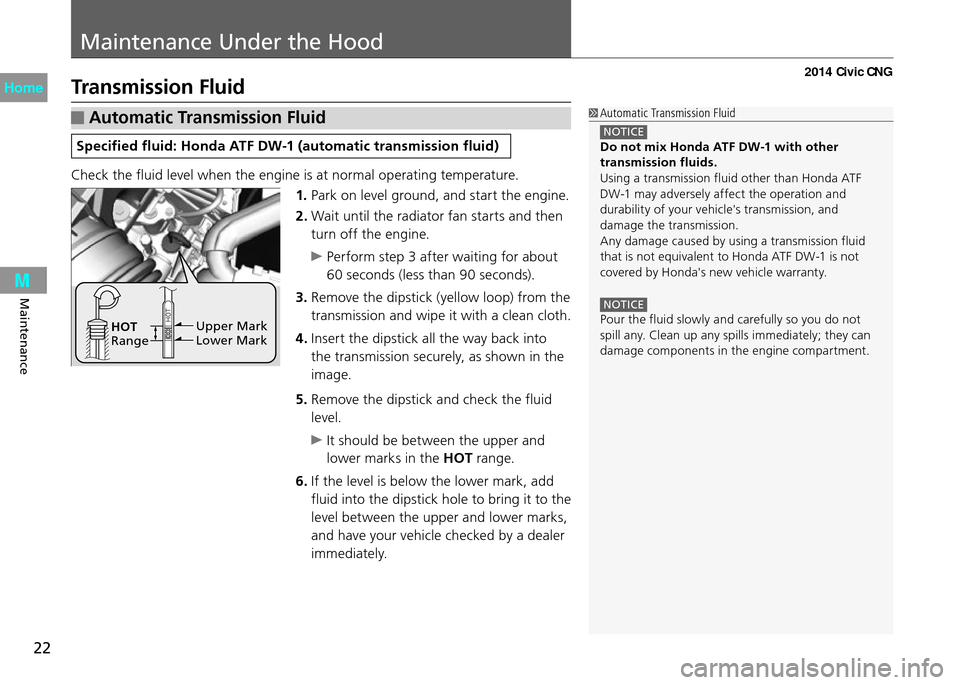
Check the fluid level when the engine is at normal operating temperature.
HOT
Range Upper Mark
Lower Mark
1.
Park on level ground, and start the engine.
2. Wait until the radiator fan starts and then
turn off the engine.
Perform step 3 after waiting for about
60 seconds (less than 90 seconds).
3. Remove the dipstick (yellow loop) from the
transmission and wipe it with a clean cloth.
4. Insert the dipstick all the way back into
the transmission securely, as shown in the
image.
5. Remove the dipstick and check the fluid
level.
It should be between the upper and
lower marks in the HOT range.
6. If the level is below the lower mark, add
fluid into the dipstick hole to bring it to the
level between the upper and lower marks,
and have your vehicle checked by a dealer
immediately.
Automatic Transmission Fluid
NOTICE Do not mix Honda ATF DW-1 with other
transmission fluids.
Using a transmission fluid other than Honda ATF
DW-1 may adversely affect the operation and
durability of your vehicle's transmission, and
damage the transmission.
Any damage caused by using a transmission fluid
that is not equivalent to Honda ATF DW-1 is not
covered by Honda's new vehicle warranty.
NOTICE Pour the fluid slowly and carefully so you do not
spill any. Clean up any spills immediately; they can
damage components in the engine compartment.
2014 Civic CNG
Page 29 of 46
28
Handling the Unexpected
If a Tire Goes Flat Changing a Flat Tire
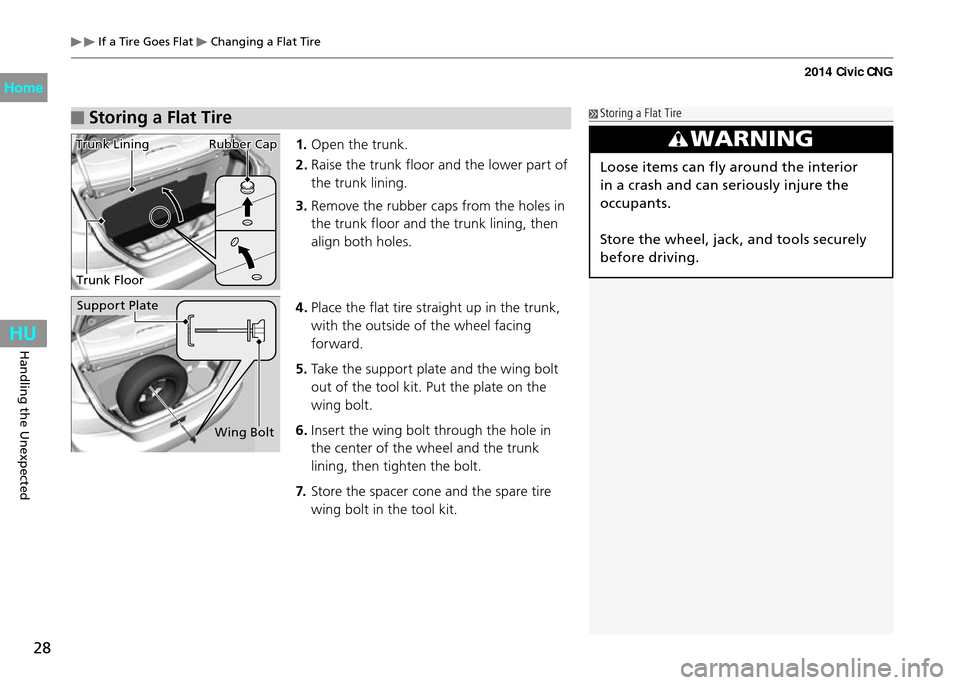
Storing a Flat Tire
WARNING
Loose items can fly around the interior
in a crash and can seriously injure the
occupants.
Store the wheel, jack, and tools securely
before driving.
Storing a Flat Tire
1. Open the trunk.
2. Raise the trunk floor and the lower part of
the trunk lining.
3. Remove the rubber caps from the holes in
the trunk floor and the trunk lining, then
align both holes.
4. Place the flat tire straight up in the trunk,
with the outside of the wheel facing
forward.
5. Take the support plate and the wing bolt
out of the tool kit. Put the plate on the
wing bolt.
6. Insert the wing bolt through the hole in
the center of the wheel and the trunk
lining, then tighten the bolt.
7. Store the spacer cone and the spare tire
wing bolt in the tool kit.Trunk LiningRubber Cap
Trunk Floor
Support Plate
Wing Bolt
2014 Civic CNG