engine HONDA CIVIC COUPE 2014 9.G CNG Owners Manual
[x] Cancel search | Manufacturer: HONDA, Model Year: 2014, Model line: CIVIC COUPE, Model: HONDA CIVIC COUPE 2014 9.GPages: 46, PDF Size: 3.84 MB
Page 7 of 46
Indicators
6
Instrument Panel
IndicatorName On/Blinking ExplanationMessage
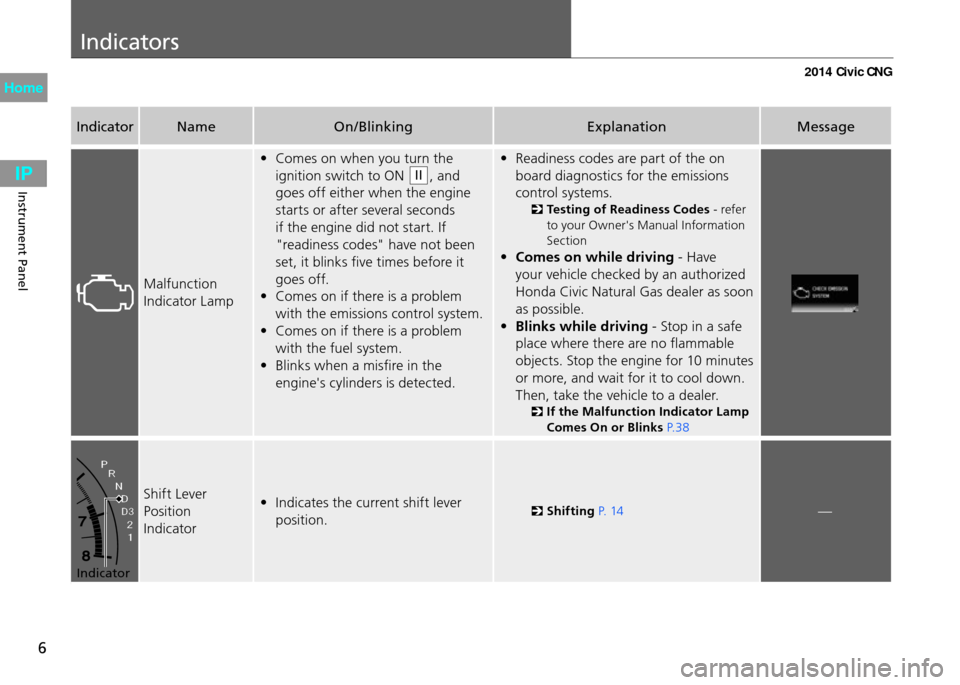
Malfunction
Indicator Lamp• Comes on when you turn the
ignition switch to ON
II, and
goes off either when the engine
starts or after several seconds
if the engine did not start. If
"readiness codes" have not been
set, it blinks five times before it
goes off.
• Comes on if there is a problem with the emissions control system.
• Comes on if there is a problem with the fuel system.
• Blinks when a misfire in the engine's cylinders is detected. • Readiness codes are part of the on
board diagnostics for the emissions
control systems.
Testing of Readiness Code s - refer
to your Owner's Manual Information
Section
• Comes on while driving - Have
your vehicle checked by an authorized
Honda Civic Natural Gas dealer as soon
as possible.
• Blinks while driving - Stop in a safe
place where there are no flammable
objects. Stop the engine for 10 minutes
or more, and wait for it to cool down.
Then, take the vehicle to a dealer.
If the Malfunction Indicator Lamp
Comes On or Blinks P. 3 8
Shift Lever
Position
Indicator • Indicates the current shift lever
position.
Shifting P. 14—
Indicator
2014 Civic CNG
Page 8 of 46
Indicators
7
Instrument Panel
IndicatorName On/Blinking ExplanationMessage
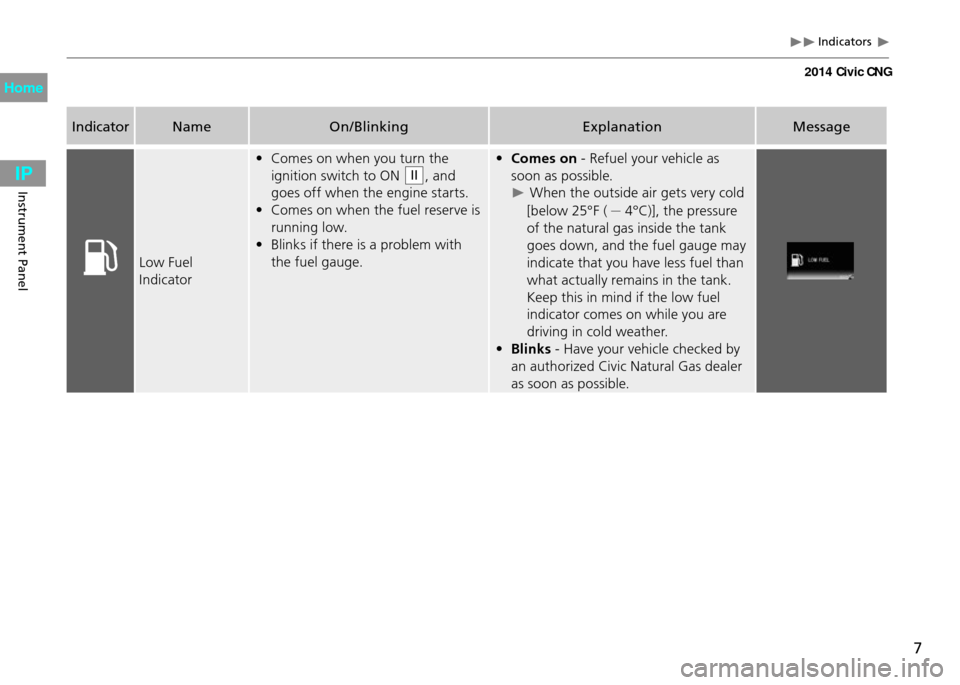
Low Fuel
Indicator• Comes on when you turn the
ignition switch to ON
II, and
goes off when the engine starts.
• Comes on when the fuel reserve is running low.
• Blinks if there is a problem with the fuel gauge. •
Comes on - Refuel your vehicle as
soon as possible.
When the outside air gets very cold
[below 25°F (
-4°C)], the pressure
of the natural gas inside the tank
goes down, and the fuel gauge may
indicate that you have less fuel than
what actually remains in the tank.
Keep this in mind if the low fuel
indicator comes on while you are
driving in cold weather.
• Blinks - Have your vehicle checked by
an authorized Civic Natural Gas dealer
as soon as possible.
2014 Civic CNG
Page 12 of 46
11
When Driving
Continued
Driving
Starting the Engine
Starting the Engine
Keep your foot firmly on the brake pedal when
starting the engine.
The engine is harder to start in cold weather and
in thinner air found at altitudes above 8,000 feet
(2,400 meters).
When starting the engine in cold weather, turn
off all electrical accessories (the lights, heating
and cooling system, and rear defogger) in order to
reduce battery drain.
If you live in a region where winter is extremely
cold, an engine block heater will improve starting
and warming of the engine. If temperatures
consistently below -22°F (-30°C) are expected, the
coolant mixture should be changed to a higher
concentration to prevent freezing. Consult a dealer
for details.
If the exhaust system sounds abnormal or you
can smell exhaust gas inside the vehicle, have
your vehicle checked by a dealer. There may be a
problem with the engine or exhaust system.
Brake Pedal
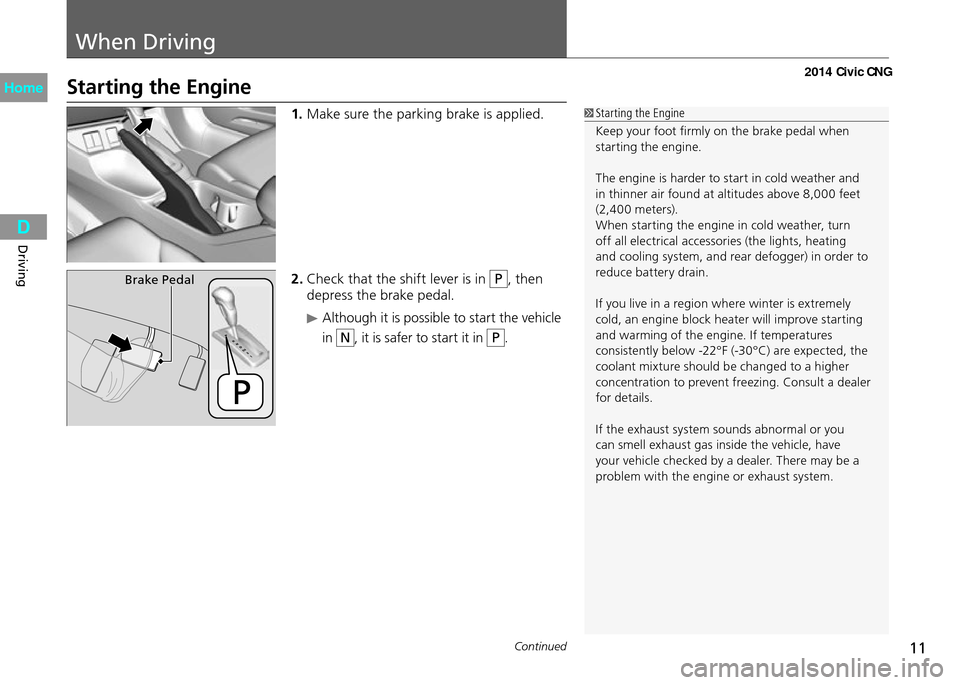
1. Make sure the parking brake is applied.
2. Check that the shift lever is in P
, then
depress the brake pedal.
Although it is possible to start the vehicle
in
N, it is safer to start it in P.
2014 Civic CNG
Page 13 of 46
When Driving Starting the Engine
12
Driving
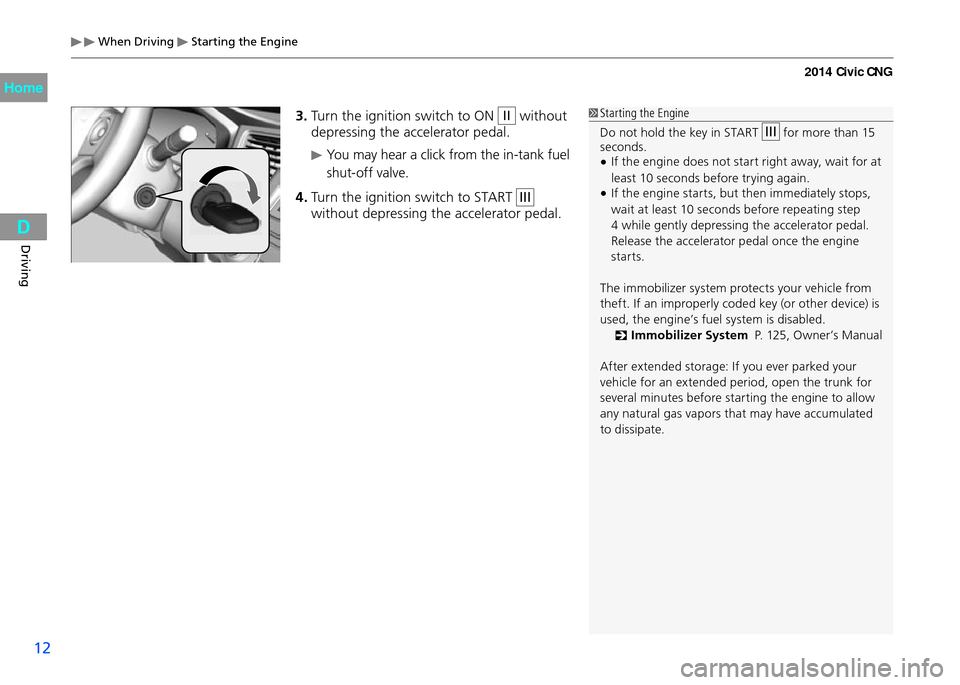
3. Turn the ignition switch to ON II without
depressing the accelerator pedal.
You may hear a click from the in-tank fuel
shut-off valve.
4. Turn the ignition switch to START III
without depressing the accelerator pedal.
Starting the Engine
Do not hold the key in START
III for more than 15
seconds.
If the engine does not start right away, wait for at
•least 10 seconds before trying again.
If the engine starts, but then immediately stops,
•wait at least 10 seconds before repeating step
4 while gently depressing the accelerator pedal.
Release the accelerator pedal once the engine
starts.
The immobilizer system protects your vehicle from
theft. If an improperly coded key (or other device) is
used, the engine’s fuel system is disabled. Immobilizer Syste m
P. 125, Owner’s Manual
After extended storage: If you ever parked your
vehicle for an extended period, open the trunk for
several minutes before starting the engine to allow
any natural gas vapors that may have accumulated
to dissipate.
2014 Civic CNG
Page 14 of 46
When Driving Automatic Transmission
13
Driving
Automatic Transmission
Creeping
The engine runs at a higher idle speed and creeping increases.
Keep the brake pedal firmly depressed when stopped.
Kickdown
Quickly depressing the accelerator pedal while driving uphill may cause the
transmission to drop to a lower gear, unexpectedly increasing vehicle speed.
Depress the accelerator pedal carefully, especially on slippery roads and curves.
2014 Civic CNG
Page 15 of 46
When Driving Shifting
14
Driving
Shifting
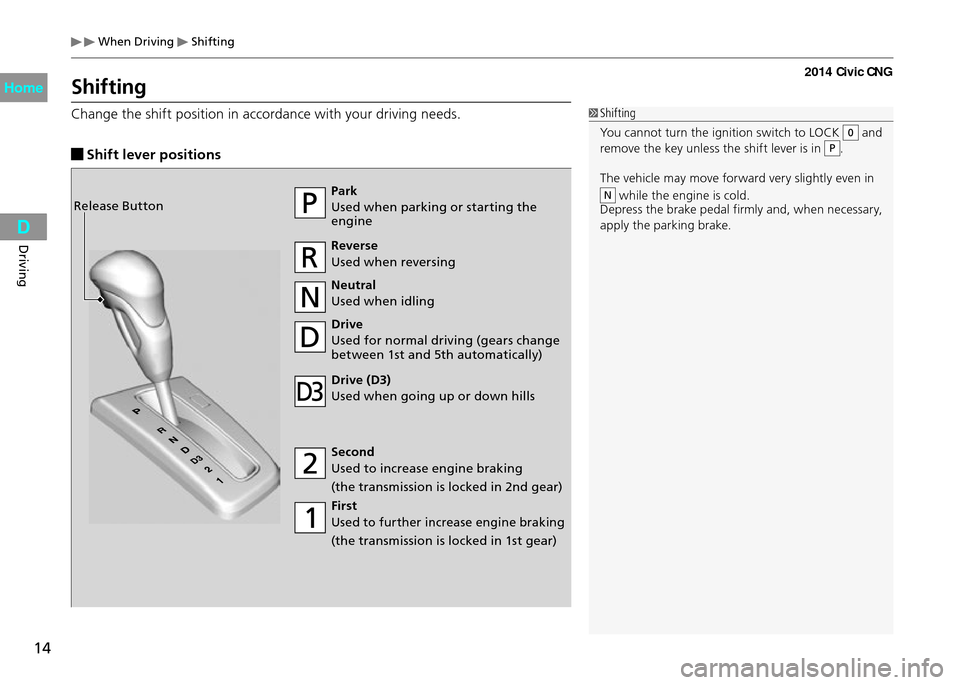
Change the shift position in accordance with your driving needs.
Shift lever positions
Park
Used when parking or starting the
engine
Reverse
Used when reversing
Neutral
Used when idling
Drive
Used for normal driving (gears change
between 1st and 5th automatically)
Drive (D3)
Used when going up or down hills
Second
Used to increase engine braking
(the transmission is locked in 2nd gear)
First
Used to further increase engine braking
(the transmission is locked in 1st gear)
Release Button
Shifting
You cannot turn the ignition switch to LOCK
0 and
remove the key unless the shift lever is in P.
The vehicle may move forward very slightly even in
N while the engine is cold.
Depress the brake pedal firmly and, when necessary,
apply the parking brake.
2014 Civic CNG
Page 16 of 46
When Driving Shifting
15Continued
Driving
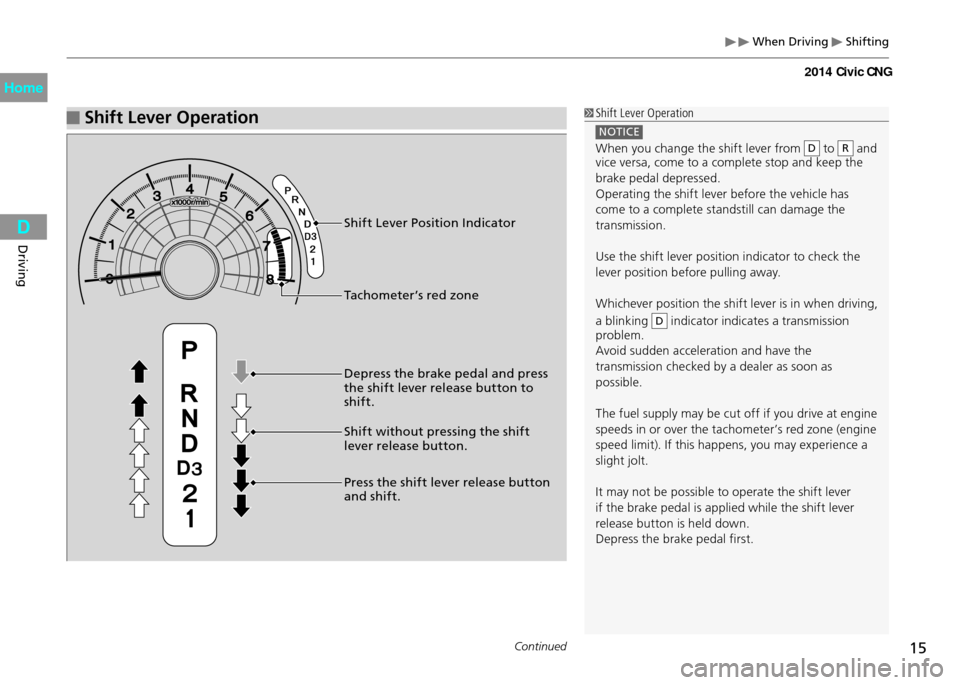
Shift Lever Operation
Shift Lever Position Indicator
Tachometer’s red zone
Depress the brake pedal and press
the shift lever release button to
shift.
Shift without pressing the shift
lever release button.
Press the shift lever release button
and shift.
Shift Lever Operation
NOTICE
When you change the shift lever from D to R and
vice versa, come to a complete stop and keep the
brake pedal depressed.
Operating the shift lever before the vehicle has
come to a complete standstill can damage the
transmission.
Use the shift lever position indicator to check the
lever position before pulling away.
Whichever position the shift lever is in when driving,
a blinking
D indicator indicates a transmission
problem.
Avoid sudden acceleration and have the
transmission checked by a dealer as soon as
possible.
The fuel supply may be cut off if you drive at engine
speeds in or over the tachometer’s red zone (engine
speed limit). If this happens, you may experience a
slight jolt.
It may not be possible to operate the shift lever
if the brake pedal is applied while the shift lever
release button is held down.
Depress the brake pedal first.
2014 Civic CNG
Page 17 of 46
Refueling
16
Driving
Fuel Information
Only fuels that can be used
NFPA-52 and SAE J1616 standards
Use of a fuel that does not meet these standards can cause a decrease in engine
power and damage the emission controls.
Fuel tank capacity:
Slow filling
6.96 gasoline gallon equivalent (3,000 psi)
7.77 gasoline gallon equivalent (3,600 psi)
Fast filling
5.84 gasoline gallon equivalent (3,000 psi)
6.51 gasoline gallon equivalent (3,600 psi)
How to Refuel
There are two methods of refueling:
Fast filling
It takes about three to five minutes to fill up the fuel tank. This method is usually
available at stations designed to refuel natural gas vehicles.
During fast filling, the natural gas is warmed, causing the pressure in the tank to
rise and reduces the amount of fuel you can put in.
Slow filling
It takes about an hour and a half per GGE (Gasoline Gallon Equivalent) to fill up
the fuel tank. This method can be done using a vehicle refueling appliance.
Fuel Quality and Home Refuelin g
P. 3
Fuel Information
For information on the locations of the CNG fuel
stations:
49 States: Visit either http://w w w.afdc.energy.gov/
afdc/fuels/natural_gas_ locations.html , or www.
cngprices.com.
Or call Gas Vehicle Coalition at (202) 824-7360.
California: Visit www.cngvc.org.
The location of the CNG pump can vary from
station to station, may not be clearly marked, or
be readily accessible during certain hours. It is
recommended that you call the station (the number
should be displayed with the address information)
to verify the location and availability of the CNG
pump before you arrive.
How to Refuel
WARNING
Compressed natural gas is flammable and
highly explosive. You could be killed or
seriously injured if leaking natural gas is
ignited.
If you suspect a leak, have your vehicle
immediately inspected and repaired by
an authorized Honda Civic Natural Gas
d e a l e r.
2014 Civic CNG
Page 18 of 46
Refueling How to Refuel
17Continued
Driving
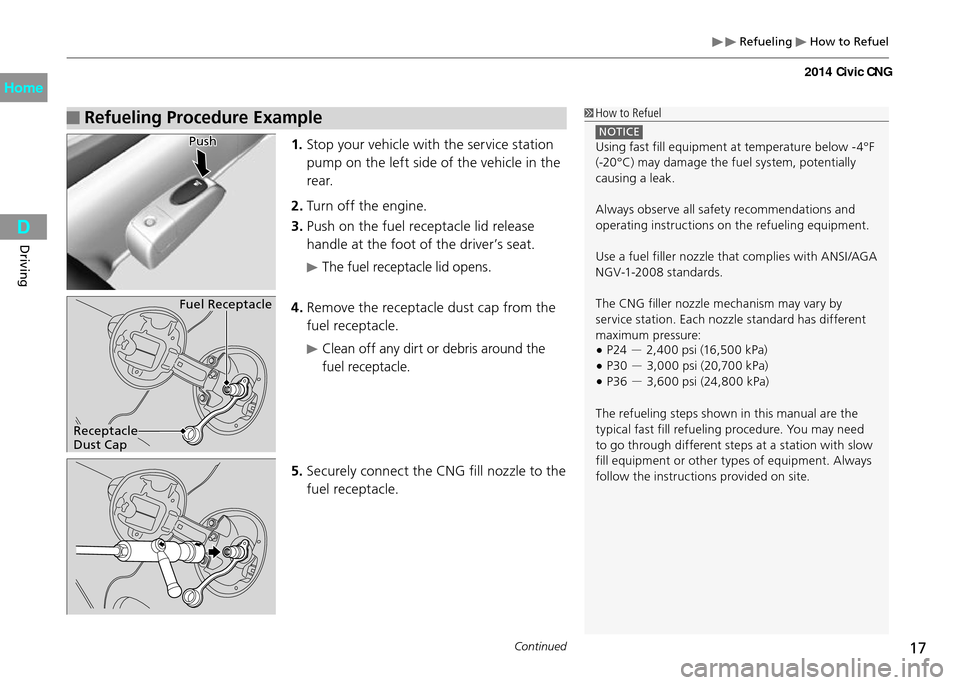
Refueling Procedure Example How to Refuel
NOTICE Using fast fill equipment at temperature below -4°F
(-20°C) may damage the fuel system, potentially
causing a leak.
Always observe all safety recommendations and
operating instructions on the refueling equipment.
Use a fuel filler nozzle that complies with ANSI/AGA
NGV-1-2008 standards.
The CNG filler nozzle mechanism may vary by
service station. Each nozzle standard has different
maximum pressure:P24
•- 2,400 psi (16,500 kPa)
P30
•- 3,000 psi (20,700 kPa)
P36
•- 3,600 psi (24,800 kPa)
The refueling steps shown in this manual are the
typical fast fill refueling procedure. You may need
to go through different steps at a station with slow
fill equipment or other types of equipment. Always
follow the instructions provided on site.
1. Stop your vehicle with the service station
pump on the left side of the vehicle in the
r e a r.
2. Turn off the engine.
3. Push on the fuel receptacle lid release
handle at the foot of the driver’s seat.
The fuel receptacle lid opens.
4. Remove the receptacle dust cap from the
fuel receptacle.
Clean off any dirt or debris around the
fuel receptacle.
5
. Securely connect the CNG fill nozzle to the
fuel receptacle.
Push
Fuel Receptacle
Receptacle
Dust Cap
2014 Civic CNG
Page 21 of 46
20
Maintenance
Maintenance MinderTM
Your vehicle displays engine oil life and maintenance service items on the
intelligent multi-information display (i-MID) to show you when you should have a
dealer do engine oil replacement and indicated maintenance service.
Refer to the important safety precautions and instructions in the Owner's Manual.
2014 Civic CNG