ignition HONDA CIVIC COUPE 2014 9.G CNG Owners Manual
[x] Cancel search | Manufacturer: HONDA, Model Year: 2014, Model line: CIVIC COUPE, Model: HONDA CIVIC COUPE 2014 9.GPages: 46, PDF Size: 3.84 MB
Page 7 of 46
Indicators
6
Instrument Panel
IndicatorName On/Blinking ExplanationMessage
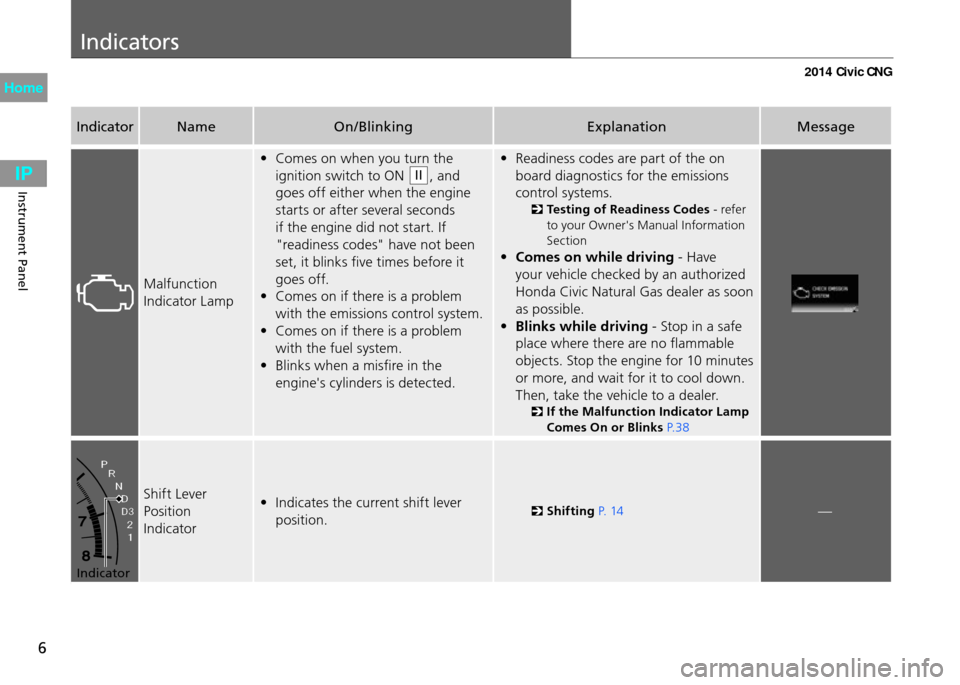
Malfunction
Indicator Lamp• Comes on when you turn the
ignition switch to ON
II, and
goes off either when the engine
starts or after several seconds
if the engine did not start. If
"readiness codes" have not been
set, it blinks five times before it
goes off.
• Comes on if there is a problem with the emissions control system.
• Comes on if there is a problem with the fuel system.
• Blinks when a misfire in the engine's cylinders is detected. • Readiness codes are part of the on
board diagnostics for the emissions
control systems.
Testing of Readiness Code s - refer
to your Owner's Manual Information
Section
• Comes on while driving - Have
your vehicle checked by an authorized
Honda Civic Natural Gas dealer as soon
as possible.
• Blinks while driving - Stop in a safe
place where there are no flammable
objects. Stop the engine for 10 minutes
or more, and wait for it to cool down.
Then, take the vehicle to a dealer.
If the Malfunction Indicator Lamp
Comes On or Blinks P. 3 8
Shift Lever
Position
Indicator • Indicates the current shift lever
position.
Shifting P. 14—
Indicator
2014 Civic CNG
Page 8 of 46
Indicators
7
Instrument Panel
IndicatorName On/Blinking ExplanationMessage
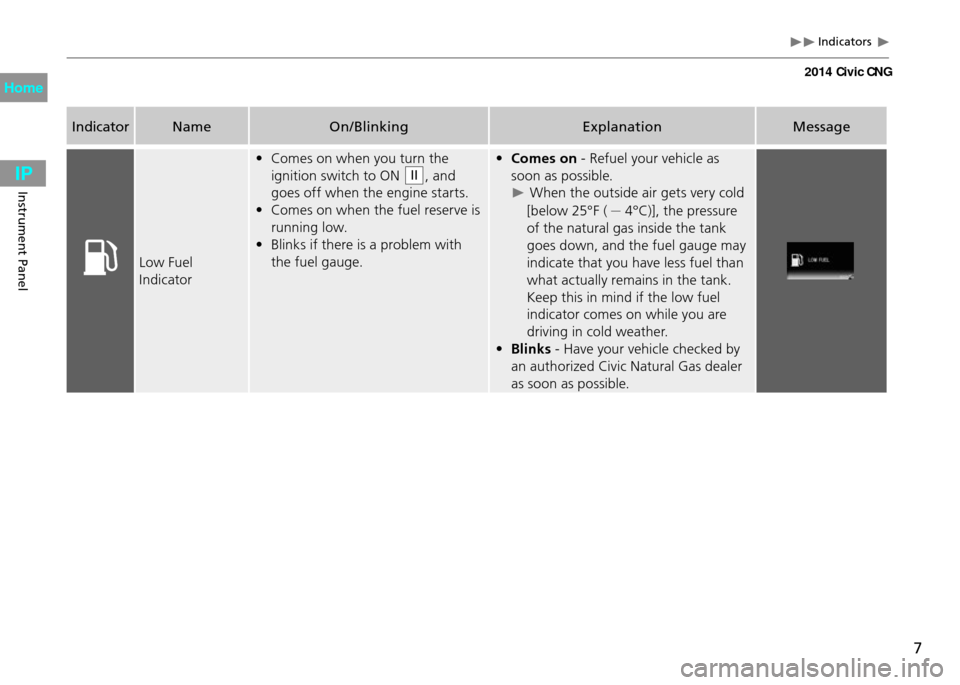
Low Fuel
Indicator• Comes on when you turn the
ignition switch to ON
II, and
goes off when the engine starts.
• Comes on when the fuel reserve is running low.
• Blinks if there is a problem with the fuel gauge. •
Comes on - Refuel your vehicle as
soon as possible.
When the outside air gets very cold
[below 25°F (
-4°C)], the pressure
of the natural gas inside the tank
goes down, and the fuel gauge may
indicate that you have less fuel than
what actually remains in the tank.
Keep this in mind if the low fuel
indicator comes on while you are
driving in cold weather.
• Blinks - Have your vehicle checked by
an authorized Civic Natural Gas dealer
as soon as possible.
2014 Civic CNG
Page 10 of 46
9
Gauges and Displays
Instrument Panel
Gauges
Fuel Gauge Fuel Gauge
The quantity of fuel remaining in the tank is
calculated based on the pressure and temperature
of the natural gas in the fuel tank.
The gauge, average fuel, range, and instant fuel
economy show more or less than the actual
amount. The tank temperature, fill method, and
ambient conditions may affect the pressure and
temperature of the natural gas.
You can choose when to reset the average fuel
economy.Customized Features
P. 90, Owner's Manual
Refueling a small amount of gas may not trigger trip
A and the average fuel economy to reset.
F UEL LID OPEN
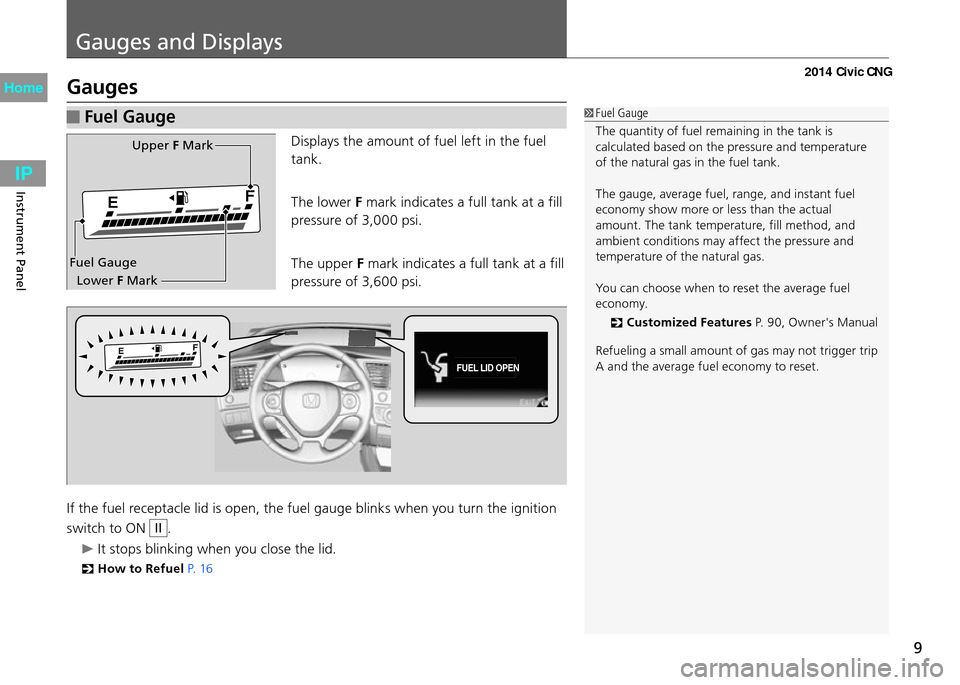
Displays the amount of fuel left in the fuel
tank.
The lower F mark indicates a full tank at a fill
pressure of 3,000 psi.
The upper F mark indicates a full tank at a fill
pressure of 3,600 psi.
If the fuel receptacle lid is open, the fuel gauge blinks when you turn the ignition
switch to ON
II.
It stops blinking when you close the lid.
How to Refue l
P. 16
Upper F Mark
Lower F Mark
Fuel Gauge
2014 Civic CNG
Page 13 of 46
When Driving Starting the Engine
12
Driving
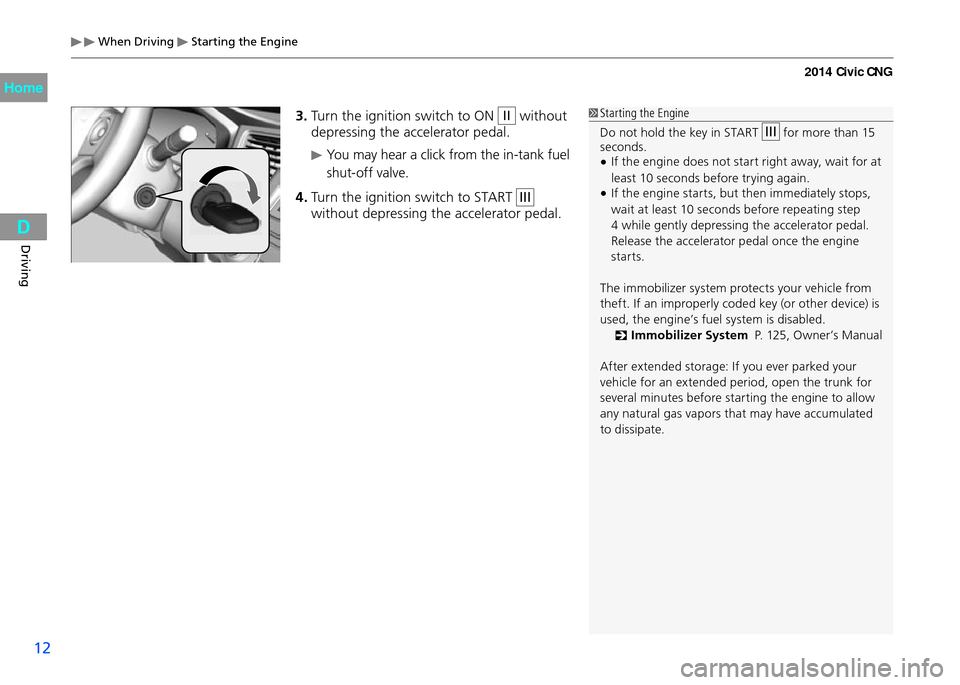
3. Turn the ignition switch to ON II without
depressing the accelerator pedal.
You may hear a click from the in-tank fuel
shut-off valve.
4. Turn the ignition switch to START III
without depressing the accelerator pedal.
Starting the Engine
Do not hold the key in START
III for more than 15
seconds.
If the engine does not start right away, wait for at
•least 10 seconds before trying again.
If the engine starts, but then immediately stops,
•wait at least 10 seconds before repeating step
4 while gently depressing the accelerator pedal.
Release the accelerator pedal once the engine
starts.
The immobilizer system protects your vehicle from
theft. If an improperly coded key (or other device) is
used, the engine’s fuel system is disabled. Immobilizer Syste m
P. 125, Owner’s Manual
After extended storage: If you ever parked your
vehicle for an extended period, open the trunk for
several minutes before starting the engine to allow
any natural gas vapors that may have accumulated
to dissipate.
2014 Civic CNG
Page 15 of 46
When Driving Shifting
14
Driving
Shifting
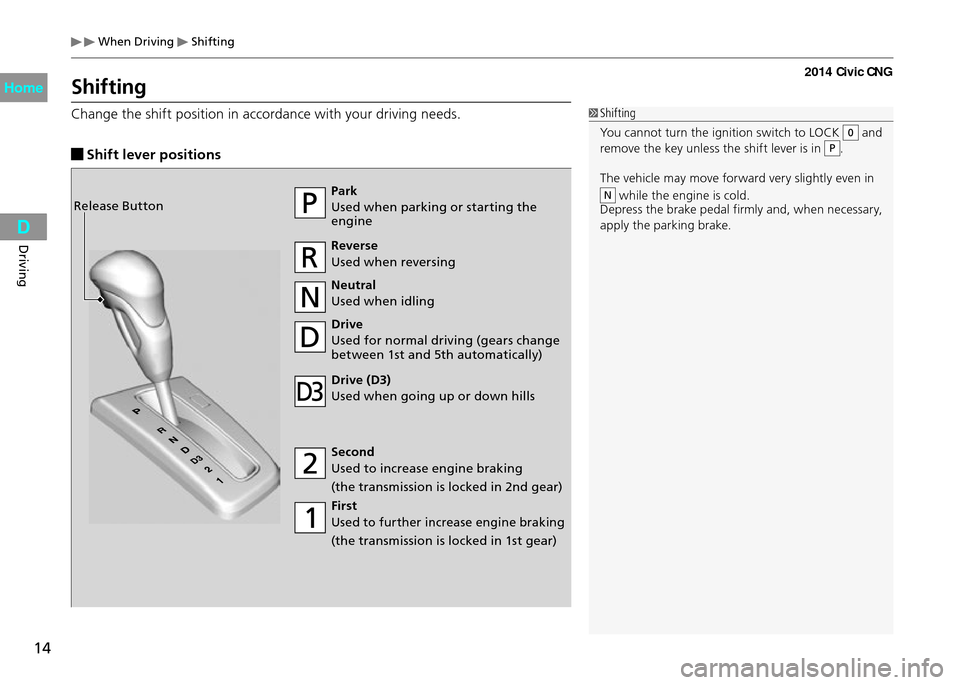
Change the shift position in accordance with your driving needs.
Shift lever positions
Park
Used when parking or starting the
engine
Reverse
Used when reversing
Neutral
Used when idling
Drive
Used for normal driving (gears change
between 1st and 5th automatically)
Drive (D3)
Used when going up or down hills
Second
Used to increase engine braking
(the transmission is locked in 2nd gear)
First
Used to further increase engine braking
(the transmission is locked in 1st gear)
Release Button
Shifting
You cannot turn the ignition switch to LOCK
0 and
remove the key unless the shift lever is in P.
The vehicle may move forward very slightly even in
N while the engine is cold.
Depress the brake pedal firmly and, when necessary,
apply the parking brake.
2014 Civic CNG
Page 30 of 46
29Continued
Handling the Unexpected
If a Tire Goes Flat Temporarily Repairing a Flat Tire
Models with tire repair kit
Temporarily Repairing a Flat Tire
This vehicle is not equipped with a spare tire. If the tire has a large cut or is
otherwise severely damaged, you will need to have the vehicle towed. If the tire
only has a small puncture, from a nail for instance, you can use the temporary tire
repair kit so that you can drive to the nearest service station for a more permanent
repair.
If a tire goes flat while driving, grasp the steering wheel firmly, and brake gradually
to reduce speed. Then stop in a safe place.
1. Park the vehicle on firm, level, and non-slippery surface and apply the parking
brake.
2. Put the shift lever in
P.
3. Turn on the hazard warning lights and turn the ignition switch to LOCK
0.
When towing a trailer, unhitch the trailer.
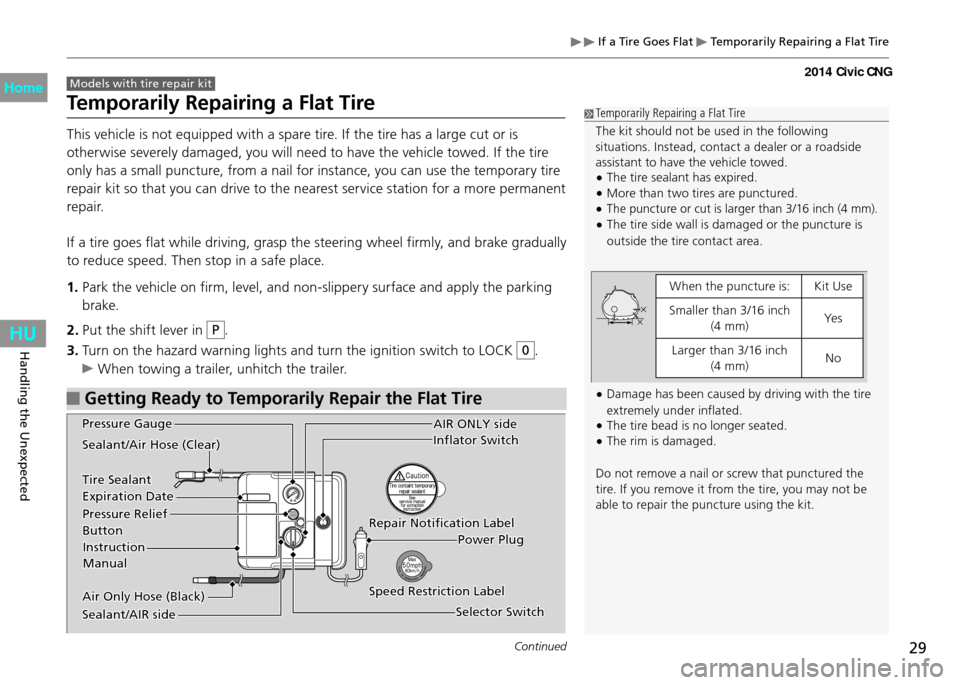
Getting Ready to Temporarily Repair the Flat Tire
AIR ONLY side
Inflator Switch
Repair Notification Label
Power Plug
Speed Restriction Label
Selector Switch
Pressure Gauge
Sealant/Air Hose (Clear)
Tire Sealant
Expiration Date
Pressure Relief
Button
Instruction
Manual
Air Only Hose (Black)
Sealant/AIR side
Temporarily Repairing a Flat Tire
The kit should not be used in the following
situations. Instead, contact a dealer or a roadside
assistant to have the vehicle towed.
The tire sealant has expired.
•More than two tires are punctured.
•The puncture or cut is larger than 3/16 inch (4 mm).
•The tire side wall is damaged or the puncture is
•outside the tire contact area.
When the puncture is: Kit Use
Smaller than 3/16 inch (4 mm) Ye s
Larger than 3/16 inch (4 mm) No
Damage has been caused by driving with the tire
•extremely under inflated.
The tire bead is no longer seated.
•The rim is damaged.
•
Do not remove a nail or screw that punctured the
tire. If you remove it from the tire, you may not be
able to repair the puncture using the kit.
2014 Civic CNG
Page 38 of 46
37
Fuel Leaks
Handling the Unexpected
If a Fuel Leak is Detected
If you smell natural gas or hear a hissing sound, except when refueling, the fuel
system may have a leak. If a Fuel Leak is Detected
WARNING
Compressed natural gas is flammable and
highly explosive. You could be killed or
seriously injured if leaking natural gas is
ignited.
If you suspect a leak, have your vehicle
immediately inspected and repaired by an
authorized Honda Civic Natural Gas
d e a l e r.
Do not jump start your vehicle if you suspect a gas
leak.
Turning Off the Manual Shut-Off Valve
We recommend that you locate the valve before
driving so that you can turn it off quickly if
ne ce s s ar y.
Turn off the valve if you ever suspect a fuel leak or
are involved in an accident.
Turn the manual shut-off valve to OFF also when
you are storing your vehicle for an extended period.
Turning Off the Manual Shut-Off Valve
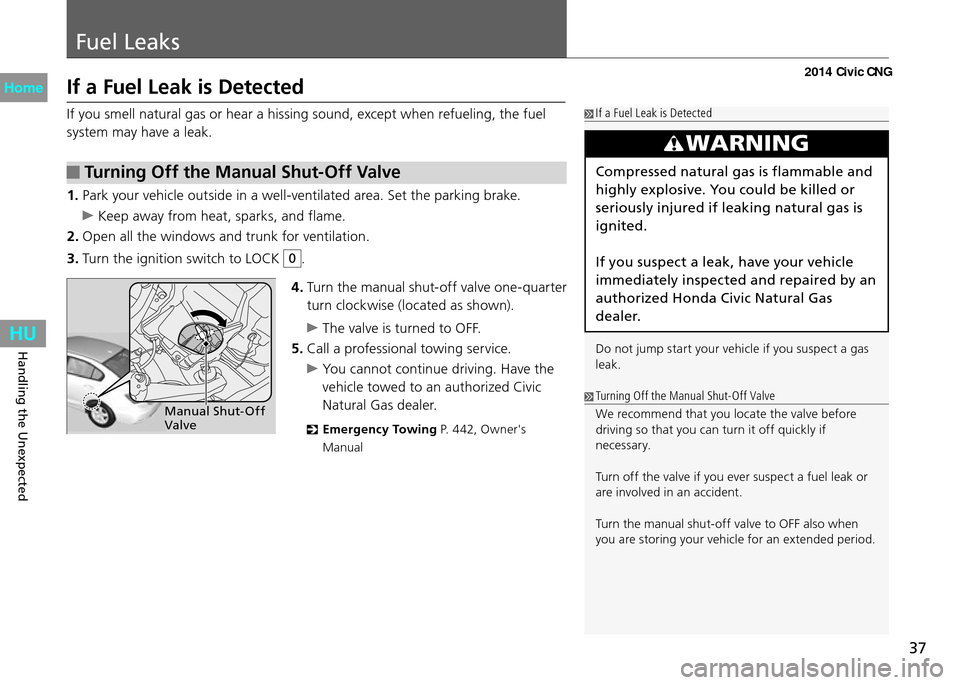
4. Turn the manual shut-off valve one-quarter
turn clockwise (located as shown).
The valve is turned to OFF.
5. Call a professional towing service.
You cannot continue driving. Have the
vehicle towed to an authorized Civic
Natural Gas dealer.
Emergency Towing
P. 442, Owner's
Manual
1. Park your vehicle outside in a well-ventilated area. Set the parking brake.
Keep away from heat, sparks, and flame.
2. Open all the windows and trunk for ventilation.
3. Turn the ignition switch to LOCK
0.
Manual Shut-Off
Valve
2014 Civic CNG
Page 41 of 46
40
Handling the Unexpected
Fuses Fuse Locations
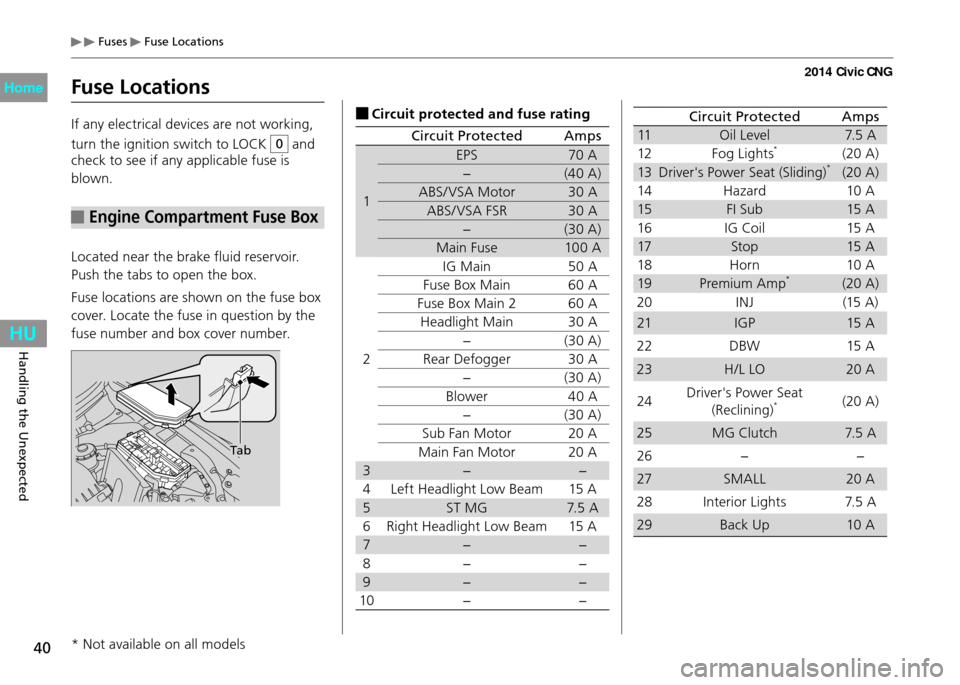
Circuit ProtectedAmps
1 EPS
70 A
− (40 A)
ABS/ VSA Motor 30 A ABS/ VSA FSR 30 A − (30 A)
Main Fuse 100 A
2 IG Main
50 A
Fuse Box Main 60 A
Fuse Box Main 2 60 A Headlight Main 30 A − (30 A)
Rear Defogger 30 A − (30 A)
Blower 40 A
− (30 A)
Sub Fan Motor 20 A
Main Fan Motor 20 A
3 − −
4 Left Headlight Low Beam 15 A
5 ST MG 7.5 A
6 Right Headlight Low Beam 15 A
7 − −
8 − −
9 − −
10 − −
Circuit Protected Amps
11 Oil Level 7.5 A
12 Fog Lights
*(20 A)
13 Driver's Power Seat (Sliding)*(20 A)
14 Hazard 10 A
15 FI Sub 15 A
16 IG Coil 15 A
17 Stop 15 A
18 Horn 10 A
19 Premium Amp
*(20 A)
20 INJ (15 A)
21 IGP 15 A
22 DBW 15 A
23 H/L LO 20 A
24 Driver's Power Seat
(Reclining)
*(20 A)
25 MG Clutch 7.5 A
26 − −
27 SMALL 20 A
28 Interior Lights 7.5 A
29 Back Up 10 A
Fuse Locations
If any electrical devices are not working,
turn the ignition switch to LOCK
0 and
check to see if any applicable fuse is
blown.
Engine Compartment Fuse Box
Located near the brake fluid reservoir.
Push the tabs to open the box.
Fuse locations are shown on the fuse box
cover. Locate the fuse in question by the
fuse number and box cover number.
Circuit protected and fuse rating
* Not available on all models
Ta b
2014 Civic CNG