light HONDA CIVIC COUPE 2016 10.G Quick Guide
[x] Cancel search | Manufacturer: HONDA, Model Year: 2016, Model line: CIVIC COUPE, Model: HONDA CIVIC COUPE 2016 10.GPages: 82, PDF Size: 5.2 MB
Page 23 of 82
38 || 39
VEHICLE CONTROLS
VEHICLE CONTROLS
Wiper Operation
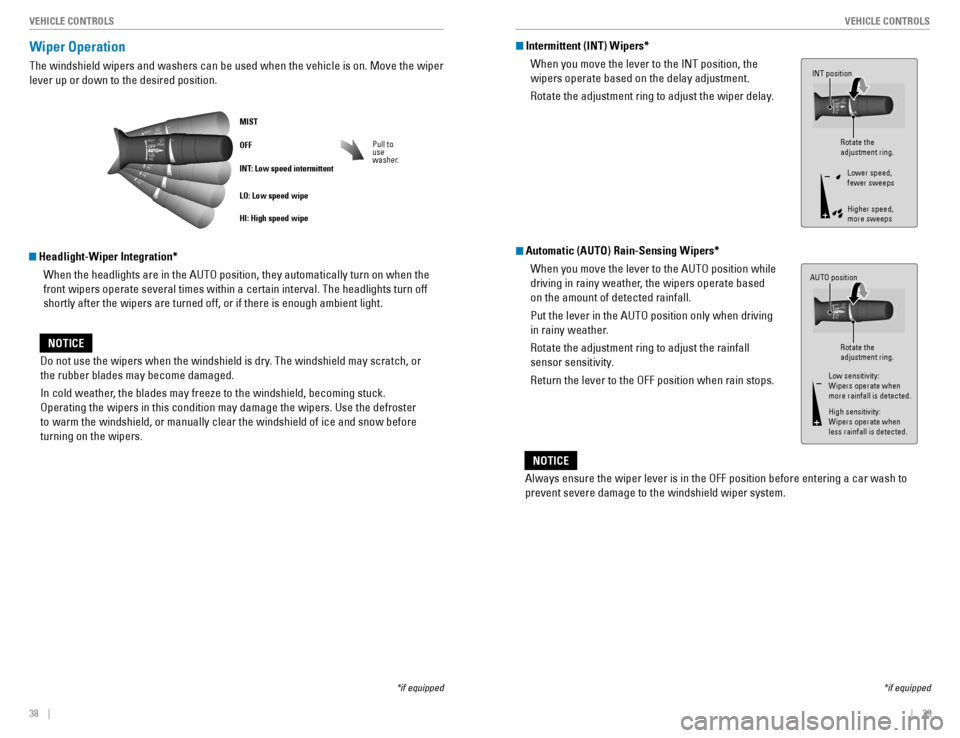
The windshield wipers and washers can be used when the vehicle is on. Move the wiper lever up or down to the desired position.
*if equipped
Pull to use
washer.
MIST OFF
INT: Low speed intermittent LO: Low speed wipe HI: High speed wipe
Headlight-Wiper Integration*
When the headlights are in the AUTO position, they automatically turn on when the
front wipers operate several times within a certain interval. The headlights turn off
shortly after the wipers are turned off, or if there is enough ambient light.
Do not use the wipers when the windshield is dry. The windshield may scratch, or the rubber blades may become damaged.
In cold weather, the blades may freeze to the windshield, becoming stuck.
Operating the wipers in this condition may damage the wipers. Use the defroster
to warm the windshield, or manually clear the windshield of ice and snow before turning on the wipers.
NOTICE
Intermittent (INT) Wipers*
When you move the lever to the INT position, the wipers operate based on the delay adjustment.
Rotate the adjustment ring to adjust the wiper delay.
Rotate the adjustment ring.
Lower speed, fewer sweeps Higher speed, more sweeps
INT position
Automatic (AUTO) Rain-Sensing Wipers*
When you move the lever to the AUTO position while
driving in rainy weather, the wipers operate based on the amount of detected rainfall. Put the lever in the AUTO position only when driving
in rainy weather. Rotate the adjustment ring to adjust the rainfall
sensor sensitivity. Return the lever to the OFF position when rain stops.
Rotate the adjustment ring.
Low sensitivity: Wipers operate whenmore rainfall is detected. High sensitivity: Wipers operate whenless rainfall is detected.
AUTO position
Always ensure the wiper lever is in the OFF position before entering a car wash to prevent severe damage to the windshield wiper system.
NOTICE
*if equipped
Page 26 of 82
44 || 45
VEHICLE CONTROLS
VEHICLE CONTROLS
Adjusting the Mirrors
Adjust the angle of the mirrors for the best visibility when you are sitting in the correct driving position.
Rearview Mirror with Day/Night Positions*
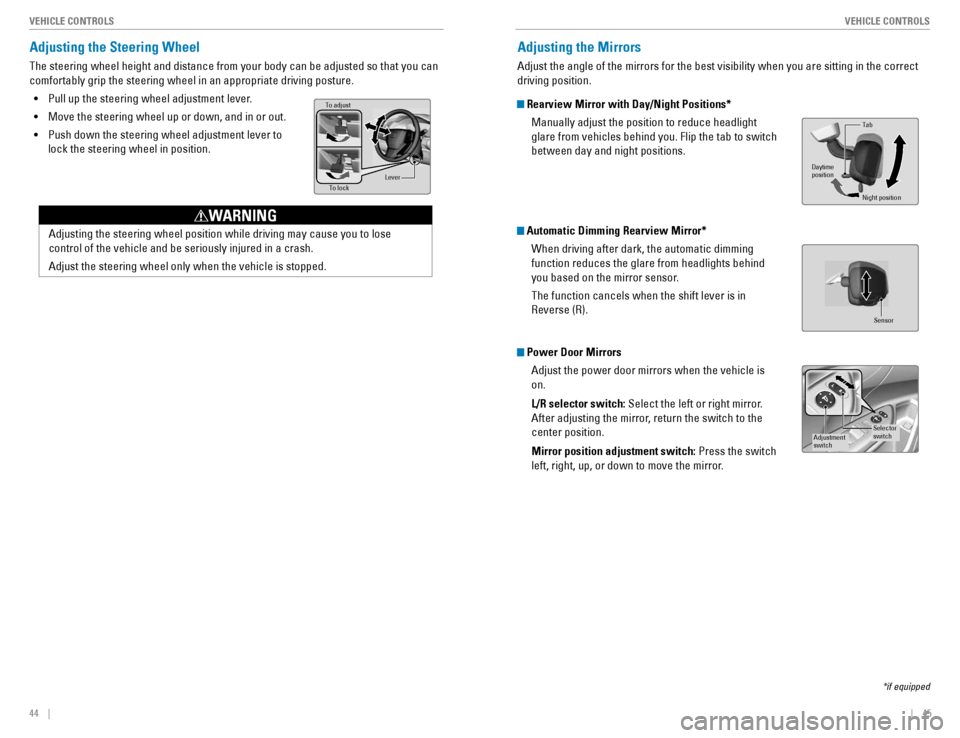
Manually adjust the position to reduce headlight glare from vehicles behind you. Flip the tab to switch between day and night positions.
Automatic Dimming Rearview Mirror*
When driving after dark, the automatic dimming function reduces the glare from headlights behind
you based on the mirror sensor. The function cancels when the shift lever is in Reverse (R).
Power Door Mirrors
Adjust the power door mirrors when the vehicle is on. L/R selector switch: Select the left or right mirror.
After adjusting the mirror, return the switch to the center position. Mirror position adjustment switch: Press the switch
left, right, up, or down to move the mirror.
Tab
Daytime position
Night position
*if equipped
Selector
switchAdjustment
switch
Sensor
Adjusting the Steering Wheel
The steering wheel height and distance from your body can be adjusted so that you can comfortably grip the steering wheel in an appropriate driving posture.
• Pull up the steering wheel adjustment lever.
• Move the steering wheel up or down, and in or out.
• Push down the steering wheel adjustment lever to
lock the steering wheel in position.
Adjusting the steering wheel position while driving may cause you to lose control of the vehicle and be seriously injured in a crash. Adjust the steering wheel only when the vehicle is stopped.
WARNING
To adjust To lock Lever
Page 30 of 82
52 || 53
AUDIO AND CONNECTIVITY
AUDIO AND CONNECTIVITY
AUDIO AND CONNECTIVITY
Learn how to operate the vehicle’s audio system.
Basic Audio Operation
Connect audio devices and operate the audio system.
USB Port
Connect a USB ash drive or other audio device, such as an iPod or iPhone ®
. Install
the ash drive or cable connector to the USB port.
Models with color audio system
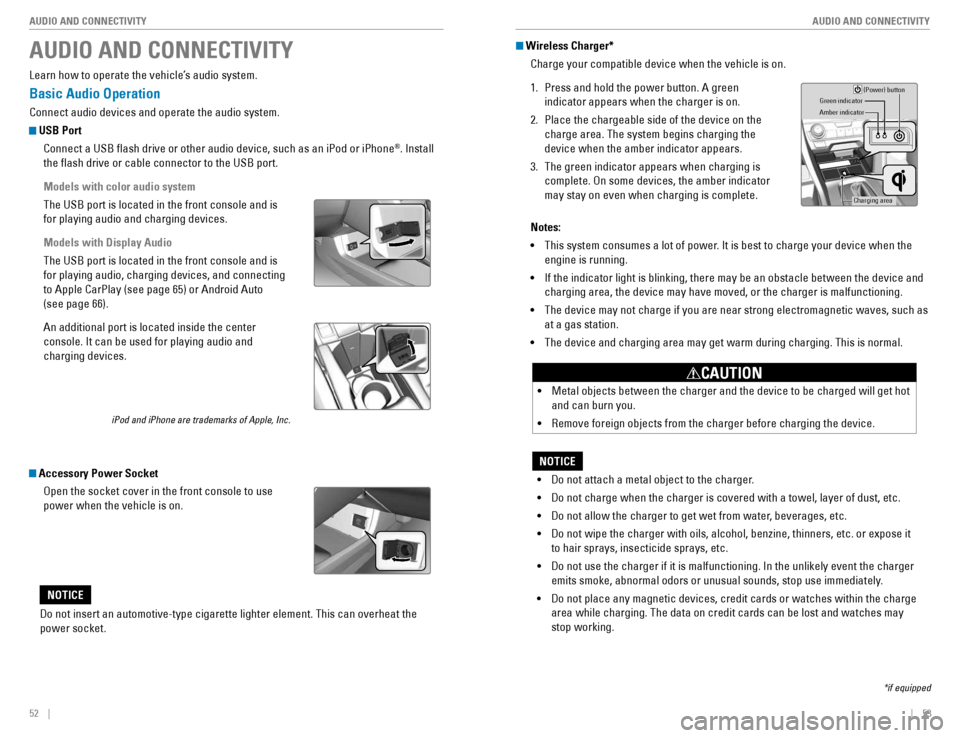
The USB port is located in the front console and is for playing audio and charging devices.
Models with Display Audio
The USB port is located in the front console and is for playing audio, charging devices, and connecting to Apple CarPlay (see page 65) or Android Auto (see page 66). An additional port is located inside the center console. It can be used for playing audio and charging devices.
iPod and iPhone are trademarks of Apple, Inc.
Do not insert an automotive-type cigarette lighter element. This can overheat the power socket.
NOTICE
Accessory Power Socket
Open the socket cover in the front console to use power when the vehicle is on.
Wireless Charger*
Charge your compatible device when the vehicle is on.
1. Press and hold the power button. A green indicator appears when the charger is on.
2. Place the chargeable side of the device on the charge area. The system begins charging the device when the amber indicator appears.
3. The green indicator appears when charging is complete. On some devices, the amber indicator may stay on even when charging is complete.
Green indicato r
Amber indicator
Charging area (Power) button
Notes: •
This system consumes a lot of power. It is best to charge your device when the
engine is running.
• If the indicator light is blinking, there may be an obstacle between the device and
charging area, the device may have moved, or the charger is malfunctioning.
• The device may not charge if you are near strong electromagnetic waves, such as
at a gas station.
• The device and charging area may get warm during charging. This is normal.
• Do not attach a metal object to the charger.
• Do not charge when the charger is covered with a towel, layer of dust, etc.
• Do not allow the charger to get wet from water, beverages, etc.
• Do not wipe the charger with oils, alcohol, benzine, thinners, etc. or expose it
to hair sprays, insecticide sprays, etc.
• Do not use the charger if it is malfunctioning. In the unlikely event the charger
emits smoke, abnormal odors or unusual sounds, stop use immediately.
• Do not place any magnetic devices, credit cards or watches within the charge
area while charging. The data on credit cards can be lost and watches may stop working.
NOTICE
• Metal objects between the charger and the device to be charged will get hot
and can burn you.
• Remove foreign objects from the charger before charging the device.
CAUTION
*if equipped
Page 42 of 82
76 || 77
BLUETOOTH ®
HANDSFREELINK ®
BLUETOOTH ®
HANDSFREELINK ®
Models with Display Audio
Basic HFL Operation
Make and receive phone calls using the vehicle’s audio system, without handling your phone. Visit
handsfreelink.com (U.S.) or handsfreelink.ca (Canada) to check phone
compatibility.
To reduce the potential for driver distraction, certain manual functions may be inoperable or grayed out while the vehicle is moving. Stop or pull over to perform the
function. Voice commands are also available.
HFL Controls
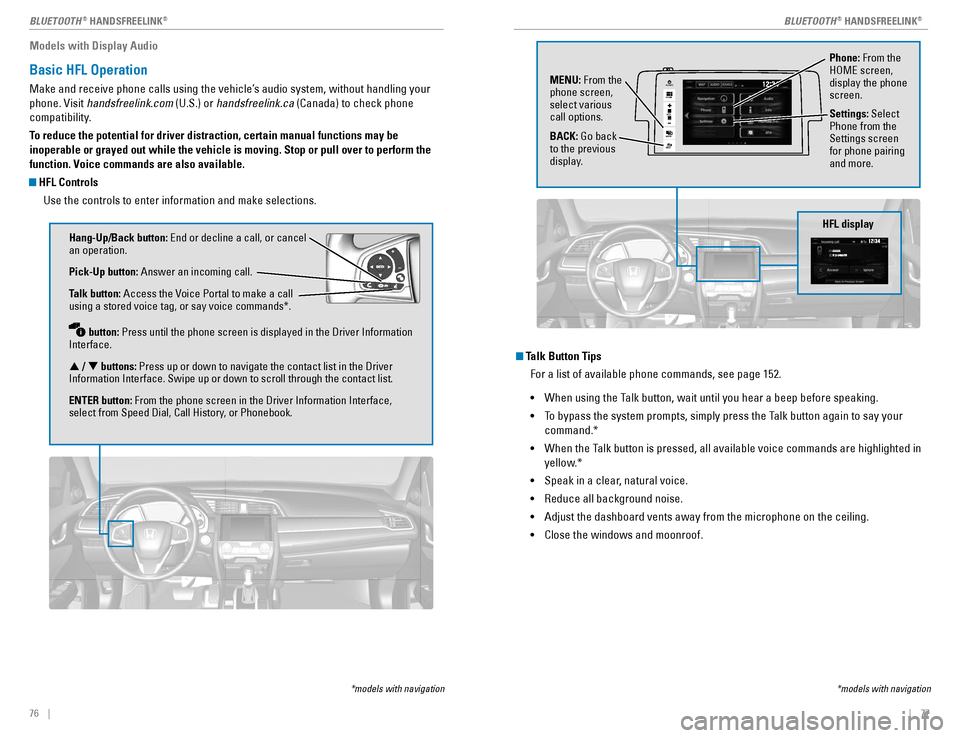
Use the controls to enter information and make selections.
Hang-Up/Back button: End or decline a call, or cancel
an operation. Pick-Up button: Answer an incoming call.
Talk button: Access the Voice Portal to make a call
using a stored voice tag, or say voice commands*. button: Press until the phone screen is displayed in the Driver Information
Interface. p / q buttons: Press up or down to navigate the contact list in the Driver
Information Interface. Swipe up or down to scroll through the contact list.ENTER button: From the phone screen in the Driver Information Interface,
select from Speed Dial, Call History, or Phonebook.
*models with navigation
Talk Button Tips
For a list of available phone commands, see page 152. • When using the Talk button, wait until you hear a beep before speaking.
• To bypass the system prompts, simply press the Talk button again to say your
command.*
• When the Talk button is pressed, all available voice commands are highlighted in
yellow.*
• Speak in a clear, natural voice.
• Reduce all background noise.
• Adjust the dashboard vents away from the microphone on the ceiling.
• Close the windows and moonroof.
Phone: From the
HOME screen, display the phone screen.
MENU:
From the
phone screen, select various call options. BACK: Go back
to the previous
display. Settings:
Select
Phone from the Settings screen for phone pairing and more.
*models with navigation
HFL display
VO L
HOME
MENU
BA CK
AUDIO
Page 49 of 82
90 || 91
DRIVING
DRIVING
DRIVING
Learn about preparation for driving, as well as other features.
Before Driving
Check the following items before you begin driving.
Exterior Checks
• Make sure there are no obstructions on the windows, door mirrors, exterior lights,
or other parts of the vehicle.
• Remove any frost, snow, or ice.
• Make sure the hood is securely closed.
• Heat from the engine and exhaust can ignite ammable materials left under the
hood, causing a re. If you’ve parked your vehicle for an extended period, inspect and remove any debris that may have collected, such as dried grass and leaves
that have fallen or have been carried in for use as a nest by a small animal. Also
check under the hood for leftover ammable materials after you or someone else has performed maintenance on your vehicle.
• Make sure the tires are in good condition.
• Make sure there are no people or objects behind or around the vehicle.
If the doors are frozen shut, use warm water around the door edges to melt any ice. Do not try to force them open, as this can damage the rubber trim around the doors. When done, wipe dry to avoid further freezing.
NOTICE
In addition: • During the rst 600 miles (1,000 km) of operation, avoid sudden acceleration or full
throttle operation so as not to damage the engine or powertrain.
• Avoid hard braking for the rst 200 miles (300 km). You should also follow this when
the brake pads are replaced.
Improper accessories or modications can affect your vehicle’s handling,
stability, and performance, and cause a crash in which you can be seriously hurt or killed.
Follow all instructions in the vehicle owner’s manual regarding accessories and modications.
WARNING
Interior Checks
• Store or secure all items on board properly.
• Do not place anything in the front-seat footwells. Make sure to secure the oor
mats.
• If you have any animals on board, do not let them move freely around in the
vehicle.
• Securely close and lock all doors and the trunk.
• Adjust your seating position, mirrors, and steering wheel properly.
• Make sure items placed on the oor behind the front seats cannot roll under the
seats.
• Everyone in the vehicle must fasten their seat belt.
• Make sure that the indicators in the instrument panel come on when you start the
vehicle, and go off soon after.
Page 50 of 82
92 || 93
DRIVING
DRIVING
Maximum Load Limit
Carrying too much cargo or improperly storing it can affect your vehicle’s
handling, stability, stopping distance, and tires, and make it unsafe.
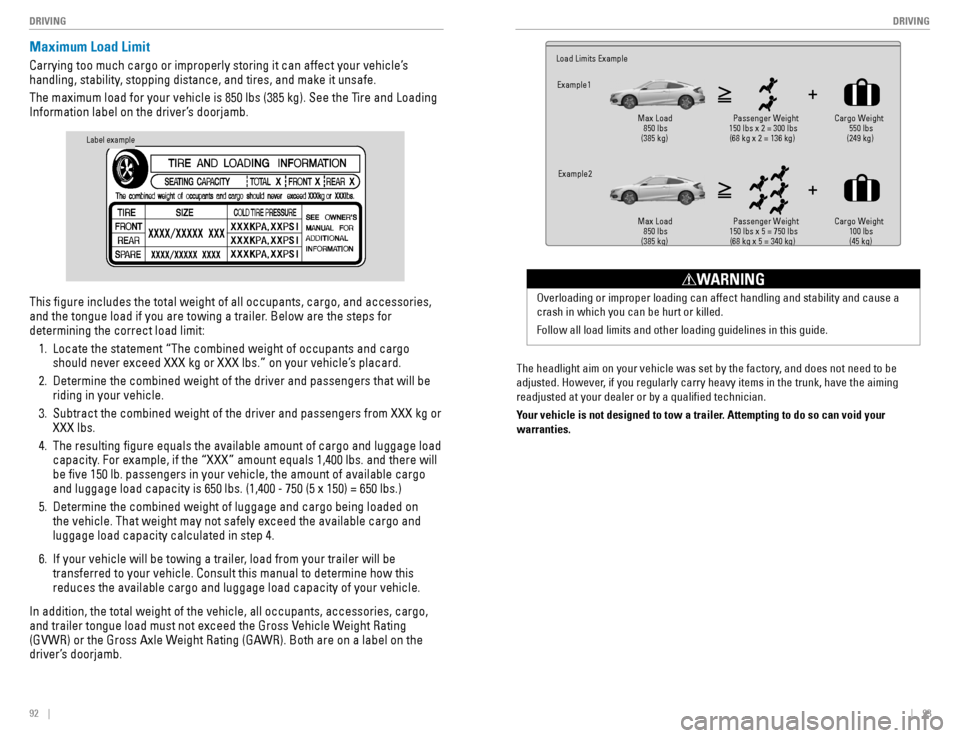
The maximum load for your vehicle is 850 lbs (385 kg). See the Tire and Loading
Information label on the driver’s doorjamb. This gure includes the total weight of all occupants, cargo, and accessories,
and the tongue load if you are towing a trailer. Below are the steps for determining the correct load limit:
1. Locate the statement “The combined weight of occupants and cargo should never exceed XXX kg or XXX lbs.” on your vehicle’s placard.
2. Determine the combined weight of the driver and passengers that will be riding in your vehicle.
3. Subtract the combined weight of the driver and passengers from XXX kg or XXX lbs.
4. The resulting gure equals the available amount of cargo and luggage load capacity. For example, if the “XXX” amount equals 1,400 lbs. and there will be ve 150 lb. passengers in your vehicle, the amount of available cargo and luggage load capacity is 650 lbs. (1,400 - 750 (5 x 150) = 650 lbs.)
5. Determine the combined weight of luggage and cargo being loaded on the vehicle. That weight may not safely exceed the available cargo and luggage load capacity calculated in step 4.
6. If your vehicle will be towing a trailer, load from your trailer will be transferred to your vehicle. Consult this manual to determine how this reduces the available cargo and luggage load capacity of your vehicle.
In addition, the total weight of the vehicle, all occupants, accessories, cargo,
and trailer tongue load must not exceed the Gross Vehicle Weight Rating
(GVWR) or the Gross Axle Weight Rating (GAWR). Both are on a label on the
driver’s doorjamb.
Label example
The headlight aim on your vehicle was set by the factory, and does not need to be
adjusted. However, if you regularly carry heavy items in the trunk, have the aiming readjusted at your dealer or by a qualied technician.
Your vehicle is not designed to tow a trailer. Attempting to do so can void your warranties.
Load Limits ExampleExample1
Max Load
850 lbs
(385 kg) 550 lbs
(249 kg)
Passenger Weight
150 lbs x 2 = 300 lbs (68 kg x 2 = 136 kg) Cargo Weight
Example2 Max Load
850 lbs
(385 kg) 100 lbs
Passenger Weight
150 lbs x 5 = 750 lbs (68 kg x 5 = 340 kg) (45 kg) Cargo Weight
Overloading or improper loading can affect handling and stability and cause a crash in which you can be hurt or killed. Follow all load limits and other loading guidelines in this guide.
WARNING
Page 51 of 82
94 || 95
DRIVING
DRIVING
Remote Engine Start*
Start your vehicle’s engine using the remote transmitter before you enter the vehicle.
Make sure the vehicle is in a safe location when using remote engine start (i.e., a well ventilated, outside area, away from any ammable materials).
Starting the Engine
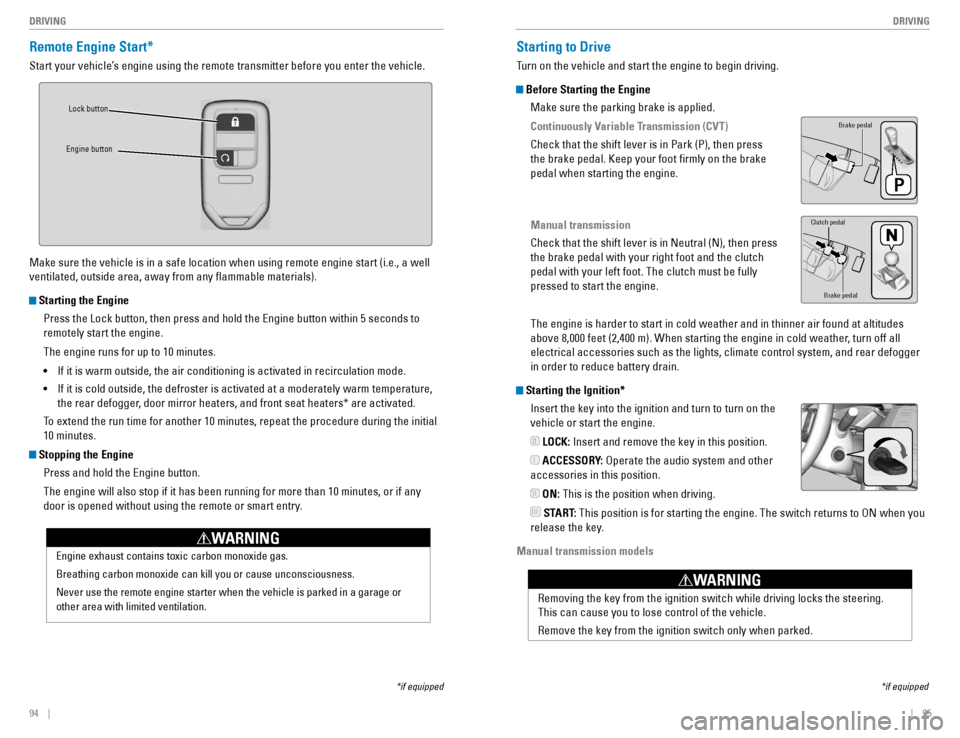
Press the Lock button, then press and hold the Engine button within 5 seconds to remotely start the engine. The engine runs for up to 10 minutes.• If it is warm outside, the air conditioning is activated in recirculation mode.
• If it is cold outside, the defroster is activated at a moderately warm temperature,
the rear defogger, door mirror heaters, and front seat heaters* are activated.
To extend the run time for another 10 minutes, repeat the procedure during the initial 10 minutes.
Stopping the Engine
Press and hold the Engine button.
The engine will also stop if it has been running for more than 10 minutes, or if any
door is opened without using the remote or smart entry.
Engine exhaust contains toxic carbon monoxide gas. Breathing carbon monoxide can kill you or cause unconsciousness.Never use the remote engine starter when the vehicle is parked in a garage or other area with limited ventilation.
WARNING
Lock button
Engine button
Starting to Drive
Turn on the vehicle and start the engine to begin driving.
Before Starting the Engine
Make sure the parking brake is applied.
Continuously Variable Transmission (CVT)
Check that the shift lever is in Park (P), then press the brake pedal. Keep your foot rmly on the brake pedal when starting the engine.
Manual transmission
Check that the shift lever is in Neutral (N), then press the brake pedal with your right foot and the clutch pedal with your left foot. The clutch must be fully pressed to start the engine. The engine is harder to start in cold weather and in thinner air found at altitudes
above 8,000 feet (2,400 m). When starting the engine in cold weather, turn off all
electrical accessories such as the lights, climate control system, and rear defogger in order to reduce battery drain.
Starting the Ignition*
Insert the key into the ignition and turn to turn on the vehicle or start the engine.
LOCK: Insert and remove the key in this position.
ACCESSORY: Operate the audio system and other
accessories in this position.
ON: This is the position when driving.
START: This position is for starting the engine. The switch returns to ON when you
release the key.
Manual transmission models
*if equipped
Brake pedal
Brake pedal
Clutch pedal
Removing the key from the ignition switch while driving locks the steering. This can cause you to lose control of the vehicle. Remove the key from the ignition switch only when parked.
WARNING
*if equipped 0 I II III
Page 53 of 82
98 || 99
DRIVING
DRIVING
Braking
Slow down or stop your vehicle, and keep it from moving when parked.
Foot Brake
Press the brake pedal to slow down or stop your vehicle from moving.
Brake Assist System
During hard or emergency braking, the system increases braking force. The brake pedal may move slightly or make a noise; this is normal. Continue to hold the brake pedal rmly down.
Anti-lock Brake System (ABS)
During hard or emergency braking, the system rapidly pumps the brakes to prevent wheel lockup and help you maintain steering control. The brake pedal may pulsate slightly during ABS operation; this is normal. Do not pump the brake pedal, and continue to hold it rmly down.
Brake pedalCVT
Brake pedal
The ABS may not function correctly if you use an incorrect tire type and size.
NOTICE
Electric Parking Brake
Keep your vehicle from moving while parked using a simple switch.
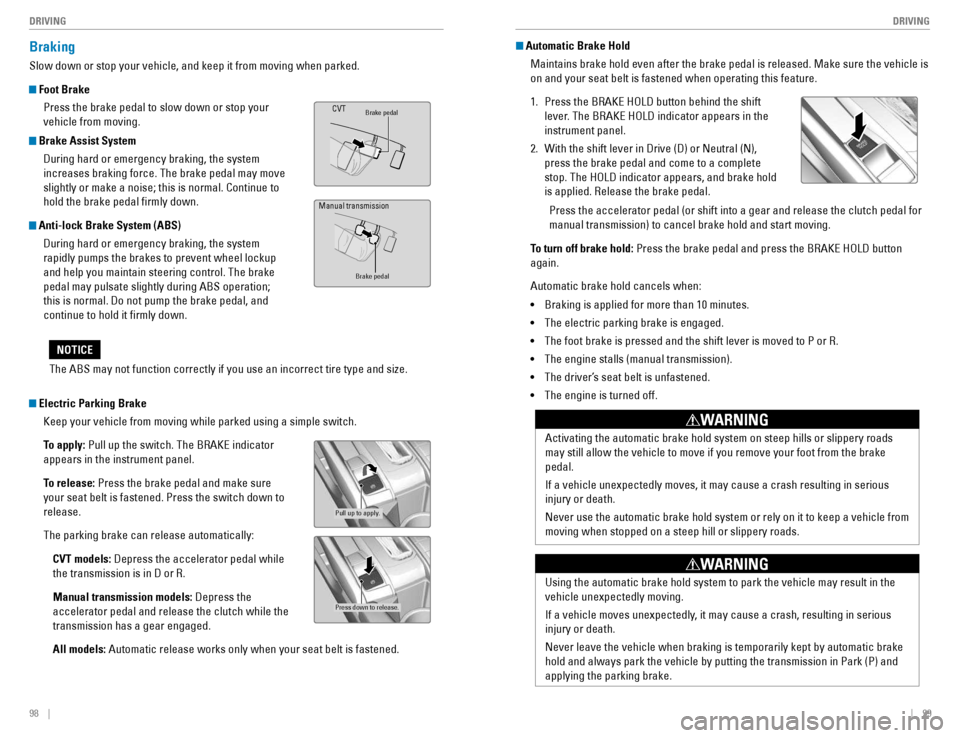
To apply: Pull up the switch. The BRAKE indicator
appears in the instrument panel.
To release: Press the brake pedal and make sure
your seat belt is fastened. Press the switch down to release. The parking brake can release automatically:
CVT models: Depress the accelerator pedal while
the transmission is in D or R.Manual transmission models: Depress the
accelerator pedal and release the clutch while the transmission has a gear engaged. All models: Automatic release works only when your seat belt is fastened.
Pull up to apply.
Press down to release.
Manual transmission
Automatic Brake Hold
Maintains brake hold even after the brake pedal is released. Make sure the vehicle is on and your seat belt is fastened when operating this feature.
1. Press the BRAKE HOLD button behind the shift
lever. The BRAKE HOLD indicator appears in the instrument panel.
2. With the shift lever in Drive (D) or Neutral (N), press the brake pedal and come to a complete stop. The HOLD indicator appears, and brake hold is applied. Release the brake pedal.
Press the accelerator pedal (or shift into a gear and release the clutch pedal for manual transmission) to cancel brake hold and start moving.
To turn off brake hold: Press the brake pedal and press the BRAKE HOLD button
again.
Automatic brake hold cancels when: • Braking is applied for more than 10 minutes.
• The electric parking brake is engaged.
• The foot brake is pressed and the shift lever is moved to P or R.
• The engine stalls (manual transmission).
• The driver’s seat belt is unfastened.
• The engine is turned off.
Activating the automatic brake hold system on steep hills or slippery roads may still allow the vehicle to move if you remove your foot from the brake pedal.
If a vehicle unexpectedly moves, it may cause a crash resulting in serious injury or death.
Never use the automatic brake hold system or rely on it to keep a vehicle from moving when stopped on a steep hill or slippery roads.
WARNING
Using the automatic brake hold system to park the vehicle may result in the vehicle unexpectedly moving.
If a vehicle moves unexpectedly, it may cause a crash, resulting in serious injury or death.
Never leave the vehicle when braking is temporarily kept by automatic brake
hold and always park the vehicle by putting the transmission in Park (P) and applying the parking brake.
WARNING
Page 54 of 82
100 || 101
DRIVING
DRIVING
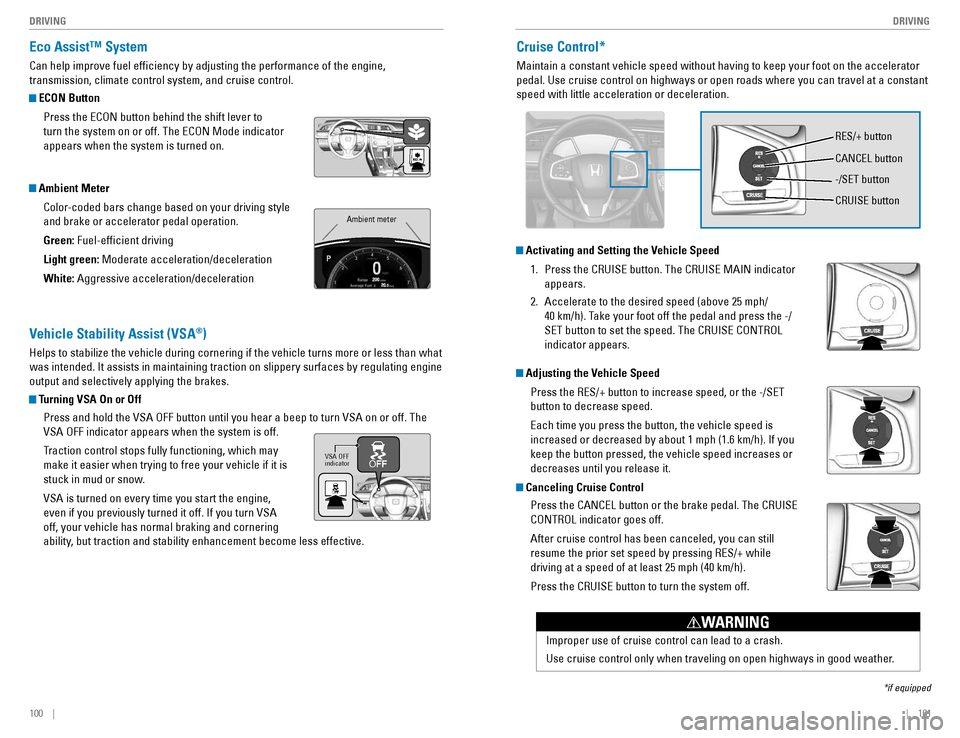
Eco Assist™ System
Can help improve fuel efciency by adjusting the performance of the engine, transmission, climate control system, and cruise control.
ECON Button
Press the ECON button behind the shift lever to turn the system on or off. The ECON Mode indicator appears when the system is turned on.
Ambient Meter
Color-coded bars change based on your driving style and brake or accelerator pedal operation. Green: Fuel-efcient driving
Light green: Moderate acceleration/deceleration
White: Aggressive acceleration/decelerationAmbient meter
Vehicle Stability Assist (VSA ®
)
Helps to stabilize the vehicle during cornering if the vehicle turns more or less than what
was intended. It assists in maintaining traction on slippery surfaces by regulating engine output and selectively applying the brakes.
Turning VSA On or Off
Press and hold the VSA OFF button until you hear a beep to turn VSA on or off. The VSA OFF indicator appears when the system is off.
Traction control stops fully functioning, which may make it easier when trying to free your vehicle if it is
stuck in mud or snow. VSA is turned on every time you start the engine, even if you previously turned it off. If you turn VSA off, your vehicle has normal braking and cornering
ability, but traction and stability enhancement become less effective.
VSA OFF
indicator
Cruise Control*
Maintain a constant vehicle speed without having to keep your foot on the accelerator
pedal. Use cruise control on highways or open roads where you can travel at a constant speed with little acceleration or deceleration.
*if equipped
RES/+ button CANCEL button CRUISE button
-/SET button
Improper use of cruise control can lead to a crash.
Use cruise control only when traveling on open highways in good weather.
WARNING
Activating and Setting the Vehicle Speed
1. Press the CRUISE button. The CRUISE MAIN indicator appears.
2. Accelerate to the desired speed (above 25 mph/ 40 km/h). Take your foot off the pedal and press the -/ SET button to set the speed. The CRUISE CONTROL indicator appears.
Adjusting the Vehicle Speed
Press the RES/+ button to increase speed, or the -/SET button to decrease speed. Each time you press the button, the vehicle speed is increased or decreased by about 1 mph (1.6 km/h). If you keep the button pressed, the vehicle speed increases or decreases until you release it.
Canceling Cruise Control
Press the CANCEL button or the brake pedal. The CRUISE CONTROL indicator goes off. After cruise control has been canceled, you can still resume the prior set speed by pressing RES/+ while driving at a speed of at least 25 mph (40 km/h). Press the CRUISE button to turn the system off.
Page 57 of 82
106 || 107
DRIVING
DRIVING
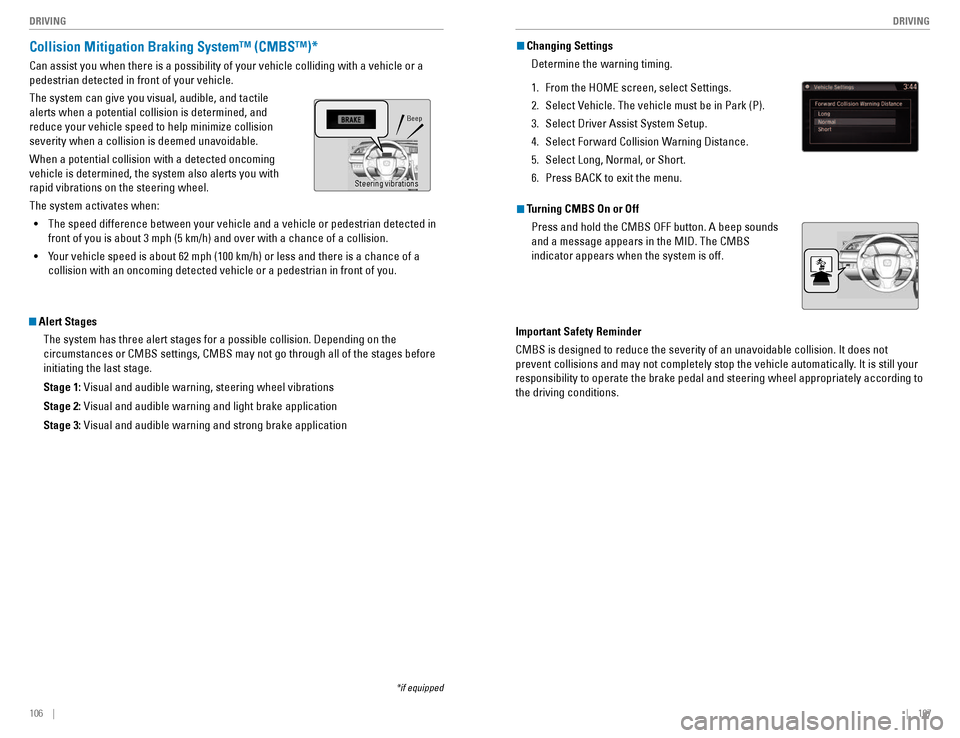
Collision Mitigation Braking System™ (CMBS™)*
Can assist you when there is a possibility of your vehicle colliding with a vehicle or a pedestrian detected in front of your vehicle. The system can give you visual, audible, and tactile alerts when a potential collision is determined, and reduce your vehicle speed to help minimize collision severity when a collision is deemed unavoidable. When a potential collision with a detected oncoming vehicle is determined, the system also alerts you with rapid vibrations on the steering wheel. The system activates when:
• The speed difference between your vehicle and a vehicle or pedestrian detected in
front of you is about 3 mph (5 km/h) and over with a chance of a collision.
• Your vehicle speed is about 62 mph (100 km/h) or less and there is a chance of a
collision with an oncoming detected vehicle or a pedestrian in front of you.
Changing Settings
Determine the warning timing.
1. From the HOME screen, select Settings.
2. Select Vehicle. The vehicle must be in Park (P).
3. Select Driver Assist System Setup.
4. Select Forward Collision Warning Distance.
5. Select Long, Normal, or Short.
6. Press BACK to exit the menu.
*if equipped
Alert Stages
The system has three alert stages for a possible collision. Depending on the circumstances or CMBS settings, CMBS may not go through all of the stages before initiating the last stage. Stage 1: Visual and audible warning, steering wheel vibrations
Stage 2: Visual and audible warning and light brake application
Stage 3: Visual and audible warning and strong brake application
Beep
Steering vibrations
Important Safety Reminder
CMBS is designed to reduce the severity of an unavoidable collision. It does not
prevent collisions and may not completely stop the vehicle automatically. It is still your responsibility to operate the brake pedal and steering wheel appropriately according to the driving conditions.
Turning CMBS On or Off
Press and hold the CMBS OFF button. A beep sounds and a message appears in the MID. The CMBS indicator appears when the system is off.