wheel HONDA CIVIC COUPE 2016 10.G Quick Guide
[x] Cancel search | Manufacturer: HONDA, Model Year: 2016, Model line: CIVIC COUPE, Model: HONDA CIVIC COUPE 2016 10.GPages: 82, PDF Size: 5.2 MB
Page 37 of 82
66 || 67
AUDIO AND CONNECTIVITY
AUDIO AND CONNECTIVITY
Models with Display Audio
Android Auto™
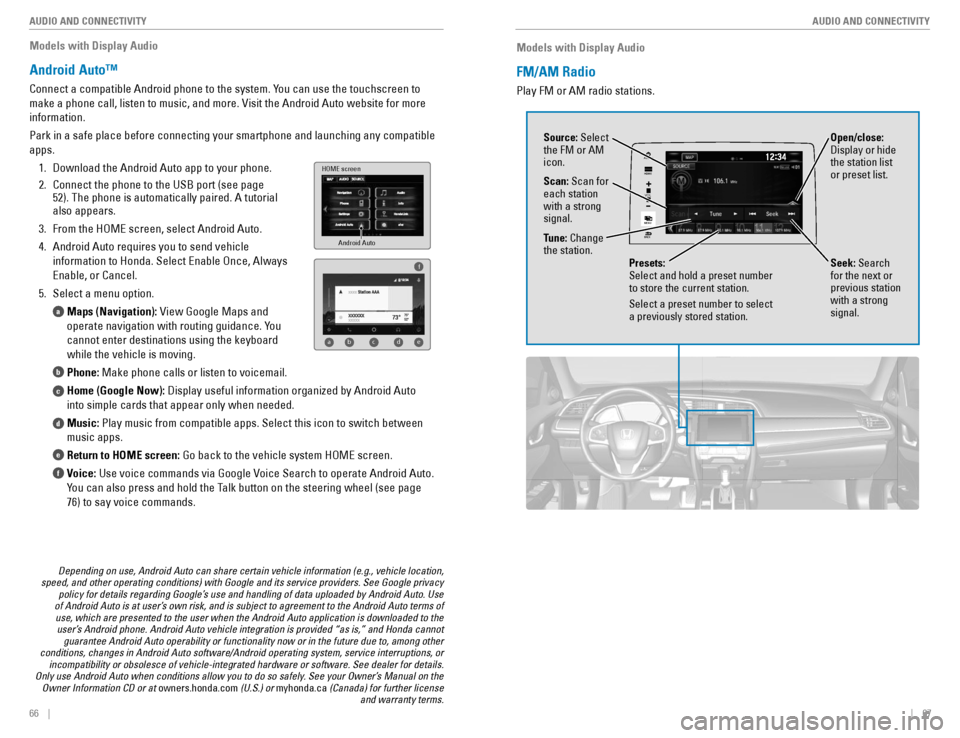
Connect a compatible Android phone to the system. You can use the touchscreen to
make a phone call, listen to music, and more. Visit the Android Auto website for more information. Park in a safe place before connecting your smartphone and launching any compatible apps.
1. Download the Android Auto app to your phone.
2. Connect the phone to the USB port (see page 52). The phone is automatically paired. A tutorial also appears.
3. From the HOME screen, select Android Auto.
4. Android Auto requires you to send vehicle information to Honda. Select Enable Once, Always Enable, or Cancel.
5. Select a menu option. Maps (Navigation): View Google Maps and
operate navigation with routing guidance. You cannot enter destinations using the keyboard while the vehicle is moving. Phone: Make phone calls or listen to voicemail.
Home (Google Now): Display useful information organized by Android Auto
into simple cards that appear only when needed.Music: Play music from compatible apps. Select this icon to switch between
music apps.Return to HOME screen: Go back to the vehicle system HOME screen.
Voice: Use voice commands via Google Voice Search to operate Android Auto.
You can also press and hold the Talk button on the steering wheel (see page 76) to say voice commands.
a
b
c
d
e
f
Android Auto
HOME screen
f
ab cde
Depending on use, Android Auto can share certain vehicle information (e.g., vehicle location,
speed, and other operating conditions) with Google and its service providers. See Google privacy policy for details regarding Google’s use and handling of data uploaded by Android Auto. Use
of Android Auto is at user’s own risk, and is subject to agreement to the Android Auto terms of use, which are presented to the user when the Android Auto application is downloaded to the user’s Android phone. Android Auto vehicle integration is provided “as is,” and Honda cannot guarantee Android Auto operability or functionality now or in the future due to, among other
conditions, changes in Android Auto software/Android operating system, service interruptions, or incompatibility or obsolesce of vehicle-integrated hardware or software. See dealer for details.
Only use Android Auto when conditions allow you to do so safely. See your Owner’s Manual on the Owner Information CD or at owners.honda.com (U.S.) or myhonda.ca (Canada) for further license
and warranty terms.
Models with Display Audio
FM/AM Radio
Play FM or AM radio stations.
VOL
HOME
MENU
BA CK
AUDIO
Source: Select
the FM or AM icon.
Tune: Change
the station.
Seek: Search
for the next or previous station with a strong signal.
Open/close: Display or hide the station list or preset list.
Scan:
Scan for
each station with a strong signal.
Presets:
Select and hold a preset number to store the current station. Select a preset number to select a previously stored station.
Page 44 of 82
80 || 81
BLUETOOTH ®
HANDSFREELINK ®
BLUETOOTH ®
HANDSFREELINK ®
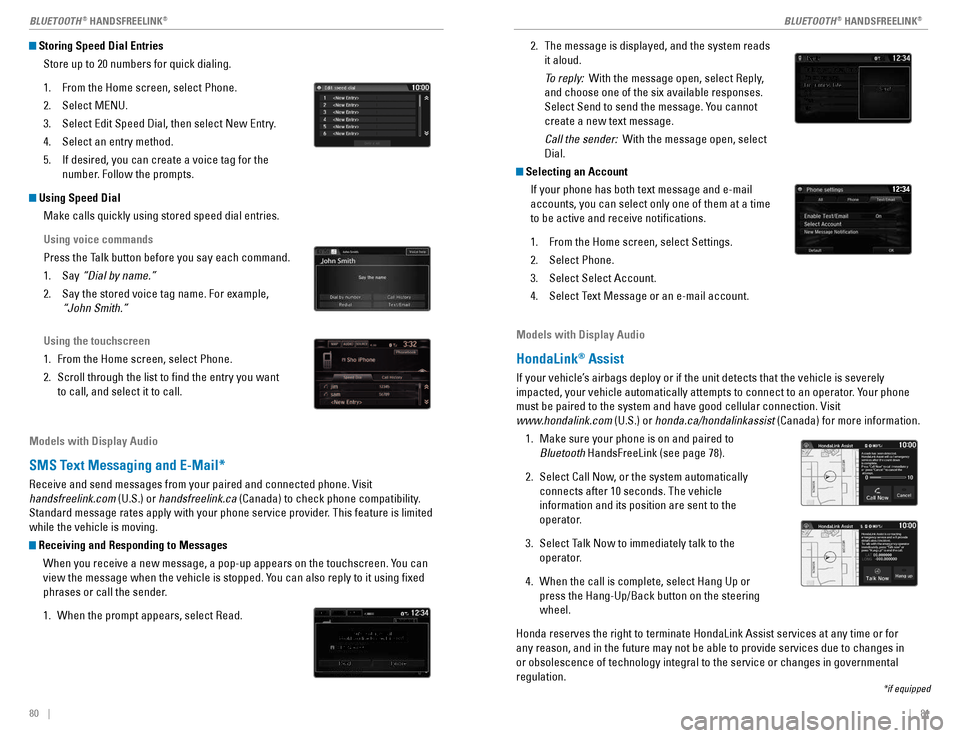
2. The message is displayed, and the system reads
it aloud.
To reply: With the message open, select Reply,
and choose one of the six available responses.
Select Send to send the message. You cannot create a new text message.
Call the sender: With the message open, select
Dial.
Selecting an Account
If your phone has both text message and e-mail accounts, you can select only one of them at a time to be active and receive notications.
1. From the Home screen, select Settings.
2. Select Phone.
3. Select Select Account.
4. Select Text Message or an e-mail account.
Storing Speed Dial Entries
Store up to 20 numbers for quick dialing.
1. From the Home screen, select Phone.
2. Select MENU.
3. Select Edit Speed Dial, then select New Entry.
4. Select an entry method.
5. If desired, you can create a voice tag for the number. Follow the prompts.
Using Speed Dial
Make calls quickly using stored speed dial entries.
Using voice commands
Press the Talk button before you say each command.
1. Say “Dial by name.”
2. Say the stored voice tag name. For example, “John Smith.”
Using the touchscreen
1. From the Home screen, select Phone.
2. Scroll through the list to nd the entry you want
to call, and select it to call.
Models with Display Audio
HondaLink ®
Assist
If your vehicle’s airbags deploy or if the unit detects that the vehicle is severely
impacted, your vehicle automatically attempts to connect to an operator. Your phone must be paired to the system and have good cellular connection. Visit
www.hondalink.com (U.S.) or honda.ca/hondalinkassist (Canada) for more information.
1. Make sure your phone is on and paired to Bluetooth HandsFreeLink (see page 78).
2. Select Call Now, or the system automatically connects after 10 seconds. The vehicle information and its position are sent to the
operator.
3. Select Talk Now to immediately talk to the operator.
4. When the call is complete, select Hang Up or press the Hang-Up/Back button on the steering wheel.
Honda reserves the right to terminate HondaLink Assist services at any time or for any reason, and in the future may not be able to provide services due to changes in or obsolescence of technology integral to the service or changes in governmental regulation.
Models with Display Audio
SMS Text Messaging and E-Mail*
Receive and send messages from your paired and connected phone. Visit handsfreelink.com (U.S.) or handsfreelink.ca (Canada) to check phone compatibility.
Standard message rates apply with your phone service provider. This feature is limited while the vehicle is moving.
Receiving and Responding to Messages
When you receive a new message, a pop-up appears on the touchscreen. You can
view the message when the vehicle is stopped. You can also reply to it using xed
phrases or call the sender.
1. When the prompt appears, select Read.
*if equipped
Page 45 of 82
| 83
NAVIGATION82 |
BLUETOOTH
®
HANDSFREELINK ®
Models with Display Audio
Siri®
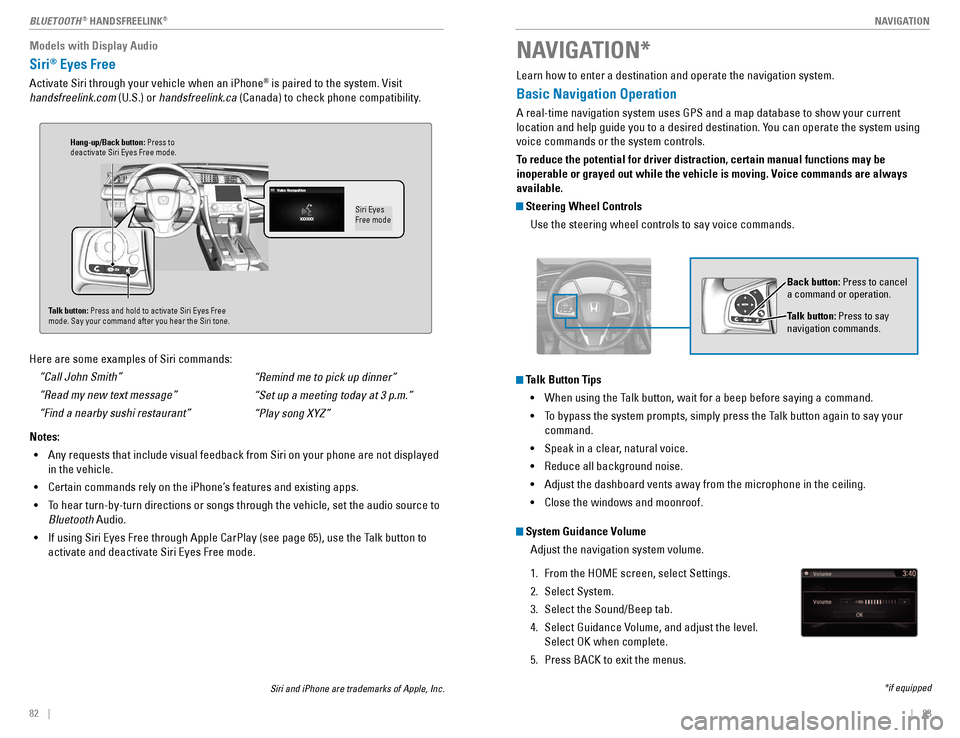
Eyes Free
Activate Siri through your vehicle when an iPhone ®
is paired to the system. Visit
handsfreelink.com (U.S.) or handsfreelink.ca (Canada) to check phone compatibility.
Here are some examples of Siri commands: “Call John Smith” “Read my new text message”“Find a nearby sushi restaurant”
Notes: • Any requests that include visual feedback from Siri on your phone are not displayed
in the vehicle.
• Certain commands rely on the iPhone’s features and existing apps.
• To hear turn-by-turn directions or songs through the vehicle, set the audio source to
Bluetooth Audio.
• If using Siri Eyes Free through Apple CarPlay (see page 65), use the Talk button to
activate and deactivate Siri Eyes Free mode. “Remind me to pick up dinner”“Set up a meeting today at 3 p.m.”“Play song XYZ”
Siri Eyes Free mode
Talk button:
Press and hold to activate Siri Eyes Free
mode. Say your command after you hear the Siri tone.
Siri and iPhone are trademarks of Apple, Inc.
Hang-up/Back button: Press to
deactivate Siri Eyes Free mode. Learn how to enter a destination and operate the navigation system.
Basic Navigation Operation
A real-time navigation system uses GPS and a map database to show your current
location and help guide you to a desired destination. You can operate the system using voice commands or the system controls.
To reduce the potential for driver distraction, certain manual functions may be
inoperable or grayed out while the vehicle is moving. Voice commands are always available.
Steering Wheel Controls
Use the steering wheel controls to say voice commands.
Talk Button Tips
•
When using the Talk button, wait for a beep before saying a command.
• To bypass the system prompts, simply press the Talk button again to say your
command.
• Speak in a clear, natural voice.
• Reduce all background noise.
• Adjust the dashboard vents away from the microphone in the ceiling.
• Close the windows and moonroof.
Back button: Press to cancel
a command or operation.
Talk button: Press to say
navigation commands.
NAVIGATION*
*if equipped
System Guidance Volume
Adjust the navigation system volume.
1. From the HOME screen, select Settings.
2. Select System.
3. Select the Sound/Beep tab.
4. Select Guidance Volume, and adjust the level.
Select OK when complete.
5. Press BACK to exit the menus.
Page 49 of 82
90 || 91
DRIVING
DRIVING
DRIVING
Learn about preparation for driving, as well as other features.
Before Driving
Check the following items before you begin driving.
Exterior Checks
• Make sure there are no obstructions on the windows, door mirrors, exterior lights,
or other parts of the vehicle.
• Remove any frost, snow, or ice.
• Make sure the hood is securely closed.
• Heat from the engine and exhaust can ignite ammable materials left under the
hood, causing a re. If you’ve parked your vehicle for an extended period, inspect and remove any debris that may have collected, such as dried grass and leaves
that have fallen or have been carried in for use as a nest by a small animal. Also
check under the hood for leftover ammable materials after you or someone else has performed maintenance on your vehicle.
• Make sure the tires are in good condition.
• Make sure there are no people or objects behind or around the vehicle.
If the doors are frozen shut, use warm water around the door edges to melt any ice. Do not try to force them open, as this can damage the rubber trim around the doors. When done, wipe dry to avoid further freezing.
NOTICE
In addition: • During the rst 600 miles (1,000 km) of operation, avoid sudden acceleration or full
throttle operation so as not to damage the engine or powertrain.
• Avoid hard braking for the rst 200 miles (300 km). You should also follow this when
the brake pads are replaced.
Improper accessories or modications can affect your vehicle’s handling,
stability, and performance, and cause a crash in which you can be seriously hurt or killed.
Follow all instructions in the vehicle owner’s manual regarding accessories and modications.
WARNING
Interior Checks
• Store or secure all items on board properly.
• Do not place anything in the front-seat footwells. Make sure to secure the oor
mats.
• If you have any animals on board, do not let them move freely around in the
vehicle.
• Securely close and lock all doors and the trunk.
• Adjust your seating position, mirrors, and steering wheel properly.
• Make sure items placed on the oor behind the front seats cannot roll under the
seats.
• Everyone in the vehicle must fasten their seat belt.
• Make sure that the indicators in the instrument panel come on when you start the
vehicle, and go off soon after.
Page 53 of 82
98 || 99
DRIVING
DRIVING
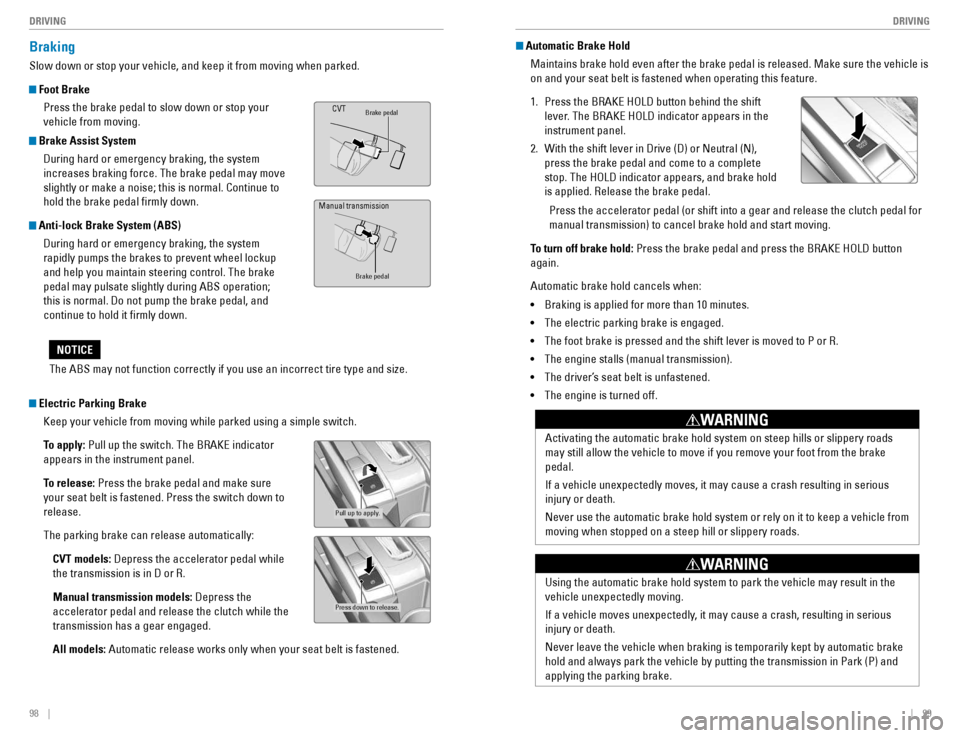
Braking
Slow down or stop your vehicle, and keep it from moving when parked.
Foot Brake
Press the brake pedal to slow down or stop your vehicle from moving.
Brake Assist System
During hard or emergency braking, the system increases braking force. The brake pedal may move slightly or make a noise; this is normal. Continue to hold the brake pedal rmly down.
Anti-lock Brake System (ABS)
During hard or emergency braking, the system rapidly pumps the brakes to prevent wheel lockup and help you maintain steering control. The brake pedal may pulsate slightly during ABS operation; this is normal. Do not pump the brake pedal, and continue to hold it rmly down.
Brake pedalCVT
Brake pedal
The ABS may not function correctly if you use an incorrect tire type and size.
NOTICE
Electric Parking Brake
Keep your vehicle from moving while parked using a simple switch.
To apply: Pull up the switch. The BRAKE indicator
appears in the instrument panel.
To release: Press the brake pedal and make sure
your seat belt is fastened. Press the switch down to release. The parking brake can release automatically:
CVT models: Depress the accelerator pedal while
the transmission is in D or R.Manual transmission models: Depress the
accelerator pedal and release the clutch while the transmission has a gear engaged. All models: Automatic release works only when your seat belt is fastened.
Pull up to apply.
Press down to release.
Manual transmission
Automatic Brake Hold
Maintains brake hold even after the brake pedal is released. Make sure the vehicle is on and your seat belt is fastened when operating this feature.
1. Press the BRAKE HOLD button behind the shift
lever. The BRAKE HOLD indicator appears in the instrument panel.
2. With the shift lever in Drive (D) or Neutral (N), press the brake pedal and come to a complete stop. The HOLD indicator appears, and brake hold is applied. Release the brake pedal.
Press the accelerator pedal (or shift into a gear and release the clutch pedal for manual transmission) to cancel brake hold and start moving.
To turn off brake hold: Press the brake pedal and press the BRAKE HOLD button
again.
Automatic brake hold cancels when: • Braking is applied for more than 10 minutes.
• The electric parking brake is engaged.
• The foot brake is pressed and the shift lever is moved to P or R.
• The engine stalls (manual transmission).
• The driver’s seat belt is unfastened.
• The engine is turned off.
Activating the automatic brake hold system on steep hills or slippery roads may still allow the vehicle to move if you remove your foot from the brake pedal.
If a vehicle unexpectedly moves, it may cause a crash resulting in serious injury or death.
Never use the automatic brake hold system or rely on it to keep a vehicle from moving when stopped on a steep hill or slippery roads.
WARNING
Using the automatic brake hold system to park the vehicle may result in the vehicle unexpectedly moving.
If a vehicle moves unexpectedly, it may cause a crash, resulting in serious injury or death.
Never leave the vehicle when braking is temporarily kept by automatic brake
hold and always park the vehicle by putting the transmission in Park (P) and applying the parking brake.
WARNING
Page 56 of 82
104 || 105
DRIVING
DRIVING
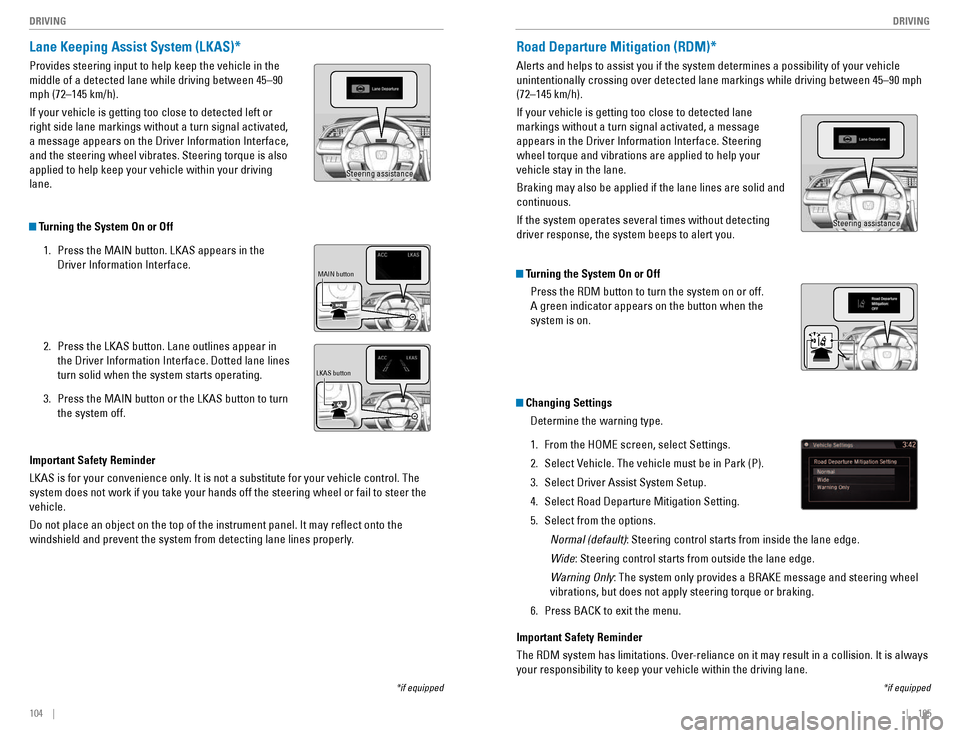
Lane Keeping Assist System (LKAS)*
Provides steering input to help keep the vehicle in the middle of a detected lane while driving between 45–90 mph (72–145 km/h). If your vehicle is getting too close to detected left or right side lane markings without a turn signal activated, a message appears on the Driver Information Interface, and the steering wheel vibrates. Steering torque is also applied to help keep your vehicle within your driving lane.
Turning the System On or Off
1. Press the MAIN button. LKAS appears in the
Driver Information Interface.
2. Press the LKAS button. Lane outlines appear in the Driver Information Interface. Dotted lane lines turn solid when the system starts operating.
3. Press the MAIN button or the LKAS button to turn the system off.
Important Safety Reminder
LKAS is for your convenience only. It is not a substitute for your vehicle control. The
system does not work if you take your hands off the steering wheel or fail to steer the vehicle. Do not place an object on the top of the instrument panel. It may reect onto the
windshield and prevent the system from detecting lane lines properly.
MAIN button
*if equipped
Steering assistance
LKAS button
Road Departure Mitigation (RDM)*
Alerts and helps to assist you if the system determines a possibility of your vehicle
unintentionally crossing over detected lane markings while driving between 45–90 mph (72–145 km/h). If your vehicle is getting too close to detected lane markings without a turn signal activated, a message appears in the Driver Information Interface. Steering wheel torque and vibrations are applied to help your vehicle stay in the lane. Braking may also be applied if the lane lines are solid and continuous. If the system operates several times without detecting driver response, the system beeps to alert you.
Changing Settings
Determine the warning type.
1. From the HOME screen, select Settings.
2. Select Vehicle. The vehicle must be in Park (P).
3. Select Driver Assist System Setup.
4. Select Road Departure Mitigation Setting.
5. Select from the options. Normal (default) : Steering control starts from inside the lane edge.
Wide : Steering control starts from outside the lane edge.
Warning Only : The system only provides a BRAKE message and steering wheel
vibrations, but does not apply steering torque or braking.
6. Press BACK to exit the menu.
Important Safety Reminder
The RDM system has limitations. Over-reliance on it may result in a collision. It is always your responsibility to keep your vehicle within the driving lane.
*if equipped
Turning the System On or Off
Press the RDM button to turn the system on or off. A green indicator appears on the button when the system is on.
RDM Button
Indicator
Steering assistance
Page 57 of 82
106 || 107
DRIVING
DRIVING
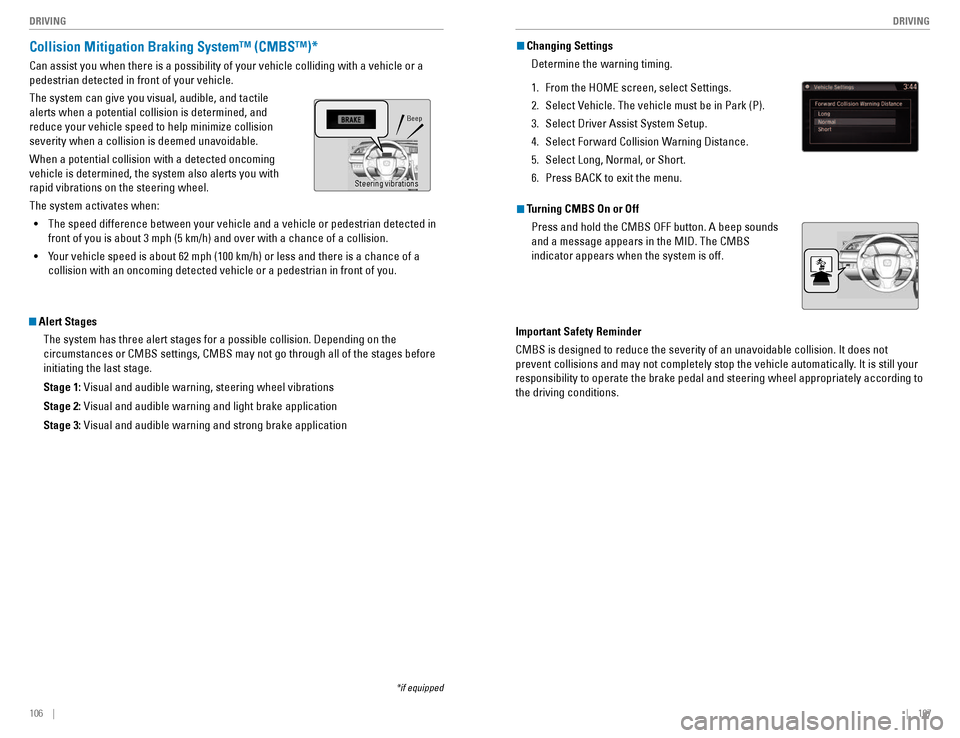
Collision Mitigation Braking System™ (CMBS™)*
Can assist you when there is a possibility of your vehicle colliding with a vehicle or a pedestrian detected in front of your vehicle. The system can give you visual, audible, and tactile alerts when a potential collision is determined, and reduce your vehicle speed to help minimize collision severity when a collision is deemed unavoidable. When a potential collision with a detected oncoming vehicle is determined, the system also alerts you with rapid vibrations on the steering wheel. The system activates when:
• The speed difference between your vehicle and a vehicle or pedestrian detected in
front of you is about 3 mph (5 km/h) and over with a chance of a collision.
• Your vehicle speed is about 62 mph (100 km/h) or less and there is a chance of a
collision with an oncoming detected vehicle or a pedestrian in front of you.
Changing Settings
Determine the warning timing.
1. From the HOME screen, select Settings.
2. Select Vehicle. The vehicle must be in Park (P).
3. Select Driver Assist System Setup.
4. Select Forward Collision Warning Distance.
5. Select Long, Normal, or Short.
6. Press BACK to exit the menu.
*if equipped
Alert Stages
The system has three alert stages for a possible collision. Depending on the circumstances or CMBS settings, CMBS may not go through all of the stages before initiating the last stage. Stage 1: Visual and audible warning, steering wheel vibrations
Stage 2: Visual and audible warning and light brake application
Stage 3: Visual and audible warning and strong brake application
Beep
Steering vibrations
Important Safety Reminder
CMBS is designed to reduce the severity of an unavoidable collision. It does not
prevent collisions and may not completely stop the vehicle automatically. It is still your responsibility to operate the brake pedal and steering wheel appropriately according to the driving conditions.
Turning CMBS On or Off
Press and hold the CMBS OFF button. A beep sounds and a message appears in the MID. The CMBS indicator appears when the system is off.
Page 59 of 82
110 || 111
DRIVING
DRIVING
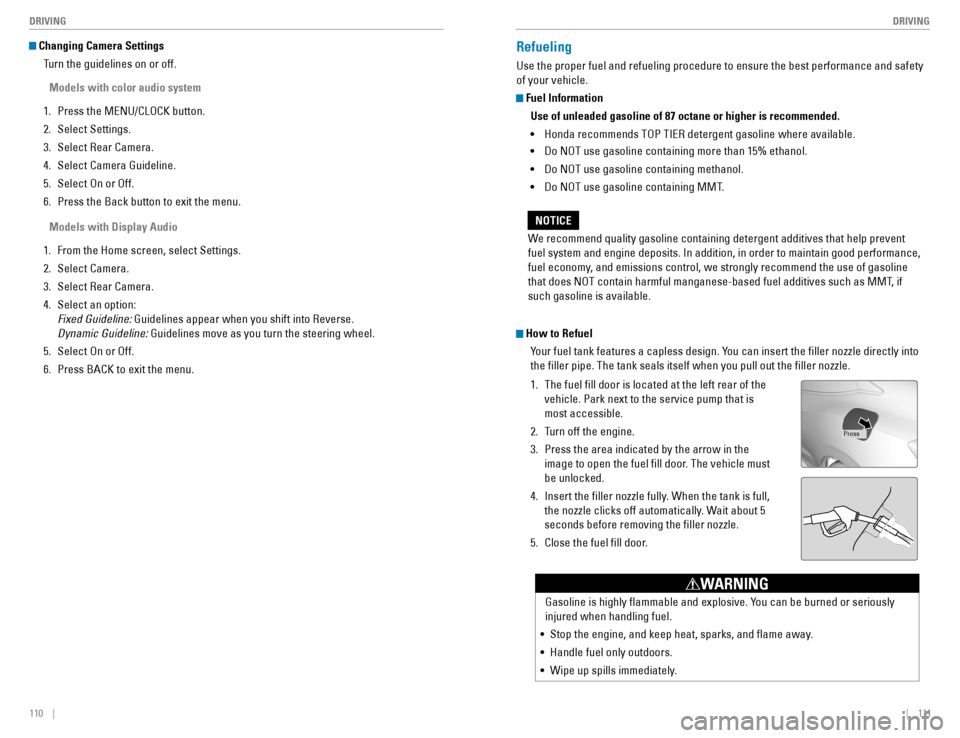
Models with Display Audio
1. From the Home screen, select Settings.
2. Select Camera.
3. Select Rear Camera.
4. Select an option:
Fixed Guideline: Guidelines appear when you shift into Reverse.
Dynamic Guideline: Guidelines move as you turn the steering wheel.
5. Select On or Off.
6. Press BACK to exit the menu.
Changing Camera Settings
Turn the guidelines on or off.
Models with color audio system
1. Press the MENU/CLOCK button.
2. Select Settings.
3. Select Rear Camera.
4. Select Camera Guideline.
5. Select On or Off.
6. Press the Back button to exit the menu.
Refueling
Use the proper fuel and refueling procedure to ensure the best performance and safety of your vehicle.
Fuel Information
Use of unleaded gasoline of 87 octane or higher is recommended. • Honda recommends TOP TIER detergent gasoline where available.
• Do NOT use gasoline containing more than 15% ethanol.
• Do NOT use gasoline containing methanol.
• Do NOT use gasoline containing MMT.
We recommend quality gasoline containing detergent additives that help prevent
fuel system and engine deposits. In addition, in order to maintain good performance,
fuel economy, and emissions control, we strongly recommend the use of gasoline
that does NOT contain harmful manganese-based fuel additives such as MMT, if such gasoline is available.
NOTICE
Gasoline is highly ammable and explosive. You can be burned or seriously injured when handling fuel.
• Stop the engine, and keep heat, sparks, and ame away.
• Handle fuel only outdoors.
• Wipe up spills immediately.
WARNING
How to Refuel
Your fuel tank features a capless design. You can insert the ller nozzle directly into the ller pipe. The tank seals itself when you pull out the ller nozzle.
1. The fuel ll door is located at the left rear of the
vehicle. Park next to the service pump that is most accessible.
2. Turn off the engine.
3. Press the area indicated by the arrow in the image to open the fuel ll door. The vehicle must be unlocked.
4. Insert the ller nozzle fully. When the tank is full, the nozzle clicks off automatically. Wait about 5 seconds before removing the ller nozzle.
5. Close the fuel ll door.
Press
Page 62 of 82
116 || 117
HANDLING THE UNEXPECTED
HANDLING THE UNEXPECTED
Overheating
If the temperature gauge pointer is at the H mark, the engine suddenly loses power, or steam or spray comes out from under the hood, your engine is overheating.
1. Immediately park the vehicle in a safe place. Turn off all accessories and turn on the hazard warning lights.
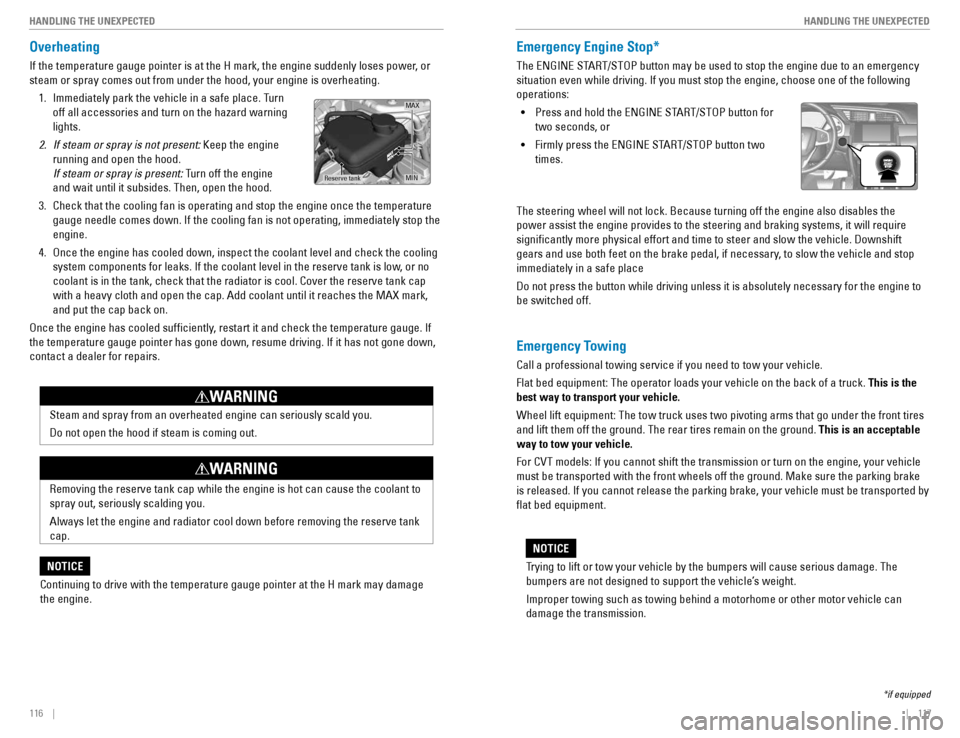
2. If steam or spray is not present: Keep the engine
running and open the hood. If steam or spray is present: Turn off the engine
and wait until it subsides. Then, open the hood.
3. Check that the cooling fan is operating and stop the engine once the temperature gauge needle comes down. If the cooling fan is not operating, immediately stop the engine.
4. Once the engine has cooled down, inspect the coolant level and check the cooling system components for leaks. If the coolant level in the reserve tank is low, or no
coolant is in the tank, check that the radiator is cool. Cover the reserve tank cap with a heavy cloth and open the cap. Add coolant until it reaches the MAX mark, and put the cap back on.
Once the engine has cooled sufciently, restart it and check the temperature gauge. If the temperature gauge pointer has gone down, resume driving. If it has not gone down, contact a dealer for repairs.
MAX
Reserve tankMIN
Steam and spray from an overheated engine can seriously scald you. Do not open the hood if steam is coming out.
WARNING
Removing the reserve tank cap while the engine is hot can cause the coolant to spray out, seriously scalding you. Always let the engine and radiator cool down before removing the reserve tank cap.
WARNING
Continuing to drive with the temperature gauge pointer at the H mark may damage the engine.
NOTICE
Emergency Engine Stop*
The ENGINE START/STOP button may be used to stop the engine due to an emergency situation even while driving. If you must stop the engine, choose one of the following operations:
• Press and hold the ENGINE START/STOP button for
two seconds, or
• Firmly press the ENGINE START/STOP button two
times.
The steering wheel will not lock. Because turning off the engine also disables the
power assist the engine provides to the steering and braking systems, it will require
signicantly more physical effort and time to steer and slow the vehicle. Downshift
gears and use both feet on the brake pedal, if necessary, to slow the vehicle and stop immediately in a safe place
Do not press the button while driving unless it is absolutely necessary for the engine to be switched off.
*if equipped
Emergency Towing
Call a professional towing service if you need to tow your vehicle. Flat bed equipment: The operator loads your vehicle on the back of a truck. This is the
best way to transport your vehicle.
Wheel lift equipment: The tow truck uses two pivoting arms that go under the front tires and lift them off the ground. The rear tires remain on the ground. This is an acceptable
way to tow your vehicle.
For CVT models: If you cannot shift the transmission or turn on the engine, your vehicle must be transported with the front wheels off the ground. Make sure the parking brake
is released. If you cannot release the parking brake, your vehicle must be transported by at bed equipment.
Trying to lift or tow your vehicle by the bumpers will cause serious damage. The
bumpers are not designed to support the vehicle’s weight. Improper towing such as towing behind a motorhome or other motor vehicle can damage the transmission.
NOTICE
Page 63 of 82
118 || 119
HANDLING THE UNEXPECTED
HANDLING THE UNEXPECTED
Tire Pressure Monitoring System (TPMS)
Monitors the tire pressure while you are driving. If your vehicle’s tire pressure becomes
signicantly low, the low tire pressure indicator comes on and a message appears on
the display. Available on U.S. models only.
What to Do
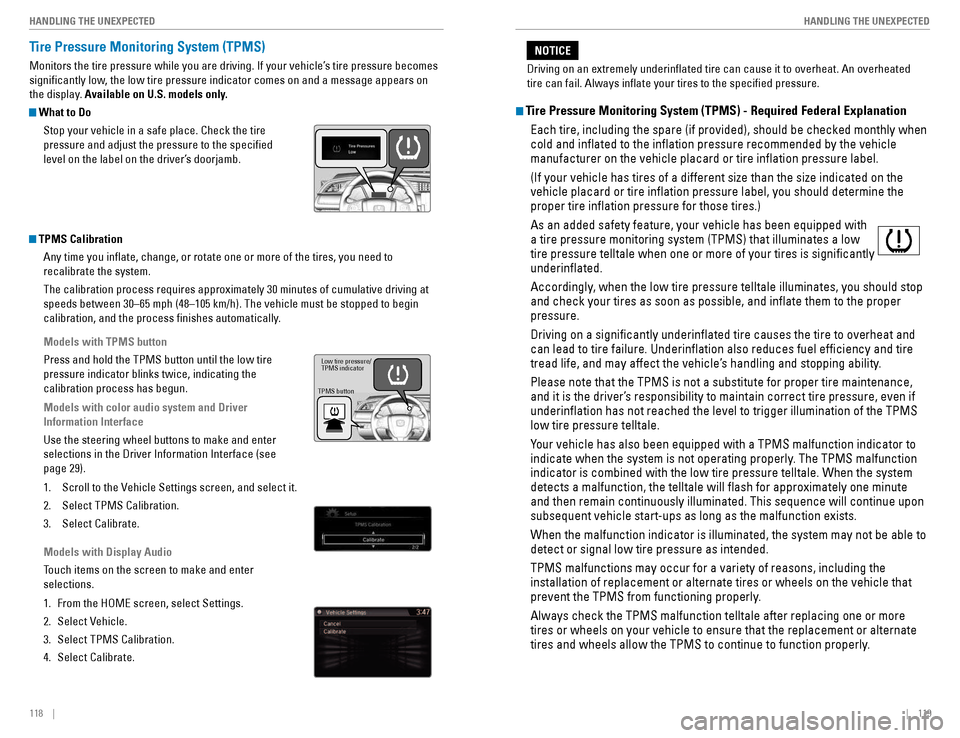
Stop your vehicle in a safe place. Check the tire pressure and adjust the pressure to the specied
level on the label on the driver’s doorjamb.
TPMS Calibration
Any time you inate, change, or rotate one or more of the tires, you need to recalibrate the system.
The calibration process requires approximately 30 minutes of cumulative driving at
speeds between 30–65 mph (48–105 km/h). The vehicle must be stopped to begin
calibration, and the process nishes automatically.
Models with TPMS button
Press and hold the TPMS button until the low tire pressure indicator blinks twice, indicating the calibration process has begun.
Models with color audio system and Driver Information Interface
Use the steering wheel buttons to make and enter selections in the Driver Information Interface (see page 29).
1. Scroll to the Vehicle Settings screen, and select it.
2. Select TPMS Calibration.
3. Select Calibrate.
Models with Display Audio
Touch items on the screen to make and enter selections.
1. From the HOME screen, select Settings.
2. Select Vehicle.
3. Select TPMS Calibration.
4. Select Calibrate.
TPMS button
Low tire pressure/ TPMS indicator
Tire Pressure Monitoring System (TPMS) - Required Federal Explanation
Each tire, including the spare (if provided), should be checked monthly when cold and inated to the ination pressure recommended by the vehicle manufacturer on the vehicle placard or tire ination pressure label. (If your vehicle has tires of a different size than the size indicated on the vehicle placard or tire ination pressure label, you should determine the proper tire ination pressure for those tires.) As an added safety feature, your vehicle has been equipped with a tire pressure monitoring system (TPMS) that illuminates a low tire pressure telltale when one or more of your tires is signicantly underinated.
Accordingly, when the low tire pressure telltale illuminates, you should stop and check your tires as soon as possible, and inate them to the proper pressure. Driving on a signicantly underinated tire causes the tire to overheat and can lead to tire failure. Underination also reduces fuel efciency and tire
tread life, and may affect the vehicle’s handling and stopping ability. Please note that the TPMS is not a substitute for proper tire maintenance,
and it is the driver’s responsibility to maintain correct tire pressure, even if underination has not reached the level to trigger illumination of the TPMS low tire pressure telltale.
Your vehicle has also been equipped with a TPMS malfunction indicator to
indicate when the system is not operating properly. The TPMS malfunction indicator is combined with the low tire pressure telltale. When the system detects a malfunction, the telltale will ash for approximately one minute and then remain continuously illuminated. This sequence will continue upon subsequent vehicle start-ups as long as the malfunction exists. When the malfunction indicator is illuminated, the system may not be able to detect or signal low tire pressure as intended. TPMS malfunctions may occur for a variety of reasons, including the installation of replacement or alternate tires or wheels on the vehicle that
prevent the TPMS from functioning properly. Always check the TPMS malfunction telltale after replacing one or more tires or wheels on your vehicle to ensure that the replacement or alternate
tires and wheels allow the TPMS to continue to function properly.
Driving on an extremely underinated tire can cause it to overheat. An overheated tire can fail. Always inate your tires to the specied pressure.
NOTICE