ECU HONDA CIVIC COUPE 2016 10.G Quick Guide
[x] Cancel search | Manufacturer: HONDA, Model Year: 2016, Model line: CIVIC COUPE, Model: HONDA CIVIC COUPE 2016 10.GPages: 82, PDF Size: 5.2 MB
Page 5 of 82
2 || 3
SAFETY
VISUAL INDEX
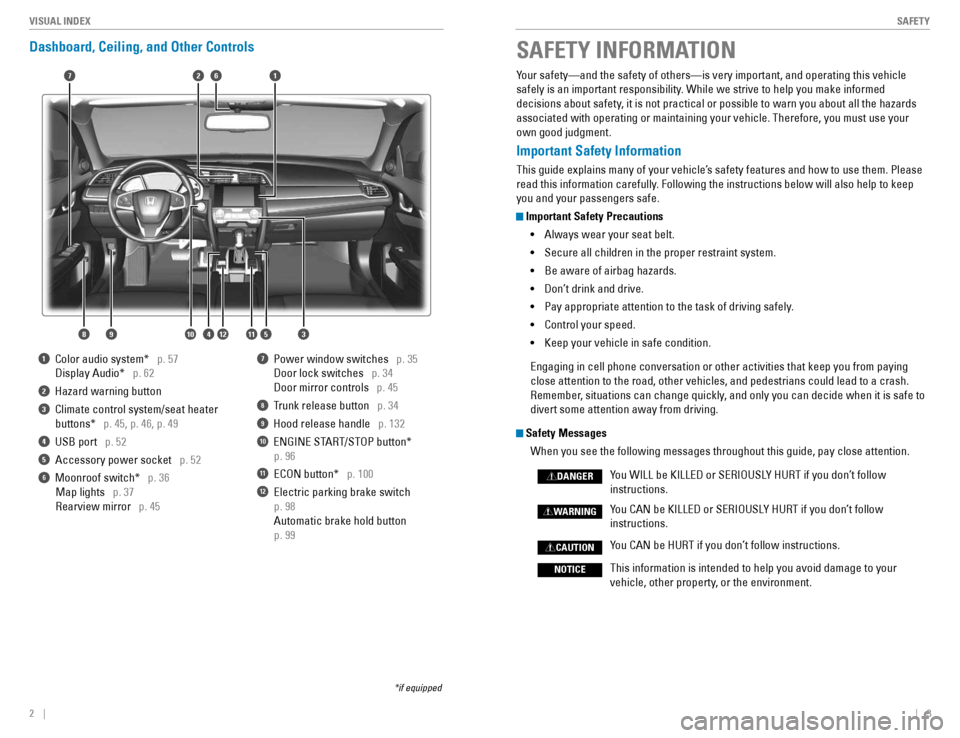
Dashboard, Ceiling, and Other Controls
1 Color audio system* p. 57
Display Audio* p. 62
2 Hazard warning button
3 Climate control system/seat heater
buttons*
p. 45, p. 46, p. 49
4 USB port p. 52
Accessory power socket p. 52
6 Moonroof switch* p. 36
Map lights p. 37
Rearview mirror p. 45
7 Power window switches p. 35
Door lock switches p. 34
Door mirror controls p. 45
8 Trunk release button p. 34
9 Hood release handle p. 132
10 ENGINE START/STOP button*
p. 96
11 ECON button* p. 100
12 Electric parking brake switch
p. 98
Automatic brake hold button
p. 99
*if equipped
SAFETY INFORMATION
2
3
71
8
6
4
Your safety—and the safety of others—is very important, and operating this vehicle
safely is an important responsibility. While we strive to help you make informed
decisions about safety, it is not practical or possible to warn you about all the hazards associated with operating or maintaining your vehicle. Therefore, you must use your own good judgment.
Important Safety Information
This guide explains many of your vehicle’s safety features and how to use them. Please
read this information carefully. Following the instructions below will also help to keep you and your passengers safe.
Important Safety Precautions
• Always wear your seat belt.
• Secure all children in the proper restraint system.
• Be aware of airbag hazards.
• Don’t drink and drive.
• Pay appropriate attention to the task of driving safely.
• Control your speed.
• Keep your vehicle in safe condition.
Engaging in cell phone conversation or other activities that keep you from paying
close attention to the road, other vehicles, and pedestrians could lead to a crash.
Remember, situations can change quickly, and only you can decide when it is safe to divert some attention away from driving.
Safety Messages
When you see the following messages throughout this guide, pay close attention. You WILL be KILLED or SERIOUSLY HURT if you don’t follow
instructions. You CAN be KILLED or SERIOUSLY HURT if you don’t follow
instructions. You CAN be HURT if you don’t follow instructions.
This information is intended to help you avoid damage to your
vehicle, other property, or the environment.
DANGER
WARNING
CAUTION
NOTICE
5
59101112
Page 7 of 82
6 || 7
SAFETY
SAFETY
Seat Belt Inspection
Regularly check the condition of your seat belts as follows: • Pull each belt out fully, and look for frays, cuts, burns, and wear.
• Check that the latches work smoothly and the belts retract easily. If a belt does
not retract easily, cleaning the belt may correct the problem. Use only mild soap
and warm water. Do not use bleach or cleaning solvents. Make sure the belt is completely dry before allowing it to retract.
Any belt that is not in good condition or working properly will not provide proper protection and should be replaced as soon as possible. A belt that has been worn during a crash may not provide the same level of protection
in a subsequent crash. Have your seat belts inspected by a dealer after any collision.
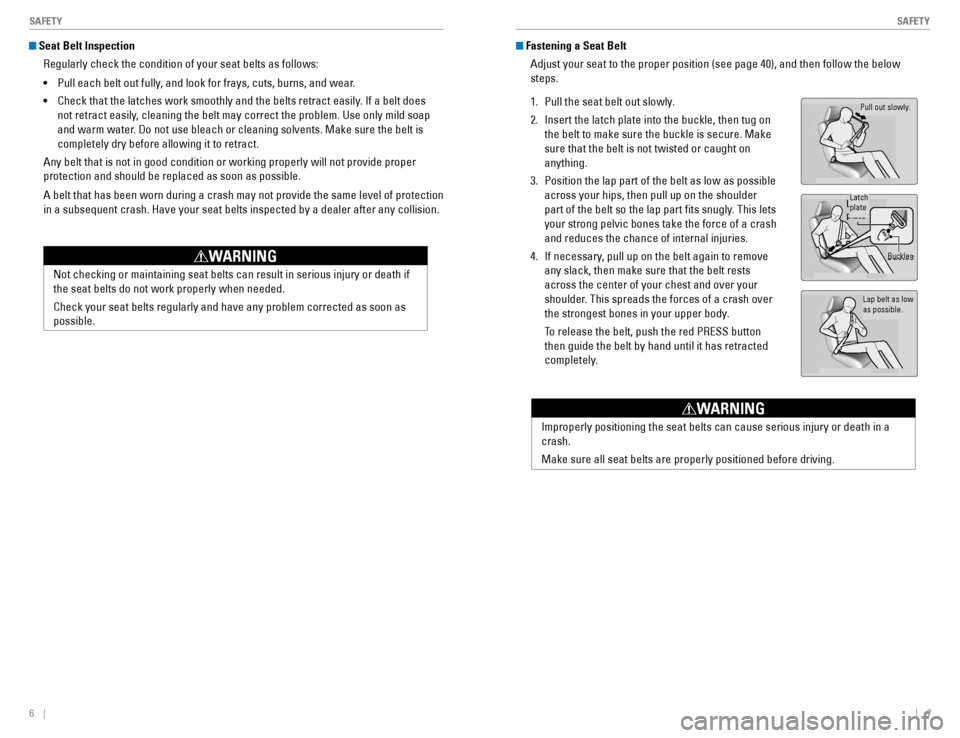
Fastening a Seat Belt
Adjust your seat to the proper position (see page 40), and then follow the below steps.
1. Pull the seat belt out slowly.
2. Insert the latch plate into the buckle, then tug on the belt to make sure the buckle is secure. Make sure that the belt is not twisted or caught on anything.
3. Position the lap part of the belt as low as possible across your hips, then pull up on the shoulder
part of the belt so the lap part ts snugly. This lets your strong pelvic bones take the force of a crash and reduces the chance of internal injuries.
4. If necessary, pull up on the belt again to remove any slack, then make sure that the belt rests across the center of your chest and over your
shoulder. This spreads the forces of a crash over
the strongest bones in your upper body.
To release the belt, push the red PRESS button then guide the belt by hand until it has retracted
completely.
Not checking or maintaining seat belts can result in serious injury or death if the seat belts do not work properly when needed.
Check your seat belts regularly and have any problem corrected as soon as possible.
WARNING
Pull out slowly.
Lap belt as low as possible.
Latch plate
BuckleLatch plate
Buckle
Improperly positioning the seat belts can cause serious injury or death in a crash. Make sure all seat belts are properly positioned before driving.
WARNING
Page 11 of 82
14 || 15
SAFETY
SAFETY
Child Safety
Each year, many children are injured or killed in vehicle crashes because they are either
unrestrained or not properly restrained. In fact, vehicle collisions are the number one
cause of death of children ages 12 and under.
The National Highway Trafc Safety Administration and Transport Canada recommend
that all children ages 12 and under be properly restrained in a rear seat. Some states or provinces/territories have laws restricting where children may ride.
To reduce the number of child deaths and injuries, every state, Canadian province and territory requires that infants and children be properly restrained when they ride in a vehicle.
Protecting Child Passengers
• An inating front or side airbag can injure or kill a child sitting in the front seat.
• A child in the front seat is more likely to interfere with the driver’s ability to safely
control the vehicle.
• Statistics show that children of all sizes and ages are safer when they are properly
restrained in a rear seat.
• Any child who is too small to wear a seat belt correctly must be restrained in an
approved child seat that is properly secured to the vehicle using either the lap belt
portion of the lap/shoulder belt or the lower anchors of the LATCH system.
• Never hold a child on your lap because it is impossible to protect them in the event
of a collision.
• Never put a seat belt over yourself and a child. During a crash, the belt would
likely press deep into the child and cause serious or fatal injuries.
• Never let two children use the same seat belt. Both children could be very
seriously injured in a crash.
• Do not allow children to operate the doors, windows, or seat adjusters.
• Do not leave children in the vehicle unattended, especially in hot weather when
the inside of the vehicle can get hot enough to kill them. They could also activate vehicle controls, causing it to move unexpectedly.
Protecting Infants
An infant must be properly restrained in a rear-facing, reclining child seat until the
infant reaches the seat manufacturer’s weight or height limit for the seat, and the
infant is at least one year old. Many experts recommend use of a rear-facing seat for
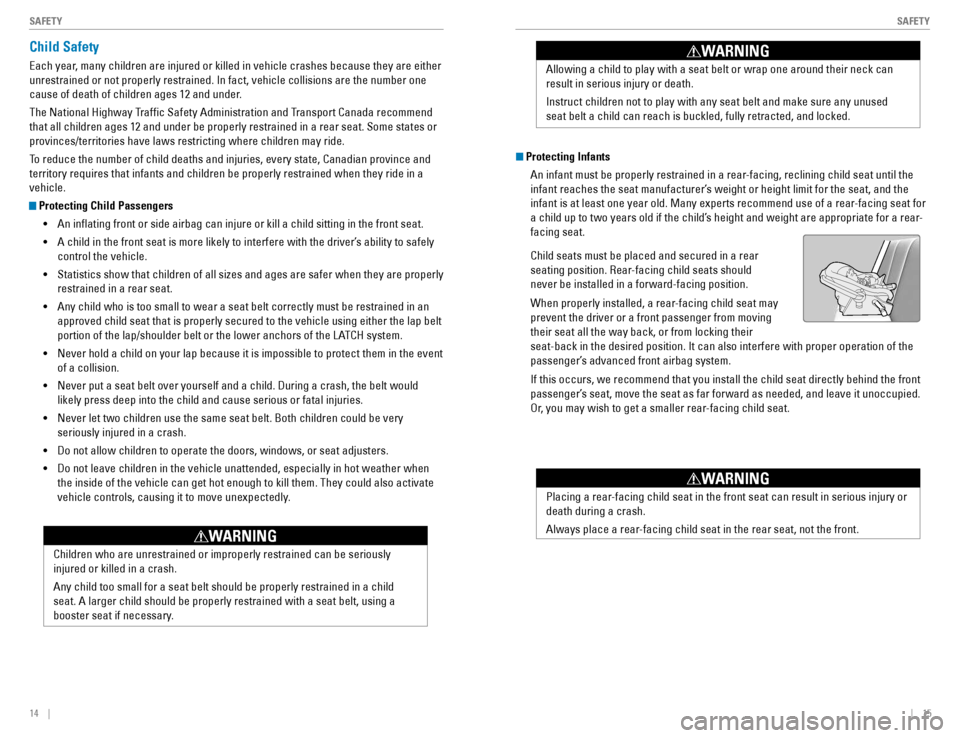
a child up to two years old if the child’s height and weight are appropriate for a rear-facing seat. Child seats must be placed and secured in a rear
seating position. Rear-facing child seats should never be installed in a forward-facing position.
When properly installed, a rear-facing child seat may prevent the driver or a front passenger from moving their seat all the way back, or from locking their seat-back in the desired position. It can also interfere with proper operation of the
passenger’s advanced front airbag system.
If this occurs, we recommend that you install the child seat directly behind the front
passenger’s seat, move the seat as far forward as needed, and leave it unoccupied.
Or, you may wish to get a smaller rear-facing child seat. Allowing a child to play with a seat belt or wrap one around their neck can result in serious injury or death.
Instruct children not to play with any seat belt and make sure any unused seat belt a child can reach is buckled, fully retracted, and locked.
WARNING
Children who are unrestrained or improperly restrained can be seriously injured or killed in a crash. Any child too small for a seat belt should be properly restrained in a child
seat. A larger child should be properly restrained with a seat belt, using a
booster seat if necessary.
WARNING
Placing a rear-facing child seat in the front seat can result in serious injury or death during a crash.
Always place a rear-facing child seat in the rear seat, not the front.
WARNING
Page 12 of 82
16 || 17
SAFETY
SAFETY
Protecting Smaller Children
If a child is at least one year old and within the weight range indicated by the child
seat manufacturer, the child should be properly restrained in a rmly secured forward-facing child seat.
We strongly recommend placing a forward-facing child seat in a rear seating position. Placing a forward-facing child seat in the front seat can be hazardous, even with advanced front airbags
that automatically turn the passenger’s front airbag off. A rear seat is the safest place for a child.
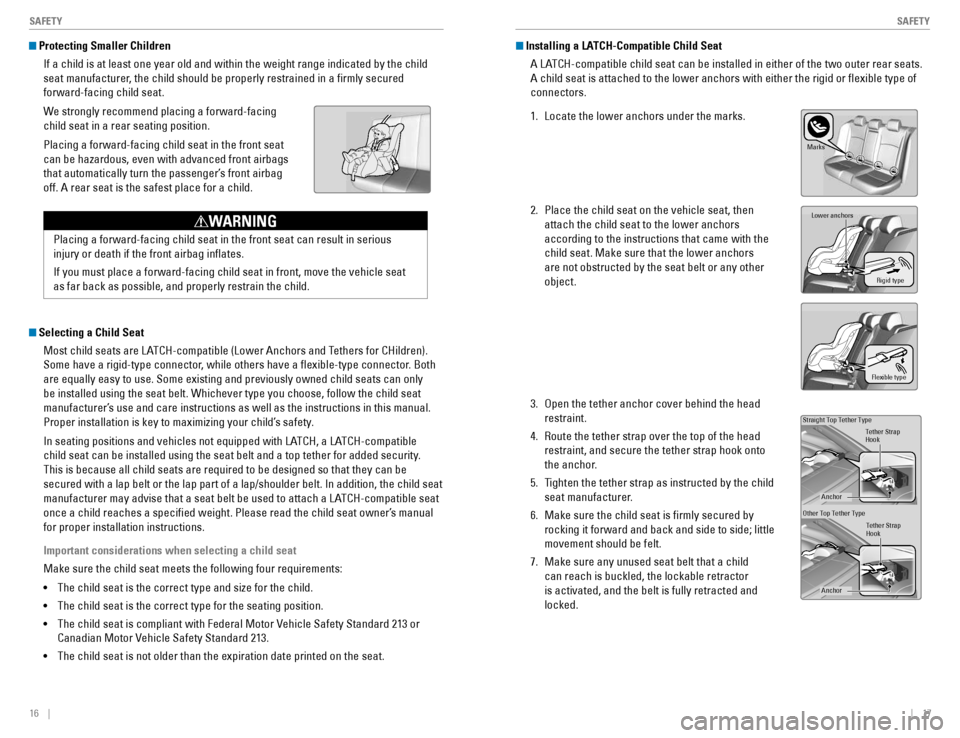
Installing a LATCH-Compatible Child Seat
A LATCH-compatible child seat can be installed in either of the two outer rear seats.
A child seat is attached to the lower anchors with either the rigid or exible type of connectors.
1. Locate the lower anchors under the marks.
2. Place the child seat on the vehicle seat, then
attach the child seat to the lower anchors according to the instructions that came with the child seat. Make sure that the lower anchors are not obstructed by the seat belt or any other object.
3. Open the tether anchor cover behind the head restraint.
4. Route the tether strap over the top of the head restraint, and secure the tether strap hook onto
the anchor.
5. Tighten the tether strap as instructed by the child seat manufacturer.
6. Make sure the child seat is rmly secured by rocking it forward and back and side to side; little movement should be felt.
7. Make sure any unused seat belt that a child can reach is buckled, the lockable retractor is activated, and the belt is fully retracted and locked.
Placing a forward-facing child seat in the front seat can result in serious injury or death if the front airbag inates.
If you must place a forward-facing child seat in front, move the vehicle seat as far back as possible, and properly restrain the child.
WARNING
Selecting a Child Seat
Most child seats are LATCH-compatible (Lower Anchors and Tethers for CHildren).
Some have a rigid-type connector, while others have a exible-type connector. Both
are equally easy to use. Some existing and previously owned child seats can only
be installed using the seat belt. Whichever type you choose, follow the child seat
manufacturer’s use and care instructions as well as the instructions in this manual.
Proper installation is key to maximizing your child’s safety.
In seating positions and vehicles not equipped with LATCH, a LATCH-compatible
child seat can be installed using the seat belt and a top tether for added security. This is because all child seats are required to be designed so that they can be
secured with a lap belt or the lap part of a lap/shoulder belt. In addition, the child seat
manufacturer may advise that a seat belt be used to attach a LATCH-compatible seat
once a child reaches a specied weight. Please read the child seat owner’s manual for proper installation instructions.
Important considerations when selecting a child seat
Make sure the child seat meets the following four requirements: • The child seat is the correct type and size for the child.
• The child seat is the correct type for the seating position.
• The child seat is compliant with Federal Motor Vehicle Safety Standard 213 or
Canadian Motor Vehicle Safety Standard 213.
• The child seat is not older than the expiration date printed on the seat.
Marks
Rigid type
Lower anchors
Flexible type
Tether Strap
Hook
Anchor
Straight Top Tether Type
Tether Strap Hook
Anchor
Other Top Tether Type
Page 13 of 82
18 || 19
SAFETY
SAFETY
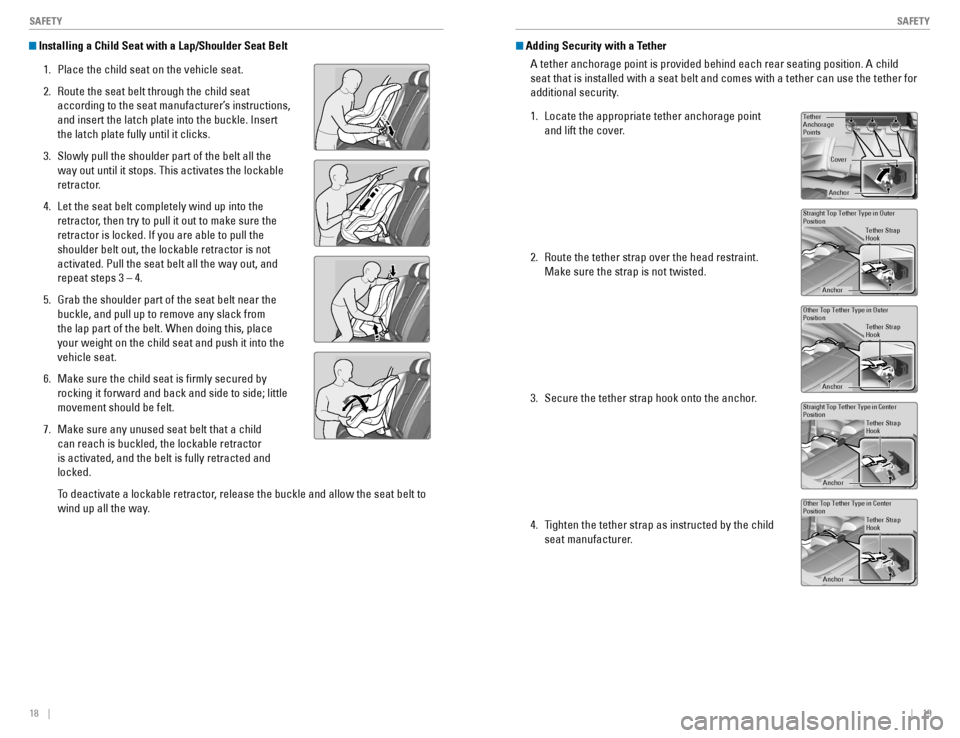
Installing a Child Seat with a Lap/Shoulder Seat Belt
1. Place the child seat on the vehicle seat.
2. Route the seat belt through the child seat
according to the seat manufacturer’s instructions, and insert the latch plate into the buckle. Insert the latch plate fully until it clicks.
3. Slowly pull the shoulder part of the belt all the way out until it stops. This activates the lockable
retractor.
4. Let the seat belt completely wind up into the retractor, then try to pull it out to make sure the retractor is locked. If you are able to pull the shoulder belt out, the lockable retractor is not activated. Pull the seat belt all the way out, and repeat steps 3 – 4.
5. Grab the shoulder part of the seat belt near the buckle, and pull up to remove any slack from the lap part of the belt. When doing this, place your weight on the child seat and push it into the vehicle seat.
6. Make sure the child seat is rmly secured by rocking it forward and back and side to side; little movement should be felt.
7. Make sure any unused seat belt that a child can reach is buckled, the lockable retractor is activated, and the belt is fully retracted and locked.
To deactivate a lockable retractor, release the buckle and allow the seat belt to wind up all the way.
Adding Security with a Tether
A tether anchorage point is provided behind each rear seating position. A child
seat that is installed with a seat belt and comes with a tether can use the tether for
additional security.
1. Locate the appropriate tether anchorage point and lift the cover.
2. Route the tether strap over the head restraint. Make sure the strap is not twisted.
3. Secure the tether strap hook onto the anchor.
4. Tighten the tether strap as instructed by the child seat manufacturer.
Tether
Points
Anchorage
Cove
r
Anchor
Tether Strap Hook
Anchor
Straight Top Tether Type in Outer
Position
Tether Strap Hook
Anchor
Other Top Tether Type in Outer
Position
Tether Strap Hook
Anchor
Straight Top Tether Type in Center
Position
Tether Strap Hook
Anchor
Other Top Tether Type in Center Position
Page 14 of 82
20 || 21
SAFETY
SAFETY
Protecting Larger Children
When a child is too big for a child seat, secure the child in a rear seat using the lap/
shoulder seat belt. Have the child sit upright and all the way back, then ensure the following:• The child’s knees bend comfortably over the edge
of the seat.
• The shoulder belt crosses between the child’s
neck and arm.
• The lap part of the seat belt is as low as possible,
touching the child’s thighs.
• The child can stay seated for the whole trip.
If a lap/shoulder belt cannot be used properly, position the child in a booster seat in
a rear seating position. For the child’s safety, check that the child meets the booster
seat manufacturer’s recommendations.
Some U.S. states and Canadian provinces/territories require children to use a booster
seat until they reach a given age or weight (e.g., 6 years or 60 lbs). Be sure to check current laws in the state or province/territory where you intend to drive.
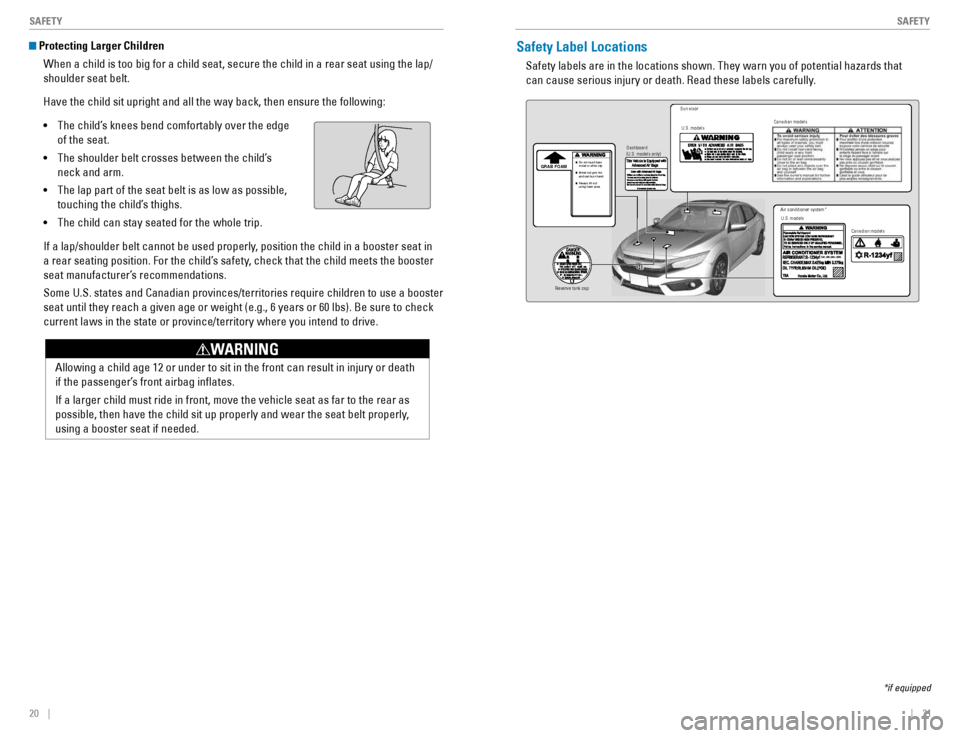
Safety Label Locations
Safety labels are in the locations shown. They warn you of potential hazards that
can cause serious injury or death. Read these labels carefully.
(SAE J639 J2842 J2845)
Reserve tank cap U.S. models
(U.S. models only)
Dashboard
Canadian models
Air conditioner system
*
Sun visor
U.S. models Canadian models
Do not touch bare
metal or white clip.
Metal rod gets hot and can burn hand. Always lift rod using foam area.GRAB FOAM
Allowing a child age 12 or under to sit in the front can result in injury or death
if the passenger’s front airbag inates.
If a larger child must ride in front, move the vehicle seat as far to the rear as
possible, then have the child sit up properly and wear the seat belt properly, using a booster seat if needed.
WARNING
*if equipped
Page 17 of 82
26 || 27
INSTRUMENT PANEL
INSTRUMENT PANEL
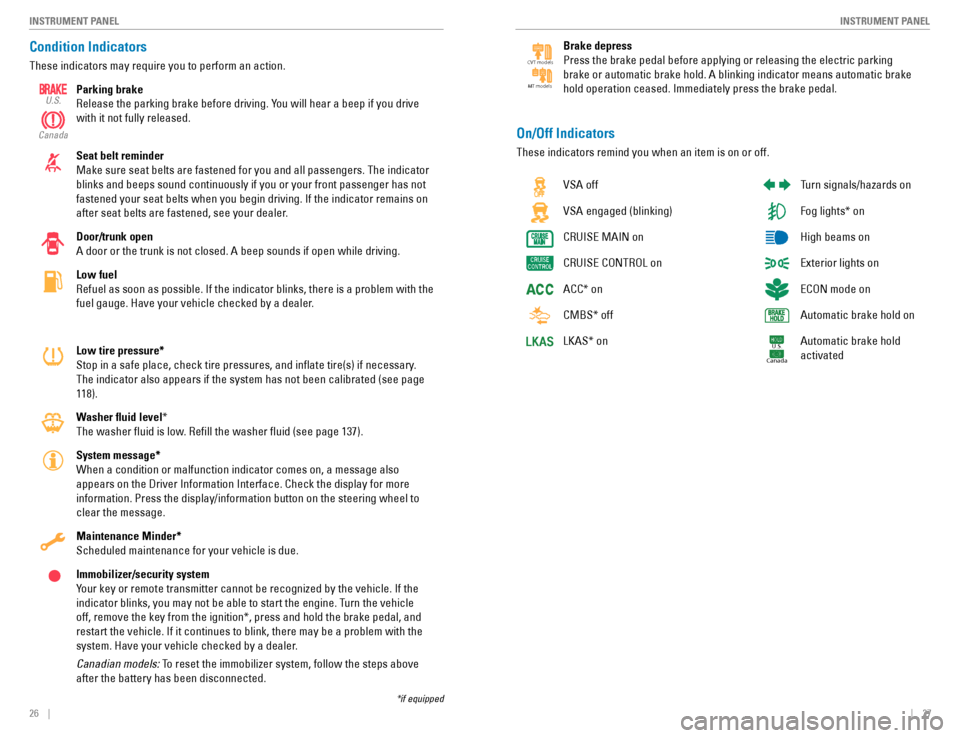
Condition Indicators
These indicators may require you to perform an action.
Parking brake
Release the parking brake before driving. You will hear a beep if you drive with it not fully released. Seat belt reminder Make sure seat belts are fastened for you and all passengers. The indicator
blinks and beeps sound continuously if you or your front passenger has not
fastened your seat belts when you begin driving. If the indicator remains on
after seat belts are fastened, see your dealer. Door/trunk open A door or the trunk is not closed. A beep sounds if open while driving. Low fuel
Refuel as soon as possible. If the indicator blinks, there is a problem with the
fuel gauge. Have your vehicle checked by a dealer. Low tire pressure*
Stop in a safe place, check tire pressures, and inate tire(s) if necessary. The indicator also appears if the system has not been calibrated (see page 118).
Washer uid level *
The washer uid is low. Rell the washer uid (see page 137).System message* When a condition or malfunction indicator comes on, a message also appears on the Driver Information Interface. Check the display for more information. Press the display/information button on the steering wheel to clear the message. Maintenance Minder* Scheduled maintenance for your vehicle is due. Immobilizer/security system
Your key or remote transmitter cannot be recognized by the vehicle. If the
indicator blinks, you may not be able to start the engine. Turn the vehicle off, remove the key from the ignition*, press and hold the brake pedal, and restart the vehicle. If it continues to blink, there may be a problem with the
system. Have your vehicle checked by a dealer. Canadian models: To reset the immobilizer system, follow the steps above
after the battery has been disconnected.
U.S.
Canada
*if equipped VSA off VSA engaged (blinking)CRUISE MAIN onCRUISE CONTROL onACC* onCMBS* offLKAS* on
Turn signals/hazards on Fog lights* onHigh beams onExterior lights onECON mode onAutomatic brake hold onAutomatic brake hold activated
U.S.
Canada
On/Off Indicators
These indicators remind you when an item is on or off.
Brake depress Press the brake pedal before applying or releasing the electric parking
brake or automatic brake hold. A blinking indicator means automatic brake hold operation ceased. Immediately press the brake pedal.
CV
T models
MT models
Page 25 of 82
42 || 43
VEHICLE CONTROLS
VEHICLE CONTROLS
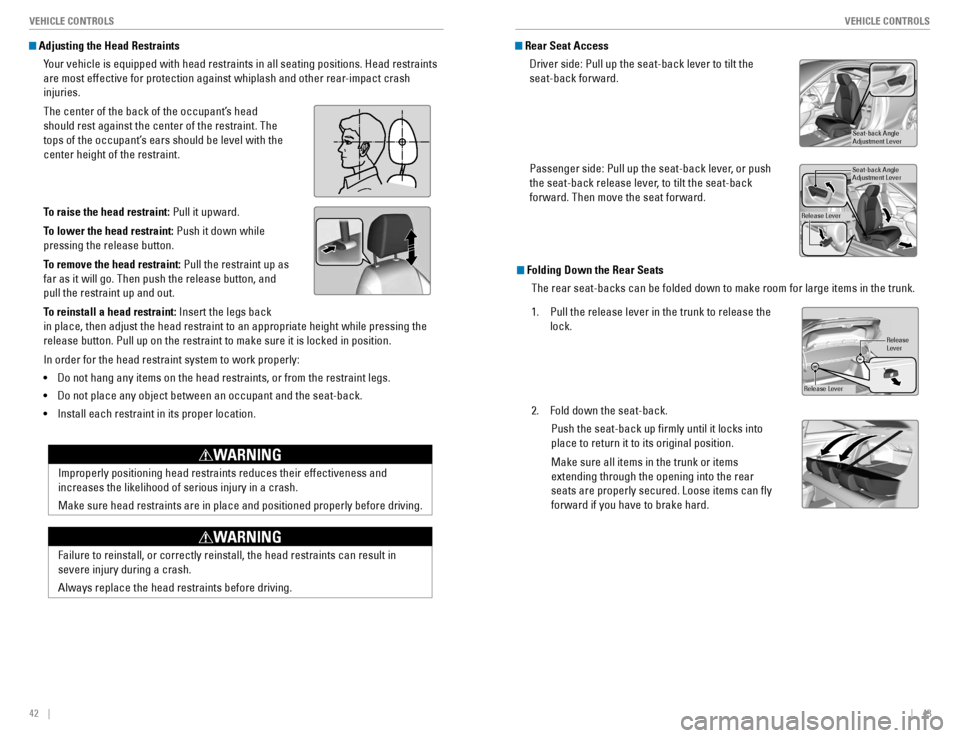
Adjusting the Head Restraints
Your vehicle is equipped with head restraints in all seating positions. Head restraints
are most effective for protection against whiplash and other rear-impact crash injuries.
The center of the back of the occupant’s head should rest against the center of the restraint. The
tops of the occupant’s ears should be level with the center height of the restraint.
To raise the head restraint: Pull it upward.
To lower the head restraint: Push it down while
pressing the release button.
To remove the head restraint: Pull the restraint up as
far as it will go. Then push the release button, and pull the restraint up and out.
To reinstall a head restraint: Insert the legs back
in place, then adjust the head restraint to an appropriate height while pressing the
release button. Pull up on the restraint to make sure it is locked in position. In order for the head restraint system to work properly: • Do not hang any items on the head restraints, or from the restraint legs.
• Do not place any object between an occupant and the seat-back.
• Install each restraint in its proper location.
Position head in the
Improperly positioning head restraints reduces their effectiveness and increases the likelihood of serious injury in a crash. Make sure head restraints are in place and positioned properly before driving.
WARNING
Failure to reinstall, or correctly reinstall, the head restraints can result in severe injury during a crash. Always replace the head restraints before driving.
WARNING
Folding Down the Rear Seats
The rear seat-backs can be folded down to make room for large items in the trunk.
1. Pull the release lever in the trunk to release the
lock.
2. Fold down the seat-back. Push the seat-back up rmly until it locks into place to return it to its original position. Make sure all items in the trunk or items extending through the opening into the rear seats are properly secured. Loose items can y forward if you have to brake hard.
LeverRelease
Release Lever
Rear Seat Access
Driver side: Pull up the seat-back lever to tilt the seat-back forward.
Passenger side: Pull up the seat-back lever, or push
the seat-back release lever, to tilt the seat-back forward. Then move the seat forward.
Seat-back Angle Adjustment Lever
Seat-back Angle Adjustment Leve r
Release Lever
Page 49 of 82
90 || 91
DRIVING
DRIVING
DRIVING
Learn about preparation for driving, as well as other features.
Before Driving
Check the following items before you begin driving.
Exterior Checks
• Make sure there are no obstructions on the windows, door mirrors, exterior lights,
or other parts of the vehicle.
• Remove any frost, snow, or ice.
• Make sure the hood is securely closed.
• Heat from the engine and exhaust can ignite ammable materials left under the
hood, causing a re. If you’ve parked your vehicle for an extended period, inspect and remove any debris that may have collected, such as dried grass and leaves
that have fallen or have been carried in for use as a nest by a small animal. Also
check under the hood for leftover ammable materials after you or someone else has performed maintenance on your vehicle.
• Make sure the tires are in good condition.
• Make sure there are no people or objects behind or around the vehicle.
If the doors are frozen shut, use warm water around the door edges to melt any ice. Do not try to force them open, as this can damage the rubber trim around the doors. When done, wipe dry to avoid further freezing.
NOTICE
In addition: • During the rst 600 miles (1,000 km) of operation, avoid sudden acceleration or full
throttle operation so as not to damage the engine or powertrain.
• Avoid hard braking for the rst 200 miles (300 km). You should also follow this when
the brake pads are replaced.
Improper accessories or modications can affect your vehicle’s handling,
stability, and performance, and cause a crash in which you can be seriously hurt or killed.
Follow all instructions in the vehicle owner’s manual regarding accessories and modications.
WARNING
Interior Checks
• Store or secure all items on board properly.
• Do not place anything in the front-seat footwells. Make sure to secure the oor
mats.
• If you have any animals on board, do not let them move freely around in the
vehicle.
• Securely close and lock all doors and the trunk.
• Adjust your seating position, mirrors, and steering wheel properly.
• Make sure items placed on the oor behind the front seats cannot roll under the
seats.
• Everyone in the vehicle must fasten their seat belt.
• Make sure that the indicators in the instrument panel come on when you start the
vehicle, and go off soon after.
Page 65 of 82
122 || 123
HANDLING THE UNEXPECTED
HANDLING THE UNEXPECTED
Replacing the Flat Tire
1. Remove the wheel nuts and at tire.
2. Mount the compact spare tire. Replace the
wheel nuts, and lightly tighten them.
3. Lower the vehicle and remove the jack. Tighten the wheel nuts in the order indicated in the image. Go around, tightening the nuts, two to
three times in this order. Do not overtighten the wheel nuts.
Models with wheel covers: Make sure the wire
support ring is hooked into the clips around the edge
of the wheel cover. Align the valve mark on the wheel cover to the tire
valve on the wheel, then install the wheel cover. If you drive with the spare tire installed, the low tire pressure/TPMS indicator appears. The indicator stays on until a regular tire is installed.
spilC
spilC
Valve mark
Storing the Flat Tire
1. Remove the center cap, if necessary.
2. Open the trunk. Place the at tire face down in
the spare tire well.
3. Remove the spacer cone from the wing bolt, ip it over, and insert it back on the bolt. Secure the at tire with the wing bolt.
4. Models with wheel covers: Make sure the wire
support ring is hooked into the clips around the
edge of the wheel cover.
5. Securely put the jack and wheel nut wrench back in the tool case. Store the case in the trunk.
Loose items can y around the interior in a crash and can seriously injure the occupants. Store the wheel, jack, and tools securely before driving.
WARNING
Spacer cone Wing bolt
For compact
spare tireFor full -
size tire
Tire valv e
Wire support rin g