tow HONDA CIVIC HATCHBACK 2021 Owner's Manual (in English)
[x] Cancel search | Manufacturer: HONDA, Model Year: 2021, Model line: CIVIC HATCHBACK, Model: HONDA CIVIC HATCHBACK 2021Pages: 711, PDF Size: 37.1 MB
Page 6 of 711
Contents
This owner’s manual should be considered a permanent part of the
vehicle and should remain with the vehicle when it is sold.
This owner’s manual covers all models of your vehicle. You may find
descriptions of equipment and features that are not on your
particular model.
Images throughout this owner’s manu al (including the front cover)
represent features and equipment that are available on some, but
not all, models. Your particular mo del may not have some of these
features.
This owner’s manual is for vehicles sold in the United States and
Canada.
The information and specifications in cluded in this publication were
in effect at the time of approval for printing. Honda Motor Co., Ltd.
reserves the right, however, to discontinue or change specifications
or design at any time without notice and without incurring any
obligation.2 Safe Driving P. 35
For Safe Driving P. 36 Seat Belts P. 40 Airbags P. 48
2Instrument Panel P. 81
Indicators P. 82 Gauges and Driver Information Interface P. 122
2Controls P. 143
Clock P. 144 Locking and Unlocking the Doors P. 145
Moonroof* P. 170
Adjusting the Seats P. 193
2 Features P. 225
Audio System P. 226 Audio System Basic Operation P. 233, 251
Customized Features P. 343, 350 HomeLink ® Universal Transceiver*P. 380
2 Driving P. 443
Before Driving P. 444 Towing a Trailer P. 450
Parking Your Vehicle P. 558 Multi-View Rear Camera P. 560
2Maintenance P. 569
Before Performing Maintenance P. 570 Maintenance MinderTM P. 573
Checking and Maintaining Wiper Blades P. 604
Climate Control System Maintenance P. 624
2Handling the Unexpected P. 633
Tools P. 634 If a Tire Goes Flat P. 635
Shift Lever Does Not Move P. 665 Overheating P. 666
If You Cannot Unlock the Fuel Fill Door P. 680
2 Information P. 683
Specifications P. 684 Identification Numbers P. 686
Emissions Testing P. 689 Warranty Coverages P. 692
21 CIVIC 5D HUM-31TGG6400_01.book 4 ページ 2020年8月28日 金曜日 午後1時48分
Page 7 of 711
Contents
Child Safety P. 64Exhaust Gas Hazard P. 79Safety Labels P. 80
Hatch P. 160 Security System P. 163 Opening and Closing the Windows P. 167
Operating the Switches Around the Steering Wheel P. 171 Adjusting the Mirrors P. 190
Interior Lights/Interior Convenience It ems P. 201 Climate Control System P. 217
Audio Error Messages P. 320General Information on the Audio System P. 324
Bluetooth ® HandsFreeLink ® P. 383, 410
When Driving P. 451 Honda Sensing®P. 488 Braking P. 549
Refueling P. 562 Fuel Economy and CO
2 Emissions P. 566 Turbo Engine Vehicle P. 567
Maintenance Under the Hood P. 579 Replacing Light Bulbs P. 594
Checking and Maintaining Tires P. 609 Battery P. 620 Remote Transmitter Care P. 622
Cleaning P. 625 Accessories and Modifications P. 631
Handling of the Jack* P. 656Engine Does Not Start P. 659If the Battery Is Dead P. 662
Indicator, Coming On/Blinking P. 668 Fuses P. 674 Emergency Towing P. 679
If You Cannot Open the Hatch P. 681 Refueling P. 682
Devices that Emit Radio Waves P. 687 Reporting Safety Defects P. 688
Authorized Manuals P. 695 Customer Service Information P. 696
Quick Reference GuideP. 6
Safe DrivingP. 35
Instrument PanelP. 81
ControlsP. 143
FeaturesP. 225
DrivingP. 443
MaintenanceP. 569
Handling the UnexpectedP. 633
InformationP. 683
IndexP. 698
21 CIVIC 5D HUM-31TGG6400_01.book 5 ページ 2020年8月28日 金曜日 午後1時48分
Page 17 of 711
15
Quick Reference Guide
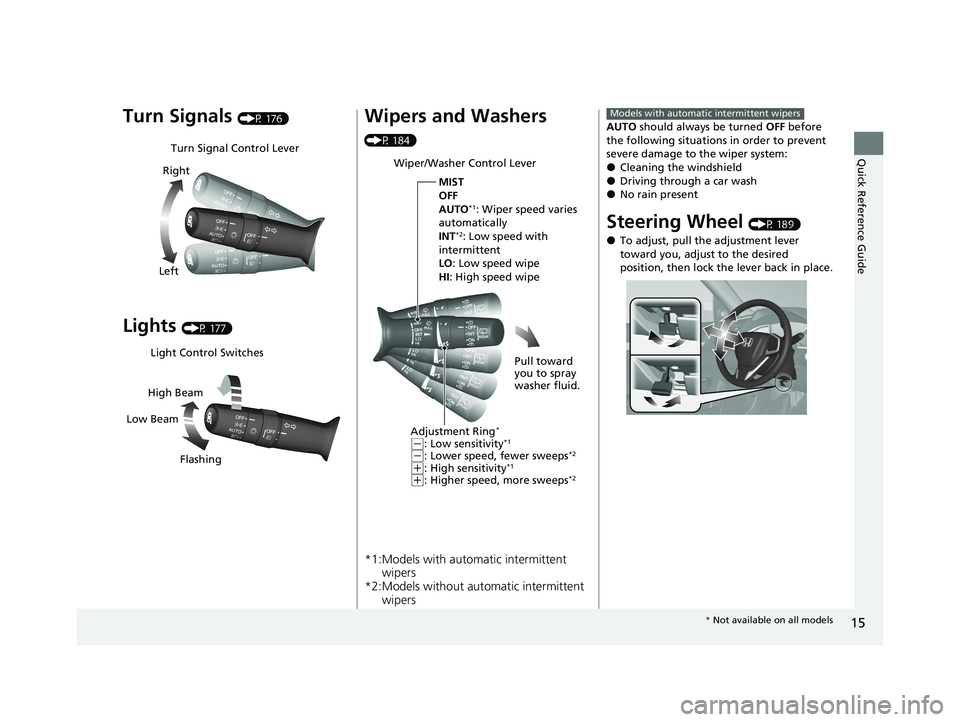
Turn Signals (P 176)
Lights (P 177)
Turn Signal Control Lever
Right
Left
Light Control Switches
Low Beam High Beam
Flashing
Wipers and Washers
(P 184)
*1:Models with automatic intermittent wipers
*2:Models without auto matic intermittent
wipers
Wiper/Washer Control Lever
Adjustment Ring
*
(-: Low sensitivity*1
(-: Lower speed, fewer sweeps*2
(+: High sensitivity*1
(+: Higher speed, more sweeps*2
MIST
OFF
AUTO
*1: Wiper speed varies
automatically
INT
*2: Low speed with
intermittent
LO : Low speed wipe
HI : High speed wipe
Pull toward
you to spray
washer fluid.
AUTO should always be turned OFF before
the following situations in order to prevent
severe damage to the wiper system:
●Cleaning the windshield●Driving through a car wash●No rain present
Steering Wheel (P 189)
●To adjust, pull the adjustment lever
toward you, adjust to the desired
position, then lock the lever back in place.
Models with automatic intermittent wipers
* Not available on all models
21 CIVIC 5D HUM-31TGG6400_01.book 15 ページ 2020年8月28日 金曜日 午後1時4 8分
Page 31 of 711
Quick Reference Guide
29
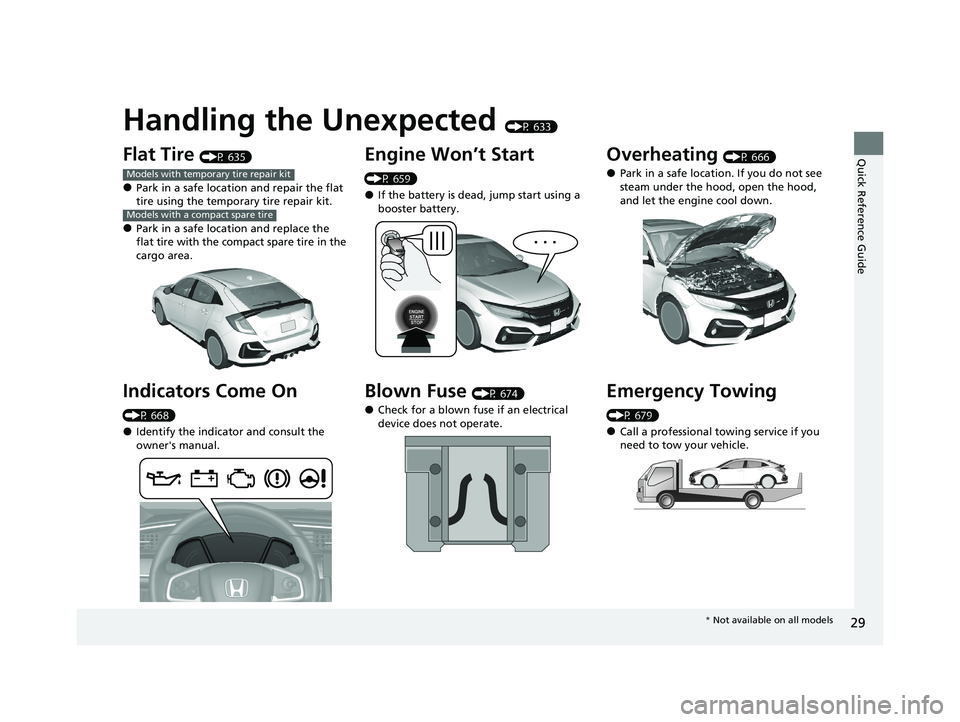
Handling the Unexpected (P 633)
Flat Tire (P 635)
●Park in a safe location and repair the flat
tire using the temporary tire repair kit.
●Park in a safe location and replace the
flat tire with the compact spare tire in the
cargo area.
Indicators Come On
(P 668)
●Identify the indicator and consult the
owner's manual.
Models with temporary tire repair kit
Models with a compact spare tire
Engine Won’t Start
(P 659)
●If the battery is dead, jump start using a
booster battery.
Blown Fuse (P 674)
●Check for a blown fuse if an electrical
device does not operate.
Overheating (P 666)
●Park in a safe location. If you do not see
steam under the hood, open the hood,
and let the engine cool down.
Emergency Towing
(P 679)
●Call a professional towing service if you
need to tow your vehicle.
* Not available on all models
21 CIVIC 5D HUM-31TGG6400_01.book 29 ページ 2020年8月28日 金曜日 午後1時4 8分
Page 47 of 711
Continued45
uuSeat Belts uFastening a Seat Belt
Safe Driving
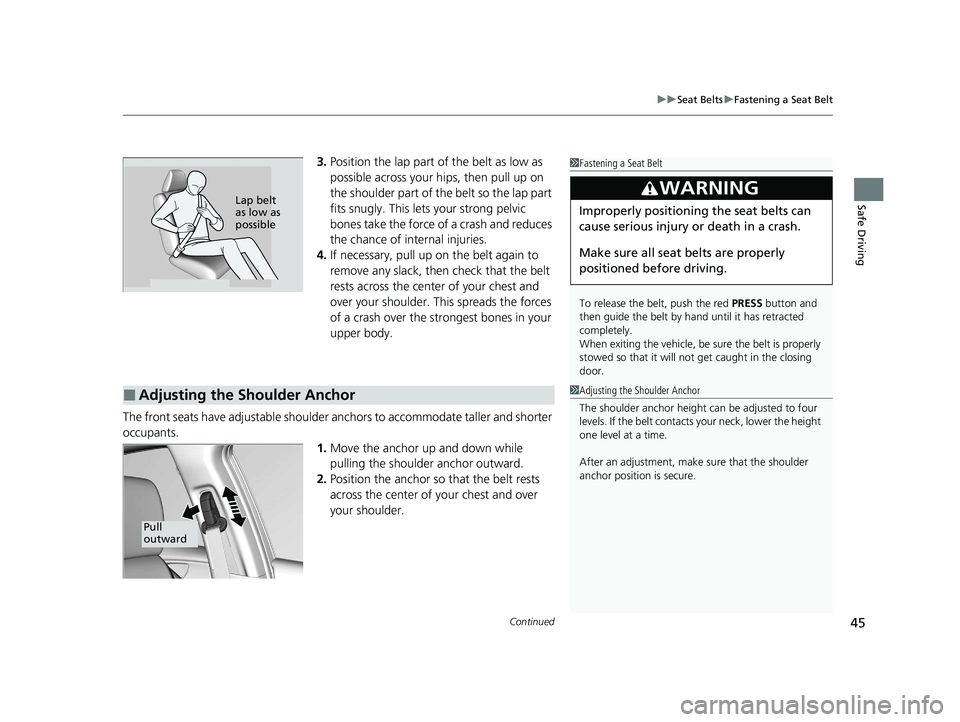
3. Position the lap part of the belt as low as
possible across your hips, then pull up on
the shoulder part of the belt so the lap part
fits snugly. This lets your strong pelvic
bones take the force of a crash and reduces
the chance of internal injuries.
4. If necessary, pull up on the belt again to
remove any slack, then check that the belt
rests across the center of your chest and
over your shoulder. Th is spreads the forces
of a crash over the strongest bones in your
upper body.
The front seats have adjustab le shoulder anchors to accommodate taller and shorter
occupants. 1.Move the anchor up and down while
pulling the shoulder anchor outward.
2. Position the anchor so that the belt rests
across the center of your chest and over
your shoulder.1 Fastening a Seat Belt
To release the belt, push the red PRESS button and
then guide the belt by hand until it has retracted
completely.
When exiting the vehicle, be sure the belt is properly
stowed so that it will not get caught in the closing
door.
3WARNING
Improperly positioning the seat belts can
cause serious injury or death in a crash.
Make sure all seat belts are properly
positioned before driving.Lap belt
as low as
possible
■Adjusting the Shoulder Anchor1 Adjusting the Shoulder Anchor
The shoulder anchor height can be adjusted to four
levels. If the belt contacts your neck, lower the height
one level at a time.
After an adjustment, make sure that the shoulder
anchor position is secure.
Pull
outward
21 CIVIC 5D HUM-31TGG6400_01.book 45 ページ 2020年8月28日 金曜日 午後1時4 8分
Page 55 of 711
53
uuAirbags uFront Airbags (SRS)
Continued
Safe Driving
■When front airbags should not deploy
Minor frontal crashes: Front airbags were designed to supplement seat belts and
help save lives, not to prev ent minor scrapes, or even br oken bones that might occur
during a less than moderate-to-severe frontal crash.
Side impacts: Front airbags can provide protection when a sudden deceleration
causes a driver or front passenger to move toward the front of the vehicle. Side
airbags and side curtain airbags have been specifically designed to help reduce the
severity of injuries that can occur during a moderate-to-severe side impact which
can cause the driver or passenger to move toward the side of the vehicle.
Rear impacts: Head restraints and seat belts are your best protection during a rear
impact. Front airbags cannot provide any si gnificant protection and are not designed
to deploy in such collisions.
Rollovers: In a rollover, your best form of protection is a seat belt or, if your vehicle
is equipped with a rollover sensor, both a seat belt and a side curtain airbag. Front
airbags, however, are not designed to depl oy in a rollover as they would provide
little if any protection.
■When front airbags deploy with little or no visible damage
Because the airbag system senses sudden deceleration, a strong impact to the
vehicle framework or suspension might caus e one or more of the airbags to deploy.
Examples include running into a curb, the edge of a hole, or other low fixed object
that causes a sudden deceleration in th e vehicle chassis. Since the impact is
underneath the vehicle, damage may not be readily apparent.
■When front airbags may not deploy , even though exterior damage
appears severe
Since crushable body parts absorb crash energy during an impact, the amount of
visible damage does not always indicate proper airbag operation. In fact, some
collisions can result in severe damage but no airbag deployment because the airbags
would not have been needed or would not have provided protection even if they
had deployed.
21 CIVIC 5D HUM-31TGG6400_01.book 53 ページ 2020年8月28日 金曜日 午後1時4 8分
Page 59 of 711
57
uuAirbags uSide Airbags
Safe Driving
■When a side airbag deploys with little or no visible damage
Because the airbag system senses sudden acceleration, a strong impact to the side
of the vehicle’s framework can cause a side airbag to deploy. In such cases, there
may be little or no damage, but the side impact sensors detected a severe enough
impact to deploy the airbag.
■When a side airbag may not deploy, even though visible damage appears
severe
It is possible for a side airbag not to deploy during an impact that results in
apparently severe damage. This can occur when the point of impact was toward the
far front or rear of the vehicle, or when the vehicle’s crushable body parts absorbed
most of the crash energy. In either case , the side airbag would not have been
needed nor provided protection even if it had deployed.
21 CIVIC 5D HUM-31TGG6400_01.book 57 ページ 2020年8月28日 金曜日 午後1時4 8分
Page 183 of 711
181
uuOperating the Switches Around the Steering Wheel uAuto High-Beam
Continued
Controls
Auto High-Beam
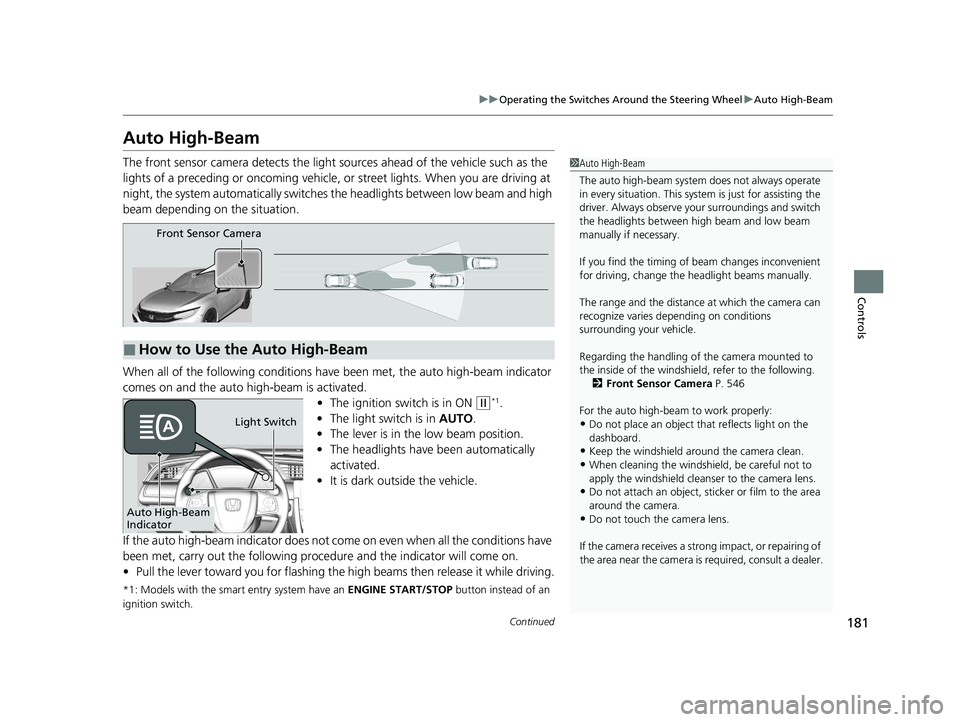
The front sensor camera detects the light sources ahead of the vehicle such as the
lights of a preceding or oncoming vehicle, or street lights. When you are driving at
night, the system automatically switches the headlights between low beam and high
beam depending on the situation.
When all of the following conditions have been met, the auto high-beam indicator
comes on and the auto high-beam is activated.
•The ignition switch is in ON
(w*1.
• The light switch is in AUTO.
• The lever is in the low beam position.
• The headlights have been automatically
activated.
• It is dark outside the vehicle.
If the auto high-beam indica tor does not come on even when all the conditions have
been met, carry out the following procedure and the indicator will come on.
• Pull the lever toward you for flashing the high beams then release it while driving.
*1: Models with the smart entry system have an ENGINE START/STOP button instead of an
ignition switch.
1 Auto High-Beam
The auto high-beam system does not always operate
in every situation. This syst em is just for assisting the
driver. Always observe your surroundings and switch
the headlights between high beam and low beam
manually if necessary.
If you find the timing of beam changes inconvenient
for driving, change the headlight beams manually.
The range and the distance at which the camera can
recognize varies de pending on conditions
surrounding your vehicle.
Regarding the handling of the camera mounted to
the inside of the windshiel d, refer to the following.
2 Front Sensor Camera P. 546
For the auto high-beam to work properly:
•Do not place an object that reflects light on the
dashboard.
•Keep the windshield around the camera clean.
•When cleaning the windshield, be careful not to
apply the windshield cleans er to the camera lens.
•Do not attach an object, sticker or film to the area
around the camera.
•Do not touch the camera lens.
If the camera receives a st rong impact, or repairing of
the area near the camera is required, consult a dealer.
■How to Use the Auto High-Beam
Front Sensor Camera
Auto High-Beam
IndicatorLight Switch
21 CIVIC 5D HUM-31TGG6400_01.book 181 ページ 2020年8月28日 金曜日 午後1時
48分
Page 184 of 711
uuOperating the Switches Around the Steering Wheel uAuto High-Beam
182
Controls
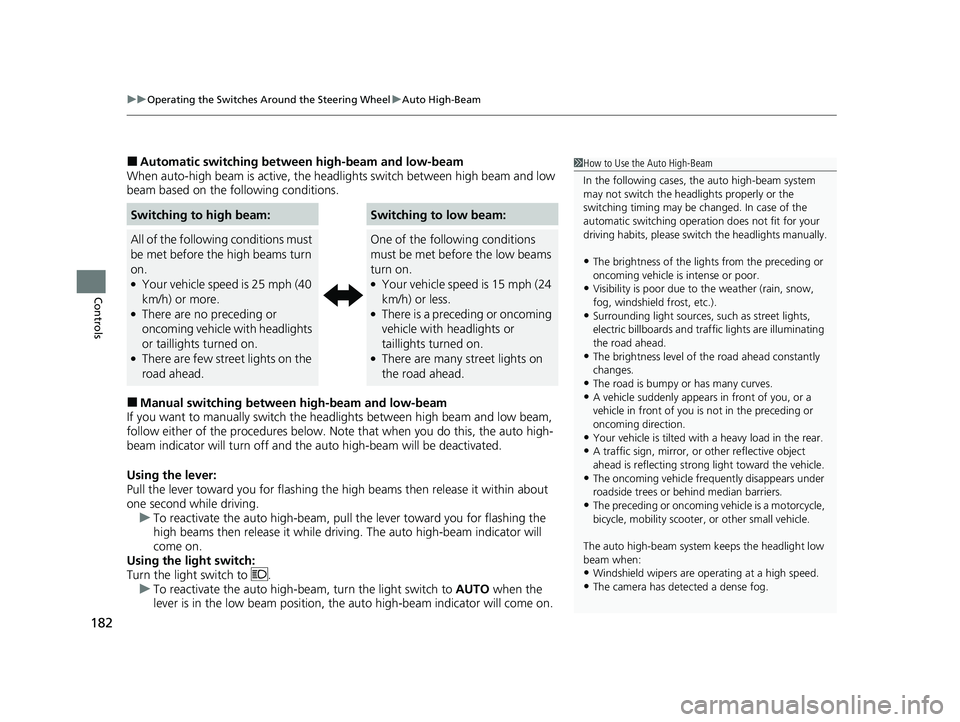
■Automatic switching between high-beam and low-beam
When auto-high beam is active, the headlights switch between high beam and low
beam based on the following conditions.
■Manual switching between high-beam and low-beam
If you want to manually switch the headlights between high beam and low beam,
follow either of the proced ures below. Note that when you do this, the auto high-
beam indicator will turn off and the auto high-beam will be deactivated.
Using the lever:
Pull the lever toward you fo r flashing the high beams th en release it within about
one second while driving. u To reactivate the auto high-beam, pull the lever toward you for flashing the
high beams then release it while driving. The auto high-beam indicator will
come on.
Using the light switch:
Turn the light switch to . u To reactivate the auto high-be am, turn the light switch to AUTO when the
lever is in the low beam position, the auto high-beam indicator will come on.
Switching to high beam:Switching to low beam:
All of the following conditions must
be met before the high beams turn
on.
●Your vehicle speed is 25 mph (40
km/h) or more.
●There are no preceding or
oncoming vehicle with headlights
or taillights turned on.
●There are few street lights on the
road ahead.
One of the following conditions
must be met before the low beams
turn on.
●Your vehicle speed is 15 mph (24
km/h) or less.
●There is a preceding or oncoming
vehicle with headlights or
taillights turned on.
●There are many street lights on
the road ahead.
1How to Use the Auto High-Beam
In the following cases, th e auto high-beam system
may not switch the head lights properly or the
switching timing may be ch anged. In case of the
automatic switching operation does not fit for your
driving habits, please swit ch the headlights manually.
•The brightness of the lights from the preceding or
oncoming vehicle is intense or poor.
•Visibility is poor due to the weather (rain, snow,
fog, windshield frost, etc.).
•Surrounding light sources, such as street lights,
electric billboards and traf fic lights are illuminating
the road ahead.
•The brightness level of th e road ahead constantly
changes.
•The road is bumpy or has many curves.•A vehicle suddenly appears in front of you, or a
vehicle in front of you is not in the preceding or
oncoming direction.
•Your vehicle is tilted with a heavy load in the rear.•A traffic sign, mirror, or other reflective object
ahead is reflecting strong light toward the vehicle.
•The oncoming vehicle freq uently disappears under
roadside trees or be hind median barriers.
•The preceding or oncoming vehicle is a motorcycle,
bicycle, mobility scooter, or other small vehicle.
The auto high-beam system keeps the headlight low
beam when:
•Windshield wipers are op erating at a high speed.
•The camera has detected a dense fog.
21 CIVIC 5D HUM-31TGG6400_01.book 182 ページ 2020年8月28日 金曜日 午後1時 48分
Page 185 of 711
183
uuOperating the Switches Around the Steering Wheel uAuto High-Beam
Controls
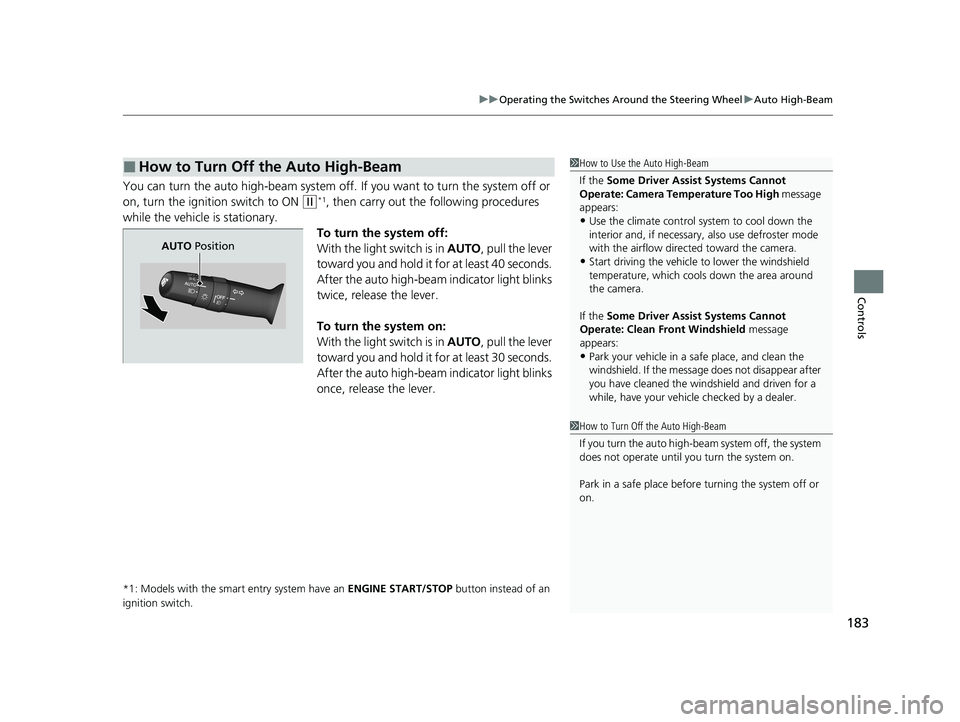
You can turn the auto high-beam system off. If you want to turn the system off or
on, turn the ignition switch to ON
(w*1, then carry out the following procedures
while the vehicle is stationary.
To turn the system off:
With the light switch is in AUTO, pull the lever
toward you and hold it for at least 40 seconds.
After the auto high-beam indicator light blinks
twice, release the lever.
To turn the system on:
With the light switch is in AUTO, pull the lever
toward you and hold it for at least 30 seconds.
After the auto high-beam indicator light blinks
once, release the lever.
*1: Models with the smart entry system have an ENGINE START/STOP button instead of an
ignition switch.
■How to Turn Off the Auto High-Beam1 How to Use the Auto High-Beam
If the Some Driver Assist Systems Cannot
Operate: Camera Temperature Too High message
appears:
•Use the climate control system to cool down the
interior and, if necessary, also use defroster mode
with the airflow directed toward the camera.
•Start driving the vehicle to lower the windshield
temperature, which cool s down the area around
the camera.
If the Some Driver Assist Systems Cannot
Operate: Clean Front Windshield message
appears:
•Park your vehicle in a sa fe place, and clean the
windshield. If the message does not disappear after
you have cleaned the winds hield and driven for a
while, have your vehicle checked by a dealer.
1 How to Turn Off the Auto High-Beam
If you turn the au to high-beam system off, the system
does not operate until you turn the system on.
Park in a safe place before turning the system off or
on.
AUTO Position
21 CIVIC 5D HUM-31TGG6400_01.book 183 ページ 2020年8月28日 金曜日 午後1時 48分