IMA HONDA CIVIC HYBRID 2012 9.G Owners Manual
[x] Cancel search | Manufacturer: HONDA, Model Year: 2012, Model line: CIVIC HYBRID, Model: HONDA CIVIC HYBRID 2012 9.GPages: 313, PDF Size: 8.65 MB
Page 1 of 313
Contents
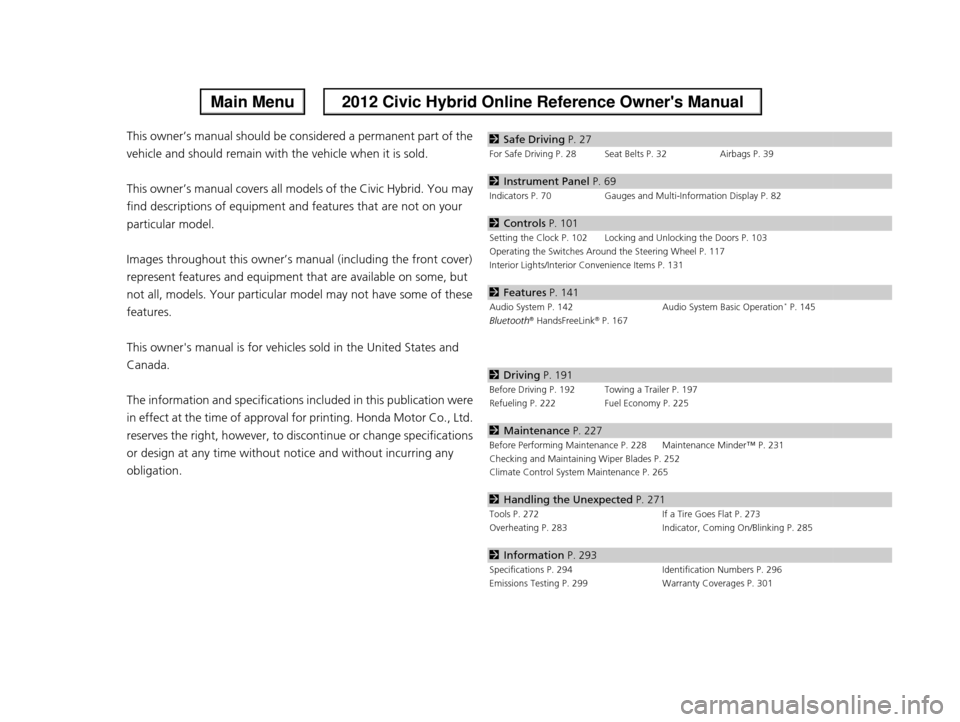
This owner’s manual should be considered a permanent part of the
vehicle and should remain with the vehicle when it is sold.
This owner’s manual covers all models of the Civic Hybrid. You may
find descriptions of equipment and features that are not on your
particular model.
Images throughout this owner’s manual (including the front cover)
represent features and equipment that are available on some, but
not all, models. Your particular mo del may not have some of these
features.
This owner's manual is for vehicles sold in the United States and
Canada.
The information and specifications in cluded in this publication were
in effect at the time of approval for printing. Honda Motor Co., Ltd.
reserves the right, however, to discontinue or change specifications
or design at any time without notice and without incurring any
obligation.2 Safe Driving P. 27
For Safe Driving P. 28 Seat Belts P. 32 Airbags P. 39
2Instrument Panel P. 69
Indicators P. 70 Gauges and Multi-Information Display P. 82
2Controls P. 101
Setting the Clock P. 102 Locking and Unlocking the Doors P. 103
Operating the Switches Around the Steering Wheel P. 117
Interior Lights/Interior Convenience Items P. 131
2Features P. 141
Audio System P. 142 Audio System Basic Operation* P. 145
Bluetooth® HandsFreeLink® P. 167
2 Driving P. 191
Before Driving P. 192 Towing a Trailer P. 197
Refueling P. 222 Fuel Economy P. 225
2Maintenance P. 227
Before Performing Maintenance P. 228 Maintenance Minder™ P. 231
Checking and Maintaining Wiper Blades P. 252
Climate Control System Maintenance P. 265
2Handling the Unexpected P. 271
Tools P. 272 If a Tire Goes Flat P. 273
Overheating P. 283 Indicator, Coming On/Blinking P. 285
2Information P. 293
Specifications P. 294 Identification Numbers P. 296
Emissions Testing P. 299 Warranty Coverages P. 301
CIVIC IMA_KAKC-31TR2600.book 0 ページ 2011年2月15日 火曜日 午前9時24分
Page 2 of 313
Contents
Child Safety P. 54Exhaust Gas Hazard P. 66Safety Labels P. 67Opening and Closing the Trunk P. 110 Security System P. 113 Opening and Closing the Windows P. 115
Adjusting the Mirrors P. 125 Adjusting the Seats P. 126
Climate Control System P. 137Audio Error Messages P. 162 General Information on the Audio System P. 164When Driving P. 198Braking P. 213Parking Your Vehicle P. 217
Accessories and Modifications P. 226Maintenance Under the Hood P. 235 Replacing Light Bulbs P. 247
Checking and Maintaining Tires P. 254 12 Volt Battery P. 263 Remote Transmitter Care P. 264
Cleaning P. 266Engine Does Not Start P. 279 Jump Starting P. 280Shift Lever Does Not Move P. 282
Fuses P. 289 Emergency Towing P. 292Devices that Emit Radio Waves P. 297 Reporting Safety Defects P. 298
Authorized Manuals P. 303 Customer Service Information P. 304
Quick Reference Guide
P. 2
Safe Driving
P. 27
Instrument Panel
P. 69
Controls
P. 101
Features
P. 141
Driving
P. 191
Maintenance
P. 227
Handling the Unexpected
P. 271
Information
P. 293
Index
P. 305
Page 3 of 313
2Quick Reference Guide
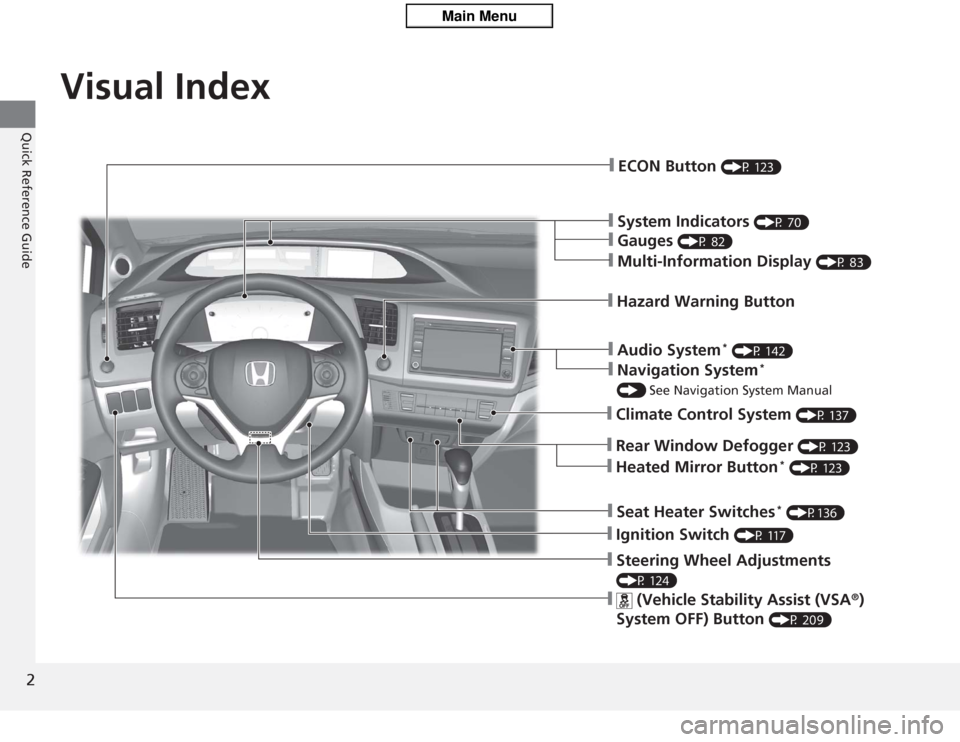
Quick Reference GuideVisual Index
❙Gauges
(P 82)
❙Multi-Information Display
(P 83)
❙Hazard Warning Button ❙Audio System
* (P 142)
❙Navigation System
*
() See Navigation System Manual❙Climate Control System
(P 137)
❙Ignition Switch
(P 117)
❙Seat Heater Switches
* (P136)
❙Steering Wheel Adjustments (P 124)❙
(Vehicle Stability Assist (VSA
®)
System OFF) Button
(P 209)
❙System Indicators
(P 70)
❙ECON Button
(P 123)
❙Heated Mirror Button
* (P 123)
❙Rear Window Defogger
(P 123)
Page 11 of 313
10Quick Reference Guide
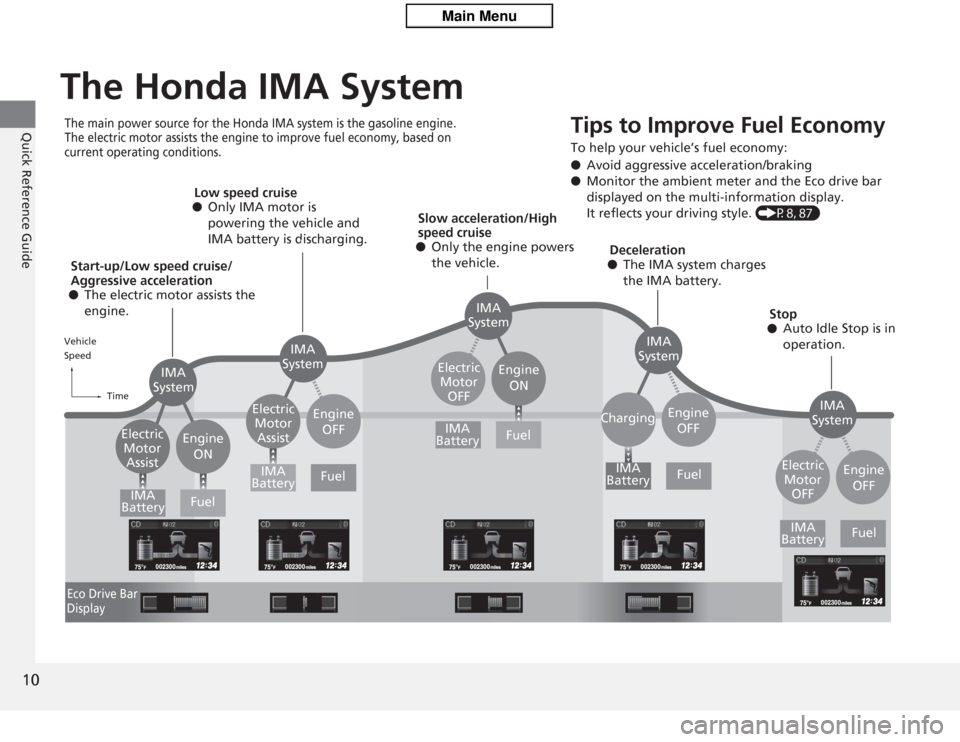
The Honda IMA SystemThe main power source for the Honda IMA system is the gasoline engine.
The electric motor assists the engine to improve fuel economy, based on
current operating conditions.
Tips to Improve Fue
l Economy
To help your vehicle’s fuel economy:
●Avoid aggressive acceleration/braking
● Monitor the ambient meter and the Eco drive bar
displayed on the multi-information display.
It reflects your driving style. (P8, 87)
Start-up/Low speed cruise/
Aggressive acceleration
● The electric motor assists the
engine. Low speed cruise
● Only IMA motor is
powering the vehicle and
IMA battery is discharging.
Slow acceleration/High
speed cruise
● Only the engine powers
the vehicle. Deceleration
● The IMA system charges
the IMA battery.
Stop
● Auto Idle Stop is in
operation.
Vehicle
Speed
TimeEco Drive Bar
Display
IMA
System IMA
System
IMA
System
IMA
System
IMA
System
Electric
Motor Assist Engine
ON Electric
Motor Assist Electric
Motor OFF
Charging
Engine
OFF Engine
ON
Engine OFF
Engine OFF
IMA
Battery IMA
Battery IMA
Battery
IMA
Battery
IMA
Battery
Fuel
Fuel Fuel
Fuel
Fuel
Electric Motor OFF
Page 12 of 313
11Quick Reference Guide
To Keep the IMA Battery in Good Condition Drive your vehicle at least once a month for more than 30 minutes. Parking your vehicle for an extended period can
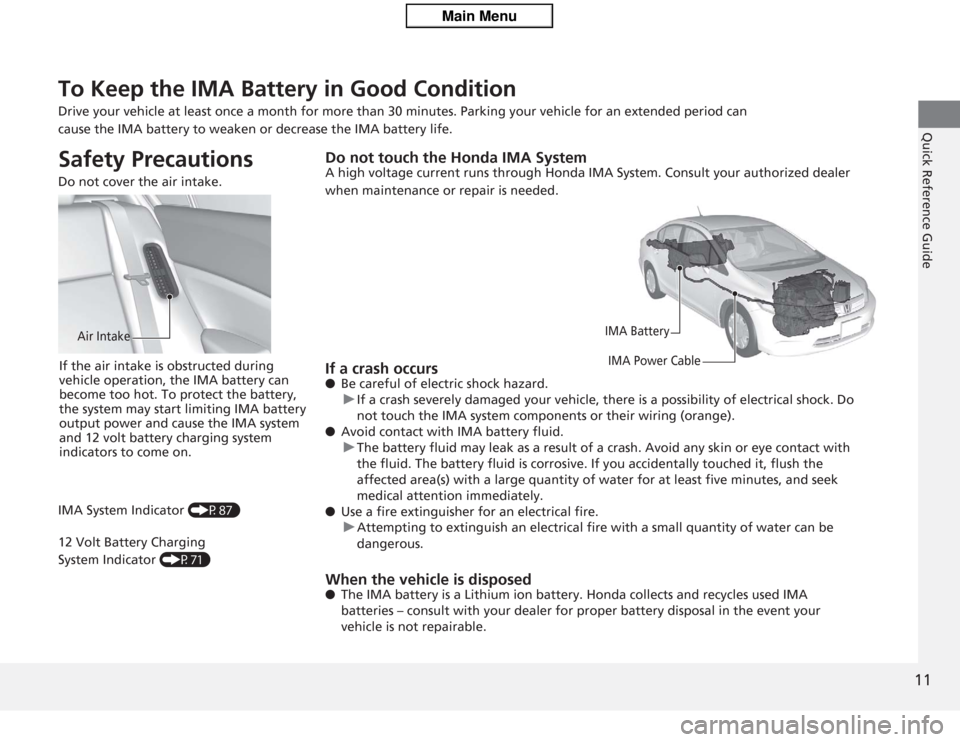
cause the IMA battery to weaken or decrease the IMA battery life.Safety Precautions Do not cover the air intake.
Air Intake
If the air intake is obstructed during
vehicle operation, the IMA battery can
become too hot. To protect the battery,
the system may start limiting IMA battery
output power and cause the IMA system
and 12 volt battery charging system
indicators to come on.
IMA System Indicator (P87)
12 Volt Battery Charging
System Indicator (P71)
Do not touch the Honda IMA SystemA high voltage current runs through Honda IMA System. Consult your authorized dealer
when maintenance or repair is needed.
IMA Battery
IMA Power Cable
If a crash occurs● Be careful of electric shock hazard.
u If a crash severely damaged your vehicle, there is a possibility of electrical shock. Do
not touch the IMA system components or their wiring (orange).
● Avoid contact with IMA battery fluid.
u The battery fluid may leak as a result of a crash. Avoid any skin or eye contact with
the fluid. The battery fluid is corrosive. If you accid entally touched it, flush the
affected area(s) with a large quantity of water for at least five minutes, and seek
medical attention immediately.
● Use a fire extinguisher for an electrical fire.
u Attempting to extinguish an electrical fire with a small quantity of water can be
dangerous.When the vehicle is disposed● The IMA battery is a Lithium ion battery. Honda collects and recycles used IMA
batteries – consult with your dealer for proper battery disposal in the event your
vehicle is not repairable.
Page 14 of 313
13Quick Reference Guide
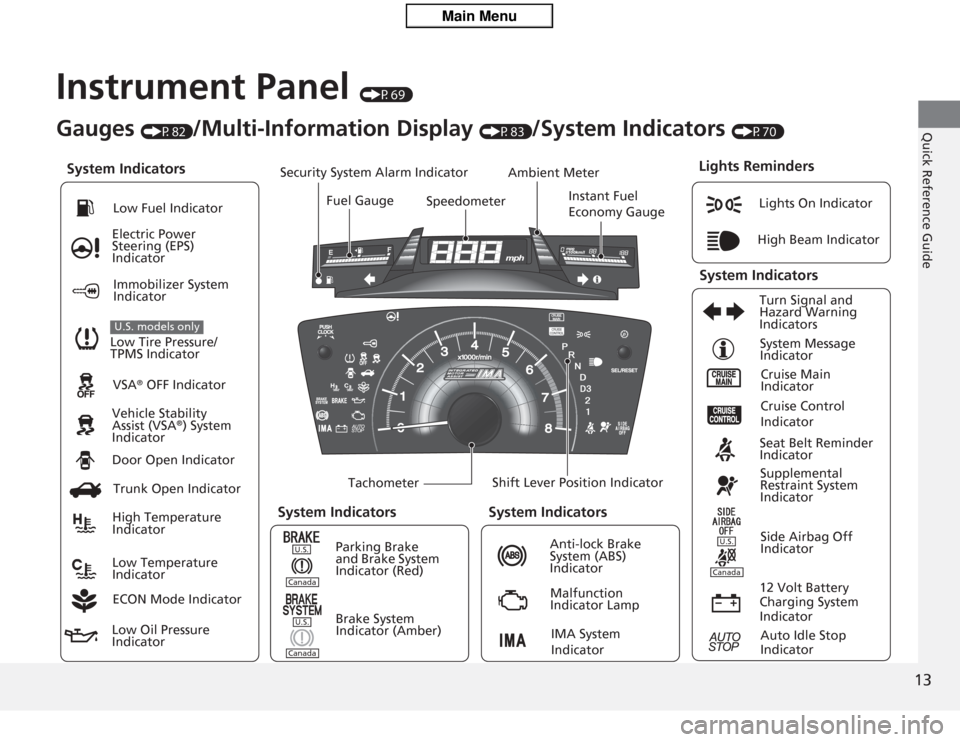
Instrument Panel
(P69)
System Indicators
Malfunction
Indicator Lamp
Low Oil Pressure
Indicator Anti-lock Brake
System (ABS)
Indicator
Vehicle Stability
Assist (VSA
®) System
Indicator VSA
® OFF Indicator
Electric Power
Steering (EPS)
Indicator
Lights On Indicator
High Beam Indicator
Immobilizer System
Indicator
Seat Belt Reminder
Indicator
Lights Reminders
Cruise Main
Indicator
System Message
Indicator
Brake System
Indicator (Amber) Supplemental
Restraint System
Indicator
Side Airbag Off
Indicator
Door Open Indicator
TachometerInstant Fuel
Economy Gauge
Speedometer
Fuel Gauge
Security System Alarm Indicator
Shift Lever Position Indicator
Low Fuel Indicator
Gauges
(P82)
/Multi-Information Display
(P83)
/System Indicators
(P70)
Trunk Open Indicator
ECON Mode Indicator Turn Signal and
Hazard Warning
Indicators
High Temperature
Indicator
Low Temperature
Indicator Ambient Meter
System Indicators
System Indicators
Low Tire Pressure/
TPMS IndicatorU.S. models only
Parking Brake
and Brake System
Indicator (Red)
IMA System
Indicator
Cruise Control
Indicator
System Indicators
12 Volt Battery
Charging System
IndicatorAuto Idle Stop
Indicator
U.S.CanadaU.S.Canada
U.S.Canada
Page 17 of 313
16Quick Reference Guide
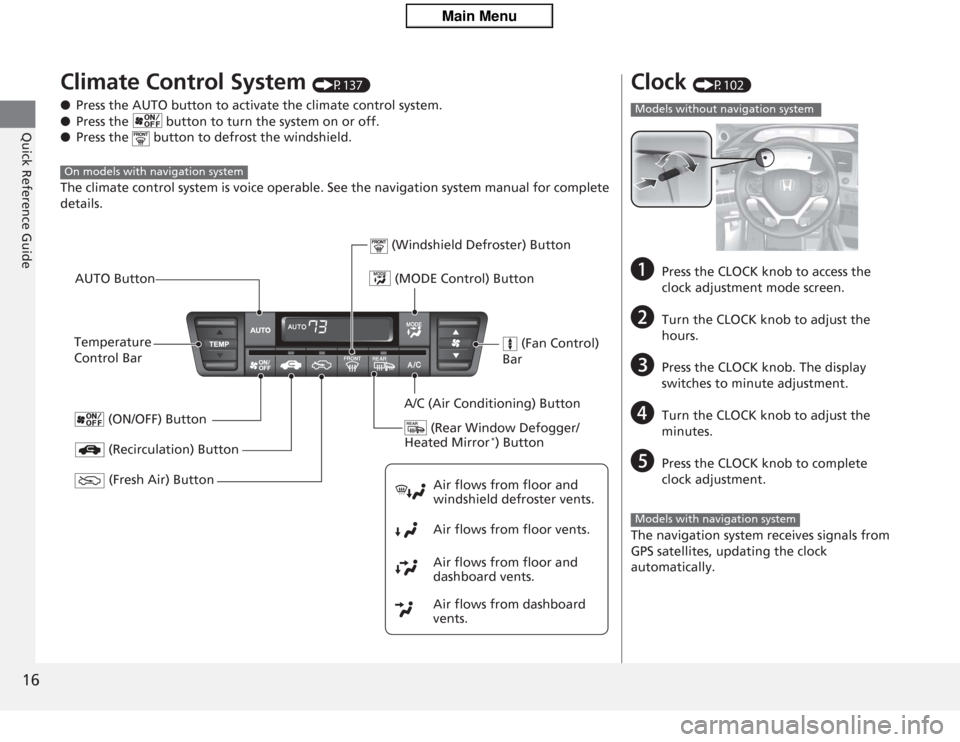
Climate Control System
(P137)
● Press the AUTO button to activate the climate control system.
● Press the button to turn the system on or off.
● Press the button to defrost the windshield.
The climate control system is voice operable. See the navigation system manual for complete
details.
On models with navigation system
(MODE Control) Button
(Rear Window Defogger/
Heated Mirror
*) Button
(Windshield Defroster) Button
A/C (Air Conditioning) Button
Air flows from floor and
windshield defroster vents.
Air flows from floor vents.
Air flows from floor and
dashboard vents.
Air flows from dashboard
vents.
(Recirculation) Button
Temperature
Control BarAUTO Button
(ON/OFF) Button
(Fresh Air) Button
(Fan Control)
Bar
Clock
(P102)
a
Press the CLOCK knob to access the
clock adjustment mode screen.
b
Turn the CLOCK knob to adjust the
hours.
c
Press the CLOCK knob. The display
switches to minute adjustment.
d
Turn the CLOCK knob to adjust the
minutes.
e
Press the CLOCK knob to complete
clock adjustment.
The navigation system receives signals from
GPS satellites, updating the clock
automatically.
Models without navigation systemModels with navigation system
Page 19 of 313
18Quick Reference Guide
Driving
(P191)
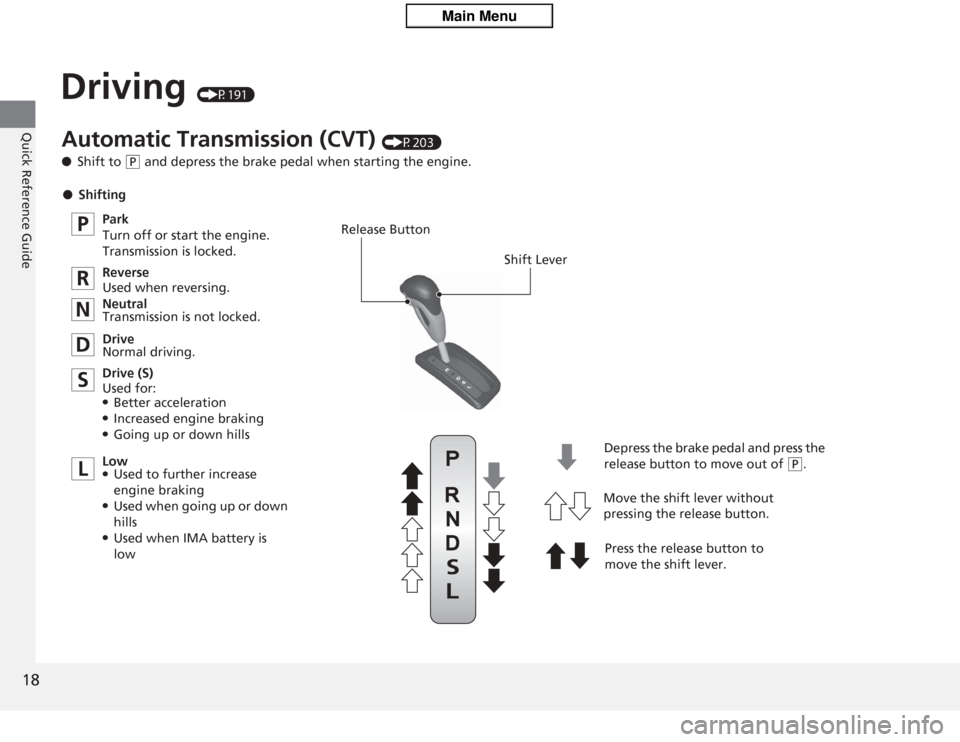
Release ButtonShift Lever
Depress the brake pedal and press the
release button to move out of
(P
.
Move the shift lever without
pressing the release button.
Press the release button to
move the shift lever.
Automatic Transmission (CVT)
(P203)
● Shift to
(P
and depress the brake pedal when starting the engine.
● Shifting
Park
Turn off or start the engine.
Transmission is locked.
Reverse
Used when reversing.
Neutral
Transmission is not locked.
Drive
Normal driving.
Drive (S)
Used for:
●Better acceleration●Increased engine braking●Going up or down hills
Low●Used to further increase
engine braking●Used when going up or down
hills●Used when IMA battery is
low
Page 43 of 313
42
uuAirbags uTypes of Airbags
Safe Driving
Types of AirbagsYour vehicle is equipped with three types of airbags:
• Front airbags: Airbags in front of the driver's and front passenger's seats.
• Side airbags: Airbags in the driver's and front passenger's seat-backs.
• Side curtain airbags: Airbags above the side windows.
Each is discussed in the following pages.Front Airbags (SRS)The front SRS airbags inflate in a moderate-to-severe frontal collision to help protect
the head and chest of the driver and/or front passenger.
SRS (Supplemental Restraint System) indicates that the airbags are designed to
supplement seat belts, not replace them. Seat belts are the occupant's primary
restraint system.
The front airbags are housed in the center of the steering wheel for the driver, and
in the dashboard for the front passenger. Both airbags are marked SRS AIRBAG.■
Housing Locations
1 Types of Airbags
The airbags can inflate whenever the ignition switch
is in ON
(w
.
1 Front Airbags (SRS)
Dual-Stage, Multiple-Threshold Front Airbags
(SRS)
Your vehicle is equipped with dual-stage, multiple-
threshold front airbags (SRS).
During a frontal crash severe enough to cause one or
both front airbags to deploy, the airbags can inflate
at different rates, depending on the severity of the
crash, whether or not the seat belts are latched, and/
or other factors. Frontal airbags are designed to
supplement the seat belts to help reduce the
likelihood of head and chest injuries in frontal
crashes.
Page 44 of 313
Continued
43
uuAirbags uFront Airbags (SRS)
Safe Driving
Front airbags are designed to inflate during moderate-to-severe frontal collisions.
When the vehicle decelerates suddenly, the sensors send information to the control
unit which signals one or both front airbags to inflate.
A frontal collision can be either head-on or angled between two vehicles, or when a
vehicle crashes into a stationary object, such as a concrete wall.
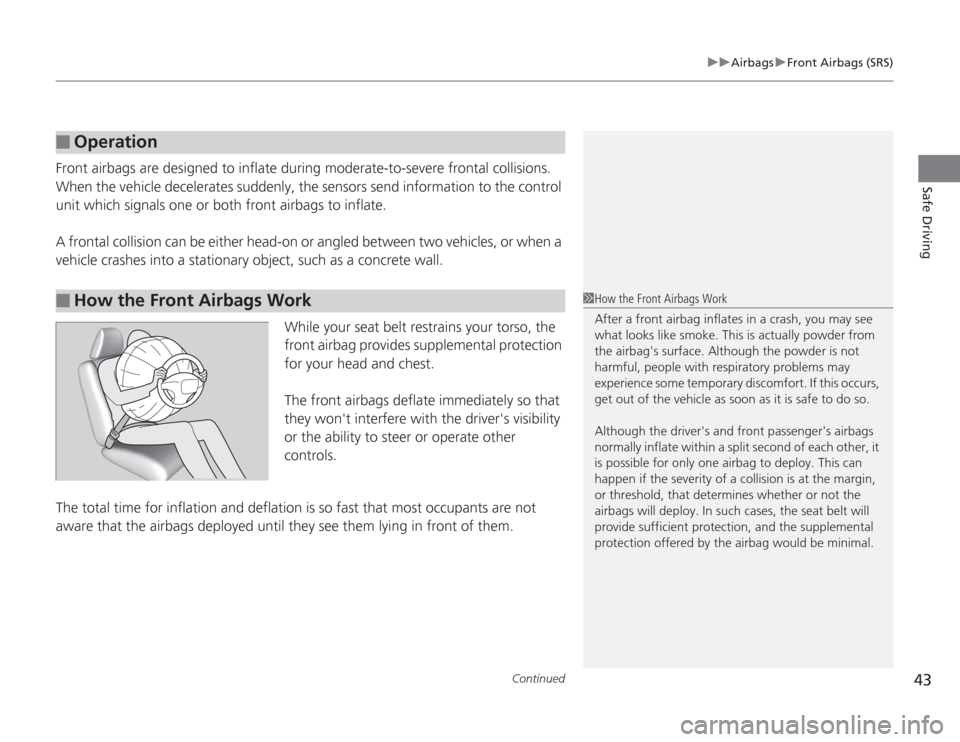
While your seat belt restrains your torso, the
front airbag provides supplemental protection
for your head and chest.
The front airbags deflate immediately so that
they won't interfere with the driver's visibility
or the ability to steer or operate other
controls.
The total time for inflation and deflation is so fast that most occupants are not
aware that the airbags deployed until they see them lying in front of them.■
Operation
■
How the Front Airbags Work
1 How the Front Airbags Work
After a front airbag inflat es in a crash, you may see
what looks like smoke. This is actually powder from
the airbag's surface. Although the powder is not
harmful, people with respiratory problems may
experience some temporary discomfort. If this occurs,
get out of the vehicle as soon as it is safe to do so.
Although the driver's and front passenger's airbags
normally inflate within a split second of each other, it
is possible for only one airbag to deploy. This can
happen if the severity of a collision is at the margin,
or threshold, that determines whether or not the
airbags will deploy. In such cases, the seat belt will
provide sufficient protection, and the supplemental
protection offered by the airbag would be minimal.