brake HONDA CIVIC HYBRID 2013 9.G Owner's Manual
[x] Cancel search | Manufacturer: HONDA, Model Year: 2013, Model line: CIVIC HYBRID, Model: HONDA CIVIC HYBRID 2013 9.GPages: 346, PDF Size: 6.95 MB
Page 217 of 346
uuWhen DrivinguStarting the Engine
216Driving
■Creep aid system
With the shift lever in
(D, this feature applies brake pressure briefly as you release
the brake pedal to prevent the vehicle from moving unexpectedly.
■Hill start assist system
Hill start assist keeps the brake engaged briefly to help prevent the vehicle from
rolling on inclines as you move your foot from the brake pedal to the accelerator.
Move the shift lever to
(D or
(L when facing uphill, or
(R when facing downhill,
then release the brake pedal.
1Hill start assist system
Hill start assist may not prevent the vehicle from
rolling downhill on a very steep or slippery slope, and
will not operate on small inclines.
Hill start assist is not a replacement for the parking
brake.
Hill start assist will still operate even when VSA® is
switched off.
Page 218 of 346
217
uuWhen DrivinguPrecautions While Driving
Driving
Precautions While DrivingAvoid driving in deep water and on flooded roads. This can damage the engine or
driveline, or cause electrical component failure.
If there is a strong impact with something under the vehicle, stop in a safe location.
Check the underside of the vehicle for damage or any fluid leaks.■In Rain■Other Precautions
1Precautions While DrivingNOTICEDo not operate the shift lever while pressing the
accelerator pedal. You could damage the
transmission.
If the ignition switch is turned to ACCESSORY
(q or
LOCK
(0 while driving, the engine will shut down
and all steering and brake power assist functions will
stop, making it difficult to control the vehicle.
Do not put the shift lever in
(N, as you will lose
engine braking (and acceleration) performance.
During the first 600 miles (1,000 km) of operation,
avoid sudden acceleration or full throttle operation so
as not to damage the engine or powertrain.
Avoid hard braking for the first 200 miles (300 km).
You should also follow this when the brake pads are
replaced.
NOTICEFollowing can damage the under spoiler:•Parking the vehicle by a parking block•Parallel parking along the road shoulder•Driving towards the bottom of a hill•Driving up or down to a different surface level
(such as a road shoulder)•Driving on a rutted or bumpy road•Driving on a road with potholes
Page 219 of 346
218
uuWhen DrivinguAutomatic Transmission (CVT)
Driving
Automatic Transmission (CVT)The engine runs at a higher idle speed and creeping increases.
Keep the brake pedal firmly depressed when stopped.
Quickly depressing the accelerator pedal while driving uphill may cause the
transmission to drop to a lower ratio, unexpectedly increasing vehicle speed.
Depress the accelerator pedal carefully, especially on slippery roads and curves.■Creeping■Kickdown
Page 220 of 346
219
uuWhen DrivinguShifting
Continued
Driving
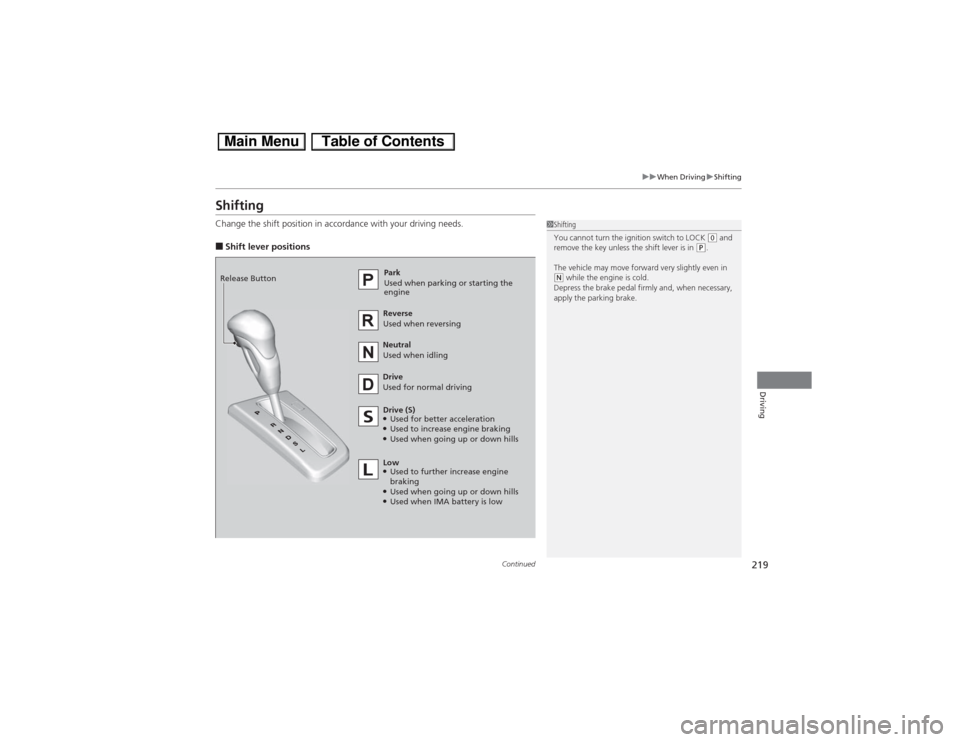
ShiftingChange the shift position in accordance with your driving needs.■Shift lever positions
1Shifting
You cannot turn the ignition switch to LOCK
(0 and
remove the key unless the shift lever is in
(P.
The vehicle may move forward very slightly even in
(N while the engine is cold.
Depress the brake pedal firmly and, when necessary,
apply the parking brake.
Park
Used when parking or starting the
engine
Reverse
Used when reversing
Neutral
Used when idling
Drive
Used for normal driving
Drive (S)●Used for better acceleration●Used to increase engine braking●Used when going up or down hills Release Button
Low●Used to further increase engine
braking●Used when going up or down hills●Used when IMA battery is low
Page 221 of 346
uuWhen DrivinguShifting
220Driving
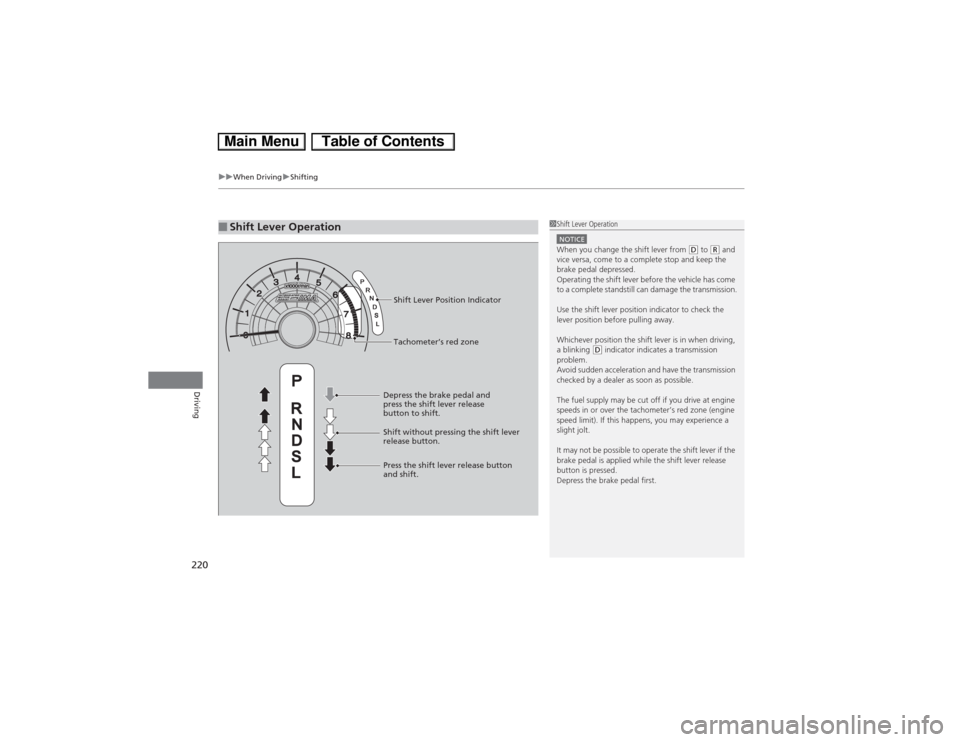
■Shift Lever Operation
1Shift Lever OperationNOTICEWhen you change the shift lever from
(D to (R and
vice versa, come to a complete stop and keep the
brake pedal depressed.
Operating the shift lever before the vehicle has come
to a complete standstill can damage the transmission.
Use the shift lever position indicator to check the
lever position before pulling away.
Whichever position the shift lever is in when driving,
a blinking
(D indicator indicates a transmission
problem.
Avoid sudden acceleration and have the transmission
checked by a dealer as soon as possible.
The fuel supply may be cut off if you drive at engine
speeds in or over the tachometer’s red zone (engine
speed limit). If this happens, you may experience a
slight jolt.
It may not be possible to operate the shift lever if the
brake pedal is applied while the shift lever release
button is pressed.
Depress the brake pedal first.
Tachometer’s red zone Shift Lever Position Indicator
Depress the brake pedal and
press the shift lever release
button to shift.
Shift without pressing the shift lever
release button.
Press the shift lever release button
and shift.
Page 224 of 346
Continued
223
uuWhen DrivinguAuto Idle Stop
Driving
The vehicle stops with the shift lever in
(D and the brake pedal depressed.
■Auto idle stop does not activate when:
•The low temperature indicator is on.
•The IMA battery charge is low.
•The bars of the electric motor power flow monitor do not move when
accelerating or decelerating.
•The transmission fluid temperature is low.
•The vehicle comes to a stop again before the vehicle speed reaches 9 mph (15
km/h) after the engine starts.
•Stopped on a steep incline.
•The shift lever is in a position other than
(D or
(N.
■Auto idle stop may not activate when:
•Even if the set temperature and the actual interior temperature are around the
same ambient conditions (strong sunlight, high or low temperature, etc.) can
prevent Auto Idle Stop from activating.
•The vehicle is stopped by braking suddenly.■Auto Idle Stop Activates When:
1Auto Idle Stop Activates When:
The Auto Idle Stop may also activate when the brake
pedal is depressed, and the vehicle slows down to a
speed below 6 mph (10 km/h).
Page 225 of 346
224
uuWhen DrivinguAuto Idle Stop
Driving
The brake pedal is released.■The engine restarts even if the brake pedal is depressed when:
•The shift position is changed to
(R or
(L.
•The accelerator pedal is depressed.
•The pressure to the brake pedal is reduced and the vehicle starts moving while
stopped on an incline.
•The IMA battery charge becomes low.
•The low temperature indicator comes on.
•Ambient conditions that may differentiate the interior temperature from the set
temperature can also be the cause to start the engine.
■The Engine Automatically Restarts When:
Page 228 of 346
227
uuWhen DrivinguCruise Control
Driving
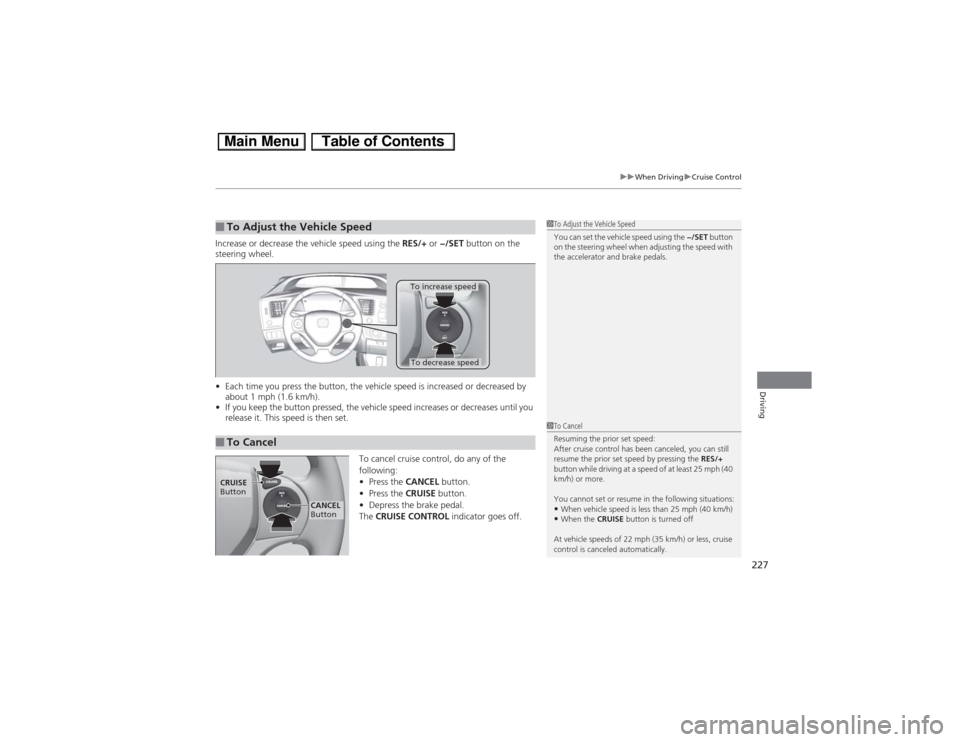
Increase or decrease the vehicle speed using the RES/+ or −/SET button on the
steering wheel.
•Each time you press the button, the vehicle speed is increased or decreased by
about 1 mph (1.6 km/h).
•If you keep the button pressed, the vehicle speed increases or decreases until you
release it. This speed is then set.
To cancel cruise control, do any of the
following:
•Press the CANCEL button.
•Press the CRUISE button.
•Depress the brake pedal.
The CRUISE CONTROL indicator goes off.■To Adjust the Vehicle Speed
1To Adjust the Vehicle Speed
You can set the vehicle speed using the −/SET button
on the steering wheel when adjusting the speed with
the accelerator and brake pedals.
■To Cancel
To decrease speedTo increase speed
1To Cancel
Resuming the prior set speed:
After cruise control has been canceled, you can still
resume the prior set speed by pressing the RES/+
button while driving at a speed of at least 25 mph (40
km/h) or more.
You cannot set or resume in the following situations:•When vehicle speed is less than 25 mph (40 km/h)•When the CRUISE button is turned off
At vehicle speeds of 22 mph (35 km/h) or less, cruise
control is canceled automatically.
CRUISE
Button
CANCEL
Button
Page 229 of 346
228
uuWhen DrivinguForward Collision Warning (FCW)
*
Driving
Forward Collision Warning (FCW)
*
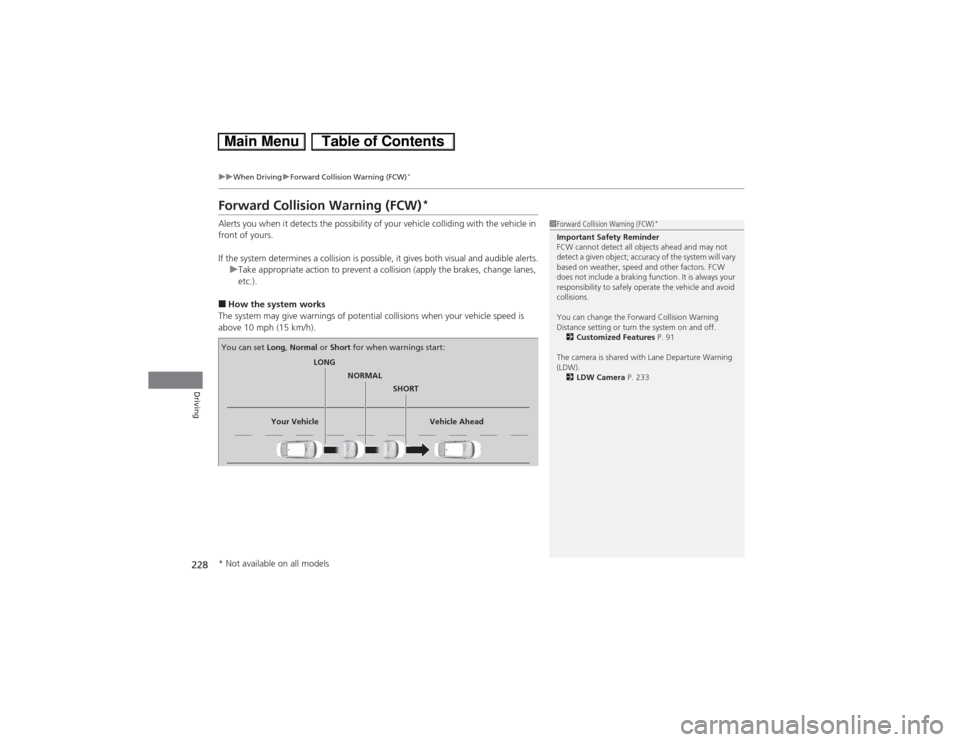
Alerts you when it detects the possibility of your vehicle colliding with the vehicle in
front of yours.
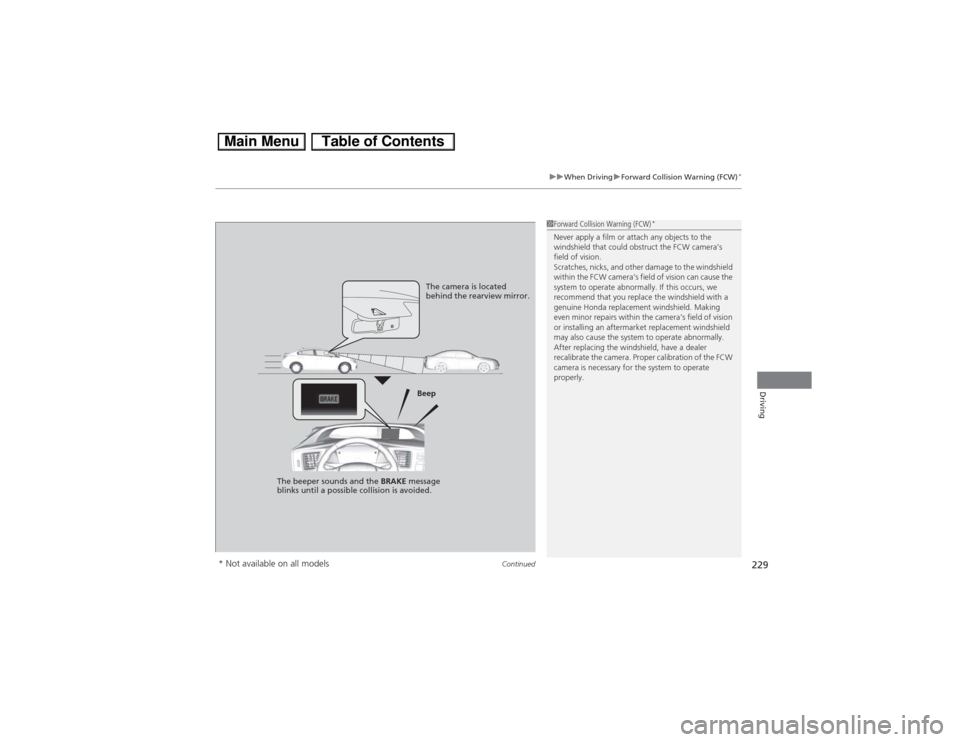
If the system determines a collision is possible, it gives both visual and audible alerts.
uTake appropriate action to prevent a collision (apply the brakes, change lanes,
etc.).■How the system works
The system may give warnings of potential collisions when your vehicle speed is
above 10 mph (15 km/h).
1Forward Collision Warning (FCW)
*
Important Safety Reminder
FCW cannot detect all objects ahead and may not
detect a given object; accuracy of the system will vary
based on weather, speed and other factors. FCW
does not include a braking function. It is always your
responsibility to safely operate the vehicle and avoid
collisions.
You can change the Forward Collision Warning
Distance setting or turn the system on and off.
2Customized Features P. 91
The camera is shared with Lane Departure Warning
(LDW).
2LDW Camera P. 233
LONG
NORMAL
SHORT
Your Vehicle Vehicle Ahead You can set Long, Normal or Short for when warnings start:
* Not available on all models
Page 230 of 346
Continued
229
uuWhen DrivinguForward Collision Warning (FCW)
*
Driving
1Forward Collision Warning (FCW)
*
Never apply a film or attach any objects to the
windshield that could obstruct the FCW camera’s
field of vision.
Scratches, nicks, and other damage to the windshield
within the FCW camera’s field of vision can cause the
system to operate abnormally. If this occurs, we
recommend that you replace the windshield with a
genuine Honda replacement windshield. Making
even minor repairs within the camera’s field of vision
or installing an aftermarket replacement windshield
may also cause the system to operate abnormally.
After replacing the windshield, have a dealer
recalibrate the camera. Proper calibration of the FCW
camera is necessary for the system to operate
properly.
The camera is located
behind the rearview mirror.
Beep
The beeper sounds and the BRAKE message
blinks until a possible collision is avoided.
* Not available on all models