brake HONDA CR-V 2000 RD1-RD3 / 1.G User Guide
[x] Cancel search | Manufacturer: HONDA, Model Year: 2000, Model line: CR-V, Model: HONDA CR-V 2000 RD1-RD3 / 1.GPages: 322, PDF Size: 4.64 MB
Page 160 of 322
5-spee
d Manua l Transmissio n
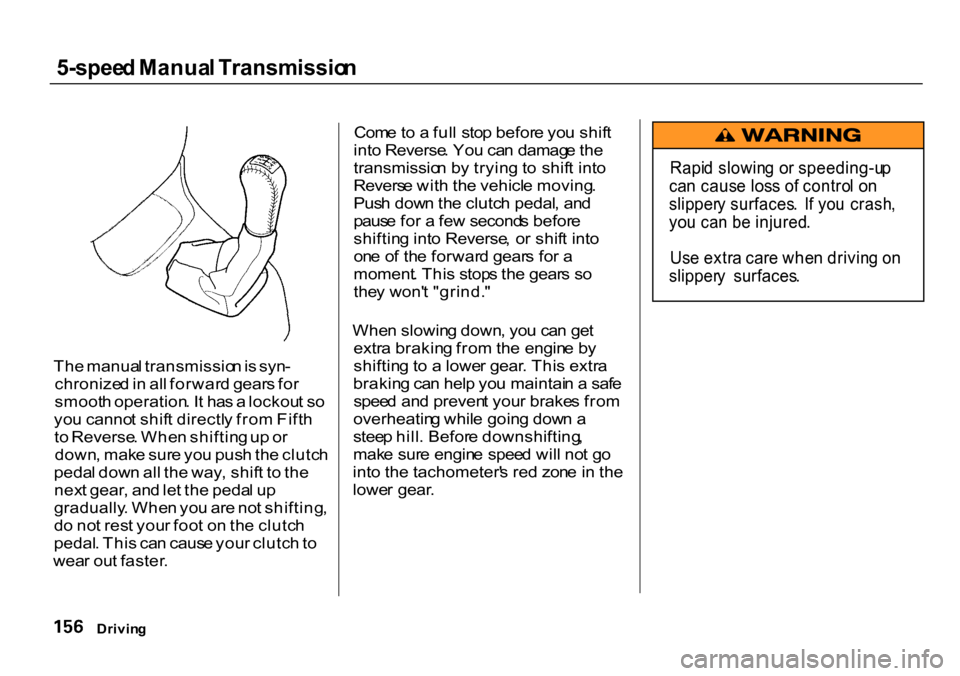
Th e manua l transmissio n is syn -
chronize d in al l forwar d gear s fo r
smoot h operation . I t ha s a lockou t s o
yo u canno t shif t directl y fro m Fift h
t o Reverse . Whe n shiftin g u p o r
down , mak e sur e yo u pus h th e clutc h
peda l dow n al l th e way , shif t t o th e
nex t gear , an d le t th e peda l u p
gradually . Whe n yo u ar e no t shifting ,
d o no t res t you r foo t o n th e clutc h
pedal . Thi s ca n caus e you r clutc h to
wea r ou t faster . Com
e to a ful l sto p befor e yo u shif t
int o Reverse . Yo u ca n damag e th e
transmissio n b y tryin g to shif t int o
Revers e wit h th e vehicl e moving .
Pus h dow n th e clutc h pedal , an d
paus e fo r a fe w second s befor e
shiftin g int o Reverse , o r shif t int o
on e o f th e forwar d gear s fo r a
moment . Thi s stop s th e gear s s o
the y won' t "grind. "
Whe n slowin g down , yo u ca n ge t
extr a brakin g fro m th e engin e b y
shiftin g to a lowe r gear . Thi s extr a
brakin g ca n hel p yo u maintai n a saf e
spee d an d preven t you r brake s fro m
overheatin g whil e goin g dow n a
stee p hill . Befor e downshifting ,
mak e sur e engin e spee d wil l no t g o
int o th e tachometer' s re d zon e in th e
lowe r gear .
Drivin g
Rapi
d slowin g o r speeding-u p
ca n caus e los s o f contro l o n
slipper y surfaces . I f yo u crash ,
yo u ca n b e injured .
Us e extr a car e whe n drivin g o n
slipper y surfaces .
Page 166 of 322
Automati
c Transmissio n
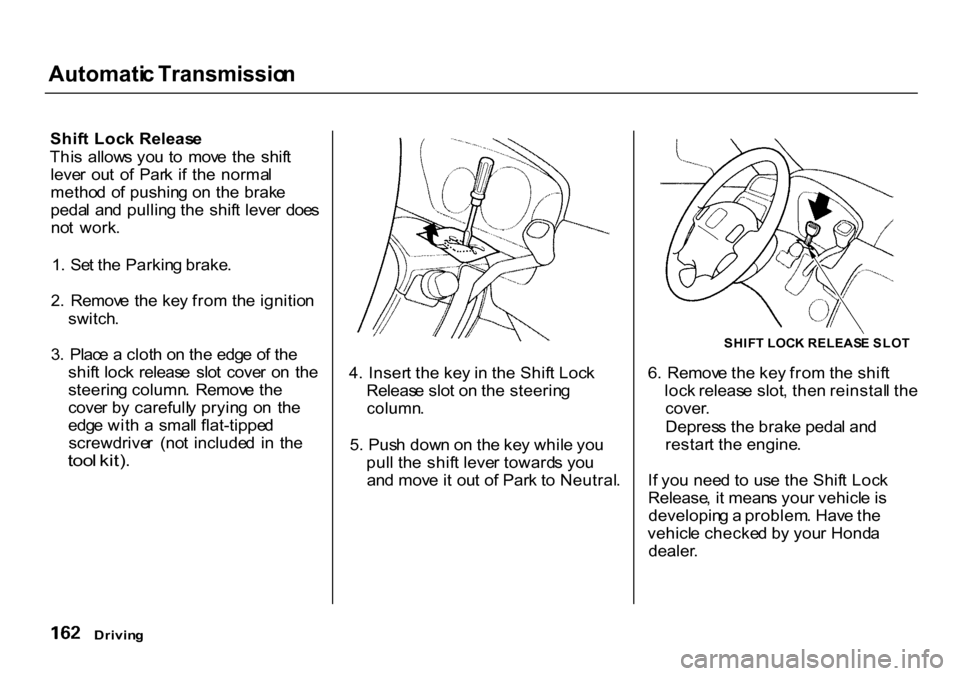
Shif t Loc k Releas e
Thi s allow s yo u t o mov e th e shif t
leve r ou t o f Par k i f the norma l
metho d o f pushin g o n th e brak e
peda l an d pullin g the shif t leve r doe s
no t work .
1 . Se t th e Parkin g brake .
2 . Remov e th e ke y fro m th e ignitio n
switch .
3 . Plac e a clot h o n the edg e o f th e
shif t loc k releas e slo t cove r o n th e
steerin g column . Remov e th e
cove r b y carefull y pryin g o n th e
edg e wit h a smal l flat-tippe d
screwdrive r (no t include d i n th e
too l kit) .
4
. Inser t th e ke y i n th e Shif t Loc k
Releas e slo t o n th e steerin g
column .
5 . Pus h dow n o n th e ke y whil e yo u
pul l th e shif t leve r toward s yo u
an d mov e it ou t o f Par k t o Neutral . SHIF
T LOC K RELEAS E SLO T
6 . Remov e th e ke y fro m th e shif t
loc k releas e slot , the n reinstal l th e
cover .
Depres s th e brak e peda l an d
restar t th e engine .
I f yo u nee d t o us e th e Shif t Loc k
Release , i t mean s you r vehicl e is
developin g a problem . Hav e th e
vehicl e checke d b y you r Hond a
dealer .
Drivin g
Page 167 of 322
Parkin
g
Alway s us e th e parkin g brak e whe n
yo u par k you r vehicle . Th e indicato r
o n th e instrumen t pane l show s tha t
th e parkin g brak e is no t full y
released ; i t doe s no t indicat e tha t th e
parkin g brak e is firml y set . Mak e
sur e th e parkin g brak e is se t firml y
o r you r vehicl e ma y rol l i f i t i s
parke d o n a n incline .
I f you r vehicl e ha s a n automati c
transmission , se t th e parkin g brak e
befor e yo u pu t th e transmissio n i n
Park . Thi s keep s th e vehicl e fro m
movin g an d puttin g pressur e o n th e
parkin g mechanis m in th e
transmissio n — makin g it easie r t o
mov e th e shif t leve r ou t o f Par k
whe n yo u wan t t o driv e away . I
f th e vehicl e i s facin g uphill , tur n
th e fron t wheels away fro m th e curb .
I f yo u hav e a manua l transmission ,
pu t i t i n firs t gear .
I f th e vehicl e i s facin g downhill , tur n
th e fron t wheel s towar d th e curb . I f
yo u hav e a manua l transmission , pu t
i t i n revers e gear .
Mak e sur e th e parkin g brak e i s full y
release d befor e drivin g away .
Drivin g wit h th e parkin g brak e
partiall y se t ca n overhea t o r damag e
th e rea r brakes . Parkin
g Tip s Mak
e sur e th e window s ar e closed . Tur
n of f th e lights . Plac
e an y packages , valuables , etc. ,
i n th e carg o are a o r tak e the m
wit h you . Loc
k th e doors . Neve
r par k ove r dr y leaves , tal l
grass , o r othe r flammabl e
materials . Th e thre e wa y catalyti c
converte r get s ver y hot , an d coul d
caus e thes e material s t o catc h o n
fire .
Driving
Page 168 of 322
Th
e Brakin g Syste m
You r Hond a i s equippe d wit h fron t
dis c brakes . Th e brake s o n th e rea r
wheel s ar e drum . Th e brakin g
syste m is power-assiste d t o reduc e
th e effor t neede d o n th e brak e pedal .
Pu t you r foo t o n th e brak e peda l onl y
whe n yo u inten d t o brake . Restin g
you r foo t o n th e peda l keep s th e
brake s applie d lightly , causin g the m
t o buil d u p heat . Hea t build-u p ca n
reduc e ho w wel l you r brake s work . I t
als o keep s you r brak e light s o n al l
th e time , confusin g driver s behin d
you .
Constan
t applicatio n o f th e brake s
whe n goin g dow n a lon g hil l build s
u p hea t an d reduce s thei r effective -
ness . Us e th e engin e to assis t th e
brake s b y downshiftin g to a lowe r
gea r an d takin g you r foo t of f th e
accelerato r pedal .
Chec k you r brake s afte r drivin g
throug h dee p water . Appl y th e
brake s moderatel y t o se e if the y fee l
normal . I f not , appl y the m gentl y an d
frequentl y unti l the y do . Sinc e a
longe r distanc e is neede d t o sto p
wit h we t brakes , b e extr a cautiou s
an d aler t i n you r driving . Brak
e Wea r Indicator s
Th e fron t dis c brake s o n al l vehicle s
hav e audibl e brak e wea r indicators .
Whe n th e brak e pad s nee d replacing ,
yo u wil l hea r a distinctiv e metalli c
"screeching " soun d whe n yo u appl y
th e brakes . I f yo u d o no t hav e th e
brak e pad s replaced , the y wil l begi n
screechin g al l th e time .
You r brake s ma y sometime s squea l
o r squea k whe n yo u appl y the m
lightly . D o no t confus e thi s wit h th e
brak e wea r indicators . The y mak e a
ver y audibl e "screeching. "
Drivin g
Page 169 of 322
Th
e Brakin g Syste m
Brak e Syste m Desig n
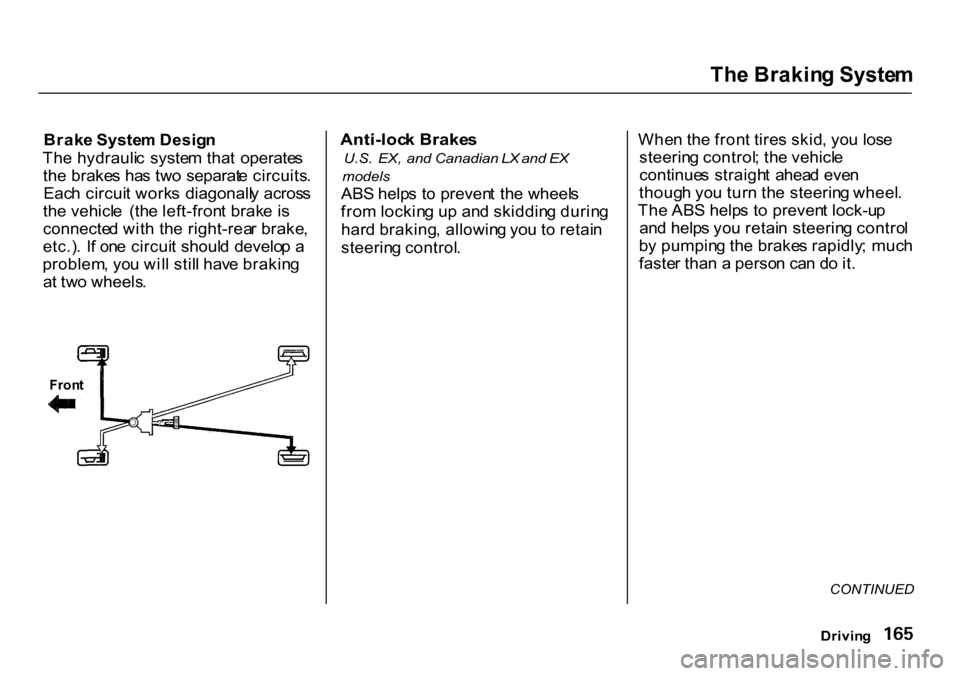
Th e hydrauli c syste m tha t operate s
th e brake s ha s tw o separat e circuits .
Eac h circui t work s diagonall y acros s
th e vehicl e (th e left-fron t brak e i s
connecte d wit h th e right-rea r brake ,
etc.) . I f on e circui t shoul d develo p a
problem , yo u wil l stil l hav e brakin g
a t tw o wheels .
Anti-loc
k Brake s
U.S. EX, and Canadian LX and EX
models
AB S help s t o preven t th e wheel s
fro m lockin g u p an d skiddin g durin g
har d braking , allowin g yo u t o retai n
steerin g control . Whe
n th e fron t tire s skid , yo u los e
steerin g control ; th e vehicl e
continue s straigh t ahea d eve n
thoug h yo u tur n th e steerin g wheel .
Th e AB S help s t o preven t lock-u p
an d help s yo u retai n steerin g contro l
b y pumpin g th e brake s rapidly ; muc h
faste r tha n a perso n ca n d o it .
CONTINUED
Fron
t
Driving
Page 170 of 322
Th
e Brakin g Syste m
Yo u shoul d neve r pum p th e
brak e pedal , thi s defeat s th e
purpos e o f th e ABS . Le t th e AB S
wor k fo r yo u b y alway s keepin g firm ,
stead y pressur e o n th e brak e peda l
a s yo u stee r awa y fro m th e hazard .
Thi s is sometime s referre d to a s
"stomp and steer."
Yo u wil l fee l a pulsatio n in th e brak e
peda l whe n th e AB S activates , an d
yo u ma y hea r som e noise . Thi s i s
normal , i t i s th e AB S rapidl y
pumpin g th e brakes .
Activatio n varie s wit h th e amoun t o f
tractio n you r tire s have . O n dr y
pavement , yo u wil l nee d t o pres s o n
th e brak e peda l ver y har d befor e yo u
activat e th e ABS . However , yo u ma y
fee l th e AB S activat e immediatel y i f
yo u ar e tryin g t o sto p o n sno w o r ice .
Important Safety Reminders
AB S doe s no t reduc e th e tim e o r
distanc e i t take s t o sto p th e
vehicle , i t onl y help s wit h steerin g
contro l durin g braking . Yo u shoul d
alway s maintai n a saf e followin g
distanc e fro m othe r vehicles .
AB S wil l no t preven t a ski d tha t
result s fro m changin g directio n
abruptly , suc h a s tryin g to tak e a
corne r to o fas t o r makin g a sudde n
lan e change . Alway s driv e a t a safe ,
pruden t spee d fo r th e roa d an d
weathe r conditions .
AB S canno t preven t a los s o f
stability . Alway s stee r moderatel y
whe n yo u ar e brakin g hard . Sever e
o r shar p steerin g whee l movemen t
ca n stil l caus e you r vehicl e t o vee r
int o oncomin g traffi c o r of f th e road .A
vehicl e wit h AB S ma y requir e a
longe r distanc e t o sto p o n loos e o r
uneve n surfaces , suc h a s grave l o r
snow , tha n a vehicl e withou t anti -
lock . Slo w dow n an d allo w a greate r
distanc e betwee n vehicle s unde r
thos e conditions .
Drivin g
Page 171 of 322
Th
e Brakin g Syste m
Drivin g
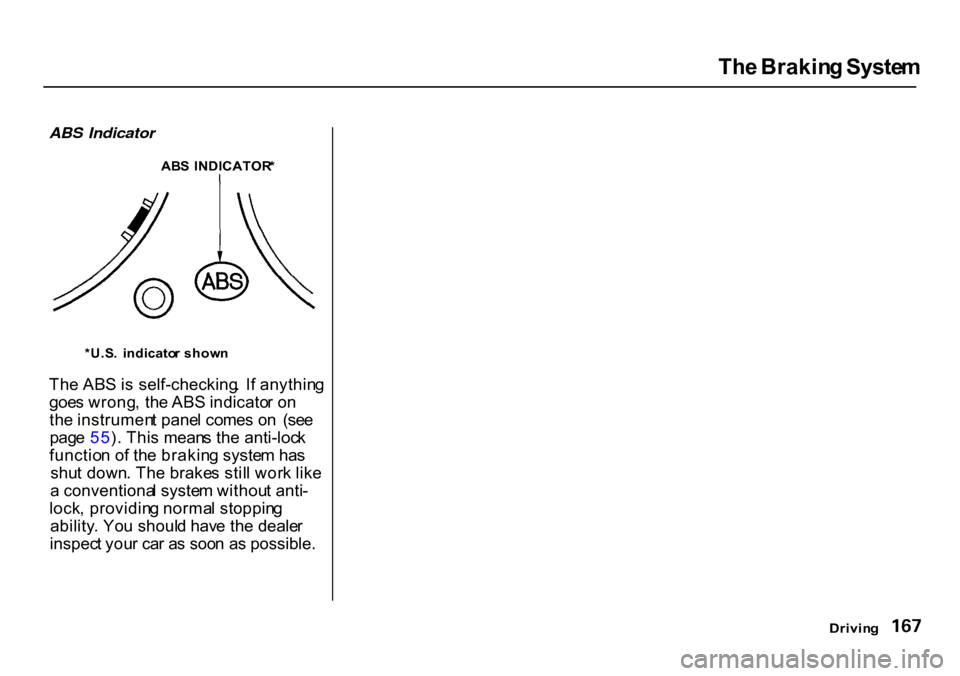
ABS Indicator
ABS INDICATOR *
Th e AB S is self-checking . I f anythin g
goe s wrong , th e AB S indicato r o n
th e instrumen t pane l come s o n (se e
pag e 55 ). Thi s mean s th e anti-loc k
functio n o f th e brakin g syste m ha s
shu t down . Th e brake s stil l wor k lik e
a conventiona l syste m withou t anti -
lock , providin g norma l stoppin g
ability . Yo u shoul d hav e th e deale r
inspec t you r ca r a s soo n a s possible.
*U.S
. indicato r show n
Page 172 of 322
Drivin
g i n Ba d Weathe r
Rain , fog , an d sno w condition s re -
quir e a differen t drivin g techniqu e
becaus e o f reduce d tractio n an d
visibility . Kee p you r vehicl e well -
maintaine d an d exercis e greate r
cautio n whe n yo u nee d t o driv e in
ba d weather . Th e cruis e contro l
shoul d no t b e use d in thes e condi -
tions .
Drivin
g Techniqu e — Alway s driv e
slowe r tha n yo u woul d in dr y
weather . I t take s you r vehicl e longe r
t o react , eve n in condition s tha t ma y
see m jus t barel y damp . Appl y
smooth , eve n pressur e to al l th e
controls . Abrup t steerin g whee l
movement s o r sudden , har d appli -
catio n o f th e brake s ca n caus e los s o f
contro l i n we t weather . B e extr a
cautiou s fo r th e firs t fe w mile s
(kilometers ) o f drivin g whil e yo u
adjus t t o th e chang e in drivin g
conditions . Thi s i s especiall y tru e in
snow . A perso n ca n forge t som e
snow-drivin g technique s durin g th e
summe r months . Practic e is neede d
t o relear n thos e skills .
Exercis e extr a cautio n whe n drivin g
i n rai n afte r a lon g dr y spell . Afte r
month s o f dr y weather , th e firs t
rain s brin g oi l t o th e surfac e o f th e
roadway , makin g it slippery . Visibilit
y — Bein g abl e to se e
clearl y i n al l direction s an d bein g
visibl e t o othe r driver s ar e importan t
i n al l weathe r conditions . Thi s i s
mor e difficul t i n ba d weather . T o b e
see n mor e clearl y durin g dayligh t
hours , tur n o n you r headlights .
Inspec t you r windshiel d wiper s an d
washer s frequently . Kee p th e wind -
shiel d washe r reservoi r ful l o f th e
prope r fluid . Hav e th e windshiel d
wipe r blade s replace d i f the y star t t o
strea k th e windshiel d o r leav e part s
unwiped . Us e th e defroster s an d ai r
conditionin g to kee p th e window s
fro m foggin g u p o n th e insid e (se e
pag e 103 ).
Drivin g
Page 176 of 322
Towin
g a Traile r
Trailer Brakes
Hond a recommend s tha t an y traile r
havin g a tota l weigh t o f 1,00 0 Ib s
(45 0 kg ) o r mor e b e equippe d wit h
it s ow n electri c o r surge-typ e brakes .
I f yo u choos e electri c brakes , b e
sur e the y ar e electronicall y actuated .
D o no t attemp t t o ta p int o you r
vehicle' s hydrauli c system . N o
matte r ho w successfu l i t ma y seem ,
an y attemp t t o attac h traile r brake s
t o you r vehicle' s hydrauli c syste m
wil l lowe r brakin g effectivenes s an d
creat e a potentia l hazard .
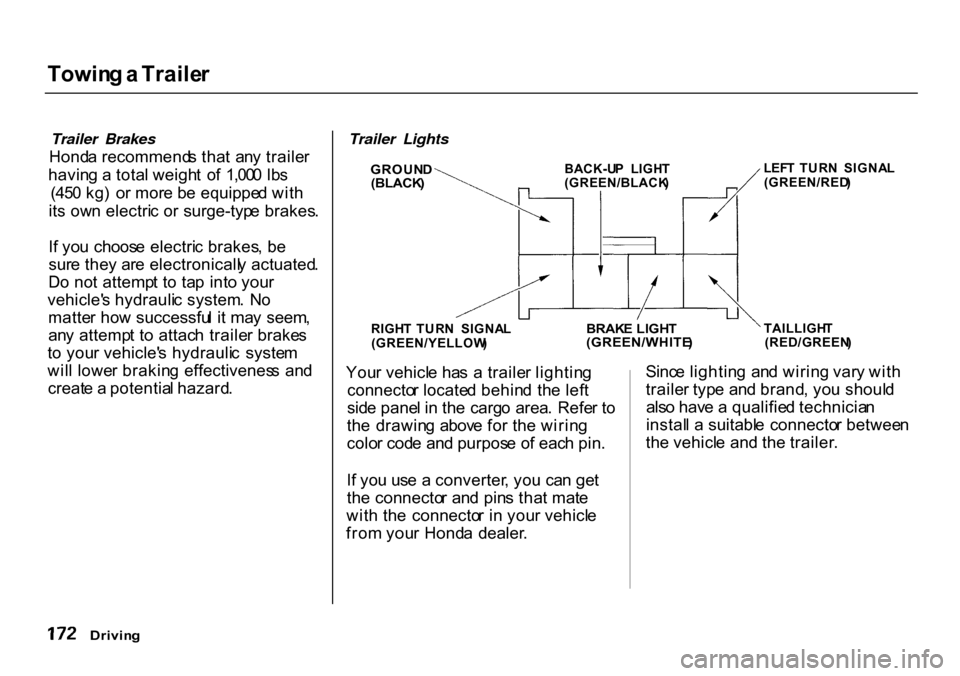
Trailer Lights
GROUN D
(BLACK )
LEF
T TUR N SIGNA L
(GREEN/RED )
RIGH T TUR N SIGNA L
(GREEN/YELLOW )
BRAK
E LIGH T
(GREEN/WHITE )
TAILLIGH
T
(RED/GREEN )
You r vehicl e ha s a traile r lightin g
connecto r locate d behin d th e lef t
sid e pane l i n th e carg o area . Refe r t o
th e drawin g abov e fo r th e wirin g
colo r cod e an d purpos e o f eac h pin .
I f yo u us e a converter , yo u ca n ge t
th e connecto r an d pin s tha t mat e
wit h th e connecto r i n you r vehicl e
fro m you r Hond a dealer . Sinc
e lightin g an d wirin g var y wit h
traile r typ e an d brand , yo u shoul d
als o hav e a qualifie d technicia n
instal l a suitabl e connecto r betwee n
th e vehicl e an d th e trailer .
Drivin g
BACK-U
P LIGH T
(GREEN/BLACK )
Page 177 of 322
Towin
g a Traile r
Additional Trailer Equipment Man y state s an d Canadia n province s
requir e specia l outsid e mirror s whe n
towin g a trailer . Eve n if the y don't ,
yo u shoul d instal l specia l mirror s if
yo u canno t clearl y se e behin d you , o r
i f th e traile r create s a blin d spot .
As k you r traile r sale s o r renta l
agenc y if an y othe r item s ar e
recommende d o r require d fo r you r
towin g situation .
Pre-To
w Checklis t
Whe n preparin g to tow , an d befor e
drivin g away , b e sur e to chec k th e
following : Th
e vehicl e ha s bee n properl y
serviced , an d th e tires , brakes ,
suspension , an d coolin g syste m
ar e in goo d operatin g condition . Al
l weight s an d load s ar e withi n
limit s (se e page s 17 0 an d 171 ). Th
e hitch , safet y chain , an d an y
other attachment s ar e secure . Al
l item s o n an d in th e traile r ar e
properl y secure d an d canno t shif t
whil e yo u drive . Th
e light s an d brake s o n you r
vehicl e an d th e traile r ar e workin g
properly . You
r vehicl e tire s an d spar e ar e
properl y inflate d (se e pag e 22 2 ) ,
an d th e traile r tire s an d spar e ar e
inflate d a s recommende d b y th e
traile r maker .
Driving