tire pressure HONDA CR-Z 2011 1.G User Guide
[x] Cancel search | Manufacturer: HONDA, Model Year: 2011, Model line: CR-Z, Model: HONDA CR-Z 2011 1.GPages: 333, PDF Size: 9.97 MB
Page 218 of 333
217
Driving
When Driving Tire Pressure Monitoring System (TPMS) - Required Federal Explanation
Tire Pressure Monitoring System (TPMS) - Required Federal Explanation
U.S. models only
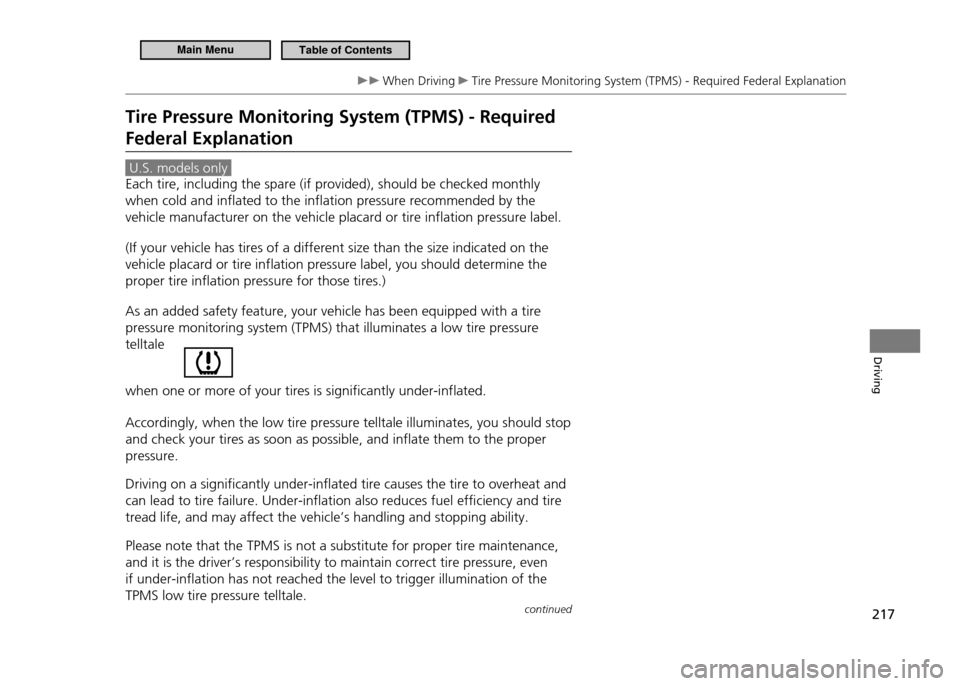
Each tire, including the spare (if provided), should be checked monthly when cold and inflated to the inflation pressure recommended by the vehicle manufacturer on the vehicle placard or tire inflation pressure label. (If your vehicle has tires of a different size than the size indicated on the vehicle placard or tire inflation pressure label, you should determine the proper tire inflation pressure for those tires.) As an added safety feature, your vehicle has been equipped with a tire pressure monitoring system (TPMS) that illuminates a low tire pressure telltale when one or more of your tires is significantly under-inflated. Accordingly, when the low tire pressure telltale illuminates, you should stop and check your tires as soon as possible, and inflate them to the proper pressure. Driving on a signiicantly under-inlated tire causes the tire to overheat and can lead to tire failure. Under-inlation also reduces fuel eficiency and tire tread life, and may affect the vehicle’s handling and stopping ability. Please note that the TPMS is not a substitute for proper tire maintenance, and it is the driver’s responsibility to maintain correct tire pressure, even if under-inlation has not reached the level to trigger illumination of the TPMS low tire pressure telltale.
continued
Main MenuTable of Contents
Page 219 of 333
218
Driving
When Driving Tire Pressure Monitoring System (TPMS) - Required Federal Explanation
Your vehicle has also been equipped with a TPMS malfunction indicator to indicate when the system is not operating properly. The TPMS malfunction indicator is combined with the low tire pressure telltale. When the system detects a malfunction, the telltale will flash for approximately one minute and then remain continuously illuminated. This sequence will continue upon subsequent vehicle start-ups as long as the malfunction exists. When the malfunction indicator is illuminated, the system may not be able to detect or signal low tire pressure as intended. TPMS malfunctions may occur for a variety of reasons, including the installation of replacement or alternate tires or wheels on the vehicle that prevent the TPMS from functioning properly. Always check the TPMS malfunction telltale after replacing one or more tires or wheels on your vehicle to ensure that the replacement or alternate tires and wheels allow the TPMS to continue to function properly.
Main MenuTable of Contents
Page 222 of 333
221
Driving
Braking ABS (Anti-lock Brake System)
ABS (Anti-lock Brake System)
ABS
■
Helps prevent the wheels from locking up, and helps you retain steering control by pumping the brakes rapidly, much faster than you can do. The electronic brake distribution (EBD) system, which is part of the ABS, also balances the front-to-rear braking distribution according to vehicle loading. You should never pump the brake pedal. Let the ABS work for you by always keeping firm, steady pressure on the brake pedal. This is sometimes referred to as “stomp and steer.”
ABS Operation
■
The brake pedal may pulsate slightly when the ABS is working. Keep holding the pedal firmly down. On dry pavement, you will need to press on the brake pedal very hard before the ABS activates. However, you may feel the ABS activate immediately if you are trying to stop on snow or ice. When the vehicle speed goes under 6 mph (10 km/h), the ABS stops.
ABS (Anti-lock Brake System)
NOTICE The ABS may not function correctly if you use an incorrect tire type and size. When the ABS indicator comes on while driving, there may be a problem with the system.While normal braking is not affected, there is a possibility of the ABS not operating. Have the vehicle checked by a dealer immediately. The ABS does not reduce the time or distance it takes to stop the vehicle. It only helps with steering control during hard braking. In the following cases, your vehicle may need more stopping distance than a vehicle without ABS: When driving on rough road surfaces, including
•
when driving on uneven surfaces, such as gravel or snow.When tire chains are installed.
•
You may hear a motor sound coming from the
engine compartment while system checks are being performed immediately after starting the engine or while driving. This is normal.
Main MenuTable of Contents
Page 235 of 333
234
Driving
Fuel Economy
Improving Fuel Economy
Improving Fuel Economy
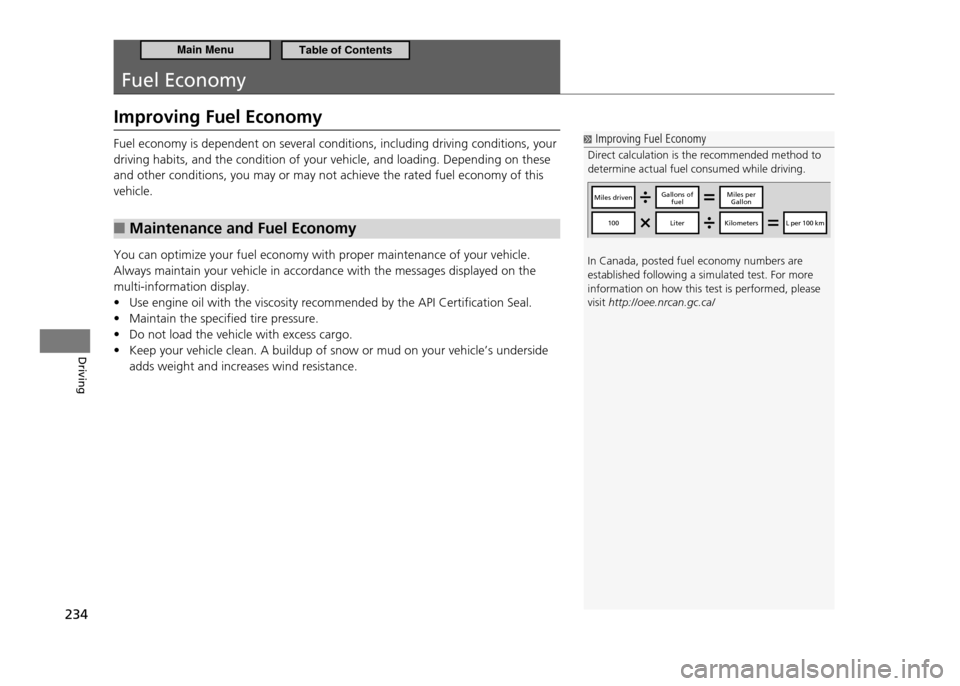
Direct calculation is the recommended method to determine actual fuel consumed while driving. In Canada, posted fuel economy numbers are established following a simulated test. For more information on how this test is performed, please visit http://oee.nrcan.gc.ca/
Miles drivenGallons of
fuelMiles per Gallon
100LiterKilometersL per 100 km
Fuel economy is dependent on several conditions, including driving conditions, your driving habits, and the condition of your vehicle, and loading. Depending on these and other conditions, you may or may not achieve the rated fuel economy of this vehicle.
Maintenance and Fuel Economy
■
You can optimize your fuel economy with proper maintenance of your vehicle. Always maintain your vehicle in accordance with the messages displayed on the multi-information display.
Use engine oil with the viscosity recommended by the API Certification Seal.
•
Maintain the specified tire pressure.
•
Do not load the vehicle with excess cargo.
•
Keep your vehicle clean. A buildup of snow or mud on your vehicle’s underside
•
adds weight and increases wind resistance.
Main MenuTable of Contents
Page 239 of 333
238
Maintenance
Before Performing Maintenance
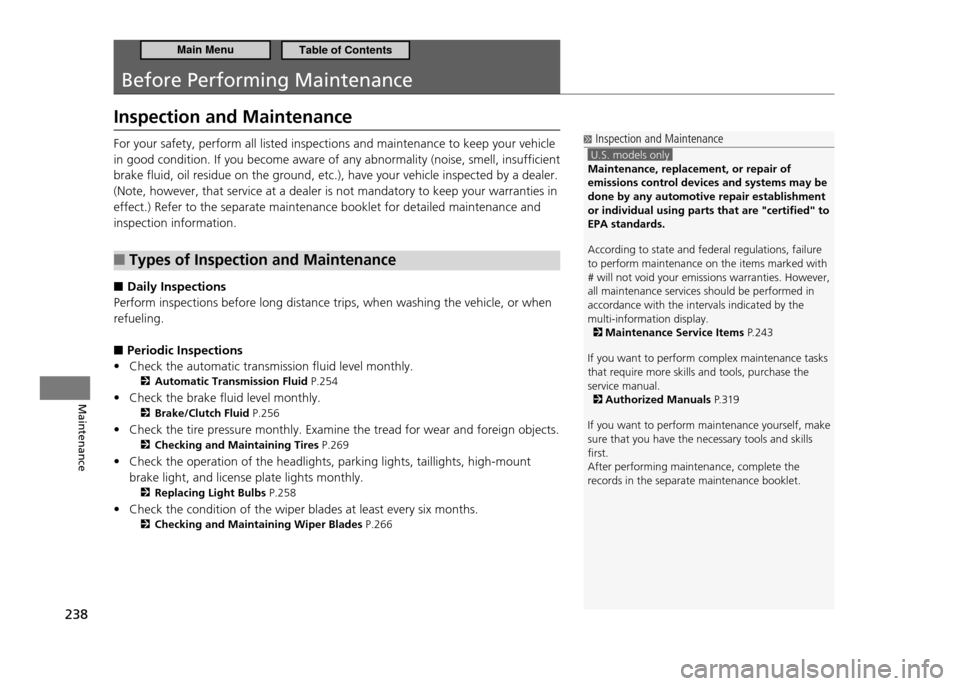
Inspection and Maintenance
For your safety, perform all listed inspections and maintenance to keep your vehicle
in good condition. If you become aware of any abnormality (noise, smell, insufficient brake fluid, oil residue on the ground, etc.), have your vehicle inspected by a dealer. (Note, however, that service at a dealer is not mandatory to keep your warranties in effect.) Refer to the separate maintenance booklet for detailed maintenance and inspection information.Types of Inspection and Maintenance
■
Daily Inspections
■
Perform inspections before long distance trips, when washing the vehicle, or when refueling.
Periodic Inspections
■
Check the automatic transmission fluid level monthly.
•
Automatic Transmission Fluid P.254
Check the brake fluid level monthly.
•
Brake/Clutch Fluid P.256
Check the tire pressure monthly. Examine the tread for wear and foreign objects.
•
Checking and Maintaining Tires P.269
Check the operation of the headlights, parking lights, taillights, high-mount
•
brake light, and license plate lights monthly.
Replacing Light Bulbs P.258
Check the condition of the wiper blades at least every six months.
•
Checking and Maintaining Wiper Blades P.266
Inspection and Maintenance
U.S. models only Maintenance, replacement, or repair of emissions control devices and systems may be done by any automotive repair establishment or individual using parts that are "certiied" to EPA standards. According to state and federal regulations, failure to perform maintenance on the items marked with # will not void your emissions warranties. However, all maintenance services should be performed in accordance with the intervals indicated by the multi-information display.
Maintenance Service Items P. 2 4 3
If you want to perform complex maintenance tasks that require more skills and tools, purchase the service manual.
Authorized Manuals P. 3 1 9
If you want to perform maintenance yourself, make sure that you have the necessary tools and skills irst.After performing maintenance, complete the records in the separate maintenance booklet.
Main MenuTable of Contents
Page 270 of 333
269
Maintenance
Checking and Maintaining Tires
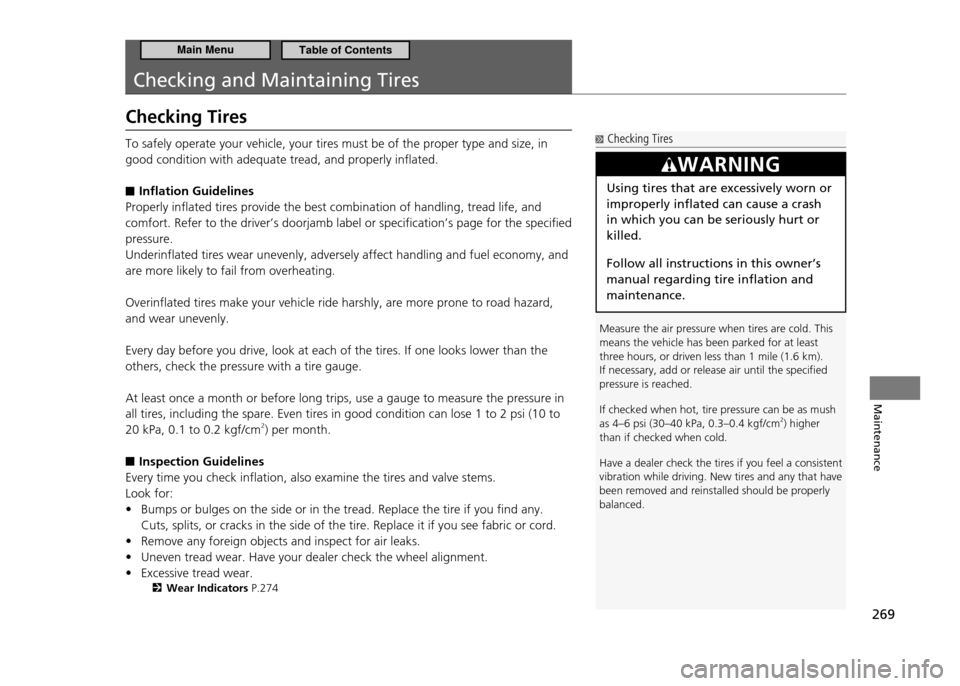
Checking Tires To safely operate your vehicle, your tires must be of the proper type and size, in good condition with adequate tread, and properly inflated.Inflation Guidelines
■
Properly inflated tires provide the best combination of handling, tread life, and
comfort. Refer to the driver’s doorjamb label or specification’s page for the specified pressure. Underinflated tires wear unevenly, adversely affect handling and fuel economy, and are more likely to fail from overheating. Overinflated tires make your vehicle ride harshly, are more prone to road hazard, and wear unevenly. Every day before you drive, look at each of the tires. If one looks lower than the others, check the pressure with a tire gauge. At least once a month or before long trips, use a gauge to measure the pressure in all tires, including the spare. Even tires in good condition can lose 1 to 2 psi (10 to 20 kPa, 0.1 to 0.2 kgf/cm 2
) per month.
Inspection Guidelines
■
Every time you check inflation, also examine the tires and valve stems.Look for:
Bumps or bulges on the side or in the tread. Replace the tire if you find any.
•
Cuts, splits, or cracks in the side of the tire. Replace it if you see fabric or cord.Remove any foreign objects and inspect for air leaks.
•
Uneven tread wear. Have your dealer check the wheel alignment.
•
Excessive tread wear.
•
Wear Indicators P.274
Checking Tires
Measure the air pressure when tires are cold. This means the vehicle has been parked for at least three hours, or driven less than 1 mile (1.6 km). If necessary, add or release air until the speciied pressure is reached. If checked when hot, tire pressure can be as mush as 4–6 psi (30–40 kPa, 0.3–0.4 kgf/cm 2
) higher
than if checked when cold.
Have a dealer check the tires if you feel a consist ent
vibration while driving. New tires and any that have been removed and reinstalled should be properly balanced.
WARNING
Using tires that are excessively worn or improperly inflated can cause a crash in which you can be seriously hurt or killed. Follow all instructions in this owner’s manual regarding tire inflation and maintenance.
Main MenuTable of Contents
Page 271 of 333
270
Maintenance
Checking and Maintaining Tires Tire and Loading Information Label Tire Labeling
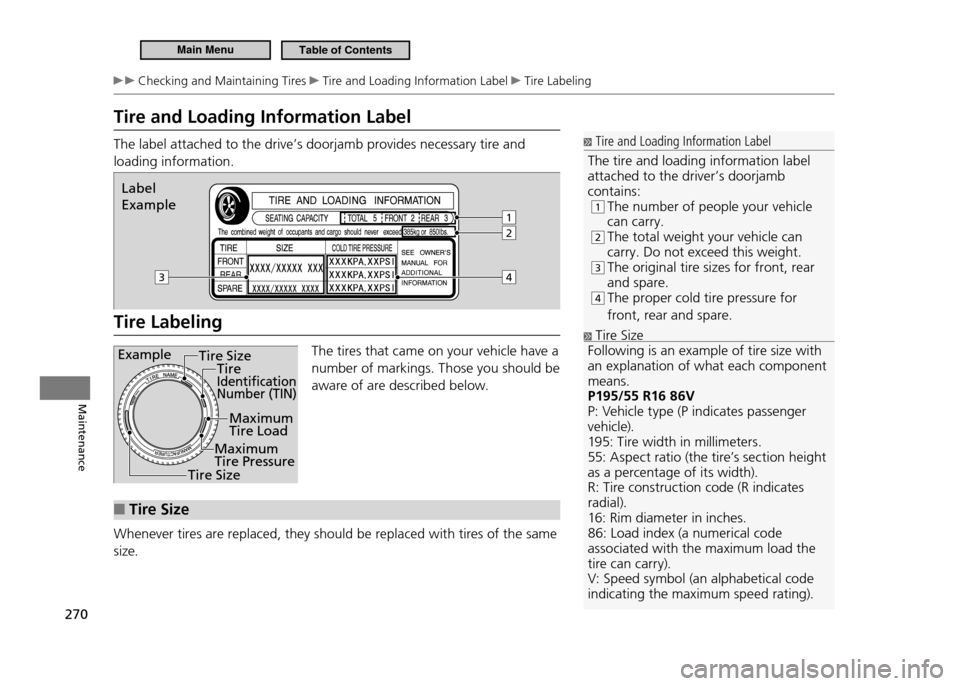
Tire and Loading Information Label
The label attached to the drive’s doorjamb provides necessary tire and loading information. Tire LabelingThe tires that came on your vehicle have a
number of markings. Those you should be
aware of are described below.
Tire Size
■
Whenever tires are replaced, they should be replaced with tires of the same
size.
1
2
43
Label Example
Tire and Loading Information Label
The tire and loading information label attached to the driver’s doorjamb contains:
1 The number of people your vehicle can carry.
2 The total weight your vehicle can carry. Do not exceed this weight.
3 The original tire sizes for front, rear and spare.
4 The proper cold tire pressure for
front, rear and spare.
Maxi mum
Tire Pressure
Tire
Size
Tire
Identiication Number (TIN)
Tire SizeMaxi
mum
Tire Load
Example
Tire Size
Following is an example of tire size with
an explanation of what each component
means.
P195/55 R16 86V
P: Vehicle type (P indicates passenger
vehicle).
195: Tire width in millimeters.
55: Aspect ratio (the tire’s section height
as a percentage of its width).
R: Tire construction code (R indicates
radial).
16: Rim diameter in inches.
86: Load index (a numerical code
associated with the maximum load the
tire can carry).
V: Speed symbol (an alphabetical code
indicating the maximum speed rating).
Main MenuTable of Contents
Page 272 of 333
271
Maintenance
Checking and Maintaining Tires Tire Labeling
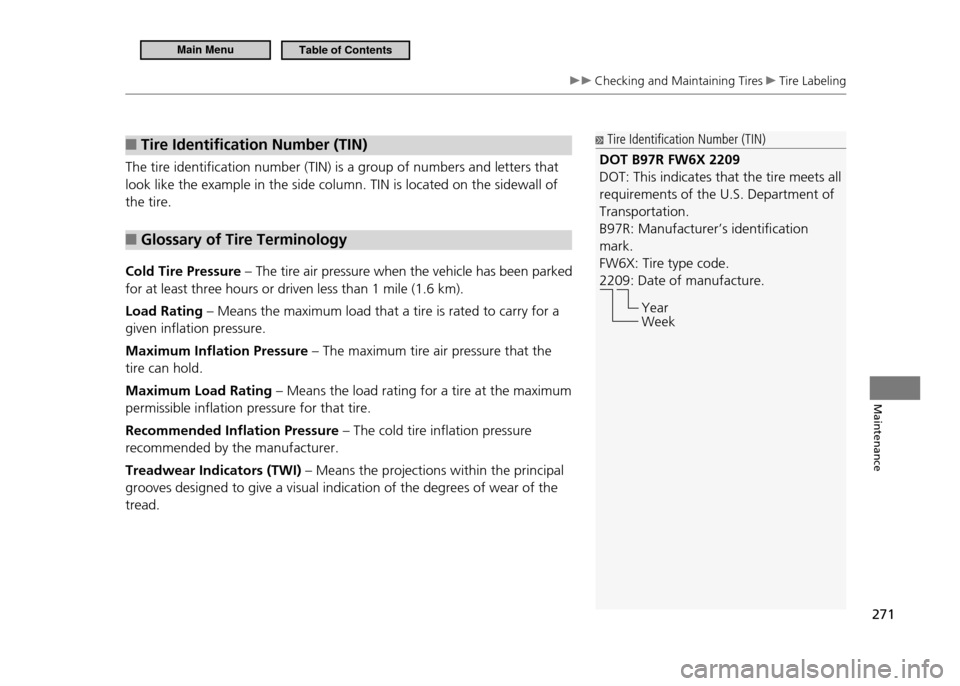
Tire Identiication Number (TIN)
■
The tire identification number (TIN) is a group of numbers and letters that look like the example in the side column. TIN is located on the sidewall of the tire.
Glossary of Tire Terminology
■
Cold Tire Pressure – The tire air pressure when the vehicle has been parked
for at least three hours or driven less than 1 mile (1.6 km). Load Rating – Means the maximum load that a tire is rated to carry for a
given inflation pressure.Maximum Inflation Pressure – The maximum tire air pressure that the
tire can hold.Maximum Load Rating – Means the load rating for a tire at the maximum
permissible inflation pressure for that tire.Recommended Inflation Pressure – The cold tire inflation pressure
recommended by the manufacturer.Treadwear Indicators (TWI) – Means the projections within the principal
grooves designed to give a visual indication of the degrees of wear of the tread.
Tire Identiication Number (TIN)
DOT B97R FW6X 2209 DOT: This indicates that the tire meets all requirements of the U.S. Department of Transportation.B97R: Manufacturer’s identiication mark.FW6X: Tire type code.2209: Date of manufacture.
Year Week
Main MenuTable of Contents
Page 275 of 333
274
Maintenance
Checking and Maintaining Tires Wear Indicators Tire Service Life
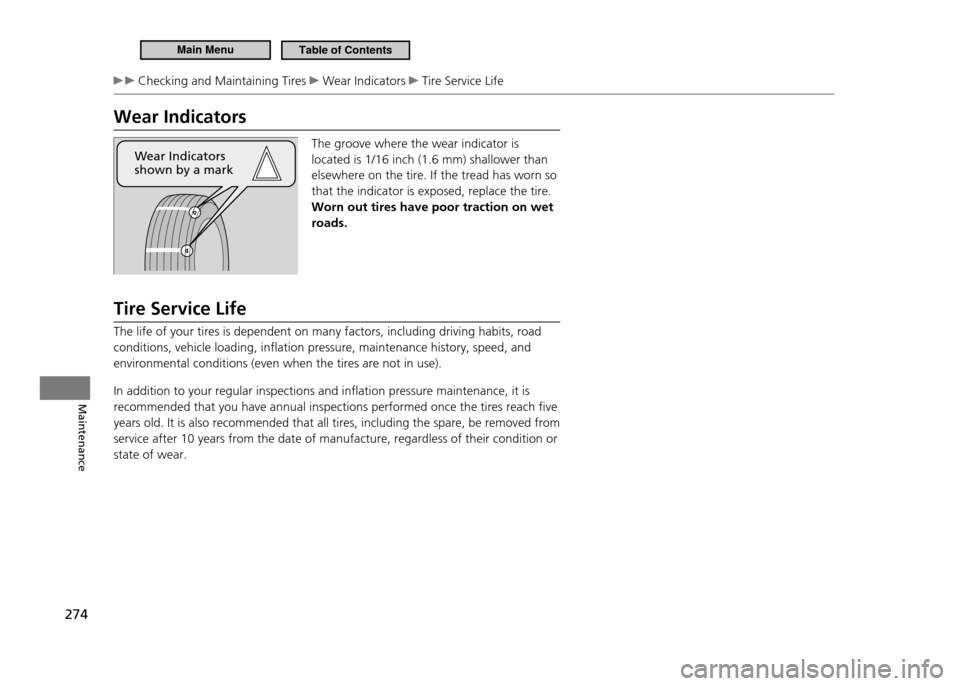
Wear Indicators
The groove where the wear indicator is located is 1/16 inch (1.6 mm) shallower than elsewhere on the tire. If the tread has worn so that the indicator is exposed, replace the tire.Worn out tires have poor traction on wet roads.
Tire Service Life The life of your tires is dependent on many factors, including driving habits, road conditions, vehicle loading, inflation pressure, maintenance history, speed, and environmental conditions (even when the tires are not in use). In addition to your regular inspections and inflation pressure maintenance, it is recommended that you have annual inspections performed once the tires reach five
years old. It is also recommended that all tires, including the spare, be removed from service after 10 years from the date of manufacture, regardless of their condition or state of wear. Wear Indicators shown by a mark
Main MenuTable of Contents
Page 276 of 333
275
Maintenance
Checking and Maintaining Tires Tire and Wheel Replacement
Tire and Wheel Replacement
Tire and Wheel Replacement
WARNING
Installing improper tires on your vehicle can affect handling and stability. This can cause a crash in which you can be seriously hurt or killed. Always use the size and type of tires recommended in this owner’s manual.
Replace your tires with radials of the same size, load range, speed rating, and maximum cold tire pressure rating (as shown on the tire’s sidewall). Using tires of a different size or construction can cause the ABS and VSA®
(vehicle stability assist)
system to work incorrectly. It is best to replace all four tires at the same time. If that isn’t possible, replace the front or rear tires in pairs.
U.S. models only
If you replace a wheel, only use TPMS specified wheels approved for your vehicle.
Main MenuTable of Contents