brake HONDA CR-Z 2011 1.G Service Manual
[x] Cancel search | Manufacturer: HONDA, Model Year: 2011, Model line: CR-Z, Model: HONDA CR-Z 2011 1.GPages: 333, PDF Size: 9.97 MB
Page 229 of 333
228
Driving
Parking Your Vehicle Auto Idle Stop (Manual Transmission)
Auto Idle Stop Activates When:
■
Stopping with the brake, the clutch pedal is fully depressed, and the shift lever is in
N.
To restart the engine automatically, depress the clutch pedal.
Auto Idle Stop Does Not Activate When:
■
The low temperature indicator is on.
•
The IMA battery charge is low.
•
The bars of the ASST/CHRG indicators do not move when accelerating or
•
decelerating. The vehicle comes to a stop again before the vehicle speed reaches 9 mph
•
(15km/h) after the engine starts.The shift lever is in
•
R.
Airflow from the climate control system increases.
•
If you have selected the fan speed manually:
The display shows more than five vertical bars.
• is on (the indicator is on).
Auto Idle Stop May Not Activate When:
■
The climate control system is in use, and there is a significant difference between
•
the set temperature and the actual interior temperature. (Except when in ECON mode).When humidity in the interior is high.
•
The vehicle is stopped by braking suddenly
•
Auto Idle Stop Activates When:
The brake pedal is depressed, the vehicle slows down to a speed below 19 mph (30 km/h), and the clutch pedal is fully pressed. The engine may not stop or restart automatically if you fail to fully depress the clutch pedal.
Keeping the proper driving positions makes it easie r
for you to depress the clutch pedal fully.
Adjusting the Seats P.11 9
Main MenuTable of Contents
Page 230 of 333
229
Driving
Parking Your Vehicle Auto Idle Stop (Manual Transmission)
The Engine Automatically Restarts When:
■
The clutch pedal is fully depressed, and the shift lever is moved to a position other than
N.
The Engine Automatically Restarts When the Clutch Pedal is Fully
■
Depressed Even If the Shift Lever is in
N When:
The low temperature indicator comes on.
•
The accelerator pedal is pressed.
•
The IMA battery charge becomes low.
•
The climate control system is in use, and the difference between the set
•
temperature and actual interior temperature becomes significant. The climate control system is being used to dehumidify the interior.
• The engine automatically restarts when the pressure on the brake pedal is repeatedly applied and released slightly during a stop. This applies even if the clutch pedal is not fully depressed.
When the Auto Idle Stop Indicator Starts Blinking Rapidly
■
Fully depress the clutch pedal.
The engine automatically restarts
When the Auto Idle Stop Indicator Starts Blinking
Rapidly
The indicator starts blinking rapidly under the following conditions: The
•
(windshield defogger) button is pressed.
When the climate control system is in use and
•
moisture builds up inside the vehicle. When the climate control system is in use and
•
the difference between the set temperature and the actual temperature inside the vehicle becomes signiicant.
Main MenuTable of Contents
Page 231 of 333
230
Driving
Parking Your Vehicle Parking
Parking
Parking
Raise the wiper arms when snow is expected. Automatic transmission (CVT) model
Depress the brake pedal firmly with the shift lever in
1. D.
Apply the parking brake while holding the brake pedal down.
2.
Move the shift lever to
3.
P.
Turn off the engine.
4.
Main MenuTable of Contents
Page 238 of 333
Maintenance
This chapter discusses basic maintenance.
237
Before Performing Maintenance
Inspection and Maintenance ................... 238
Safety When Performing Maintenance ... 239Parts and Fluids Used in Maintenance
Service .................................................. 240
Maintenance Minder ™
............................ 241
Maintenance Under the Hood Maintenance Items Under the Hood ....... 245
Opening the Hood ................................. 246
Recommended Engine Oil ...................... 247
Oil Check ............................................... 248
Adding Engine Oil .................................. 249
Changing the Engine Oil and Oil Filter .... 250 Engine Coolant ...................................... 252
Transmission Fluid .................................. 254
Brake/Clutch Fluid .................................. 256
Refilling Window Washer Fluid ............... 257
Replacing Light Bulbs ............................. 258
Checking and Maintaining Wiper Blades Checking Wiper Blades ........................... 266
Changing the Front Wiper Blade Rubber 266
Changing the Rear Wiper Blade Rubber .. 268
Checking and Maintaining Tires Checking Tires ........................................ 269
Tire and Loading Information Label ........ 270
Tire Labeling ........................................... 270 DOT Tire Quality Grading (U.S. Vehicles)
.272
Wear Indicators ...................................... 274
Tire Service Life ...................................... 274
Tire and Wheel Replacement .................. 275
Tire Rotation .......................................... 276
Winter Tires ............................................ 277
12 Volt Battery ........................................ 278
Remote Transmitter Care ....................... 279
Replacing the Battery ............................. 279
Climate Control System Maintenance ... 280
Cleaning ................................................... 281
Interior Care ........................................... 281
Exterior Care .......................................... 283
Main Menu
Page 239 of 333
238
Maintenance
Before Performing Maintenance
Inspection and Maintenance
For your safety, perform all listed inspections and maintenance to keep your vehicle
in good condition. If you become aware of any abnormality (noise, smell, insufficient brake fluid, oil residue on the ground, etc.), have your vehicle inspected by a dealer. (Note, however, that service at a dealer is not mandatory to keep your warranties in effect.) Refer to the separate maintenance booklet for detailed maintenance and inspection information.Types of Inspection and Maintenance
■
Daily Inspections
■
Perform inspections before long distance trips, when washing the vehicle, or when refueling.
Periodic Inspections
■
Check the automatic transmission fluid level monthly.
•
Automatic Transmission Fluid P.254
Check the brake fluid level monthly.
•
Brake/Clutch Fluid P.256
Check the tire pressure monthly. Examine the tread for wear and foreign objects.
•
Checking and Maintaining Tires P.269
Check the operation of the headlights, parking lights, taillights, high-mount
•
brake light, and license plate lights monthly.
Replacing Light Bulbs P.258
Check the condition of the wiper blades at least every six months.
•
Checking and Maintaining Wiper Blades P.266
Inspection and Maintenance
U.S. models only Maintenance, replacement, or repair of emissions control devices and systems may be done by any automotive repair establishment or individual using parts that are "certiied" to EPA standards. According to state and federal regulations, failure to perform maintenance on the items marked with # will not void your emissions warranties. However, all maintenance services should be performed in accordance with the intervals indicated by the multi-information display.
Maintenance Service Items P. 2 4 3
If you want to perform complex maintenance tasks that require more skills and tools, purchase the service manual.
Authorized Manuals P. 3 1 9
If you want to perform maintenance yourself, make sure that you have the necessary tools and skills irst.After performing maintenance, complete the records in the separate maintenance booklet.
Main MenuTable of Contents
Page 240 of 333
239
Maintenance
Before Performing Maintenance Safety When Performing Maintenance
Safety When Performing Maintenance
Some of the most important safety precautions are given here. However, we cannot warn you of every conceivable hazard that can arise in performing maintenance. Only you can decide whether or not you should perform a given task.Maintenance Safety
■
To reduce the possibility of fire or explosion, keep cigarettes, sparks, and flames
•
away from the battery and all fuel related parts. To clean parts, use a commercially available degreaser or parts cleaner, not
•
gasoline.Wear eye protection and protective clothing when working with the 12 volt
•
battery or compressed air.Engine exhaust gasses contain carbon monoxide, which is poisonous and can kill
•
you.
Only operate the engine if there is sufficient ventilation.
Vehicle Safety
■
The vehicle must be in a stationary condition.
•
Make sure your vehicle is parked on level ground, the parking brake is set,
and the engine is off.
Be aware that hot parts can burn you.
•
Make sure to let the engine and exhaust system cool thoroughly before
touching vehicle parts.
Be aware that moving parts can injure you.
•
Do not start the engine unless instructed, and keep your hands and limbs
away from moving parts.
Do not touch the IMA battery and wirings (orange).
•
Safety When Performing Maintenance
WARNING
Improperly maintaining this vehicle or failing to correct a problem before driving can cause a crash in which you can be seriously hurt or killed. Always follow the inspection and maintenance recommendations according to the schedules in this owner’s manual.
WARNING
Failure to properly follow maintenance instructions and precautions can cause you to be seriously hurt or killed. Always follow the procedures and precautions in this owner’s manual.
Main MenuTable of Contents
Page 244 of 333
243
Maintenance
Maintenance Minder™
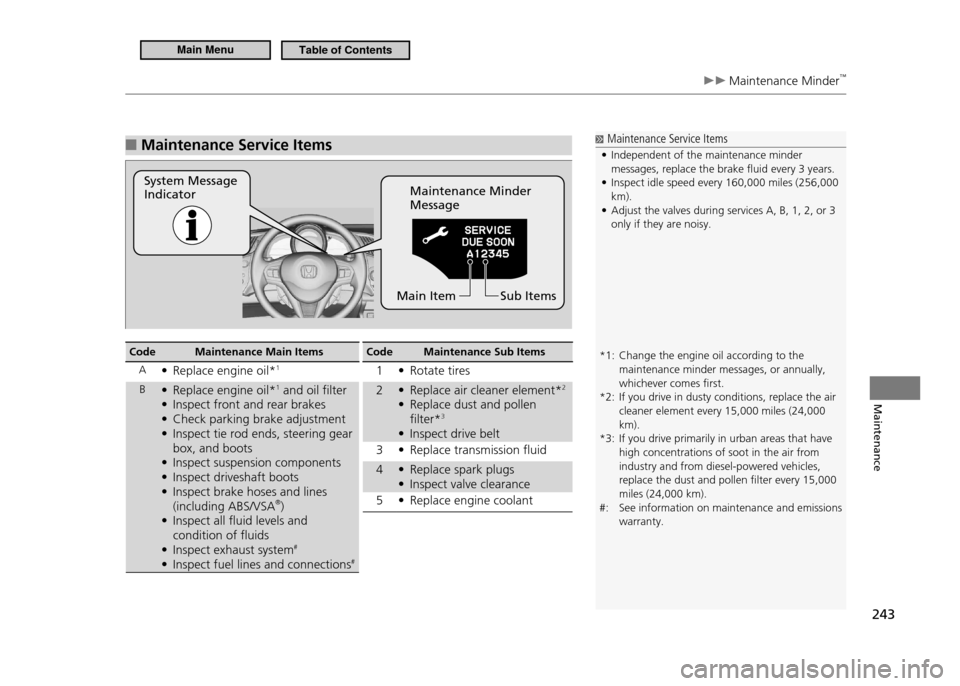
Maintenance Service Items
■
System Message Indicator Maintenance Minder Message
Sub Items
Main Item
Maintenance Service Items
Independent of the maintenance minder
•
messages, replace the brake luid every 3 years. Inspect idle speed every 160,000 miles (256,000
•
km).Adjust the valves during services A, B, 1, 2, or 3
•
only if they are noisy.
*1: Change the engine oil according to the maintenance minder messages, or annually, whichever comes irst.
*2: If you drive in dusty conditions, replace the air cleaner element every 15,000 miles (24,000 km).
*3: If you drive primarily in urban areas that have high concentrations of soot in the air from industry and from diesel-powered vehicles, replace the dust and pollen ilter every 15,000 miles (24,000 km).
#: See information on maintenance and emissions warranty.
Code Maintenance Main Items
A Replace engine oil*
• 1
B Replace engine oil*
• 1
and oil filter
Inspect front and rear brakes
•
Check parking brake adjustment
•
Inspect tie rod ends, steering gear
•
box, and boots
Inspect suspension components
•
Inspect driveshaft boots
•
Inspect brake hoses and lines
•
(including ABS/VSA ®
)
Inspect all fluid levels and
•
condition of fluids
Inspect exhaust system
• #
Inspect fuel lines and connections
• #Code Maintenance Sub Items
1 Rotate tires •
2 Replace air cleaner element* • 2
Replace dust and pollen
•
filter* 3
Inspect drive belt
•
3 Replace transmission fluid •
4 Replace spark plugs •
Inspect valve clearance
•
5 Replace engine coolant •
Main MenuTable of Contents
Page 246 of 333
245
Maintenance
Maintenance Under the Hood
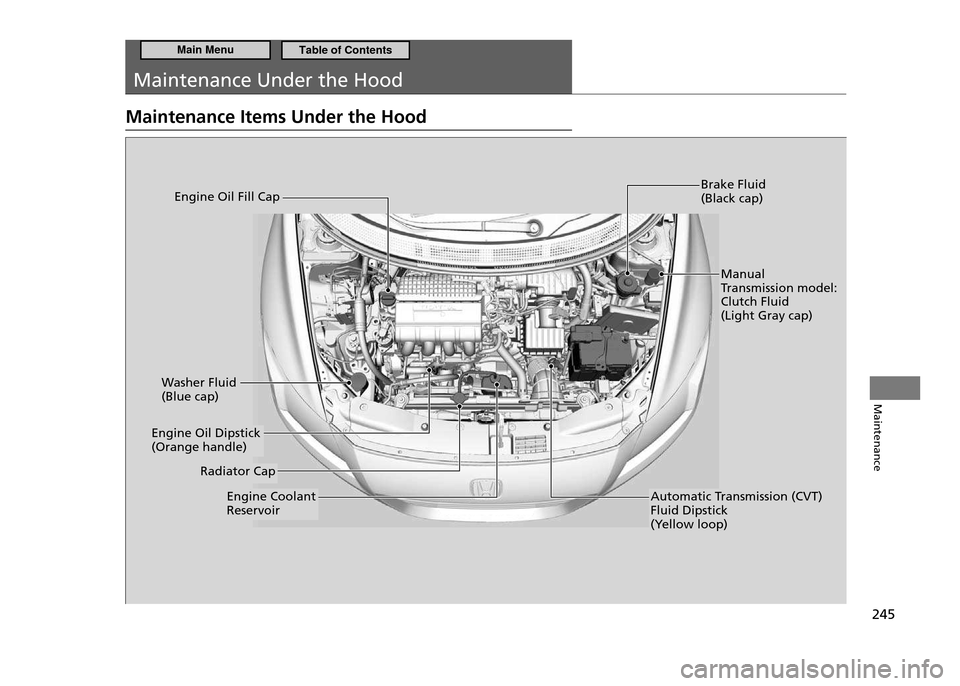
Maintenance Items Under the Hood
Brake Fluid (Black cap)
Washer Fluid (Blue cap)
Engine Coolant Reservoir
Engine Oil Fill Cap
Manual
Transmission model:Clutch Fluid(Light Gray cap)
Automatic Transmission (CVT) Fluid Dipstick
(Yellow loop)
Radiator Cap
Engine Oil Dipstick (Orange handle)
Main MenuTable of Contents
Page 247 of 333
246
Maintenance
Maintenance Under the Hood Opening the Hood
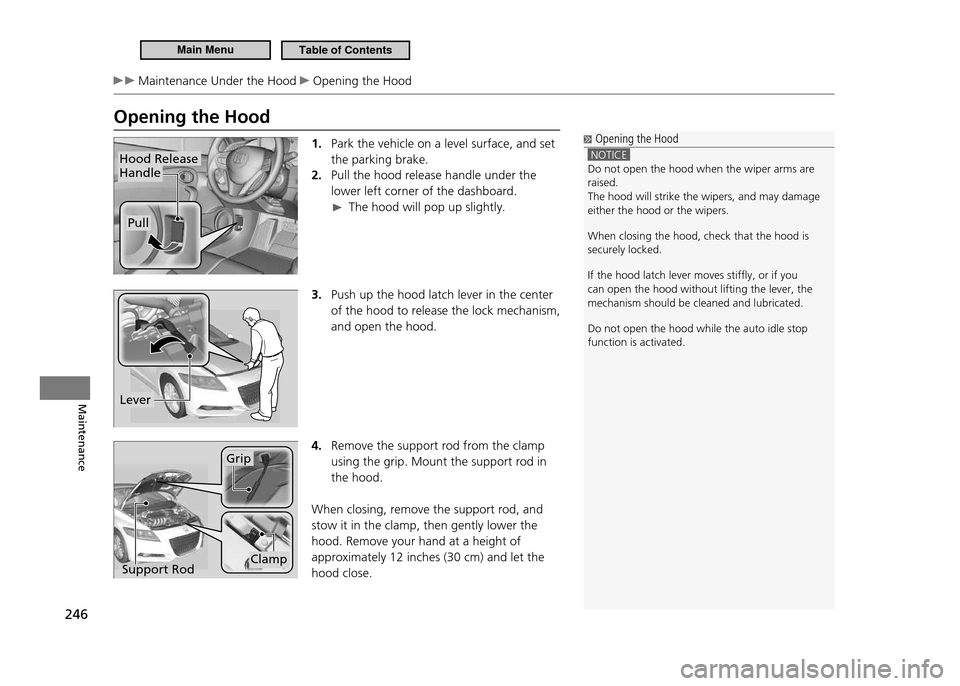
Opening the Hood1. Park the vehicle on a level surface, and set the parking brake.Pull the hood release handle under the
2.
lower left corner of the dashboard.
The hood will pop up slightly.
3. Push up the hood latch lever in the center
of the hood to release the lock mechanism, and open the hood.
4. Remove the support rod from the clamp using the grip. Mount the support rod in the hood.
When closing, remove the support rod, and stow it in the clamp, then gently lower the hood. Remove your hand at a height of approximately 12 inches (30 cm) and let the hood close.
Hood Release Handle
Pull
Opening the Hood
NOTICE Do not open the hood when the wiper arms are raised.The hood will strike the wipers, and may damage either the hood or the wipers. When closing the hood, check that the hood is securely locked. If the hood latch lever moves stifly, or if you can open the hood without lifting the lever, the mechanism should be cleaned and lubricated. Do not open the hood while the auto idle stop function is activated.
Lever
Support Rod
Grip
Clamp
Main MenuTable of Contents
Page 257 of 333
256
Maintenance
Maintenance Under the Hood Brake/Clutch Fluid
Brake/Clutch Fluid
Specified fluid: Honda Heavy Duty Brake Fluid DOT 3
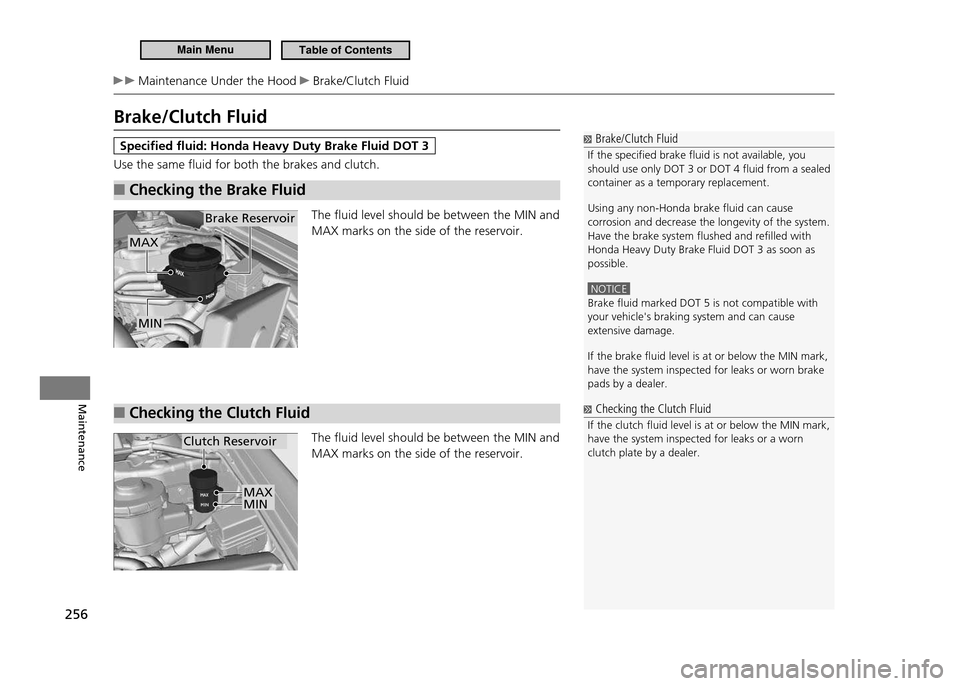
Use the same fluid for both the brakes and clutch.
Checking the Brake Fluid
■
The fluid level should be between the MIN and MAX marks on the side of the reservoir.
Checking the Clutch Fluid
■
The fluid level should be between the MIN and MAX marks on the side of the reservoir.
Brake/Clutch Fluid
If the speciied brake luid is not available, you
should use only DOT 3 or DOT 4 luid from a sealed container as a temporary replacement. Using any non-Honda brake luid can cause corrosion and decrease the longevity of the system. Have the brake system lushed and reilled with Honda Heavy Duty Brake Fluid DOT 3 as soon as possible.
NOTICE Brake luid marked DOT 5 is not compatible with your vehicle's braking system and can cause extensive damage. If the brake luid level is at or below the MIN mark, have the system inspected for leaks or worn brake pads by a dealer.
Brake Reservoir
MIN
MAX
Checking the Clutch Fluid
If the clutch luid level is at or below the MIN mark, have the system inspected for leaks or a worn clutch plate by a dealer.
Clutch Reservoir
MINMAX
Main MenuTable of Contents