belt HONDA CR-Z 2012 1.G Owners Manual
[x] Cancel search | Manufacturer: HONDA, Model Year: 2012, Model line: CR-Z, Model: HONDA CR-Z 2012 1.GPages: 333, PDF Size: 10.43 MB
Page 1 of 333
Contents
This owner’s manual should be considered a permanent part of the
vehicle and should remain with the vehicle when it is sold.
This owner’s manual covers all models of your vehicle. You may find
descriptions of equipment and features that are not on your
particular model.
Images throughout this owner’s manual (including the front cover)
represent features and equipment that are available on some, but
not all, models. Your particular model may not have some of these features.
This owner's manual is for vehicles sold in the United States and Canada.
The information and specifications included in this publication were
in effect at the time of approval for printing. Honda Motor Co., Ltd.
reserves the right, however, to discontinue or change specifications
or design at any time without notice and without incurring any
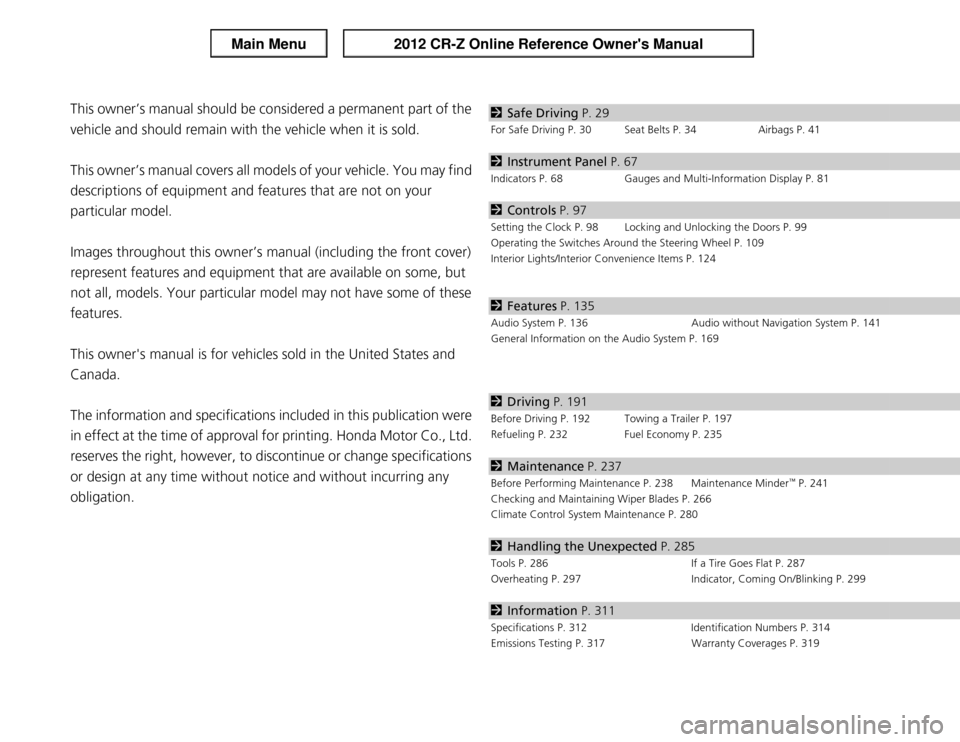
obligation.2 Safe Driving P. 29
For Safe Driving P. 30 Seat Belts P. 34 Airbags P. 41
2Instrument Panel P. 67
Indicators P. 68 Gauges and Multi-Information Display P. 81
2Controls P. 97
Setting the Clock P. 98 Locking and Unlocking the Doors P. 99
Operating the Switches Around the Steering Wheel P. 109
Interior Lights/Interior Convenience Items P. 124
2Features P. 135
Audio System P. 136 Audio without Navigation System P. 141
General Information on the Audio System P. 169
2Driving P. 191
Before Driving P. 192 Towing a Trailer P. 197
Refueling P. 232 Fuel Economy P. 235
2Maintenance P. 237
Before Performing Maintenance P. 238 Maintenance Minder ™
P. 241
Checking and Maintaining Wiper Blades P. 266
Climate Control System Maintenance P. 280
2 Handling the Unexpected P. 285
Tools P. 286 If a Tire Goes Flat P. 287
Overheating P. 297 Indicator, Coming On/Blinking P. 299
2Information P. 311
Specifications P. 312 Identification Numbers P. 314
Emissions Testing P. 317 Warranty Coverages P. 319
Main Menu2012 CR-Z Online Reference Owner's Manual
Page 6 of 333
5
Quick Reference Guide
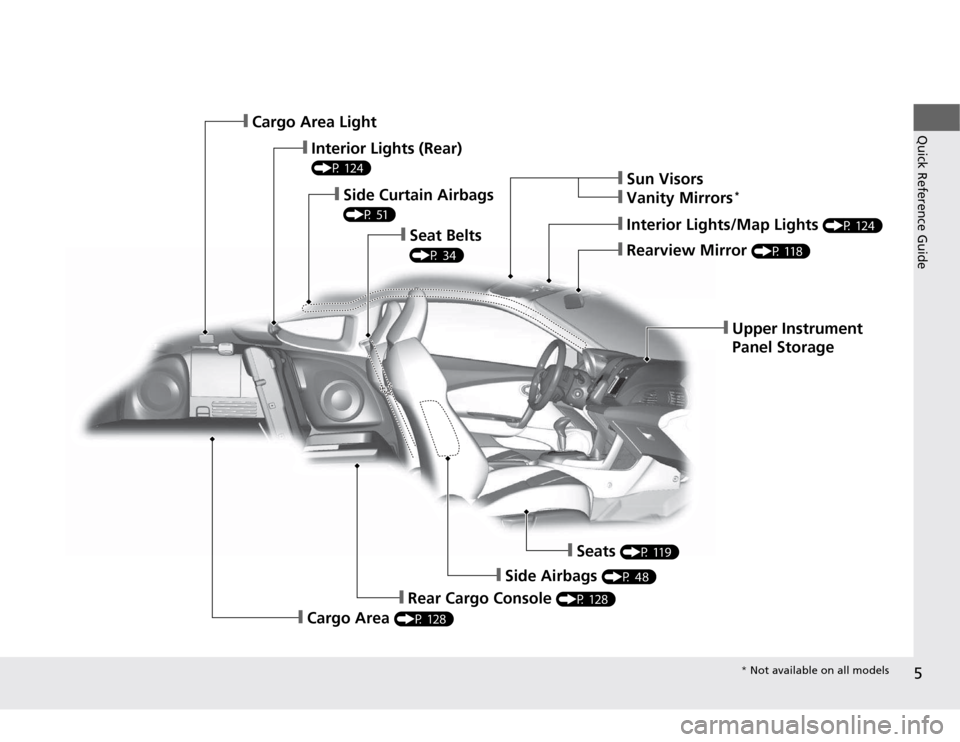
❙Upper Instrument
Panel Storage
❙Rearview Mirror (P 118)
❙Interior Lights/Map Lights (P 124)
❙Sun Visors
❙Vanity Mirrors*
❙Seat Belts
(P 34)
❙Side Curtain Airbags
(P 51)
❙Interior Lights (Rear)
(P 124)
❙Cargo Area Light
❙Seats
(P 119)
❙Side Airbags (P 48)
❙Rear Cargo Console (P 128)
❙Cargo Area (P 128)
* Not available on all models
Page 14 of 333
13
Quick Reference Guide
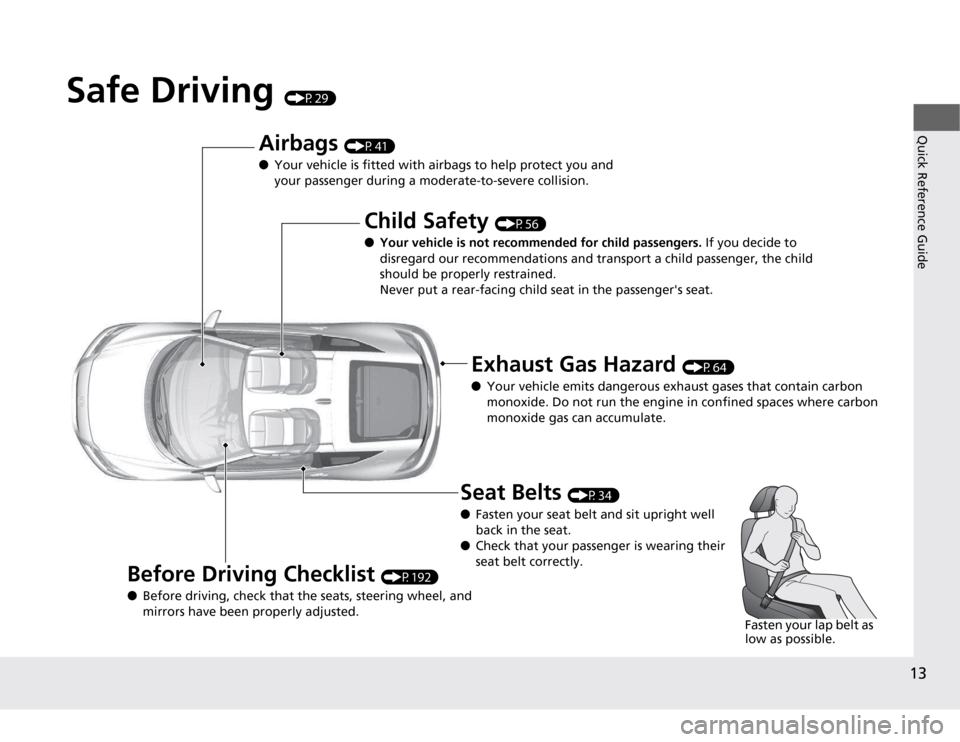
Safe Driving (P29)
Airbags (P41)
● Your vehicle is fitted with airbags to help protect you and
your passenger during a moderate-to-severe collision.
Child Safety (P56)
● Your vehicle is not recommended for child passengers. If you decide to
disregard our recommendations and transport a child passenger, the child
should be properly restrained.
Never put a rear-facing child seat in the passenger's seat.
Exhaust Gas Hazard (P64)
● Your vehicle emits dangerous exhaust gases that contain carbon
monoxide. Do not run the engine in confined spaces where carbon
monoxide gas can accumulate.
Before Driving Checklist (P192)
● Before driving, check that the seats, steering wheel, and
mirrors have been properly adjusted. Seat Belts
(P34)
● Fasten your seat belt and sit upright well back in the seat.
● Check that your passenger is wearing their
seat belt correctly.
Fasten your lap belt as
low as possible.
Page 15 of 333
14
Quick Reference Guide
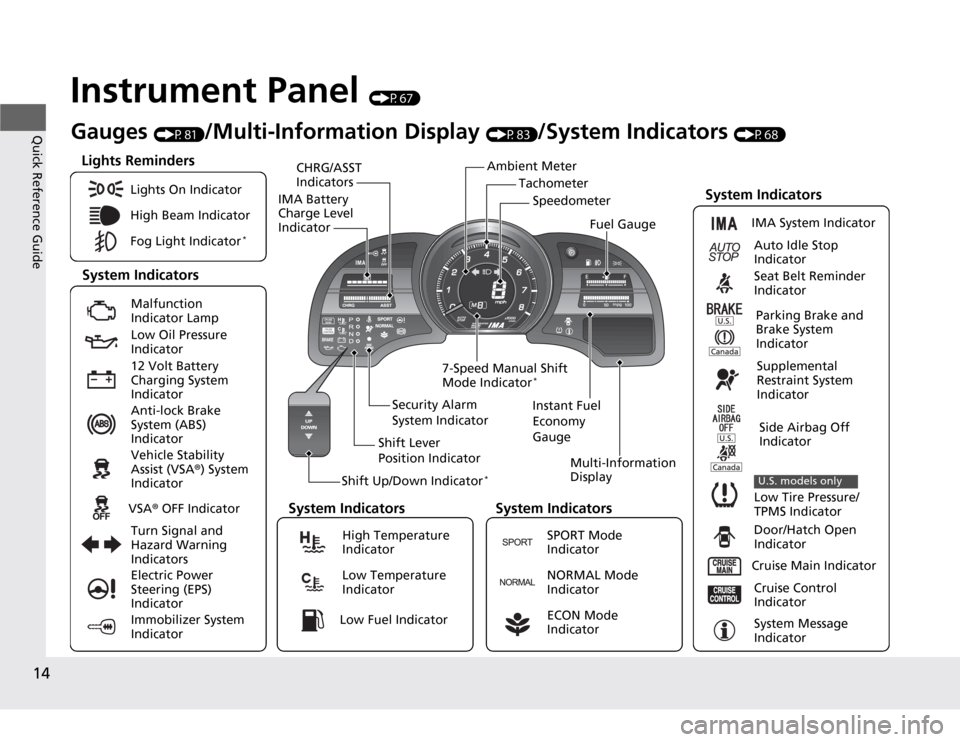
Instrument Panel (P67)
Tachometer
CHRG/ASST Indicators
IMA Battery Charge Level Indicator
Shift Up/Down Indicator *Multi-Information
Display
7-Speed Manual Shift Mode Indicator
*
System Indicators
Lights Reminders
Instant Fuel
Economy GaugeSpeedometer
Fuel Gauge
Security Alarm
System Indicator
Shift Lever
Position Indicator
Gauges
(P81)/Multi-Information Display (P83)/System Indicators (P68)
Ambient Meter
System Indicators System Indicators
System IndicatorsLights On Indicator
High Beam Indicator
Fog Light Indicator *
Malfunction
Indicator Lamp
Low Oil Pressure Indicator
12 Volt Battery
Charging System Indicator
Anti-lock Brake
System (ABS) Indicator
Vehicle Stability Assist (VSA
®) System
Indicator
VSA ® OFF Indicator
Turn Signal and
Hazard Warning
Indicators
Electric Power Steering (EPS) Indicator
Immobilizer System Indicator
IMA System Indicator
Auto Idle Stop
Indicator
Seat Belt Reminder
Indicator
Parking Brake and
Brake System
Indicator
Supplemental
Restraint System
Indicator
Side Airbag Off
Indicator
Low Tire Pressure/
TPMS Indicator
U.S. models only
Door/Hatch Open
Indicator
Cruise Main Indicator
Cruise Control
Indicator
System Message
Indicator
High Temperature Indicator
Low Temperature Indicator
SPORT Mode
Indicator
NORMAL Mode
Indicator
ECON Mode
Indicator Low Fuel Indicator
Page 26 of 333
25
Quick Reference Guide
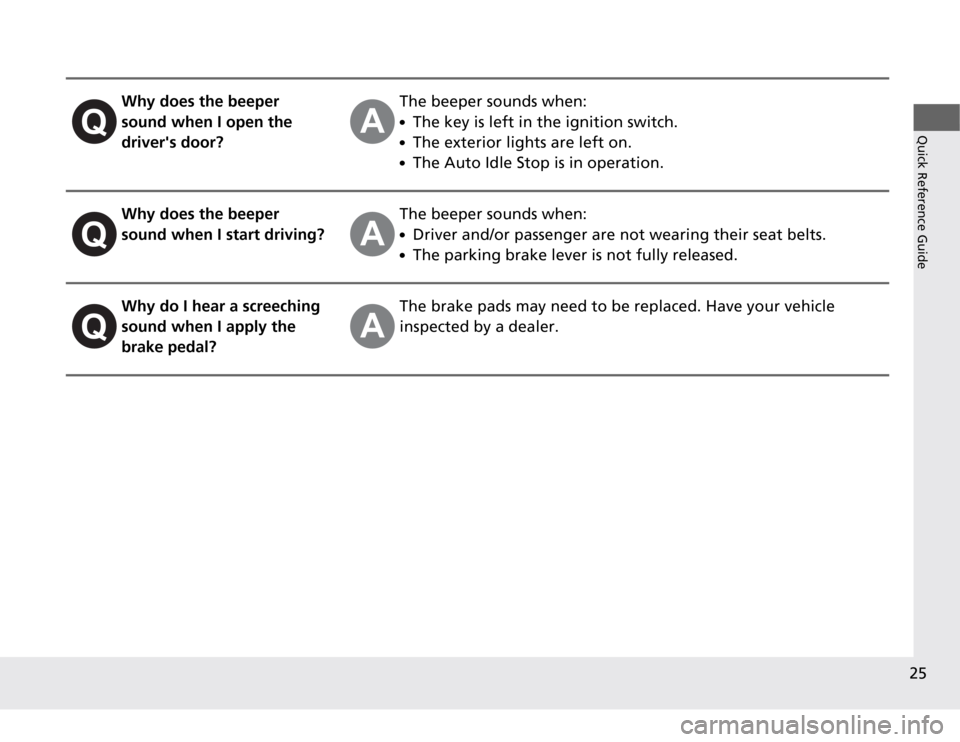
Why does the beeper
sound when I open the driver's door?The beeper sounds when: ●The key is left in the ignition switch.
● The exterior lights are left on.
● The Auto Idle Stop is in operation.
Why does the beeper
sound when I start driving?The beeper sounds when: ●Driver and/or passenger are not wearing their seat belts.
● The parking brake lever is not fully released.
Why do I hear a screeching
sound when I apply the brake pedal?The brake pads may need to be replaced. Have your vehicle
inspected by a dealer.
Page 27 of 333

26
Quick Reference Guide
California Proposition 65 Warning
Event Data Recorders
This vehicle is equipped with an event data recorder (EDR).
The main purpose of an EDR is to record, in certain crash or near
crash-like situations, such as an air bag deployment or hitting a
road obstacle, data that will assist in understanding how a vehicle’s systems performed. The EDR is designed to record data related
to vehicle dynamics and safety systems for a short period of
time, typically 30 second s or less. The EDR in this vehicle is
designed to record such data as: • How various syst ems in your vehicle were operating;
• Whether or not the driver and passenger safety belts were
buckled/fastened;
• How far (if at all) the driver was depressing the accelerator
and/or brake pedal; and,
• How fast the vehicle was traveling.
These data can help provide a better understanding of the
circumstances in which crashes and injuries occur. NOTE: EDR data
are recorded by your vehicle only if a non-trivial crash situation
occurs; no data are recorded by the EDR under normal driving
conditions and no personal data (e.g., name, gender, age, and
crash location) are recorded. However, other parties, such as law
enforcement, could combine the EDR data with the type of
personally identifying data routin ely acquired during a crash
investigation. WARNING:
This product contains or emits
chemicals known to the st ate of California to cause
cancer and birth defects or other reproductive
harm. To read data recorded by an EDR, special equipment is required,
and access to the vehicle or the EDR is needed. In addition to the
vehicle manufacturer, other parties, such as law enforcement, that
have the special equipment, can read the information if they have
access to the vehicle or the EDR.
The data belongs to the vehicle owner and may not be accessed by
anyone else except as legally required or with the permission of the
vehicle owner.
Service Diagnostic Recorders
This vehicle is equipped with service-related devices that record
information about powertrain performance. The data can be used
to verify emissions law requirements and/or help technicians
diagnose and solve service probl
ems. It may also be combined with
data from other sources for research purposes, but it remains confidential.
California Perchlorate Contamination Prevention Act
The airbags, seat belt tensioners, and CR type batteries in this
vehicle may contain perchlorate materials - special handling may apply. See www.dtsc.ca.gov/haz ardouswaste/perchlorate/
As you read this manual, you will find information that is preceded
by a symbol. This information is intended to help you avoid
damage to your vehicle, other property, or the environment.
NOTICE
Page 30 of 333
29
Safe Driving
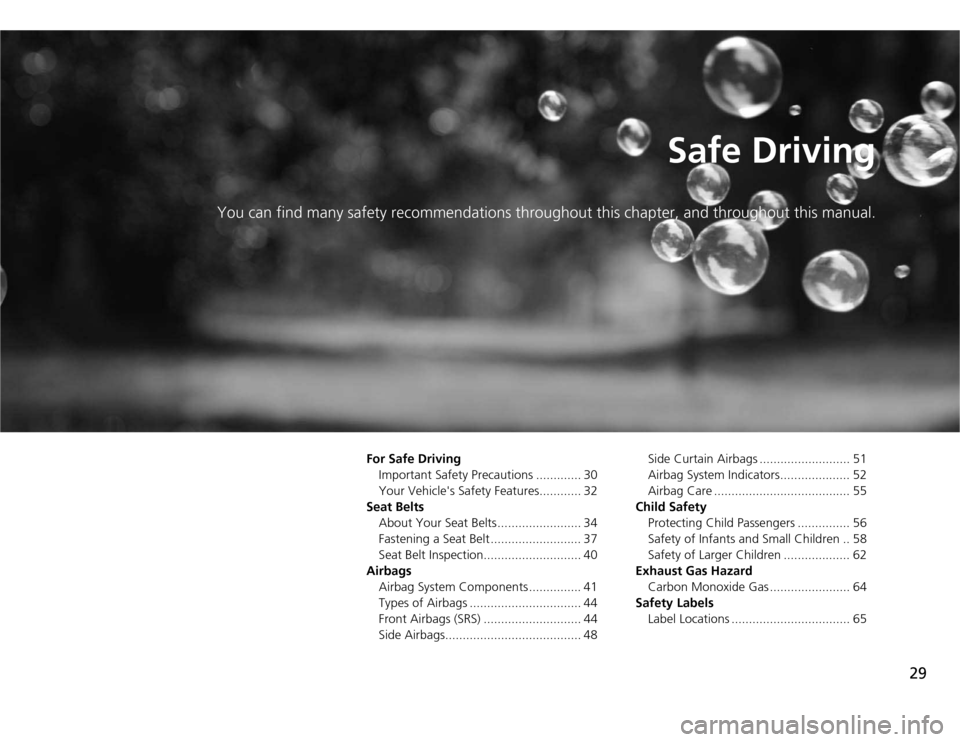
You can find many safety recommendat ions throughout this chapter, and throughout this manual.
For Safe Driving
Important Safety Precautions ............. 30
Your Vehicle's Safety Features............ 32
Seat Belts About Your Seat Belts ........................ 34
Fastening a Seat Belt .......................... 37
Seat Belt Inspection............................ 40
Airbags Airbag System Components ............... 41
Types of Airbags ................................ 44
Front Airbags (SRS) ............................ 44
Side Airbags....................................... 48 Side Curtain Airbags .......................... 51
Airbag System Indicators.................... 52
Airbag Care ....................................... 55
Child Safety
Protecting Child Passengers ............... 56
Safety of Infants and Small Children .. 58
Safety of Larger Children ................... 62
Exhaust Gas Hazard Carbon Monoxide Gas ....................... 64
Safety Labels Label Locations .................................. 65
Page 31 of 333
30
Safe Driving
For Safe Driving
The following pages explain your vehicle's safety features and how to use them
properly. The safety precautions below are ones that we consider to be among the most important.
Important Safety Precautions ■Always wear your seat belt
A seat belt is your best protection in all types of collisions. Airbags are designed to
supplement seat belts, not replace them. So even though your vehicle is equipped
with airbags, make sure you and your passenger always wear your seat belts, and
wear them properly. ■ Your vehicle is not recom mended for child passengers
The National Highway Traffic Safety Administration and Transport Canada
recommend that all children age 12 and under be properly restrained in a back seat.
Since this vehicle does not have a back seat, we strongly recommend that you do
not carry any child who is not large enough and mature enough to ride in front.
■ Be aware of airbag hazards
While airbags can save lives, they can cause serious or fatal injuries to occupants
who sit too close to them, or are not properly restrained. Infants, young children,
and short adults are at the greatest risk. Be sure to follow all instructions and
warnings in this manual.
■ Don't drink and drive
Alcohol and driving don't mix. Even one drin k can reduce your ability to respond to
changing conditions, and your reaction time gets worse with every additional drink.
So don't drink and drive, and don't let your friends drink and drive, either.1Important Safety Precautions
Some states, provinces and territories prohibit the use
of cell phones other than hands-free devices by the
driver while driving.
Never carry an infant in a rear-facing child seat in this
vehicle.
If an older child must ride in this vehicle, follow all
child safety instructions and warnings in this manual. 2 Child Safety P. 56
Page 33 of 333
32
uuFor Safe DrivinguYour Vehicle's Safety Features
Safe Driving
Your Vehicle's Safety Features
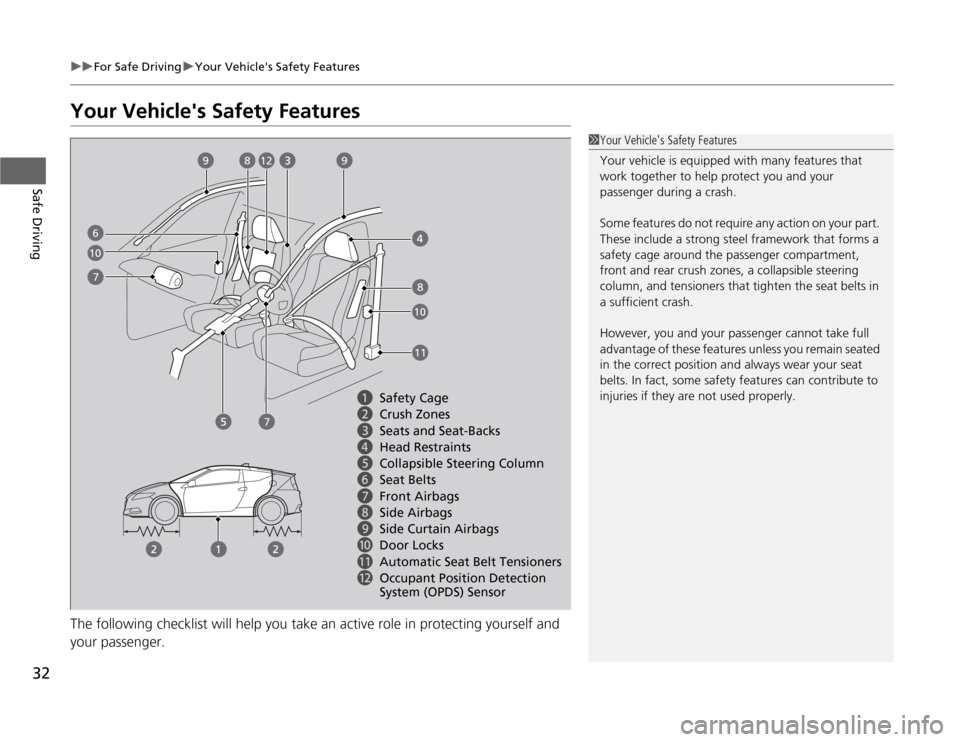
The following checklist will help you take an active role in protecting yourself and your passenger.
1Your Vehicle's Safety Features
Your vehicle is equipped with many features that
work together to help protect you and your
passenger during a crash.
Some features do not require any action on your part.
These include a strong steel framework that forms a
safety cage around the passenger compartment,
front and rear crush zones, a collapsible steering
column, and tensioners that tighten the seat belts in
a sufficient crash.
However, you and your passenger cannot take full
advantage of these features unless you remain seated
in the correct position and always wear your seat
belts. In fact, some safety features can contribute to
injuries if they are not used properly.
6
7
89
10
11
12
Safety Cage
Crush Zones
Seats and Seat-Backs
Head Restraints
Collapsible Steering Column
Seat BeltsFront Airbags
Side Airbags
Side Curtain Airbags
Door Locks
Automatic Seat Belt Tensioners Occupant Position Detection
System (OPDS) Sensor
7
8
9
10
a b c d e fg h i j k l
Page 34 of 333
33
uuFor Safe DrivinguYour Vehicle's Safety Features
Safe Driving
For the safety of you and your passenger, make a habit of checking these items each
time before you drive.•After everyone has entered the vehicle, be sure both doors and the hatch are
closed and locked. Locking the doors and the hatch helps prevent an occupant
from being ejected and an outsider from unexpectedly opening a door or the
hatch. 2 Locking/Unlocking the Doors from the Inside P. 102
• Adjust your seat to a position suitable for driving. Be sure the seats are adjusted
as far to the rear as possible while allowing the driver to control the vehicle.
Sitting too close to a front airbag can result in serious or fatal injury in a crash.
2 Adjusting the Seats P. 119
• Always wear your seat belt, and make sure you wear it properly. Confirm that any
passenger is properly belted as well.
2 Fastening a Seat Belt P. 37
• If you choose to ignore our warnings and carry a child in this vehicle, make every
effort to protect them by properly using a seat belt or a child seat according to the
child’s age, height, and weight.
2 Child Safety P. 56
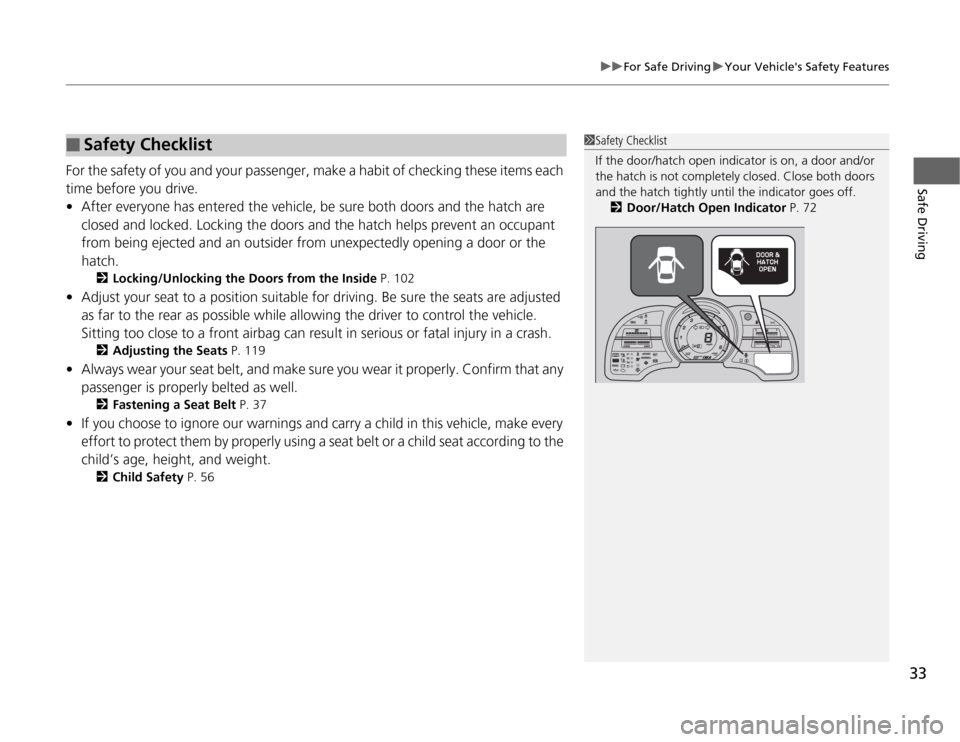
■Safety Checklist1Safety Checklist
If the door/hatch open indicator is on, a door and/or
the hatch is not completely closed. Close both doors
and the hatch tightly until the indicator goes off.
2 Door/Hatch Open Indicator P. 72