fuel pressure HONDA CR-Z 2012 1.G Owners Manual
[x] Cancel search | Manufacturer: HONDA, Model Year: 2012, Model line: CR-Z, Model: HONDA CR-Z 2012 1.GPages: 333, PDF Size: 10.43 MB
Page 15 of 333
14
Quick Reference Guide
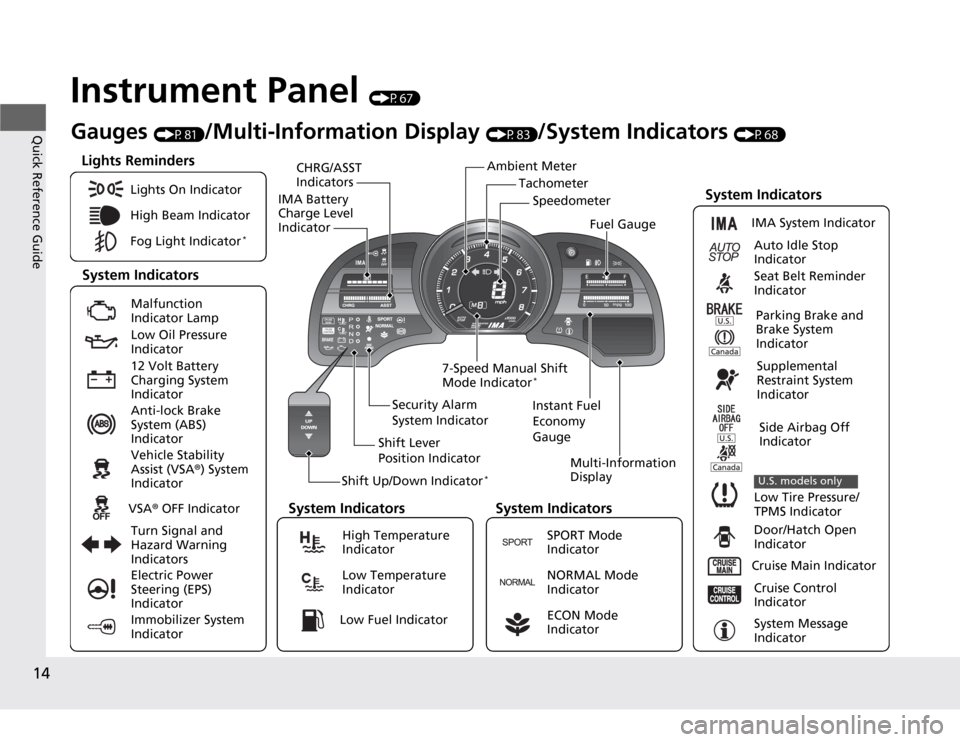
Instrument Panel (P67)
Tachometer
CHRG/ASST Indicators
IMA Battery Charge Level Indicator
Shift Up/Down Indicator *Multi-Information
Display
7-Speed Manual Shift Mode Indicator
*
System Indicators
Lights Reminders
Instant Fuel
Economy GaugeSpeedometer
Fuel Gauge
Security Alarm
System Indicator
Shift Lever
Position Indicator
Gauges
(P81)/Multi-Information Display (P83)/System Indicators (P68)
Ambient Meter
System Indicators System Indicators
System IndicatorsLights On Indicator
High Beam Indicator
Fog Light Indicator *
Malfunction
Indicator Lamp
Low Oil Pressure Indicator
12 Volt Battery
Charging System Indicator
Anti-lock Brake
System (ABS) Indicator
Vehicle Stability Assist (VSA
®) System
Indicator
VSA ® OFF Indicator
Turn Signal and
Hazard Warning
Indicators
Electric Power Steering (EPS) Indicator
Immobilizer System Indicator
IMA System Indicator
Auto Idle Stop
Indicator
Seat Belt Reminder
Indicator
Parking Brake and
Brake System
Indicator
Supplemental
Restraint System
Indicator
Side Airbag Off
Indicator
Low Tire Pressure/
TPMS Indicator
U.S. models only
Door/Hatch Open
Indicator
Cruise Main Indicator
Cruise Control
Indicator
System Message
Indicator
High Temperature Indicator
Low Temperature Indicator
SPORT Mode
Indicator
NORMAL Mode
Indicator
ECON Mode
Indicator Low Fuel Indicator
Page 22 of 333
21
Quick Reference Guide
VSA® OFF Button (P216)
● The vehicle stability assist (VSA ®) system
helps stabilize the vehicle during
cornering, and helps maintain traction
while accelerating on loose or slippery road surfaces.
● VSA ® comes on automatically every time
you start the engine.
● To turn VSA ® on or off, press and hold
the button until you hear a beep.
Cruise Control (P212)
● Cruise control allows you to maintain a set speed without keep ing your foot on
the accelerator pedal.
● To use cruise control, press the CRUISE
button, then press button
when the vehicle speed is above 25 mph
(40 km/h).
Tire Pressure Monitoring System (TPMS) (P217)
● TPMS monitors tire pressure.
● TPMS is turned on automatically every
time you start the engine.
DECEL/SET
U.S. models only
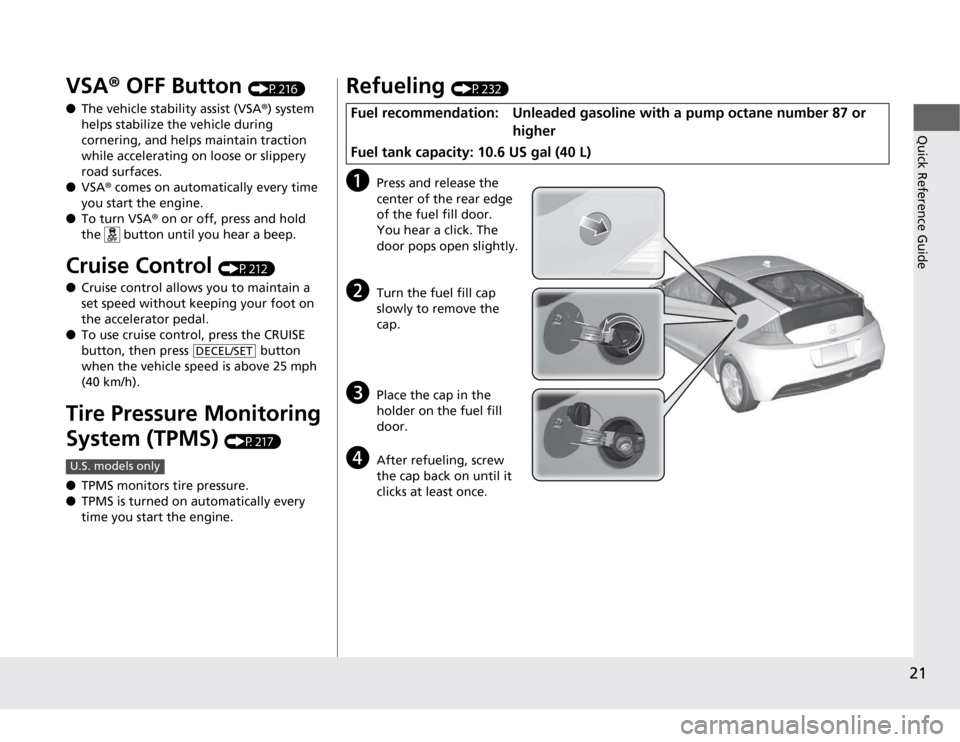
Refueling (P232)
a Press and release the center of the rear edge
of the fuel fill door.
You hear a click. The
door pops open slightly.
b Turn the fuel fill cap slowly to remove the cap.
c Place the cap in the
holder on the fuel fill
door.
d After refueling, screw
the cap back on until it
clicks at least once.
Fuel recommendation: Unle
aded gasoline with a pump octane number 87 or
higher
Fuel tank capacity: 10.6 US gal (40 L)
Page 192 of 333
191
Driving
This chapter discusses driving, refueling, and information on items such as accessories.
Before Driving Driving Preparation .......................... 192
Maximum Load Limit........................ 195
Towing a Trailer Towing Your Vehicle ........................ 197
When Driving Starting the Engine .......................... 198
Precautions While Driving................. 201
Automatic Transmission (CVT) .......... 202
Shifting ............................................ 203
Shifting ............................................ 208
Automatic transmission (CVT) models
Manual transmission models
3-Mode Drive System ....................... 211
Cruise Control ................................. 212
VSA ® (Vehicle Stability Assist), aka ESC
(Electronic Stability Control), System .. 215
TPMS (Tire Pressure Monitoring System) ... 217
Tire Pressure Monitoring System (TPMS) -
Required Federal Explanation ......... 218
Braking Brake System ................................... 220
ABS (Anti-lock Brake System) ........... 222
Brake Assist System.......................... 223
Parking Your Vehicle When Stopped................................. 224 Auto Idle Stop ................................. 225
Auto Idle Stop ................................. 228
Parking ............................................ 231
Refueling Fuel Information .............................. 232
How to Refuel ................................. 233
Fuel Economy Improving Fuel Economy .................. 235
Accessories and Modifications
Accessories ...................................... 236
Modifications................................... 236Automatic transmission (CVT) models
Manual transmission models
Page 219 of 333

218
uuWhen DrivinguTire Pressure Monitoring System (TPMS) - Required Federal Explanation
Driving
Tire Pressure Monitoring System (TPMS) - Required
Federal Explanation
Each tire, including the spare (if provided), should be checked monthly when cold and inflated to the inflation pressure
recommended by the vehicle manufacturer on the vehicle placard
or tire inflation pressure label. (If your vehicle has tires of a different size than the size indicated
on the vehicle placard or tire inflation pressure label, you should
determine the proper tire inflation pressure for those tires.)
As an added safety feature, your vehicle has been equipped with
a tire pressure monitoring system (TPMS) that illuminates a low tire pressure telltale
when one or more of your tire s is significantly under-inflated.
Accordingly, when the low tire pressure telltale illuminates, you
should stop and check your tires as soon as possible, and inflate
them to the proper pressure.
Driving on a significantly under-inflated tire causes the tire to overheat and can lead to tire failure. Un der-inflation also reduces
fuel efficiency and tire tread life, and may affect the vehicle's handling an d stopping ability.
U.S. models
Page 236 of 333
235
Driving
Fuel Economy
Improving Fuel Economy
Fuel economy depends on several conditions, including driving conditions, your
driving habits, the condition of your vehicle, and loading. Depending on these and
other conditions, you may or may not achieve the rated fuel economy of this vehicle.
You can optimize your fuel economy with proper maintenance of your vehicle.
Always maintain your vehicle in accordance with the messages displayed on the
multi-information display. • Use the recommended viscosity engine oil, displaying the API Certification Seal.
• Maintain the specified tire pressure.
• Do not load the vehicle with excess cargo.
• Keep your vehicle clean. A buildup of snow or mud on your vehicle's underside adds weight and increases wind resistance.
■Maintenance and Fuel Economy
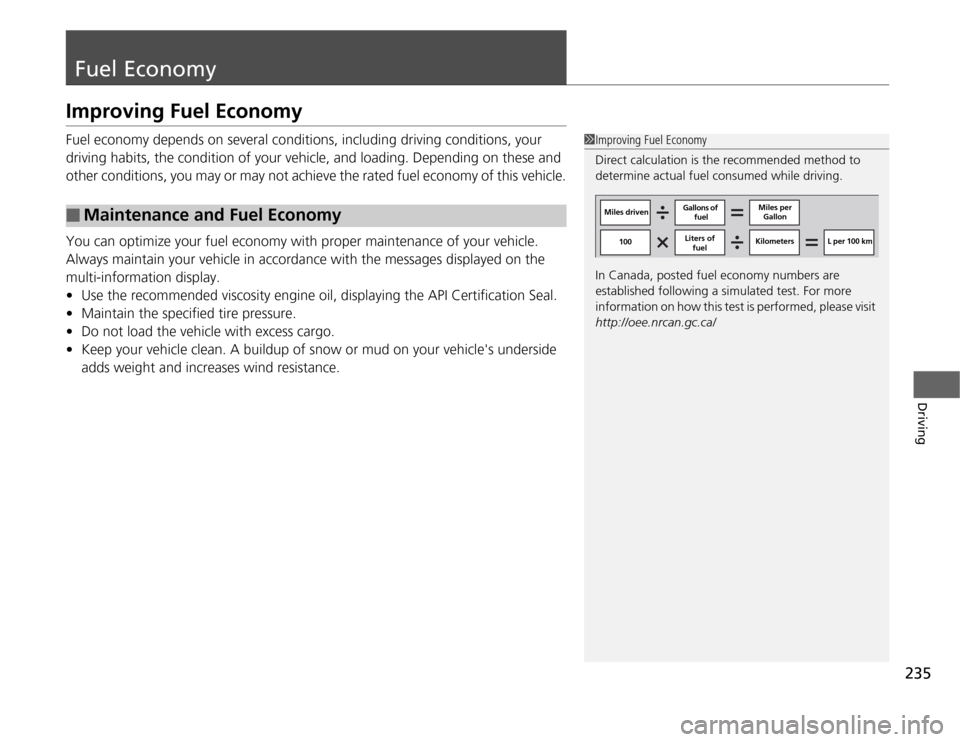
1Improving Fuel Economy
Direct calculation is the recommended method to
determine actual fuel consumed while driving.
In Canada, posted fuel economy numbers are
established following a simulated test. For more
information on how this test is performed, please visit http://oee.nrcan.gc.ca/
Miles driven Gallons of
fuel Miles per
Gallon
100 Liters of
fuel Kilometers L per 100 km
Page 239 of 333
238
Maintenance
Before Performing Maintenance
Inspection and Maintenance
For your safety, perform all listed inspections and maintenance to keep your vehicle
in good condition. If you become aware of any abnormality (noise, smell, insufficient
brake fluid, oil residue on the ground, etc.), have your vehicle inspected by a dealer.
(Note, however, that service at a dealer is not mandatory to keep your warranties in
effect.) Refer to the separate maintenance booklet for detailed maintenance and
inspection information. ■ Daily inspections
Perform inspections before long distance trips, when washing the vehicle, or when refueling. ■ Periodic inspections
• Check the automatic transmission fluid level monthly.
2 Automatic Transmission Fluid P. 254
• Check the brake fluid level monthly.
2 Brake/Clutch Fluid P. 256
• Check the tire pressure monthly. Examine the tread for wear and foreign objects.
2 Checking and Maintaining Tires P. 269
• Check the operation of the exterior lights monthly.
2 Replacing Light Bulbs P. 258
• Check the condition of the wiper blades at least every six months.
2 Checking and Mainta ining Wiper Blades P. 266
■Types of Inspection and Maintenance
1Inspection and Maintenance
Maintenance, replacement, or repair of
emissions control devices and systems may be
done by any automotive repair establishment or
individuals using parts that are “certified” to EPA standards.
According to state and federal regulations, failure to
perform maintenance on the maintenance main
items marked with # will not void your emissions
warranties. However, all maintenance services should
be performed in accordance with the intervals
indicated by the multi-information display. 2 Maintenance Service Items P. 243
If you want to perform complex maintenance tasks
that require more skills and tools, you can purchase a
subscription to the Service Express website at
www.techinfo.honda.com .
2 Authorized Manuals P. 321
If you want to perform maintenance yourself, make
sure that you have the necessary tools and skills first.
After performing maintenance, update the records in
the separate maintenance booklet.
U.S. models
Page 270 of 333
269
Maintenance
Checking and Maintaining Tires
Checking Tires
To safely operate your vehicle, your tires must be of the proper type and size, in
good condition with adequate tread, and properly inflated. ■Inflation guidelines
Properly inflated tires provide the best co mbination of handling, tread life, and comfort.
Refer to the driver’s doorjamb label or specification’s page for the specified pressure.
Underinflated tires wear unevenly, adversely affect handling and fuel economy, and
are more likely to fail from overheating.
Overinflated tires make your vehicle ride harshly, are more prone to road hazards, and wear unevenly.
Every day before you drive, look at each of the tires. If one looks lower than the
others, check the pressure with a tire gauge.
At least once a month or before long trips, use a gauge to measure the pressure in
all tires, including the spare. Even tires in good condition can lose 1 to 2 psi (10 to
20 kPa, 0.1 to 0.2 kgf/cm 2
) per month.
■ Inspection guidelines
Every time you check inflation, also examine the tires and valve stems.Look for:• Bumps or bulges on the side or in the tread. Replace the tire if you find any cuts,
splits, or cracks in the side of the tire. Replace it if you see fabric or cord.
• Remove any foreign objects and inspect for air leaks.
• Uneven tread wear. Have a dealer check the wheel alignment.
• Excessive tread wear.
2 Wear Indicators P. 274
• Cracks or other damage around valve stem.
1Checking Tires
Measure the air pressure when tires are cold. This
means the vehicle has been par ked for at least three
hours, or driven less than 1 mile (1.6 km). If
necessary, add or release air until the specified pressure is reached.
If checked when hot, tire pressure can be as much as
4–6 psi (30–40 kPa, 0.3–0.4 kgf/cm 2
) higher than if
checked when cold.
Have a dealer check the tires if you feel a consistent
vibration while driving. New tires and any that have
been removed and reinstalled should be properly balanced.
3WARNING
Using tires that are excessively worn or
improperly inflated can cause a crash in
which you can be seri ously hurt or killed.
Follow all instruc tions in this owner’s
manual regarding tire inflation and
maintenance.
Page 284 of 333
283
uuCleaninguExterior Care
Continued
Maintenance
Exterior Care
Dust off the vehicle body after you drive.
Regularly inspect your vehicle for scratches on painted surfaces. A scratch on a
painted surface can result in body rust. If you find a scratch, promptly repair it.
Wash the vehicle regularly. Wash more frequently when driving in the following
conditions: •If driving on roads with road salt.
• If driving in coastal areas.
• If tar, soot, bird droppings, insects, or tree sap are stuck to painted surfaces.
Fold in the door mirrors. Make sure to follow the instructions indicated on the
automated vehicle wash. • Keep sufficient distance between the cleaning nozzle and the vehicle body.
• Take particular care around the windows. St anding too close may cause water to
enter the vehicle interior. Do not spray water into the engine compartment.
■Washing the Vehicle
■Using an Automated Vehicle Wash
■Using High Pressure Cleaners
1Washing the Vehicle
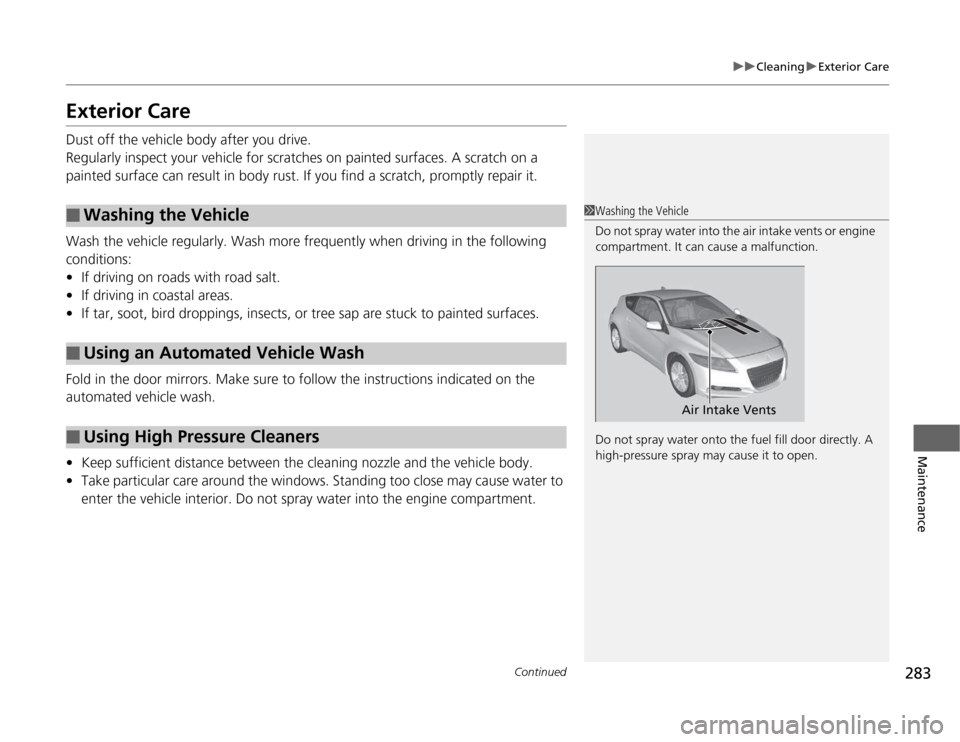
Do not spray water into the air intake vents or engine
compartment. It can cause a malfunction.
Do not spray water onto the fuel fill door directly. A
high-pressure spray may cause it to open.
Air Intake Vents
Page 324 of 333
Index
323
Index
Index
Numbers
7-Speed Manual Shift Mode................... 205
A
ABS (Anti-lock Brake System) .................. 222
Accessories and Modifications ................ 236
Accessory Power Socket ........................... 127
Active Head Restraints ............................. 123
Additives
Coolant .................................................. 252
Engine Oil ............................................... 249
Washer ................................................... 257
Additives, Engine Oil ............................... 247
Adjusting
Head Restraints ....................................... 121
Headlights .............................................. 258
Mirrors.................................................... 118
Seats....................................................... 119
Steering Wheel ....................................... 117
Air Conditioning System
(Climate Control System) ....................... 132
Changing the Mode................................ 132 Defrosting the Windscreen and
Windows .............................................. 133
Dust and Pollen Filter .............................. 280
Recirculation/Fresh Air Mode................... 132
Sensors ................................................... 134
Using Automatic Climate Control............ 132
Air Pressure ...................................... 269, 313
Airbags ....................................................... 41 Advanced Airbags ..................................... 47
After a Collision ......................................... 45
Airbag Care ............................................... 55
Event Data Recorders ................................. 26
Front Airbags (SRS) .................................... 44
Indicator ........................................ 52, 70, 74
Passenger Airbag Off Indicator .................. 53
Sensors ...................................................... 47
Side Airbag Cutoff System ......................... 50
Side Airbag Off Indicator ........................... 50
Side Airbags .............................................. 48
Side Curtain Airbags .................................. 51
AM/FM Audio ................................... 143, 154
Anti-lock Brake System (ABS) .................. 222
Indicator .................................................... 70
ASST Indicator ............................................. 82
Audio Remote Controls .............................. 19
Audio System ............................................ 136
Adjusting the Sound ................................ 142
Auxiliary Input Jack .................................. 138
Error Messages ........................................ 167
General Information ................................ 169
MP3/WMA/AAC ...................................... 149
PC Card ................................................... 172
Radio Data System (RDS) ......................... 144
Reactivating ............................................. 139
Recommended CDs ................................. 169
Recommended Drives .............................. 171
Security Code .......................................... 139
Theft Protection ....................................... 139
USB Adapter Cable .................................. 137 USB Flash Drives ...................................... 171
with Navigation System ........................... 151
without Navigation System ...................... 141
Authorized Manuals ................................ 321
Auto Door Locking/Unlocking ................. 103
Customize ................................................. 90
Auto Idle Stop .......................................... 225
Auto Idle Stop Indicator ............................ 76
Automatic Lighting .................................. 111
Automatic Transmission (CVT) ................. 202
Creeping ................................................. 202
Fluid ........................................................ 254
Kickdown ................................................ 202
Operating the Shift Lever......................... 204
Shift Lever Does Not Move ...................... 296
Shifting ................................................... 203
Auxiliary Input Jack .................................. 138
Average Fuel Economy .............................. 88
Average Fuel Economy Records ................ 88
Average Speed ........................................... 85
B
Back-Up Light ........................................... 263
Battery ...................................................... 278
Charging System Indicator................. 69, 300
Jump Starting .......................................... 294 Maintenance }
(Checking the 12 Volt Battery) ............... 278
Maintenance (Replacing) ......................... 279
Battery Charge in Progress (CHRG) ........... 82
Page 326 of 333

325
Index
Locking/Unlocking the Doors from the Inside...................................... 102
Locking/Unlocking the Doors from the Outside................................... 100
Lockout Prevention System ..................... 101
DOT Tire Quality Grading ........................ 272
Driving ...................................................... 191
Automatic Transmission (CVT)................. 202
Braking ................................................... 220
Cruise Control ........................................ 212
Shifting Gear .......................................... 203
Starting the Engine ................................. 198
Dust and Pollen Filter .............................. 280
E
Eco Assist System .......................................... 8
Eco Drive Bar .......................................... 9, 87
Eco Guide ............................................... 9, 86
Eco Score ................................................ 9, 86
ECON Mode Indicator ................................ 77
Elapsed Time .............................................. 85
Electric Motor Assist Indicator (ASST) ....... 82
Electric Power Steering System (EPS)
Indicator ........................................... 72, 302
Electronic Stability Control (ESC) ............ 215
Emergency ................................................ 308
Emissions Testing (Readiness Codes) ...... 317
Engine ....................................................... 314
Coolant .................................................. 252
Jump Starting ......................................... 294 Oil ........................................................... 247
Starting ................................................... 198
Switch Buzzer .......................................... 109
Engine Coolant ......................................... 252
Adding to the Radiator ............................ 253
Adding to the Reserve Tank ..................... 252
High Temperature Indicator ....................... 73
Low Temperature Indicator ........................ 74
Overheating ............................................ 297
Engine Oil ................................................. 247
Adding .................................................... 249
Checking ................................................. 248
Displaying Oil Life .................................... 241
Low Oil Pressure Indicator .................. 68, 299
Recommended Engine Oil ........................ 247
Engine Oil Life ............................................ 88
EPS
(Electric Power Steering System) ..... 72, 302
Exhaust Gas Hazard (Carbon Monoxide) .. 64
Exterior Care (Cleaning) ........................... 283
Exterior Mirrors ........................................ 118
F Features ..................................................... 135
Filters ......................................................... 280
Dust and Pollen ....................................... 280
Oil ........................................................... 250
Flat Tire ..................................................... 287
Floor Mats ................................................. 282 Fluid
Clutch ..................................................... 256
Manual Transmission ....................... 254, 255
Fluids
Brake ...................................................... 256
Engine Coolant ....................................... 252
Windshield Washer ................................. 257
Foot Brake ................................................ 221
Front Airbags (SRS) ..................................... 44
Front Wiper/Washer ................................. 113
Fuel ...................................................... 21, 232
Economy ................................................. 235
Gauge ....................................................... 81
Instant Fuel Economy Gauge ..................... 81
Low Fuel Indicator ..................................... 70
Range ....................................................... 85
Recommendation .................................... 232
Refueling................................................. 232
Fuel Economy ........................................... 235
Fuel Fill Cap ........................................ 21, 234
Message.................................................. 301
Fuel Fill Door ...................................... 21, 233
Fuses .......................................................... 304
Inspecting and Changing......................... 307
Locations......................................... 304, 305