seats HONDA CR-Z 2013 1.G Owners Manual
[x] Cancel search | Manufacturer: HONDA, Model Year: 2013, Model line: CR-Z, Model: HONDA CR-Z 2013 1.GPages: 325, PDF Size: 11.73 MB
Page 2 of 325
Contents
Child Safety P. 54 Exhaust Gas Hazard P. 62 Safety Labels P. 63
Opening and Closing the Hatch P. 104 Security System P. 106 Opening and Closing the Windows P. 108
Adjusting the Mirrors P. 119Adjusting the Seats P. 121
Climate Control System P. 134
General Information on the Audio System P. 155 Bluetooth® HandsFreeLink ® P. 158
When Driving P. 178 Braking P. 208 Parking Your Vehicle P. 212
Rearview Camera P. 214
Accessories and Modifications P. 220
Maintenance Under the Hood P. 229 Replacing Light Bulbs P. 242
Checking and Maintaining Tires P. 253 12 Volt Battery P. 262 Remote Transmitter Care P. 263
Cleaning P. 265
Engine Does Not Start P. 286 Jump Starting P. 287 Shift Lever Does Not Move P. 289
Fuses P. 297 Emergency Towing P. 301 When You Cannot Open the Hatch P. 303
Devices that Emit Radio Waves P. 309 Reporting Safety Defects P. 310
Authorized Manuals P. 315 Customer Service Information P. 316
Quick Reference GuideP. 2
Safe DrivingP. 27
Instrument PanelP. 65
ControlsP. 97
FeaturesP. 137
DrivingP. 171
MaintenanceP. 221
Handling the UnexpectedP. 269
InformationP. 305
IndexP. 317
Note: All page numbers referenced in this document are hyperlinked.
2013 CR-Z Online Reference Owner's Manual
Page 6 of 325
5
Quick Reference Guide
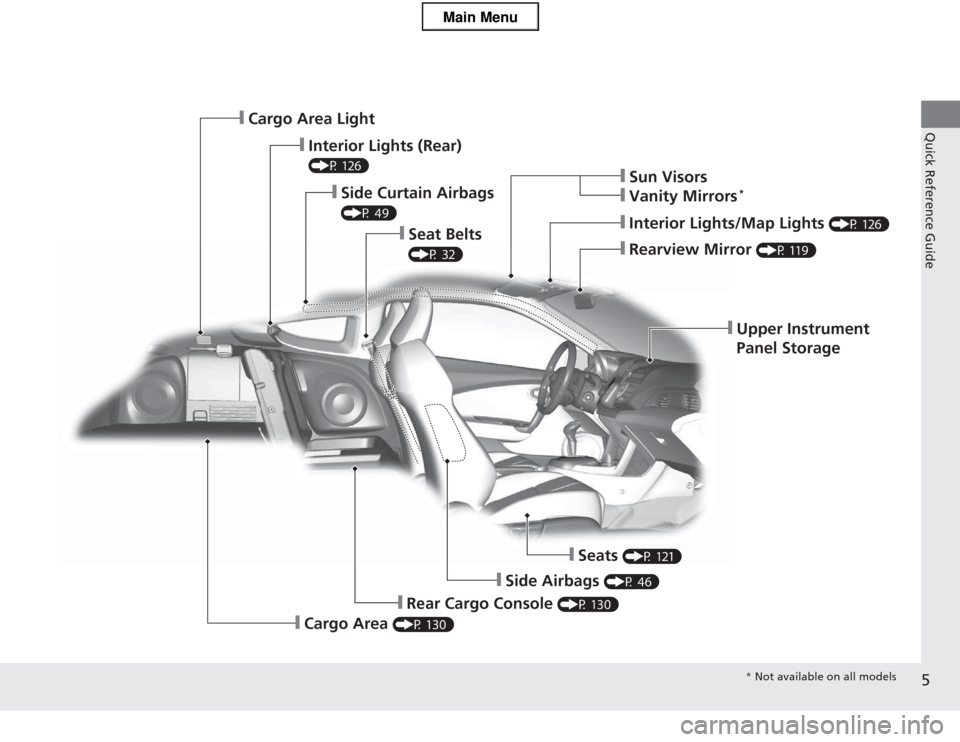
❙Upper Instrument
Panel Storage
❙Rearview Mirror (P 119)
❙Interior Lights/Map Lights (P 126)
❙Sun Visors
❙Vanity Mirrors*
❙Seat Belts
(P 32)
❙Side Curtain Airbags
(P 49)
❙Interior Lights (Rear)
(P 126)
❙Cargo Area Light
❙Seats
(P 121)
❙Side Airbags (P 46)
❙Rear Cargo Console (P 130)
❙Cargo Area (P 130)
* Not available on all models
Main Menu
Page 14 of 325
13
Quick Reference Guide
Safe Driving (P27)
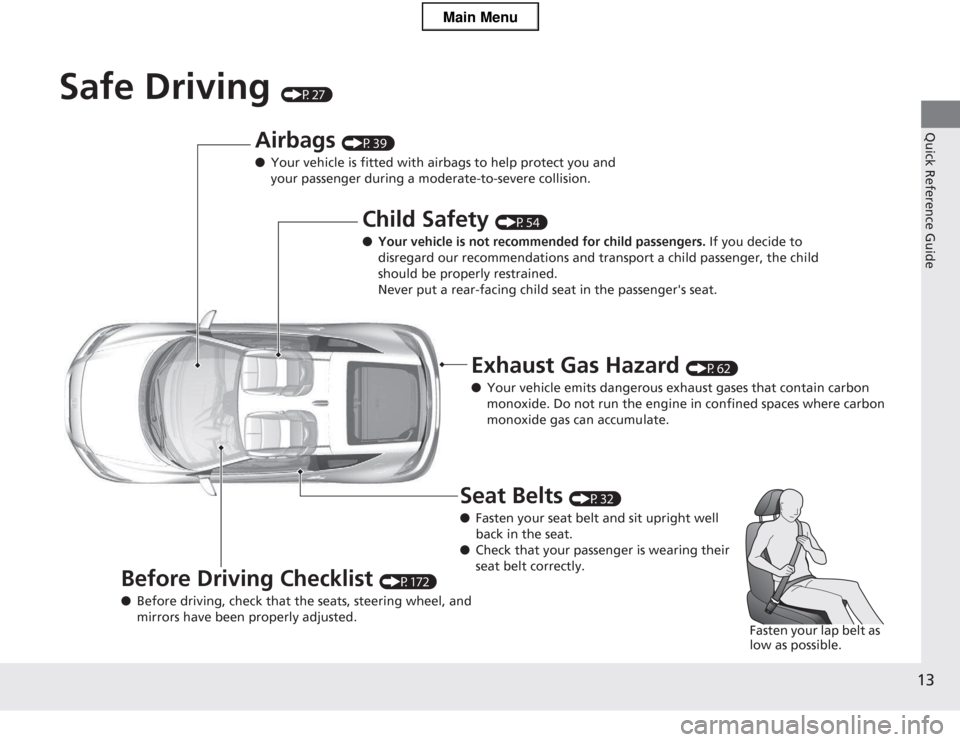
Airbags (P39)
● Your vehicle is fitted with airbags to help protect you and
your passenger during a moderate-to-severe collision.
Child Safety (P54)
● Your vehicle is not recommended for child passengers. If you decide to
disregard our recommendations and transport a child passenger, the child
should be properly restrained.
Never put a rear-facing child seat in the passenger's seat.
Exhaust Gas Hazard (P62)
● Your vehicle emits dangerous exhaust gases that contain carbon
monoxide. Do not run the engine in confined spaces where carbon
monoxide gas can accumulate.
Before Driving Checklist (P172)
● Before driving, check that the seats, steering wheel, and
mirrors have been properly adjusted. Seat Belts
(P32)
● Fasten your seat belt and sit upright well back in the seat.
● Check that your passenger is wearing their
seat belt correctly.
Fasten your lap belt as
low as possible.
Main Menu
Page 31 of 325
30
uuFor Safe DrivinguYour Vehicle's Safety Features
Safe Driving
Your Vehicle's Safety Features
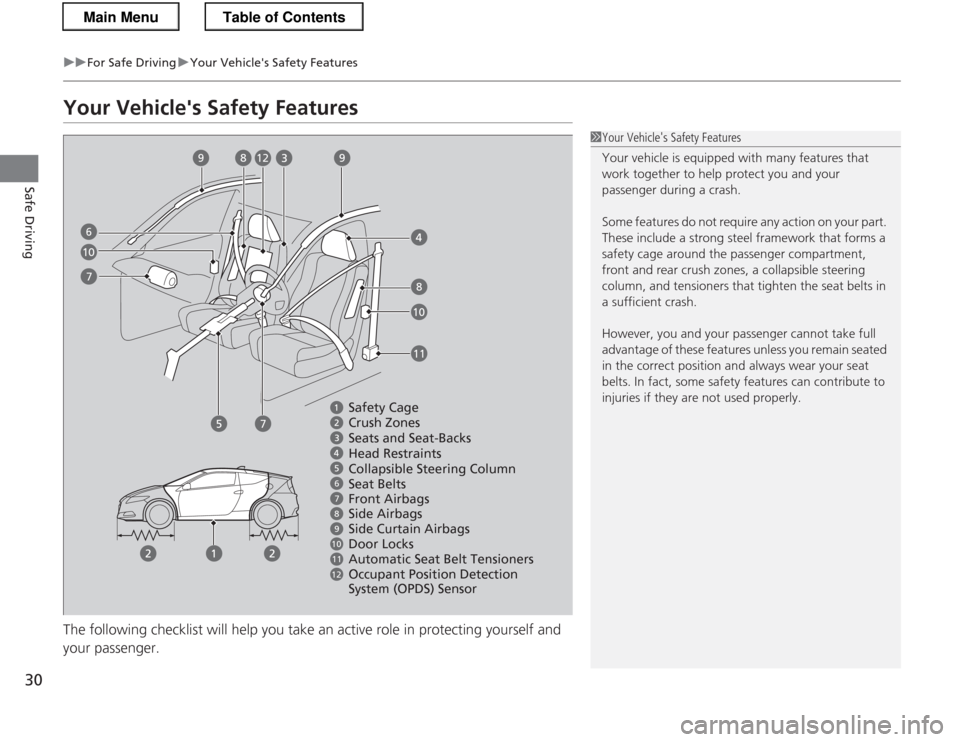
The following checklist will help you take an active role in protecting yourself and your passenger.
1Your Vehicle's Safety Features
Your vehicle is equipped with many features that
work together to help protect you and your
passenger during a crash.
Some features do not require any action on your part.
These include a strong steel framework that forms a
safety cage around the passenger compartment,
front and rear crush zones, a collapsible steering
column, and tensioners that tighten the seat belts in
a sufficient crash.
However, you and your passenger cannot take full
advantage of these features unless you remain seated
in the correct position and always wear your seat
belts. In fact, some safety features can contribute to
injuries if they are not used properly.
6
7
89
10
11
12
7
8
9
10
6
7
8
9
10
12
Safety Cage
Crush Zones
Seats and Seat-Backs Head Restraints
Collapsible Steering Column Seat Belts
Front Airbags
Side Curtain Airbags Door Locks
Occupant Position Detection
System (OPDS) Sensor
Side Airbags
11Automatic Seat Belt Tensioners
Main MenuTable of Contents
Page 32 of 325
31
uuFor Safe DrivinguYour Vehicle's Safety Features
Safe Driving
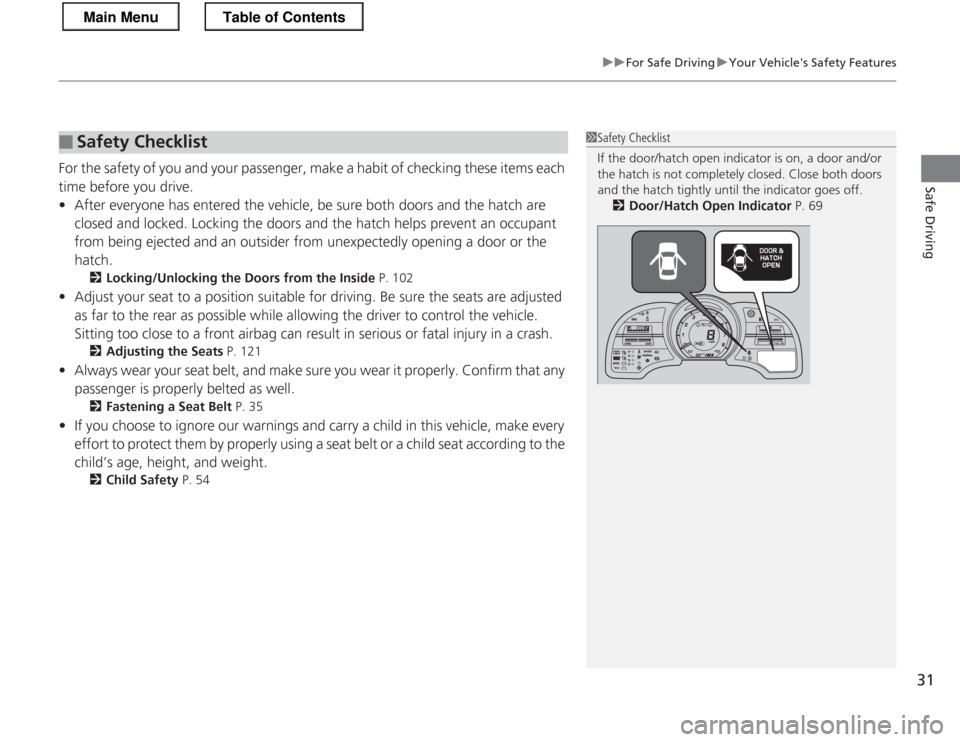
For the safety of you and your passenger, make a habit of checking these items each
time before you drive.•After everyone has entered the vehicle, be sure both doors and the hatch are
closed and locked. Locking the doors and the hatch helps prevent an occupant
from being ejected and an outsider from unexpectedly opening a door or the
hatch. 2 Locking/Unlocking the Doors from the Inside P. 102
• Adjust your seat to a position suitable for driving. Be sure the seats are adjusted
as far to the rear as possible while allowing the driver to control the vehicle.
Sitting too close to a front airbag can result in serious or fatal injury in a crash.
2 Adjusting the Seats P. 121
• Always wear your seat belt, and make sure you wear it properly. Confirm that any
passenger is properly belted as well.
2 Fastening a Seat Belt P. 35
• If you choose to ignore our warnings and carry a child in this vehicle, make every
effort to protect them by properly using a seat belt or a child seat according to the
child’s age, height, and weight.
2 Child Safety P. 54
■Safety Checklist1Safety Checklist
If the door/hatch open indicator is on, a door and/or
the hatch is not completely closed. Close both doors
and the hatch tightly until the indicator goes off.
2 Door/Hatch Open Indicator P. 69
READY
Main MenuTable of Contents
Page 35 of 325
uuSeat BeltsuAbout Your Seat Belts
34
Safe Driving
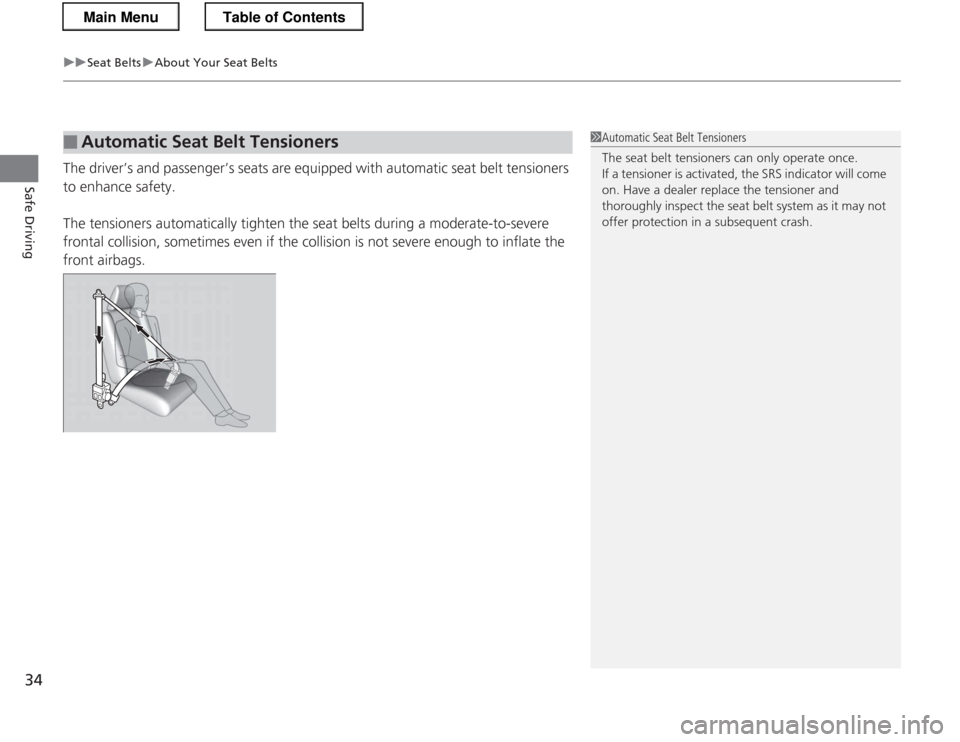
The driver’s and passenger’s seats are equipped with automatic seat belt tensioners
to enhance safety.
The tensioners automatically tighten the seat belts during a moderate-to-severe
frontal collision, sometimes even if the collision is not severe enough to inflate the front airbags.
■Automatic Seat Belt Tensioners1Automatic Seat Belt Tensioners
The seat belt tensioners can only operate once. If a tensioner is activated, the SRS indicator will come
on. Have a dealer replace the tensioner and
thoroughly inspect the seat belt system as it may not
offer protection in a subsequent crash.
Main MenuTable of Contents
Page 36 of 325
35
uuSeat BeltsuFastening a Seat Belt
Continued
Safe Driving
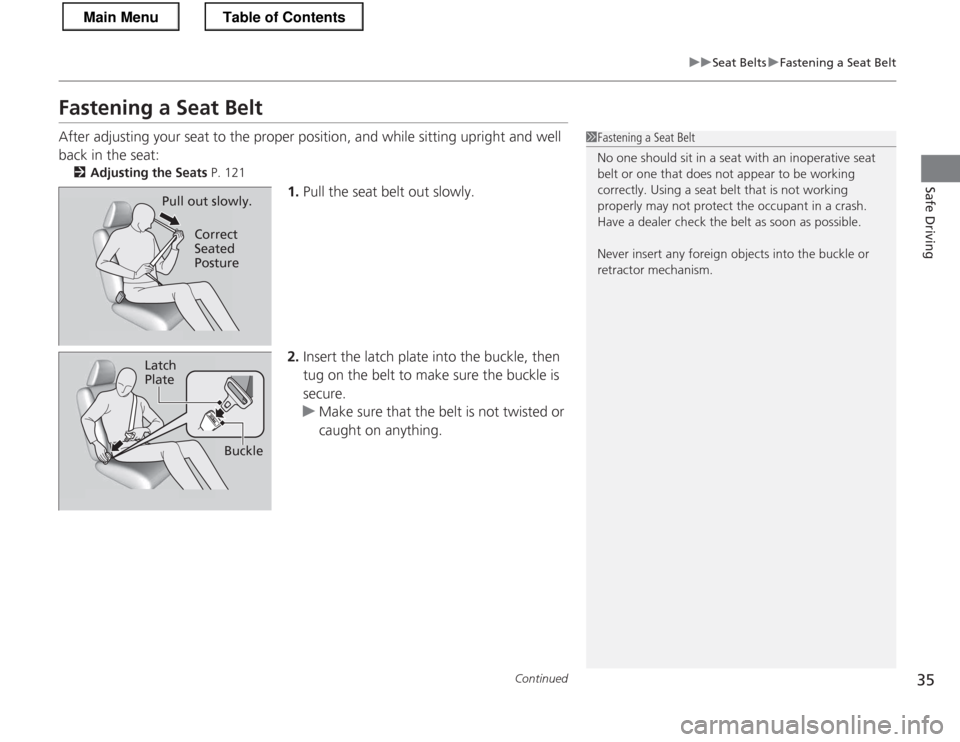
Fastening a Seat Belt
After adjusting your seat to the proper position, and while sitting upright and well back in the seat:2 Adjusting the Seats P. 121
1.Pull the seat belt out slowly.
2. Insert the latch plate into the buckle, then
tug on the belt to make sure the buckle is secure.
uMake sure that the belt is not twisted or
caught on anything.
1Fastening a Seat Belt
No one should sit in a seat with an inoperative seat
belt or one that does not appear to be working
correctly. Using a seat belt that is not working
properly may not protect the occupant in a crash.
Have a dealer check the belt as soon as possible.
Never insert any foreign objects into the buckle or
retractor mechanism.
Pull out slowly.
Correct Seated
Posture
Latch Plate
Buckle
Main MenuTable of Contents
Page 43 of 325
42
uuAirbagsuTypes of Airbags
Safe Driving
Types of Airbags
Your vehicle is equipped with three types of airbags: •Front airbags: Airbags in front of the driver's and passenger's seats.
• Side airbags: Airbags in the driver's and passenger's seat-backs.
• Side curtain airbags: Airbags above the side windows.
Each is discussed in the following pages.
Front Airbags (SRS)
The front SRS airbags inflate in a moderate-to-severe frontal collision to help protect
the head and chest of the driver and/or passenger. SRS (Supplemental Restraint System) indicates that the airbags are designed to
supplement seat belts, not replace them. Seat belts are the occupant's primary
restraint system.
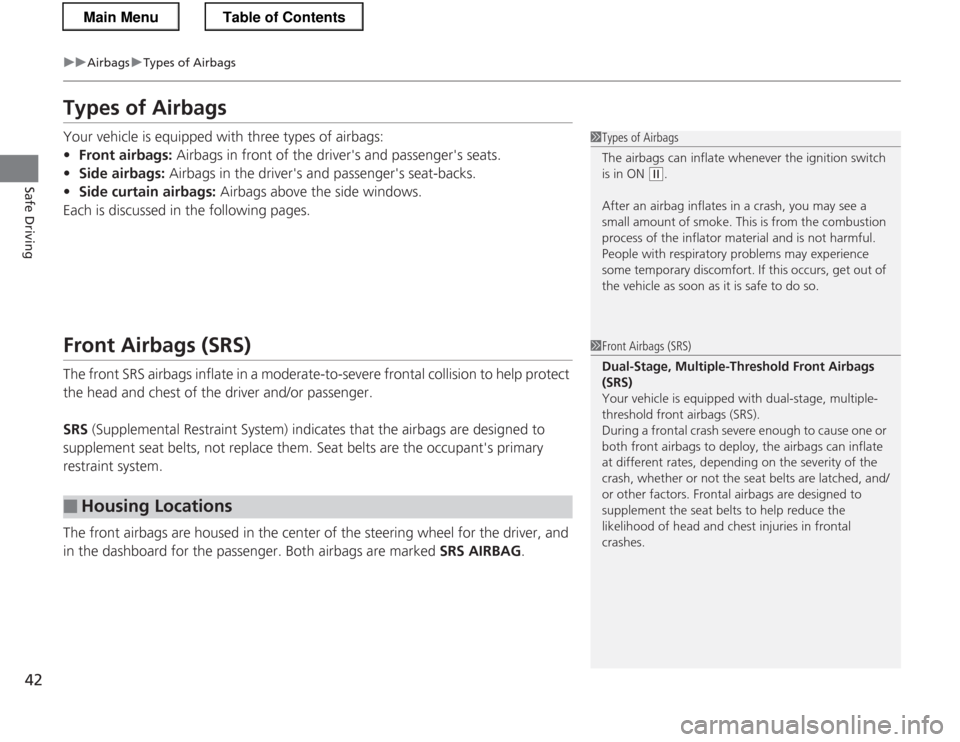
The front airbags are housed in the center of the steering wheel for the driver, and
in the dashboard for the passenger. Both airbags are marked SRS AIRBAG.
■Housing Locations
1Types of Airbags
The airbags can inflate whenever the ignition switch is in ON
(w.
After an airbag inflates in a crash, you may see a
small amount of smoke. This is from the combustion
process of the inflator ma terial and is not harmful.
People with respiratory problems may experience
some temporary discomfort. If this occurs, get out of
the vehicle as soon as it is safe to do so.
1Front Airbags (SRS)
Dual-Stage, Multiple-Threshold Front Airbags
(SRS)
Your vehicle is equipped with dual-stage, multiple-
threshold front airbags (SRS).
During a frontal crash severe enough to cause one or
both front airbags to deploy, the airbags can inflate at different rates, depending on the severity of the
crash, whether or not the seat belts are latched, and/ or other factors. Frontal airbags are designed to
supplement the seat belts to help reduce the
likelihood of head and chest injuries in frontal
crashes.
Main MenuTable of Contents
Page 46 of 325
45
uuAirbagsuFront Airbags (SRS)
Safe Driving
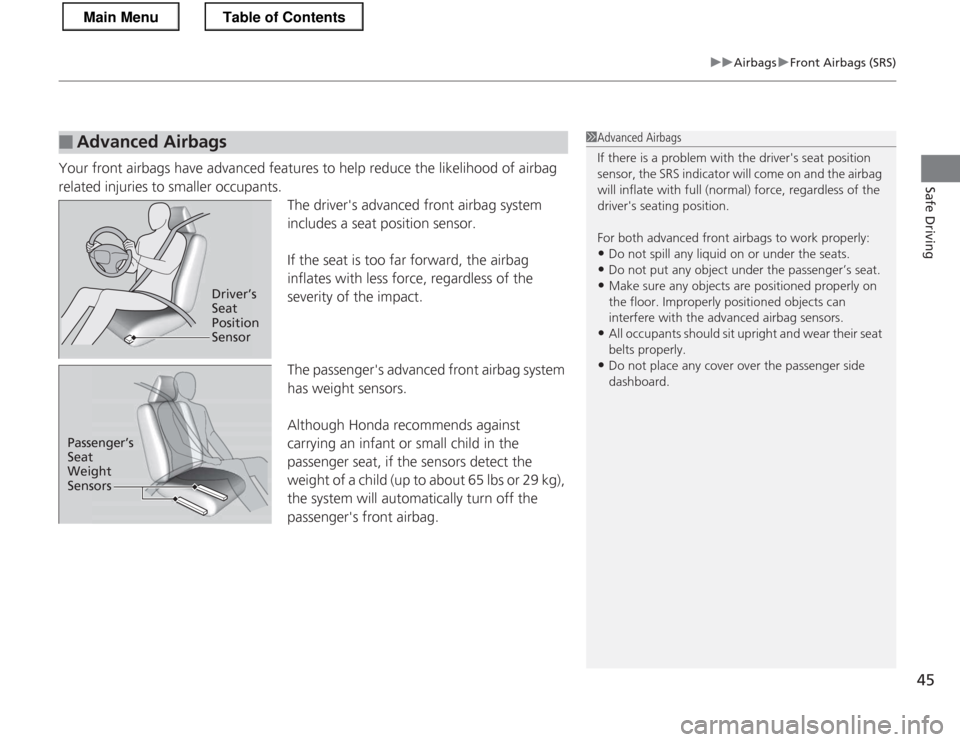
Your front airbags have advanced features to help reduce the likelihood of airbag
related injuries to smaller occupants.The driver's advanced front airbag system
includes a seat position sensor.
If the seat is too far forward, the airbag
inflates with less force, regardless of the
severity of the impact. The passenger's advanced front airbag system
has weight sensors.
Although Honda recommends against
carrying an infant or small child in the
passenger seat, if the sensors detect the
weight of a child (up to about 65 lbs or 29 kg),
the system will automatically turn off the
passenger's front airbag.
■Advanced Airbags1Advanced Airbags
If there is a problem with the driver's seat position
sensor, the SRS indicator will come on and the airbag
will inflate with full (normal) force, regardless of the
driver's seating position.
For both advanced front airbags to work properly: • Do not spill any liquid on or under the seats.
• Do not put any object under the passenger’s seat.
• Make sure any objects are positioned properly on
the floor. Improperly positioned objects can
interfere with the advanced airbag sensors.
• All occupants should sit upright and wear their seat belts properly.
• Do not place any cover over the passenger side dashboard.
Driver’s Seat Position Sensor
Passenger’s Seat
Weight
Sensors
Main MenuTable of Contents
Page 57 of 325
56
uuChild SafetyuSafety of Infants and Small Children
Safe Driving
Safety of Infants and Small Children
An infant must be properly restrained in a rear-facing, reclining child seat until the
infant reaches the seat maker's weight or height limit for the seat, and the infant is
at least one year old. Because rear-facing child seats should not be used in this
vehicle, you should never carry an infant in this vehicle.
■Protecting Infants1Protecting Infants
Rear-facing child seats should never be installed in a
forward facing position.
3WARNING
Placing a rear-facing child seat in the
passenger’s seat can result in serious injury
or death during a crash.
Never install a rear-facing child seat in this vehicle.
Main MenuTable of Contents