child seat HONDA ELEMENT 2009 1.G User Guide
[x] Cancel search | Manufacturer: HONDA, Model Year: 2009, Model line: ELEMENT, Model: HONDA ELEMENT 2009 1.GPages: 345, PDF Size: 18.9 MB
Page 31 of 345
Advanced AirbagsYour front airbags are also advanced
airbags. The main purpose of this
feature is to help prevent airbag-
caused injuries to short drivers and
children who ride in front.
For both advanced airbags to work
properly:●Occupants must sit upright and
wear their seat belts properly.●Do not spill any liquids on or
under the seats, cover the sensors,
or put any objects or metal items
under the front seats.●Back-seat passengers should not
put their feet under the front seats.
Failure to follow these instructions
could damage the sensors or prevent
them from working properly.
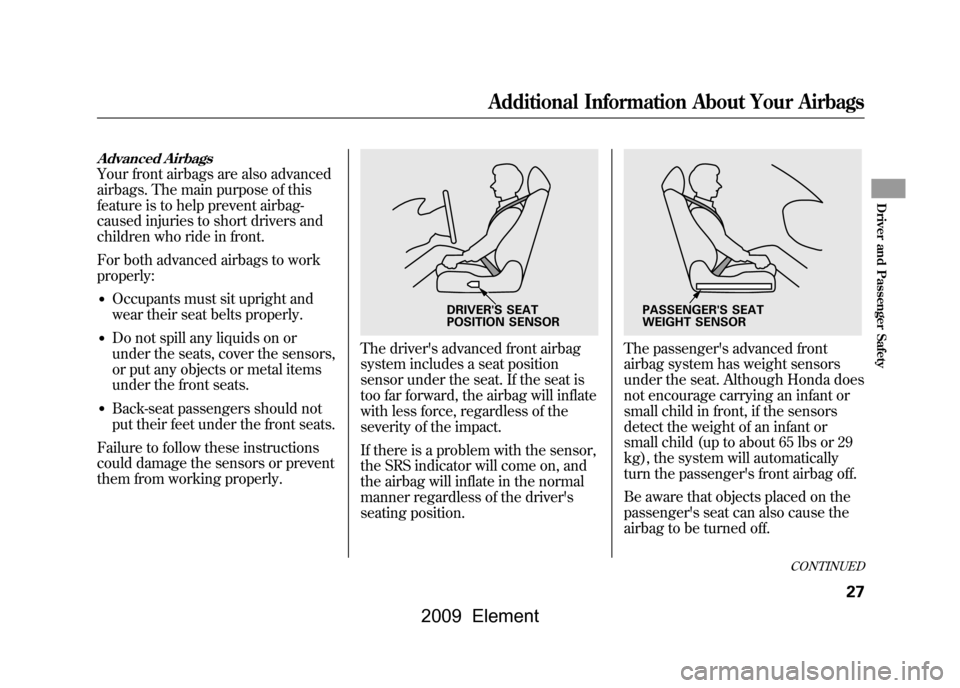
The driver's advanced front airbag
system includes a seat position
sensor under the seat. If the seat is
too far forward, the airbag will inflate
with less force, regardless of the
severity of the impact.
If there is a problem with the sensor,
the SRS indicator will come on, and
the airbag will inflate in the normal
manner regardless of the driver's
seating position.
The passenger's advanced front
airbag system has weight sensors
under the seat. Although Honda does
not encourage carrying an infant or
small child in front, if the sensors
detect the weight of an infant or
small child (up to about 65 lbs or 29
kg), the system will automatically
turn the passenger's front airbag off.
Be aware that objects placed on the
passenger's seat can also cause the
airbag to be turned off.
DRIVER'S SEAT
POSITION SENSOR
PASSENGER'S SEAT
WEIGHT SENSOR
CONTINUED
Additional Information About Your Airbags
27
Driver and Passenger Safety
2009 Element
Page 33 of 345

Only one airbag will deploy during a
side impact. If the impact is on the
passenger's side, the passenger's
side airbag will deploy even if there
is no passenger.
To get the best protection from the
side airbags, front seat occupants
should wear their seat belts and sit
upright and well back in their seats.
Side Airbag Cutoff SystemYour vehicle has a side airbag cutoff
system designed primarily to protect
a child riding in the front passenger's
seat.
Although Honda does not encourage
children to ride in front, if the
position sensors detect a child has
leaned into the side airbag's
deployment path, the airbag will shut
off.
The side airbag may also shut off if a
short adult leans sideways, or a
larger adult slouches and leans
sideways into the airbag's
deployment path.
Objects placed on the front
passenger seat can also cause the
side airbag to be shut off.If the side airbag off indicator comes
on (see page32),have the passenger
sit upright. Once the passenger is
out of the airbag's deployment path,
the system will turn the airbag back
on, and the indicator will go out.
There will be some delay between
the moment the passenger moves
into or out of the airbag deployment
path and when the indicator comes
on or goes off.
A front seat passenger should not
use a cushion or other object as a
backrest. It may prevent the cutoff
system from working properly.
Additional Information About Your Airbags
29
Driver and Passenger Safety
2009 Element
Page 36 of 345
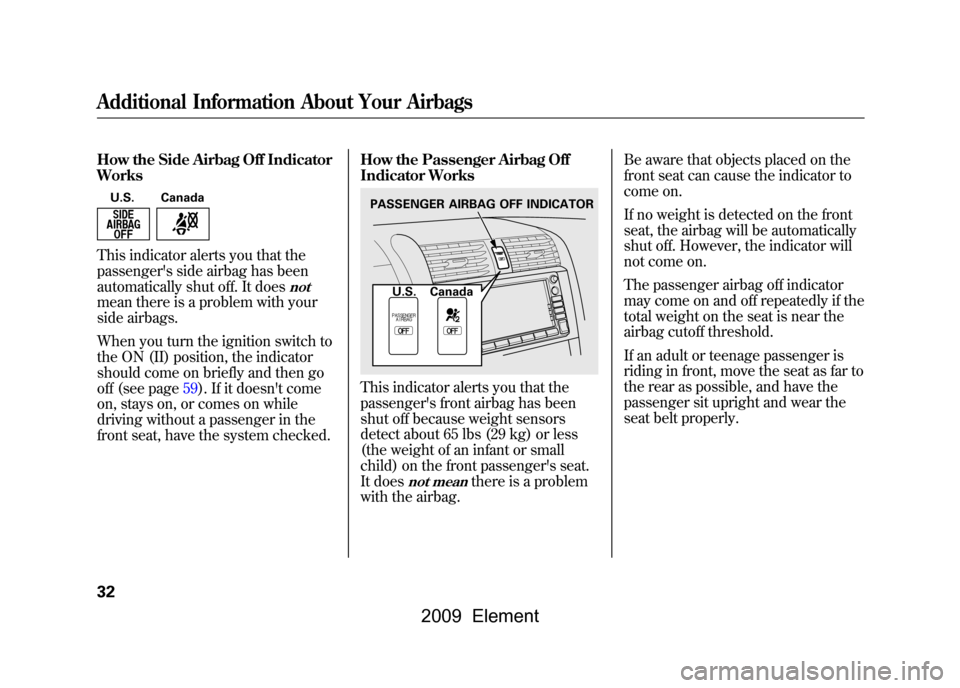
How the Side Airbag Off Indicator
WorksU.S. CanadaThis indicator alerts you that the
passenger's side airbag has been
automatically shut off. It does
not
mean there is a problem with your
side airbags.
When you turn the ignition switch to
the ON (II) position, the indicator
should come on briefly and then go
off (see page59).If it doesn't come
on, stays on, or comes on while
driving without a passenger in the
front seat, have the system checked.How the Passenger Airbag Off
Indicator Works
This indicator alerts you that the
passenger's front airbag has been
shut off because weight sensors
detect about 65 lbs (29 kg) or less
(the weight of an infant or small
child) on the front passenger's seat.
It does
not mean
there is a problem
with the airbag. Be aware that objects placed on the
front seat can cause the indicator to
come on.
If no weight is detected on the front
seat, the airbag will be automatically
shut off. However, the indicator will
not come on.
The passenger airbag off indicator
may come on and off repeatedly if the
total weight on the seat is near the
airbag cutoff threshold.
If an adult or teenage passenger is
riding in front, move the seat as far to
the rear as possible, and have the
passenger sit upright and wear the
seat belt properly.
PASSENGER AIRBAG OFF INDICATOR
U.S. Canada
Additional Information About Your Airbags32
2009 Element
Page 39 of 345
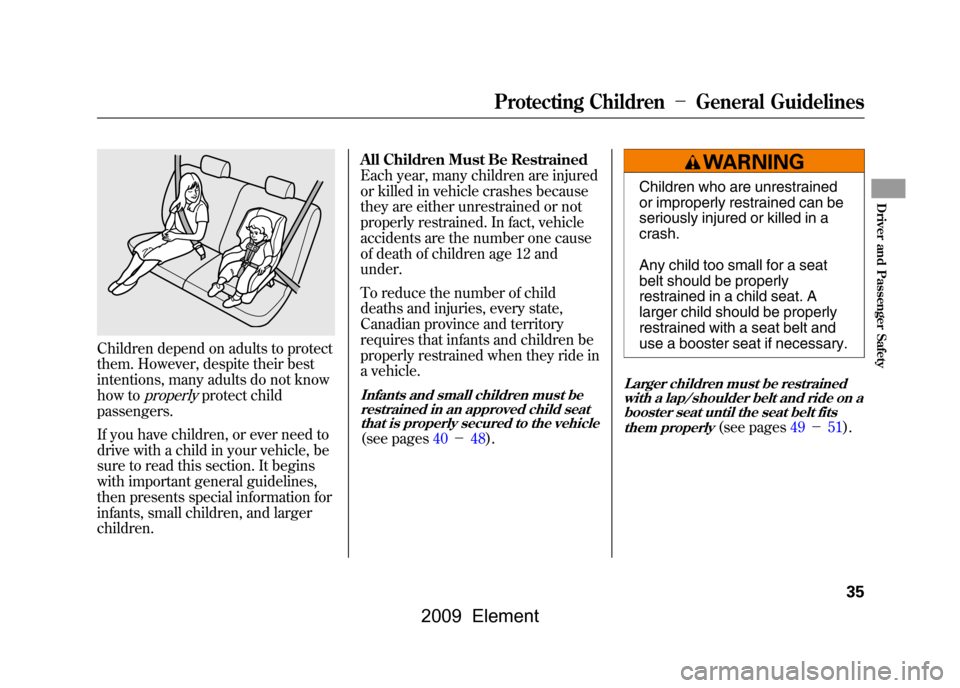
Children depend on adults to protect
them. However, despite their best
intentions, many adults do not know
how to
properly
protect child
passengers.
If you have children, or ever need to
drive with a child in your vehicle, be
sure to read this section. It begins
with important general guidelines,
then presents special information for
infants, small children, and larger
children. All Children Must Be Restrained
Each year, many children are injured
or killed in vehicle crashes because
they are either unrestrained or not
properly restrained. In fact, vehicle
accidents are the number one cause
of death of children age 12 and
under.
To reduce the number of child
deaths and injuries, every state,
Canadian province and territory
requires that infants and children be
properly restrained when they ride in
a vehicle.
Infants and small children must be
restrained in an approved child seatthat is properly secured to the vehicle(see pages40 -48).
Children who are unrestrained
or improperly restrained can be
seriously injured or killed in a
crash.
Any child too small for a seat
belt should be properly
restrained in a child seat. A
larger child should be properly
restrained with a seat belt and
use a booster seat if necessary.
Larger children must be restrained
with a lap/shoulder belt and ride on abooster seat until the seat belt fits
them properly
(see pages49 -51).
Protecting Children -General Guidelines
35
Driver and Passenger Safety
2009 Element
Page 40 of 345

All Children Should Sit in a Back
Seat
According to accident statistics,
children of all ages and sizes are
safer when they are restrained in a
back seat. The National Highway
Traffic Safety Administration and
Transport Canada recommend that
all children aged 12 and under be
properly restrained in a back seat.
Some states have laws restricting
where children may ride.
Children who ride in back are less
likely to be injured by striking
interior vehicle parts during a
collision or hard braking. Also,
children cannot be injured by an
inflating front airbag when they ride
in the back.The Passenger's Front Airbag Can
Pose Serious Risks
Front airbags have been designed to
help protect adults in a moderate to
severe frontal collision. To do this,
the passenger's front airbag is quite
large, and it can inflate with enough
force to cause very serious injuries.
Even though your vehicle has an
advanced front airbag system that
automatically turns the passenger's
front airbag off (see page32),please
follow these guidelines:
Infants
Never put a rear-facing child seat inthe front seat of a vehicle equipped
with a passenger's front airbag.
If the
airbag inflates, it can hit the back of
the child seat with enough force to
kill or very seriously injure an infant.
Small Children
Placing a forward-facing child seat inthe front seat of a vehicle equipped
with a passenger's front airbag can be
hazardous.
If the vehicle seat is too
far forward, or the child's head is
thrown forward during a collision, an
inflating front airbag can strike the
child with enough force to kill or
very seriously injure a small child.
Larger Children
Children who have outgrown childseats are also at risk of being injuredor killed by an inflating passenger's
front airbag.
Whenever possible,
larger children should sit in the back
seat, on a booster seat if needed, and
be properly restrained with a seat
belt (see page49for important
information about protecting larger
children).
Protecting Children -General Guidelines36
2009 Element
Page 41 of 345
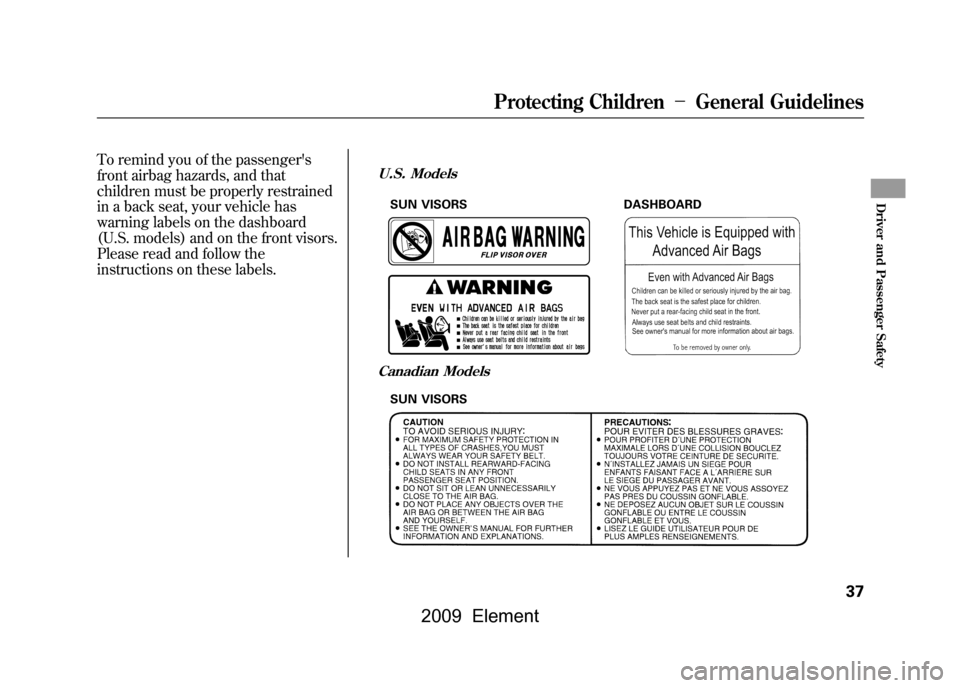
To remind you of the passenger's
front airbag hazards, and that
children must be properly restrained
in a back seat, your vehicle has
warning labels on the dashboard
(U.S. models) and on the front visors.
Please read and follow the
instructions on these labels.
U.S. Models
DASHBOARD
Canadian ModelsSUN VISORS
SUN VISORS
Protecting Children-General Guidelines
37
Driver and Passenger Safety
2009 Element
Page 42 of 345
If You Must Drive with Several
Children
Your vehicle has two back seats
where children can be properly
restrained. If you ever have to carry a
group of children, and a child must
ride in front:●Place the largest child in the front
seat, provided the child is large
enough to wear the lap/shoulder
belt properly (see page49).●Move the vehicle seat as far to the
rear as possible (see page83).●Have the child sit upright and well
back in the seat (see page15).●Make sure the seat belt is properly
positioned and secured (see page
14).If a Child Requires Close
Attention
Many parents say they prefer to put
an infant or a small child in the front
passenger seat so they can watch the
child, or because the child requires
attention.
Placing a child in the front seat
exposes the child to hazards in a
frontal collision, and paying close
attention to a child distracts the
driver from the important tasks of
driving, placing both of you at risk.
If a child requires physical attention
or frequent visual contact, we
strongly recommend that another
adult ride with the child in the back
seat. The back seat is far safer for a
child than the front.Protecting Children
-General Guidelines38
2009 Element
Page 43 of 345
Additional Safety Precautions●Never hold an infant or child onyour lap.
If you are not wearing a
seat belt in a crash, you could be
thrown forward and crush the
child against the dashboard or a
seat-back. If you are wearing a seat
belt, the child can be torn from
your arms and be seriously hurt or
killed.
●Never put a seat belt over yourself
and a child.
During a crash, the
belt could press deep into the child
and cause serious or fatal injuries.
●Never let two children use the
same seat belt.
If they do, they
could be very seriously injured in a
crash.
●Make sure any unused seat belt that a child can reach is buckled,the lockable retractor is activated,
and the belt is fully retracted and
locked.
If a child wraps a loose
seat belt around their neck, they
can be seriously or fatally injured.
(See page46for how to activate
and deactivate the lockable
retractor.)
●Do not leave children alone in a
vehicle.
Leaving children without
adult supervision is illegal in most
states, Canadian provinces/
territories, and can be very
hazardous.
For example, infants and small
children left in a vehicle on a hot
day can die from heatstroke. A
child left alone with the key in the
ignition switch can accidentally set
the vehicle in motion, possibly
injuring themselves or others.
●Lock all doors, the tailgate and the hatch when your vehicle is not in
use.
Children who play in vehicles
can accidentally get trapped inside.
Teach your children not to play in
or around vehicles.
●Keep vehicle keys and remote transmitters out of the reach of
children.
Even very young
children learn how to unlock
vehicle doors, turn on the ignition,
and open the tailgate or hatch,
which can lead to accidental injury
or death.
Protecting Children -General Guidelines
39
Driver and Passenger Safety
2009 Element
Page 44 of 345
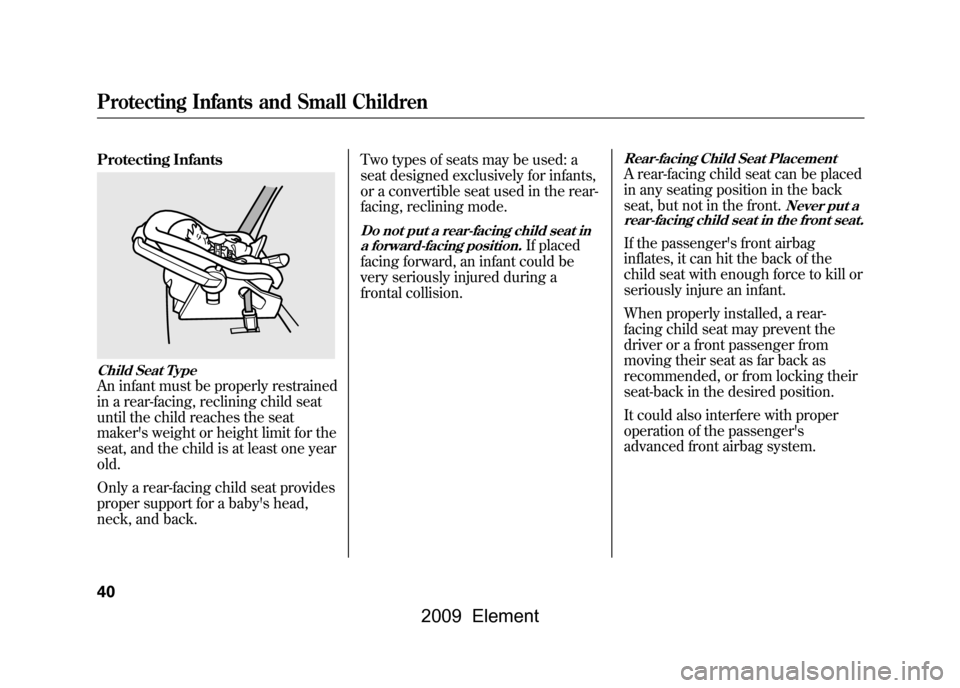
Protecting InfantsChild Seat TypeAn infant must be properly restrained
in a rear-facing, reclining child seat
until the child reaches the seat
maker's weight or height limit for the
seat, and the child is at least one year
old.
Only a rear-facing child seat provides
proper support for a baby's head,
neck, and back.Two types of seats may be used: a
seat designed exclusively for infants,
or a convertible seat used in the rear-
facing, reclining mode.
Do not put a rear-facing child seat in
a forward-facing position.
If placed
facing forward, an infant could be
very seriously injured during a
frontal collision.
Rear-facing Child Seat PlacementA rear-facing child seat can be placed
in any seating position in the back
seat, but not in the front.
Never put a
rear-facing child seat in the front seat.
If the passenger's front airbag
inflates, it can hit the back of the
child seat with enough force to kill or
seriously injure an infant.
When properly installed, a rear-
facing child seat may prevent the
driver or a front passenger from
moving their seat as far back as
recommended, or from locking their
seat-back in the desired position.
It could also interfere with proper
operation of the passenger's
advanced front airbag system.
Protecting Infants and Small Children40
2009 Element
Page 45 of 345
In any of these situations, we
strongly recommend that you install
the child seat directly behind the
front passenger's seat, move the seat
as far forward as needed, and leave it
unoccupied. Or, you may wish to get
a smaller rear-facing child seat.
Placing a rear-facing child seat
in the front seat can result in
serious injury or death during a
collision.
Always place a rear-facing child
seat in the back seat, not the
front.Protecting Small Children
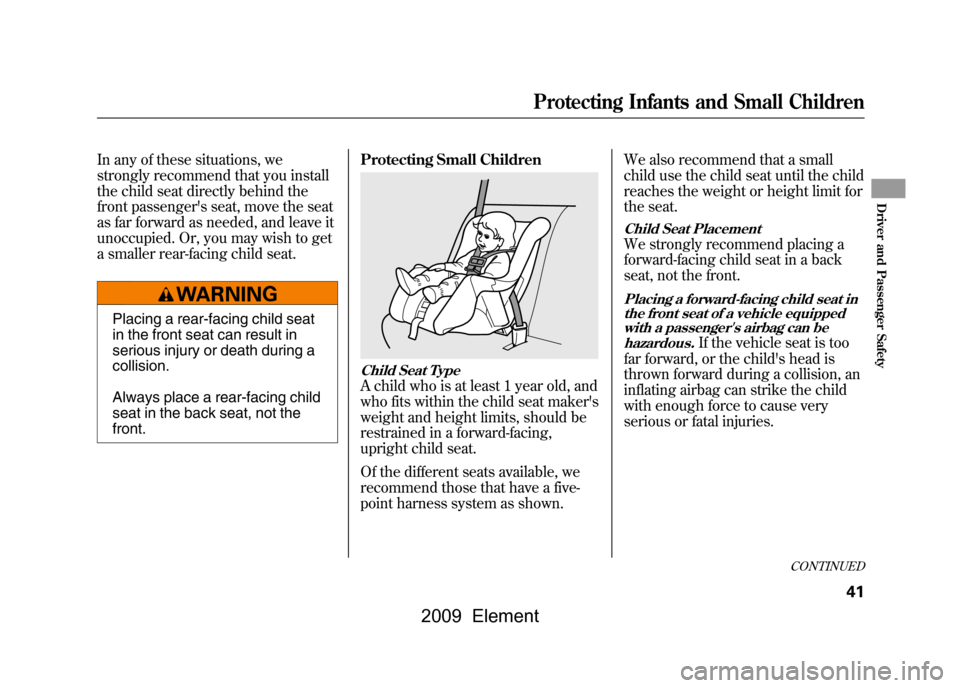
Child Seat TypeA child who is at least 1 year old, and
who fits within the child seat maker's
weight and height limits, should be
restrained in a forward-facing,
upright child seat.
Of the different seats available, we
recommend those that have a five-
point harness system as shown. We also recommend that a small
child use the child seat until the child
reaches the weight or height limit for
the seat.
Child Seat PlacementWe strongly recommend placing a
forward-facing child seat in a back
seat, not the front.Placing a forward-facing child seat in
the front seat of a vehicle equipped
with a passenger's airbag can be
hazardous.
If the vehicle seat is too
far forward, or the child's head is
thrown forward during a collision, an
inflating airbag can strike the child
with enough force to cause very
serious or fatal injuries.
CONTINUED
Protecting Infants and Small Children
41
Driver and Passenger Safety
2009 Element