child seat HONDA ELEMENT 2009 1.G Owners Manual
[x] Cancel search | Manufacturer: HONDA, Model Year: 2009, Model line: ELEMENT, Model: HONDA ELEMENT 2009 1.GPages: 345, PDF Size: 18.9 MB
Page 5 of 345
2009 Element Online Reference Owner's Manual
Contents
Owner's Identification Form
Introduction .......................................................................................................................................................... i A Few Words About Safety .............................................................................................................................. iii Important Handling Information .................................................................................................................... iv
Your Vehicle at a Glance (main controls) .................................................................................................... 3
Driver and Passenger Safety (seat belts, SRS, and child protection) .................................................... 5
Instruments and Controls
(indicators, gauges, dashboard, and steering column)
............................................ 55
Features (
heating and cooling, audio, steering wheel, cruise control and other convenience items
)
................... 103
Before Driving (fuel, vehicle break- in, and cargo loading) ..................................................................... 197
Driving (engine and transmission operation) ................................................................................................ 213
Maintenance (minder, fluid checking, minor services, and vehicle storage)........................................... 241
Taking Care of the Unexpected (flat tire, dead battery, overheating, and fuses) ............................. 281
Technical Information (vehicle specifications, tires, and emissions controls) ....................................... 305
Warranty and Customer Relations (U. S. and Canada only) (warranty and contact information) ... 321
Index ........................................................................................................................................................................ I
Service Information Summary ( fluid capacities and tire pressures)
1 00X31-SCV-6600
Page 6 of 345

Contents
A convenient reference to the
sections in this manual.
Your Vehicle at a Glance
A quick reference to the main
controls in your vehicle.
Driver and Passenger Safety
Important information about the
proper use and care of your vehicle's
seat belts, an overview of the
supplemental restraint system, and
valuable information on how to
protect children with child restraints.
Instruments and Controls
Explains the purpose of each
instrument panel indicator and
gauge, and how to use the controls
on the dashboard and steering
column.
Features
How to operate the heating and air
conditioning system, the audio
system, and other convenience
features.Before Driving
What gasoline to use, how to break-
in your new vehicle, and how to load
luggage and other cargo.
Driving
The proper way to start the engine,
shift the transmission, and park; plus
what you need to know if you're
planning to tow a trailer.
Maintenance
The maintenance minder shows you
when you need to take your vehicle
to the dealer for maintenance
service. There is also a list of things
to check and instructions on how to
check them.
Taking Care of the Unexpected
This section covers several problems
motorists sometimes experience, and
details how to handle them.
Technical Information
ID numbers, dimensions, capacities,
and technical information.
Warranty and Customer Relations
(U.S. and Canada only)
A summary of the warranties
covering your new vehicle, and how
to contact us for any reason. Refer to
your warranty manual for detailed
information.
Index
Service Information Summary
A summary of the information you
need when you pull up to the fuel
pump.Overview of Contents2
2009 Element
Page 9 of 345
This section gives you important
information about how to protect
yourself and your passengers. It shows
you how to use seat belts. It explains
how your airbags work. And it tells you
how to properly restrain infants and
children in your vehicle.
Important Safety Precautions
.............
6
Your Vehicle's Safety Features
..........
7
Seat Belts
.....................................
8
Airbags
........................................
9
Protecting Adults and Teens
...........
11
1.
Close and Lock the Doors
........
11
2.
Adjust the Front Seats
.............
11
3.
Adjust the Seat-Backs
..............
12
4.
Adjust the Head Restraints
......
13
5.
Fasten and Position the Seat Belts
..................................
14
6.
Maintain a Proper Sitting Position
..............................
15
Advice for Pregnant Women
........
16
Additional Safety Precautions
......
16
Additional Information About Your Seat Belts
...............................
18
Seat Belt System Components
.....
18 Lap/Shoulder Belt
......................
19
Automatic Seat Belt Tensioners
.............................
20
Seat Belt Maintenance
................
20
Additional Information About Your Airbags
..................................
22
Airbag System Components
........
22
How Your Front Airbags Work
....
25
How Your Side Airbags Work
......
28
How Your Side Curtain Airbags Work
.....................................
30
How the SRS Indicator Works
.....
31
How the Side Airbag Off Indicator Works
.....................
32
How the Passenger Airbag Off Indicator Works
.....................
32
Airbag Service
............................
33
Additional Safety Precautions
......
34
Protecting Children -General
Guidelines
..............................
35
All Children Must Be
Restrained
..............................
35
All Children Should Sit in a Back Seat
.......................................
36
The Passenger's Front Airbag Can Pose Serious Risks
...........
36 If You Must Drive with Several
Children
................................
38
If a Child Requires Close Attention
................................
38
Additional Safety Precautions
......
39
Protecting Infants and Small Children
.................................
40
Protecting Infants
.......................
40
Protecting Small Children
...........
41
Selecting a Child Seat
.....................
42
Installing a Child Seat
.....................
43
Installing a Child Seat with
LATCH
..................................
44
Installing a Child Seat with a Lap/Shoulder Belt
..................
46
Installing a Child Seat with a Tether
...................................
48
Protecting Larger Children
.............
49
Checking Seat Belt Fit
................
49
Using a Booster Seat
...................
50
When Can a Larger Child Sit in
Front
.....................................
50
Additional Safety Precautions
......
51
Carbon Monoxide Hazard
...............
52
Safety Labels
..................................
53
Driver and Passenger Safety
5
Driver and Passenger Safety
2009 Element
Page 10 of 345

You'll find many safety
recommendations throughout this
section, and throughout this manual.
The recommendations on this page
are the ones we consider to be the
most important.Always Wear Your Seat BeltA seat belt is your best protection in all
types of collisions. Airbags are
designed to supplement seat belts, not
replace them. So even though your
vehicle is equipped with airbags, make
sure you and your passengers always
wear your seat belts, and wear them
properly (see page14).
Restrain All ChildrenChildren age 12 and under should ride
properly restrained in a back seat, not
the front seat. Infants and small
children should be restrained in a
child seat. Larger children should use
a booster seat and a lap/shoulder belt
until they can use the belt properly
without a booster seat (see pages
35-51).Be Aware of Airbag HazardsWhile airbags can save lives, they can
cause serious or fatal injuries to
occupants who sit too close to them, or
are not properly restrained. Infants,
young children, and short adults are at
the greatest risk. Be sure to follow all
instructions and warnings in this
manual.
Don't Drink and DriveAlcohol and driving don't mix. Even
one drink can reduce your ability to
respond to changing conditions, and
your reaction time gets worse with
every additional drink. So don't drink
and drive, and don't let your friends
drink and drive, either.Control Your SpeedExcessive speed is a major factor in
crash injuries and deaths. Generally,
the higher the speed, the greater the
risk, but serious injuries can also
occur at lower speeds. Never drive
faster than is safe for current
conditions, regardless of the
maximum speed posted.Keep Your Vehicle in Safe
ConditionHaving a tire blowout or a mechanical
failure can be extremely hazardous.
To reduce the possibility of such
problems, check your tire pressures
and condition frequently, and perform
all regularly scheduled maintenance
(see page243).
Important Safety Precautions6
2009 Element
Page 12 of 345

Seat Belts
Your vehicle is equipped with seat
belts in all seating positions.
Your seat belt system also includes
an indicator on the instrument panel
and a beeper to remind you and your
passengers to fasten your seat belts.Why Wear Seat BeltsSeat belts are the single most
effective safety device for adults and
larger children. (Infants and smaller
children must be properly restrained
in child seats.)
Not wearing a seat belt properly
increases the chance of serious
injury or death in a crash, even
though your vehicle has airbags.
In addition, most states, all Canadian
provinces and territories require you
to wear seat belts.
Not wearing a seat belt properly
increases the chance of serious
injury or death in a crash, even
though your vehicle has
airbags.
Be sure you and your
passengers always wear seat
belts and wear them properly.
When properly worn, seat belts:●Keep you connected to the vehicle
so you can take advantage of the
vehicle's built-in safety features.●Help protect you in almost every
type of crash, including: – frontal impacts
– side impacts
– rear impacts
– rollovers
●Help keep you from being thrown
against the inside of the vehicle
and against other occupants.●Keep you from being thrown out of
the vehicle.●Help keep you in a good position
should the airbags ever deploy. A
good position reduces the risk of
injury from an inflating airbag and
allows you to get the best
advantage from the airbag.
Of course, seat belts cannot
completely protect you in every
crash. But in most cases, seat belts
can reduce your risk of serious
injury.What You Should Do:Always wear your seat belt, and
make sure you wear it properly.
Your Vehicle's Safety Features8
2009 Element
Page 15 of 345
Introduction
The following pages provide
instructions on how to properly
protect the driver, adult passengers,
and teenage children who are large
enough and mature enough to drive
or ride in the front.
See pages35-51for important
guidelines on how to properly protect
infants, small children, and larger
children who ride in your vehicle. 1. Close and Lock the Doors
After everyone has entered the
vehicle, be sure the doors, the hatch,
and the tailgate are closed and
locked.
Your vehicle has a door and
tailgate open indicator on
the instrument panel to indicate
when a specific door, the tailgate or
the hatch is not tightly closed.
Locking the doors, the hatch, and the
tailgate reduces the chance of
someone being thrown out of the
vehicle during a crash, and it helps
prevent passengers from accidentally
opening a door, the hatch, or the
tailgate and falling out.
Locking the doors, the hatch, or the
tailgate also helps prevent an
outsider from unexpectedly opening
a door when you come to a stop.
See page80for how to lock the
doors, and page61for how the door
and tailgate indicator system works. 2. Adjust the Front Seats
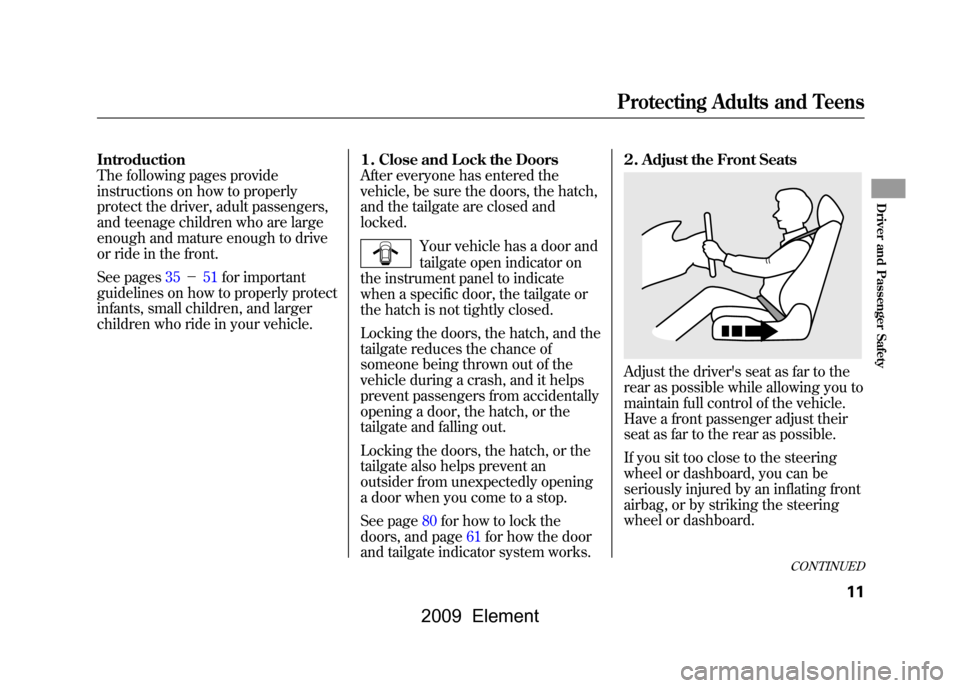
Adjust the driver's seat as far to the
rear as possible while allowing you to
maintain full control of the vehicle.
Have a front passenger adjust their
seat as far to the rear as possible.
If you sit too close to the steering
wheel or dashboard, you can be
seriously injured by an inflating front
airbag, or by striking the steering
wheel or dashboard.
CONTINUED
Protecting Adults and Teens
11
Driver and Passenger Safety
2009 Element
Page 20 of 345
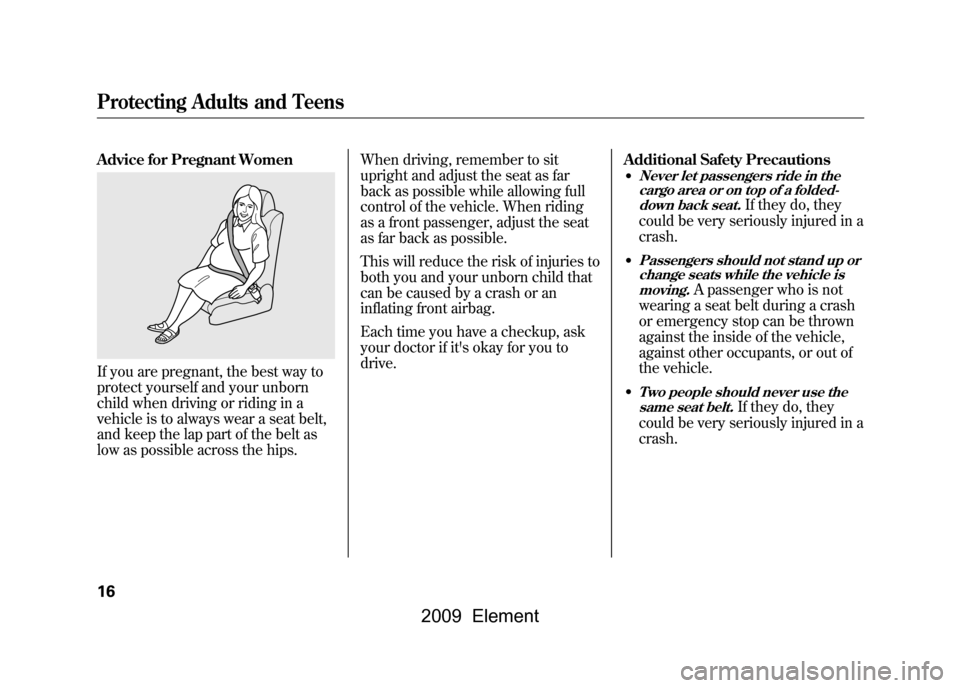
Advice for Pregnant WomenIf you are pregnant, the best way to
protect yourself and your unborn
child when driving or riding in a
vehicle is to always wear a seat belt,
and keep the lap part of the belt as
low as possible across the hips.When driving, remember to sit
upright and adjust the seat as far
back as possible while allowing full
control of the vehicle. When riding
as a front passenger, adjust the seat
as far back as possible.
This will reduce the risk of injuries to
both you and your unborn child that
can be caused by a crash or an
inflating front airbag.
Each time you have a checkup, ask
your doctor if it's okay for you to
drive.
Additional Safety Precautions
●Never let passengers ride in the
cargo area or on top of a folded-
down back seat.
If they do, they
could be very seriously injured in a
crash.
●Passengers should not stand up or change seats while the vehicle is
moving.
A passenger who is not
wearing a seat belt during a crash
or emergency stop can be thrown
against the inside of the vehicle,
against other occupants, or out of
the vehicle.
●Two people should never use the
same seat belt.
If they do, they
could be very seriously injured in a
crash.
Protecting Adults and Teens16
2009 Element
Page 22 of 345

Seat Belt System Components
Your seat belt system includes lap/
shoulder belts in all four seating
positions. The front seat belts are
also equipped with automatic seat
belt tensioners.
This system uses the same sensors
as the front airbags to monitor
whether the front seat belts are
latched or unlatched, and how much
weight is on the front passenger's
seat (see page27).
The seat belt system
includes an indicator on the
instrument panel and a beeper to
remind you and your passengers to
fasten your seat belts. This system monitors the front seat
belts. If you turn the ignition switch
to the ON (II) position before your
seat belt is fastened, the beeper will
sound and the indicator will flash. If
your seat belt is not fastened before
the beeper stops, the indicator will
stop flashing but remain on.
If a front passenger does not fasten
their seat belt, the indicator will
come on about 6 seconds after the
ignition switch is turned to the ON
(II) position.
If either the driver or a front
passenger does not fasten their seat
belt while driving, the beeper will
sound and the indicator will flash
again at regular intervals.
When no one is sitting in the front
passenger's seat, or a child or small
adult is riding there, the indicator
should not come on and the beeper
should not sound.If the indicator comes on or the
beeper sounds when the driver's seat
belt is latched and there is no front
seat passenger and no items on the
front seat, something may be
interfering with the monitoring
system. Look for and remove:
●Any items under the front
passenger's seat.●Any object(s) hanging on the seat
or in the seat-back pocket.●Any object(s) touching the rear of
the seat-back.
If no obstructions are found, have
your vehicle checked by a dealer.
Additional Information About Your Seat Belts18
2009 Element
Page 23 of 345

Lap/Shoulder Belt
The lap/shoulder belt goes over your
shoulder, across your chest, and
across your hips.
To fasten the belt, insert the latch
plate into the buckle, then tug on the
belt to make sure the buckle is
latched (see page14for how to
properly position the belt).To unlock the belt, press the red
PRESS button on the buckle. Guide
the belt across your body so that it
retracts completely. After exiting the
vehicle, be sure the belt is out of the
way and will not get closed in the
door.
All seat belts have an emergency
locking retractor. In normal driving,
the retractor lets you move freely in
your seat while it keeps some tension
on the belt. During a collision or
sudden stop, the retractor
automatically locks the belt to help
restrain your body.The seat belts in all positions except
the driver's have a lockable retractor
that must be activated to secure a
child seat (see page46).
If the shoulder part of the belt is
pulled all the way out, the lockable
retractor will activate. The belt will
retract, but it will not allow the
passenger to move freely.
To deactivate the lockable retractor,
unlatch the buckle and let the seat
belt fully retract. To refasten the seat
belt, pull it out only as far as needed.
Additional Information About Your Seat Belts
19
Driver and Passenger Safety
2009 Element
Page 28 of 345

●Automatic front seat belt
tensioners (see page20).●Sensors that can detect a moderate
to severe front impact, side impact,
or rollover.●Sensors that can detect whether a
child is in the passenger's side
airbag path and signal the control
unit to turn the airbag off (see
page29).●Sensors that can detect whether
the driver's seat belt and the front
passenger's seat belt are latched or
unlatched (see page18).●A driver's seat position sensor that
monitors the distance of the seat
from the front airbag. If the seat is
too far forward, the airbag will
inflate with less force (see page
27).
●Weight sensors that monitor the
weight on the front passenger's
seat. If the weight is about 65 lbs
(29 kg) or less (the weight of an
infant or small child), the
passenger's front airbag will be
turned off (see page27).●A sophisticated electronic system
that continually monitors and
records information about the
sensors, the control unit, the
airbag activators, the seat belt
tensioners, and driver and front
passenger seat belt use when the
ignition switch is in the ON (II)
position.●An indicator on the instrument
panel that alerts you to a possible
problem with your airbags,
sensors, or seat belt tensioners
(see page31).
●An indicator on the instrument
panel that alerts you that the
passenger's side airbag has been
turned off (see page32).●An indicator on the dashboard that
alerts you that the passenger's
front airbag has been turned off
(see page32).●Emergency backup power in case
your vehicle's electrical system is
disconnected in a crash.
Additional Information About Your Airbags24
2009 Element