fuel pressure HONDA ELEMENT 2009 1.G Owners Manual
[x] Cancel search | Manufacturer: HONDA, Model Year: 2009, Model line: ELEMENT, Model: HONDA ELEMENT 2009 1.GPages: 345, PDF Size: 18.9 MB
Page 5 of 345

2009 Element Online Reference Owner's Manual
Contents
Owner's Identification Form
Introduction .......................................................................................................................................................... i A Few Words About Safety .............................................................................................................................. iii Important Handling Information .................................................................................................................... iv
Your Vehicle at a Glance (main controls) .................................................................................................... 3
Driver and Passenger Safety (seat belts, SRS, and child protection) .................................................... 5
Instruments and Controls
(indicators, gauges, dashboard, and steering column)
............................................ 55
Features (
heating and cooling, audio, steering wheel, cruise control and other convenience items
)
................... 103
Before Driving (fuel, vehicle break- in, and cargo loading) ..................................................................... 197
Driving (engine and transmission operation) ................................................................................................ 213
Maintenance (minder, fluid checking, minor services, and vehicle storage)........................................... 241
Taking Care of the Unexpected (flat tire, dead battery, overheating, and fuses) ............................. 281
Technical Information (vehicle specifications, tires, and emissions controls) ....................................... 305
Warranty and Customer Relations (U. S. and Canada only) (warranty and contact information) ... 321
Index ........................................................................................................................................................................ I
Service Information Summary ( fluid capacities and tire pressures)
1 00X31-SCV-6600
Page 61 of 345
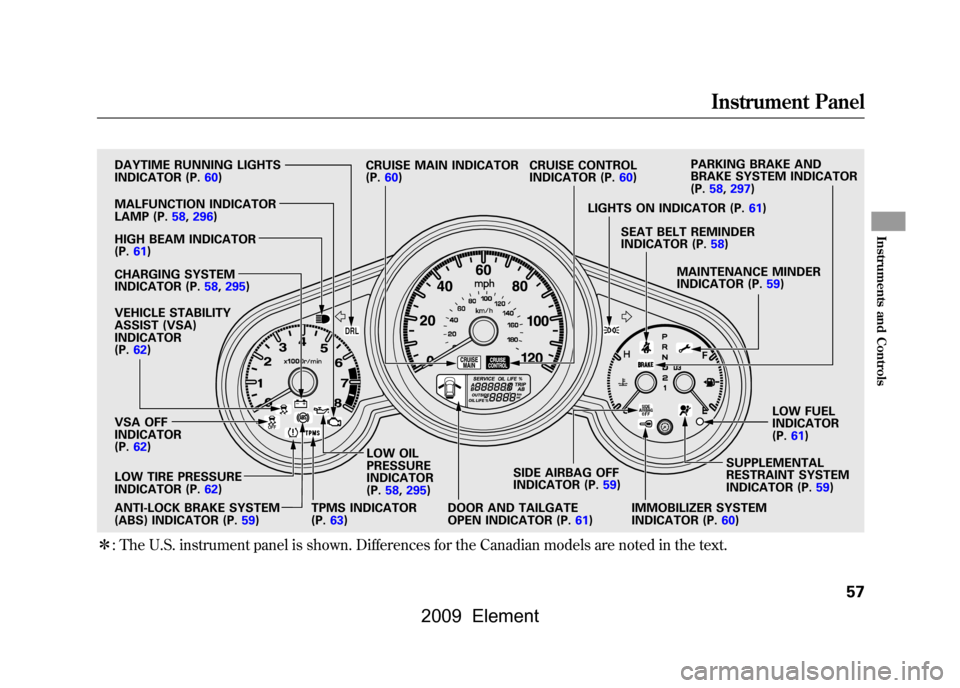
ꭧ: The U.S. instrument panel is shown. Differences for the Canadian models are noted in the text.
DRL
DAYTIME RUNNING LIGHTS
INDICATOR (P.
60)
HIGH BEAM INDICATOR
(P.
61)
CHARGING SYSTEM
INDICATOR (P.
58,295)
VEHICLE STABILITY
ASSIST (VSA)
INDICATOR
(P.
62)
VSA OFF
INDICATOR
(P.
62)
ANTI-LOCK BRAKE SYSTEM
(ABS) INDICATOR (P.
59) LOW OIL
PRESSURE
INDICATOR
(P.
58,295)
DOOR AND TAILGATE
OPEN INDICATOR (P.
61)SIDE AIRBAG OFF
INDICATOR (P.
59)
IMMOBILIZER SYSTEM
INDICATOR (P.
60) SUPPLEMENTAL
RESTRAINT SYSTEM
INDICATOR (P.
59)LOW FUEL
INDICATOR
(P.
61)MAINTENANCE MINDER
INDICATOR (P.
59)SEAT BELT REMINDER
INDICATOR (P.
58)LIGHTS ON INDICATOR (P. 61)PARKING BRAKE AND
BRAKE SYSTEM INDICATOR
(P.
58,297)
CRUISE CONTROL
INDICATOR (P.60)
TPMS INDICATOR
(P.
63) CRUISE MAIN INDICATOR
(P.
60)
MALFUNCTION INDICATOR
LAMP (P.
58,296)
LOW TIRE PRESSURE
INDICATOR (P.
62)
Instrument Panel
57
Instruments and Controls
2009 Element
Page 203 of 345

If you notice any undesirable
operating symptoms, try another
service station or switch to another
brand of gasoline.
For further important fuel-related
information, please refer to your
Quick Start Guide.Refueling
1. Park with the driver's side closest to
the service station pump.
2. Outside of the vehicle, open the fuel fill door by pulling its notched edge.
Gasoline is highly flammable and
explosive. You can be burned or
seriously injured when handling
fuel.●Stop the engine and keep heat,
sparks, and flame away.●Handle fuel only outdoors.●Wipe up spills immediately.
3. Remove the fuel fill cap slowly. You may hear a hissing sound as
pressure inside the tank escapes.
Place the cap in the holder on the
fuel fill door. 4. Stop filling the tank after the fuel
nozzle automatically clicks off. Do
not try to ‘‘top off ’’the tank. This
leaves some room in the fuel tank for
the fuel to expand with temperature
changes.
If the fuel nozzle keeps clicking offeven though the tank is not full,
there may be a problem with your
vehicle's fuel vapor recovery system.
The system helps keep fuel vapor
from going into the atmosphere. Try
filling at another pump. If this does
not fix the problem, consult your
dealer.
5. Screw the fuel fill cap back on until it clicks at least once. If you do not
properly tighten the cap, the
malfunction indicator lamp may
come on (see page296).You will
also see a ‘‘CHECK FUEL CAP’’
message on the information display.
6. Close the fuel fill door.
Fuel Recommendation, Service Station Procedures
199
Before Driving
2009 Element
Page 220 of 345
1. Apply the parking brake.
2. In cold weather, turn off allelectrical accessories to reduce the
drain on the battery.
3.Manual transmission:Press the clutch pedal down all the
way. The START (III) position
does not function unless the clutch
pedal is pressed.Automatic transmission:Make sure the shift lever is in
Park. Press on the brake pedal. 4. Without touching the accelerator
pedal, turn the ignition key to the
START (III) position. Do not hold
the key in the START (III) position
for more than 15 seconds at a time.
If the engine does not start right
away, pause for at least 10 seconds
before trying again.
The immobilizer system protects your
vehicle from theft. If an improperly
coded key (or other device) is used, the
engine's fuel system is disabled. For
more information, see page76.
5. If the engine does not start within15 seconds, or starts but stalls
right away, repeat step 4 with the
accelerator pedal pressed halfway
down. If the engine starts, release
pressure on the accelerator pedal
so the engine does not race. 6. If the engine fails to start, press
the accelerator pedal all the way
down, and hold it there while
starting to clear flooding. If the
engine still does not start, return to
step 5.
The engine is harder to start in cold
weather. Also, the thinner air found at
altitudes above 8,000 feet (2,400
meters) adds to this problem.
Starting the Engine216
2009 Element
Page 231 of 345

Your vehicle is equipped with a tire
pressure monitoring system (TPMS)
that turns on every time you start the
engine and monitors the pressure in
your tires while driving.
Each tire has its own pressure sensor
(not including the spare tire). If the
air pressure of a tire becomes
significantly low, the sensor in that
tire immediately sends a signal that
causes the low tire pressure indicator
to come on.
Low Tire Pressure
Indicator
When the low tire pressure indicator
is on, one or more of your tires is
significantly underinflated. You
should stop and check your tires as
soon as possible, and inflate them to
the proper pressure as indicated on
the vehicle's tire information placard.
If you think you can safely drive a
short distance to a service station,
proceed slowly, and inflate the tire to
the recommended pressure shown
on the driver's doorjamb.
If the tire is flat, or if the tire pressure
is too low to continue driving, replace
the tire with the compact spare tire
(see page282). If you cannot make the low tire
pressure indicator go out after
inflating the tires to the specified
values, have your dealer check the
system as soon as possible.
Driving on a significantly
underinflated tire causes the tire to
overheat and can lead to tire failure.
Underinflation also reduces fuel
efficiency and tire tread life, and may
affect the vehicle's handling and
stopping ability.
Because tire pressure varies by
temperature and other conditions,
the low tire pressure indicator may
come on unexpectedly.
CONTINUED
Tire Pressure Monitoring System (TPMS)
227
Driving
2009 Element
Page 252 of 345

However, service at a dealer is not
mandatory to keep your warranties in
effect. Maintenance may be done by
any qualified service facility or
person who is skilled in this type of
automotive service. Make sure to
have the service facility or person
reset the display as previously
described. Keep all receipts as proof
of completion, and have the person
who does the work fill out your
Honda Service History or Canadian
Maintenance Log. Check your
warranty booklet for more
information.
We recommend using Honda parts
and fluids whenever you have
maintenance done. These are
manufactured to the same high
quality standards as the original
components, so you can be confident
of their performance and durability.U.S. Vehicles:
Maintenance, replacement, or
repair of emissions control
devices and systems may be done
by any automotive repair
establishment or individual using
parts that are
‘‘certified’’to EPA
standards.
According to state and federal
regulations, failure to perform
maintenance on the items marked
with #will not void your emissions
warranties. However, all
maintenance services should be
performed in accordance with the
intervals indicated by the information
display.
Owner's Maintenance Checks
You should check the following
items at the specified intervals. If you
are unsure of how to perform any
check, turn to the appropriate page
listed.
●Engine oil level -Check every
time you fill the fuel tank. See page
201.●Engine coolant level -Check the
radiator reserve tank every time
you fill the fuel tank. See page201.●Automatic transmission -Check
the fluid level monthly. See page
256.●Brakes -Check the fluid level
monthly. See page258.●Tires -Check the tire pressure
monthly. Examine the tread for
wear and foreign objects. See page
271.●Lights -Check the operation of
the headlights, parking lights,
taillights, high-mount brake light,
and license plate lights monthly.
See page261.
Maintenance Minder248
2009 Element
Page 275 of 345

Wheels
Clean the wheels as you would the
rest of the exterior. Wash them with
the same solution, and rinse them
thoroughly.If equippedAluminum alloy wheels have a
protective clear-coat that keeps the
aluminum from corroding and
tarnishing. Cleaning the wheels with
harsh chemicals (including some
commercial wheel cleaners) or a stiff
brush can damage the clear-coat. To
clean the wheels, use a mild
detergent and a soft brush or sponge.Tires
To safely operate your vehicle, your
tires must be the proper type and
size, in good condition with adequate
tread, and correctly inflated.
The following pages give more
detailed information on how to take
care of your tires and what to do
when they need to be replaced.
Using tires that are excessively
worn or improperly inflated can
cause a crash in which you can
be seriously hurt or killed.
Follow all instructions in this
owner's manual regarding tire
inflation and maintenance.Inflation Guidelines
Keeping the tires properly inflated
provides the best combination of
handling, tread life, and riding
comfort.
●Underinflated tires wear unevenly,
adversely affect handling and fuel
economy, and are more likely to
fail from being overheated.●Overinflated tires can make your
vehicle ride more harshly, are
more prone to damage from road
hazards, and wear unevenly.
The tire pressure monitoring system
(TPMS) will warn you when a tire
pressure is low. See page227for
more information on the TPMS.
CONTINUED
Wheels, Tires
271
Maintenance
2009 Element
Page 309 of 345

The diagrams in this section give you
the dimensions and capacities of
your vehicle and the locations of the
identification numbers. It also
includes information you should
know about your vehicle's tires and
emissions control systems.Identification Numbers
...............
306
Specifications
..............................
308
DOT Tire Quality Grading (U.S. Vehicles)
.............................
311
Uniform Tire Quality Grading
...............................
311
Treadwear
...............................
311
Traction
..................................
311
Temperature
...........................
312
Tire Labeling
..............................
313
Tire Pressure Monitoring System
(TPMS) -Required Federal
Explanation
.........................
314
Emissions Controls
.....................
316
The Clean Air Act
....................
316
Crankcase Emissions Control System
................................
316
Evaporative Emissions Control
System
................................
316
Onboard Refueling Vapor
Recovery
.............................
316
Exhaust Emissions
Controls
..............................
317 Three Way Catalytic
Converter
................................
318
Emissions Testing
.......................
319
Technical Information
305
Technical Information
2009 Element
Page 319 of 345

Driving on a significantly under-
inflated tire causes the tire to
overheat and can lead to tire failure.
Under-inflation also reduces fuel
efficiency and tire tread life, and may
affect the vehicle's handling and
stopping ability.
Please note that the TPMS is not a
substitute for proper tire
maintenance, and it is the driver's
responsibility to maintain correct tire
pressure, even if under-inflation has
not reached the level to trigger
illumination of the TPMS low tire
pressure telltale.Your vehicle has also been equipped
with a TPMS malfunction indicator to
indicate when the system is not
operating properly. The TPMS
malfunction indicator is provided by
a separate telltale, which displays the
symbol
‘‘TPMS ’’when illuminated.
When the malfunction indicator is
illuminated,
the system may not be able to detect
or signal low tire pressure as
intended.
TPMS malfunctions may occur for a
variety of reasons, including the
installation of replacement or
alternate tires or wheels on the
vehicle that prevent the TPMS from
functioning properly. Always check the TPMS malfunction
telltale after replacing one or more
tires or wheels on your vehicle to
ensure that the replacement or
alternate tires and wheels allow the
TPMS to continue to function
properly.
Tire Pressure Monitoring System (TPMS)
-Required Federal Explanation
315
Technical Information
2009 Element
Page 333 of 345
DipstickAutomatic Transmission
.........
256
Engine Oil
...............................
201
Directional Signals
.......................
60
Disc Brake Wear Indicators
.......
225
Disc Care
...................................
183
Disc Changer Error Messages
...............................
126
Disc Player Error Messages
........................
125,148
Disposal of Used Oil
...................
253
Doors
Indicator
...................................
11
Locking and Unlocking
............
80
Power Door Locks
...................
80
DOT Tire Quality Grading (U.S. Vehicles)
................................
311
Downshifting, Manual Transmission
..........................
217
Driver and Passenger Safety
..........
5
Driving
.......................................
213
Economy
.................................
202
Driving Guidelines
.....................
214
Dust and Pollen Filter
................
269 E
Economy, Fuel
...........................
202
Emergencies on the Road
..........
281
Battery, Jump Starting
.............
291
Brake System Indicator
.....
58,297
Changing a Flat Tire
...............
283
Charging System
Indicator
........................
58,295
Checking the Fuses
................
298
Driving with a Flat Tire
...........
282
Hazard Warning Flashers
........
73
Jump Starting
..........................
291
Low Oil Pressure Indicator
........................
58,295
Malfunction Indicator Lamp
.............................
58,296
Overheated Engine
.................
293
Towing
....................................
303
Emergency Brake
........................
94
Emergency Flashers
....................
73
Emergency Towing
....................
303
Emissions Controls
....................
316
Emissions Testing
......................
319 Engine
Adding Engine Coolant
...........
254
Coolant Temperature Gauge
....
67
If it Won ’t Start
........................
289
Malfunction Indicator Lamp
.............................
58,296
Oil Life Indicator
.....................
243
Oil Pressure Indicator
.......
58,295
Oil, What Kind to Use
.............
251
Overheating
............................
293
Specifications
..........................
308
Speed Limiter
..................
218,221
Starting
...................................
216
Ethanol in Gasoline
....................
198
Evaporative Emissions Controls
..................................
316
Exhaust Fumes
............................
52
Expectant Mothers, Use of Seat Belts by
....................................
16
F
Fan, Interior
...............................
105
Features, Comfort and Convenience
...........................
103
CONTINUED
Index
III
INDEX
2009 Element