cooling HONDA ELEMENT 2011 1.G Owners Manual
[x] Cancel search | Manufacturer: HONDA, Model Year: 2011, Model line: ELEMENT, Model: HONDA ELEMENT 2011 1.GPages: 286, PDF Size: 14.07 MB
Page 7 of 286

Your Vehicle at a Glance(main controls)
....................................................................................................................
3
Driver and Passenger Safety (seat belts, SRS, and child protection)
...........................................................................
5
Instruments and Controls (indicators, gauges, dashboard, and steering column)
....................................................
55
Features (heating and cooling, audio, steering wheel, cruise control, and other convenience items)
......................
103
Before Driving (fuel, vehicle break-in, and cargo loading)
.......................................................................................
141
Driving (engine and transmission operation)
...........................................................................................................
157
Maintenance (minder, fluid checking, minor services, and vehicle storage)
...........................................................
183
Taking Care of the Unexpected (flat tire, jump starting, overheating, and fuses)
...................................................
221
Technical Information (vehicle specifications, tires, and emissions controls)
........................................................
247
Warranty and Customer Relations (warranty and contact information)
................................................................
263
Index
..............................................................................................................................................................................
I
INDEX
Service Information Summary (fluid capacities and tire pressures)
...............................................................
last page
Contents
1
10/08/06 08:34:41 11 ELEMENT MMC North America Owner's Man 50 31SCV680 enu
Page 9 of 286
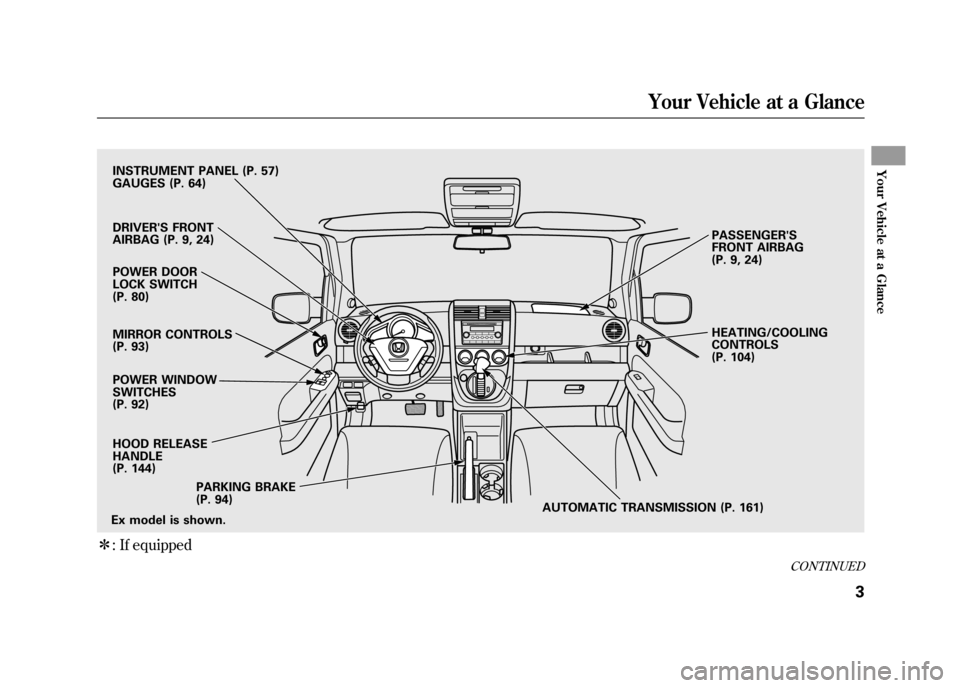
ꭧ: If equipped
POWER DOOR
LOCK SWITCH
(P. 80)
POWER WINDOW
SWITCHES
(P. 92)
HOOD RELEASE
HANDLE
(P. 144)
Ex model is shown. AUTOMATIC TRANSMISSION (P. 161)
PARKING BRAKE
(P. 94) HEATING/COOLING
CONTROLS
(P. 104) PASSENGER'S
FRONT AIRBAG
(P. 9, 24)
DRIVER'S FRONT
AIRBAG (P. 9, 24) INSTRUMENT PANEL (P. 57)
GAUGES (P. 64)
MIRROR CONTROLS
(P. 93)
CONTINUED
Your Vehicle at a Glance
3
Your Vehicle at a Glance
10/08/06 08:34:41 11 ELEMENT MMC North America Owner's Man 50 31SCV680 enu
Page 58 of 286

Your vehicle's exhaust contains
carbon monoxide gas. Carbon
monoxide should not enter the
vehicle in normal driving if you
maintain your vehicle properly and
follow the information on this page.
Have the exhaust system inspected
for leaks whenever:●The vehicle is raised for an oil
change.●You notice a change in the sound
of the exhaust.●The vehicle was in a collision that
may have damaged the underside.
Carbon monoxide gas is toxic.
Breathing it can cause
unconsciousness and even kill
you.
Avoid any enclosed areas or
activities that expose you to
carbon monoxide.
High levels of carbon monoxide can
collect rapidly in enclosed areas,
such as a garage. Do not run the
engine with the garage door closed.
Even with the door open, run the
engine only long enough to move the
vehicle out of the garage. With the tailgate or hatch open, air
flow can pull exhaust gas into your
vehicle's interior and create a
hazardous condition. If you must
drive with the tailgate or hatch open,
open all the windows and set the
heating and cooling system as shown
below.
If you must sit in your parked vehicle
with the engine running, even in an
unconfined area, adjust the heating
and cooling system as follows:
1. Select the fresh air mode.
2. Select the
mode.
3. Turn the fan on high speed.
4. Set the temperature control to a comfortable setting.
Carbon Monoxide Hazard5210/08/06 08:34:41 11 ELEMENT MMC North America Owner's Man 50 31SCV680 enu
Page 62 of 286
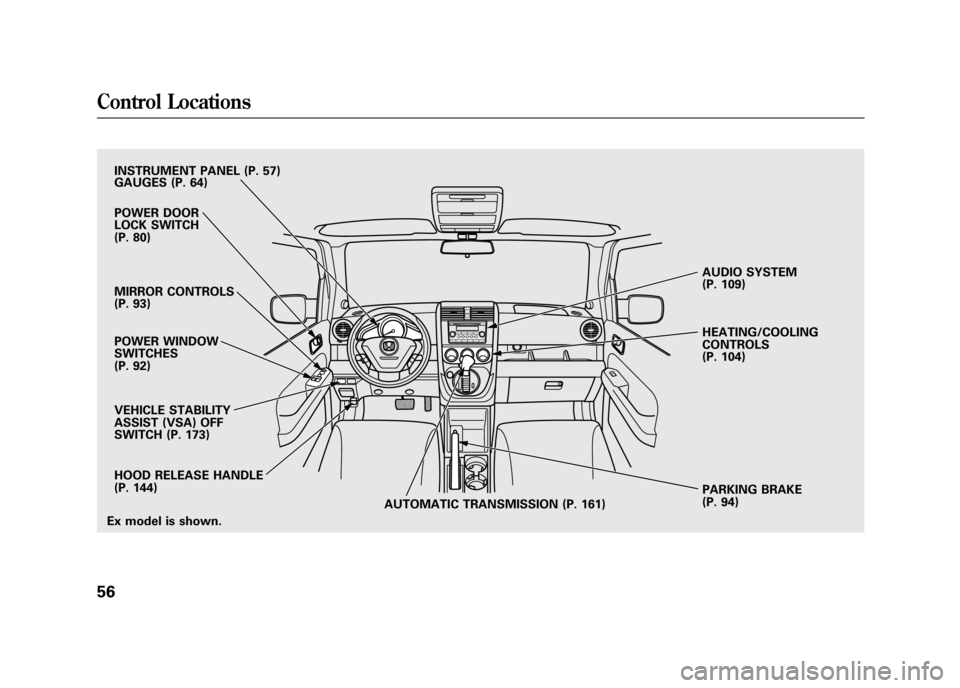
VEHICLE STABILITY
ASSIST (VSA) OFF
SWITCH (P. 173)PARKING BRAKE
(P. 94) AUDIO SYSTEM
(P. 109)
HEATING/COOLING
CONTROLS
(P. 104)
Ex model is shown. POWER DOOR
LOCK SWITCH
(P. 80)
MIRROR CONTROLS
(P. 93)
POWER WINDOW
SWITCHES
(P. 92) INSTRUMENT PANEL (P. 57)
HOOD RELEASE HANDLE
(P. 144) GAUGES (P. 64)
AUTOMATIC TRANSMISSION (P. 161)
Control Locations5610/08/06 08:34:41 11 ELEMENT MMC North America Owner's Man 50 31SCV680 enu
Page 73 of 286

If the system still detects a leak in
your vehicle's evaporative emissions
system, the malfunction indicator
lamp (MIL) comes on. If the fuel fill
cap was not already tightened, turn
the engine off, and check or
retighten the fuel fill cap until it
clicks at least once. The MIL should
go off after several days of normal
driving once the cap is tightened or
replaced. If the MIL does not go off,
have your vehicle inspected by a
dealer. For more information, see
page 236.Temperature Gauge
This shows the temperature of the
engine's coolant. During normal
operation, the pointer should rise to
about the middle of the gauge. In
severe driving conditions, the pointer
may rise to the upper zone. If it
reaches the red (hot) mark, pull
safely to the side of the road. Turn to
page 233 for instructions and
precautions on checking the engine's
cooling system.
Maintenance Minder
™
The information display in the
instrument panel shows you the
engine oil life and maintenance
service items when the ignition
switch is in the ON (II) position. This
information helps to keep you aware
of the periodic maintenance your
vehicle needs for continued trouble-
free driving. Refer to page 185 for
more information.
Gauges
67
Instruments and Controls
10/08/06 08:34:41 11 ELEMENT MMC North America Owner's Man 50 31SCV680 enu
Page 111 of 286

Air Flow Controls
Fan Control Dial
Turn this dial clockwise to increase
the fan speed and airflow.
Temperature Control Dial
Turning this dial clockwise increases
the temperature of the airflow.
Air Conditioning (A/C) Button
This button turns the air
conditioning on and off. The
indicator in the button is on when the
A/C is on.
Recirculation ButtonWhen the recirculation indicator is
on, air from the vehicle's interior is
sent throughout the system again.
When the indicator is off, air is
brought in from the outside of the
vehicle (fresh air mode).The outside air intakes for the
heating and cooling system are at the
base of the windshield. Keep this
area clear of leaves and other debris.
The system should be left in fresh air
mode under almost all conditions.
Keeping the system in recirculation
mode, particularly with the A/C off,
can cause the windows to fog up.
Switch to recirculation mode when
driving through dusty or smoky
conditions, then return to fresh air
mode.
Rear Window Defogger Button
This button turns the rear window
defogger on and off (see page 74).
Mode Control Dial
Use the mode control dial to select
the vents the air flows from. Some air
will flow from the dashboard vents in
all modes.
The system automatically turns
on the A/C and switches to
recirculation mode. Air flows from
the center and side vents in the
dashboard (see page 106).Air flows from the center and
corner vents in the dashboard.Airflow is divided between the
vents in the dashboard and the floor
vents.Air flows from the floor vents.
When you select
, the system
automatically switches to fresh air
mode.
Airflow is divided between the
floor vents and the defroster vents at
the base of the windshield.
CONTINUED
Vents, Heating, and A/C
105
Features
10/08/06 08:34:41 11 ELEMENT MMC North America Owner's Man 50 31SCV680 enu
Page 184 of 286

Pre-Tow Checklist
When preparing to tow, and before
driving away, be sure to check the
following:●The vehicle has been properly
serviced, and the tires, brakes,
suspension, cooling system, and
lights are in good operating
condition.●The trailer has been properly
serviced and is in good condition.●All weights and loads are within
limits (see pages 174 and 175).●The hitch, safety chains, and any
other attachments are secure.●All items in or on the trailer are
properly secured and cannot shift
while you drive.
●Your vehicle tires and spare are
properly inflated (see page 212),
and the trailer tires and spare are
inflated as recommended by the
trailer maker.Driving Safely With a Trailer
The added weight, length, and
height of a trailer will affect your
vehicle's handling and performance,
so driving with a trailer requires
some special driving skills and
techniques.
For your safety and the safety of
others, take time to practice driving
maneuvers before heading for the
open road, and follow the guidelines
below.
Towing Speeds and GearsDrive slower than normal in all
driving situations, and obey posted
speed limits for vehicles with trailers.
Use the D position when towing a
trailer on level roads. D3 is the
proper shift lever position to use
when towing a trailer in hilly terrain.
(See
‘‘
Driving on Hills
’’on the next
page for additional gear information.)
Towing a Trailer17810/08/06 08:34:41 11 ELEMENT MMC North America Owner's Man 50 31SCV680 enu
Page 202 of 286
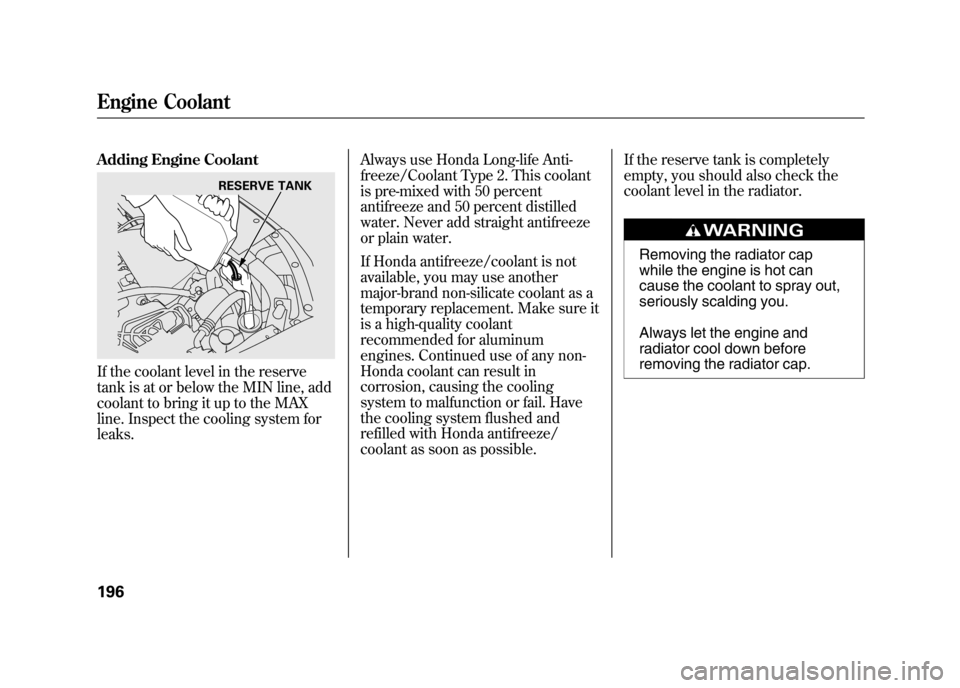
Adding Engine CoolantIf the coolant level in the reserve
tank is at or below the MIN line, add
coolant to bring it up to the MAX
line. Inspect the cooling system for
leaks.Always use Honda Long-life Anti-
freeze/Coolant Type 2. This coolant
is pre-mixed with 50 percent
antifreeze and 50 percent distilled
water. Never add straight antifreeze
or plain water.
If Honda antifreeze/coolant is not
available, you may use another
major-brand non-silicate coolant as a
temporary replacement. Make sure it
is a high-quality coolant
recommended for aluminum
engines. Continued use of any non-
Honda coolant can result in
corrosion, causing the cooling
system to malfunction or fail. Have
the cooling system flushed and
refilled with Honda antifreeze/
coolant as soon as possible.If the reserve tank is completely
empty, you should also check the
coolant level in the radiator.
Removing the radiator cap
while the engine is hot can
cause the coolant to spray out,
seriously scalding you.
Always let the engine and
radiator cool down before
removing the radiator cap.
RESERVE TANK
Engine Coolant19610/08/06 08:34:41 11 ELEMENT MMC North America Owner's Man 50 31SCV680 enu
Page 203 of 286
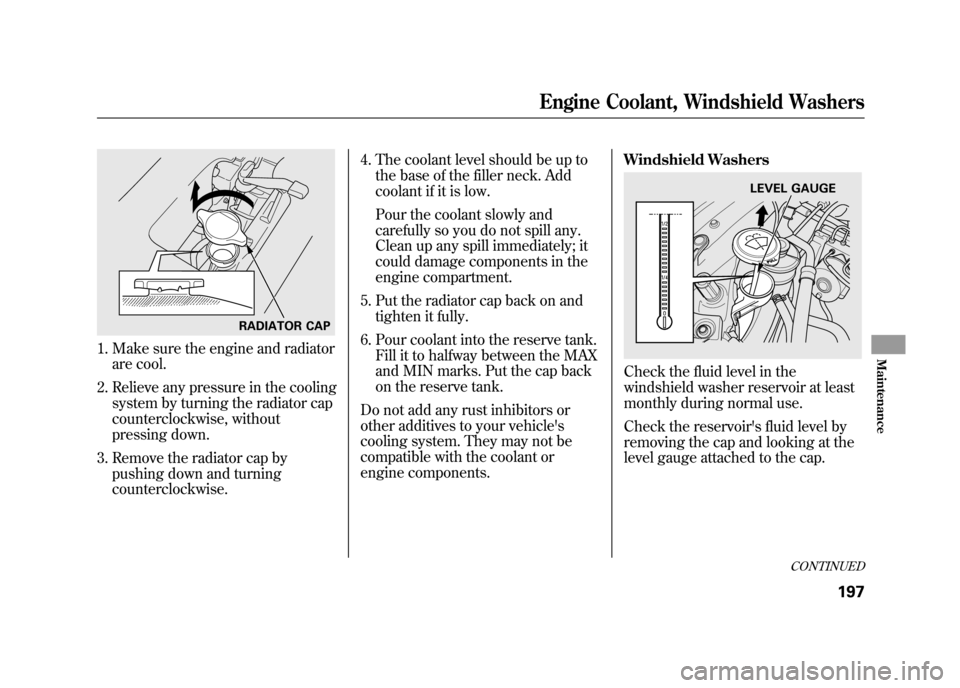
1. Make sure the engine and radiatorare cool.
2. Relieve any pressure in the cooling system by turning the radiator cap
counterclockwise, without
pressing down.
3. Remove the radiator cap by pushing down and turning
counterclockwise. 4. The coolant level should be up to
the base of the filler neck. Add
coolant if it is low.
Pour the coolant slowly and
carefully so you do not spill any.
Clean up any spill immediately; it
could damage components in the
engine compartment.
5. Put the radiator cap back on and tighten it fully.
6. Pour coolant into the reserve tank. Fill it to halfway between the MAX
and MIN marks. Put the cap back
on the reserve tank.
Do not add any rust inhibitors or
other additives to your vehicle's
cooling system. They may not be
compatible with the coolant or
engine components. Windshield Washers
Check the fluid level in the
windshield washer reservoir at least
monthly during normal use.
Check the reservoir's fluid level by
removing the cap and looking at the
level gauge attached to the cap.
RADIATOR CAP
LEVEL GAUGE
CONTINUED
Engine Coolant, Windshield Washers
197
Maintenance
10/08/06 08:34:41 11 ELEMENT MMC North America Owner's Man 50 31SCV680 enu
Page 216 of 286
If you remove the driver's floor mat,
make sure to re-anchor it when you
put it back in your vehicle.
If you use non-Honda floor mats,
make sure they fit properly and that
they can be used with the floor mat
anchors. Do not put additional floor
mats on top of the anchored mats.Dust and Pollen Filter
This filter removes the dust and
pollen that is brought in from the
outside through the heating and
cooling system.
Have your dealer replace the filter
when this service is indicated by a
maintenance message on the
information display. It should be
replaced every 15,000 miles
(24,000 km) if you drive primarily in
urban areas that have high
concentrations of soot in the air, or if
the flow from the heating and cooling
system becomes less than usual.Wiper Blades
Check the condition of the wiper
blades at least every 6 months.
Replace them if you find signs of
cracking in the rubber, areas that are
getting hard, or if they leave streaks
and unwiped areas when used.
1. Front:
Raise the wiper arm off the
windshield.
Do not open the hood when the wiper
arms are raised, or you will damage the
hood and the arms.
Rear:
Raise the wiper arm off the hatch
glass and hold it.
Floor Mats, Dust and Pollen Filter, Wiper Blades21010/08/06 08:34:41 11 ELEMENT MMC North America Owner's Man 50 31SCV680 enu