tires HONDA FIT 2009 2.G Owner's Manual
[x] Cancel search | Manufacturer: HONDA, Model Year: 2009, Model line: FIT, Model: HONDA FIT 2009 2.GPages: 352, PDF Size: 17.67 MB
Page 282 of 352
Wheels
Clean the wheels as you would the
rest of the exterior. Wash them with
the same solution, and rinse them
thoroughly.If equippedAluminum alloy wheels have a
protective clear-coat that keeps the
aluminum from corroding and
tarnishing. Cleaning the wheels with
harsh chemicals (including some
commercial wheel cleaners) or a stiff
brush can damage the clear-coat. To
clean the wheels, use a mild
detergent and a soft brush or sponge.Checking the Battery
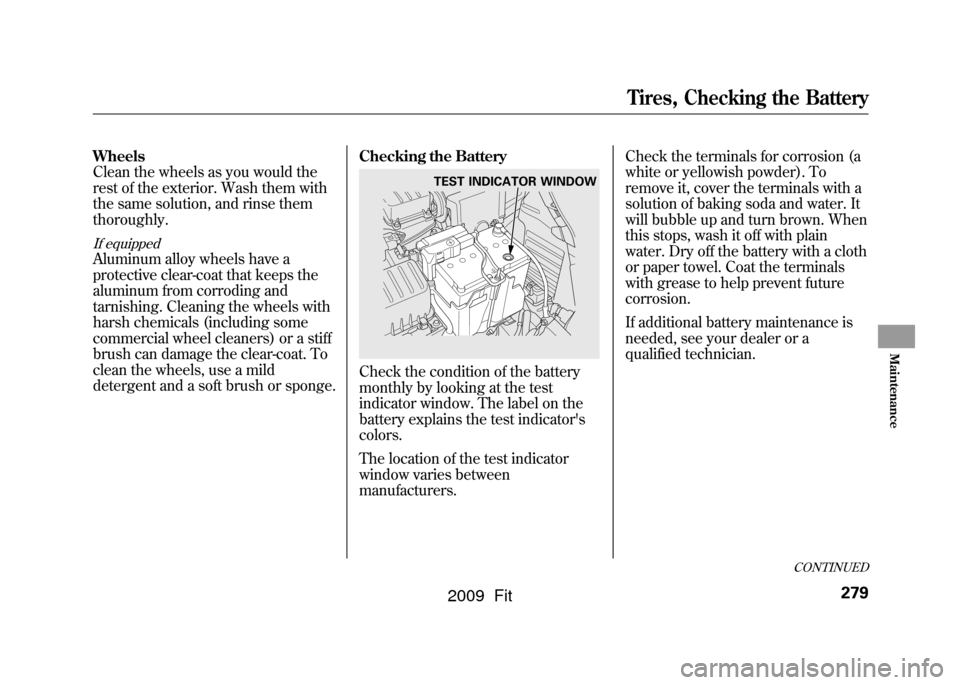
Check the condition of the battery
monthly by looking at the test
indicator window. The label on the
battery explains the test indicator's
colors.
The location of the test indicator
window varies between
manufacturers.Check the terminals for corrosion (a
white or yellowish powder). To
remove it, cover the terminals with a
solution of baking soda and water. It
will bubble up and turn brown. When
this stops, wash it off with plain
water. Dry off the battery with a cloth
or paper towel. Coat the terminals
with grease to help prevent future
corrosion.
If additional battery maintenance is
needed, see your dealer or a
qualified technician.
TEST INDICATOR WINDOW
CONTINUED
Tires, Checking the Battery
279
Maintenance
2009 Fit
Page 284 of 352

If you need to park your vehicle for
an extended period (more than 1
month), there are several things you
should do to prepare it for storage.
Proper preparation helps prevent
deterioration and makes it easier to
get your vehicle back on the road. If
possible, store your vehicle indoors.●Fill the fuel tank.●Wash and dry the exterior
completely.●Clean the interior. Make sure the
carpeting, floor mats, etc., are
completely dry.●Leave the parking brake off. Put
the transmission in reverse
(manual) or Park (automatic).●Block the rear wheels.
●If the vehicle is to be stored for a
longer period, it should be
supported on jackstands so the
tires are off the ground.●Leave one window open slightly (if
the vehicle is being stored
indoors).●Disconnect the battery.●Support the front and rear wiper
blade arms with a folded towel or
rag so they do not touch the
windshield.●To minimize sticking, apply a
silicone spray lubricant to all door
and tailgate seals. Also, apply a
vehicle body wax to the painted
surfaces that mate with the door
and tailgate seals.
●Cover the vehicle with a
‘‘breathable ’’cover, one made
from a porous material such as
cotton. Non-porous materials, such
as plastic sheeting, trap moisture,
which can damage the paint.●If possible, periodically run the
engine until it reaches full
operating temperature (the cooling
fans cycle on and off twice).
Preferably, do this once a month.
Vehicle Storage
281
Maintenance
2009 Fit
Page 287 of 352

Except all Canadian models withautomatic transmissionUse the compact spare tire as a
temporary replacement only. Get
your regular tire repaired or
replaced, and put it back on your
vehicle as soon as you can.
Check the inflation pressure of the
compact spare tire every time you
check the other tires. It should be
inflated to:
60 psi (420 kPa, 4.2 kgf/cm
2) Follow these precautions:
●Never exceed 50 mph (80 km/h).●This tire gives a harsher ride and
less traction on some road
surfaces. Use greater caution while
driving.●Do not mount tire chains on the
compact spare tire.●Do not use your compact spare tire
on another vehicle unless it is the
same make and model.●On vehicles with the TPMS
system, the low tire pressure
indicator comes on and stays on
after you replace the flat tire with
the compact spare tire. After
several miles (kilometers) driving
with the compact spare tire, the
TPMS indicator comes on and the
low tire pressure indicator goes
off.
Replace the tire when you can see
the tread wear indicator bars. The
replacement should be the same size
and design tire, mounted on the
same wheel. The spare tire is not
designed to be mounted on a regular
wheel, and the spare wheel is not
designed for mounting a regular tire.INDICATOR LOCATION MARK
TREAD WEAR INDICATOR BAR
Compact Spare Tire284
2009 Fit
Page 314 of 352

If your vehicle needs to be towed,
call a professional towing service or
organization. Never tow your vehicle
with just a rope or chain. It is very
dangerous.
There are two ways to tow your
vehicle:Flat-bed Equipment
-The operator
loads your vehicle on the back of a
truck. This is the best way to
transport your vehicle.
Wheel-lift Equipment
- The tow
truck uses two pivoting arms that go
under the front tires and lift them off
the ground. The rear tires remain on
the ground. This is an acceptable
way to tow your vehicle. If, due to damage, your vehicle must
be towed with the front wheels on
the ground, do this:
Manual transmission:●Release the parking brake.●Shift the transmission to neutral.●Leave the ignition switch in the
ACCESSORY (I) position so the
steering wheel does not lock.
Automatic transmission:●Release the parking brake.●Start the engine.●Shift to D position and hold for 5
seconds, then to N. Let the engine
run for 3 minutes, then turn it off.●Turn off the engine.●Leave the ignition switch in the
ACCESSORY (I) position so the
steering wheel does not lock.
Improper towing preparation will
damage the transmission. Follow the
above procedure exactly. If you cannot
shift the transmission or start the
engine (automatic transmission), your
vehicle must be transported with the
front wheels off the ground.
With the front wheels on the ground,
it is best to tow the vehicle no farther
than 50 miles (80 km), and keep the
speed below 35 mph (55 km/h).
CONTINUED
Emergency Towing
311
Taking Care of the Unexpected
2009 Fit
Page 318 of 352

The diagrams in this section give you
the dimensions and capacities of
your vehicle and the locations of the
identification numbers. It also
includes information you should
know about your vehicle's tires and
emissions control systems.Identification Numbers
...............
316
Specifications
..............................
318
DOT Tire Quality Grading (U.S. Vehicles)
.............................
321
Uniform Tire Quality Grading
...............................
321
Treadwear
...............................
321
Traction
..................................
321
Temperature
...........................
322
Tire Labeling
..............................
323
Tire Pressure Monitoring System (TPMS) -Required Federal
Explanation
.........................
324
Emissions Controls
.....................
326
The Clean Air Act
....................
326
Crankcase Emissions Control System
................................
326
Evaporative Emissions Control System
................................
326
Onboard Refueling Vapor
Recovery
.............................
326
Exhaust Emissions Controls
...
327
Replacement Parts
..................
327
Three Way Catalytic Converter
................................
328 Emissions Testing
.......................
329
Technical Information
315
Technical Information
2009 Fit
Page 323 of 352

BatteryCapacity 12 V-32 AH/5 HR
12 V -34 AH/5 HR
12 V -40 AH/20 HR
Fuses Interior See page309or the fuse label
attached to the dashboard.
Under-hood See page310or the fuse box cover.
Alignment Toe-in Front 0.0 in (0 mm)
Rear 0.10 in (2.5 mm)
Camber Front 0°
Rear -1°
Caster Front 3°20'Tires
Size Front/Rear 175/65R15 84S
ꭧ1
185/55R16 83H
ꭧ2
Spare T125/70D15 95M
ꭧ3
T135/80D15 99M
ꭧ4
Pressure Front/Rear 32 psi (220 kPa,
2.2 kgf/cm
2)ꭧ 1
33 psi (230 kPa,
2.3 kgf/cm
2)ꭧ 2
Spare 60 psi (420 kPa,
4.2 kgf/cm
2)
ꭧ 1: All models except Sport
ꭧ 2: Sport model
ꭧ 3: On models without VSA system and all Canadian models with
manual transmission
ꭧ 4: On models with VSA system
Specifications320
2009 Fit
Page 324 of 352

The tires on your vehicle meet all
U.S. Federal Safety Requirements.
All tires are also graded for
treadwear, traction, and temperature
performance according to
Department of Transportation (DOT)
standards. The following explains
these gradings.
Uniform Tire Quality Grading
Quality grades can be found where
applicable on the tire sidewall
between tread shoulder and
maximum section width. For
example:Treadwear 200
Traction AA
Temperature A
All passenger car tires must conform
to Federal Safety Requirements in
addition to these grades. Treadwear
The treadwear grade is a
comparative rating based on the wear
rate of the tire when tested under
controlled conditions on a specified
government test course. For
example, a tire graded 150 would
wear one and one-half (1 1/2) times
as well on the government course as
a tire graded 100. The relative
performance of tires depends upon
the actual conditions of their use,
however, and may depart
significantly from the norm due to
variations in driving habits, service
practices and differences in road
characteristics and climate.
Traction
The traction grades, from highest to
lowest, are AA, A, B, and C. Those
grades represent the tire's ability to
stop on wet pavement as measured
under controlled conditions on
specified government test surfaces of
asphalt and concrete. A tire marked
C may have poor traction
performance.
Warning: The traction grade
assigned to this tire is based on
straight-ahead braking traction tests,
and does not include acceleration,
cornering, hydroplaning, or peak
traction characteristics.
DOT Tire Quality Grading (U.S. Vehicles)
321
Technical Information
2009 Fit
Page 325 of 352

Temperature
The temperature grades are A (the
highest), B, and C, representing the
tire's resistance to the generation of
heat and its ability to dissipate heat
when tested under controlled
conditions on a specified indoor
laboratory test wheel. Sustained high
temperature can cause the material
of the tire to degenerate and reduce
tire life, and excessive temperature
can lead to sudden tire failure. The
grade C corresponds to a level of
performance which all passenger car
tires must meet under the Federal
Motor Vehicle Safety Standard No.
109. Grades B and A represent
higher levels of performance on the
laboratory test wheel than the
minimum required by law.Warning: The temperature grade for
this tire is established for a tire that
is properly inflated and not
overloaded. Excessive speed,
underinflation, or excessive loading,
either separately or in combination,
can cause heat buildup and possible
tire failure.DOT Tire Quality Grading (U.S. Vehicles)322
2009 Fit
Page 326 of 352
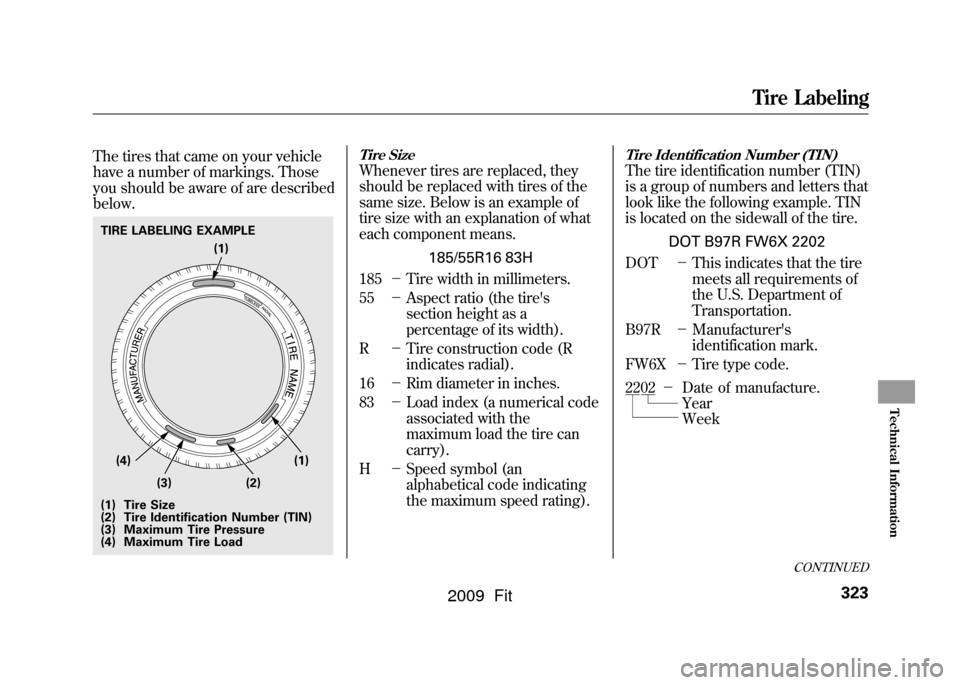
The tires that came on your vehicle
have a number of markings. Those
you should be aware of are described
below.
Tire SizeWhenever tires are replaced, they
should be replaced with tires of the
same size. Below is an example of
tire size with an explanation of what
each component means.185/55R16 83H
185 -Tire width in millimeters.
55 -Aspect ratio (the tire's
section height as a
percentage of its width).
R -Tire construction code (R
indicates radial).
16 -Rim diameter in inches.
83 -Load index (a numerical code
associated with the
maximum load the tire can
carry).
H -Speed symbol (an
alphabetical code indicating
the maximum speed rating).
Tire Identification Number (TIN)The tire identification number (TIN)
is a group of numbers and letters that
look like the following example. TIN
is located on the sidewall of the tire.
DOT B97R FW6X 2202
DOT -This indicates that the tire
meets all requirements of
the U.S. Department of
Transportation.
B97R -Manufacturer's
identification mark.
FW6X -Tire type code.
TIRE LABELING EXAMPLE
(1)
(1) Tire Size
(2) Tire Identification Number (TIN)
(3) Maximum Tire Pressure
(4) Maximum Tire Load (4)
(3) (2)(1)
2202
-
Year
Week Date of manufacture.
CONTINUED
Tire Labeling
323
Technical Information
2009 Fit
Page 327 of 352

Maximum Tire PressureMax Press-The maximum air
pressure the tire can hold.Maximum Tire LoadMax Load -The maximum load the
tire can carry at maximum air
pressure.
Tire Pressure Monitoring System
(TPMS) -Required Federal
ExplanationU.S. models onlyEach tire, including the spare (if
provided), should be checked
monthly when cold and inflated to
the inflation pressure recommended
by the vehicle manufacturer on the
vehicle placard or tire inflation
pressure label.
(If your vehicle has tires of a different
size than the size indicated on the
vehicle placard or tire inflation
pressure label, you should determine
the proper tire inflation pressure for
those tires.) As an added safety feature, your
vehicle has been equipped with a tire
pressure monitoring system (TPMS)
that illuminates a low tire pressure
telltale
when one or more of your tires is
significantly under-inflated.
Accordingly, when the low tire
pressure telltale illuminates, you
should stop and check your tires as
soon as possible, and inflate them to
the proper pressure.
Driving on a significantly under-
inflated tire causes the tire to
overheat and can lead to tire failure.
Under-inflation also reduces fuel
efficiency and tire tread life, and may
affect the vehicle's handling and
stopping ability.
Please note that the TPMS is not a
substitute for proper tire
maintenance, and it is the driver's
responsibility to maintain correct tire
pressure, even if under-inflation has
not reached the level to trigger
illumination of the TPMS low tire
pressure telltale.
Tire Labeling, Tire Pressure Monitoring System (TPMS)
-Required Federal Explanation324
2009 Fit