transmission HONDA FIT 2009 2.G Owners Manual
[x] Cancel search | Manufacturer: HONDA, Model Year: 2009, Model line: FIT, Model: HONDA FIT 2009 2.GPages: 352, PDF Size: 17.67 MB
Page 4 of 352
2009 Fit Online Reference Owner's Manual
Contents
Owner's Identification Form
Introduction .............................................................................................................................\
............................. i
A Few Words About Safety ......................................................................\
........................................................ iii
Your Vehicle at a Glance (main controls) ....................................................\
................................................ 3
Driver and Passenger Safety (seat belts, SRS, and child protection) ......................\
.............................. 5
Instruments and Controls
(indicators, gauges, dashboard, steering wheel, and other convenience items)
............. 57
Features (heating and cooling, audio, steering wheel, security, and cruise control) ................................. 109
Before Driving (fuel, vehicle break-in, and cargo loading) ...........................................\
........................... 197
Driving (engine and transmission operation) .........................................\
....................................................... 213
Maintenance (minder, fluid checking, minor services, and vehicle storage)........................................... 243
Taking Care of the Unexpected (flat tire, dead battery, overheating, and fuses) .............................. 283
Technical Information (vehicle specifications, tires, and emissions controls) ....................................... 315
Warranty and Customer Relations (U. S. and Canada only) (warranty and contact information) ... 331
Index ....................................................................................................................................\
.................................... I
Service Information Summary ( fluid capacities and tire pressures)
\
\
1 00X31-TK6-6003
Page 5 of 352

Contents
A convenient reference to the
sections in this manual.
Your Vehicle at a Glance
A quick reference to the main
controls in your vehicle.
Driver and Passenger Safety
Important information about the
proper use and care of your vehicle's
seat belts, an overview of the
supplemental restraint system, and
valuable information on how to
protect children with child restraints.
Instruments and Controls
Explains the purpose of each
instrument panel indicator and
gauge, and how to use the controls
on the dashboard and steering
column.
Features
How to operate the heating and air
conditioning system, the audio
system, and other convenience
features.Before Driving
What gasoline to use, how to break-
in your new vehicle, and how to load
luggage and other cargo.
Driving
The proper way to start the engine,
shift the transmission, and park.
Maintenance
The maintenance minder shows you
when you need to take your vehicle
to the dealer for maintenance
service. There is also a list of things
to check and instructions on how to
check them.
Taking Care of the Unexpected
This section covers several problems
motorists sometimes experience, and
details how to handle them.
Technical Information
ID numbers, dimensions, capacities,
and technical information.
Warranty and Customer Relations
(U.S. and Canada only)
A summary of the warranties
covering your new vehicle, and how
to contact us for any reason. Refer to
your warranty manual for detailed
information.
Index
Service Information Summary
A summary of the information you
need when you pull up to the fuel
pump.Overview of Contents2
2009 Fit
Page 6 of 352
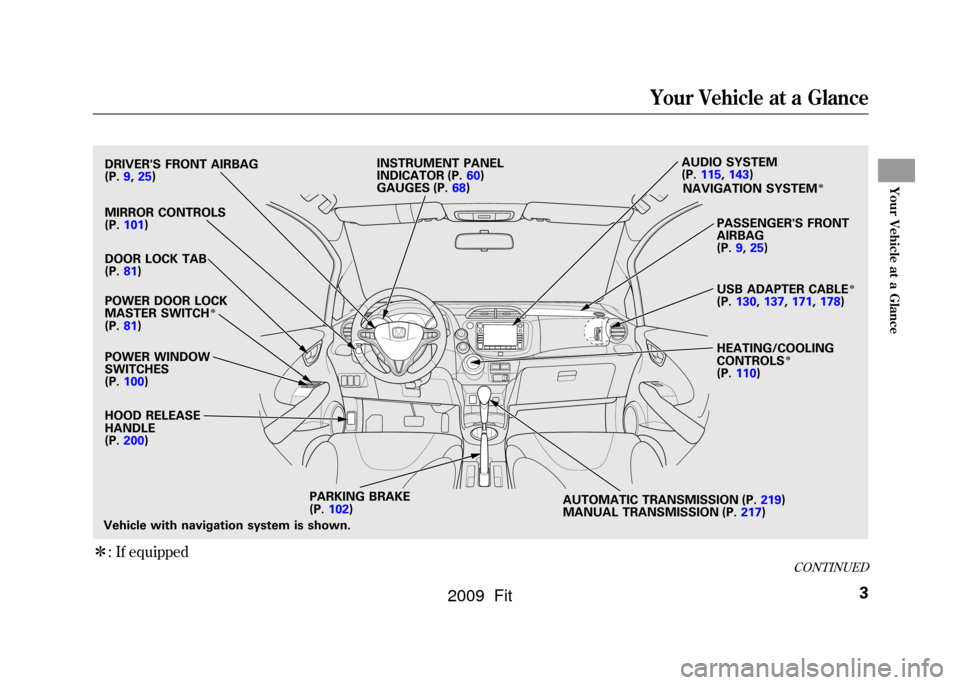
ꭧ: If equippedVehicle with navigation system is shown.DRIVER'S FRONT AIRBAG
(P.
9,25)
MIRROR CONTROLS
(P. 101 )
DOOR LOCK TAB
(P. 81)
POWER DOOR LOCK
MASTER SWITCH
ꭧ
(P. 81)
POWER WINDOW
SWITCHES
(P. 100 )
HOOD RELEASE
HANDLE
(P. 200 ) INSTRUMENT PANEL
INDICATOR (P.
60)
GAUGES (P. 68) AUDIO SYSTEM
(P.
115, 143)
PASSENGER'S FRONT
AIRBAG
(P. 9,25)
USB ADAPTER CABLE
ꭧ
(P. 130, 137,171, 178)
HEATING/COOLING
CONTROLS
ꭧ
(P. 110)
PARKING BRAKE
(P. 102) AUTOMATIC TRANSMISSION (P.
219)
MANUAL TRANSMISSION (P. 217)
NAVIGATION SYSTEM
ꭧ
CONTINUED
Your Vehicle at a Glance
3
Your Vehicle at a Glance
2009 Fit
Page 61 of 352
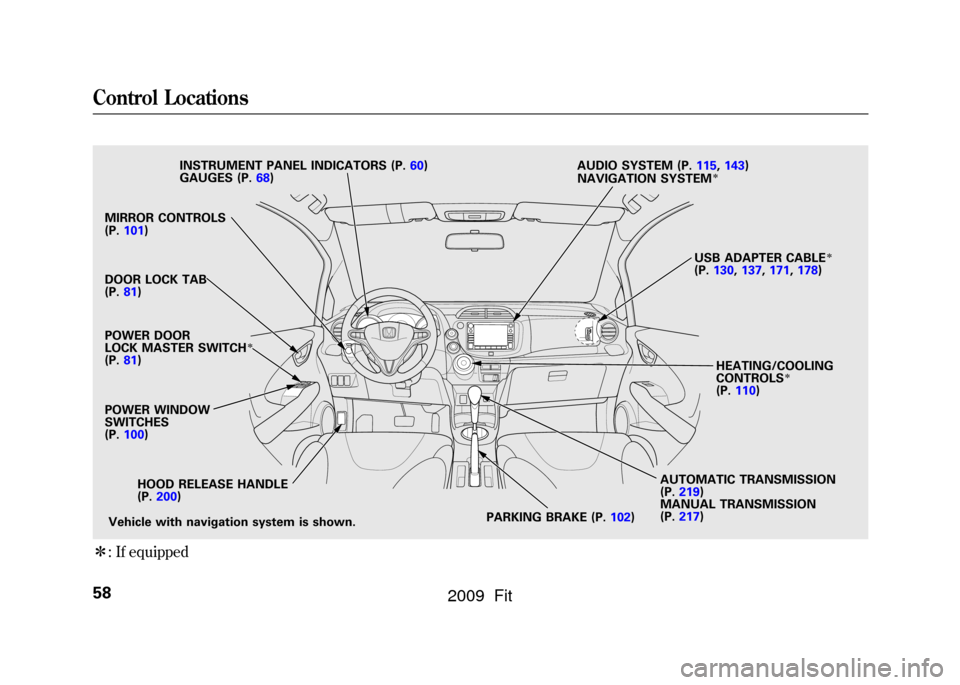
ꭧ: If equippedMIRROR CONTROLS
(P. 101)
POWER DOOR
LOCK MASTER SWITCH
ꭧ
(P. 81)
HOOD RELEASE HANDLE
(P. 200)
POWER WINDOW
SWITCHES
(P.
100)
PARKING BRAKE (P.102)AUTOMATIC TRANSMISSION
(P.
219)
MANUAL TRANSMISSION
(P. 217) HEATING/COOLING
CONTROLS
ꭧ
(P.
110)
AUDIO SYSTEM (P.
115,143)
INSTRUMENT PANEL INDICATORS (P. 60)
GAUGES (P. 68)
DOOR LOCK TAB
(P. 81)
Vehicle with navigation system is shown. USB ADAPTER CABLE
ꭧ
(P.
130, 137,171,178)
NAVIGATION SYSTEM
ꭧ
Control Locations58
2009 Fit
Page 77 of 352
4. Hold past OFF to turn the rearwindow wiper on and to spary the
rear window washer. The rear
window wiper makes one more
sweep after you release the switch.
When you shift the transmission to
the reverse position with the front
windshield wiper activated, the rear
wiper operates automatically even if
the rear wiper switch is off.
The rear window washer uses the
same fluid reservoir as the
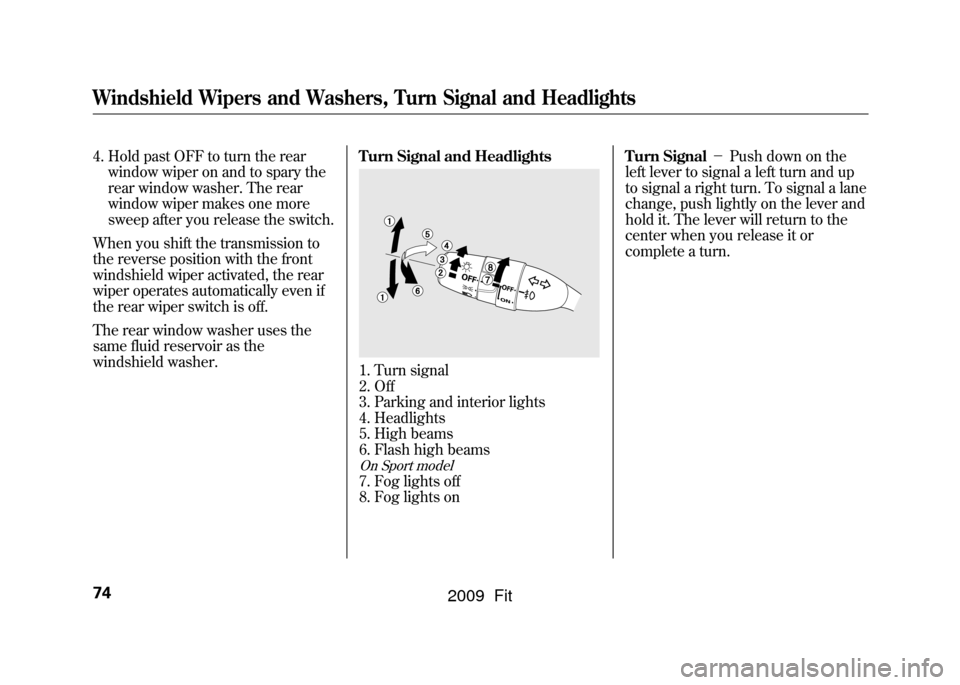
windshield washer. Turn Signal and Headlights
1. Turn signal
2. Off
3. Parking and interior lights
4. Headlights
5. High beams
6. Flash high beamsOn Sport model7. Fog lights off
8. Fog lights onTurn Signal
-Push down on the
left lever to signal a left turn and up
to signal a right turn. To signal a lane
change, push lightly on the lever and
hold it. The lever will return to the
center when you release it or
complete a turn.
Windshield Wipers and Washers, Turn Signal and Headlights74
2009 Fit
Page 83 of 352
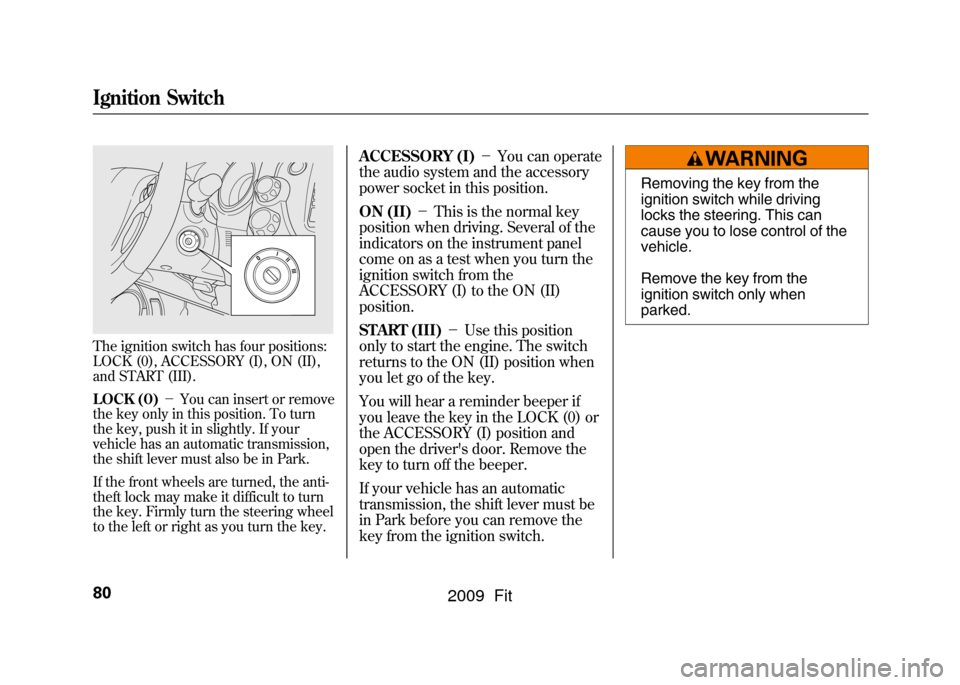
The ignition switch has four positions:
LOCK (0), ACCESSORY (I), ON (II),
and START (III).
LOCK (0)-You can insert or remove
the key only in this position. To turn
the key, push it in slightly. If your
vehicle has an automatic transmission,
the shift lever must also be in Park.
If the front wheels are turned, the anti-
theft lock may make it difficult to turn
the key. Firmly turn the steering wheel
to the left or right as you turn the key.
ACCESSORY (I) -You can operate
the audio system and the accessory
power socket in this position.
ON (II) -This is the normal key
position when driving. Several of the
indicators on the instrument panel
come on as a test when you turn the
ignition switch from the
ACCESSORY (I) to the ON (II)
position.
START (III) -Use this position
only to start the engine. The switch
returns to the ON (II) position when
you let go of the key.
You will hear a reminder beeper if
you leave the key in the LOCK (0) or
the ACCESSORY (I) position and
open the driver's door. Remove the
key to turn off the beeper.
If your vehicle has an automatic
transmission, the shift lever must be
in Park before you can remove the
key from the ignition switch.
Removing the key from the
ignition switch while driving
locks the steering. This can
cause you to lose control of the
vehicle.
Remove the key from the
ignition switch only when
parked.
Ignition Switch80
2009 Fit
Page 107 of 352
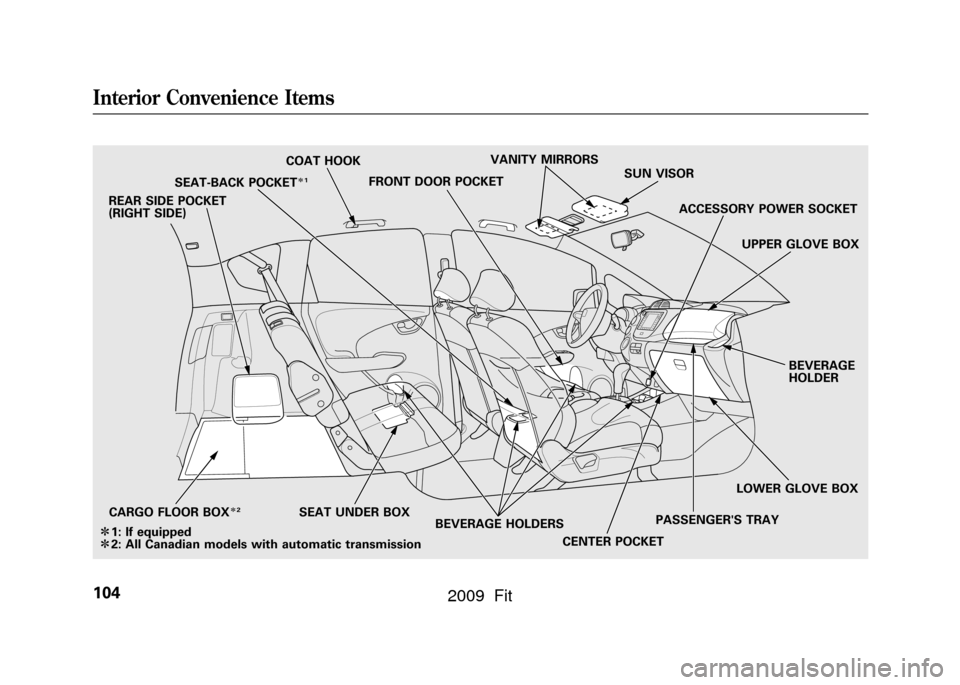
SEAT-BACK POCKET
ꭧ1COAT HOOK
FRONT DOOR POCKET VANITY MIRRORS
SUN VISOR
SEAT UNDER BOX CENTER POCKETPASSENGER'S TRAYUPPER GLOVE BOX
ACCESSORY POWER SOCKET
BEVERAGE
HOLDER
REAR SIDE POCKET
(RIGHT SIDE)
LOWER GLOVE BOX
BEVERAGE HOLDERS
CARGO FLOOR BOX
ꭧ
2
ꭧ1: If equipped
ꭧ 2: All Canadian models with automatic transmissionInterior Convenience Items104
2009 Fit
Page 197 of 352
On Sport model and Canadian LX modelCruise control allows you to maintain
a set speed above 25 mph (40 km/h)
without keeping your foot on the
accelerator pedal. It should be used
for cruising on straight, open
highways. It is not recommended for
city driving, winding roads, slippery
roads, heavy rain, or bad weather.
Improper use of the cruise
control can lead to a crash.
Use the cruise control only
when traveling on open
highways in good weather.Using the Cruise Control
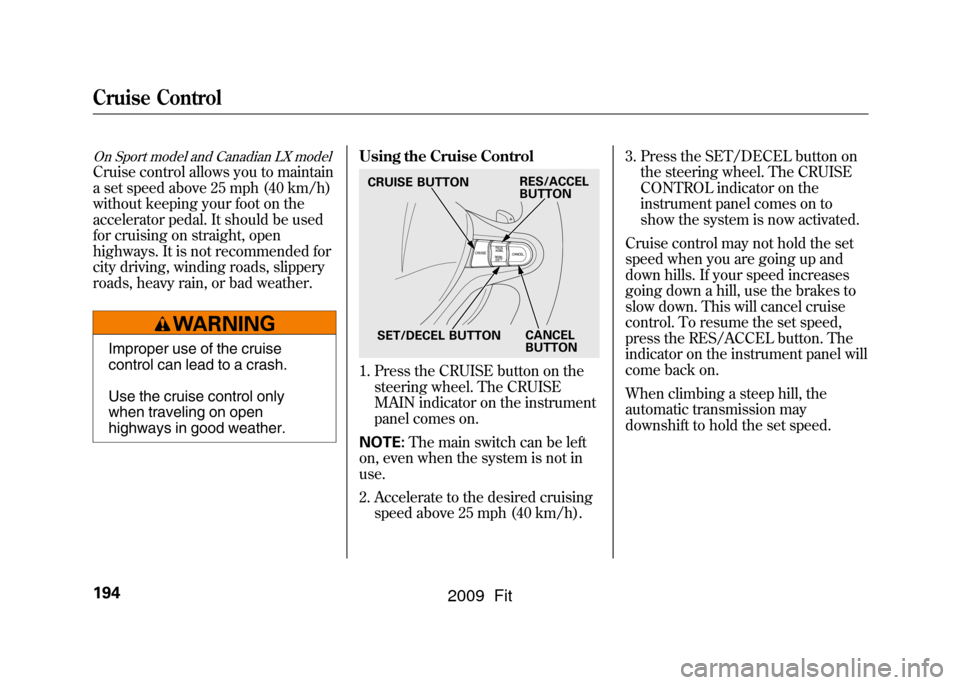
1. Press the CRUISE button on the
steering wheel. The CRUISE
MAIN indicator on the instrument
panel comes on.
NOTE: The main switch can be left
on, even when the system is not in
use.
2. Accelerate to the desired cruising speed above 25 mph (40 km/h). 3. Press the SET/DECEL button on
the steering wheel. The CRUISE
CONTROL indicator on the
instrument panel comes on to
show the system is now activated.
Cruise control may not hold the set
speed when you are going up and
down hills. If your speed increases
going down a hill, use the brakes to
slow down. This will cancel cruise
control. To resume the set speed,
press the RES/ACCEL button. The
indicator on the instrument panel will
come back on.
When climbing a steep hill, the
automatic transmission may
downshift to hold the set speed.CRUISE BUTTON
SET/DECEL BUTTON CANCEL
BUTTON
RES/ACCEL
BUTTON
Cruise Control194
2009 Fit
Page 207 of 352

Fuel Economy Factors
The following factors can lower your
vehicle's fuel economy:●Aggressive driving (hard
acceleration and braking)●Excessive idling, accelerating and
braking in stop-and-go traffic●Cold engine operation (engines
are more efficient when warmed
up)●Driving with a heavy load or the air
conditioner running●Improperly inflated tiresImproving Fuel Economy
Vehicle MaintenanceA properly maintained vehicle
maximizes fuel economy. Poor
maintenance can significantly reduce
fuel economy. Always maintain your
vehicle according to the maintenance
messages displayed on the
information display (see
Owner's
Maintenance Checks on page250).
For example:●Use the recommended viscosity
motor oil, displaying the API
Certification Seal (see page
253).●Maintain proper tire inflation -
An under-inflated tire increases
‘‘ rolling resistance, ’’which
reduces fuel economy.●Avoid carrying excess weight in
your vehicle -It puts a heavier
load on the engine, increasing fuel
consumption.
●Keep your vehicle clean -In
particular, a build-up of snow or
mud on your vehicle's underside
adds weight and rolling resistance.
Frequent cleaning helps your fuel
economy.
Drive Efficiently●Drive moderately -Rapid
acceleration, abrupt cornering, and
hard braking increase fuel
consumption.●Observe the speed limit -
Aerodynamic drag has a big effect
on fuel mileage at speeds above 45
mph (75 km/h). Reduce your
speed and you reduce the drag.
Trailers, car top carriers, roof
racks and bike racks are also big
contributors to increased drag.●Always drive in the highest gear
possible -If your vehicle has a
manual transmission, you can
boost your fuel economy by up
shifting as early as possible.
Fuel Economy204
2009 Fit
Page 211 of 352
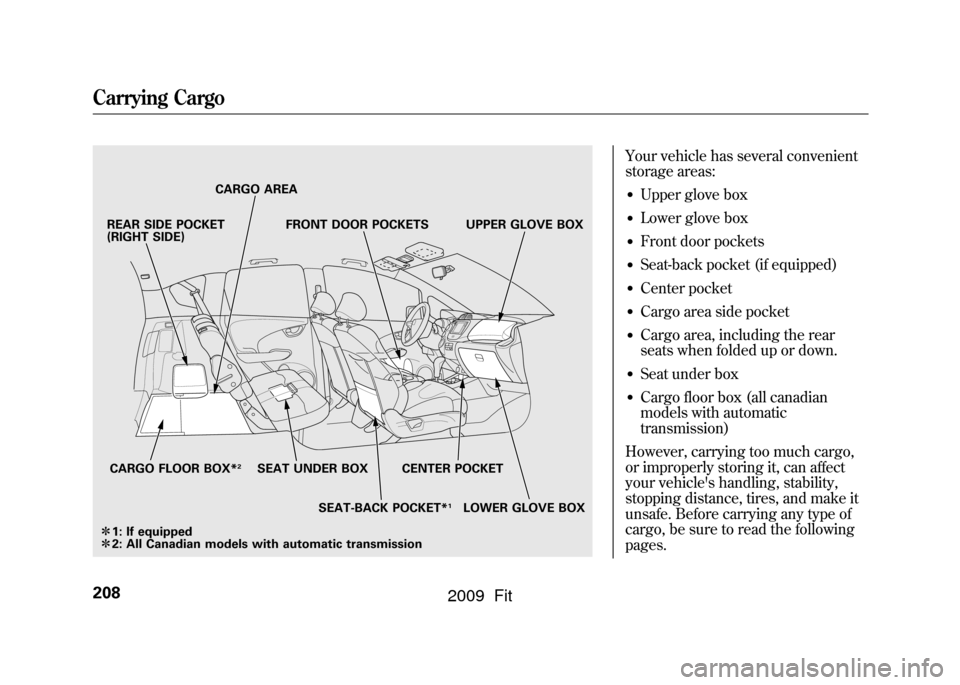
Your vehicle has several convenient
storage areas:●Upper glove box●Lower glove box●Front door pockets●Seat-back pocket (if equipped)●Center pocket●Cargo area side pocket●Cargo area, including the rear
seats when folded up or down.●Seat under box●Cargo floor box (all canadian
models with automatic
transmission)
However, carrying too much cargo,
or improperly storing it, can affect
your vehicle's handling, stability,
stopping distance, tires, and make it
unsafe. Before carrying any type of
cargo, be sure to read the following
pages.
REAR SIDE POCKET
(RIGHT SIDE)
CARGO FLOOR BOX*
2
FRONT DOOR POCKETS
SEAT-BACK POCKET*
1
SEAT UNDER BOX CENTER POCKET
CARGO AREA
LOWER GLOVE BOX
ꭧ 1: If equipped
ꭧ 2: All Canadian models with automatic transmission UPPER GLOVE BOX
Carrying Cargo208
2009 Fit