belt HONDA FIT 2009 2.G Owners Manual
[x] Cancel search | Manufacturer: HONDA, Model Year: 2009, Model line: FIT, Model: HONDA FIT 2009 2.GPages: 352, PDF Size: 17.67 MB
Page 2 of 352

California Proposition 65 Warning
WARNING:This product contains or emits chemicals known to the State of California to cause cancer and birth
defects or other reproductive harm.Event Data Recorders
This vehicle is equipped with one or more devices commonly referred to as event data recorders. These
devices record front seat belt use, front passenger seat occupancy, airbag deployment data, and the failure of
any airbag system component. This data belongs to the vehicle owner and may not be accessed by anyone else
except as legally required or with the permission of the vehicle owner.Service Diagnostic Recorders
This vehicle is equipped with service-related devices that record information about powertrain performance. The data
can be used to verify emissions law requirements and/or help technicians diagnose and solve service problems. It
may also be combined with data from other sources for research purposes, but it remains confidential and is never
linked to the vehicle owner.Introductionii
2009 Fit
Page 4 of 352
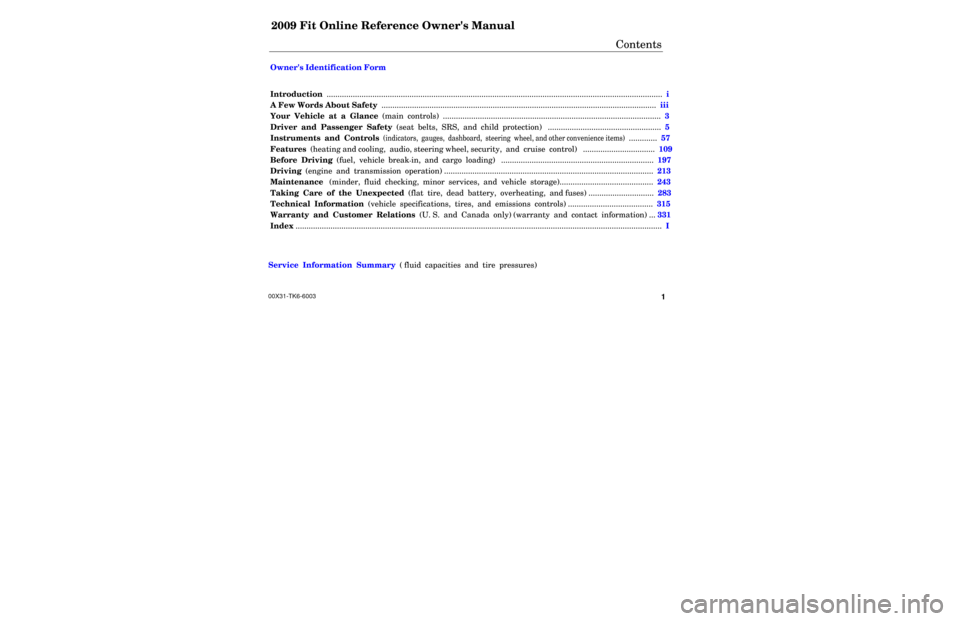
2009 Fit Online Reference Owner's Manual
Contents
Owner's Identification Form
Introduction .............................................................................................................................\
............................. i
A Few Words About Safety ......................................................................\
........................................................ iii
Your Vehicle at a Glance (main controls) ....................................................\
................................................ 3
Driver and Passenger Safety (seat belts, SRS, and child protection) ......................\
.............................. 5
Instruments and Controls
(indicators, gauges, dashboard, steering wheel, and other convenience items)
............. 57
Features (heating and cooling, audio, steering wheel, security, and cruise control) ................................. 109
Before Driving (fuel, vehicle break-in, and cargo loading) ...........................................\
........................... 197
Driving (engine and transmission operation) .........................................\
....................................................... 213
Maintenance (minder, fluid checking, minor services, and vehicle storage)........................................... 243
Taking Care of the Unexpected (flat tire, dead battery, overheating, and fuses) .............................. 283
Technical Information (vehicle specifications, tires, and emissions controls) ....................................... 315
Warranty and Customer Relations (U. S. and Canada only) (warranty and contact information) ... 331
Index ....................................................................................................................................\
.................................... I
Service Information Summary ( fluid capacities and tire pressures)
\
\
1 00X31-TK6-6003
Page 5 of 352

Contents
A convenient reference to the
sections in this manual.
Your Vehicle at a Glance
A quick reference to the main
controls in your vehicle.
Driver and Passenger Safety
Important information about the
proper use and care of your vehicle's
seat belts, an overview of the
supplemental restraint system, and
valuable information on how to
protect children with child restraints.
Instruments and Controls
Explains the purpose of each
instrument panel indicator and
gauge, and how to use the controls
on the dashboard and steering
column.
Features
How to operate the heating and air
conditioning system, the audio
system, and other convenience
features.Before Driving
What gasoline to use, how to break-
in your new vehicle, and how to load
luggage and other cargo.
Driving
The proper way to start the engine,
shift the transmission, and park.
Maintenance
The maintenance minder shows you
when you need to take your vehicle
to the dealer for maintenance
service. There is also a list of things
to check and instructions on how to
check them.
Taking Care of the Unexpected
This section covers several problems
motorists sometimes experience, and
details how to handle them.
Technical Information
ID numbers, dimensions, capacities,
and technical information.
Warranty and Customer Relations
(U.S. and Canada only)
A summary of the warranties
covering your new vehicle, and how
to contact us for any reason. Refer to
your warranty manual for detailed
information.
Index
Service Information Summary
A summary of the information you
need when you pull up to the fuel
pump.Overview of Contents2
2009 Fit
Page 8 of 352
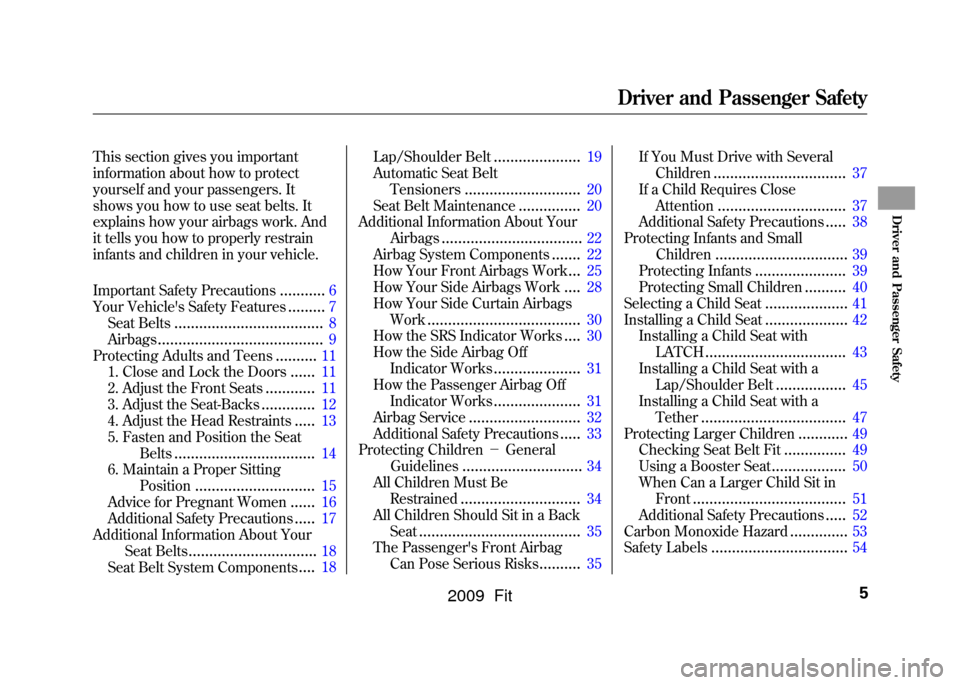
This section gives you important
information about how to protect
yourself and your passengers. It
shows you how to use seat belts. It
explains how your airbags work. And
it tells you how to properly restrain
infants and children in your vehicle.
Important Safety Precautions
...........
6
Your Vehicle's Safety Features
.........
7
Seat Belts
....................................
8
Airbags
........................................
9
Protecting Adults and Teens
..........
11
1. Close and Lock the Doors
......
11
2. Adjust the Front Seats
............
11
3. Adjust the Seat-Backs
.............
12
4. Adjust the Head Restraints
.....
13
5. Fasten and Position the Seat
Belts
..................................
14
6. Maintain a Proper Sitting
Position
.............................
15
Advice for Pregnant Women
......
16
Additional Safety Precautions
.....
17
Additional Information About Your Seat Belts
...............................
18
Seat Belt System Components
....
18 Lap/Shoulder Belt
.....................
19
Automatic Seat Belt
Tensioners
............................
20
Seat Belt Maintenance
...............
20
Additional Information About Your Airbags
..................................
22
Airbag System Components
.......
22
How Your Front Airbags Work
...
25
How Your Side Airbags Work
....
28
How Your Side Curtain Airbags Work
.....................................
30
How the SRS Indicator Works
....
30
How the Side Airbag Off
Indicator Works
.....................
31
How the Passenger Airbag Off Indicator Works
.....................
31
Airbag Service
...........................
32
Additional Safety Precautions
.....
33
Protecting Children -General
Guidelines
.............................
34
All Children Must Be Restrained
.............................
34
All Children Should Sit in a Back Seat
.......................................
35
The Passenger's Front Airbag
Can Pose Serious Risks
..........
35 If You Must Drive with Several
Children
................................
37
If a Child Requires Close Attention
...............................
37
Additional Safety Precautions
.....
38
Protecting Infants and Small Children
................................
39
Protecting Infants
......................
39
Protecting Small Children
..........
40
Selecting a Child Seat
....................
41
Installing a Child Seat
....................
42
Installing a Child Seat with LATCH
..................................
43
Installing a Child Seat with a Lap/Shoulder Belt
.................
45
Installing a Child Seat with a Tether
...................................
47
Protecting Larger Children
............
49
Checking Seat Belt Fit
...............
49
Using a Booster Seat
..................
50
When Can a Larger Child Sit in Front
.....................................
51
Additional Safety Precautions
.....
52
Carbon Monoxide Hazard
..............
53
Safety Labels
.................................
54
Driver and Passenger Safety
5
Driver and Passenger Safety
2009 Fit
Page 9 of 352

You'll find many safety
recommendations throughout this
section, and throughout this manual.
The recommendations on this page
are the ones we consider to be the
most important.
Always Wear Your Seat Belt
A seat belt is your best protection in
all types of collisions. Airbags are
designed to supplement seat belts,
not replace them. So even though
your vehicle is equipped with
airbags, make sure you and your
passengers always wear your seat
belts, and wear them properly (see
page14).Restrain All Children
Children age 12 and under should
ride properly restrained in a back
seat, not the front seat. Infants and
small children should be restrained
in a child seat. Larger children
should use a booster seat and a lap/
shoulder belt until they can use the
belt properly without a booster seat
(see pages34
-52).
Be Aware of Airbag Hazards
While airbags can save lives, they
can cause serious or fatal injuries to
occupants who sit too close to them,
or are not properly restrained.
Infants, young children, and short
adults are at the greatest risk. Be
sure to follow all instructions and
warnings in this manual.
Don't Drink and DriveAlcohol and driving don't mix. Even
one drink can reduce your ability to
respond to changing conditions, and
your reaction time gets worse with
every additional drink. So don't drink
and drive, and don't let your friends
drink and drive, either.Control Your SpeedExcessive speed is a major factor in
crash injuries and deaths. Generally,
the higher the speed, the greater the
risk, but serious injuries can also occur
at lower speeds. Never drive faster
than is safe for current conditions,
regardless of the maximum speed
posted.Keep Your Vehicle in Safe ConditionHaving a tire blowout or a mechanical
failure can be extremely hazardous. To
reduce the possibility of such
problems, check your tire pressures
and condition frequently, and perform
all regularly scheduled maintenance
(see page245).
Important Safety Precautions6
2009 Fit
Page 10 of 352
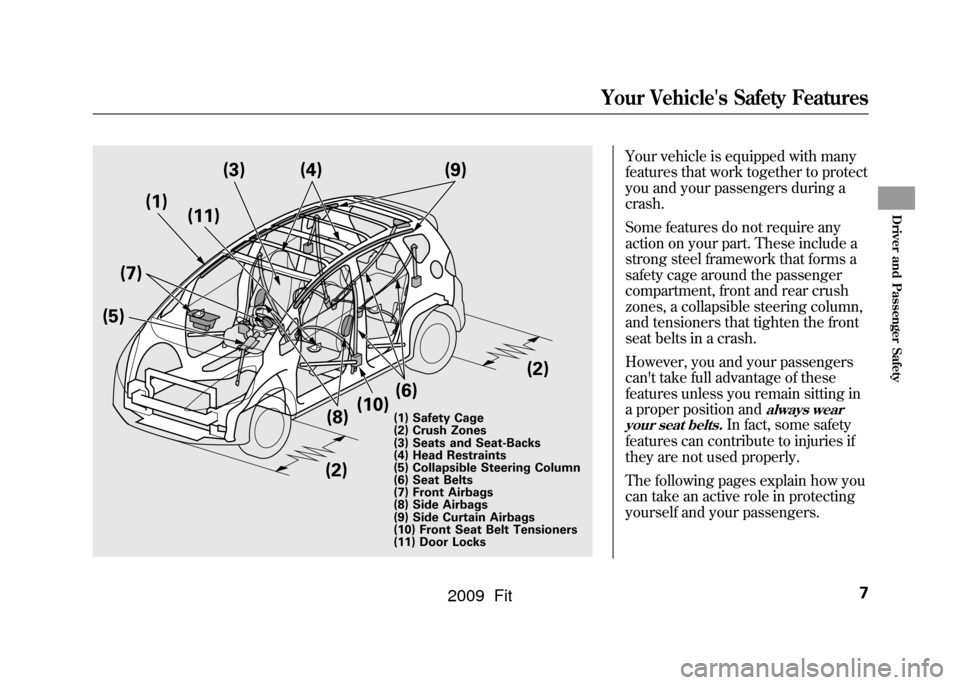
Your vehicle is equipped with many
features that work together to protect
you and your passengers during a
crash.
Some features do not require any
action on your part. These include a
strong steel framework that forms a
safety cage around the passenger
compartment, front and rear crush
zones, a collapsible steering column,
and tensioners that tighten the front
seat belts in a crash.
However, you and your passengers
can't take full advantage of these
features unless you remain sitting in
a proper position and
always wear
your seat belts.
In fact, some safety
features can contribute to injuries if
they are not used properly.
The following pages explain how you
can take an active role in protecting
yourself and your passengers.
(7) (1)
(4)
(5) (9)
(3)
(11)
(2)(8)
(10) (6) (2)
(1) Safety Cage
(2) Crush Zones
(3) Seats and Seat-Backs
(4) Head Restraints
(5) Collapsible Steering Column
(6) Seat Belts
(7) Front Airbags
(8) Side Airbags
(9) Side Curtain Airbags
(10) Front Seat Belt Tensioners
(11) Door Locks
Your Vehicle's Safety Features
7
Driver and Passenger Safety
2009 Fit
Page 11 of 352

Seat Belts
Your vehicle is equipped with seat
belts in all seating positions.
Your seat belt system also includes
an indicator on the instrument panel
and a beeper to remind you and your
passengers to fasten your seat belts.Why Wear Seat BeltsSeat belts are the single most
effective safety device for adults and
larger children. (Infants and smaller
children must be properly restrained
in child seats.)
Not wearing a seat belt properly
increases the chance of serious
injury or death in a crash, even
though your vehicle has airbags.
In addition, most states and all
Canadian provinces require you to
wear seat belts.
Not wearing a seat belt properly
increases the chance of serious
injury or death in a crash, even
though your vehicle has
airbags.
Be sure you and your
passengers always wear seat
belts and wear them properly.
When properly worn, seat belts:●Keep you connected to the vehicle
so you can take advantage of the
vehicle's built-in safety features.●Help protect you in almost every
type of crash, including:
- frontal impacts
- side impacts
- rear impacts
- rollovers
●Help keep you from being thrown
against the inside of the vehicle
and against other occupants.●Keep you from being thrown out of
the vehicle.●Help keep you in a good position
should the airbags ever deploy. A
good position reduces the risk of
injury from an inflating airbag and
allows you to get the best
advantage from the airbag.
Of course, seat belts cannot
completely protect you in every
crash. But in most cases, seat belts
can reduce your risk of serious
injury.
What You Should Do:Always wear your seat belt, and
make sure you wear it properly.
Your Vehicle's Safety Features8
2009 Fit
Page 13 of 352

The most important things you need
to know about your airbags are:●Airbags do not replace seat belts.They are designed to supplement
the seat belts.●Airbags offer no protection in rearimpacts, or minor frontal or side
collisions.●Airbags can pose serious hazards.To do their job, airbags must
inflate with tremendous force. So
while airbags help save lives, they
can cause minor injuries or more
serious or even fatal injuries if
occupants are not properly
restrained or sitting properly.
What you should do:
Always wear
your seat belt properly, and sit
upright and as far back from the
steering wheel as possible while
allowing full control of the vehicle. A
front passenger should move their
seat as far back from the dashboard
as possible. The rest of this section gives more
detailed information about how you
can maximize your safety.
Remember, however, that no safety
system can prevent all injuries or
deaths that can occur in a severe
crash, even when seat belts are
properly worn and the airbags
deploy.
Your Vehicle's Safety Features10
2009 Fit
Page 16 of 352
Reclining the seat-back too far
can result in serious injury or
death in a crash.
Adjust the seat-back to an
upright position, and sit well
back in the seat.
Reclining a seat-back so that the
shoulder part of the belt no longer
rests against the occupant's chest
reduces the protective capability of
the belt. It also increases the chance
of sliding under the belt in a crash
and being seriously injured. The
farther a seat-back is reclined, the
greater the risk of injury.
See page93for how to adjust the
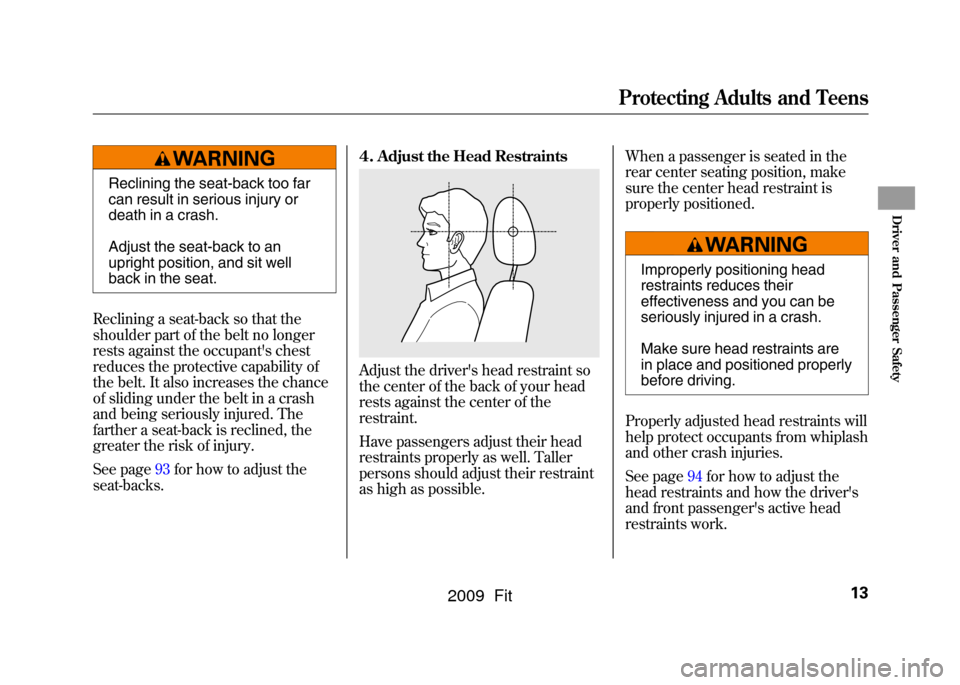
seat-backs. 4. Adjust the Head Restraints
Adjust the driver's head restraint so
the center of the back of your head
rests against the center of the
restraint.
Have passengers adjust their head
restraints properly as well. Taller
persons should adjust their restraint
as high as possible.When a passenger is seated in the
rear center seating position, make
sure the center head restraint is
properly positioned.
Improperly positioning head
restraints reduces their
effectiveness and you can be
seriously injured in a crash.
Make sure head restraints are
in place and positioned properly
before driving.
Properly adjusted head restraints will
help protect occupants from whiplash
and other crash injuries.
See page94for how to adjust the
head restraints and how the driver's
and front passenger's active head
restraints work.
Protecting Adults and Teens
13
Driver and Passenger Safety
2009 Fit
Page 17 of 352
5. Fasten and Position the SeatBelts
Insert the latch plate into the buckle,
then tug on the belt to make sure the
belt is securely latched. Check that
the belt is not twisted, because a
twisted belt can cause serious
injuries in a crash.
The seat belt in the center position of
the back seat can be unlatched and
retracted to allow the back seat to be
folded up or down. This seat belt
should be latched whenever the seat-
back is in an upright position. See
page99for how to unlatch and
relatch the seat belt.
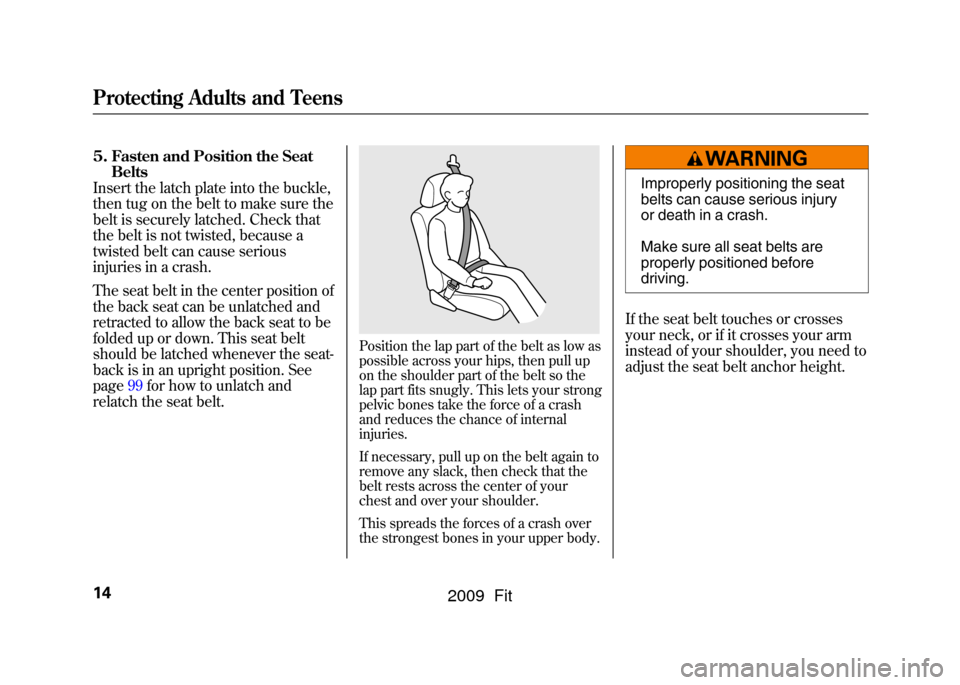
Position the lap part of the belt as low as
possible across your hips, then pull up
on the shoulder part of the belt so the
lap part fits snugly. This lets your strong
pelvic bones take the force of a crash
and reduces the chance of internal
injuries.
If necessary, pull up on the belt again to
remove any slack, then check that the
belt rests across the center of your
chest and over your shoulder.
This spreads the forces of a crash over
the strongest bones in your upper body.
Improperly positioning the seat
belts can cause serious injury
or death in a crash.
Make sure all seat belts are
properly positioned before
driving.
If the seat belt touches or crosses
your neck, or if it crosses your arm
instead of your shoulder, you need to
adjust the seat belt anchor height.
Protecting Adults and Teens14
2009 Fit