tire pressure HONDA FIT 2009 2.G Owners Manual
[x] Cancel search | Manufacturer: HONDA, Model Year: 2009, Model line: FIT, Model: HONDA FIT 2009 2.GPages: 352, PDF Size: 17.67 MB
Page 4 of 352

2009 Fit Online Reference Owner's Manual
Contents
Owner's Identification Form
Introduction .............................................................................................................................\
............................. i
A Few Words About Safety ......................................................................\
........................................................ iii
Your Vehicle at a Glance (main controls) ....................................................\
................................................ 3
Driver and Passenger Safety (seat belts, SRS, and child protection) ......................\
.............................. 5
Instruments and Controls
(indicators, gauges, dashboard, steering wheel, and other convenience items)
............. 57
Features (heating and cooling, audio, steering wheel, security, and cruise control) ................................. 109
Before Driving (fuel, vehicle break-in, and cargo loading) ...........................................\
........................... 197
Driving (engine and transmission operation) .........................................\
....................................................... 213
Maintenance (minder, fluid checking, minor services, and vehicle storage)........................................... 243
Taking Care of the Unexpected (flat tire, dead battery, overheating, and fuses) .............................. 283
Technical Information (vehicle specifications, tires, and emissions controls) ....................................... 315
Warranty and Customer Relations (U. S. and Canada only) (warranty and contact information) ... 331
Index ....................................................................................................................................\
.................................... I
Service Information Summary ( fluid capacities and tire pressures)
\
\
1 00X31-TK6-6003
Page 9 of 352

You'll find many safety
recommendations throughout this
section, and throughout this manual.
The recommendations on this page
are the ones we consider to be the
most important.
Always Wear Your Seat Belt
A seat belt is your best protection in
all types of collisions. Airbags are
designed to supplement seat belts,
not replace them. So even though
your vehicle is equipped with
airbags, make sure you and your
passengers always wear your seat
belts, and wear them properly (see
page14).Restrain All Children
Children age 12 and under should
ride properly restrained in a back
seat, not the front seat. Infants and
small children should be restrained
in a child seat. Larger children
should use a booster seat and a lap/
shoulder belt until they can use the
belt properly without a booster seat
(see pages34
-52).
Be Aware of Airbag Hazards
While airbags can save lives, they
can cause serious or fatal injuries to
occupants who sit too close to them,
or are not properly restrained.
Infants, young children, and short
adults are at the greatest risk. Be
sure to follow all instructions and
warnings in this manual.
Don't Drink and DriveAlcohol and driving don't mix. Even
one drink can reduce your ability to
respond to changing conditions, and
your reaction time gets worse with
every additional drink. So don't drink
and drive, and don't let your friends
drink and drive, either.Control Your SpeedExcessive speed is a major factor in
crash injuries and deaths. Generally,
the higher the speed, the greater the
risk, but serious injuries can also occur
at lower speeds. Never drive faster
than is safe for current conditions,
regardless of the maximum speed
posted.Keep Your Vehicle in Safe ConditionHaving a tire blowout or a mechanical
failure can be extremely hazardous. To
reduce the possibility of such
problems, check your tire pressures
and condition frequently, and perform
all regularly scheduled maintenance
(see page245).
Important Safety Precautions6
2009 Fit
Page 62 of 352
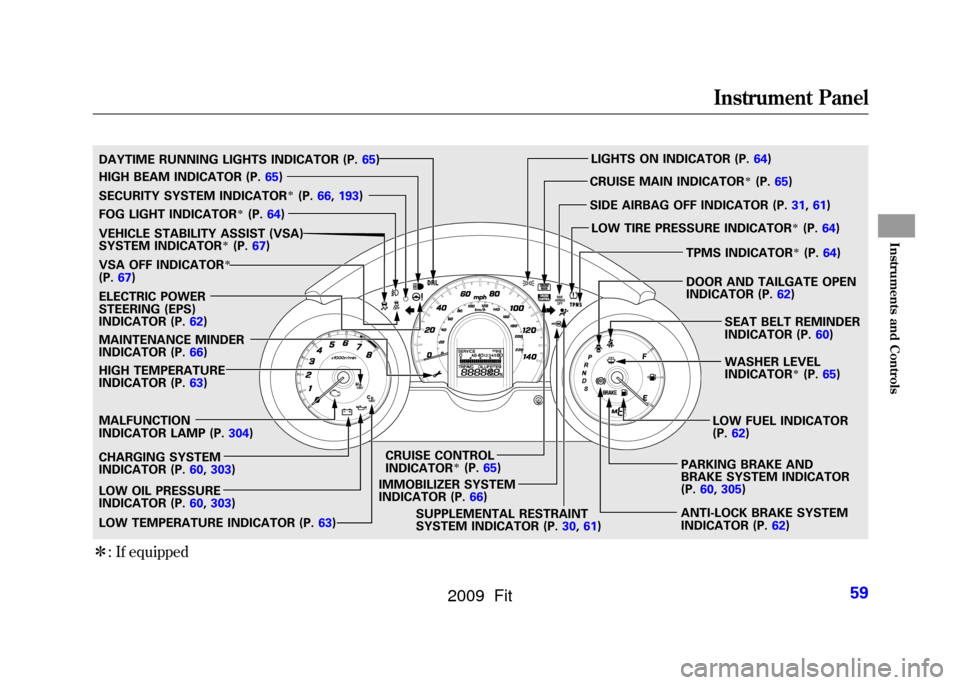
ꭧ: If equippedSECURITY SYSTEM INDICATOR
ꭧ(P. 66, 193)
WASHER LEVEL
INDICATOR
ꭧ(P.65)
MALFUNCTION
INDICATOR LAMP (P. 304)
CHARGING SYSTEM
INDICATOR (P. 60,303)
LOW OIL PRESSURE
INDICATOR (P. 60,303) IMMOBILIZER SYSTEM
INDICATOR (P.
66)
FOG LIGHT INDICATOR
ꭧ(P.
64) LIGHTS ON INDICATOR (P.
64)
SUPPLEMENTAL RESTRAINT
SYSTEM INDICATOR (P. 30,61)
MAINTENANCE MINDER
INDICATOR (P.
66) CRUISE MAIN INDICATOR
ꭧ(P.
65)
CRUISE CONTROL
INDICATOR
ꭧ(P. 65)
LOW TEMPERATURE INDICATOR (P. 63)
ELECTRIC POWER
STEERING (EPS)
INDICATOR (P.
62)
HIGH BEAM INDICATOR (P.
65)
LOW FUEL INDICATOR
(P.62)
TPMS INDICATOR
ꭧ(P.
64)
SEAT BELT REMINDER
INDICATOR (P. 60)
PARKING BRAKE AND
BRAKE SYSTEM INDICATOR
(P. 60, 305)
DAYTIME RUNNING LIGHTS INDICATOR (P.
65)
HIGH TEMPERATURE
INDICATOR (P. 63)
VEHICLE STABILITY ASSIST (VSA)
SYSTEM INDICATOR
ꭧ(P.
67)
VSA OFF INDICATORꭧ
(P. 67) SIDE AIRBAG OFF INDICATOR (P.
31,61)
LOW TIRE PRESSURE INDICATOR
ꭧ(P. 64)
ANTI-LOCK BRAKE SYSTEM
INDICATOR (P. 62)
DOOR AND TAILGATE OPEN
INDICATOR (P.
62)
Instrument Panel
59
Instruments and Controls
2009 Fit
Page 63 of 352
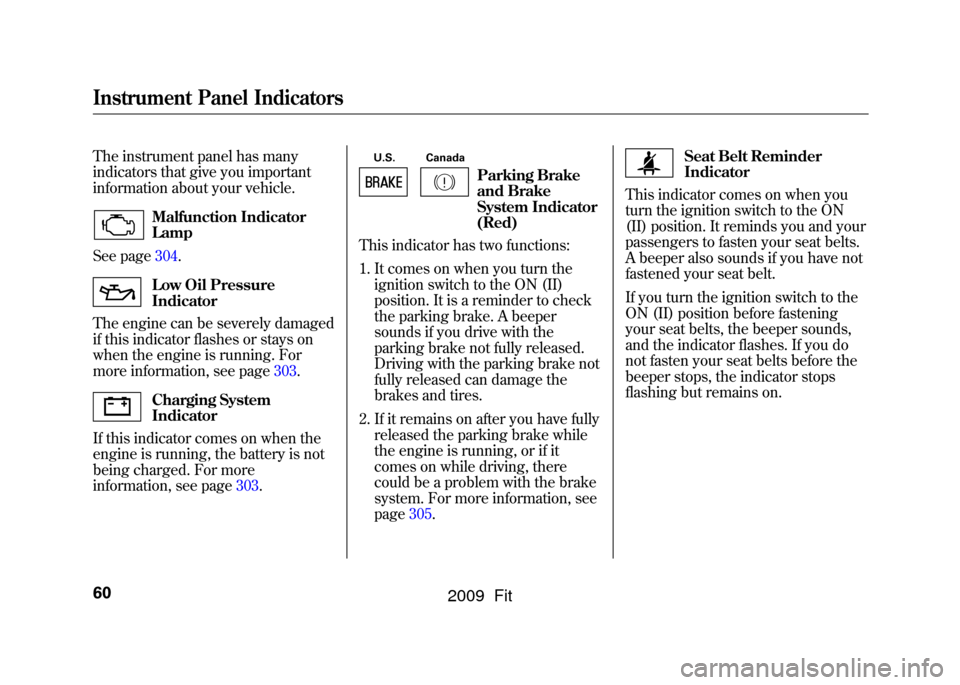
The instrument panel has many
indicators that give you important
information about your vehicle.
Malfunction Indicator
Lamp
See page304.Low Oil Pressure
Indicator
The engine can be severely damaged
if this indicator flashes or stays on
when the engine is running. For
more information, see page303.Charging System
Indicator
If this indicator comes on when the
engine is running, the battery is not
being charged. For more
information, see page303.
U.S. Canada
Parking Brake
and Brake
System Indicator
(Red)
This indicator has two functions:
1. It comes on when you turn the ignition switch to the ON (II)
position. It is a reminder to check
the parking brake. A beeper
sounds if you drive with the
parking brake not fully released.
Driving with the parking brake not
fully released can damage the
brakes and tires.
2. If it remains on after you have fully released the parking brake while
the engine is running, or if it
comes on while driving, there
could be a problem with the brake
system. For more information, see
page305.
Seat Belt Reminder
Indicator
This indicator comes on when you
turn the ignition switch to the ON
(II) position. It reminds you and your
passengers to fasten your seat belts.
A beeper also sounds if you have not
fastened your seat belt.
If you turn the ignition switch to the
ON (II) position before fastening
your seat belts, the beeper sounds,
and the indicator flashes. If you do
not fasten your seat belts before the
beeper stops, the indicator stops
flashing but remains on.
Instrument Panel Indicators60
2009 Fit
Page 67 of 352

Low Tire Pressure
Indicator
U.S. models onlyThis indicator normally comes on for
a few seconds when you turn the
ignition switch to the ON (II)
position. If it comes on while driving,
it indicates that one or more of your
vehicle's tires are significantly low on
pressure.
If this happens, pull to the side of the
road when it is safe, check which tire
has lost the pressure, and determine
the cause. If it is because of a flat tire,
replace the flat tire with the compact
spare (see page284),and have the
flat tire repaired as soon as possible.
If two or more tires are underinflated,
call a professional towing service
(see page311).For more
information, see page235.
Tire Pressure Monitoring
System (TPMS) Indicator
U.S. models onlyThis indicator normally comes on for
a few seconds when you turn the
ignition switch to the ON (II)
position.
If this indicator comes on and stays
on at any other time, or if it does not
come on when you turn the ignition
switch to the ON (II) position, there
is a problem with the TPMS. With
this indicator on, the low tire
pressure indicator will not come on
when a tire loses pressure. Take the
vehicle to your dealer to have the
system checked.
Lights On Indicator
This indicator reminds you that the
exterior lights are on. It comes on
when the light switch is in either the
or
position. If you turn the
ignition switch to the ACCESSORY
(I) or LOCK (0) position without
turning off the light switch, this
indicator will stay on. A reminder
chime will also sound when you open
the driver's door.Fog Light Indicator
On Sport modelThis indicator comes on when you
turn on the fog lights. For more
information, see page75.
Instrument Panel Indicators64
2009 Fit
Page 209 of 352
Modifying your vehicle, or installing
some non-Honda accessories, can
make it unsafe. Before you make any
modifications or add any accessories,
be sure to read the following
information.
Accessories
Your dealer has Honda accessories
that allow you to personalize your
vehicle. These accessories have been
designed and approved for your
vehicle, and are covered by warranty.
Although non-Honda accessories
may fit on your vehicle, they may not
meet factory specifications, and could
adversely affect your vehicle's
handling and stability.
Improper accessories or
modifications can affect your
vehicle's handling, stability, and
performance, and cause a
crash in which you can be hurt
or killed.
Follow all instructions in this
owner's manual regarding
accessories and modifications.
When properly installed, cellular
phones, alarms, two-way radios, and
low-powered audio systems should
not interfere with your vehicle's
computer controlled systems, such
as your airbags, anti-lock brakes, and
tire pressure monitoring system (if
equipped). Before installing any accessory:
●Make sure the accessory does not
obscure any lights, or interfere
with proper vehicle operation or
performance.●Be sure electronic accessories do
not overload electrical circuits (see
page307)or interfere with proper
operation of your vehicle.●Before installing any electronic
accessory, have the installer
contact your dealer for assistance.
If possible, have your dealer
inspect the final installation.●Do not install accessories on the
side pillars or across the rear
windows. Accessories installed in
these areas may interfere with
proper operation of the side
curtain airbags.
Accessories and Modifications206
2009 Fit
Page 210 of 352

Modifying Your Vehicle
Removing parts from your vehicle, or
replacing components with non-
Honda components could seriously
affect your vehicle's handling,
stability, and reliability.
Here are some examples:●Lowering your vehicle with a non-
Honda suspension kit that
significantly reduces ground
clearance can allow the
undercarriage to hit speed bumps
or other raised objects, which
could cause the airbags to deploy.●Raising your vehicle with a non-
Honda suspension kit can affect
the handling and stability.
●Non-Honda wheels, because they
are a universal design, can cause
excessive stress on suspension
components and will not be
compatible with the tire pressure
monitoring system (TPMS)
ꭧ.
ꭧ : If equipped
●Larger or smaller wheels and tires
can interfere with the operation of
your vehicle's anti-lock brakes and
other systems.●Modifying your steering wheel or
any other part of your vehicle's
safety features can make the
systems ineffective.
If you plan to modify your vehicle,
consult your dealer.
CONTINUED
Accessories and Modifications
207
Before Driving
2009 Fit
Page 216 of 352

This section gives you tips on
starting the engine under various
conditions, and how to operate the
manual and automatic transmissions.
It also includes important information
on parking your vehicle, the braking
system, the vehicle stability assist
(VSA
®), and the tire pressure
monitoring system (TPMS). Driving Guidelines
......................
214
Preparing to Drive
......................
215
Starting the Engine
.....................
216
Manual Transmission
.................
217
Automatic Transmission
.............
219
Driving with the Paddle Shifters
(Sport only)
.............................
224
Parking
.......................................
229
Braking System
..........................
230
Anti-lock Brakes (ABS)
...............
231
Vehicle Stability Assist (VSA
®),
aka Electronic Stability Control
(ESC), System
.....................
233
Tire Pressure Monitoring System (TPMS)
...................................
235
Towing a Trailer
..........................
238
Towing Your Vehicle Behind a
Motorhome
.............................
238
Driving
213
Driving
2009 Fit
Page 218 of 352

You should do the following checks
and adjustments before you drive
your vehicle.
1. Make sure all windows, mirrors,and outside lights are clean and
unobstructed. Remove frost, snow,
or ice.
2. Check that the hood is fully closed.
3. Visually check the tires. If a tire looks low, use a gauge to check its
pressure (see page273).
4. Check that any items you may be carrying are stored properly or
fastened down securely. 5. Check the seat adjustment (see
page 93).
6. Check the adjustment of the inside and outside mirrors (see page
101).
7. Check the steering wheel adjustment (see page 77).
8. Make sure the doors and the tailgate are securely closed and
locked.
9. Fasten your seat belt. Check that your passengers have fastened
their seat belts (see page 14).
10. When you start the engine, check the gauges and indicators in the
instrument panel (see page 59).
Preparing to Drive
215
Driving
2009 Fit
Page 236 of 352
If equippedThe vehicle stability assist (VSA)
system helps to stabilize the vehicle
during cornering if the vehicle turns
more or less than desired. It also
assists you in maintaining traction
while accelerating on loose or
slippery road surfaces. It does this by
regulating the engine's output and by
selectively applying the brakes.
When VSA activates, you may notice
that the engine does not respond to
the accelerator in the same way it
does at other times. There may also
be some noise from the VSA
hydraulic system. You will also see
the VSA system indicator blink.
The VSA system cannot enhance the
vehicle's driving stability in all
situations and does not control your
vehicle's entire braking system. It is
still your responsibility to drive and
corner at reasonable speeds and to
leave a sufficient margin of safety.
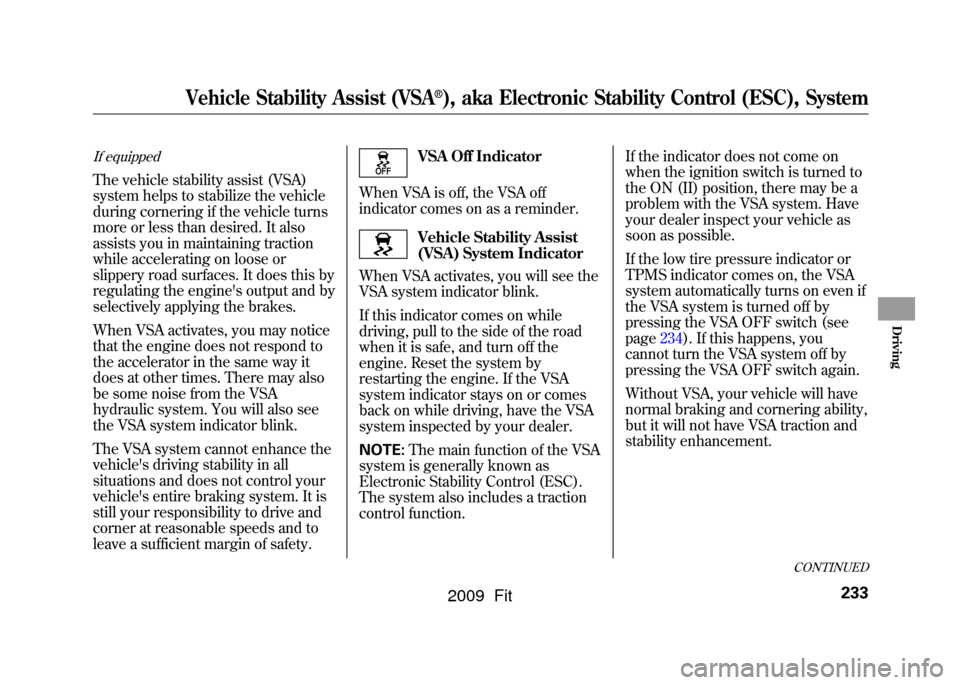
VSA Off Indicator
When VSA is off, the VSA off
indicator comes on as a reminder.Vehicle Stability Assist
(VSA) System Indicator
When VSA activates, you will see the
VSA system indicator blink.
If this indicator comes on while
driving, pull to the side of the road
when it is safe, and turn off the
engine. Reset the system by
restarting the engine. If the VSA
system indicator stays on or comes
back on while driving, have the VSA
system inspected by your dealer.
NOTE: The main function of the VSA
system is generally known as
Electronic Stability Control (ESC).
The system also includes a traction
control function. If the indicator does not come on
when the ignition switch is turned to
the ON (II) position, there may be a
problem with the VSA system. Have
your dealer inspect your vehicle as
soon as possible.
If the low tire pressure indicator or
TPMS indicator comes on, the VSA
system automatically turns on even if
the VSA system is turned off by
pressing the VSA OFF switch (see
page234).If this happens, you
cannot turn the VSA system off by
pressing the VSA OFF switch again.
Without VSA, your vehicle will have
normal braking and cornering ability,
but it will not have VSA traction and
stability enhancement.
CONTINUED
Vehicle Stability Assist (VSA
®), aka Electronic Stability Control (ESC), System
233
Driving
2009 Fit