tire type HONDA FIT 2009 2.G Owners Manual
[x] Cancel search | Manufacturer: HONDA, Model Year: 2009, Model line: FIT, Model: HONDA FIT 2009 2.GPages: 352, PDF Size: 17.67 MB
Page 9 of 352

You'll find many safety
recommendations throughout this
section, and throughout this manual.
The recommendations on this page
are the ones we consider to be the
most important.
Always Wear Your Seat Belt
A seat belt is your best protection in
all types of collisions. Airbags are
designed to supplement seat belts,
not replace them. So even though
your vehicle is equipped with
airbags, make sure you and your
passengers always wear your seat
belts, and wear them properly (see
page14).Restrain All Children
Children age 12 and under should
ride properly restrained in a back
seat, not the front seat. Infants and
small children should be restrained
in a child seat. Larger children
should use a booster seat and a lap/
shoulder belt until they can use the
belt properly without a booster seat
(see pages34
-52).
Be Aware of Airbag Hazards
While airbags can save lives, they
can cause serious or fatal injuries to
occupants who sit too close to them,
or are not properly restrained.
Infants, young children, and short
adults are at the greatest risk. Be
sure to follow all instructions and
warnings in this manual.
Don't Drink and DriveAlcohol and driving don't mix. Even
one drink can reduce your ability to
respond to changing conditions, and
your reaction time gets worse with
every additional drink. So don't drink
and drive, and don't let your friends
drink and drive, either.Control Your SpeedExcessive speed is a major factor in
crash injuries and deaths. Generally,
the higher the speed, the greater the
risk, but serious injuries can also occur
at lower speeds. Never drive faster
than is safe for current conditions,
regardless of the maximum speed
posted.Keep Your Vehicle in Safe ConditionHaving a tire blowout or a mechanical
failure can be extremely hazardous. To
reduce the possibility of such
problems, check your tire pressures
and condition frequently, and perform
all regularly scheduled maintenance
(see page245).
Important Safety Precautions6
2009 Fit
Page 211 of 352
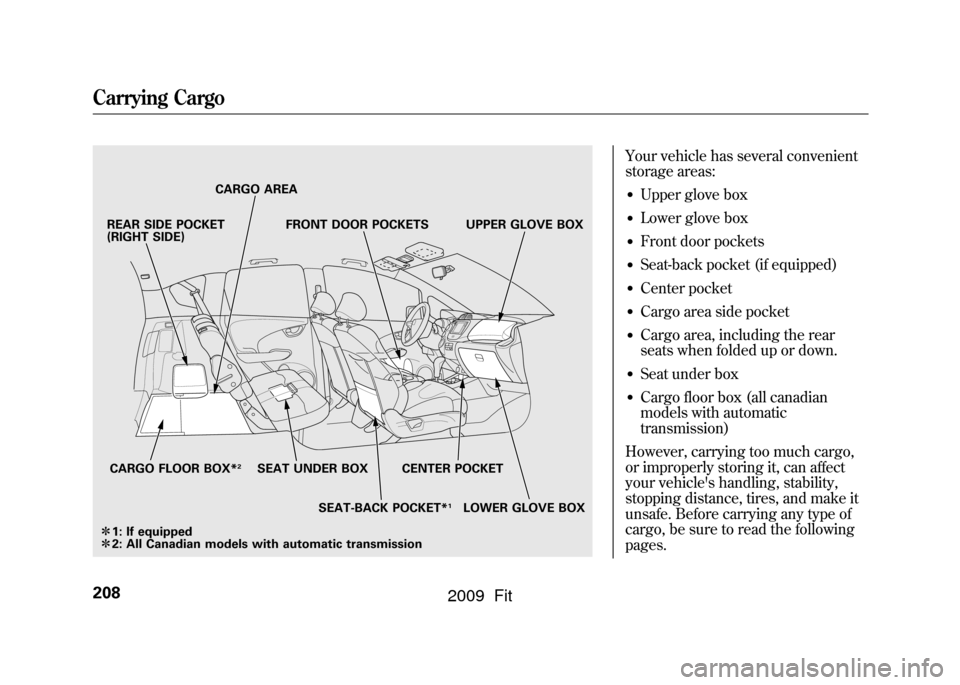
Your vehicle has several convenient
storage areas:●Upper glove box●Lower glove box●Front door pockets●Seat-back pocket (if equipped)●Center pocket●Cargo area side pocket●Cargo area, including the rear
seats when folded up or down.●Seat under box●Cargo floor box (all canadian
models with automatic
transmission)
However, carrying too much cargo,
or improperly storing it, can affect
your vehicle's handling, stability,
stopping distance, tires, and make it
unsafe. Before carrying any type of
cargo, be sure to read the following
pages.
REAR SIDE POCKET
(RIGHT SIDE)
CARGO FLOOR BOX*
2
FRONT DOOR POCKETS
SEAT-BACK POCKET*
1
SEAT UNDER BOX CENTER POCKET
CARGO AREA
LOWER GLOVE BOX
ꭧ 1: If equipped
ꭧ 2: All Canadian models with automatic transmission UPPER GLOVE BOX
Carrying Cargo208
2009 Fit
Page 237 of 352
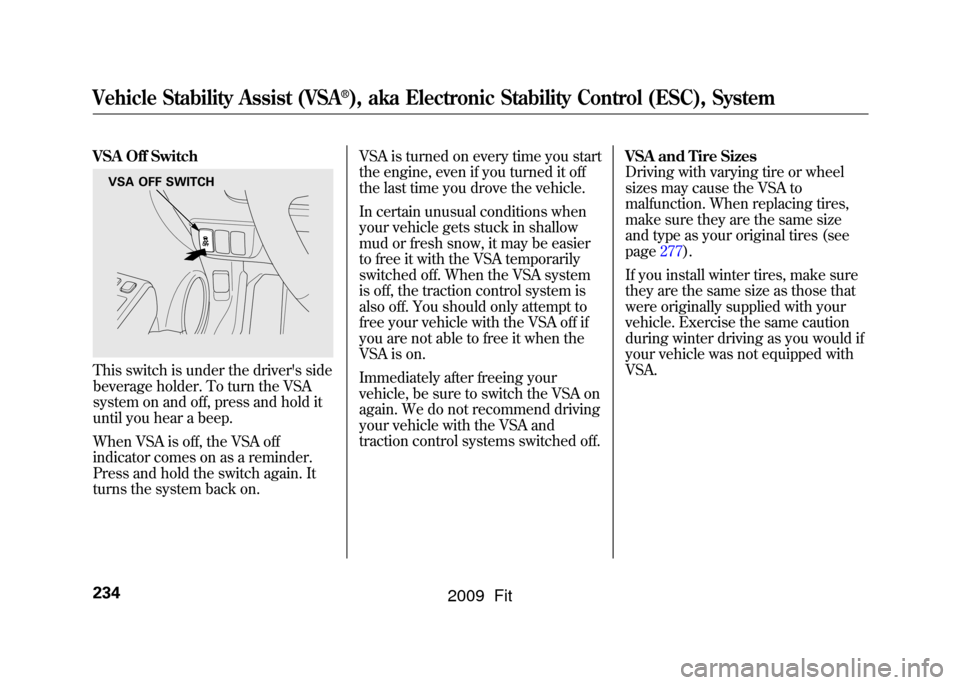
VSA Off SwitchThis switch is under the driver's side
beverage holder. To turn the VSA
system on and off, press and hold it
until you hear a beep.
When VSA is off, the VSA off
indicator comes on as a reminder.
Press and hold the switch again. It
turns the system back on.VSA is turned on every time you start
the engine, even if you turned it off
the last time you drove the vehicle.
In certain unusual conditions when
your vehicle gets stuck in shallow
mud or fresh snow, it may be easier
to free it with the VSA temporarily
switched off. When the VSA system
is off, the traction control system is
also off. You should only attempt to
free your vehicle with the VSA off if
you are not able to free it when the
VSA is on.
Immediately after freeing your
vehicle, be sure to switch the VSA on
again. We do not recommend driving
your vehicle with the VSA and
traction control systems switched off.
VSA and Tire Sizes
Driving with varying tire or wheel
sizes may cause the VSA to
malfunction. When replacing tires,
make sure they are the same size
and type as your original tires (see
page
277).
If you install winter tires, make sure
they are the same size as those that
were originally supplied with your
vehicle. Exercise the same caution
during winter driving as you would if
your vehicle was not equipped with
VSA.
VSA OFF SWITCH
Vehicle Stability Assist (VSA
®), aka Electronic Stability Control (ESC), System
234
2009 Fit
Page 253 of 352

However, service at a dealer is not
mandatory to keep your warranties in
effect. Maintenance may be done by
any qualified service facility or
person who is skilled in this type of
automotive service. Make sure to
have the service facility or person
reset the display as previously
described. Keep all receipts as proof
of completion, and have the person
who does the work fill out your
Honda Service History or Canadian
Maintenance Log. Check your
warranty booklet for more
information.
We recommend using Honda parts
and fluids whenever you have
maintenance done. These are
manufactured to the same high
quality standards as the original
components, so you can be confident
of their performance and durability.U.S. Vehicles:
Maintenance,
replacement, or repair of
emissions control devices and
systems may be done by any
automotive repair establishment
or individual using parts that are
‘‘ certified ’’to EPA standards.
According to state and federal
regulations, failure to perform
maintenance on the items marked
with# will not void your emissions
warranties. However, all
maintenance services should be
performed in accordance with the
intervals indicated by the information
display.
Owner's Maintenance Checks
You should check the following
items at the specified intervals. If you
are unsure of how to perform any
check, turn to the appropriate page
listed.
●Engine oil level -Check every
time you fill the fuel tank. See page
201.●Engine coolant level -Check the
radiator reserve tank every time
you fill the fuel tank. See page202.●Automatic transmission -Check
the fluid level monthly. See page
259.●Brakes -Check the fluid level
monthly. See page 261.●Tires-Check the tire pressure
monthly. Examine the tread for
wear and foreign objects. See page
274.●Lights -Check the operation of
the headlights, parking lights,
taillights, high-mount brake light,
and license plate lights monthly.
See page 262.
Maintenance Minder250
2009 Fit
Page 276 of 352
To safely operate your vehicle, your
tires must be the proper type and
size, in good condition with adequate
tread, and correctly inflated.
The following pages give more
detailed information on how to take
care of your tires and what to do
when they need to be replaced.
Using tires that are excessively
worn or improperly inflated can
cause a crash in which you can
be seriously hurt or killed.
Follow all instructions in this
owner's manual regarding tire
inflation and maintenance.Inflation Guidelines
Keeping the tires properly inflated
provides the best combination of
handling, tread life, and riding
comfort.
●Underinflated tires wear unevenly,
adversely affect handling and fuel
economy, and are more likely to
fail from being overheated.●Overinflated tires can make your
vehicle ride more harshly, are
more prone to damage from road
hazards, and wear unevenly.
The tire pressure monitoring system
(TPMS)
ꭧwarns you when a tire
pressure is low. See page 235for
more information.
ꭧ : If equipped Even though your vehicle is
equipped with TPMS, we
recommend that you visually check
your tires every day. If you think a
tire might be low, check it
immediately with a tire gauge.
Use a gauge to measure the air
pressure in each tire at least once a
month. Even tires that are in good
condition may lose 1 to 2 psi (10 to
20 kPa, 0.1 to 0.2 kgf/cm
2) per
month. Remember to check the
spare tire (if equipped) at the same
time.
Check the air pressures when the
tires are cold. This means the vehicle
has been parked for at least 3 hours,
or driven less than 1 mile (1.6 km).
Add or release air, if needed, to
match the recommended cold tire
pressures.CONTINUED
Tires
273
Maintenance
2009 Fit
Page 280 of 352
It is best to replace all four tires at
the same time. If that is not possible
or necessary, replace the two front
tires or two rear tires as a pair.
Replacing just one tire can seriously
affect your vehicle's handling.
If you ever replace a wheel, make
sure that the wheel's specifications
match those of the original wheels.
Also be sure you use only TPMS
specific wheels (if equipped). If you
do not, the tire pressure monitoring
system will not work.
Replacement wheels are available at
your dealer.
Installing improper tires on your
vehicle can affect handling and
stability. This can cause a crash
in which you can be seriously
hurt or killed.
Always use the size and type of
tires recommended in this
owner's manual.Wheel and Tire Specifications
Wheels:
All models except Sport15 x 5 1/2JSport model16 x 6J
Tires:All models except Sport175/65R15 84SSport model185/55R16 83H
See page321for DOT tire quality
grading information, and page323
for tire size and labeling information.
CONTINUED
Tires
277
Maintenance
2009 Fit
Page 326 of 352
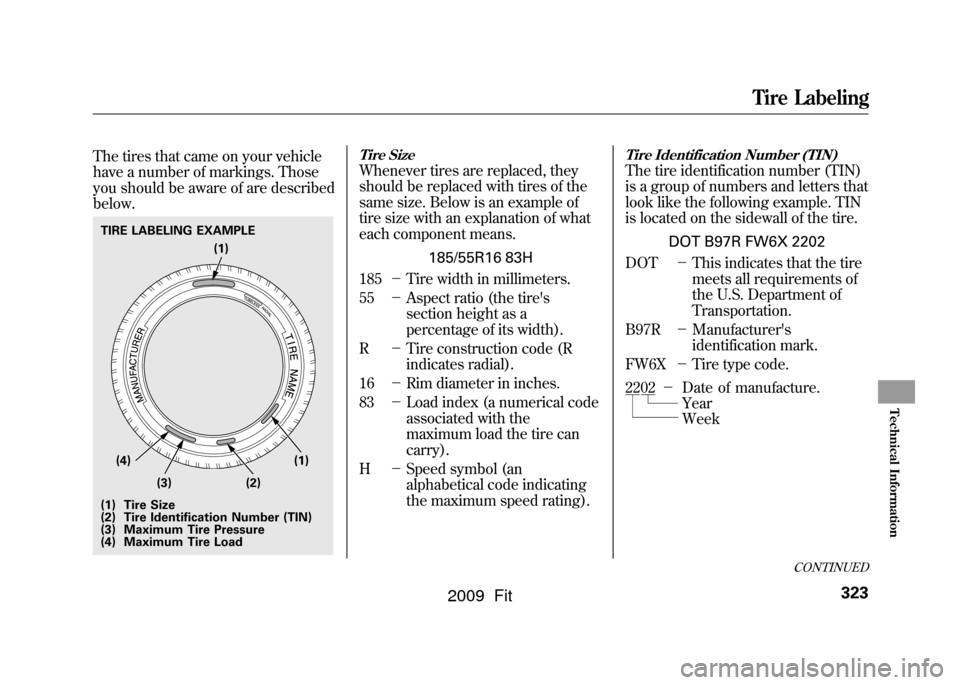
The tires that came on your vehicle
have a number of markings. Those
you should be aware of are described
below.
Tire SizeWhenever tires are replaced, they
should be replaced with tires of the
same size. Below is an example of
tire size with an explanation of what
each component means.185/55R16 83H
185 -Tire width in millimeters.
55 -Aspect ratio (the tire's
section height as a
percentage of its width).
R -Tire construction code (R
indicates radial).
16 -Rim diameter in inches.
83 -Load index (a numerical code
associated with the
maximum load the tire can
carry).
H -Speed symbol (an
alphabetical code indicating
the maximum speed rating).
Tire Identification Number (TIN)The tire identification number (TIN)
is a group of numbers and letters that
look like the following example. TIN
is located on the sidewall of the tire.
DOT B97R FW6X 2202
DOT -This indicates that the tire
meets all requirements of
the U.S. Department of
Transportation.
B97R -Manufacturer's
identification mark.
FW6X -Tire type code.
TIRE LABELING EXAMPLE
(1)
(1) Tire Size
(2) Tire Identification Number (TIN)
(3) Maximum Tire Pressure
(4) Maximum Tire Load (4)
(3) (2)(1)
2202
-
Year
Week Date of manufacture.
CONTINUED
Tire Labeling
323
Technical Information
2009 Fit
Page 336 of 352

U.S. Owners
Your new vehicle is covered by these
warranties:New Vehicle Limited Warranty
-
covers your new vehicle, except for
the battery, emissions control
systems, and accessories against
defects in materials and
workmanship.
Emissions Control Systems Defects
Warranty and Emissions
Performance Warranty
- these two
warranties cover your vehicle's
emissions control systems. Time,
mileage, and coverage are
conditional. Please read your
warranty booklet for exact
information.
Original Equipment Battery Limited
Warranty
- this warranty gives up to
100% credit toward a replacement
battery.
Seat Belt Limited Warranty
- a seat
belt that fails to function properly is
covered by a limited warranty. Please
read your warranty booklet for
details.
Rust Perforation Limited Warranty
-
all exterior body panels are covered
for rust-through from the inside for
the specified time period with no
mileage limit.
Accessory Limited Warranty
-
Honda accessories are covered
under this warranty. Time and
mileage limits depend on the type of
accessory and other factors. Please
read your warranty booklet for
details.
Replacement Parts Limited Warranty- covers all Honda replacement
parts against defects in materials and
workmanship.
Replacement Battery Limited
Warranty
- provides prorated
coverage for a replacement battery
purchased from your dealer.
Replacement Muffler Lifetime
Limited Warranty
- provides
coverage for as long as the purchaser
of the muffler owns the vehicle.
Restrictions and exclusions apply to
all these warranties. Please read the
2009 Honda warranty information
booklet that came with your vehicle
for precise information on warranty
coverages. Your vehicle's original
tires are covered by their
manufacturer. Tire warranty
information is in a separate booklet.
Canadian Owners
Please refer to the 2009 warranty
manual that came with your vehicle.
Warranty Coverages
333
Warranty and Customer Relations
2009 Fit