TPMS HONDA FIT 2010 2.G User Guide
[x] Cancel search | Manufacturer: HONDA, Model Year: 2010, Model line: FIT, Model: HONDA FIT 2010 2.GPages: 351, PDF Size: 5.67 MB
Page 288 of 351

To safely operate your vehicle, your
tires must be the proper type and
size, in good condition with adequate
tread, and correctly inflated.
The following pages give more
detailed information on how to take
care of your tires and what to do
when they need to be replaced.
Using tires that are excessively
worn or improperly inflated can
cause a crash in which you can
be seriously hurt or killed.
Follow all instructions in this
owner's manual regarding tire
inflation and maintenance.Inflation Guidelines
Keeping the tires properly inflated
provides the best combination of
handling, tread life, and ridingcomfort.
● Underinflated tires wear unevenly,
adversely affect handling and fuel
economy, and are more likely to
fail from being overheated.
● Overinflated tires can make your
vehicle ride more harshly, are
more prone to damage from road
hazards, and wear unevenly.
The tire pressure monitoring system(TPMS)
ꭧwarns you when a tire
pressure is low. See page 235 for
more information. ꭧ : If equipped Even though your vehicle is
equipped with TPMS, we
recommend that you visually check
your tires every day. If you think a
tire might be low, check it
immediately with a tire gauge.
Use a gauge to measure the air
pressure in each tire at least once a
month. Even tires that are in good
condition may lose 1 to 2 psi (10 to
20 kPa, 0.1 to 0.2 kgf/cm
2) per
month. Remember to check the
spare tire (if equipped) at the sametime.
Check the air pressures when the
tires are cold. This means the vehicle
has been parked for at least 3 hours,
or driven less than 1 mile (1.6 km).
Add or release air, if needed, to
match the recommended cold tirepressures.
CONTINUED
Tires
273
Maintenance
Table of Contents
Page 292 of 351

It is best to replace all four tires at
the same time. If that is not possible
or necessary, replace the two front
tires or two rear tires as a pair.
Replacing just one tire can seriously
affect your vehicle's handling.
If you ever replace a wheel, make
sure that the wheel's specifications
match those of the original wheels.
Also be sure you use only TPMS
specific wheels (if equipped). If you
do not, the tire pressure monitoring
system will not work.
Replacement wheels are available at
your dealer.
Installing improper tires on your
vehicle can affect handling and
stability. This can cause a crash
in which you can be seriously
hurt or killed.
Always use the size and type of
tires recommended in this
owner's manual.Wheel and Tire SpecificationsWheels:All models except Sport
15 x 5 1/2J
Sport model
16 x 6J
Tires:
All models except Sport
175/65R15 84S
Sport model
185/55R16 83H
See page 321 for DOT tire quality
grading information, and page 323
for tire size and labeling information.
CONTINUED
Tires
277
Maintenance
Table of Contents
Page 299 of 351
Except all Canadian models withautomatic transmission
Use the compact spare tire as a
temporary replacement only. Get
your regular tire repaired or
replaced, and put it back on your
vehicle as soon as you can.
Check the inflation pressure of the
compact spare tire every time you
check the other tires. It should be
inflated to:
60 psi (420 kPa, 4.2 kgf/cm
2) Follow these precautions:
● Never exceed 50 mph (80 km/h).
● This tire gives a harsher ride and
less traction on some road
surfaces. Use greater caution while driving.
● Do not mount tire chains on the
compact spare tire.
● Do not use your compact spare tire
on another vehicle unless it is the
same make and model.
● On vehicles with the TPMS
system, the low tire pressure
indicator comes on and stays on
after you replace the flat tire with
the compact spare tire. After
several miles (kilometers) driving
with the compact spare tire, the
TPMS indicator comes on and the
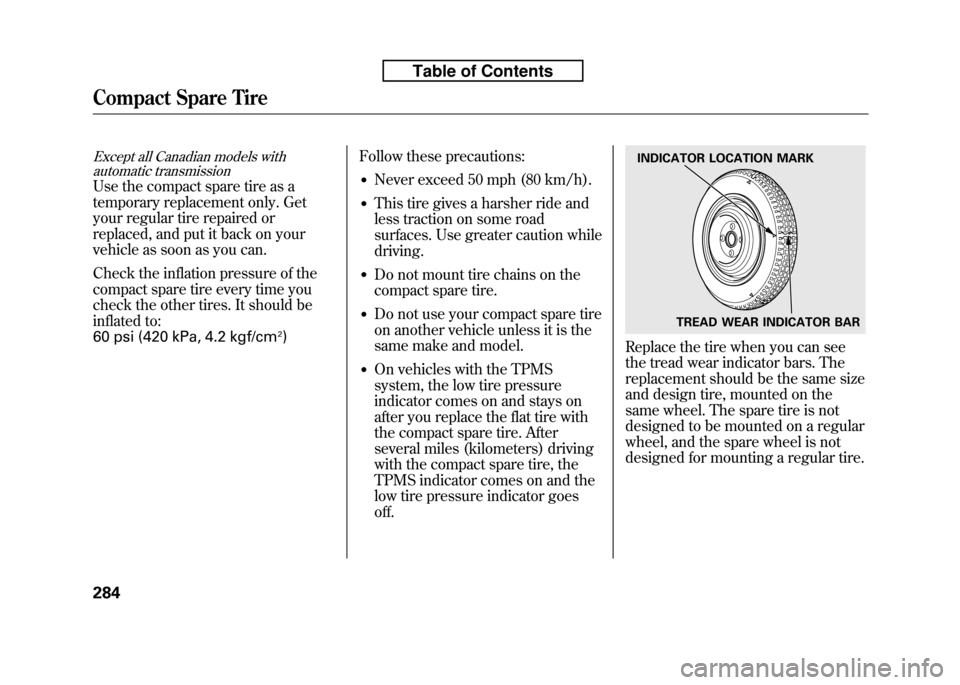
low tire pressure indicator goesoff.Replace the tire when you can see
the tread wear indicator bars. The
replacement should be the same size
and design tire, mounted on the
same wheel. The spare tire is not
designed to be mounted on a regular
wheel, and the spare wheel is not
designed for mounting a regular tire.
INDICATOR LOCATION MARK
TREAD WEAR INDICATOR BAR
Compact Spare Tire
284
Table of Contents
Page 304 of 351
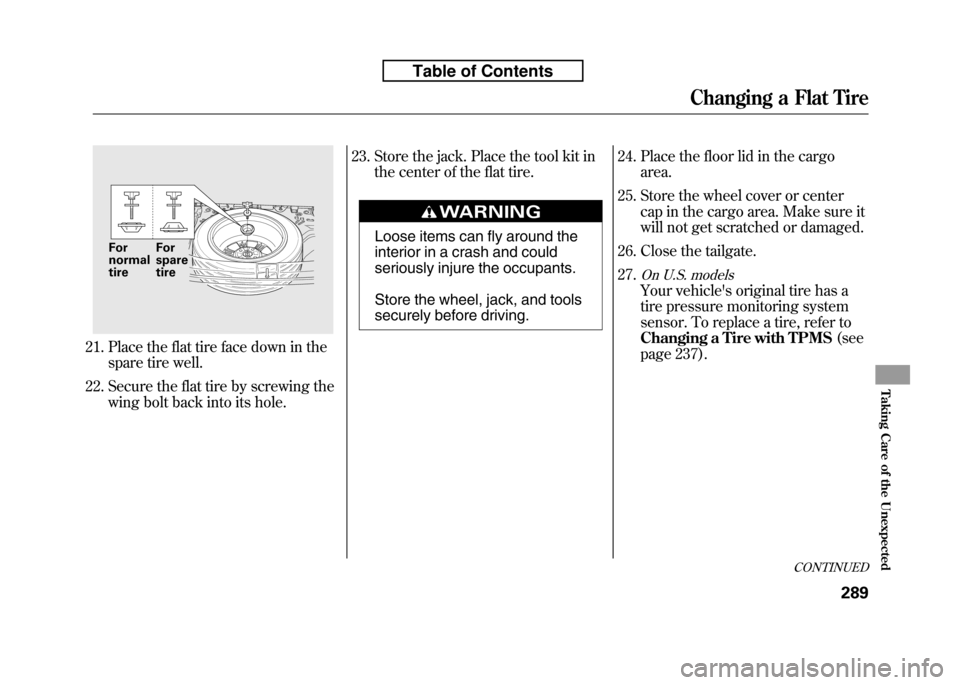
21. Place the flat tire face down in thespare tire well.
22. Secure the flat tire by screwing the wing bolt back into its hole. 23. Store the jack. Place the tool kit in
the center of the flat tire.
Loose items can fly around the
interior in a crash and could
seriously injure the occupants.
Store the wheel, jack, and tools
securely before driving. 24. Place the floor lid in the cargo
area.
25. Store the wheel cover or center cap in the cargo area. Make sure it
will not get scratched or damaged.
26. Close the tailgate. 27.
On U.S. models
Your vehicle's original tire has a
tire pressure monitoring system
sensor. To replace a tire, refer to
Changing a Tire with TPMS (see
page 237).
For normal tire For spare tire
CONTINUED
Changing a Flat Tire
289
Taking Care of the Unexpected
Table of Contents
Page 324 of 351
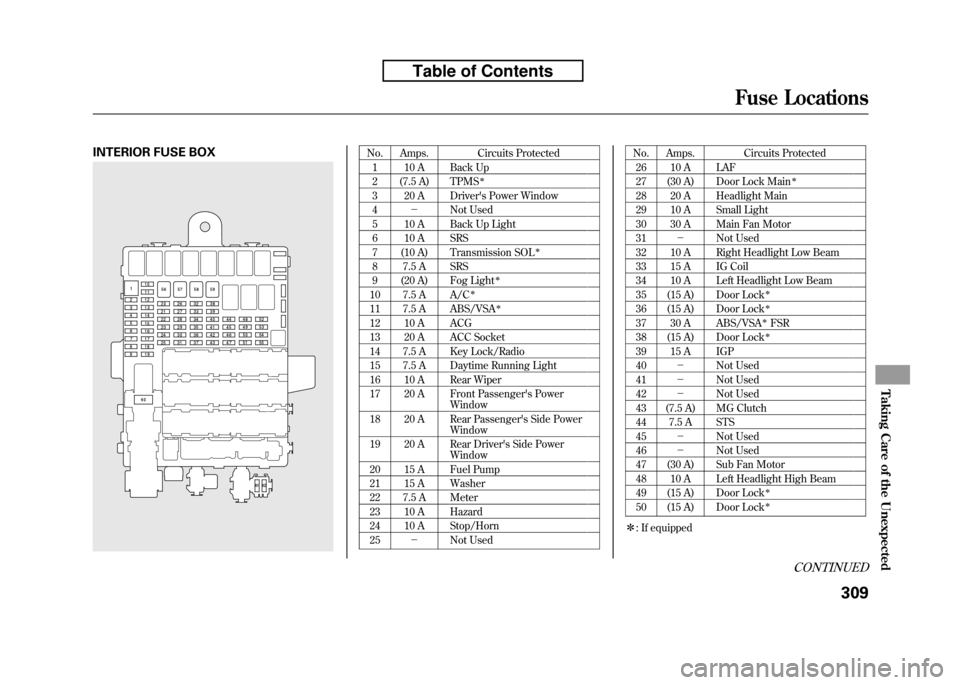
INTERIOR FUSE BOXNo. Amps. Circuits Protected1 10 A Back Up
2 (7.5 A) TPMS
ꭧ
3 20 A Driver's Power Window 4 - Not Used
5 10 A Back Up Light
6 10 A SRS
7 (10 A) Transmission SOL
ꭧ
8 7.5 A SRS
9 (20 A) Fog Lightꭧ
10 7.5 A A/Cꭧ
11 7.5 A ABS/VSAꭧ
12 10 A ACG
13 20 A ACC Socket
14 7.5 A Key Lock/Radio
15 7.5 A Daytime Running Light
16 10 A Rear Wiper
17 20 A Front Passenger's Power Window
18 20 A Rear Passenger's Side Power Window
19 20 A Rear Driver's Side Power Window
20 15 A Fuel Pump
21 15 A Washer
22 7.5 A Meter
23 10 A Hazard
24 10 A Stop/Horn25 - Not Used No. Amps. Circuits Protected
26 10 A LAF
27 (30 A) Door Lock Main
ꭧ
28 20 A Headlight Main
29 10 A Small Light
30 30 A Main Fan Motor31 - Not Used
32 10 A Right Headlight Low Beam
33 15 A IG Coil
34 10 A Left Headlight Low Beam
35 (15 A) Door Lock
ꭧ
36 (15 A) Door Lockꭧ
37 30 A ABS/VSAꭧFSR
38 (15 A) Door Lockꭧ
39 15 A IGP40 - Not Used
41 - Not Used
42 - Not Used
43 (7.5 A) MG Clutch
44 7.5 A STS45 - Not Used
46 - Not Used
47 (30 A) Sub Fan Motor
48 10 A Left Headlight High Beam
49 (15 A) Door Lock
ꭧ
50 (15 A) Door Lockꭧ
ꭧ : If equipped
CONTINUED
Fuse Locations
309
Taking Care of the Unexpected
Table of Contents
Page 330 of 351
The diagrams in this section give you
the dimensions and capacities of
your vehicle and the locations of the
identification numbers. It also
includes information you should
know about your vehicle's tires and
emissions control systems.Identification Numbers...............
316
Specifications ..............................
318
DOT Tire Quality Grading (U.S. Vehicles) .............................
321
Uniform Tire Quality Grading ...............................
321
Treadwear ...............................
321
Traction ..................................
321
Temperature ...........................
322
Tire Labeling ..............................
323
Tire Pressure Monitoring System (TPMS) -Required Federal
Explanation .........................
324
Emissions Controls .....................
326
The Clean Air Act ....................
326
Crankcase Emissions Control System ................................
326
Evaporative Emissions Control System ................................
326
Onboard Refueling Vapor
Recovery .............................
326
Exhaust Emissions Controls ..............................
327
Replacement Parts ..................
327Three Way Catalytic
Converter ................................
328
Emissions Testing .......................
329
Technical Information
315
Technical Information
Page 339 of 351

Glossary of Tire Terminology
Cold Tire Pressure - The tire air
pressure when the vehicle has been
parked for at least three hours or
driven less than 1 mile (1.6km).
Load Rating - Means the maximum
load that a tire is rated to carry for a
given inflation presure.
Maximum Inflation Pressure - the
maximum tire air pressure that the
tire can hold.
Maximum Load Rating - Means the
load rating for a tire at the maximum
permissible inflation pressure for thattire.
Recommended Inflation Pressure -
The cold tire inflation pressure
recommended by the manufacturer.
Treadwear Indicators (TWI) - Means
the projections within the principal
grooves designed to give a visual
indication of the degrees of wear of
the tread.Tire Pressure Monitoring System(TPMS)
-Required Federal
Explanation
U.S. models only
Each tire, including the spare (if
provided), should be checked
monthly when cold and inflated to
the inflation pressure recommended
by the vehicle manufacturer on the
vehicle placard or tire inflation
pressure label.
(If your vehicle has tires of a different
size than the size indicated on the
vehicle placard or tire inflation
pressure label, you should determine
the proper tire inflation pressure for
those tires.) As an added safety feature, your
vehicle has been equipped with a tire
pressure monitoring system (TPMS)
that illuminates a low tire pressuretelltale
when one or more of your tires is
significantly under-inflated.
Accordingly, when the low tire
pressure telltale illuminates, you
should stop and check your tires as
soon as possible, and inflate them to
the proper pressure.
Tire Labeling, Tire Pressure Monitoring System (TPMS)
-Required Federal Explanation
324
Table of Contents
Page 340 of 351

Driving on a significantly under-
inflated tire causes the tire to
overheat and can lead to tire failure.
Under-inflation also reduces fuel
efficiency and tire tread life, and may
affect the vehicle's handling and
stopping ability.
Please note that the TPMS is not a
substitute for proper tire
maintenance, and it is the driver's
responsibility to maintain correct tire
pressure, even if under-inflation has
not reached the level to trigger
illumination of the TPMS low tire
pressure telltale.Your vehicle has also been equipped
with a TPMS malfunction indicator to
indicate when the system is not
operating properly. The TPMS
malfunction indicator is provided by
a separate telltale, which displays thesymbol
‘‘TPMS ’’when illuminated.
When the malfunction indicator isilluminated,
the system may not be able to detect
or signal low tire pressure asintended.
TPMS malfunctions may occur for a
variety of reasons, including the
installation of replacement or
alternate tires or wheels on the
vehicle that prevent the TPMS from
functioning properly. Always check the TPMS malfunction
telltale after replacing one or more
tires or wheels on your vehicle to
ensure that the replacement or
alternate tires and wheels allow the
TPMS to continue to functionproperly.
Tire Pressure Monitoring System (TPMS)
-Required Federal Explanation
325
Technical Information
Table of Contents